
ORIGINGRACE Glucose Reduction and Atherosclerosis Continuing Evaluation A


- Slides: 38
ORIGINGRACE Glucose Reduction and Atherosclerosis Continuing Evaluation A Substudy of the ORIGIN Trial
Study Rationale • Atherosclerosis is the major cause of death and disability in people with dyslycemia • Large epidemiological studies show consistent independent associations between glycemia and CV risk • Metabolic abnormalities associated with dysglycemia promote atherogenesis • Exogenous insulin can provide effective glycemic control but its effects on atherosclerosis remain unknown • Some studies suggest possible proatherogenic effects of exogenous insuline and effects on clinical macrovascular events remain unproven
Study Rationale • Essential long chain N-3 PUFA may have beneficial effects on atherosclerosis in experimental settings • Higher intake of fish or of N-3 FA supplements are associated with lower rates of CHD and death • Some, but not all, previous randomized trials reported reduced CV events in patients receiving N-3 FA supplements • Effects of these supplements on human atherosclerosis were evaluated in few small studies and remain inconclusive
Research Questions • In high risk people with dysglycemia does treatment with: – Basal insulin glargine targeting fasting normoglycemia (< 5. 3 m. M or 95 mg%), reduce the progression of atherosclerosis? – Omega-3 Fatty Acid Supplements reduce the progression of atherosclerosis?
Study Organization • Investigator- initiated substudy of the ORIGIN trial • Conducted at 32 ORIGIN centers in 7 countries, selected based on interest and availability of adequate US equipment and expert sonographers • Funding and regulatory support were provided by Sanofi and capsules containing n– 3 FA and placebo by Pronova Bio. Pharma, Norway • Project coordination, data management and statistical analyses - independently provided by the Population Health Research Institute in Hamilton, Canada, which was also the site for the Core CUS and the Central Biochemistry Laboratories
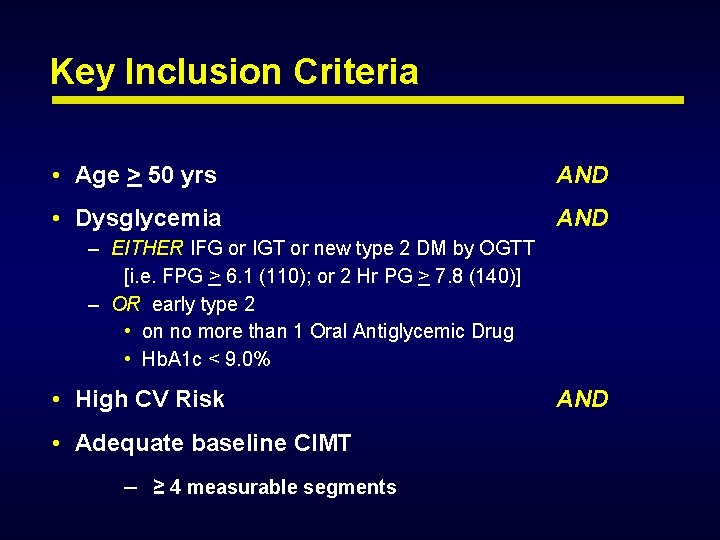
Key Inclusion Criteria • Age > 50 yrs AND • Dysglycemia AND – EITHER IFG or IGT or new type 2 DM by OGTT [i. e. FPG > 6. 1 (110); or 2 Hr PG > 7. 8 (140)] – OR early type 2 • on no more than 1 Oral Antiglycemic Drug • Hb. A 1 c < 9. 0% • High CV Risk • Adequate baseline CIMT – ≥ 4 measurable segments AND
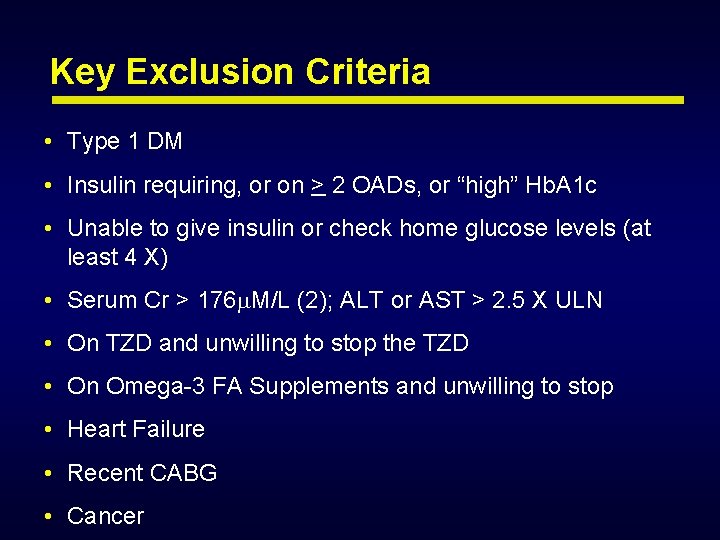
Key Exclusion Criteria • Type 1 DM • Insulin requiring, or on > 2 OADs, or “high” Hb. A 1 c • Unable to give insulin or check home glucose levels (at least 4 X) • Serum Cr > 176 M/L (2); ALT or AST > 2. 5 X ULN • On TZD and unwilling to stop the TZD • On Omega-3 FA Supplements and unwilling to stop • Heart Failure • Recent CABG • Cancer
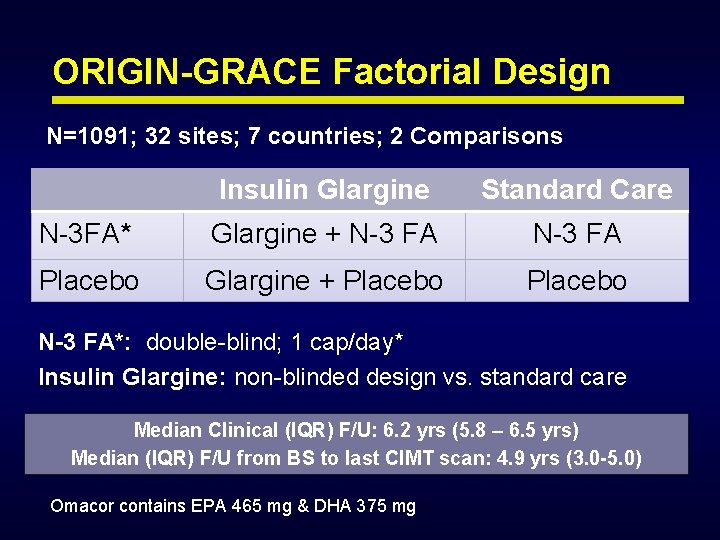
ORIGIN-GRACE Factorial Design N=1091; 32 sites; 7 countries; 2 Comparisons Insulin Glargine Standard Care N-3 FA* Glargine + N-3 FA Placebo Glargine + Placebo N-3 FA*: double-blind; 1 cap/day* Insulin Glargine: non-blinded design vs. standard care Median Clinical (IQR) F/U: 6. 2 yrs (5. 8 – 6. 5 yrs) Median (IQR) F/U from BS to last CIMT scan: 4. 9 yrs (3. 0 -5. 0) Omacor contains EPA 465 mg & DHA 375 mg
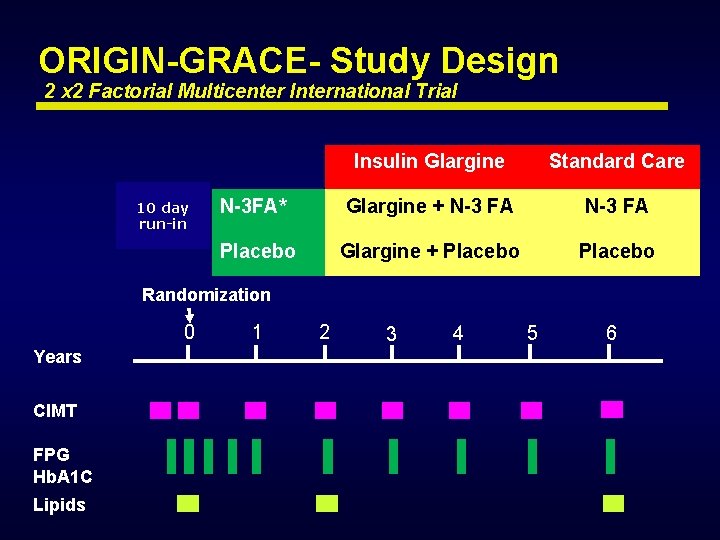
ORIGIN-GRACE- Study Design 2 x 2 Factorial Multicenter International Trial 10 day run-in Insulin Glargine Standard Care N-3 FA* Glargine + N-3 FA Placebo Glargine + Placebo Randomization 0 Years CIMT FPG Hb. A 1 C Lipids 1 2 3 4 5 6
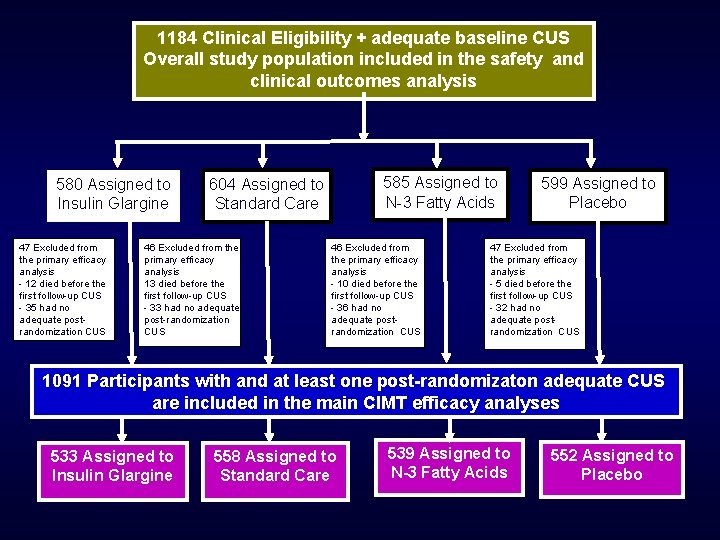
1184 Clinical Eligibility + adequate baseline CUS Overall study population included in the safety and clinical outcomes analysis 580 Assigned to Insulin Glargine 47 Excluded from the primary efficacy analysis - 12 died before the first follow-up CUS - 35 had no adequate postrandomization CUS 585 Assigned to N-3 Fatty Acids 604 Assigned to Standard Care 46 Excluded from the primary efficacy analysis 13 died before the first follow-up CUS - 33 had no adequate post-randomization CUS 46 Excluded from the primary efficacy analysis - 10 died before the first follow-up CUS - 36 had no adequate postrandomization CUS 599 Assigned to Placebo 47 Excluded from the primary efficacy analysis - 5 died before the first follow-up CUS - 32 had no adequate postrandomization CUS 1091 Participants with and at least one post-randomizaton adequate CUS are included in the main CIMT efficacy analyses 533 Assigned to Insulin Glargine 558 Assigned to Standard Care 539 Assigned to N-3 Fatty Acids 552 Assigned to Placebo
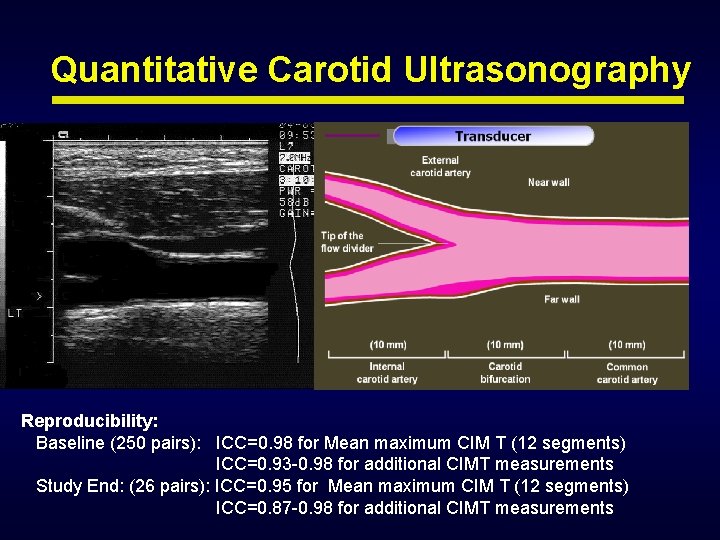
Quantitative Carotid Ultrasonography Reproducibility: Baseline (250 pairs): ICC=0. 98 for Mean maximum CIM T (12 segments) ICC=0. 93 -0. 98 for additional CIMT measurements Study End: (26 pairs): ICC=0. 95 for Mean maximum CIM T (12 segments) ICC=0. 87 -0. 98 for additional CIMT measurements
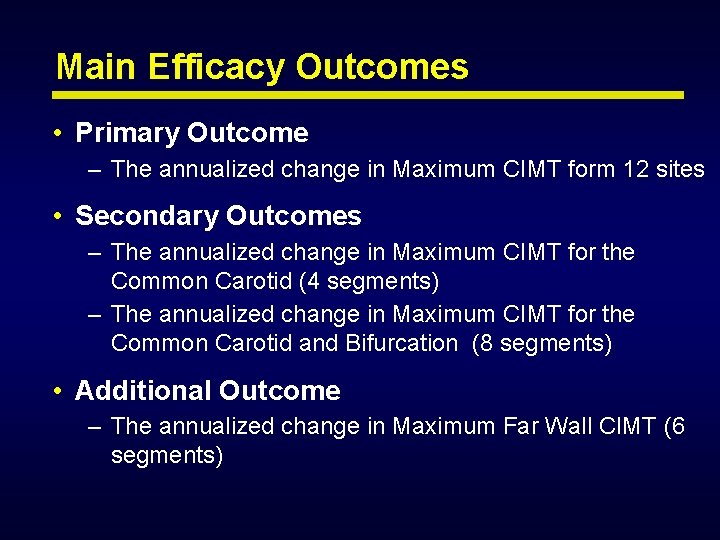
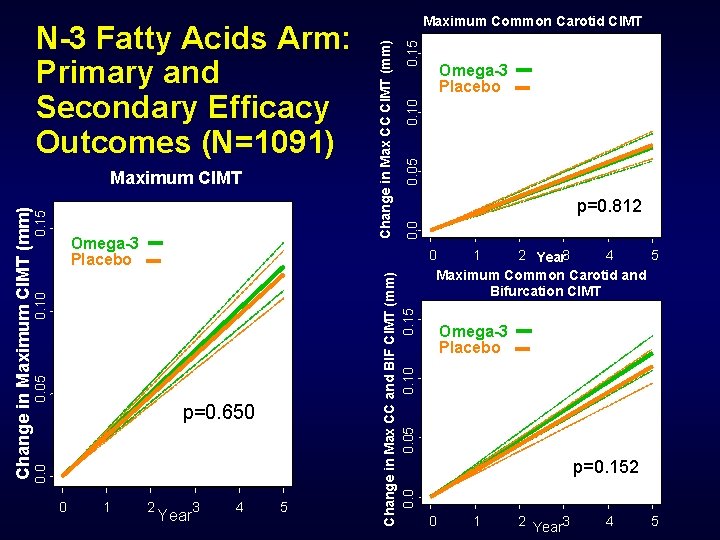
Main Efficacy Outcomes • Primary Outcome – The annualized change in Maximum CIMT form 12 sites • Secondary Outcomes – The annualized change in Maximum CIMT for the Common Carotid (4 segments) – The annualized change in Maximum CIMT for the Common Carotid and Bifurcation (8 segments) • Additional Outcome – The annualized change in Maximum Far Wall CIMT (6 segments)
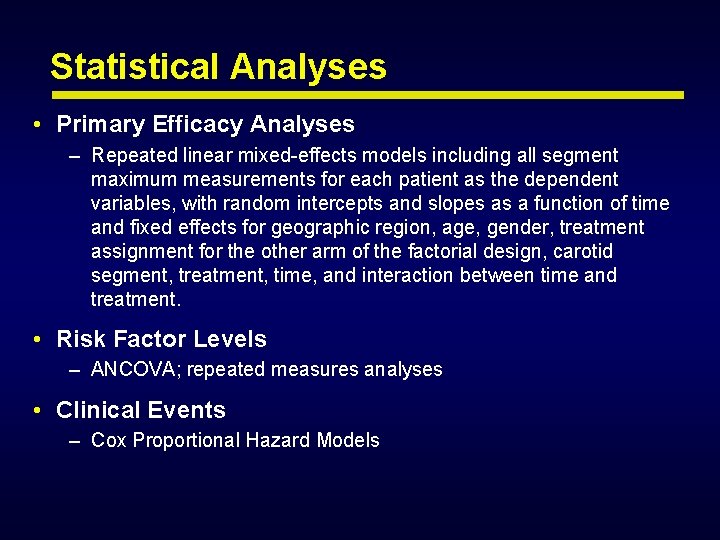
Statistical Analyses • Primary Efficacy Analyses – Repeated linear mixed-effects models including all segment maximum measurements for each patient as the dependent variables, with random intercepts and slopes as a function of time and fixed effects for geographic region, age, gender, treatment assignment for the other arm of the factorial design, carotid segment, treatment, time, and interaction between time and treatment. • Risk Factor Levels – ANCOVA; repeated measures analyses • Clinical Events – Cox Proportional Hazard Models
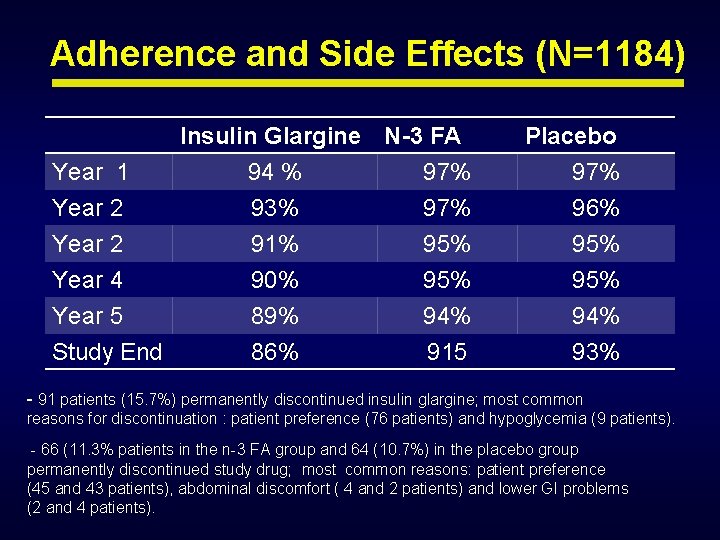
Adherence and Side Effects (N=1184) Insulin Glargine N-3 FA Year 1 94 % 97% Year 2 93% 97% Year 2 91% 95% Year 4 90% 95% Year 5 89% 94% Study End 86% 915 Placebo 97% 96% 95% 94% 93% - 91 patients (15. 7%) permanently discontinued insulin glargine; most common reasons for discontinuation : patient preference (76 patients) and hypoglycemia (9 patients). - 66 (11. 3% patients in the n-3 FA group and 64 (10. 7%) in the placebo group permanently discontinued study drug; most common reasons: patient preference (45 and 43 patients), abdominal discomfort ( 4 and 2 patients) and lower GI problems (2 and 4 patients).
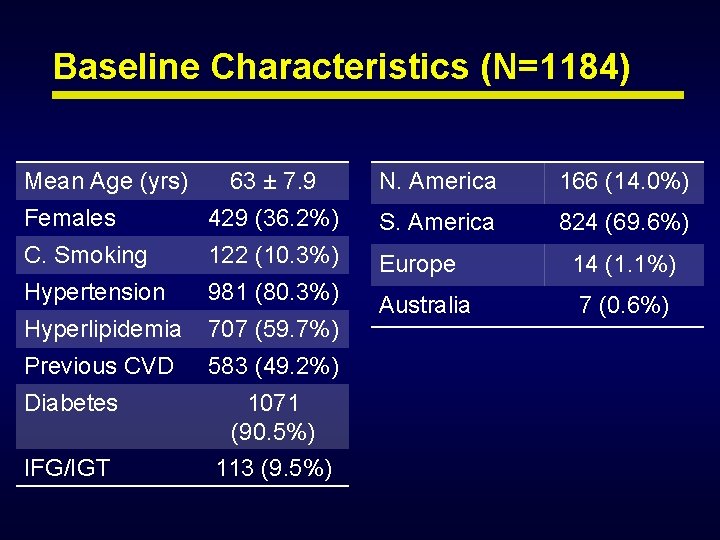
Baseline Characteristics (N=1184) 63 ± 7. 9 N. America 166 (14. 0%) Females 429 (36. 2%) S. America 824 (69. 6%) C. Smoking 122 (10. 3%) Europe 14 (1. 1%) Hypertension 981 (80. 3%) Hyperlipidemia 707 (59. 7%) Australia 7 (0. 6%) Previous CVD 583 (49. 2%) Diabetes 1071 (90. 5%) 113 (9. 5%) Mean Age (yrs) IFG/IGT
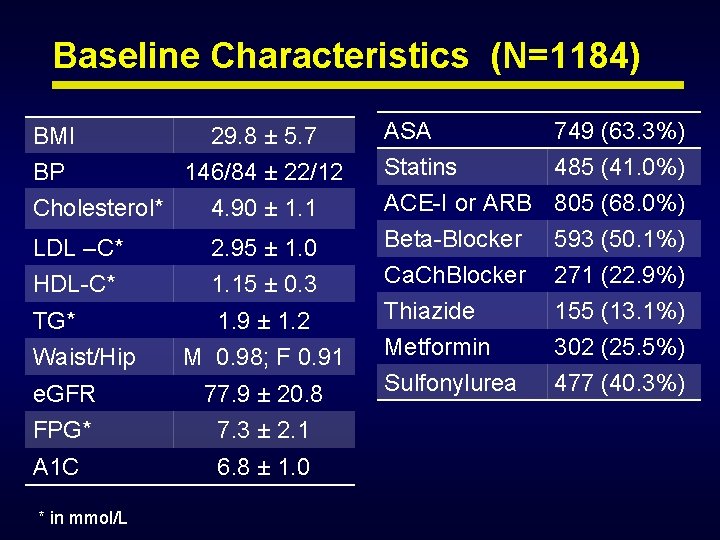
Baseline Characteristics (N=1184) BMI 29. 8 ± 5. 7 BP 146/84 ± 22/12 Cholesterol* 4. 90 ± 1. 1 LDL –C* 2. 95 ± 1. 0 HDL-C* 1. 15 ± 0. 3 TG* 1. 9 ± 1. 2 Waist/Hip M 0. 98; F 0. 91 e. GFR 77. 9 ± 20. 8 FPG* 7. 3 ± 2. 1 A 1 C 6. 8 ± 1. 0 * in mmol/L ASA Statins ACE-I or ARB Beta-Blocker 749 (63. 3%) 485 (41. 0%) 805 (68. 0%) 593 (50. 1%) Ca. Ch. Blocker Thiazide Metformin Sulfonylurea 271 (22. 9%) 155 (13. 1%) 302 (25. 5%) 477 (40. 3%)
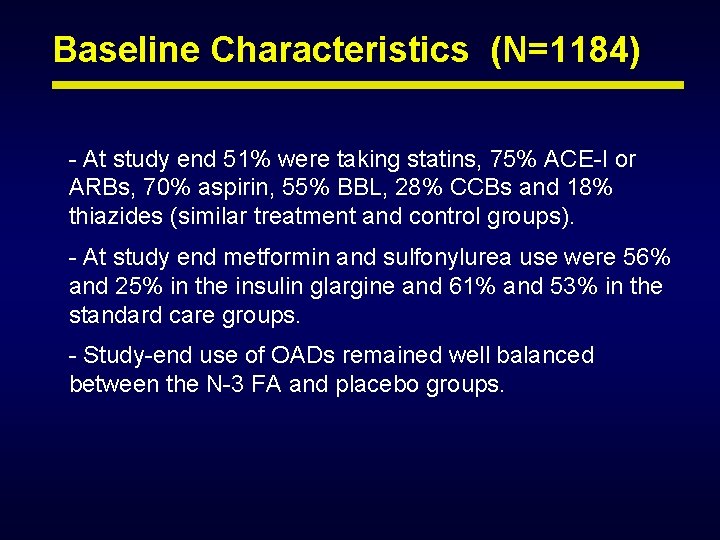
Baseline Characteristics (N=1184) - At study end 51% were taking statins, 75% ACE-I or ARBs, 70% aspirin, 55% BBL, 28% CCBs and 18% thiazides (similar treatment and control groups). - At study end metformin and sulfonylurea use were 56% and 25% in the insulin glargine and 61% and 53% in the standard care groups. - Study-end use of OADs remained well balanced between the N-3 FA and placebo groups.
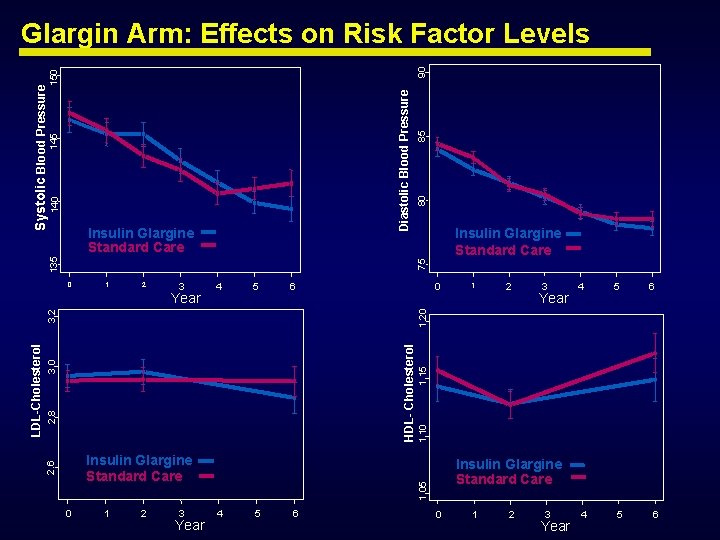
0 1 2 3 4 5 85 0 6 1 2 3 Year 4 5 6 0 1 2 3 Year 1. 15 Insulin Glargine Standard Care 1. 05 2. 6 Insulin Glargine Standard Care 1. 10 2. 8 3. 0 HDL- Cholesterol 3. 2 1. 20 Year LDL-Cholesterol Insulin Glargine Standard Care 75 135 Insulin Glargine Standard Care 80 Diastolic Blood Pressure 140 145 Systolic Blood Pressure 150 90 Glargin Arm: Effects on Risk Factor Levels 4 5 6 0 1 2 3 Year 4 5 6
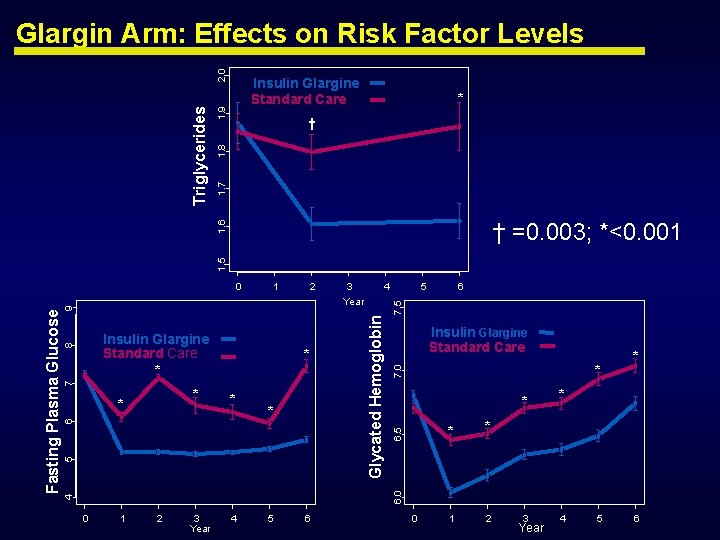
1. 9 Insulin Glargine Standard Care * 1. 7 1. 8 † † =0. 003; *<0. 001 1. 5 1. 6 Triglycerides 2. 0 Glargin Arm: Effects on Risk Factor Levels * * * 6 7. 5 5 Insulin Glargine Standard Care 7. 0 * * 1 2 * * 6. 0 5 6 * * 4 6. 5 7 8 Insulin Glargine Standard Care * 3 Year Glycated Hemoglobin 2 9 1 4 Fasting Plasma Glucose 0 0 1 2 3 Year 4 5 6 0 3 Year 4 5 6
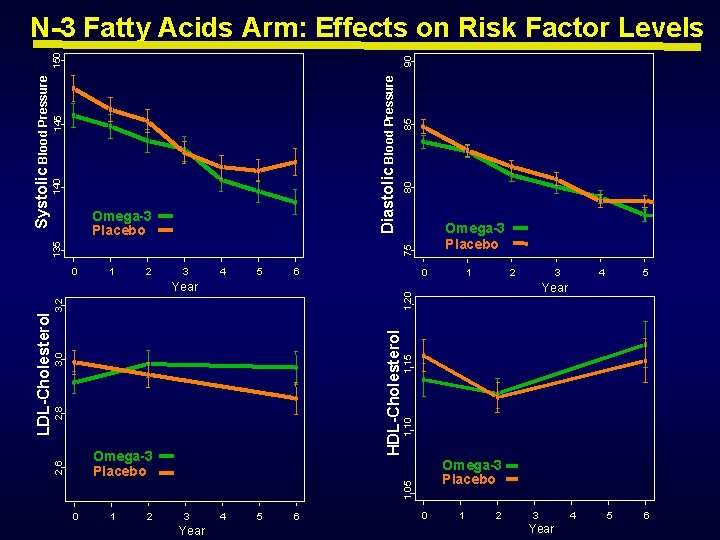
90 85 Omega-3 Placebo 75 0 1 2 3 4 5 6 0 1 2 3 5 1. 10 2. 8 1. 15 3. 0 HDL-Cholesterol 3. 2 4 Year 1. 20 Year Omega-3 Placebo 1. 05 2. 6 LDL-Cholesterol 80 Diastolic Blood Pressure 145 140 Omega-3 Placebo 135 Systolic Blood Pressure 150 N-3 Fatty Acids Arm: Effects on Risk Factor Levels 0 1 2 3 Year 4 5 6
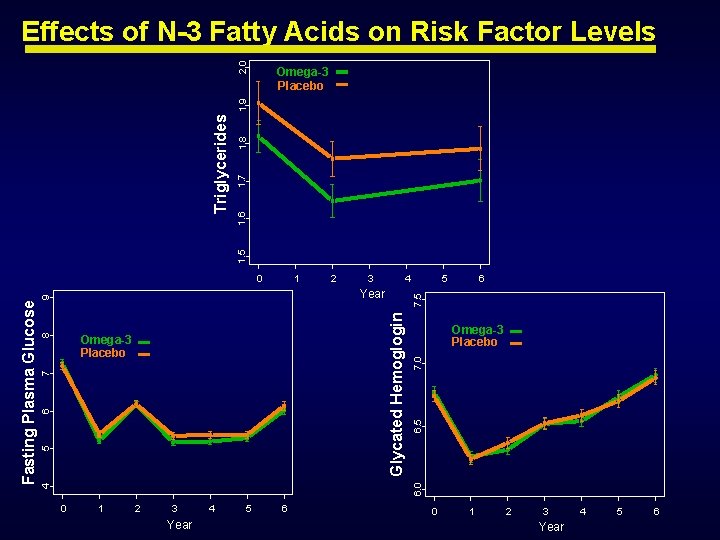
2. 0 Effects of N-3 Fatty Acids on Risk Factor Levels 1. 8 1. 7 1. 6 1. 5 Triglycerides 1. 9 Omega-3 Placebo 3 4 6 Omega-3 Placebo 6. 0 5 6 7 Omega-3 Placebo 5 7. 5 Glycated Hemoglogin 8 9 Year 4 Fasting Plasma Glucose 2 7. 0 1 6. 5 0 0 1 2 3 Year 4 5 6
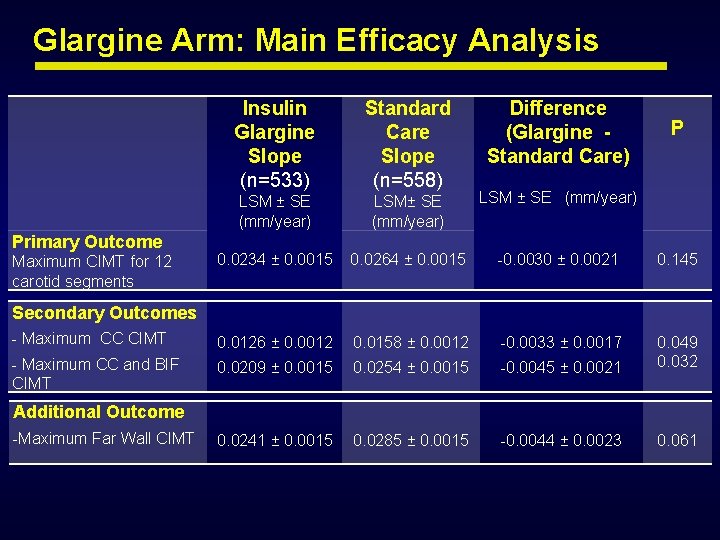
Glargine Arm: Main Efficacy Analysis Insulin Glargine Slope (n=533) Standard Care Slope (n=558) LSM ± SE (mm/year) 0. 0234 ± 0. 0015 0. 0264 ± 0. 0015 -0. 0030 ± 0. 0021 0. 145 - Maximum CC CIMT 0. 0126 ± 0. 0012 0. 0158 ± 0. 0012 -0. 0033 ± 0. 0017 - Maximum CC and BIF CIMT 0. 0209 ± 0. 0015 0. 0254 ± 0. 0015 -0. 0045 ± 0. 0021 0. 049 0. 032 0. 0241 ± 0. 0015 0. 0285 ± 0. 0015 -0. 0044 ± 0. 0023 0. 061 Primary Outcome Maximum CIMT for 12 carotid segments Difference (Glargine Standard Care) P Secondary Outcomes Additional Outcome -Maximum Far Wall CIMT
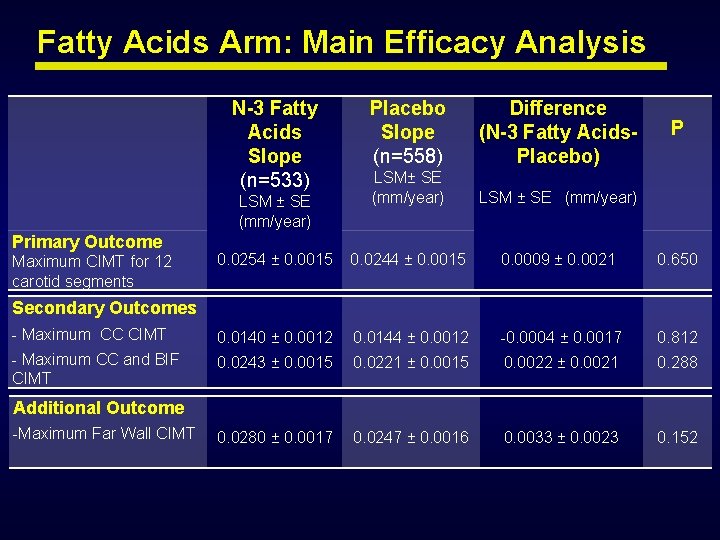
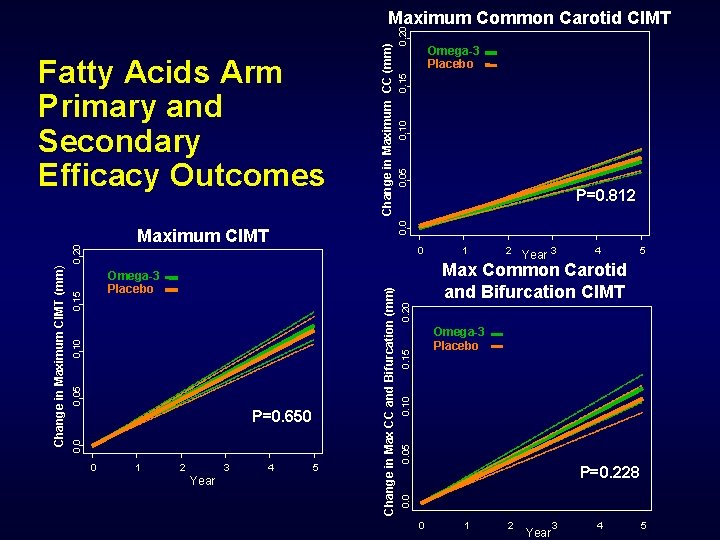
Fatty Acids Arm: Main Efficacy Analysis N-3 Fatty Acids Slope (n=533) Placebo Slope (n=558) Difference (N-3 Fatty Acids. Placebo) LSM± SE (mm/year) LSM ± SE (mm/year) 0. 0254 ± 0. 0015 0. 0244 ± 0. 0015 0. 0009 ± 0. 0021 0. 650 - Maximum CC CIMT 0. 0140 ± 0. 0012 0. 0144 ± 0. 0012 -0. 0004 ± 0. 0017 0. 812 - Maximum CC and BIF CIMT 0. 0243 ± 0. 0015 0. 0221 ± 0. 0015 0. 0022 ± 0. 0021 0. 288 0. 0280 ± 0. 0017 0. 0247 ± 0. 0016 0. 0033 ± 0. 0023 0. 152 LSM ± SE (mm/year) Primary Outcome Maximum CIMT for 12 carotid segments P Secondary Outcomes Additional Outcome -Maximum Far Wall CIMT
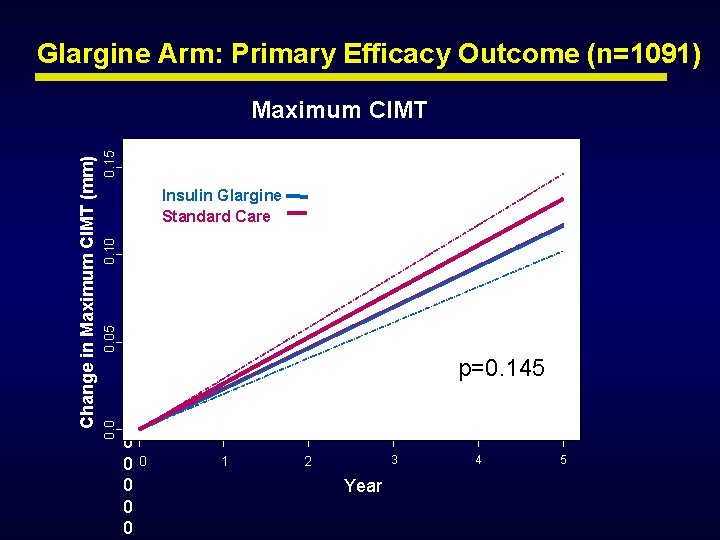
Glargine Arm: Primary Efficacy Outcome (n=1091) 0. 15 0. 10 0. 05 0. 0 Change in Maximum CIMT (mm) Maximum CIMT 0000000000000000000000 0 0 0 0 Insulin Glargine Standard Care p=0. 145 0 1 3 2 Year 4 5
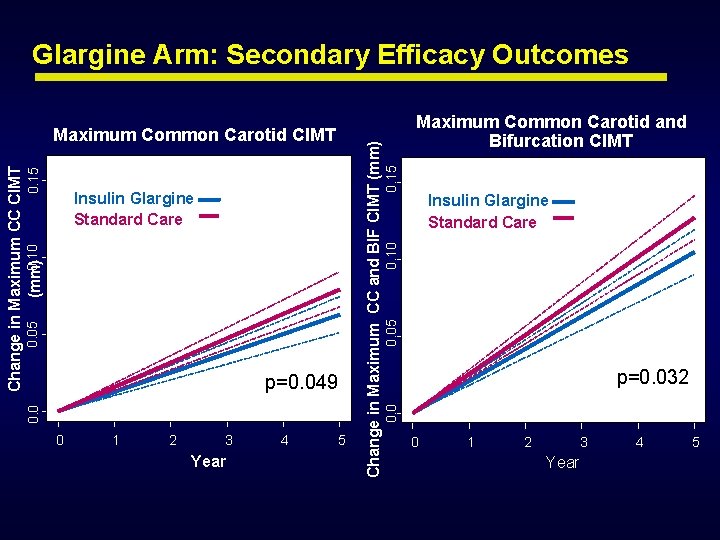
p=0. 049 0 1 2 3 Year 4 5 0. 10 Insulin Glargine Standard Care 0. 05 Insulin Glargine Standard Care Maximum Common Carotid and Bifurcation CIMT p=0. 032 0. 0 Change in Maximum CC CIMT 0. 10 0. 05 0. 0 0. 15 (mm) Maximum Common Carotid CIMT Change in Maximum CC and BIF CIMT (mm) Glargine Arm: Secondary Efficacy Outcomes 0 1 2 3 Year 4 5
0. 05 0. 0 p=0. 650 0 1 2 3 Year 4 5 Omega-3 Placebo 0. 05 0. 10 0. 15 p p=0. 812 0. 0 Omega-3 Placebo Change in Max CC CIMT (mm) P 0. 10 0. 15 Change in Maximum CIMT (mm) Maximum CIMT Change in Max CC and BIF CIMT (mm) 0. 05 0. 10 0. 15 N-3 Fatty Acids Arm: Primary and Secondary Efficacy Outcomes (N=1091) Maximum Common Carotid CIMT 0 1 2 Year 3 4 5 Maximum Common Carotid and Bifurcation CIMT Omega-3 Placebo p=0. 152 0 1 2 Year 3 4 5
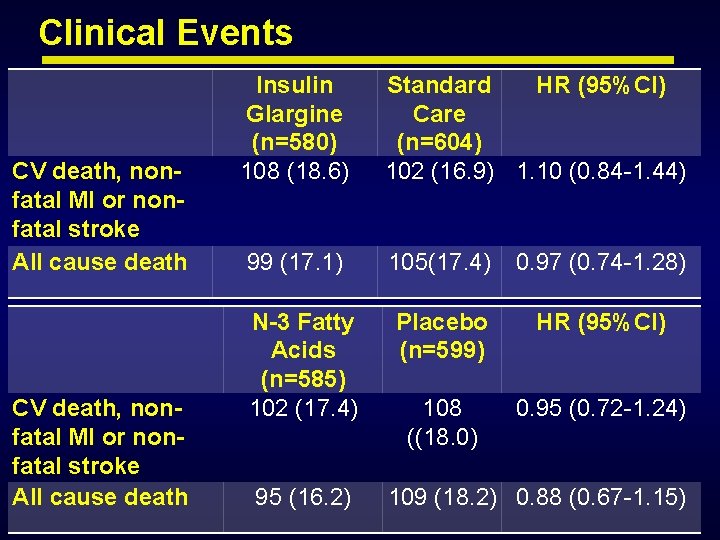
Clinical Events CV death, nonfatal MI or nonfatal stroke All cause death Insulin Glargine (n=580) 108 (18. 6) Standard HR (95%CI) Care (n=604) 102 (16. 9) 1. 10 (0. 84 -1. 44) 99 (17. 1) 105(17. 4) 0. 97 (0. 74 -1. 28) Placebo (n=599) HR (95%CI) 108 ((18. 0) 0. 95 (0. 72 -1. 24) N-3 Fatty Acids (n=585) 102 (17. 4) 95 (16. 2) 109 (18. 2) 0. 88 (0. 67 -1. 15)
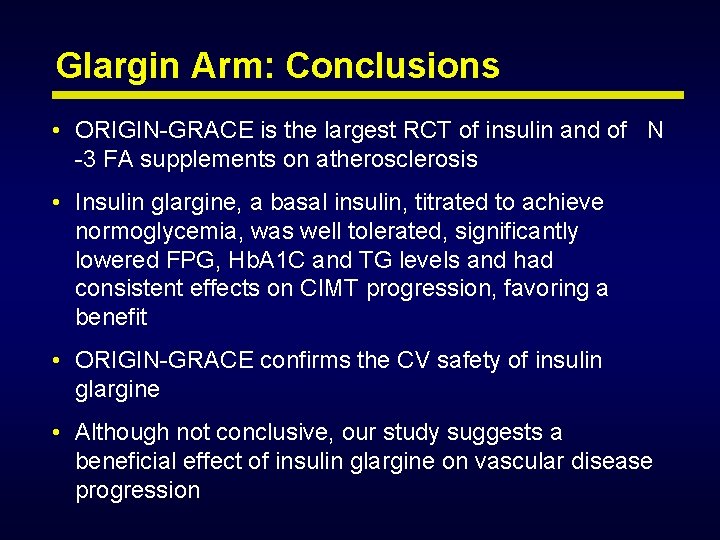
Glargin Arm: Conclusions • ORIGIN-GRACE is the largest RCT of insulin and of N -3 FA supplements on atherosclerosis • Insulin glargine, a basal insulin, titrated to achieve normoglycemia, was well tolerated, significantly lowered FPG, Hb. A 1 C and TG levels and had consistent effects on CIMT progression, favoring a benefit • ORIGIN-GRACE confirms the CV safety of insulin glargine • Although not conclusive, our study suggests a beneficial effect of insulin glargine on vascular disease progression
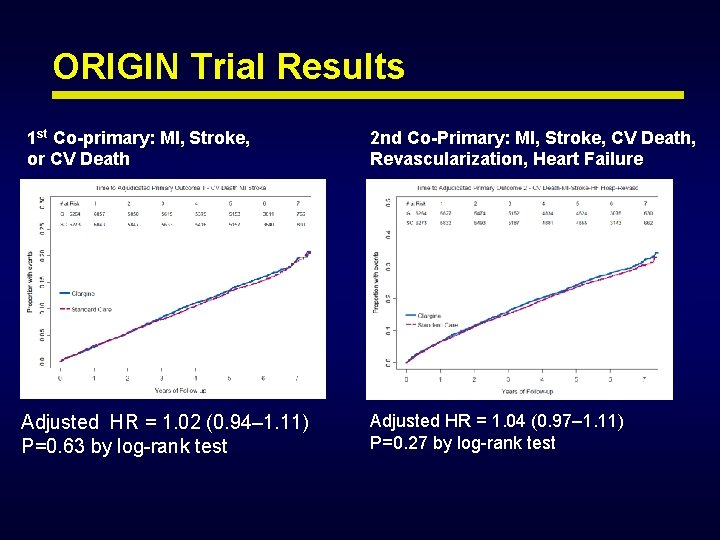
ORIGIN Trial Results 1 st Co-primary: MI, Stroke, or CV Death Adjusted HR = 1. 02 (0. 94– 1. 11) P=0. 63 by log-rank test 2 nd Co-Primary: MI, Stroke, CV Death, Revascularization, Heart Failure Adjusted HR = 1. 04 (0. 97– 1. 11) P=0. 27 by log-rank test
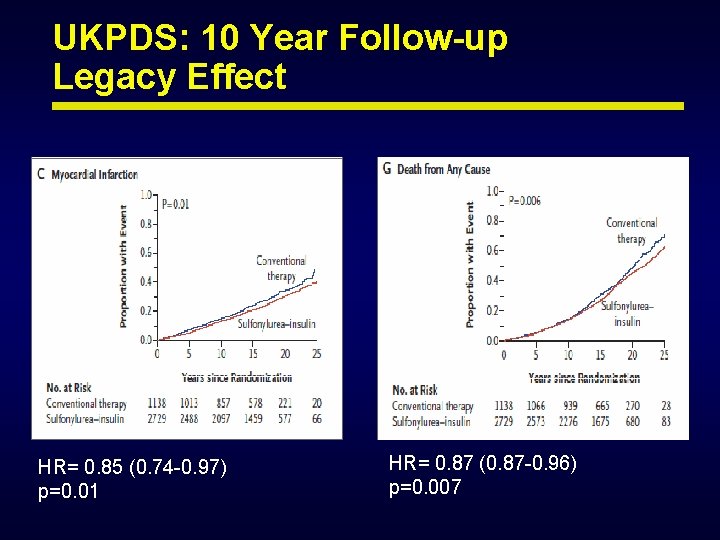
UKPDS: 10 Year Follow-up Legacy Effect HR= 0. 85 (0. 74 -0. 97) p=0. 01 HR= 0. 87 (0. 87 -0. 96) p=0. 007
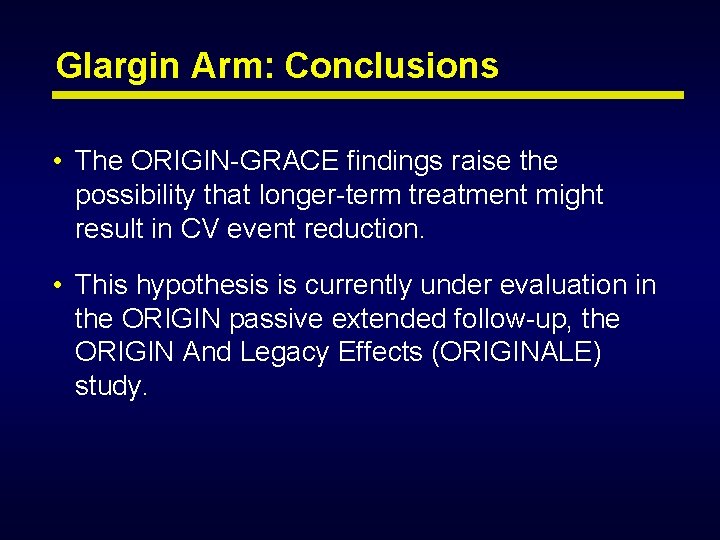
Glargin Arm: Conclusions • The ORIGIN-GRACE findings raise the possibility that longer-term treatment might result in CV event reduction. • This hypothesis is currently under evaluation in the ORIGIN passive extended follow-up, the ORIGIN And Legacy Effects (ORIGINALE) study.
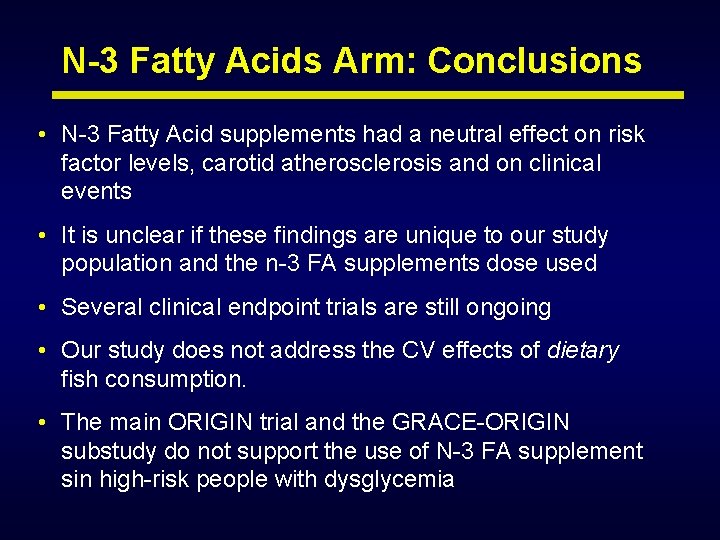
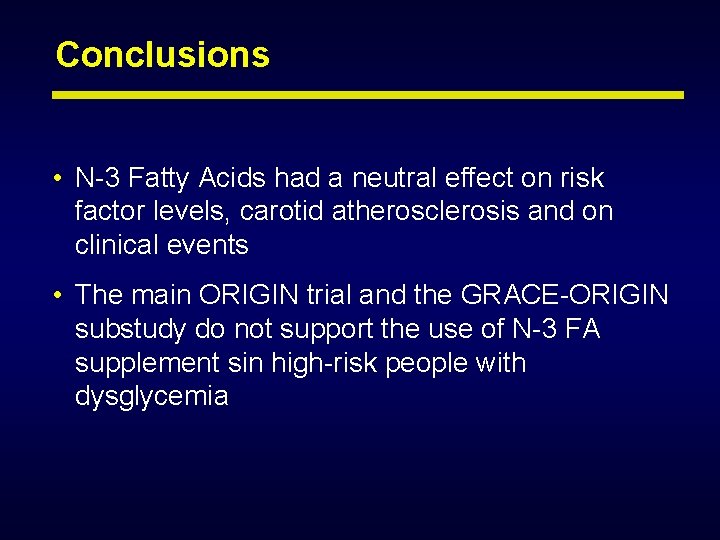
N-3 Fatty Acids Arm: Conclusions • N-3 Fatty Acid supplements had a neutral effect on risk factor levels, carotid atherosclerosis and on clinical events • It is unclear if these findings are unique to our study population and the n-3 FA supplements dose used • Several clinical endpoint trials are still ongoing • Our study does not address the CV effects of dietary fish consumption. • The main ORIGIN trial and the GRACE-ORIGIN substudy do not support the use of N-3 FA supplement sin high-risk people with dysglycemia
Back-up Slides
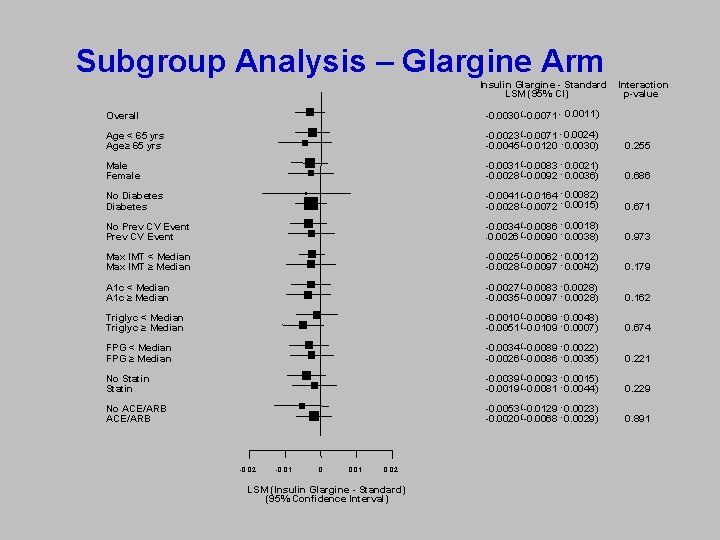
Subgroup Analysis – Glargine Arm Insulin Glargine - Standard LSM (95% CI) Interaction p-value Overall -0. 0030 ( -0. 0071 - 0. 0011) Age < 65 yrs Age≥ 65 yrs -0. 0023 ( -0. 0071 - 0. 0024) -0. 0045 ( -0. 0120 - 0. 0030) 0. 255 Male Female -0. 0031 ( -0. 0083 - 0. 0021) -0. 0028 ( -0. 0092 - 0. 0036) 0. 686 No Diabetes -0. 0041 ( -0. 0164 - 0. 0082) ) -0. 0028 ( -0. 0072 - 0. 0015) 0. 671 No Prev CV Event -0. 0034 ( -0. 0086 - 0. 0018) -0. 0026 ( -0. 0090 0. 0038) 0. 973 Max IMT < Median Max IMT ≥ Median -0. 0025 ( -0. 0062 - 0. 0012) ) -0. 0028 ( -0. 0097 - 0. 0042) 0. 179 A 1 c < Median A 1 c ≥ Median -0. 0027 ( -0. 0083 - 0. 0028) -0. 0035 ( -0. 0097 - 0. 0028) 0. 162 Triglyc < Median Triglyc ≥ Median -0. 0010 ( -0. 0069 - 0. 0048) -0. 0051 ( -0. 0109 - 0. 0007) 0. 674 FPG < Median FPG ≥ Median -0. 0034 ( -0. 0089 - 0. 0022) -0. 0026 ( -0. 0086 - 0. 0035) 0. 221 No Statin -0. 0039 ( -0. 0093 - 0. 0015) -0. 0019 ( -0. 0081 - 0. 0044) 0. 229 No ACE/ARB -0. 0053 ( -0. 0129 - 0. 0023) -0. 0020 ( -0. 0068 - 0. 0029) 0. 891 -0. 02 -0. 01 0. 02 LSM (Insulin Glargine - Standard) (95% Confidence Interval)
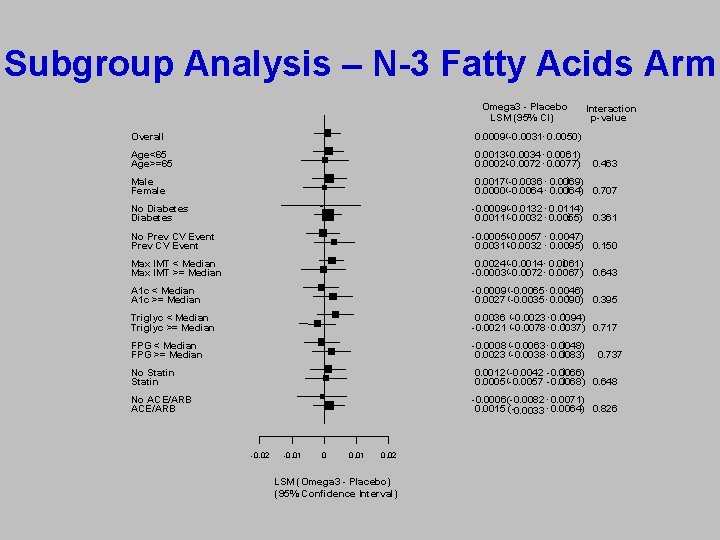
Subgroup Analysis – N-3 Fatty Acids Arm Omega 3 - Placebo LSM (95% CI) Interaction p-value Overall 0. 0009 (-0. 0031 - 0. 0050) Age<65 Age>=65 0. 0013 (-0. 0034 - 0. 0061) 0. 0002 (-0. 0072 - 0. 0077) Male Female ) 0. 0017 (-0. 0036 - 0. 0069) ) 0. 0000 (-0. 0064 - 0. 0064) 0. 707 0. 463 No Diabetes -0. 0009 (-0. 0132 - 0. 0114) ) 0. 0011 (-0. 0032 - 0. 0055) 0. 361 No Prev CV Event -0. 0005 (-0. 0057 - 0. 0047) 0. 0031 (-0. 0032 - 0. 0095) 0. 150 Max IMT < Median Max IMT >= Median ) 0. 0024 (-0. 0014 - 0. 0061) -0. 0003 (-0. 0072 - 0. 0067) 0. 643 A 1 c < Median A 1 c >= Median -0. 0009 (-0. 0065 - 0. 0046) ) 0. 0027 (-0. 0035 - 0. 0090) 0. 395 Triglyc < Median Triglyc >= Median ) 0. 0036 (-0. 0023 - - 0. 0094) ) -0. 0021 (-0. 0078 - 0. 0037) 0. 717 FPG < Median FPG >= Median ) -0. 0008 (-0. 0063 - 0. 0048) ) 0. 0023 (-0. 0038 - 0. 0083) No Statin ) 0. 0012 (-0. 0042 - 0. 0066) ) 0. 0005 (-0. 0057 - 0. 0068) 0. 648 No ACE/ARB -0. 0006 (-0. 0082 - 0. 0071) 0. 0015 (-0. 0033 - 0. 0064) 0. 826 -0. 02 -0. 01 0. 02 LSM (Omega 3 - Placebo) (95% Confidence Interval) 0. 737
3 Year 4 5 0. 20 0. 15 0. 10 0. 05 2 Year 3 4 5 0. 20 Max Common Carotid and Bifurcation CIMT 0. 10 0. 15 Omega-3 Placebo 0. 05 2 1 P=0. 228 0. 0 P=0. 650 Change in Max CC and Bifurcation (mm) 0. 05 0. 10 0. 15 Omega-3 Placebo 1 P=0. 812 0 0. 0 Change in Maximum CIMT (mm) 0. 20 Maximum CIMT 0 Omega-3 Placebo 0. 0 Fatty Acids Arm Primary and Secondary Efficacy Outcomes Change in Maximum CC (mm) Maximum Common Carotid CIMT 0 1 2 Year 3 4 5
Conclusions • N-3 Fatty Acids had a neutral effect on risk factor levels, carotid atherosclerosis and on clinical events • The main ORIGIN trial and the GRACE-ORIGIN substudy do not support the use of N-3 FA supplement sin high-risk people with dysglycemia
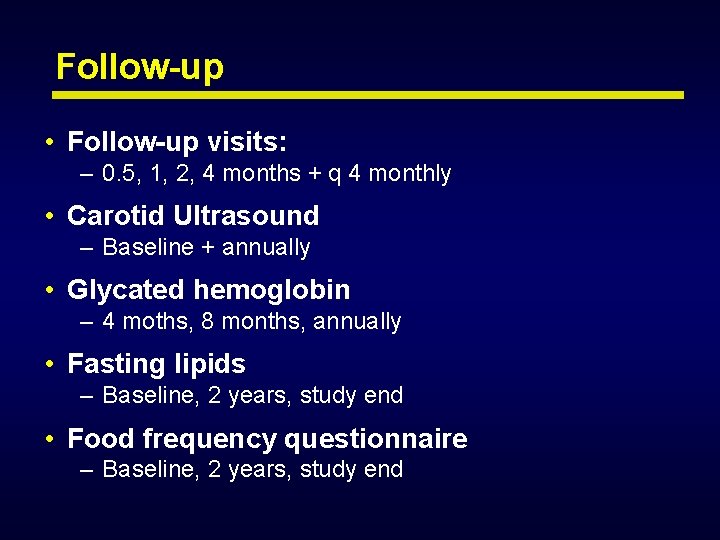
Follow-up • Follow-up visits: – 0. 5, 1, 2, 4 months + q 4 monthly • Carotid Ultrasound – Baseline + annually • Glycated hemoglobin – 4 moths, 8 months, annually • Fasting lipids – Baseline, 2 years, study end • Food frequency questionnaire – Baseline, 2 years, study end