
Original author of the slides Vadim Bulitko University

Original author of the slides: Vadim Bulitko University of Alberta http: //www. cs. ualberta. ca/~bulitko/W 04 Modified by T. Andrew Yang (yang@uhcl. edu) 1
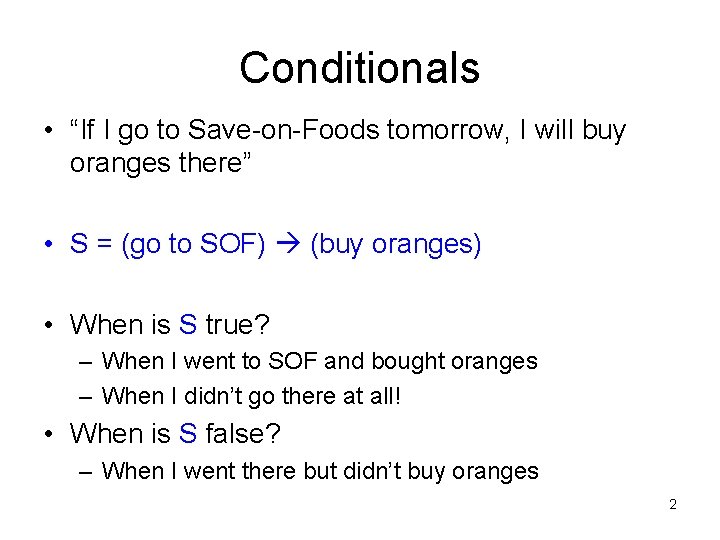
Conditionals • “If I go to Save-on-Foods tomorrow, I will buy oranges there” • S = (go to SOF) (buy oranges) • When is S true? – When I went to SOF and bought oranges – When I didn’t go there at all! • When is S false? – When I went there but didn’t buy oranges 2
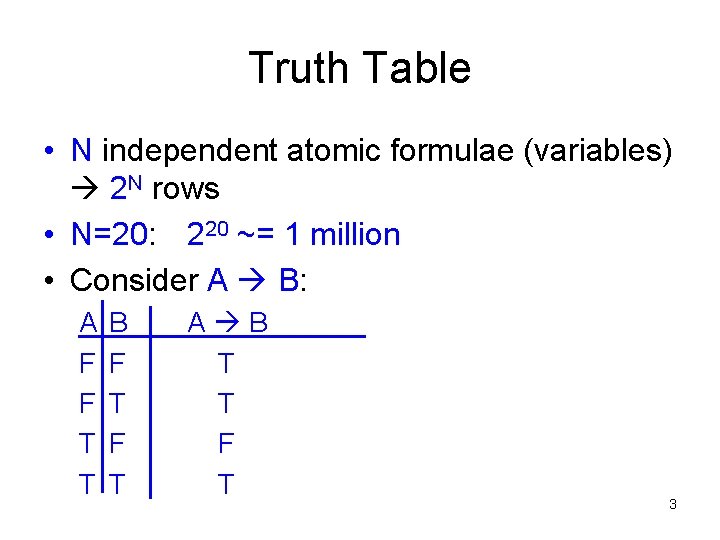
Truth Table • N independent atomic formulae (variables) 2 N rows • N=20: 220 ~= 1 million • Consider A B: A F F T T B F T A B T T F T 3
More terminology • A B • A is called: – Assumption – Premise – Antecedent • B is called – Conclusion 4
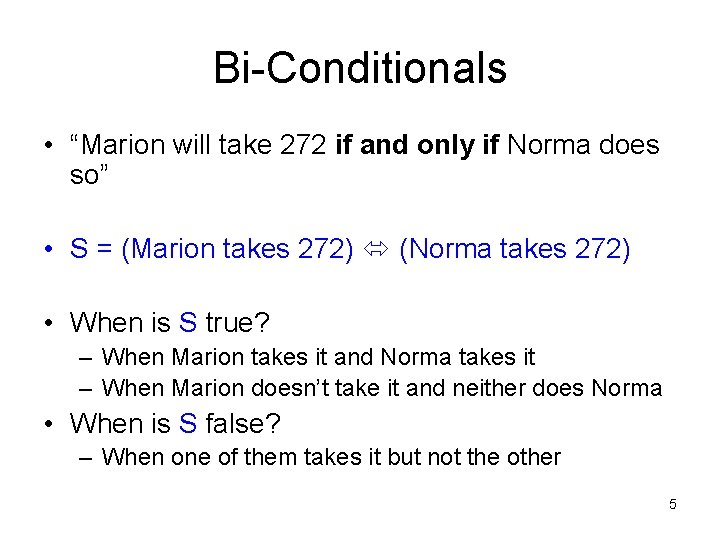
Bi-Conditionals • “Marion will take 272 if and only if Norma does so” • S = (Marion takes 272) (Norma takes 272) • When is S true? – When Marion takes it and Norma takes it – When Marion doesn’t take it and neither does Norma • When is S false? – When one of them takes it but not the other 5
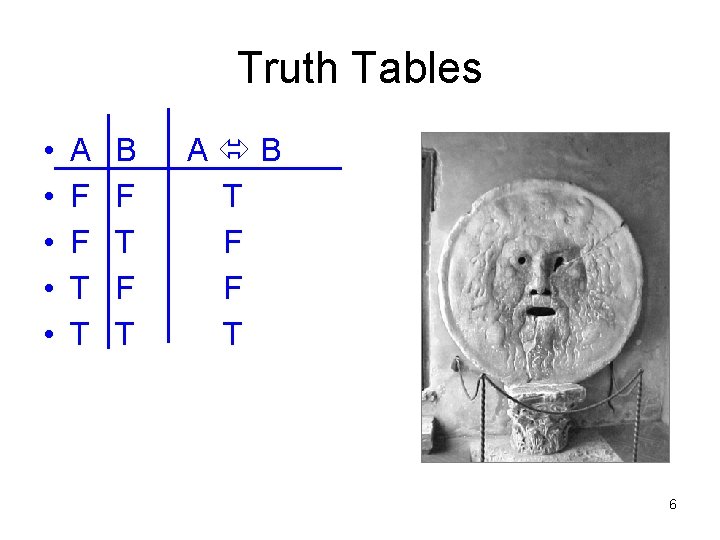
Truth Tables • • • A F F T T B F T A B T F F T 6
if, iff, only if, and Daily Life • Suppose: “Buy Ferrari” = B, “Ferrari is on sale” = S • I will buy a Ferrari if it is on sale: • S B (or B if S) • I will buy a Ferrari if and only if it is on sale: • S B (or B iff S) • I will buy a Ferrari only if it is on sale: B only if S • ~S ~B • B S (Note: not equivalent to S B) • Exercise: Show the truth tables for B if S, B iff S, and B only if S. 7
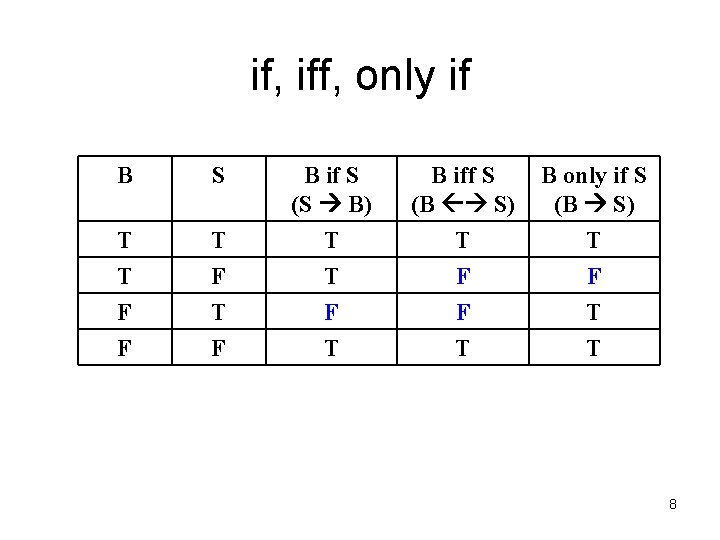
if, iff, only if B S B if S (S B) B iff S (B S) B only if S (B S) T T F F T F T T F F T T 8
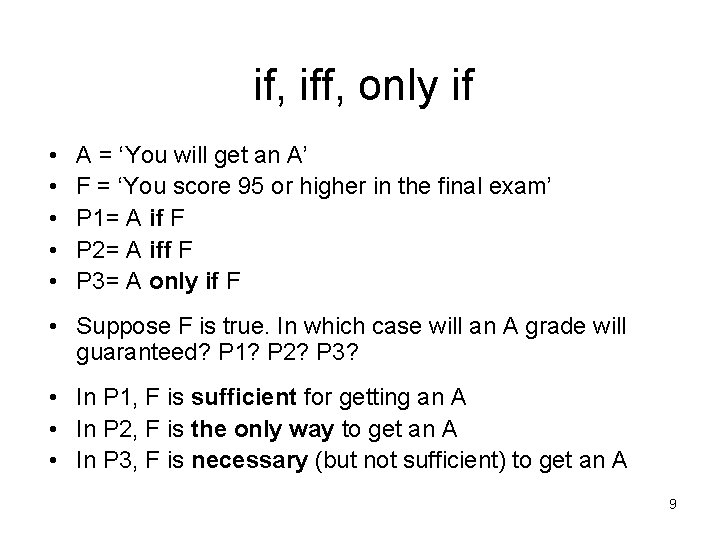
if, iff, only if • • • A = ‘You will get an A’ F = ‘You score 95 or higher in the final exam’ P 1= A if F P 2= A iff F P 3= A only if F • Suppose F is true. In which case will an A grade will guaranteed? P 1? P 2? P 3? • In P 1, F is sufficient for getting an A • In P 2, F is the only way to get an A • In P 3, F is necessary (but not sufficient) to get an A 9
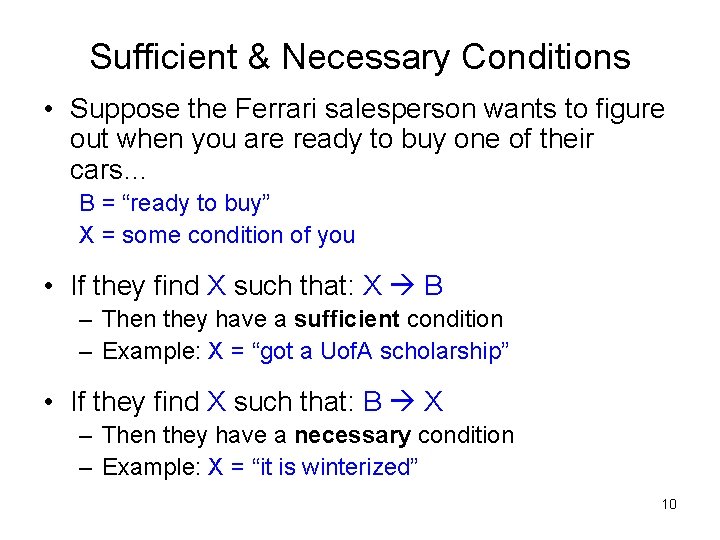
Sufficient & Necessary Conditions • Suppose the Ferrari salesperson wants to figure out when you are ready to buy one of their cars… B = “ready to buy” X = some condition of you • If they find X such that: X B – Then they have a sufficient condition – Example: X = “got a Uof. A scholarship” • If they find X such that: B X – Then they have a necessary condition – Example: X = “it is winterized” 10
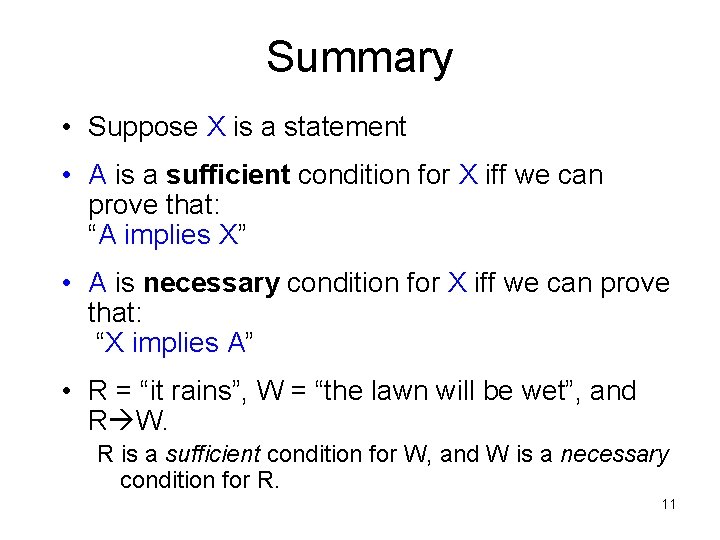
Summary • Suppose X is a statement • A is a sufficient condition for X iff we can prove that: “A implies X” • A is necessary condition for X iff we can prove that: “X implies A” • R = “it rains”, W = “the lawn will be wet”, and R W. R is a sufficient condition for W, and W is a necessary condition for R. 11
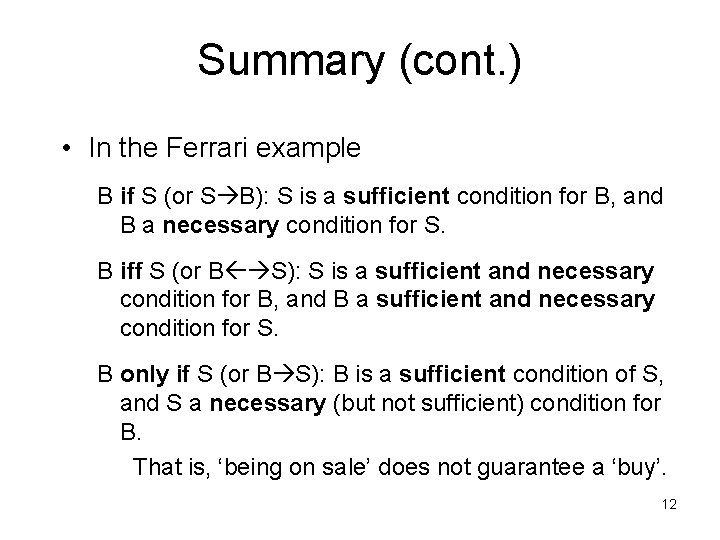
Summary (cont. ) • In the Ferrari example B if S (or S B): S is a sufficient condition for B, and B a necessary condition for S. B iff S (or B S): S is a sufficient and necessary condition for B, and B a sufficient and necessary condition for S. B only if S (or B S): B is a sufficient condition of S, and S a necessary (but not sufficient) condition for B. That is, ‘being on sale’ does not guarantee a ‘buy’. 12
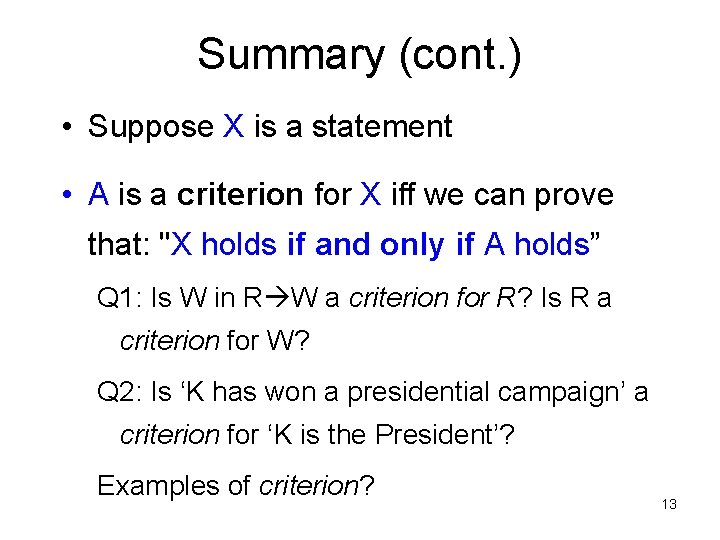
Summary (cont. ) • Suppose X is a statement • A is a criterion for X iff we can prove that: "X holds if and only if A holds” Q 1: Is W in R W a criterion for R? Is R a criterion for W? Q 2: Is ‘K has won a presidential campaign’ a criterion for ‘K is the President’? Examples of criterion? 13
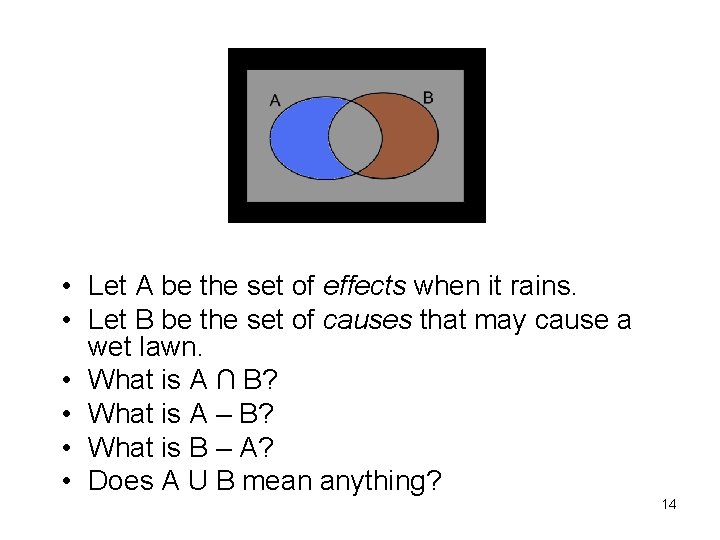
• Let A be the set of effects when it rains. • Let B be the set of causes that may cause a wet lawn. • What is A ∩ B? • What is A – B? • What is B – A? • Does A U B mean anything? 14
Questions? 15
Contradictions & Tautologies • Contradiction: – A statement that is always false regardless of the values of its variables • Examples: A & ~A • Tautology: – A statement that is always true regardless of the values of its variables • Examples: A v ~A 16
Contingencies • What if I have a formula that is sometimes true and sometimes false? • It is called a contingency • Example: • A&B • If A and B are independent variables 17
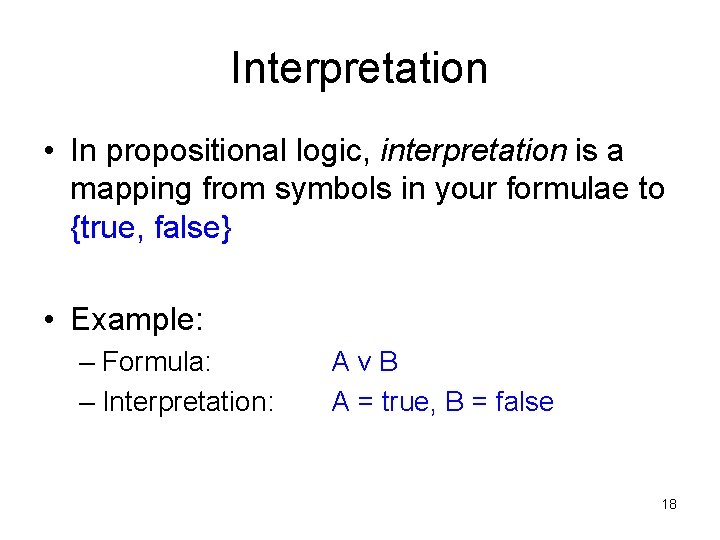
Interpretation • In propositional logic, interpretation is a mapping from symbols in your formulae to {true, false} • Example: – Formula: – Interpretation: Av. B A = true, B = false 18
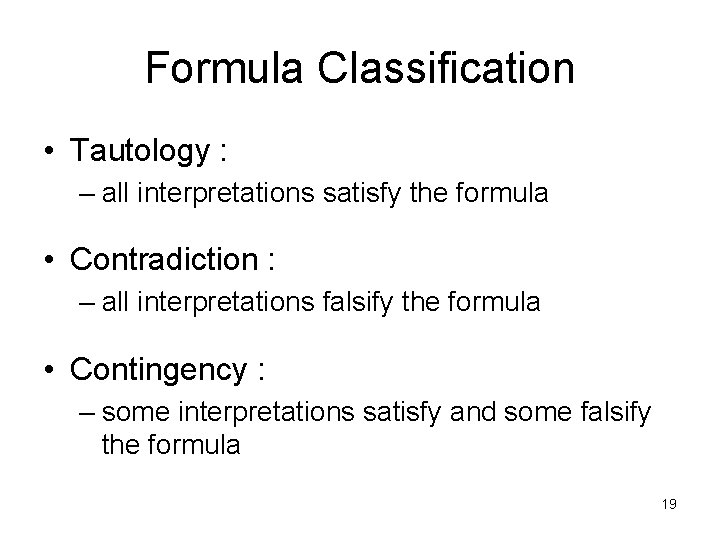
Formula Classification • Tautology : – all interpretations satisfy the formula • Contradiction : – all interpretations falsify the formula • Contingency : – some interpretations satisfy and some falsify the formula 19
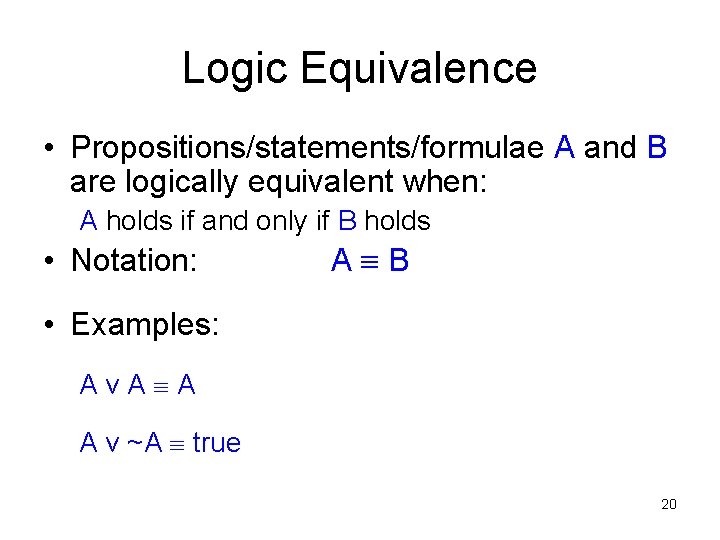
Logic Equivalence • Propositions/statements/formulae A and B are logically equivalent when: A holds if and only if B holds • Notation: A B • Examples: Av. A A A v ~A true 20
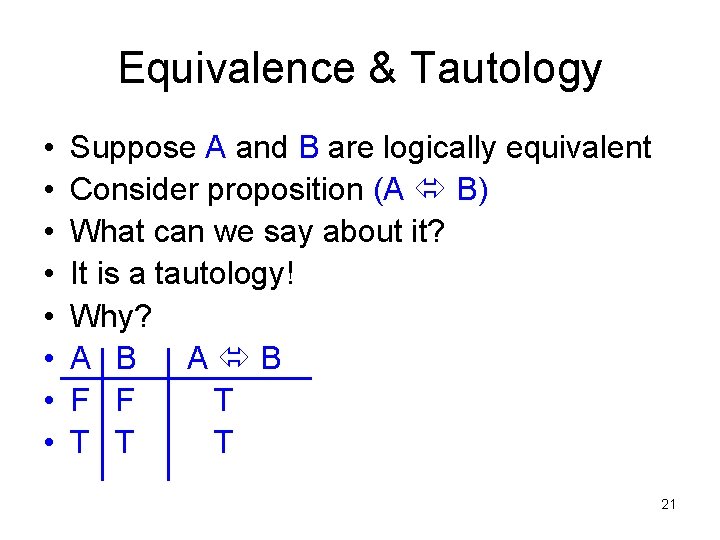
Equivalence & Tautology • • Suppose A and B are logically equivalent Consider proposition (A B) What can we say about it? It is a tautology! Why? A B F F T T 21
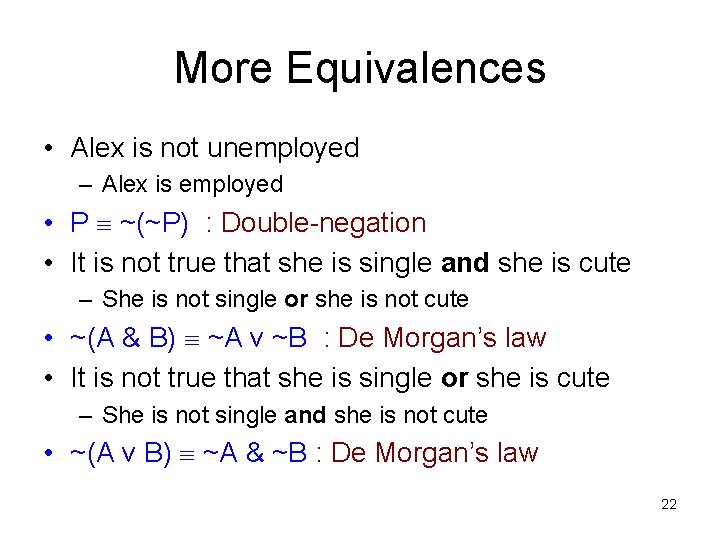
More Equivalences • Alex is not unemployed – Alex is employed • P ~(~P) : Double-negation • It is not true that she is single and she is cute – She is not single or she is not cute • ~(A & B) ~A v ~B : De Morgan’s law • It is not true that she is single or she is cute – She is not single and she is not cute • ~(A v B) ~A & ~B : De Morgan’s law 22
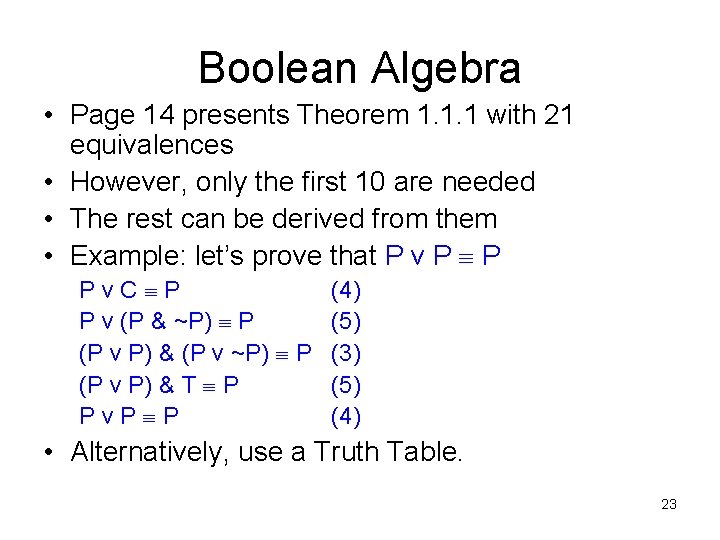
Boolean Algebra • Page 14 presents Theorem 1. 1. 1 with 21 equivalences • However, only the first 10 are needed • The rest can be derived from them • Example: let’s prove that P v P P Pv. C P P v (P & ~P) P (P v P) & (P v ~P) P (P v P) & T P Pv. P P (4) (5) (3) (5) (4) • Alternatively, use a Truth Table. 23
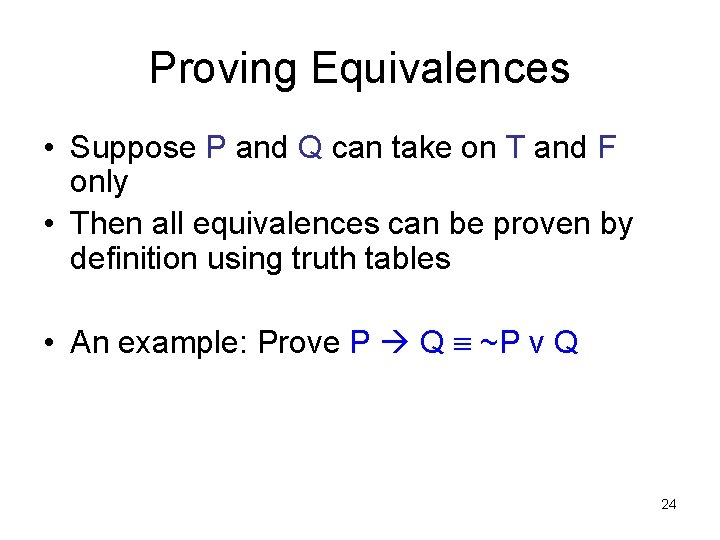
Proving Equivalences • Suppose P and Q can take on T and F only • Then all equivalences can be proven by definition using truth tables • An example: Prove P Q ~P v Q 24
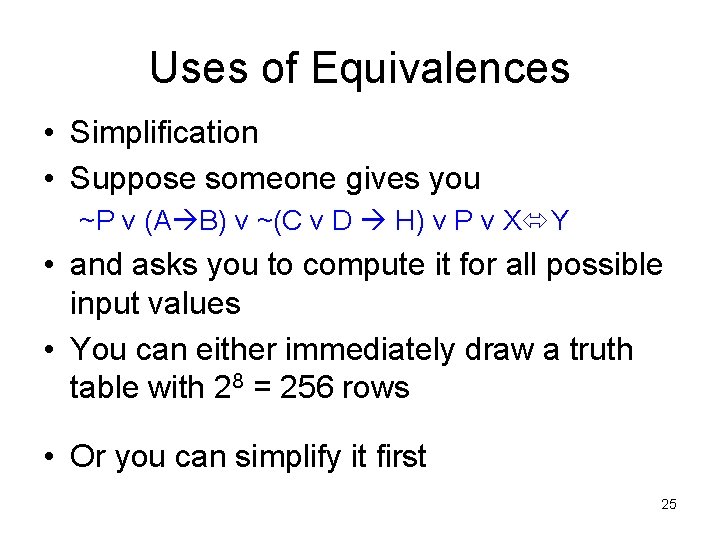
Uses of Equivalences • Simplification • Suppose someone gives you ~P v (A B) v ~(C v D H) v P v X Y • and asks you to compute it for all possible input values • You can either immediately draw a truth table with 28 = 256 rows • Or you can simplify it first 25
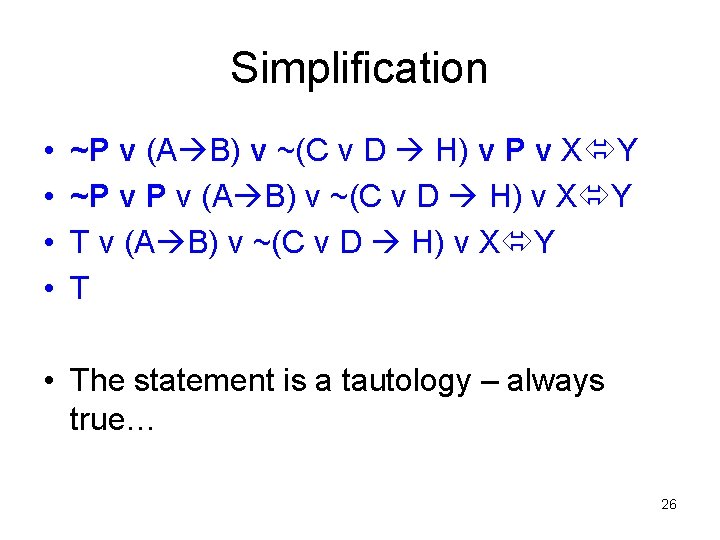
Simplification • • ~P v (A B) v ~(C v D H) v P v X Y ~P v (A B) v ~(C v D H) v X Y T • The statement is a tautology – always true… 26
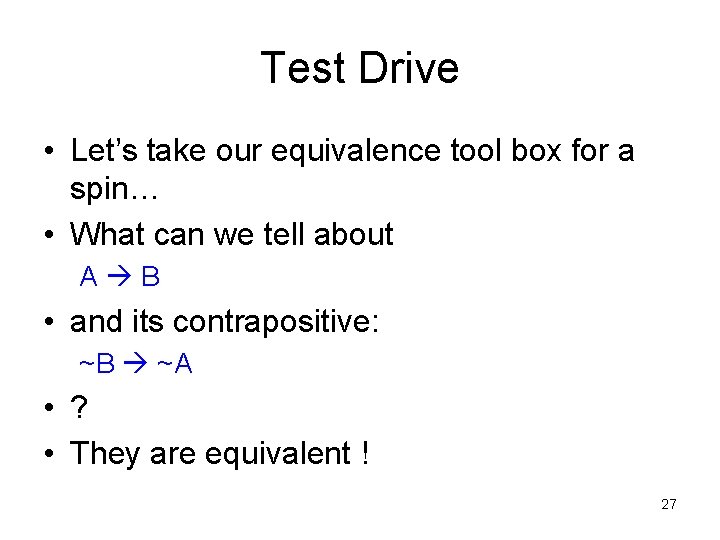
Test Drive • Let’s take our equivalence tool box for a spin… • What can we tell about A B • and its contrapositive: ~B ~A • ? • They are equivalent ! 27
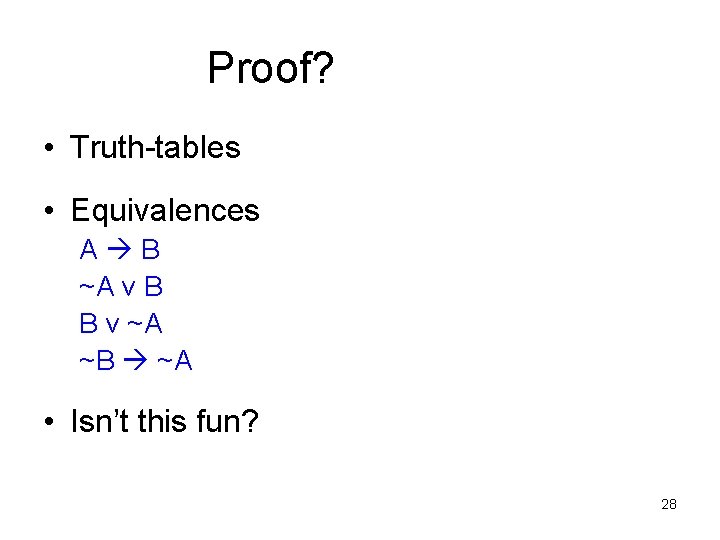
Proof? • Truth-tables • Equivalences A B ~A v B B v ~A ~B ~A • Isn’t this fun? 28
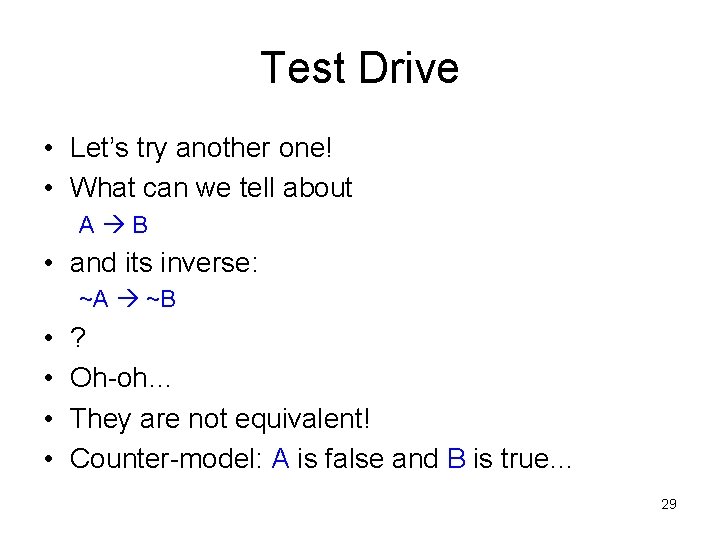
Test Drive • Let’s try another one! • What can we tell about A B • and its inverse: ~A ~B • • ? Oh-oh… They are not equivalent! Counter-model: A is false and B is true… 29
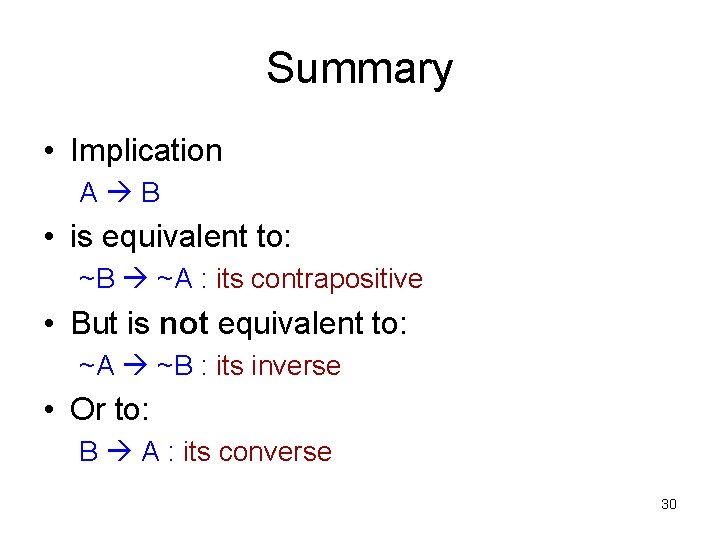
Summary • Implication A B • is equivalent to: ~B ~A : its contrapositive • But is not equivalent to: ~A ~B : its inverse • Or to: B A : its converse 30
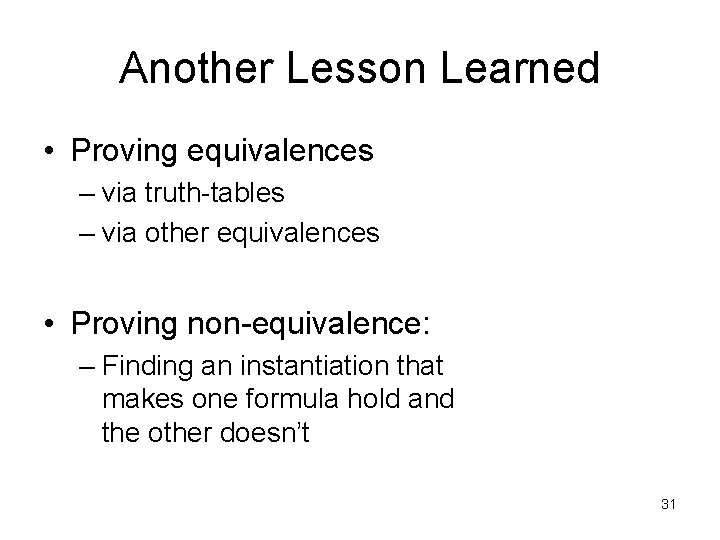
Another Lesson Learned • Proving equivalences – via truth-tables – via other equivalences • Proving non-equivalence: – Finding an instantiation that makes one formula hold and the other doesn’t 31
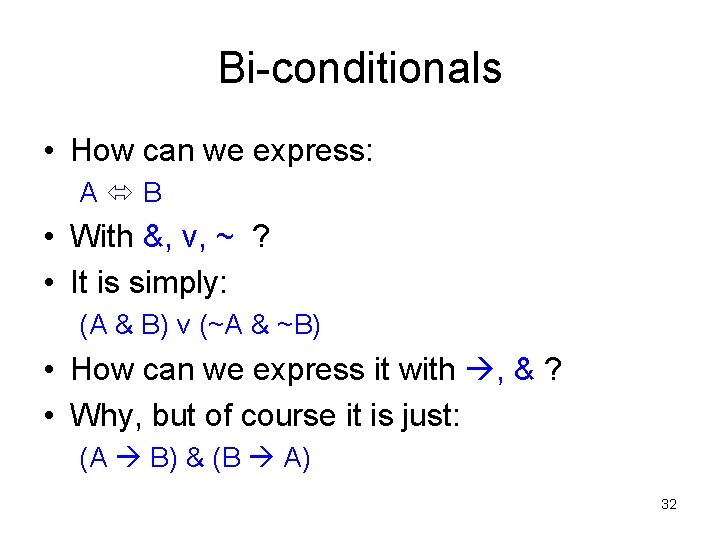
Bi-conditionals • How can we express: A B • With &, v, ~ ? • It is simply: (A & B) v (~A & ~B) • How can we express it with , & ? • Why, but of course it is just: (A B) & (B A) 32
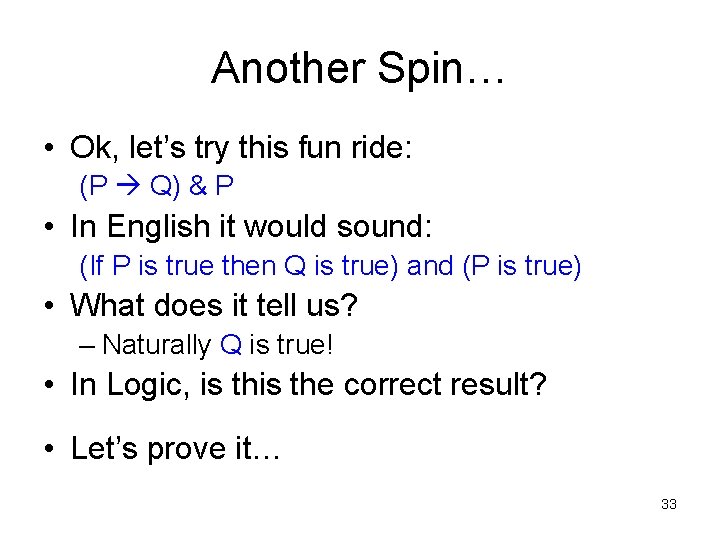
Another Spin… • Ok, let’s try this fun ride: (P Q) & P • In English it would sound: (If P is true then Q is true) and (P is true) • What does it tell us? – Naturally Q is true! • In Logic, is the correct result? • Let’s prove it… 33
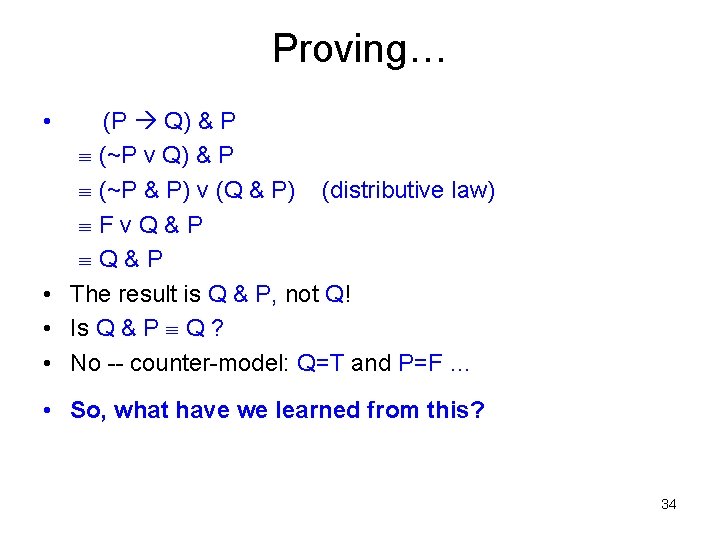
Proving… • (P Q) & P (~P v Q) & P (~P & P) v (Q & P) (distributive law) Fv. Q&P • The result is Q & P, not Q! • Is Q & P Q ? • No -- counter-model: Q=T and P=F … • So, what have we learned from this? 34
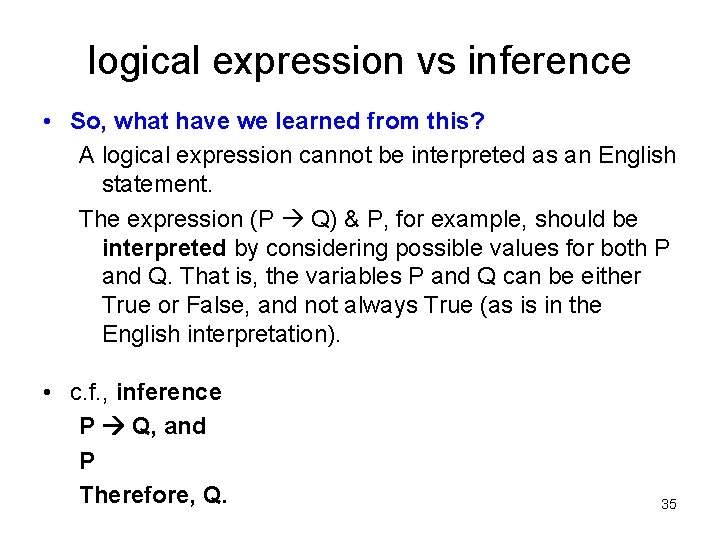
logical expression vs inference • So, what have we learned from this? A logical expression cannot be interpreted as an English statement. The expression (P Q) & P, for example, should be interpreted by considering possible values for both P and Q. That is, the variables P and Q can be either True or False, and not always True (as is in the English interpretation). • c. f. , inference P Q, and P Therefore, Q. 35
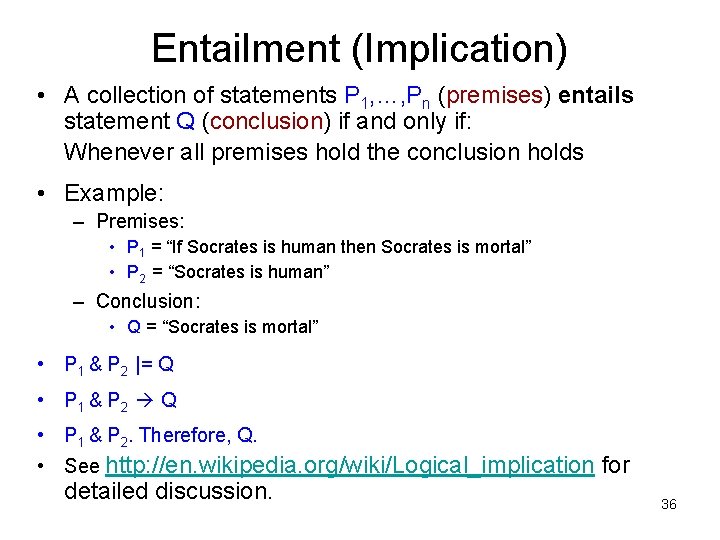
Entailment (Implication) • A collection of statements P 1, …, Pn (premises) entails statement Q (conclusion) if and only if: Whenever all premises hold the conclusion holds • Example: – Premises: • P 1 = “If Socrates is human then Socrates is mortal” • P 2 = “Socrates is human” – Conclusion: • Q = “Socrates is mortal” • P 1 & P 2 |= Q • P 1 & P 2. Therefore, Q. • See http: //en. wikipedia. org/wiki/Logical_implication for detailed discussion. 36
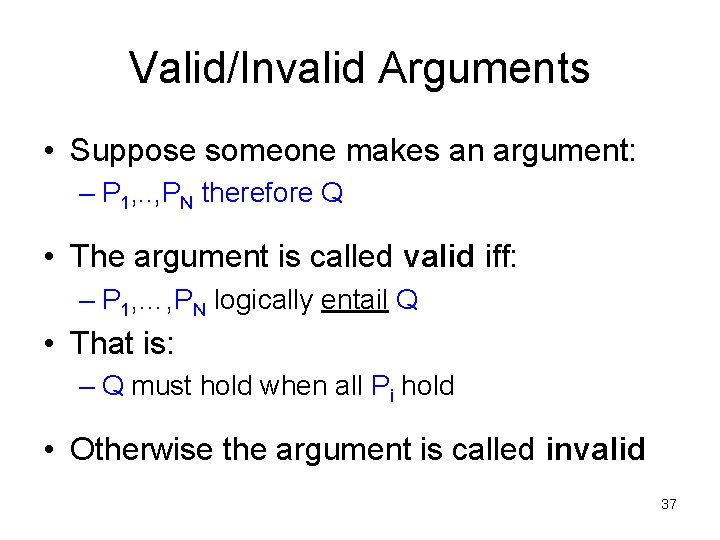
Valid/Invalid Arguments • Suppose someone makes an argument: – P 1, . . , PN therefore Q • The argument is called valid iff: – P 1, …, PN logically entail Q • That is: – Q must hold when all Pi hold • Otherwise the argument is called invalid 37
Questions? 38
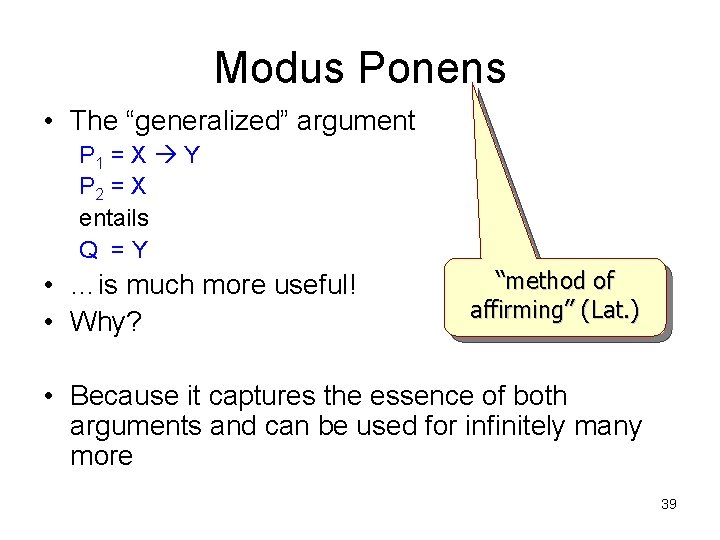
Modus Ponens • The “generalized” argument P 1 = X Y P 2 = X entails Q =Y • …is much more useful! • Why? “method of affirming” (Lat. ) • Because it captures the essence of both arguments and can be used for infinitely many more 39
Valid Arguments (Revisited) • Suppose someone makes an argument: – P 1, . . , PN therefore Q • The argument is called valid iff: – P 1, …, PN logically entail Q • That is: – For any interpretation I that satisfies all Pj, interpretation I must necessarily satisfy Q • Usually: Pj and Q are somehow related formulae and P 1 & … & PN can be true or false depending on the interpretation I 40
How Do We: • Tell between a valid argument and an invalid argument: – People are mortal. Socrates is a man. Socrates is mortal. – Ducks fly. F-16 flies. F-16 is a duck. • Prove that something logically follows from something else: – 1: Everybody likes Bob – 2: Everybody likes someone • Prove that something is logically equivalent to something else: – 1: Everybody likes cream and sugar – 2: Everybody likes cream and everybody likes sugar • Prove that there is a contradiction? 41
Propositional Logic • Method #1: – Go through all possible interpretations and check the definition of valid argument • Method #2: – Use derivation rules to get from the premises to the conclusion in a logically sound way • “derive the conclusions from premises” 42
Method #1 • Section 1. 3 in the text proves many arguments/inference rules using truth tables • Suppose the argument is: P 1, …, PN therefore Q • Create a truth table formula X = (P 1 & … & PN Q) • Check if X is a tautology 43
But Why? Recall: • Formula A entails formula B iff (A B) is a tautology • In general: – premises P 1, …, PN entail Q – iff – formula F=(P 1 & … & PN Q) – is a tautology 44
Example #1 • • Pv. Qv. R ~R entails Pv. Q • valid/invalid? • (example 1. 3. 2 in the book, p. 31) 45
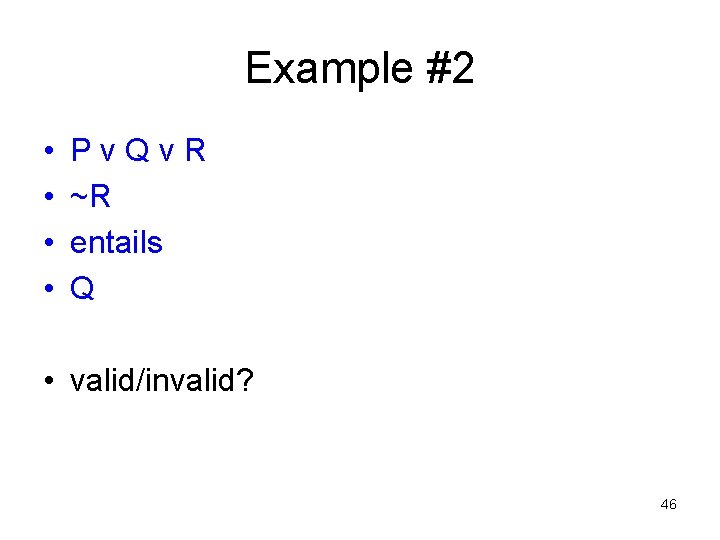
Example #2 • • Pv. Qv. R ~R entails Q • valid/invalid? 46
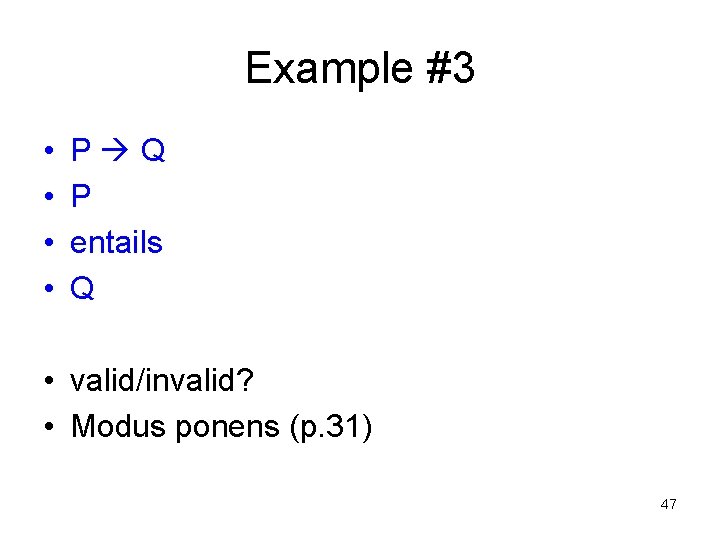
Example #3 • • P Q P entails Q • valid/invalid? • Modus ponens (p. 31) 47
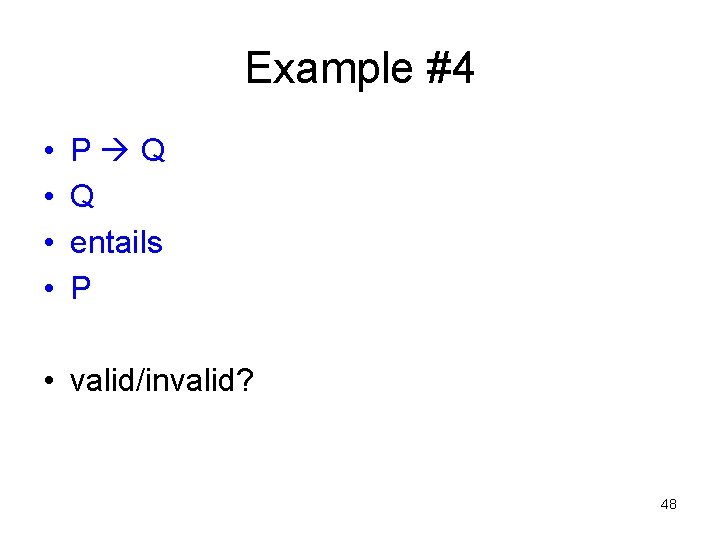
Example #4 • • P Q Q entails P • valid/invalid? 48
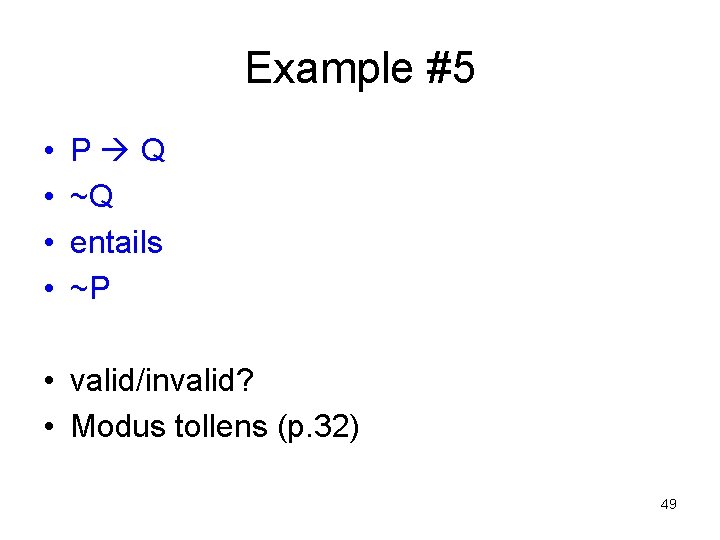
Example #5 • • P Q ~Q entails ~P • valid/invalid? • Modus tollens (p. 32) 49
Example #6 • P Q • entails • ~Q ~P • valid/invalid? • In fact, we proved last time that: • (P Q) (~Q ~P) 50
Pros & Cons • Method #1: – Pro: straight-forward, not much creativity machines can do – Con: the number of interpretations grows exponentially with the number of variables cannot do for many variables – Con: in predicate and some other logics even a small formula may have an infinite number of interpretations 51
Method #2 : Derivations • To prove that an argument is valid: – Begin with the premises – Use valid/sound inference rules – Arrive at the conclusion 52
Inference Rules • But what are these “inference rules”? • They are simply… – …valid arguments! • Example: –X&Y Z&W – therefore –Z&W by modus ponens 53
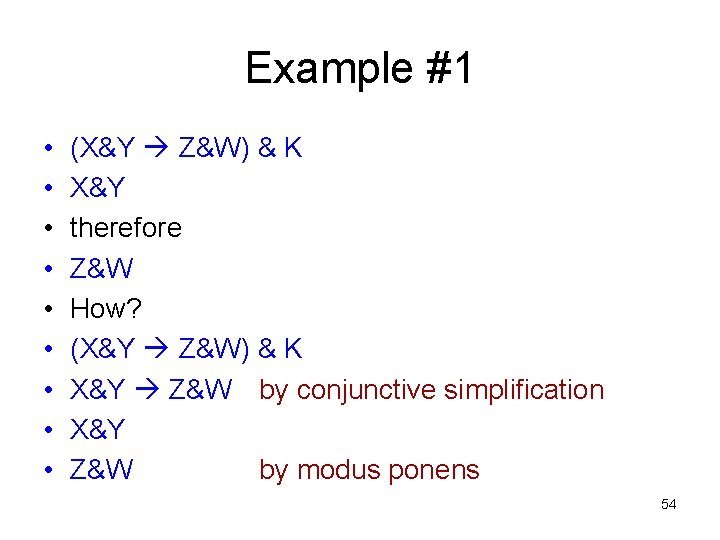
Example #1 • • • (X&Y Z&W) & K X&Y therefore Z&W How? (X&Y Z&W) & K X&Y Z&W by conjunctive simplification X&Y Z&W by modus ponens 54
Derivations • The chain of inference rules that starts with the premises and ends with the conclusion • …is called a derivation: – The conclusion is derived from the premises • Such a derivation makes a proof of an argument’s validity 55
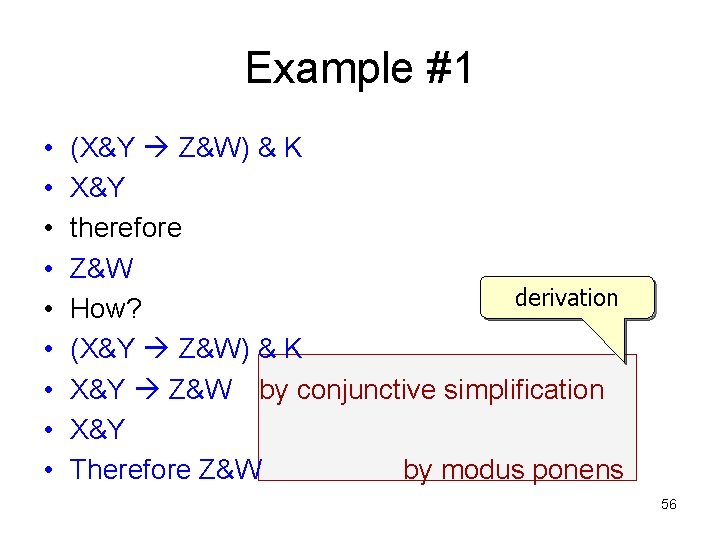
Example #1 • • • (X&Y Z&W) & K X&Y therefore Z&W derivation How? (X&Y Z&W) & K X&Y Z&W by conjunctive simplification X&Y Therefore Z&W by modus ponens 56
Fallacies • An error in derivation leading to an invalid argument • Possible causes: – Vague formulations of premises/conclusion – Missing steps – Using non-sound inference rules, e. g. : • Converse error • Inverse error 57
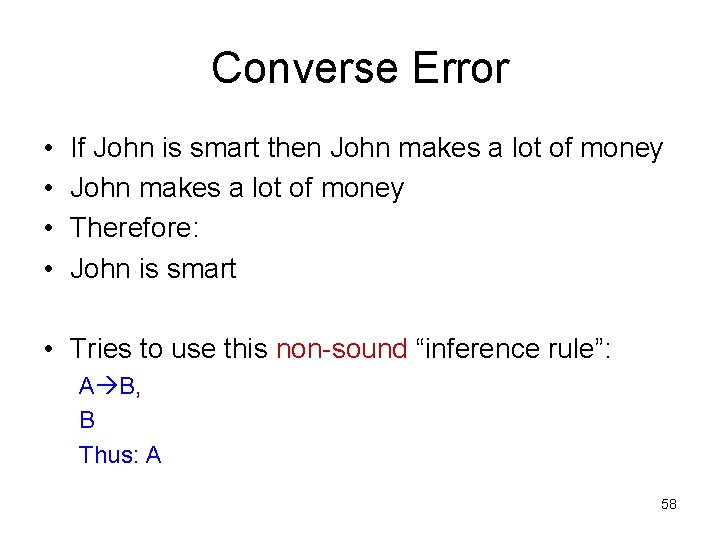
Converse Error • • If John is smart then John makes a lot of money Therefore: John is smart • Tries to use this non-sound “inference rule”: A B, B Thus: A 58
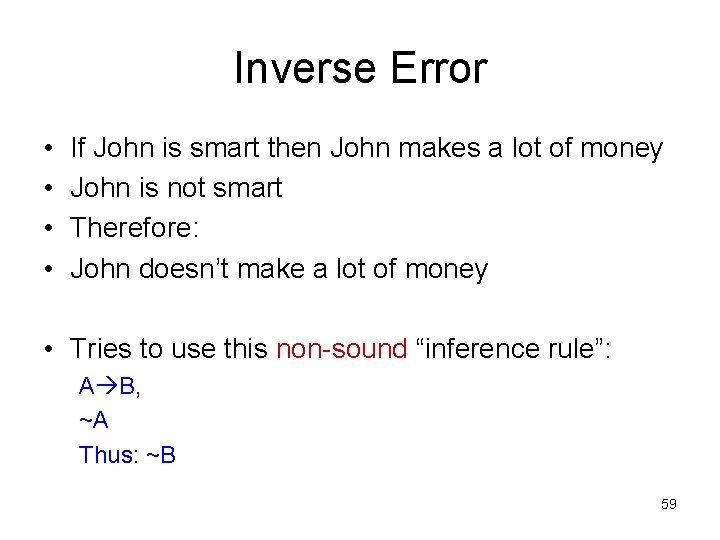
Inverse Error • • If John is smart then John makes a lot of money John is not smart Therefore: John doesn’t make a lot of money • Tries to use this non-sound “inference rule”: A B, ~A Thus: ~B 59
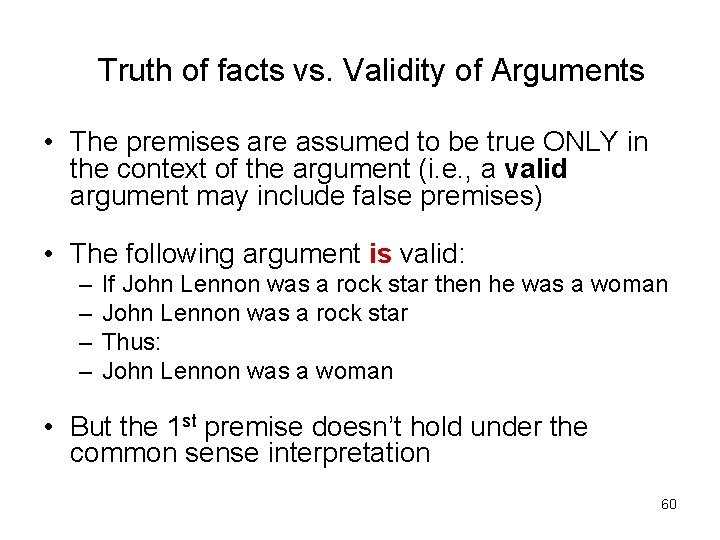
Truth of facts vs. Validity of Arguments • The premises are assumed to be true ONLY in the context of the argument (i. e. , a valid argument may include false premises) • The following argument is valid: – – If John Lennon was a rock star then he was a woman John Lennon was a rock star Thus: John Lennon was a woman • But the 1 st premise doesn’t hold under the common sense interpretation 60
Inference Rules • Table 1. 3. 1 on page 40 • If practice with the rules then will be more fluent using them • If are more fluent using them then will be more likely to get a better mark on exams 61
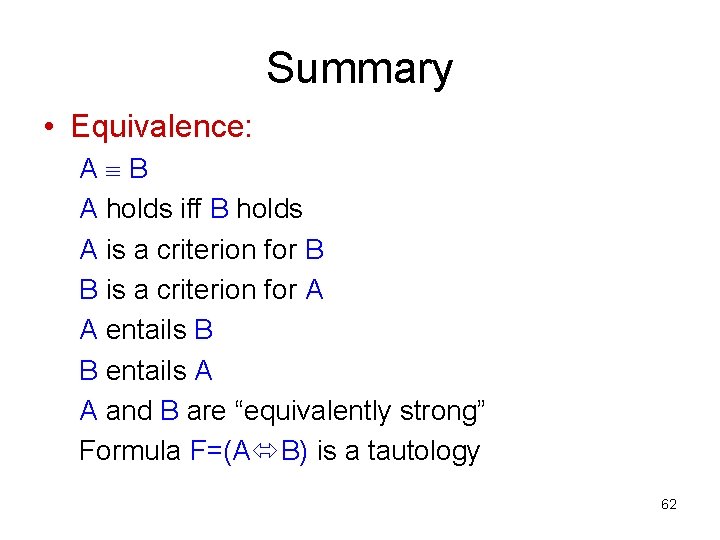
Summary • Equivalence: A B A holds iff B holds A is a criterion for B B is a criterion for A A entails B B entails A A and B are “equivalently strong” Formula F=(A B) is a tautology 62
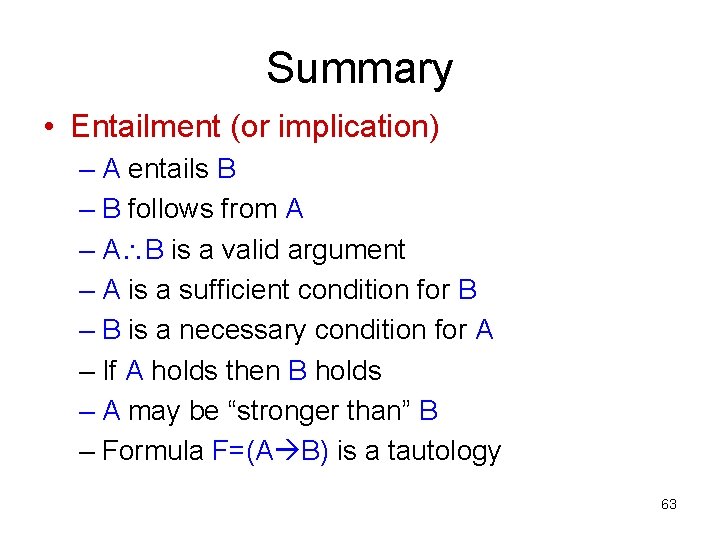
Summary • Entailment (or implication) – A entails B – B follows from A – A B is a valid argument – A is a sufficient condition for B – B is a necessary condition for A – If A holds then B holds – A may be “stronger than” B – Formula F=(A B) is a tautology 63
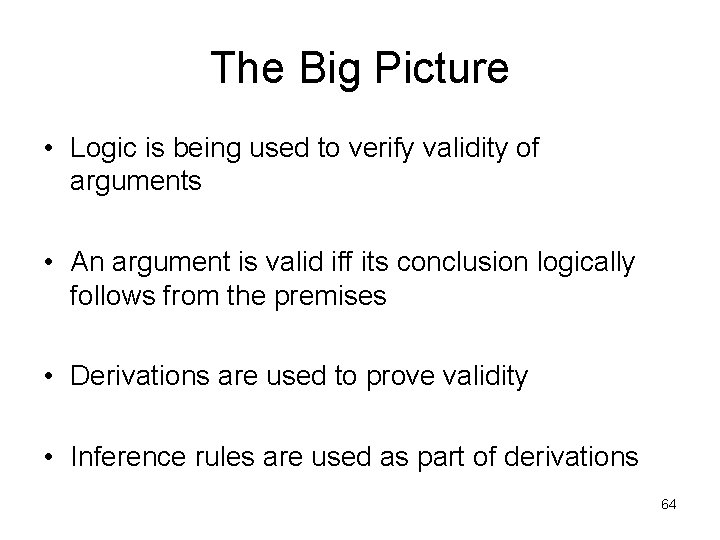
The Big Picture • Logic is being used to verify validity of arguments • An argument is valid iff its conclusion logically follows from the premises • Derivations are used to prove validity • Inference rules are used as part of derivations 64
Questions? 65
- Slides: 65