
Origin of Metazoans and Topology of the Animal
- Slides: 36
Origin of Metazoans and Topology of the Animal Kingdom
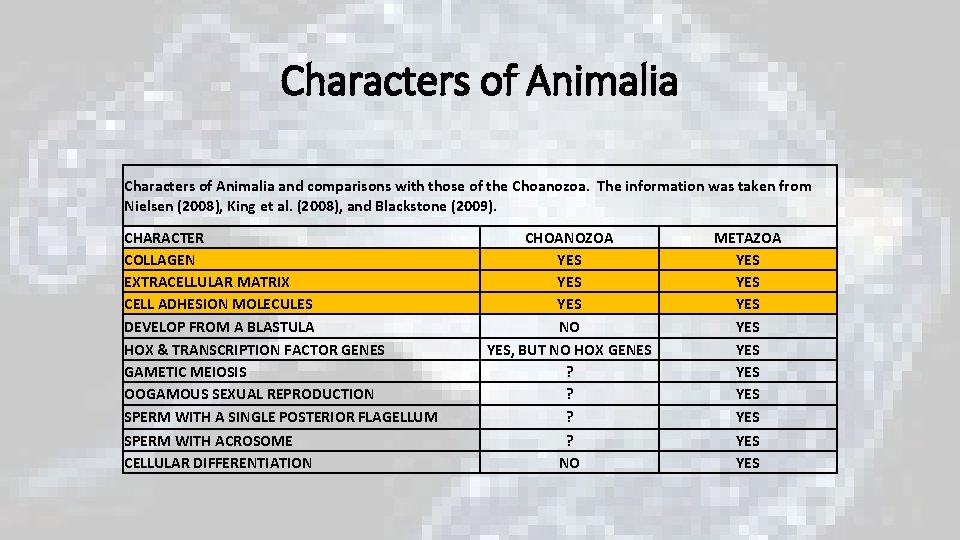
Characters of Animalia and comparisons with those of the Choanozoa. The information was taken from Nielsen (2008), King et al. (2008), and Blackstone (2009). CHARACTER COLLAGEN EXTRACELLULAR MATRIX CELL ADHESION MOLECULES DEVELOP FROM A BLASTULA HOX & TRANSCRIPTION FACTOR GENES GAMETIC MEIOSIS OOGAMOUS SEXUAL REPRODUCTION SPERM WITH A SINGLE POSTERIOR FLAGELLUM SPERM WITH ACROSOME CELLULAR DIFFERENTIATION CHOANOZOA YES YES NO YES, BUT NO HOX GENES ? ? NO METAZOA YES YES YES
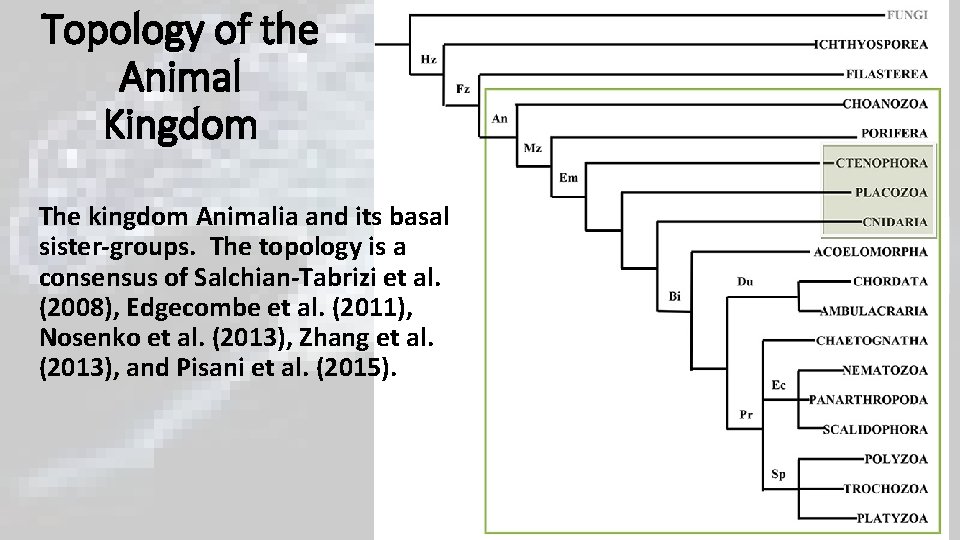
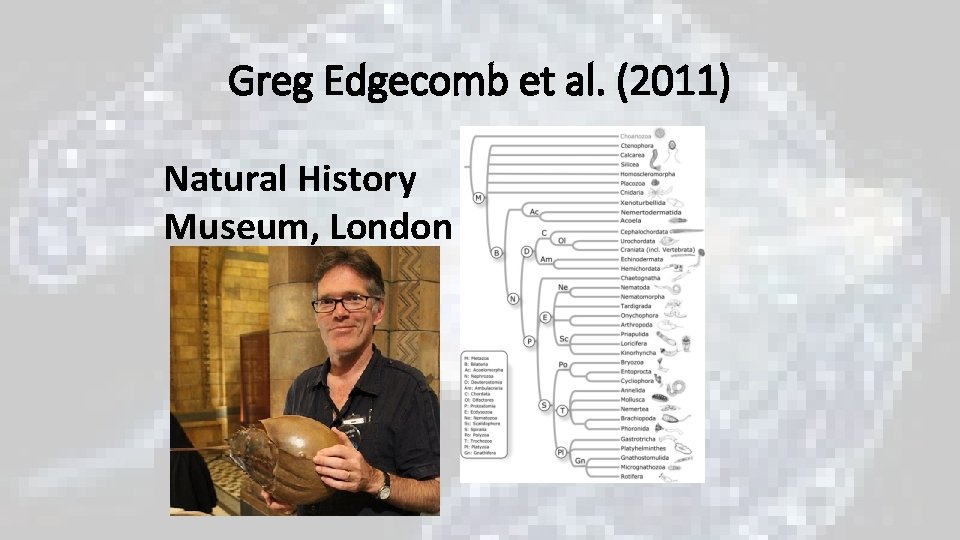
Topology of the Animal Kingdom The kingdom Animalia and its basal sister-groups. The topology is a consensus of Salchian-Tabrizi et al. (2008), Edgecombe et al. (2011), Nosenko et al. (2013), Zhang et al. (2013), and Pisani et al. (2015).
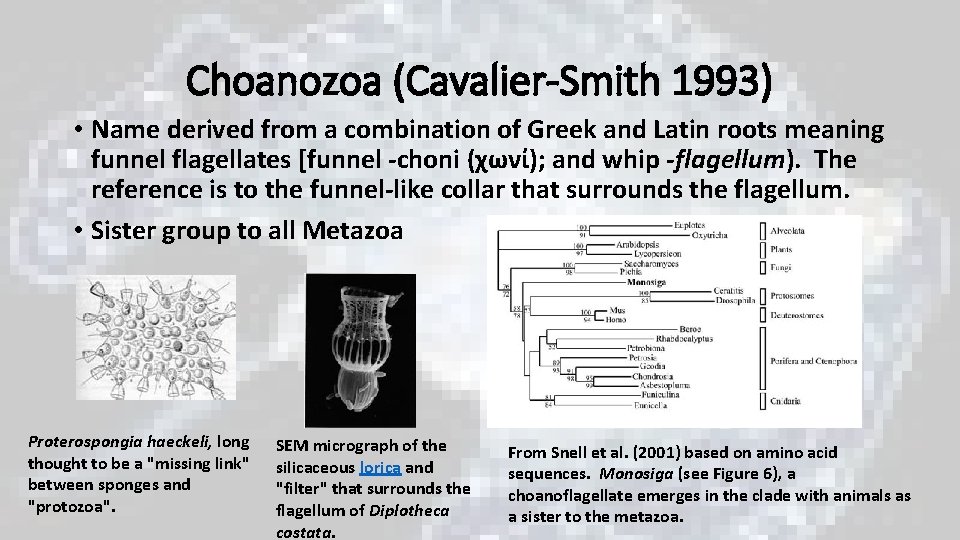
Choanozoa (Cavalier-Smith 1993) • Name derived from a combination of Greek and Latin roots meaning funnel flagellates [funnel -choni (χωνί); and whip -flagellum). The reference is to the funnel-like collar that surrounds the flagellum. • Sister group to all Metazoa Proterospongia haeckeli, long thought to be a "missing link" between sponges and "protozoa". SEM micrograph of the silicaceous lorica and "filter" that surrounds the flagellum of Diplotheca costata. From Snell et al. (2001) based on amino acid sequences. Monosiga (see Figure 6), a choanoflagellate emerges in the clade with animals as a sister to the metazoa.
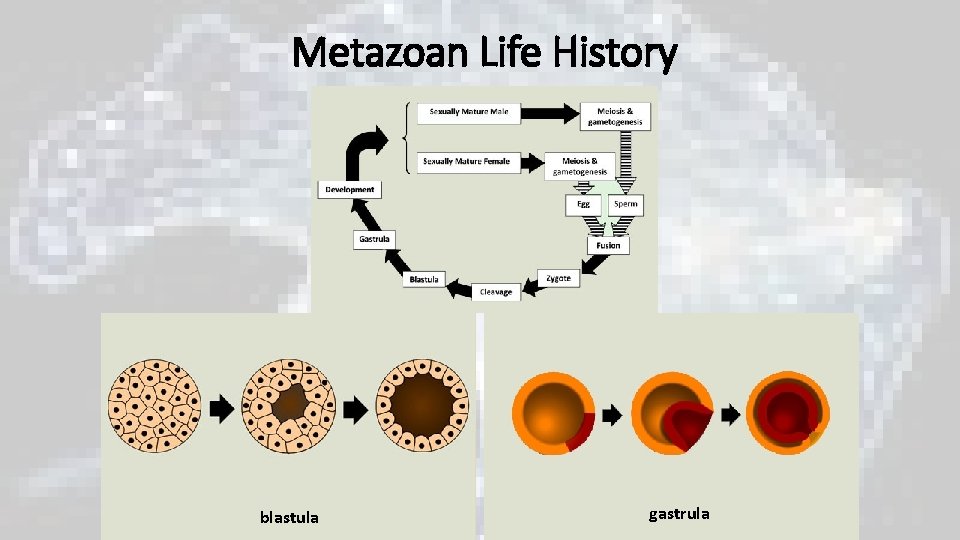
Metazoan Life History blastula gastrula
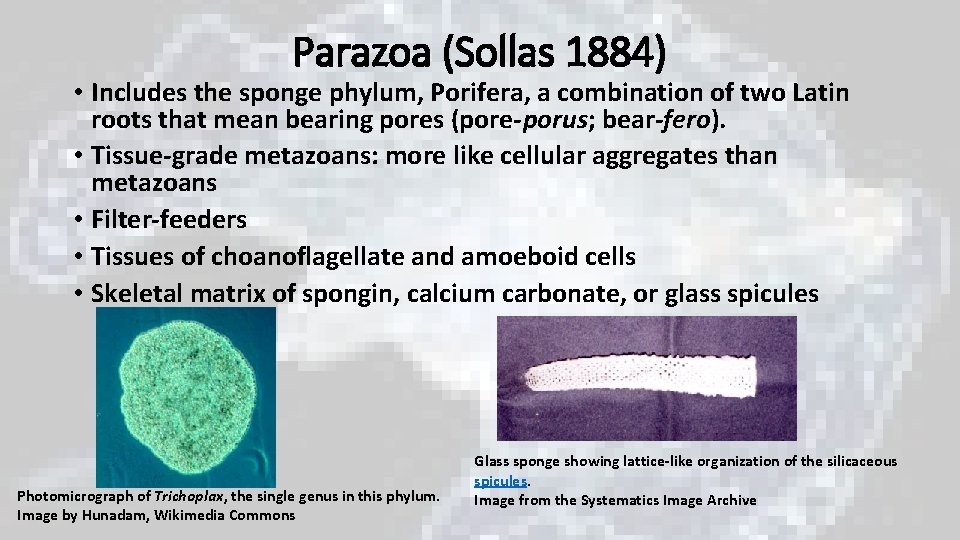
Parazoa (Sollas 1884) • Includes the sponge phylum, Porifera, a combination of two Latin roots that mean bearing pores (pore-porus; bear-fero). • Tissue-grade metazoans: more like cellular aggregates than metazoans • Filter-feeders • Tissues of choanoflagellate and amoeboid cells • Skeletal matrix of spongin, calcium carbonate, or glass spicules Photomicrograph of Trichoplax, the single genus in this phylum. Image by Hunadam, Wikimedia Commons Glass sponge showing lattice-like organization of the silicaceous spicules. Image from the Systematics Image Archive
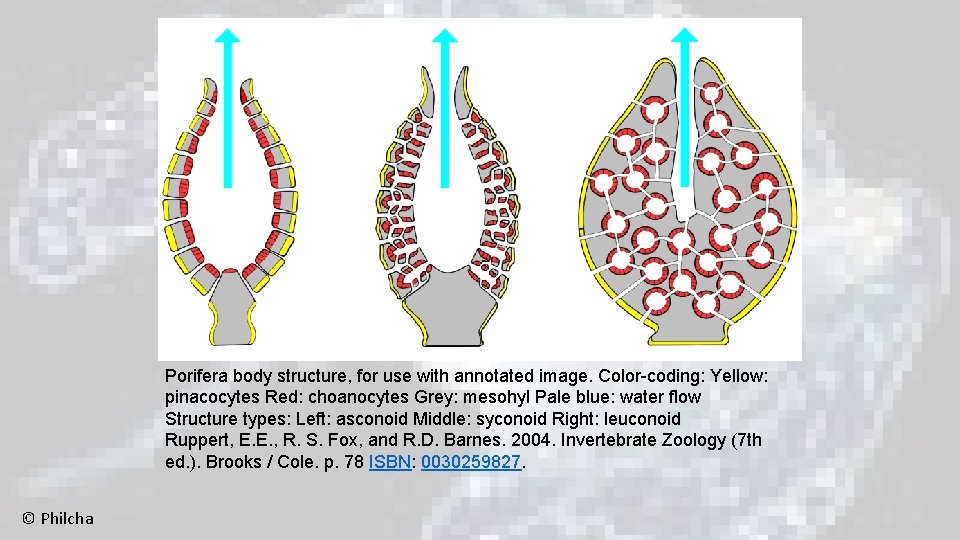
Porifera body structure, for use with annotated image. Color-coding: Yellow: pinacocytes Red: choanocytes Grey: mesohyl Pale blue: water flow Structure types: Left: asconoid Middle: syconoid Right: leuconoid Ruppert, E. E. , R. S. Fox, and R. D. Barnes. 2004. Invertebrate Zoology (7 th ed. ). Brooks / Cole. p. 78 ISBN: 0030259827. © Philcha
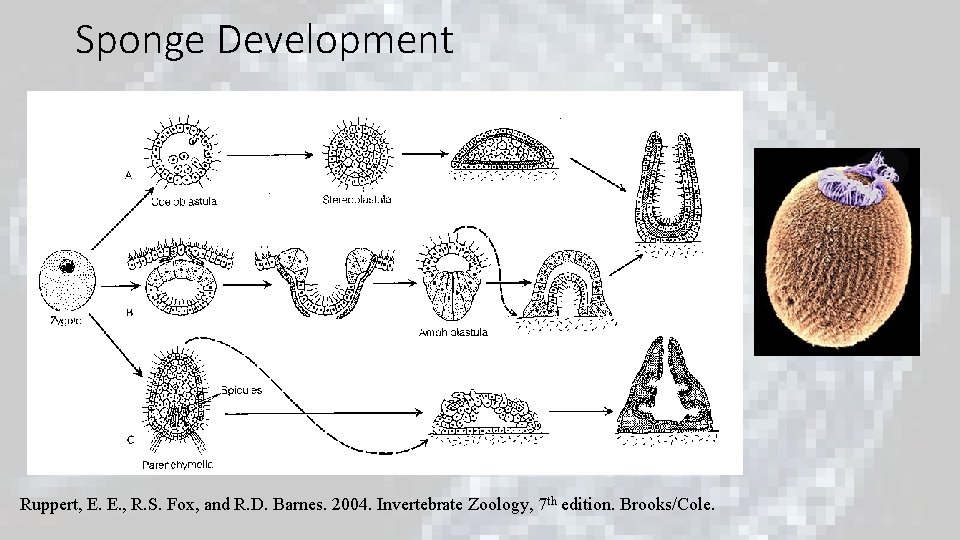
Sponge Development Ruppert, E. E. , R. S. Fox, and R. D. Barnes. 2004. Invertebrate Zoology, 7 th edition. Brooks/Cole.
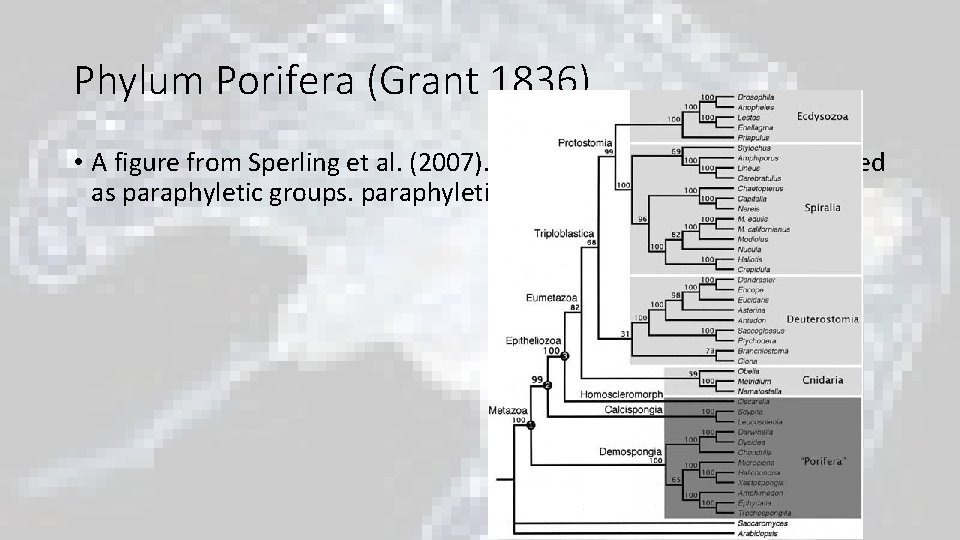
Phylum Porifera (Grant 1836) • A figure from Sperling et al. (2007). The classes of sponges are nested as paraphyletic groups.
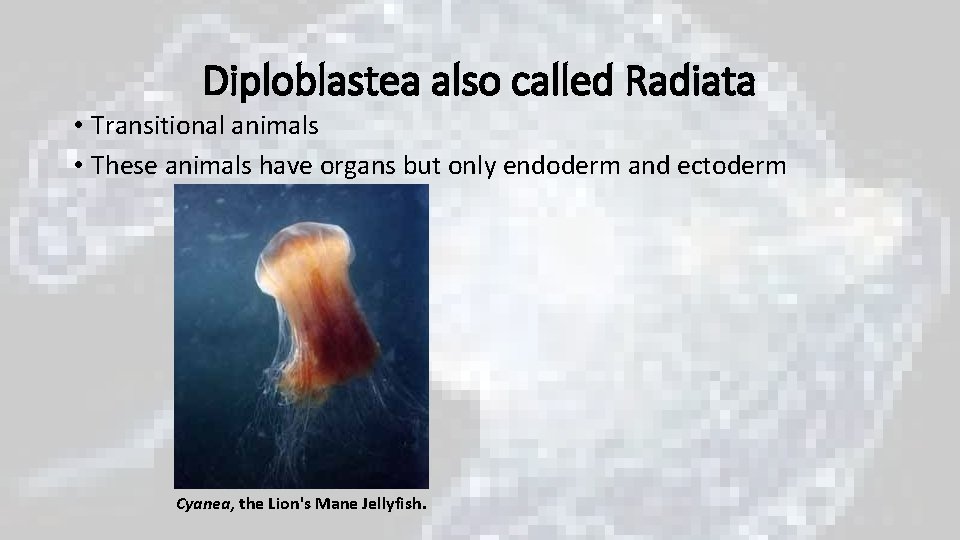
Diploblastea also called Radiata • Transitional animals • These animals have organs but only endoderm and ectoderm Cyanea, the Lion's Mane Jellyfish.
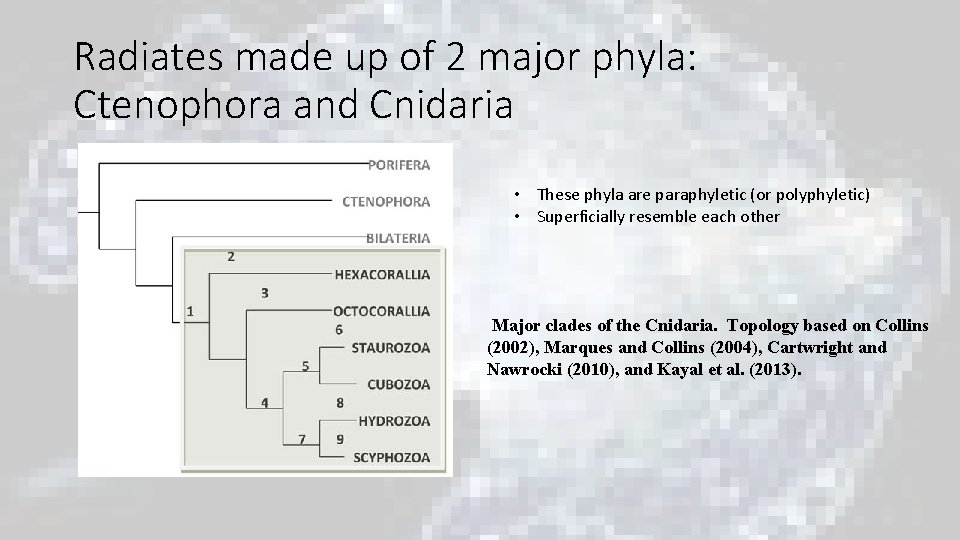
Radiates made up of 2 major phyla: Ctenophora and Cnidaria • These phyla are paraphyletic (or polyphyletic) • Superficially resemble each other Major clades of the Cnidaria. Topology based on Collins (2002), Marques and Collins (2004), Cartwright and Nawrocki (2010), and Kayal et al. (2013).
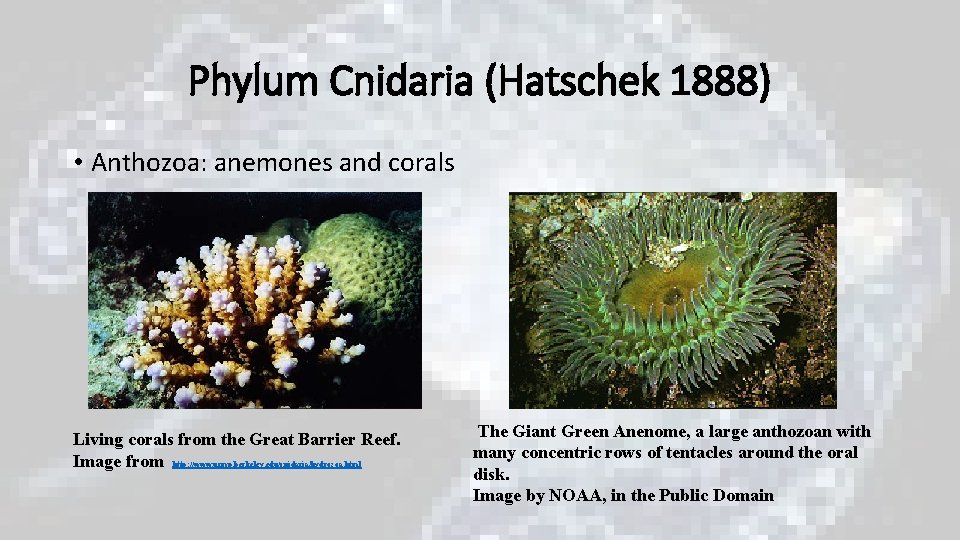
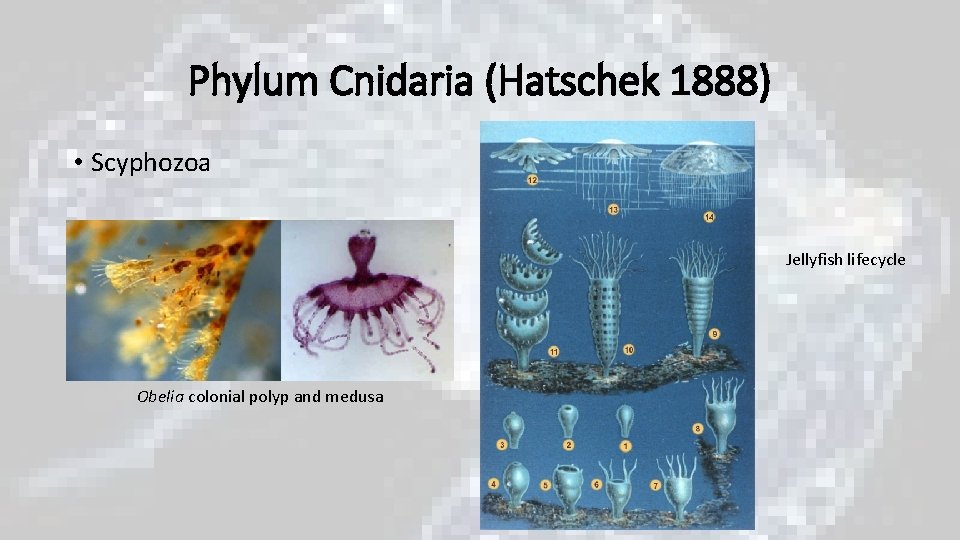
Phylum Cnidaria (Hatschek 1888) • Cnidaria is the Latinized form of a Greek word (κνιδοσ) that means sting. • Scyphozoa: a monophyletic group that has both hydroid and medusoid stages • Anthozoa: a paraphyletic group that contains only hydroid stages.
Phylum Cnidaria (Hatschek 1888) • Anthozoa: anemones and corals Living corals from the Great Barrier Reef. Image from http: //www. ucmp. berkeley. edu/cnidaria/hydrozoa. html The Giant Green Anenome, a large anthozoan with many concentric rows of tentacles around the oral disk. Image by NOAA, in the Public Domain
Phylum Cnidaria (Hatschek 1888) • Scyphozoa Jellyfish lifecycle Obelia colonial polyp and medusa
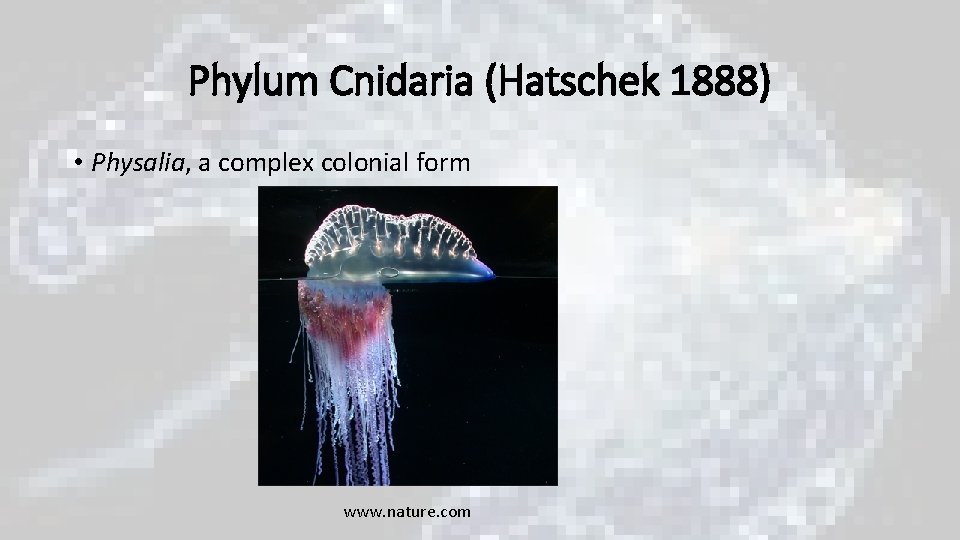
Phylum Cnidaria (Hatschek 1888) • Physalia, a complex colonial form www. nature. com
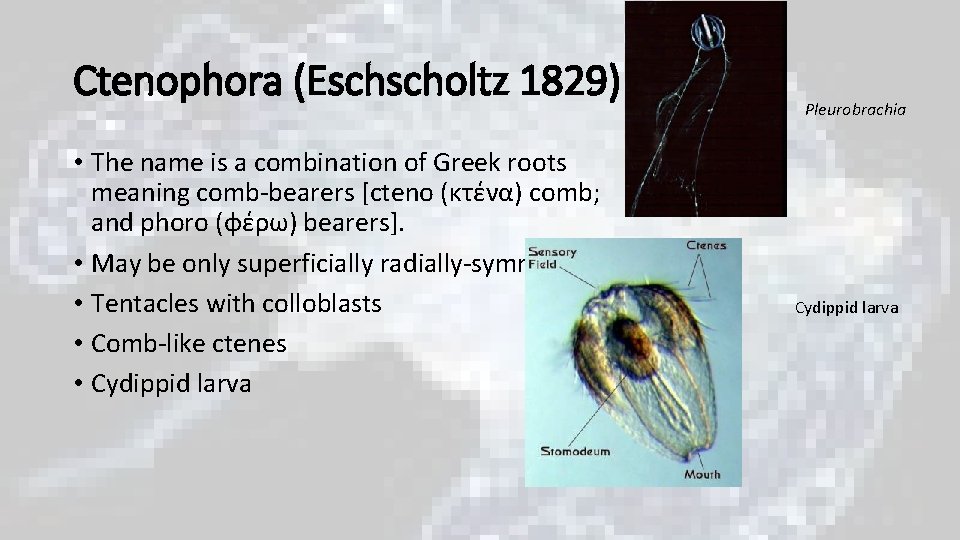
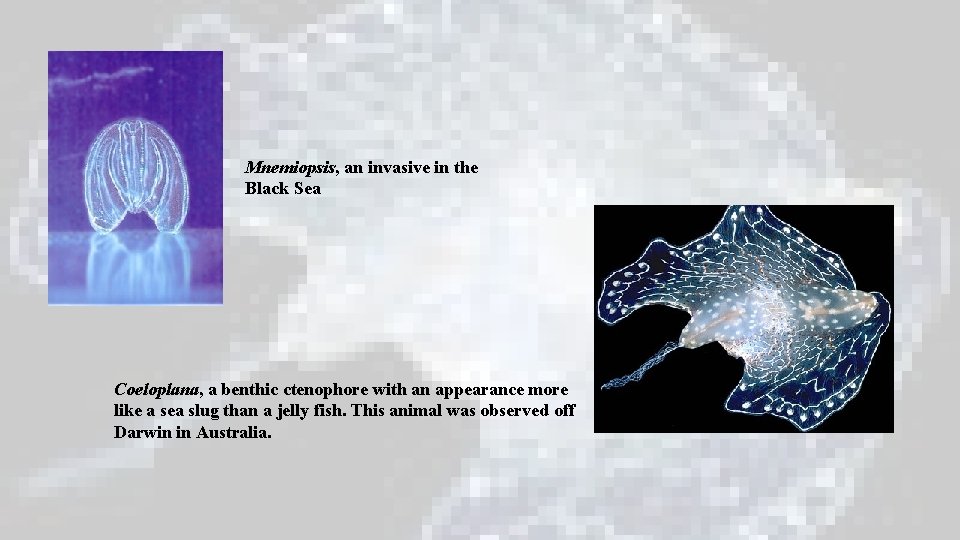
Ctenophora (Eschscholtz 1829) • The name is a combination of Greek roots meaning comb-bearers [cteno (κτένα) comb; and phoro (φέρω) bearers]. • May be only superficially radially-symmetrical. • Tentacles with colloblasts • Comb-like ctenes • Cydippid larva Pleurobrachia Cydippid larva
Mnemiopsis, an invasive in the Black Sea Coeloplana, a benthic ctenophore with an appearance more like a sea slug than a jelly fish. This animal was observed off Darwin in Australia.
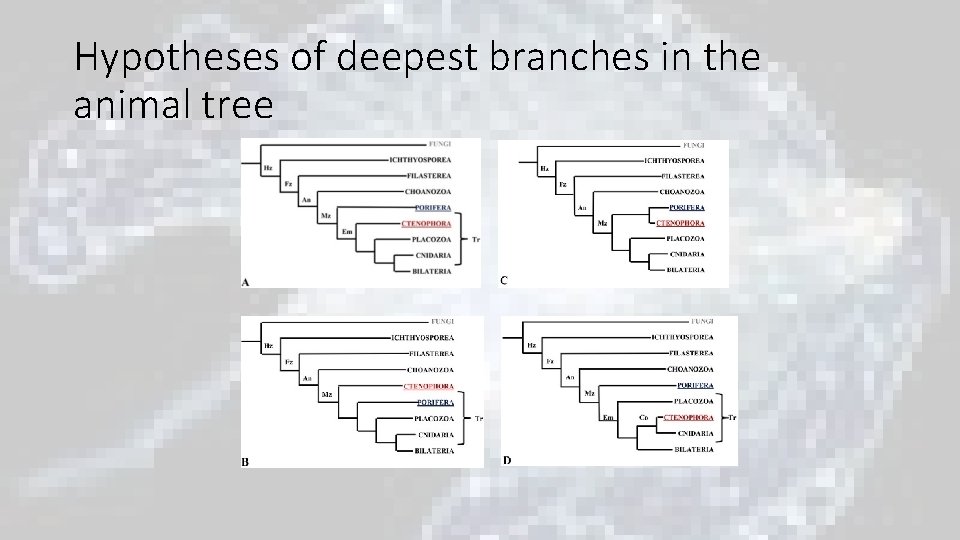
Evolution of our thinking regarding the deep branches of the animal kingdom How do the apparently primitive animal phyla relate to each other?
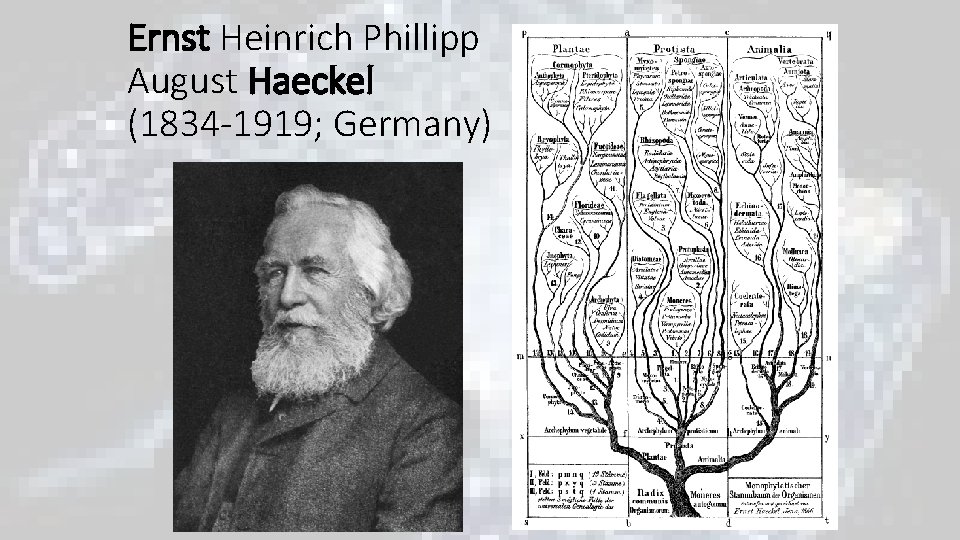
Ernst Heinrich Phillipp August Haeckel (1834 -1919; Germany)
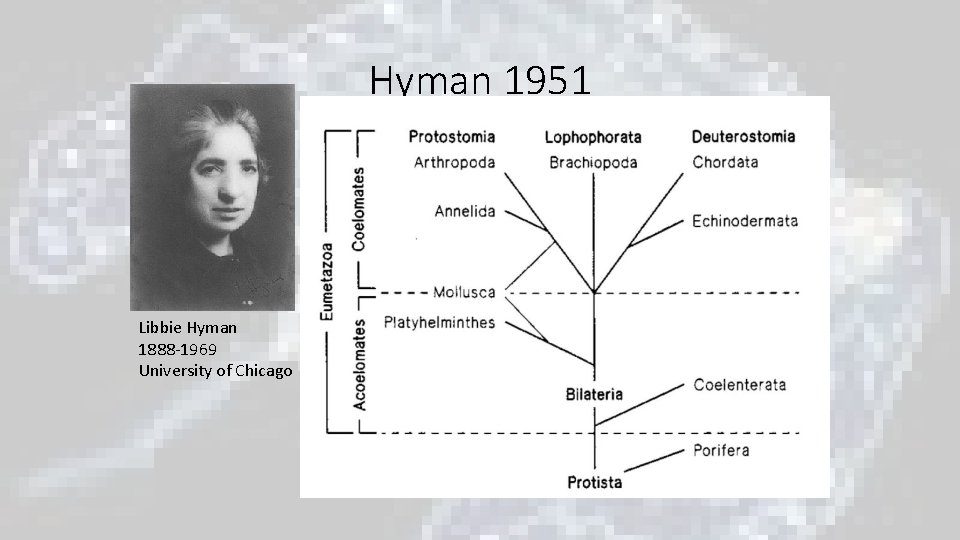
Hyman 1951 Libbie Hyman 1888 -1969 University of Chicago
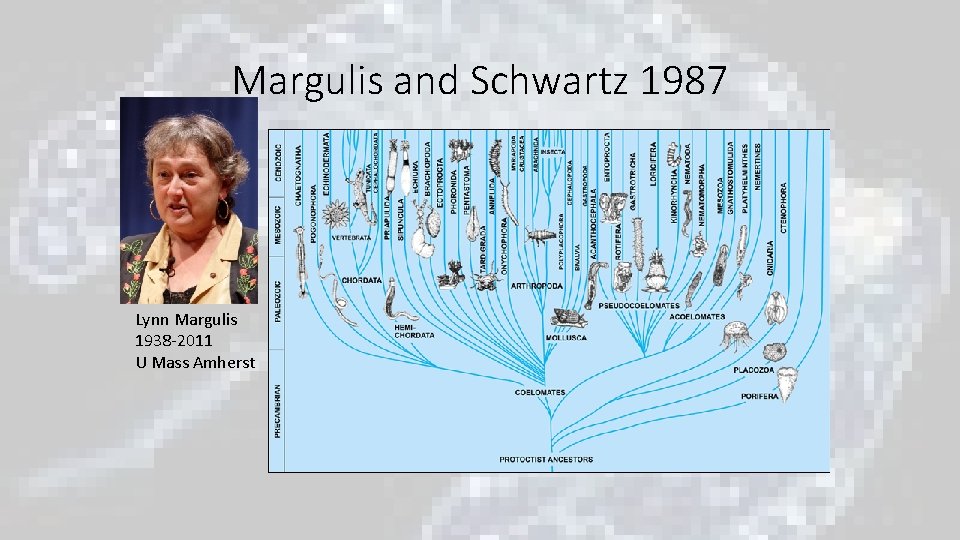
Margulis and Schwartz 1987 Lynn Margulis 1938 -2011 U Mass Amherst
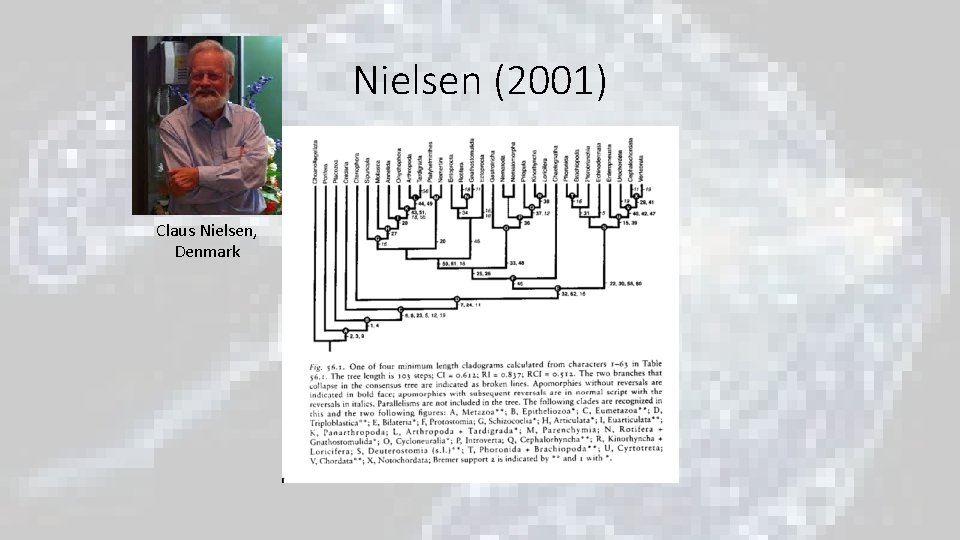
Nielsen (2001) Claus Nielsen, Denmark
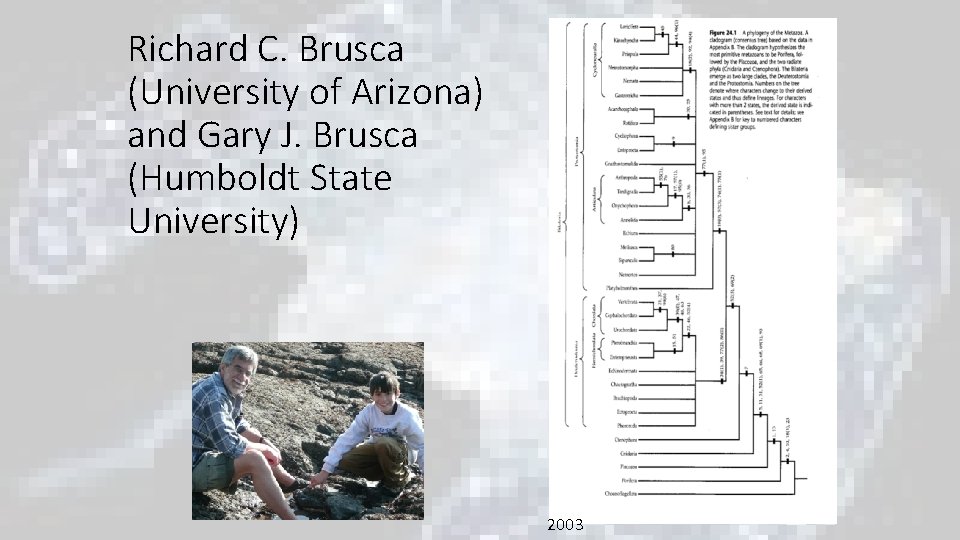
Richard C. Brusca (University of Arizona) and Gary J. Brusca (Humboldt State University) 2003
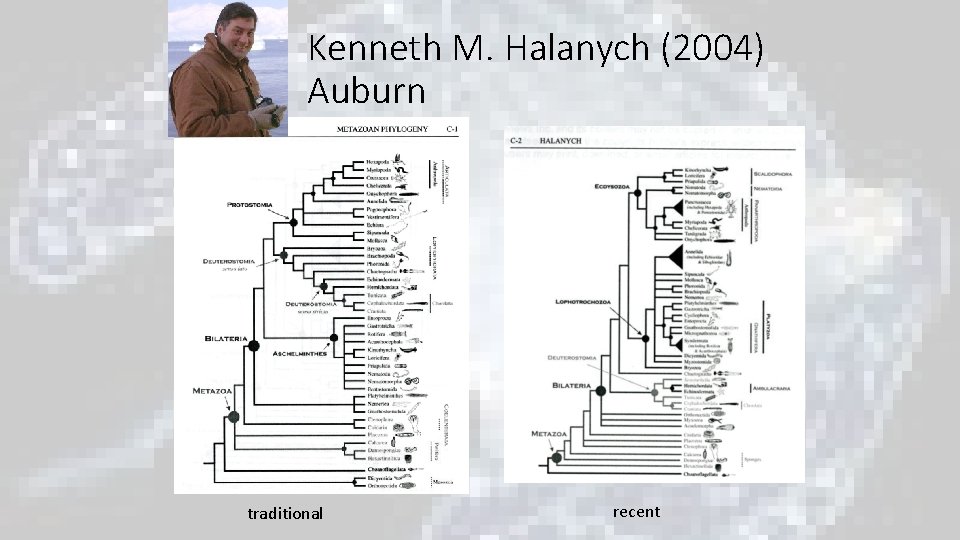
Kenneth M. Halanych (2004) Auburn traditional recent
Greg Edgecomb et al. (2011) Natural History Museum, London
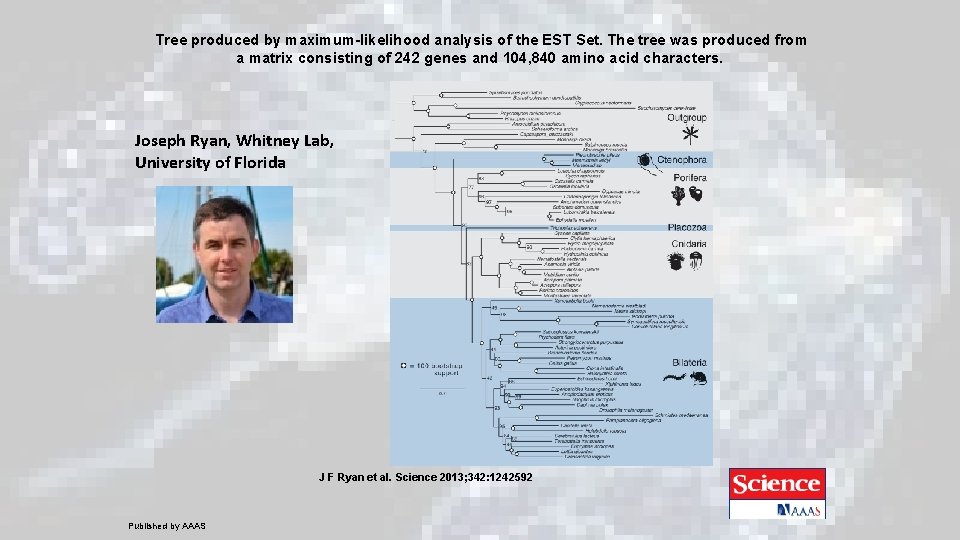
Tree produced by maximum-likelihood analysis of the EST Set. The tree was produced from a matrix consisting of 242 genes and 104, 840 amino acid characters. Joseph Ryan, Whitney Lab, University of Florida J F Ryan et al. Science 2013; 342: 1242592 Published by AAAS
Hypotheses of deepest branches in the animal tree
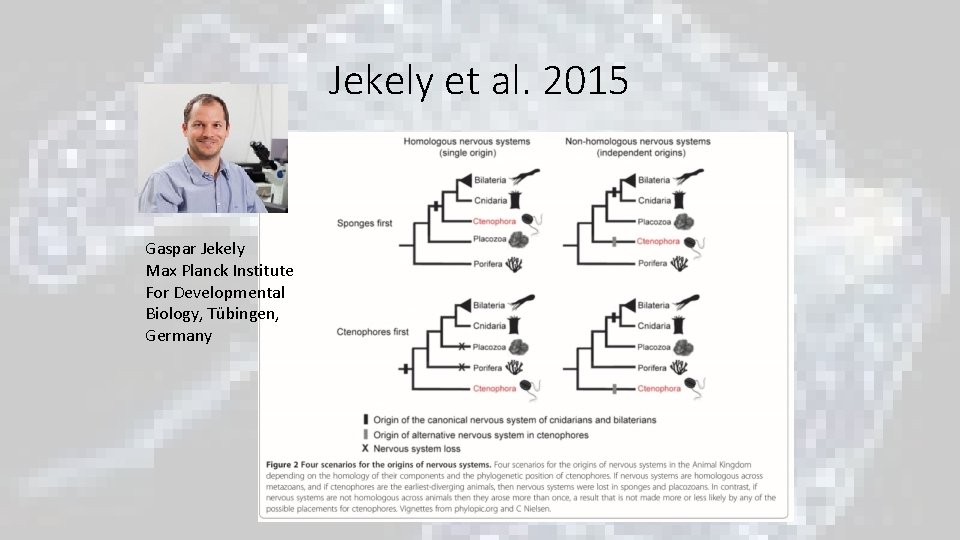
Jekely et al. 2015 Gaspar Jekely Max Planck Institute For Developmental Biology, Tübingen, Germany
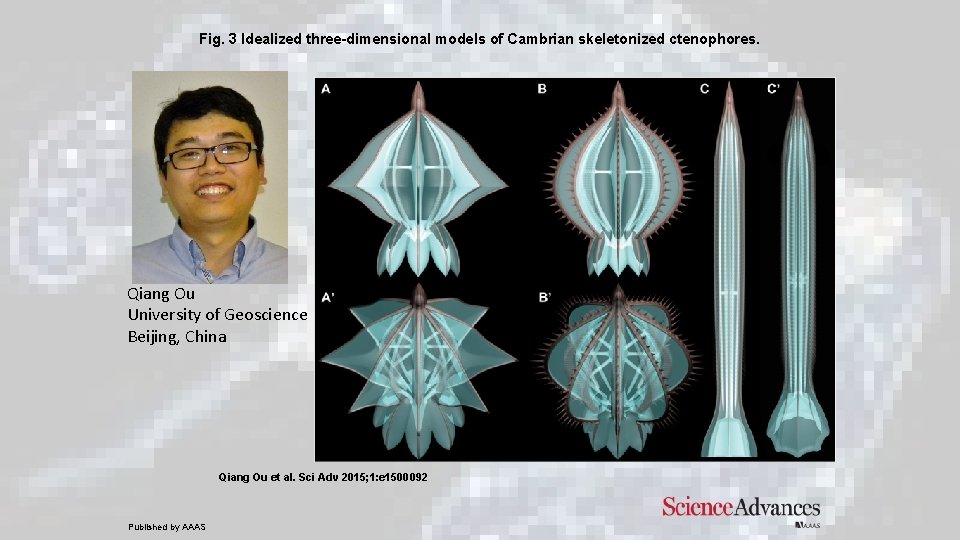
Fig. 3 Idealized three-dimensional models of Cambrian skeletonized ctenophores. Qiang Ou University of Geoscience Beijing, China Qiang Ou et al. Sci Adv 2015; 1: e 1500092 Published by AAAS
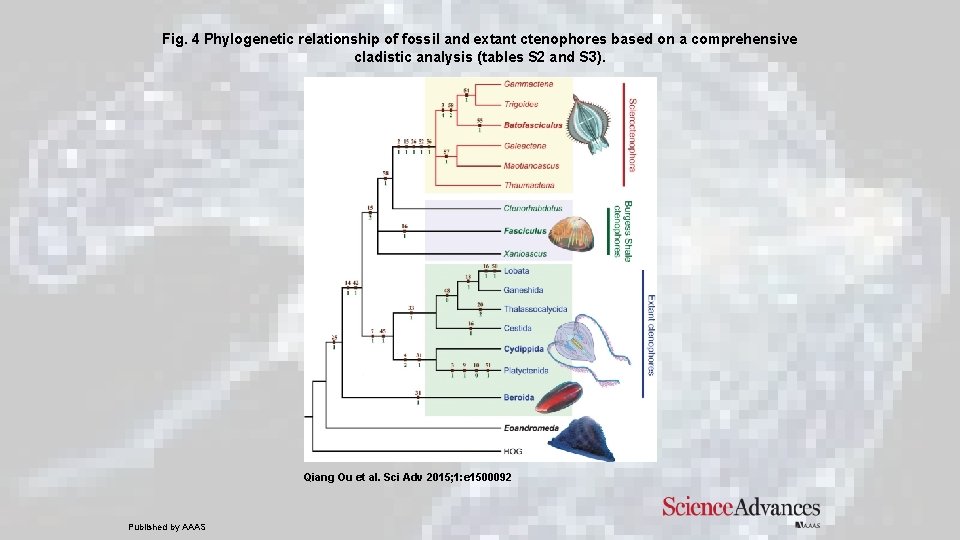
Fig. 4 Phylogenetic relationship of fossil and extant ctenophores based on a comprehensive cladistic analysis (tables S 2 and S 3). Qiang Ou et al. Sci Adv 2015; 1: e 1500092 Published by AAAS
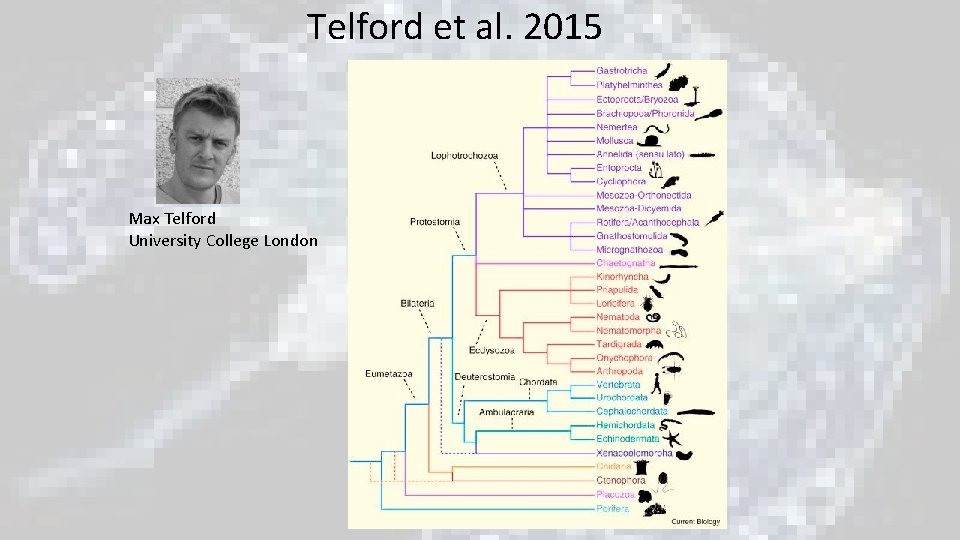
Telford et al. 2015 Max Telford University College London
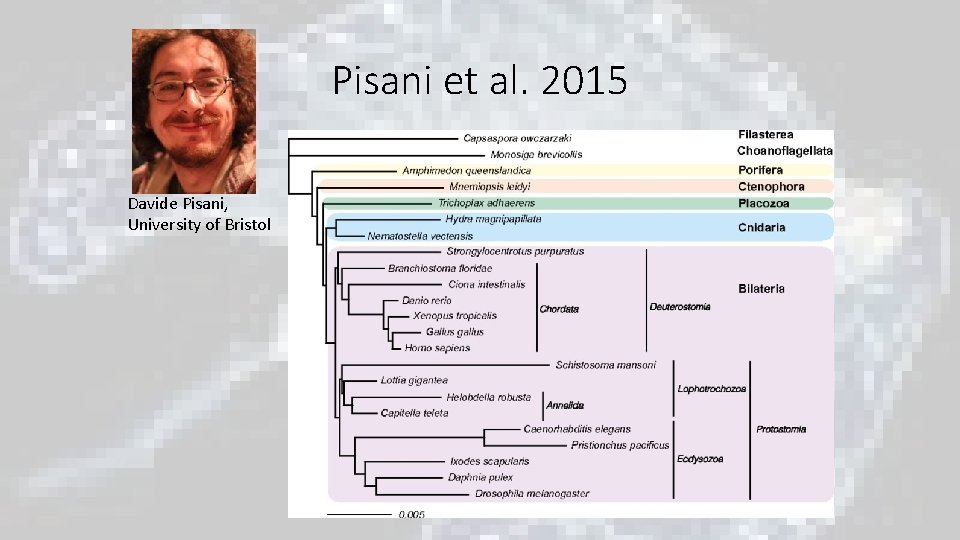
Pisani et al. 2015 Davide Pisani, University of Bristol
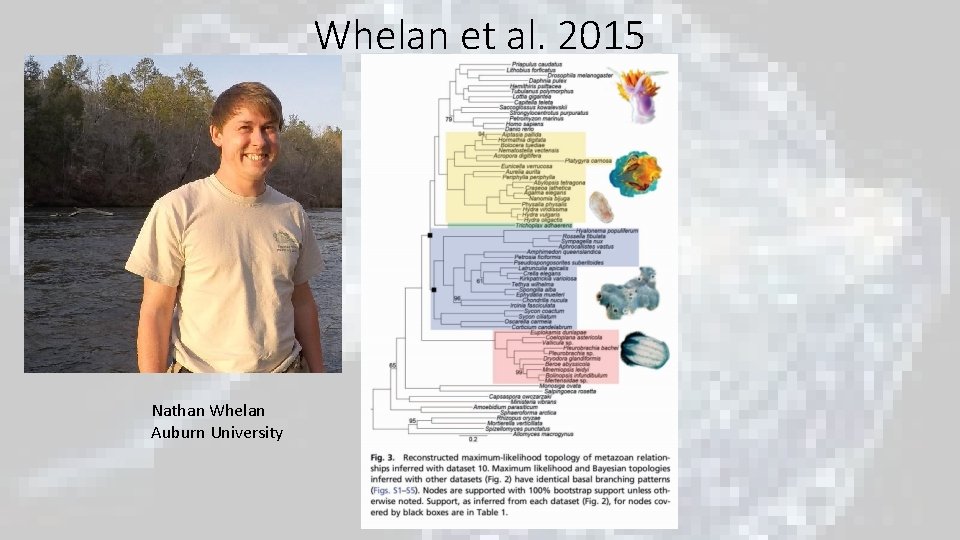
Whelan et al. 2015 Nathan Whelan Auburn University
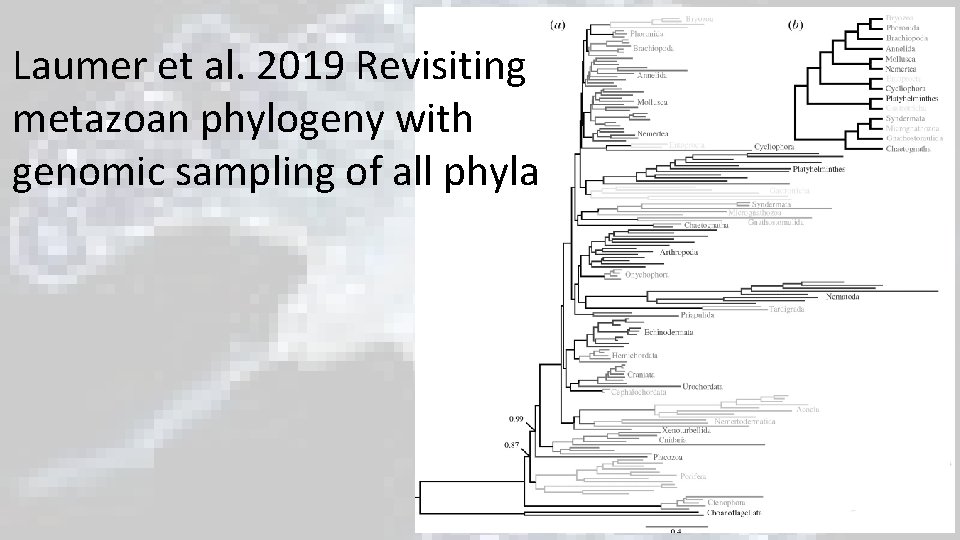
Laumer et al. 2019 Revisiting metazoan phylogeny with genomic sampling of all phyla
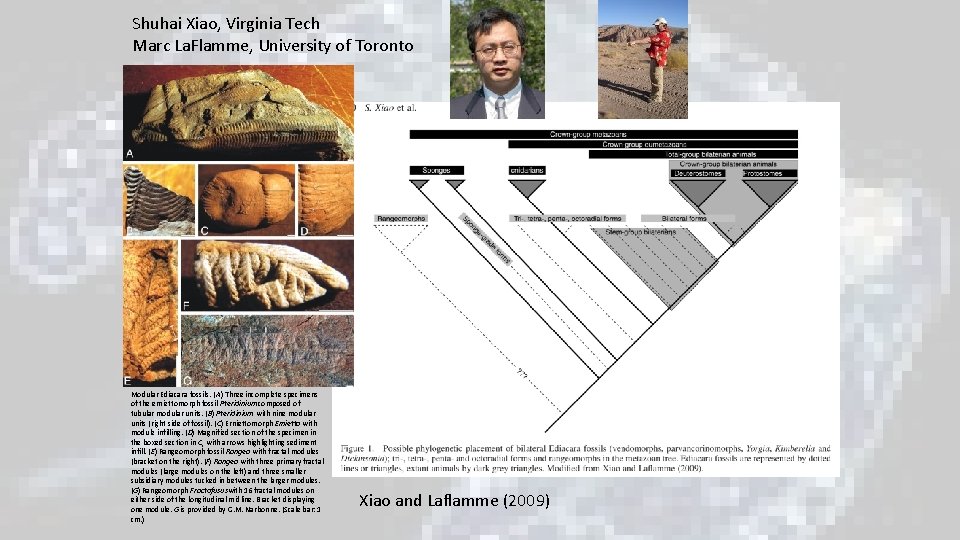
Shuhai Xiao, Virginia Tech Marc La. Flamme, University of Toronto Modular Ediacara fossils. (A) Three incomplete specimens of the erniettomorph fossil Pteridiniumcomposed of tubular modular units. (B) Pteridinium with nine modular units (right side of fossil). (C) Erniettomorph Ernietta with module infilling. (D) Magnified section of the specimen in the boxed section in C, with arrows highlighting sediment infill. (E) Rangeomorph fossil Rangea with fractal modules (bracket on the right). (F) Rangea with three primary fractal modules (large modules on the left) and three smaller subsidiary modules tucked in between the larger modules. (G) Rangeomorph Fractofususwith 16 fractal modules on either side of the longitudinal midline. Bracket displaying one module. G is provided by G. M. Narbonne. (Scale bar: 1 cm. ) Xiao and Laflamme (2009)