
ORIENTATION VS ONBOARDING MOVING BEYOND THE STAFF ORIENTATION
ORIENTATION VS ONBOARDING: MOVING BEYOND THE STAFF ORIENTATION CHECKLIST Michelle Doughty, Professional Development Coordinator Kaley Held, School Age and Day Camp Coordinator
Introduction According to March 2015 edition of Harvard Business Review, almost a quarter of companies say they don’t bother with formal onboarding programs Creating a good onboarding experience is no longer nice-to-have, it’s a necessity! Onboarding is considered to be one of the most broken processes in the workplace New employees typically take eight months to reach full productivity. 62% of employees hired in the last 12 months met first performance milestones on time compared to 17% without formal onboarding process Without a good onboarding process about half of new hires fail within 18 months
Large Group Discussion • Every organization has its own version of the complex process through which new hires learn attitudes, knowledge, skills and behaviors required to function effectively • What are the challenges you face with your current Orientation Process?
State Orientation Checklist Within 1 week of start date (20 topics) • Review of Licensing Rules (94 pgs…over 108 licensing rules) • Review of Center Policies and Procedures • Review of emergency plans • Prevention & response to allergies • Administration of medication • Job Responsibilities • Training in recognizing childhood illnesses • Schedule of center activities • Review of child abuse and neglect • Review of child tracking procedures • Child management techniques • Procedure for sharing information related to special needs (health and other) • SIDS (as applicable) • Procedure for absent child notification • Building and hazards safety • Handling & storage of hazardous materials • SBS video (as applicable) • Evacuating sleeping children (as applicable) Nearly 50% • Of employers report that in-demand skills are lacking among candidates • Orientation & onboarding tend to be after thoughts • Orientations are passive, presenter centered and lecture driven with little or no opportunity for participant interaction New employees are typically…. • Overwhelmed • Bored • Left to sink or swim • Given too much info to understand implement in much too much a time period (too many facts, figures and faces packed in too few hours) new hires to retain everything and be ready to use it confidently when it is over • Expected to retain everything and be ready to use it confidently when it is over Remember… • Licensing is the BARE MINIMUM of health and safety requirements • Usually done in a passive approach with little else systematically addressed (paperwork and rules covered but little else)
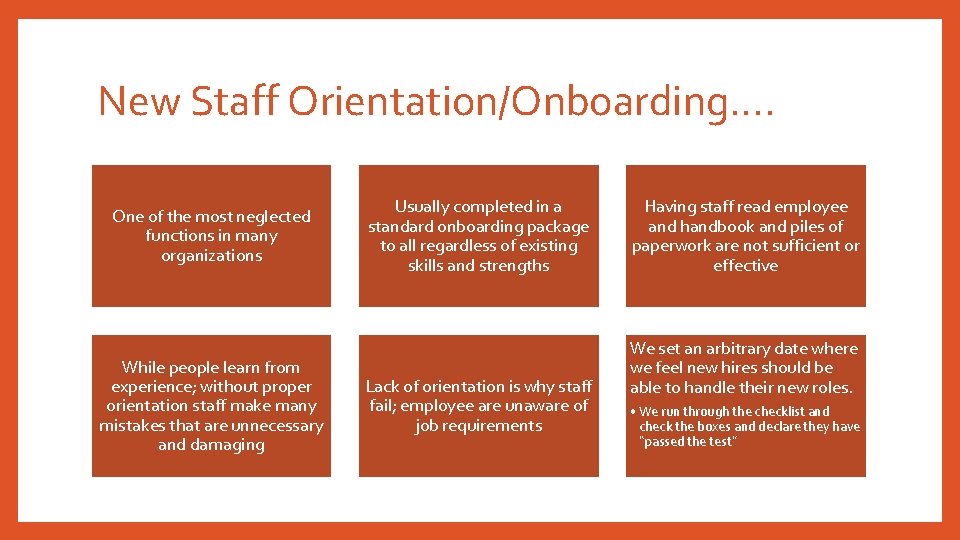
New Staff Orientation/Onboarding…. One of the most neglected functions in many organizations While people learn from experience; without proper orientation staff make many mistakes that are unnecessary and damaging Usually completed in a standard onboarding package to all regardless of existing skills and strengths Lack of orientation is why staff fail; employee are unaware of job requirements Having staff read employee and handbook and piles of paperwork are not sufficient or effective We set an arbitrary date where we feel new hires should be able to handle their new roles. • We run through the checklist and check the boxes and declare they have “passed the test”
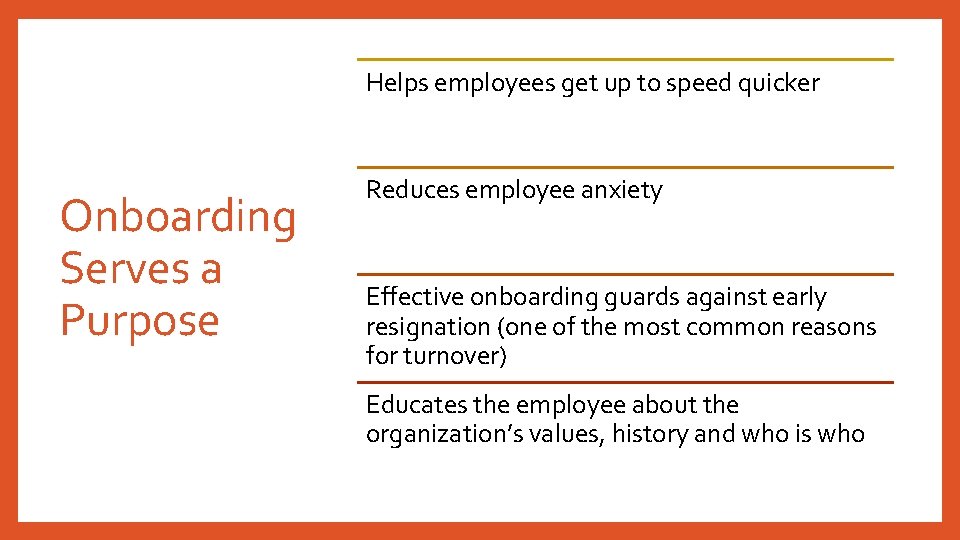
Helps employees get up to speed quicker Onboarding Serves a Purpose Reduces employee anxiety Effective onboarding guards against early resignation (one of the most common reasons for turnover) Educates the employee about the organization’s values, history and who is who
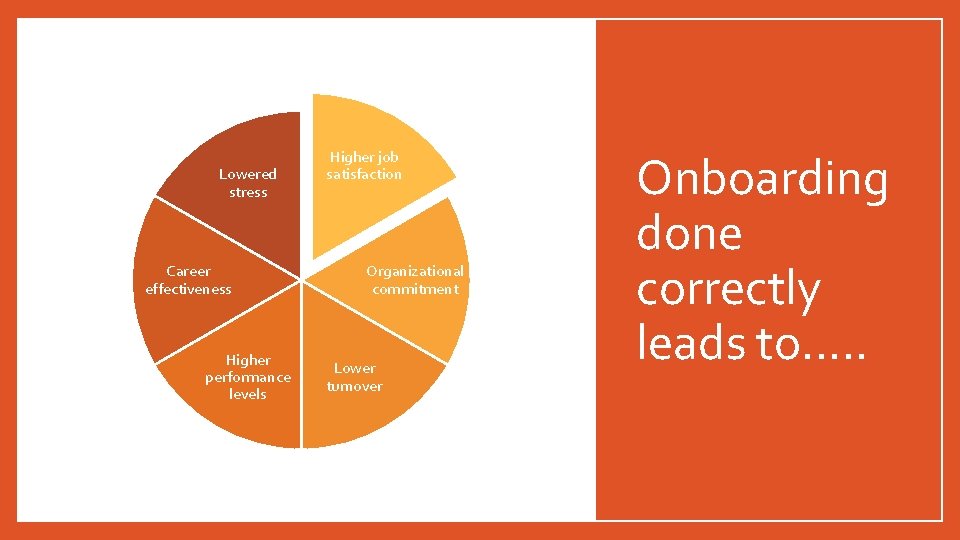
Lowered stress Career effectiveness Higher performance levels Higher job satisfaction Organizational commitment Lower turnover Onboarding done correctly leads to…. .
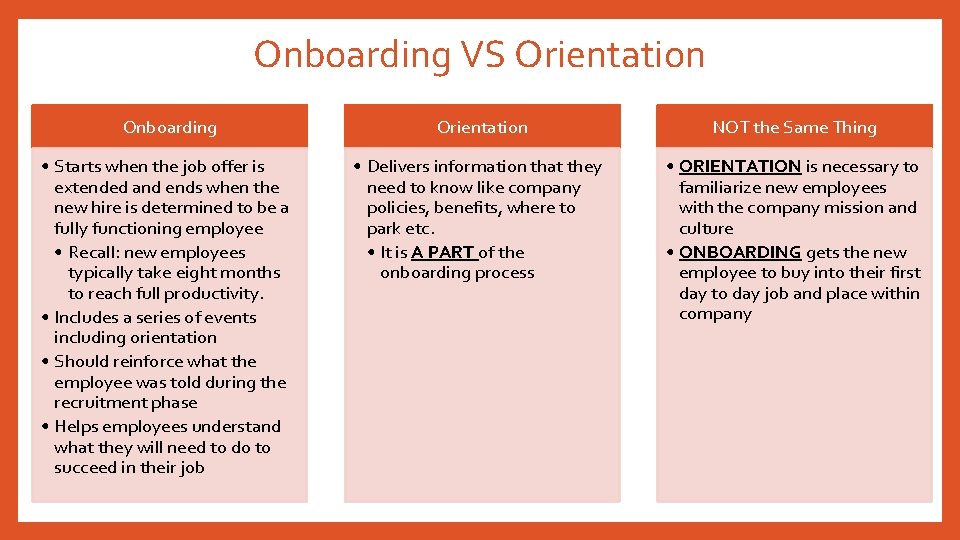
Onboarding VS Orientation Onboarding Orientation NOT the Same Thing • Starts when the job offer is extended and ends when the new hire is determined to be a fully functioning employee • Recall: new employees typically take eight months to reach full productivity. • Includes a series of events including orientation • Should reinforce what the employee was told during the recruitment phase • Helps employees understand what they will need to do to succeed in their job • Delivers information that they need to know like company policies, benefits, where to park etc. • It is A PART of the onboarding process • ORIENTATION is necessary to familiarize new employees with the company mission and culture • ONBOARDING gets the new employee to buy into their first day to day job and place within company
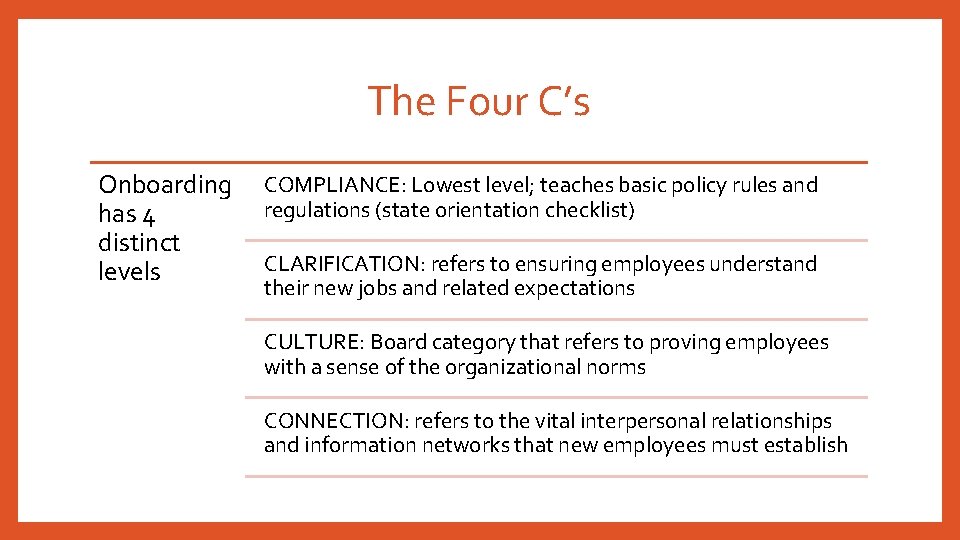
The Four C’s Onboarding has 4 distinct levels COMPLIANCE: Lowest level; teaches basic policy rules and regulations (state orientation checklist) CLARIFICATION: refers to ensuring employees understand their new jobs and related expectations CULTURE: Board category that refers to proving employees with a sense of the organizational norms CONNECTION: refers to the vital interpersonal relationships and information networks that new employees must establish
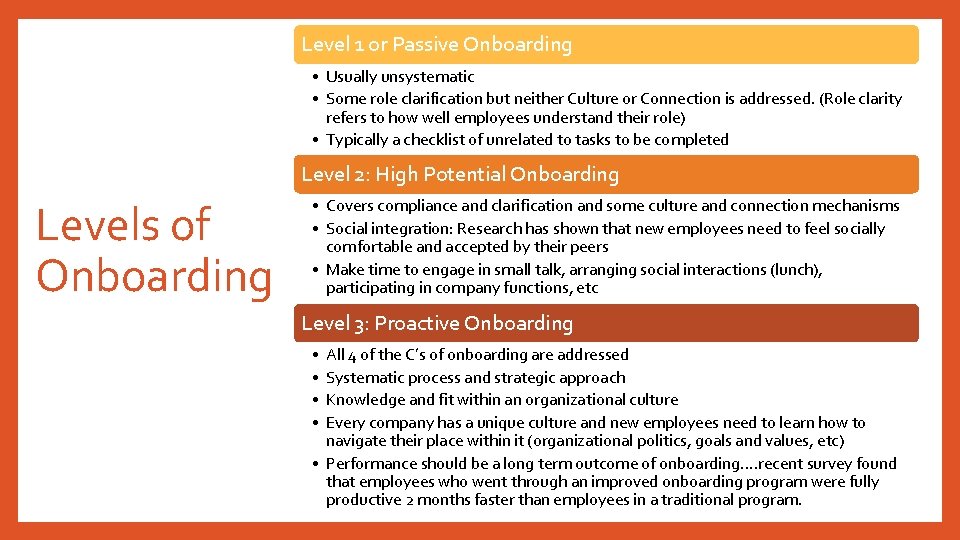
Level 1 or Passive Onboarding • Usually unsystematic • Some role clarification but neither Culture or Connection is addressed. (Role clarity refers to how well employees understand their role) • Typically a checklist of unrelated to tasks to be completed Level 2: High Potential Onboarding Levels of Onboarding • Covers compliance and clarification and some culture and connection mechanisms • Social integration: Research has shown that new employees need to feel socially comfortable and accepted by their peers • Make time to engage in small talk, arranging social interactions (lunch), participating in company functions, etc Level 3: Proactive Onboarding • • All 4 of the C’s of onboarding are addressed Systematic process and strategic approach Knowledge and fit within an organizational culture Every company has a unique culture and new employees need to learn how to navigate their place within it (organizational politics, goals and values, etc) • Performance should be a long term outcome of onboarding…. recent survey found that employees who went through an improved onboarding program were fully productive 2 months faster than employees in a traditional program.
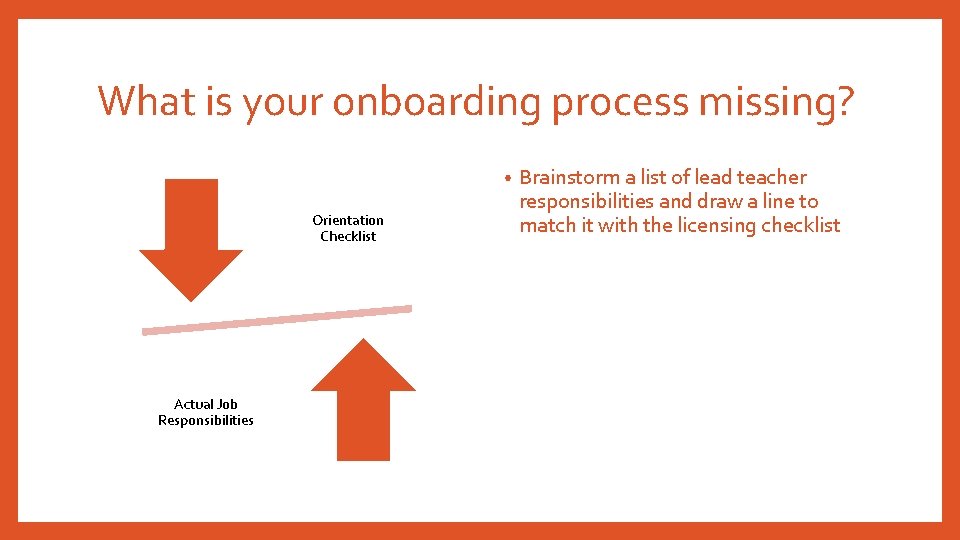
What is your onboarding process missing? • Orientation Checklist Actual Job Responsibilities Brainstorm a list of lead teacher responsibilities and draw a line to match it with the licensing checklist
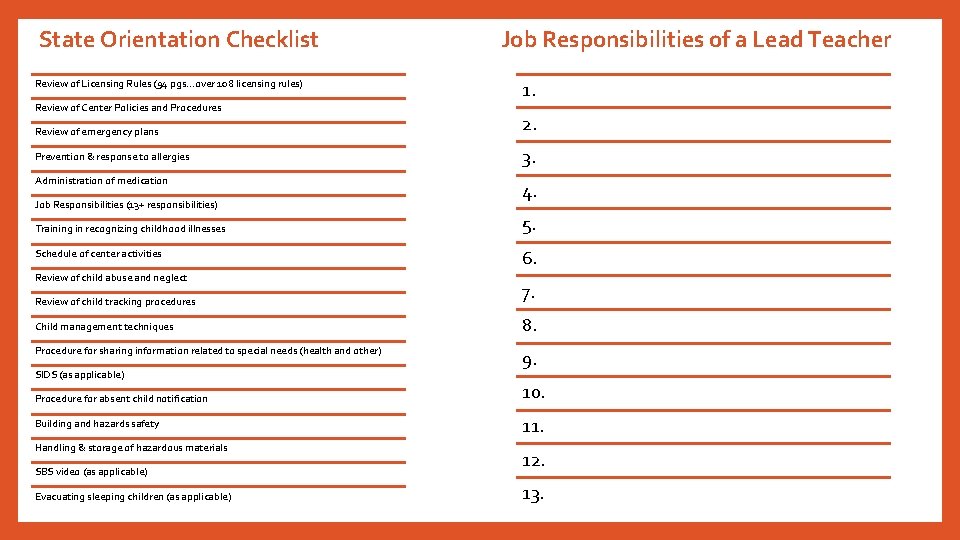
State Orientation Checklist Review of Licensing Rules (94 pgs…over 108 licensing rules) Review of Center Policies and Procedures Review of emergency plans Job Responsibilities of a Lead Teacher 1. 2. Prevention & response to allergies 3. Administration of medication 4. Job Responsibilities (13+ responsibilities) Training in recognizing childhood illnesses 5. Schedule of center activities 6. Review of child abuse and neglect Review of child tracking procedures Child management techniques Procedure for sharing information related to special needs (health and other) SIDS (as applicable) Procedure for absent child notification Building and hazards safety Handling & storage of hazardous materials SBS video (as applicable) Evacuating sleeping children (as applicable) 7. 8. 9. 10. 11. 12. 13.
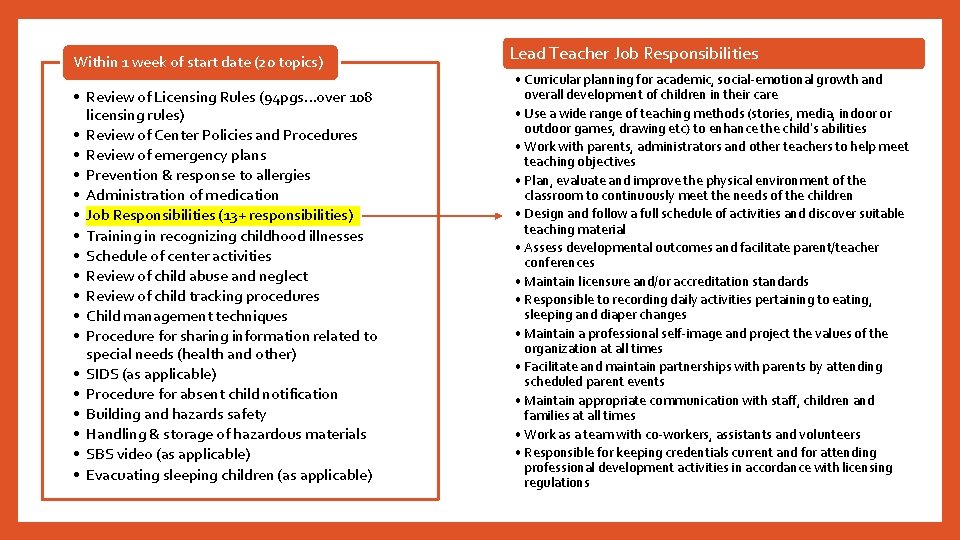
Within 1 week of start date (20 topics) • Review of Licensing Rules (94 pgs…over 108 licensing rules) • Review of Center Policies and Procedures • Review of emergency plans • Prevention & response to allergies • Administration of medication • Job Responsibilities (13+ responsibilities) • Training in recognizing childhood illnesses • Schedule of center activities • Review of child abuse and neglect • Review of child tracking procedures • Child management techniques • Procedure for sharing information related to special needs (health and other) • SIDS (as applicable) • Procedure for absent child notification • Building and hazards safety • Handling & storage of hazardous materials • SBS video (as applicable) • Evacuating sleeping children (as applicable) Lead Teacher Job Responsibilities • Curricular planning for academic, social-emotional growth and overall development of children in their care • Use a wide range of teaching methods (stories, media, indoor or outdoor games, drawing etc) to enhance the child’s abilities • Work with parents, administrators and other teachers to help meet teaching objectives • Plan, evaluate and improve the physical environment of the classroom to continuously meet the needs of the children • Design and follow a full schedule of activities and discover suitable teaching material • Assess developmental outcomes and facilitate parent/teacher conferences • Maintain licensure and/or accreditation standards • Responsible to recording daily activities pertaining to eating, sleeping and diaper changes • Maintain a professional self-image and project the values of the organization at all times • Facilitate and maintain partnerships with parents by attending scheduled parent events • Maintain appropriate communication with staff, children and families at all times • Work as a team with co-workers, assistants and volunteers • Responsible for keeping credentials current and for attending professional development activities in accordance with licensing regulations
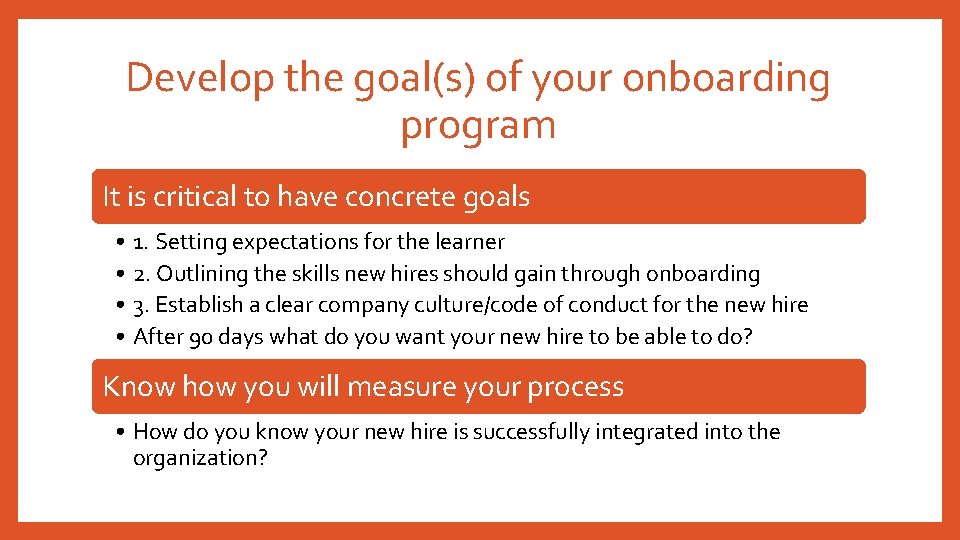
Develop the goal(s) of your onboarding program It is critical to have concrete goals • 1. Setting expectations for the learner • 2. Outlining the skills new hires should gain through onboarding • 3. Establish a clear company culture/code of conduct for the new hire • After 90 days what do you want your new hire to be able to do? Know how you will measure your process • How do you know your new hire is successfully integrated into the organization?
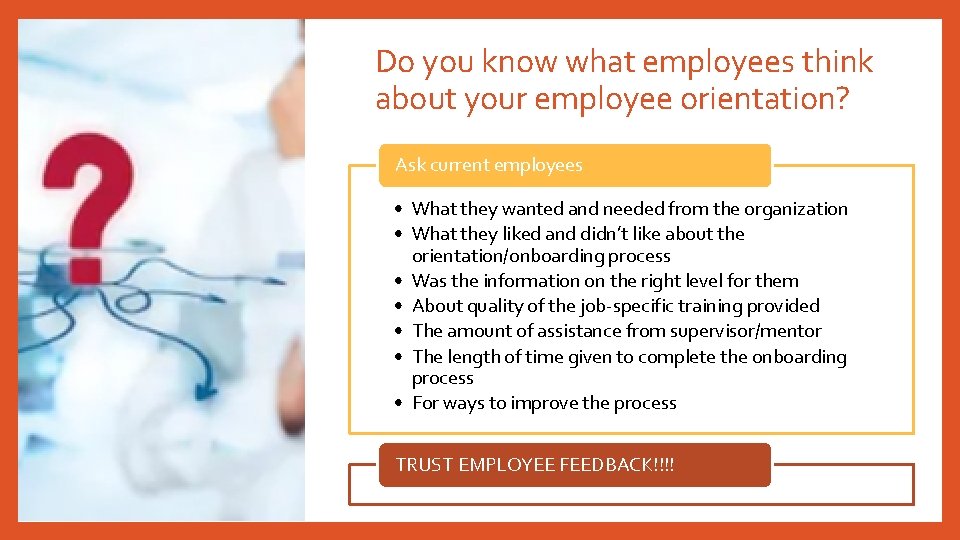
Do you know what employees think about your employee orientation? Ask current employees • What they wanted and needed from the organization • What they liked and didn’t like about the orientation/onboarding process • Was the information on the right level for them • About quality of the job-specific training provided • The amount of assistance from supervisor/mentor • The length of time given to complete the onboarding process • For ways to improve the process TRUST EMPLOYEE FEEDBACK!!!!
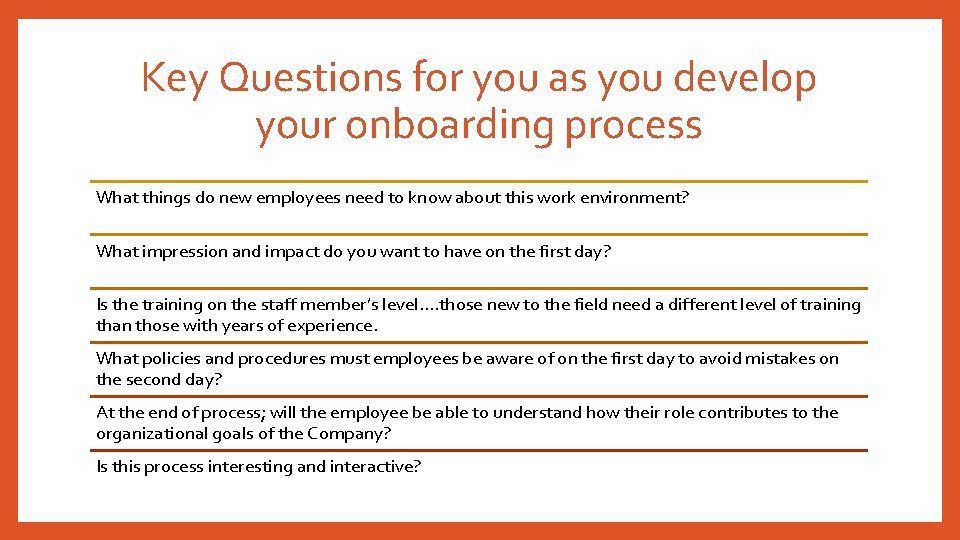
Key Questions for you as you develop your onboarding process What things do new employees need to know about this work environment? What impression and impact do you want to have on the first day? Is the training on the staff member’s level…. those new to the field need a different level of training than those with years of experience. What policies and procedures must employees be aware of on the first day to avoid mistakes on the second day? At the end of process; will the employee be able to understand how their role contributes to the organizational goals of the Company? Is this process interesting and interactive?
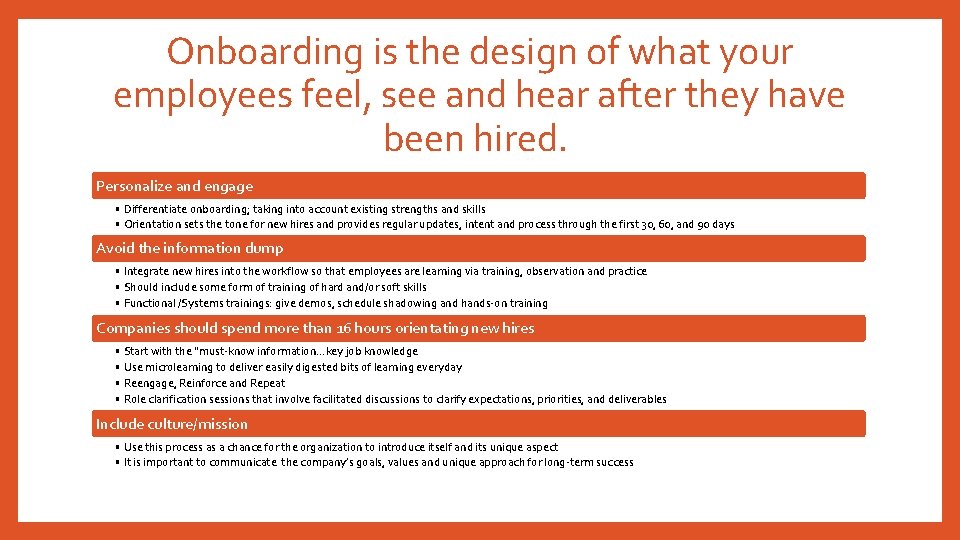
Onboarding is the design of what your employees feel, see and hear after they have been hired. Personalize and engage • Differentiate onboarding; taking into account existing strengths and skills • Orientation sets the tone for new hires and provides regular updates, intent and process through the first 30, 60, and 90 days Avoid the information dump • Integrate new hires into the workflow so that employees are learning via training, observation and practice • Should include some form of training of hard and/or soft skills • Functional /Systems trainings: give demos, schedule shadowing and hands-on training Companies should spend more than 16 hours orientating new hires • Start with the “must-know information…key job knowledge • Use microlearning to deliver easily digested bits of learning everyday • Reengage, Reinforce and Repeat • Role clarification sessions that involve facilitated discussions to clarify expectations, priorities, and deliverables Include culture/mission • Use this process as a chance for the organization to introduce itself and its unique aspect • It is important to communicate the company’s goals, values and unique approach for long-term success
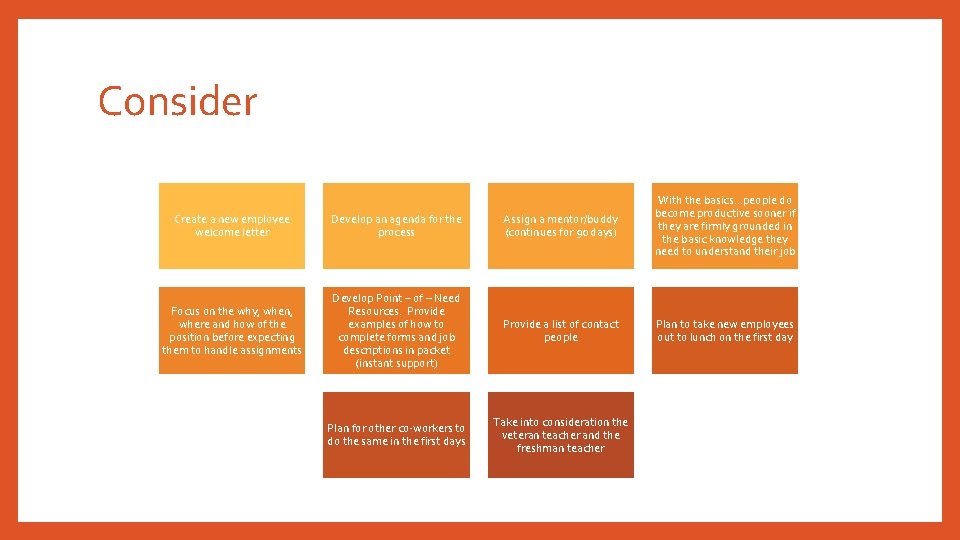
Consider Create a new employee welcome letter Develop an agenda for the process Assign a mentor/buddy (continues for 90 days) With the basics…people do become productive sooner if they are firmly grounded in the basic knowledge they need to understand their job Focus on the why, when, where and how of the position before expecting them to handle assignments Develop Point – of – Need Resources. Provide examples of how to complete forms and job descriptions in packet (instant support) Provide a list of contact people Plan to take new employees out to lunch on the first day Plan for other co-workers to do the same in the first days Take into consideration the veteran teacher and the freshman teacher
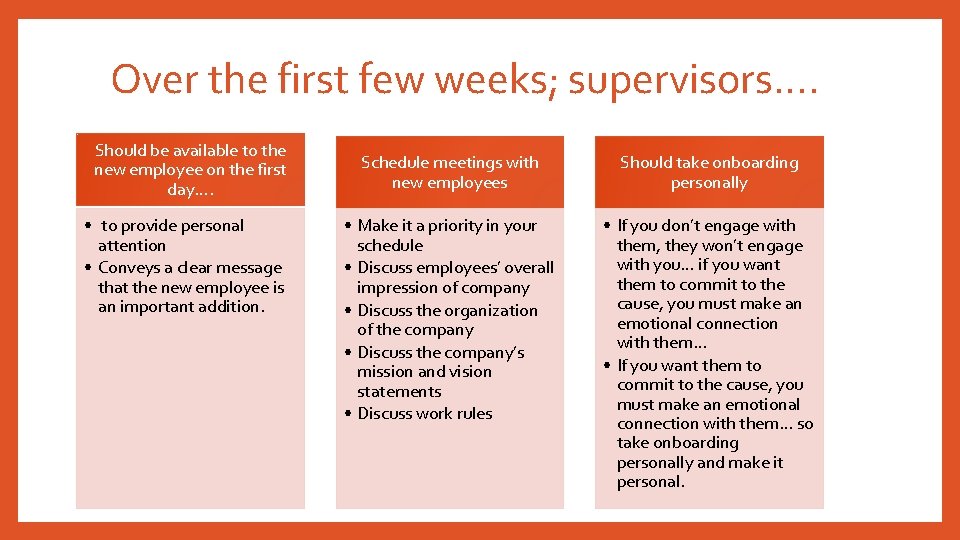
Over the first few weeks; supervisors…. Should be available to the new employee on the first day…. • to provide personal attention • Conveys a clear message that the new employee is an important addition. Schedule meetings with new employees Should take onboarding personally • Make it a priority in your schedule • Discuss employees’ overall impression of company • Discuss the organization of the company • Discuss the company’s mission and vision statements • Discuss work rules • If you don’t engage with them, they won’t engage with you… if you want them to commit to the cause, you must make an emotional connection with them… • If you want them to commit to the cause, you must make an emotional connection with them… so take onboarding personally and make it personal.
Refences • Bauer, T. N. (2010). Onboarding New Employees: Maximizing Success. Published by SHRM Foundations. • Brown, J. (May 20, 2018). How to provide effective new employee Orientation. • Semmons, G. (September 26, 2017) Onboarding vs Orientation. Retrieved from Bizfluent.
- Slides: 20