
Orientation for New Clinical Research PERSONNEL Module 4



- Slides: 83
Orientation for New Clinical Research PERSONNEL Module 4 • Presented by • NC Tra. CS Institute • UNC Office of Clinical Trials • UNC Network for Research Professionals
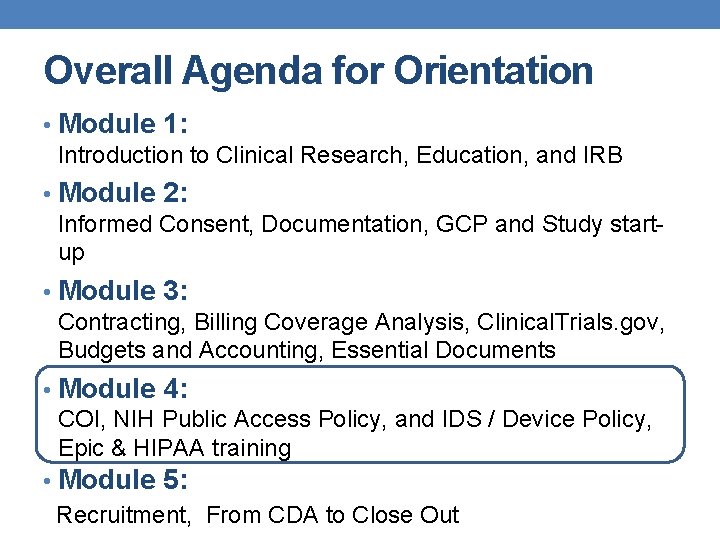
Overall Agenda for Orientation • Module 1: Introduction to Clinical Research, Education, and IRB • Module 2: Informed Consent, Documentation, GCP and Study startup • Module 3: Contracting, Billing Coverage Analysis, Clinical. Trials. gov, Budgets and Accounting, Essential Documents • Module 4: COI, NIH Public Access Policy, and IDS / Device Policy, Epic & HIPAA training • Module 5: Recruitment, From CDA to Close Out
CONFLICT OF INTEREST Joy Bryde, MSW Conflict of Interest Officer Conflict of Interest Program jbryde@unc. edu
Who is Covered by the Policy on Individual Conflicts of Interest (COI) and Commitment? UNC Chapel Hill Eight sections for Conflict of Interest, including Research
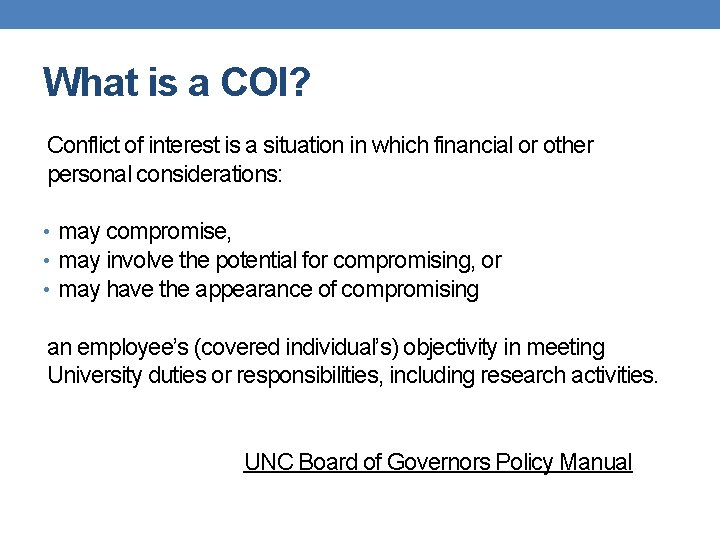
What is a COI? Conflict of interest is a situation in which financial or other personal considerations: • may compromise, • may involve the potential for compromising, or • may have the appearance of compromising an employee’s (covered individual’s) objectivity in meeting University duties or responsibilities, including research activities. UNC Board of Governors Policy Manual
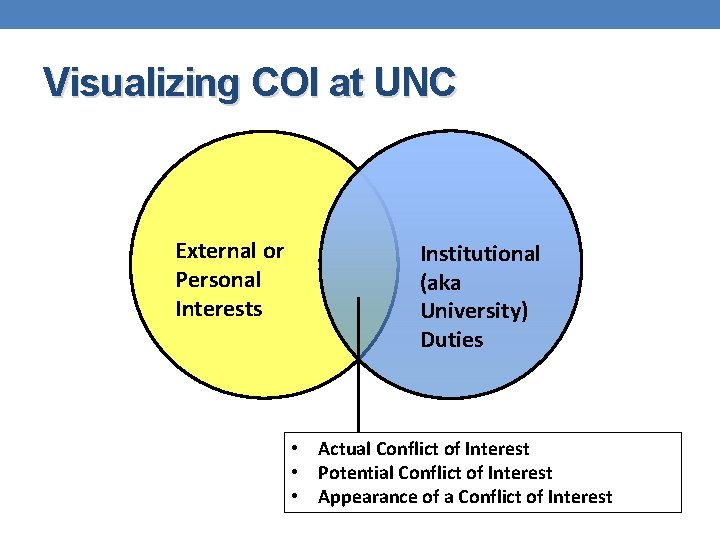
Visualizing COI at UNC External or Personal Interests Institutional (aka University) Duties • Actual Conflict of Interest • Potential Conflict of Interest • Appearance of a Conflict of Interest
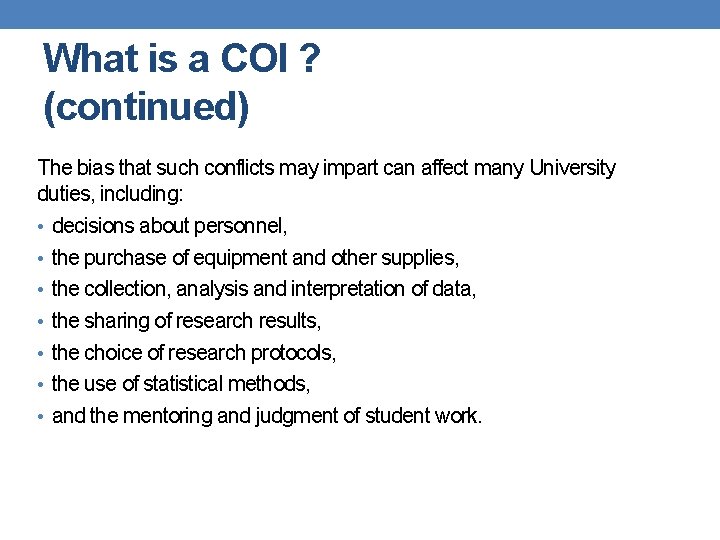
What is a COI ? (continued) The bias that such conflicts may impart can affect many University duties, including: • decisions about personnel, • the purchase of equipment and other supplies, • the collection, analysis and interpretation of data, • the sharing of research results, • the choice of research protocols, • the use of statistical methods, • and the mentoring and judgment of student work.
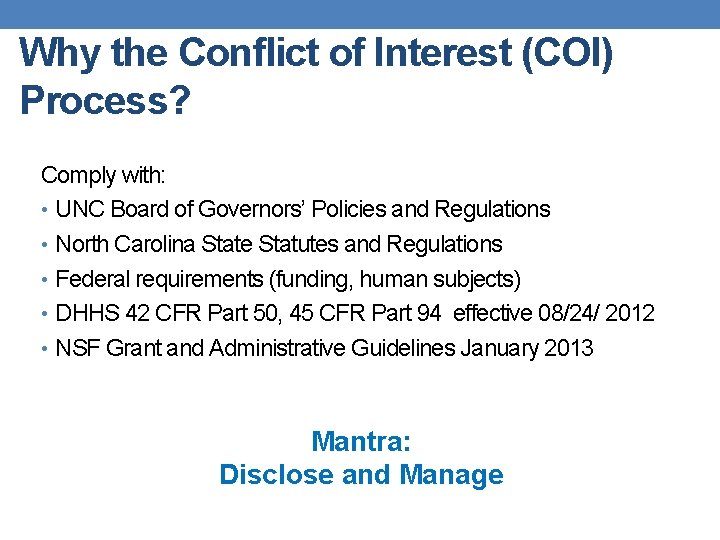
Why the Conflict of Interest (COI) Process? Comply with: • UNC Board of Governors’ Policies and Regulations • North Carolina State Statutes and Regulations • Federal requirements (funding, human subjects) • DHHS 42 CFR Part 50, 45 CFR Part 94 effective 08/24/ 2012 • NSF Grant and Administrative Guidelines January 2013 Mantra: Disclose and Manage
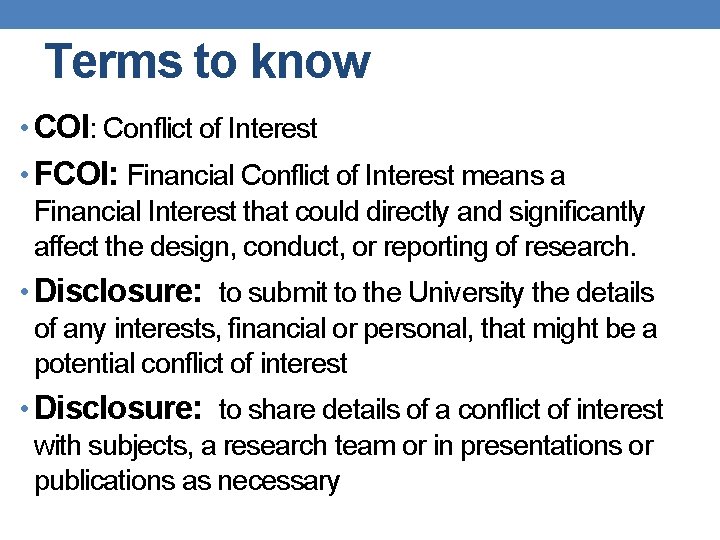
Terms to know • COI: Conflict of Interest • FCOI: Financial Conflict of Interest means a Financial Interest that could directly and significantly affect the design, conduct, or reporting of research. • Disclosure: to submit to the University the details of any interests, financial or personal, that might be a potential conflict of interest • Disclosure: to share details of a conflict of interest with subjects, a research team or in presentations or publications as necessary
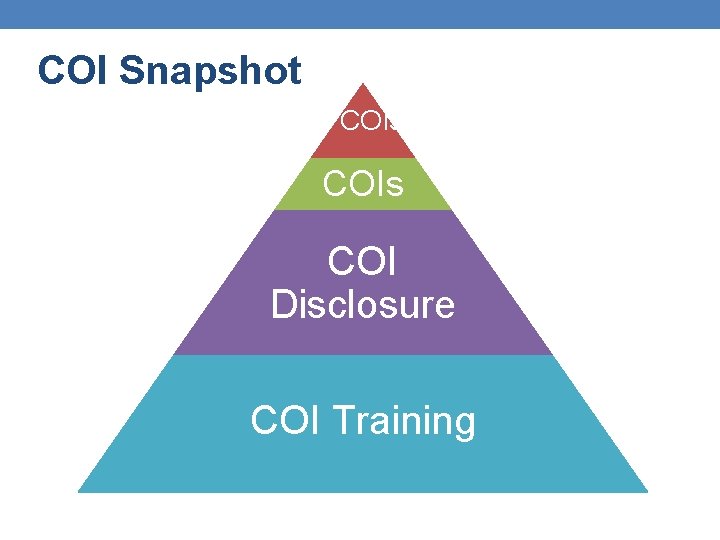
COI Snapshot FCOIs COI Disclosure COI Training
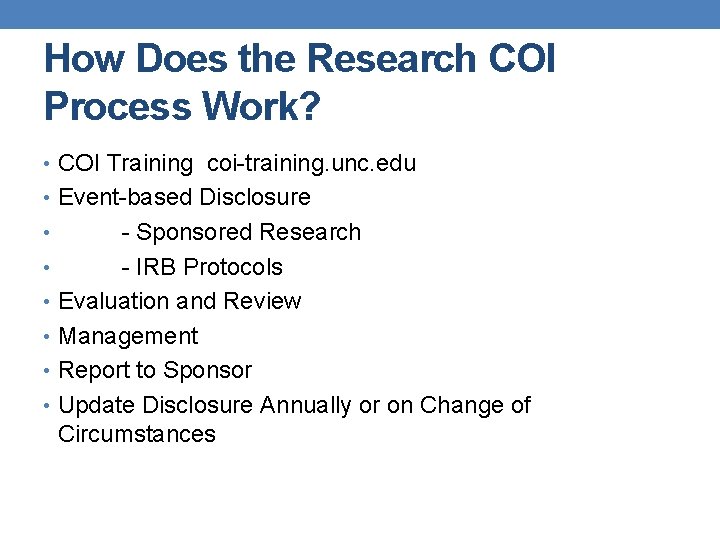
How Does the Research COI Process Work? • COI Training coi-training. unc. edu • Event-based Disclosure - Sponsored Research • - IRB Protocols • Evaluation and Review • Management • Report to Sponsor • Update Disclosure Annually or on Change of Circumstances •
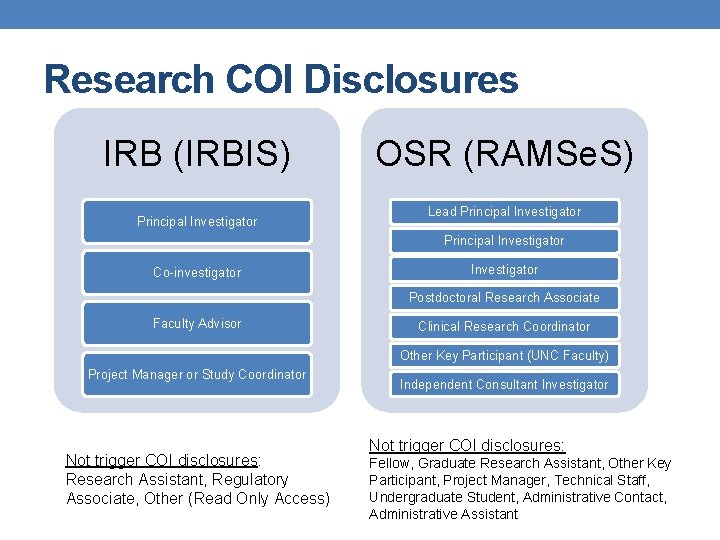
Research COI Disclosures IRB (IRBIS) Principal Investigator OSR (RAMSe. S) Lead Principal Investigator Co-investigator Investigator Postdoctoral Research Associate Faculty Advisor Clinical Research Coordinator Other Key Participant (UNC Faculty) Project Manager or Study Coordinator Not trigger COI disclosures: Research Assistant, Regulatory Associate, Other (Read Only Access) Independent Consultant Investigator Not trigger COI disclosures: Fellow, Graduate Research Assistant, Other Key Participant, Project Manager, Technical Staff, Undergraduate Student, Administrative Contact, Administrative Assistant
Why is a Disclosure Required for Each Study and Reviewed for a “Known” Conflict ? • Federal regulation • University Policy • Each study is different even if the “conflict” appears to be the same • Different drugs • Different protocol • Different people • For human subjects research, informed consent text must be context specific
What Happens Next? No conflicts indicated • System filters every 10 minutes • IRBIS/Ramses automatically updated Potential conflicts indicated • Initial Evaluation at COI Office, usually further information is needed • Next Step • Expedited Review with Committee Chair(s) (Existing Management plans or <$10 K) OR • Full Committee (New conflict, >10 K) NOTE: Five Standing COI Committees – Medicine, Public Health, Dentistry, Pharmacy and College of Arts & Sciences. Some committees meet 1 x per month; others every 2 -3 months.
What are Financial Interests? Tangible • Personal Income - real or potential value • Equity/Stock/Options (mutual funds excluded) • Royalties/licensing fees/copyrights • Indirect – family member • Gifts (for self or others)
What are Non-Financial Interests? • Board membership • Executive position • Scientific or technical advisor • Trustee • Volunteer position • (such as fundraising)
Management Principles • Transparency • Honoring the Student/ Trainee Experience • Protection of the credibility of the individual doing the work
Management Tools • Management Plans • • Public Disclosure Independent Review of Data Change in Roles Monitoring Committees • Alternative Options for Trainees • Alternative Administrative Routing NOTE: Significant financial interests presumed not allowable in human subjects research, particularly for a principal investigator.
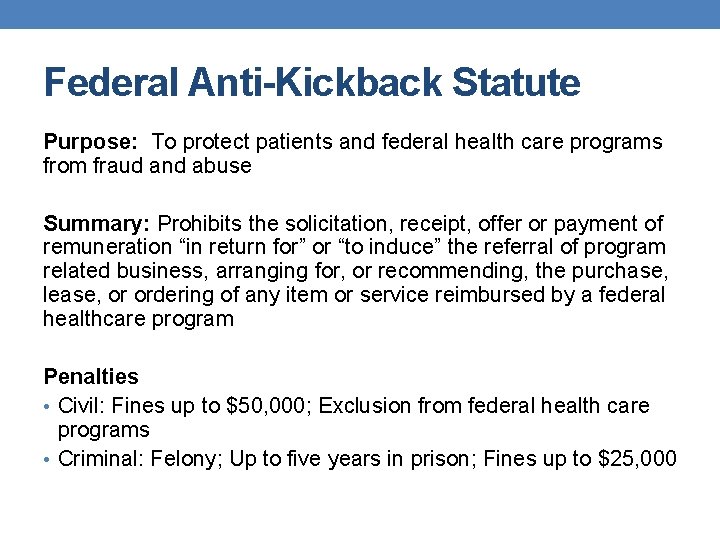
Federal Anti-Kickback Statute Purpose: To protect patients and federal health care programs from fraud and abuse Summary: Prohibits the solicitation, receipt, offer or payment of remuneration “in return for” or “to induce” the referral of program related business, arranging for, or recommending, the purchase, lease, or ordering of any item or service reimbursed by a federal healthcare program Penalties • Civil: Fines up to $50, 000; Exclusion from federal health care programs • Criminal: Felony; Up to five years in prison; Fines up to $25, 000
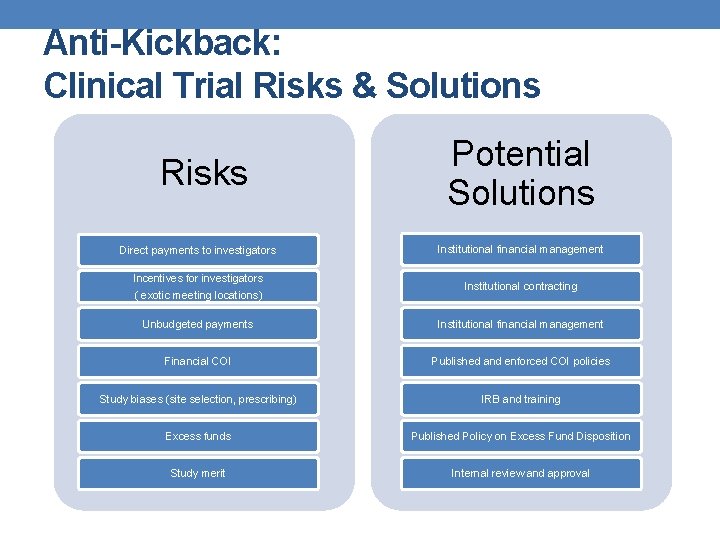
Anti-Kickback: Clinical Trial Risks & Solutions Risks Potential Solutions Direct payments to investigators Institutional financial management Incentives for investigators ( exotic meeting locations) Institutional contracting Unbudgeted payments Institutional financial management Financial COI Published and enforced COI policies Study biases (site selection, prescribing) IRB and training Excess funds Published Policy on Excess Fund Disposition Study merit Internal review and approval
UNC-CH CONFLICT OF INTEREST POLICY IS STRICTER THAN FDA • Stricter definition of significant financial interest • Project-by-project disclosure of financial and other conflicts of interest • Any changes to financial and other interests must be reported within 30 days. • University rules regarding compensation from Sponsors
UNC Policy regarding Compensation from Sponsors • University employees may not accept gifts, payments, or in-kind support (including but not limited to financial payments, gift certificates, books, conference attendance and payment of travel expenses) • as inducements for performance in a University project • except as expressly included in budgeted project costs in a contract between the University and the project sponsor. Pages 6 -7
FDA Investigator Financial Disclosure • This disclosure requires that the Principal Investigator certifies that s/he does not have a significant financial holding in the company with which he wishes to contract. • This helps to avoid conflict of interest situations in which the Investigator’s data may be called into question because of financial interest in the company.
Contact Information Joy M. Bryde, MSW Conflict of Interest Officer Mailing Address: Conflict of Interest Program UNC-CH CB 9103 Physical Address: Bynum Hall, Suite 301 D 222 E. Cameron Ave. E-mail: jbryde@unc. edu Phone: (919) 843 -9953 Website: http: //research. unc. edu/offices/coi/ General Email for questions: coi@unc. edu Websites: air. unc. edu coi-training. unc. edu
NIH COMPLIANCE POLICIES & YOU Mary White, MSHI, AHIP, EMT-B Tra. CS Knowledge Management Librarian NC Tra. CS & Health Sciences Library mw@unc. edu
3 Take Home Points! 1. Want NIH Funding? NIH Funded? Could be in jeopardy if you aren’t in compliance with NIH Policies (Biosketch & Public Access). 2. As a Clinical Research Professional, You Can Help! 3. Wait, what? Contact the UNC Health Sciences Library & NC Tra. CS!
Your Funding? NIH Funded?
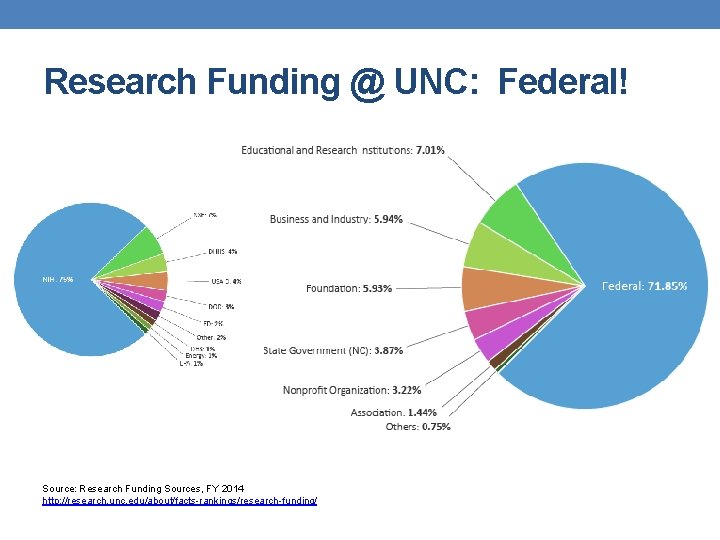
Research Funding @ UNC: Federal! Source: Research Funding Sources, FY 2014 http: //research. unc. edu/about/facts-rankings/research-funding/
Policies Impacting Those Funded by the NIH üNIH Biosketch üNIH Public Access Policy
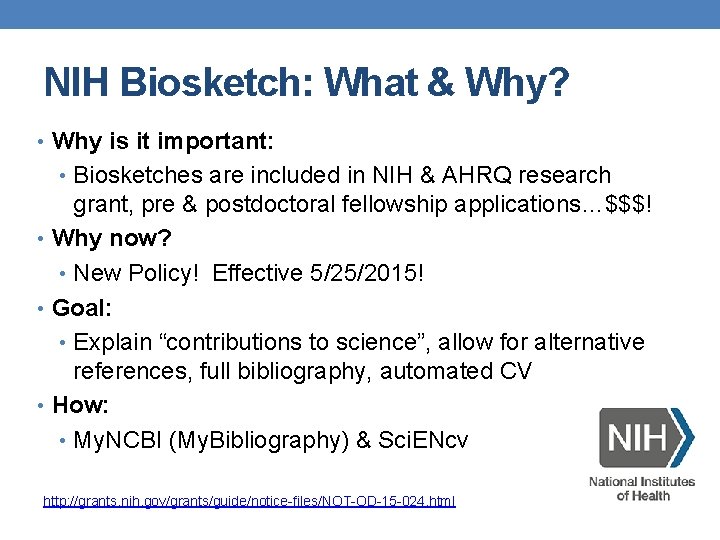
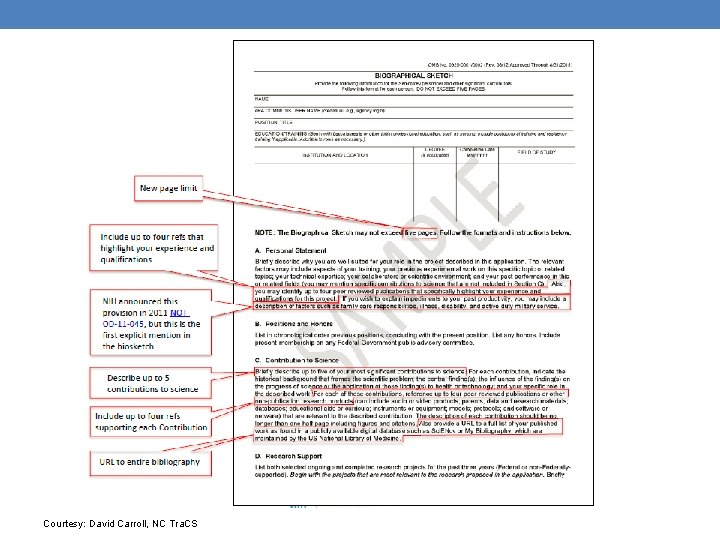
NIH Biosketch: What & Why? • Why is it important: • Biosketches are included in NIH & AHRQ research grant, pre & postdoctoral fellowship applications…$$$! • Why now? • New Policy! Effective 5/25/2015! • Goal: • Explain “contributions to science”, allow for alternative references, full bibliography, automated CV • How: • My. NCBI (My. Bibliography) & Sci. ENcv http: //grants. nih. gov/grants/guide/notice-files/NOT-OD-15 -024. html
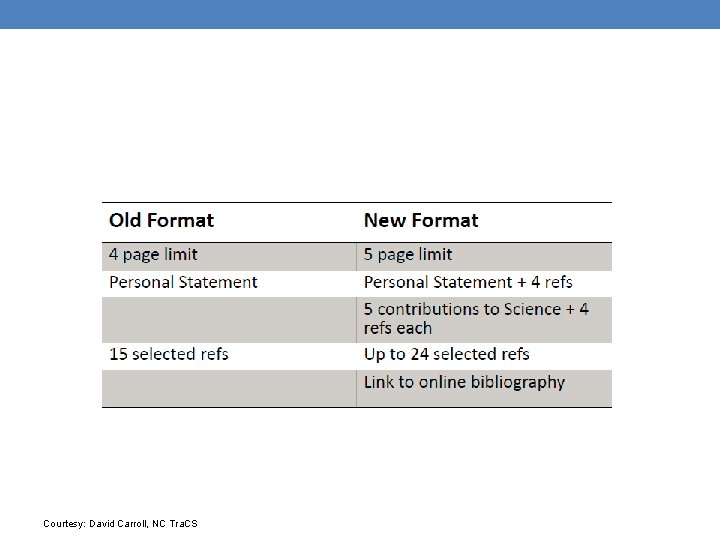
Courtesy: David Carroll, NC Tra. CS
Courtesy: David Carroll, NC Tra. CS
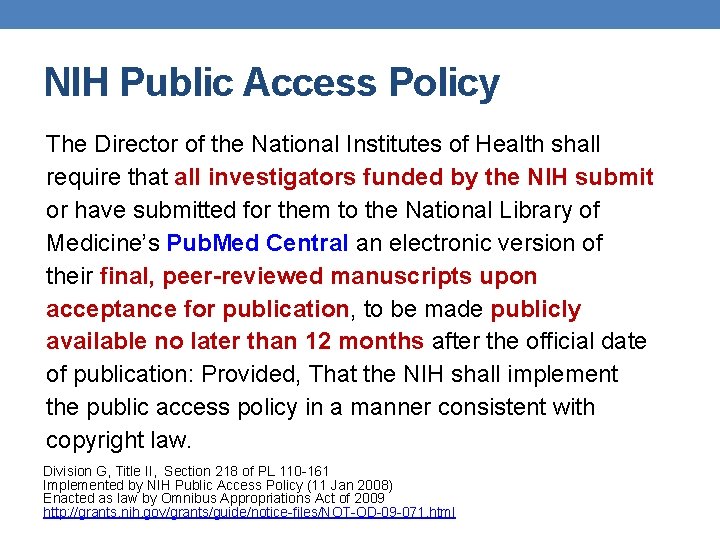
NIH Public Access Policy The Director of the National Institutes of Health shall require that all investigators funded by the NIH submit or have submitted for them to the National Library of Medicine’s Pub. Med Central an electronic version of their final, peer-reviewed manuscripts upon acceptance for publication, to be made publicly available no later than 12 months after the official date of publication: Provided, That the NIH shall implement the public access policy in a manner consistent with copyright law. Division G, Title II, Section 218 of PL 110 -161 Implemented by NIH Public Access Policy (11 Jan 2008) Enacted as law by Omnibus Appropriations Act of 2009 http: //grants. nih. gov/grants/guide/notice-files/NOT-OD-09 -071. html
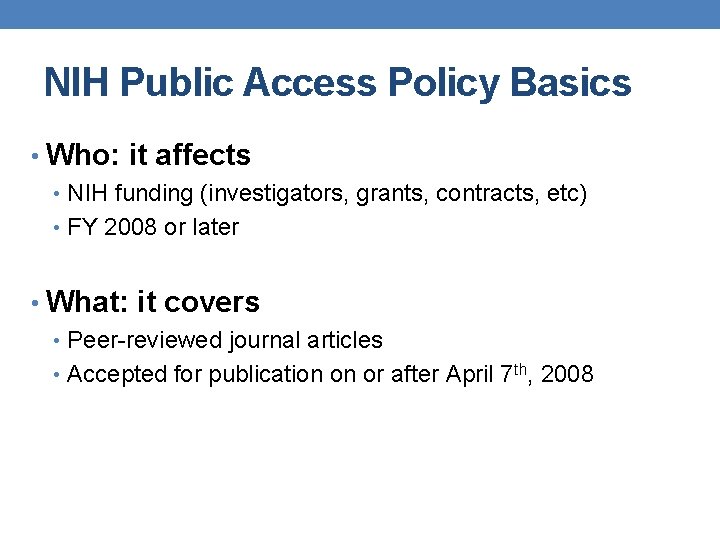
NIH Public Access Policy Basics • Who: it affects • NIH funding (investigators, grants, contracts, etc) • FY 2008 or later • What: it covers • Peer-reviewed journal articles • Accepted for publication on or after April 7 th, 2008
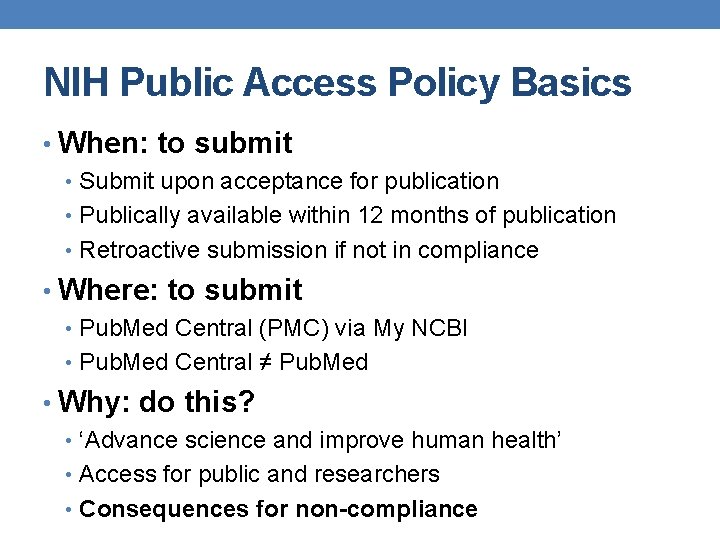
NIH Public Access Policy Basics • When: to submit • Submit upon acceptance for publication • Publically available within 12 months of publication • Retroactive submission if not in compliance • Where: to submit • Pub. Med Central (PMC) via My NCBI • Pub. Med Central ≠ Pub. Med • Why: do this? • ‘Advance science and improve human health’ • Access for public and researchers • Consequences for non-compliance
Why: Changes in Policy Compliance • As of July 1, 2013: – NIH will delay processing of an award if publications arising from it are not in compliance with the NIH public access policy.
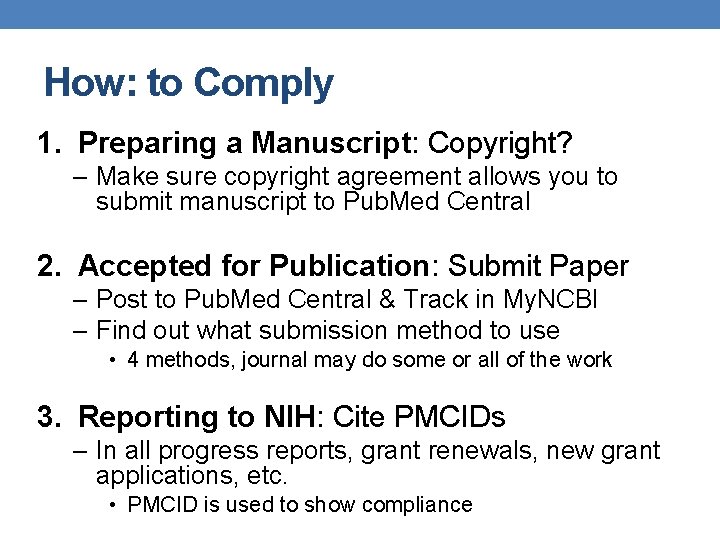
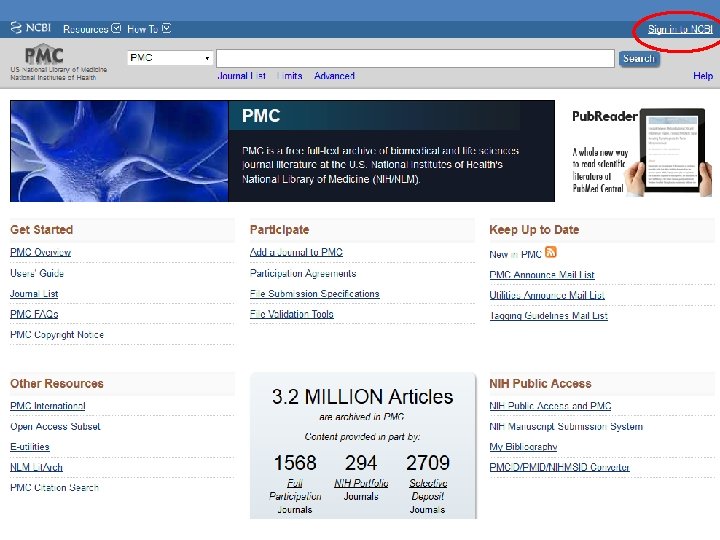
How: to Comply 1. Preparing a Manuscript: Copyright? – Make sure copyright agreement allows you to submit manuscript to Pub. Med Central 2. Accepted for Publication: Submit Paper – Post to Pub. Med Central & Track in My. NCBI – Find out what submission method to use • 4 methods, journal may do some or all of the work 3. Reporting to NIH: Cite PMCIDs – In all progress reports, grant renewals, new grant applications, etc. • PMCID is used to show compliance
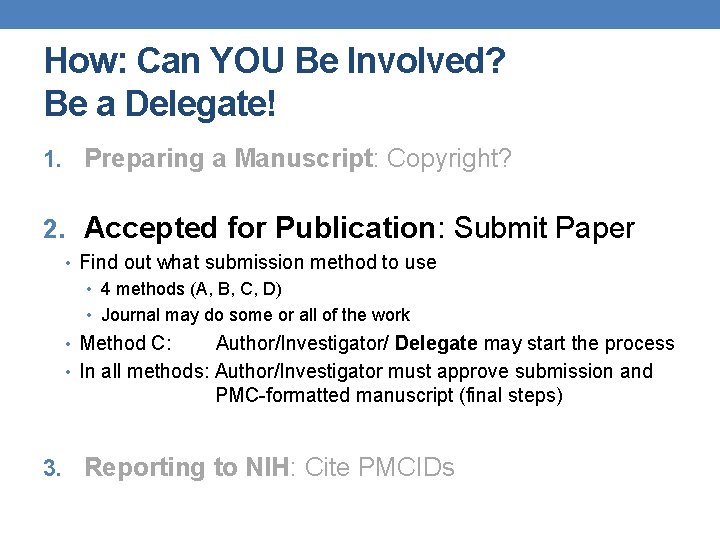
How: Can YOU Be Involved? Be a Delegate! 1. Preparing a Manuscript: Copyright? 2. Accepted for Publication: Submit Paper • Find out what submission method to use • 4 methods (A, B, C, D) • Journal may do some or all of the work • Method C: Author/Investigator/ Delegate may start the process • In all methods: Author/Investigator must approve submission and PMC-formatted manuscript (final steps) 3. Reporting to NIH: Cite PMCIDs
How: to manage compliance for Biosketch & Public Access Policies – As of July 1, 2013: Investigators must use My NCBI to enter publications into progress reports for the Public Access Compliance.
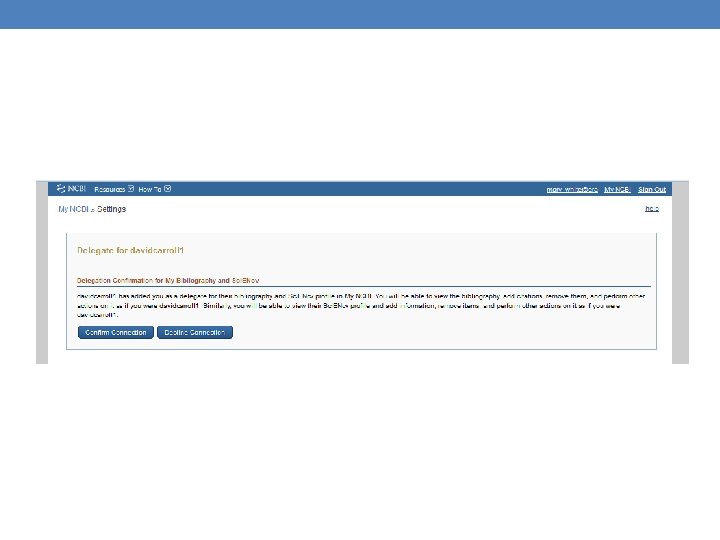
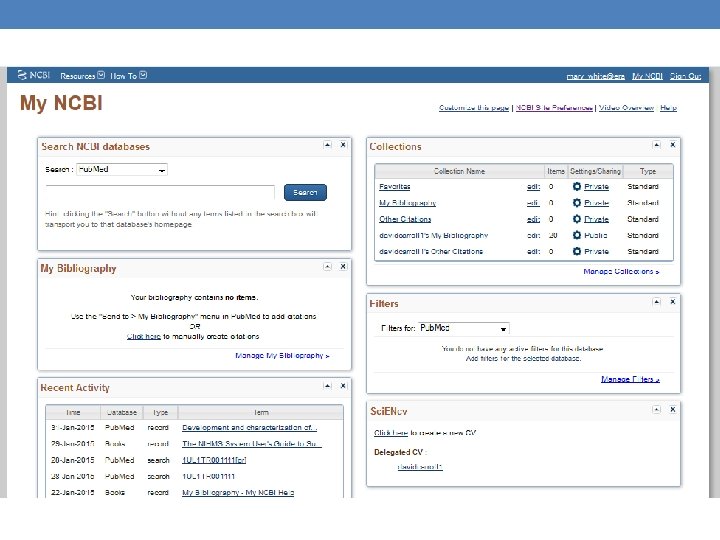
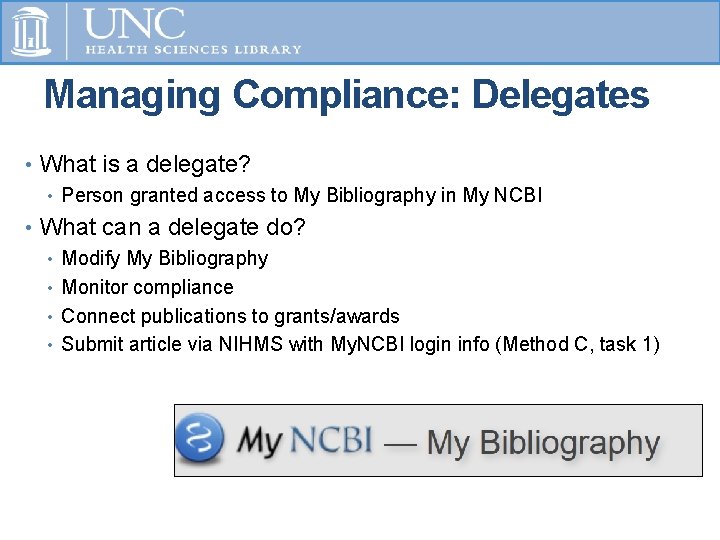
How: to manage compliance for Biosketch & Public Access Policies – What is My NCBI? • My NCBI is a personalized account that allows you to manage your publications and track compliance • e. RA Commons to be linked to author/investigator’s My NCBI account • Author/investigator adds you as a delegate in My NCBI
Managing Compliance: Delegates • What is a delegate? • Person granted access to My Bibliography in My NCBI • What can a delegate do? • Modify My Bibliography • Monitor compliance • Connect publications to grants/awards • Submit article via NIHMS with My. NCBI login info (Method C, task 1) 45
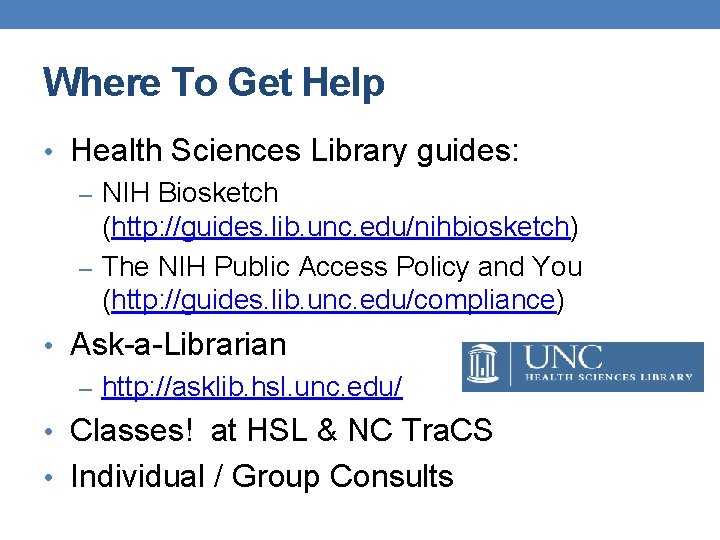
Where To Get Help • Health Sciences Library guides: – NIH Biosketch (http: //guides. lib. unc. edu/nihbiosketch) – The NIH Public Access Policy and You (http: //guides. lib. unc. edu/compliance) • Ask-a-Librarian – http: //asklib. hsl. unc. edu/ • Classes! at HSL & NC Tra. CS • Individual / Group Consults
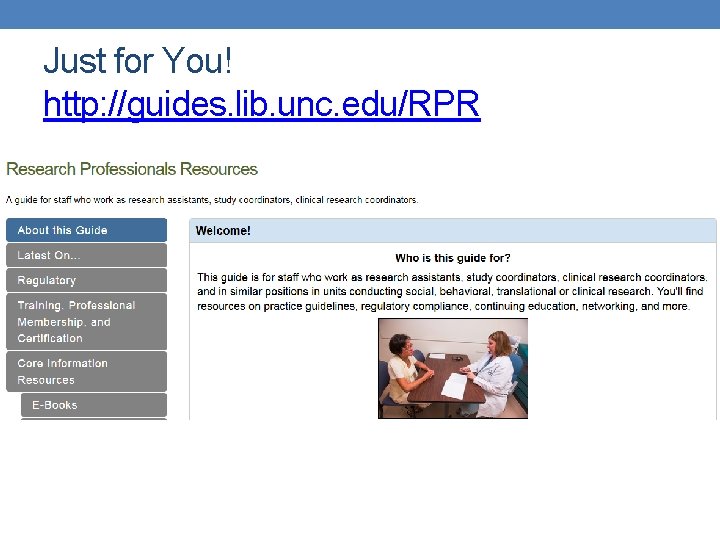
Just for You! http: //guides. lib. unc. edu/RPR
3 Take Home Points! 1. Want NIH Funding? NIH Funded? Could be in jeopardy if you aren’t in compliance with NIH Policies (Biosketch & Public Access). 2. As a Clinical Research Professional, You Can Help! 3. Wait, what? Contact the UNC Health Sciences Library & NC Tra. CS!
INVESTIGATIONAL DRUG SERVICE (IDS) Sue Pope, Pharmacist Manager, UNC IDS
IDS Operational Overview • IDS staff – 3 Pharmacist and 4 Technician FTEs • Studies managed – Over 330 total studies managed annually • IDS hours of operation – 0730 to 1600 Monday through Friday – IDS closed on major hospital and university holidays • Locations – 3 rd floor Memorial Hospital - Prepares medications for protocols that contain IV products – Ground floor Neurosciences Hospital- Prepares medications for protocols that only contain oral, nonchemotherapy medications – 3 rd floor North Carolina Cancer Hospital
IDS Staff LEADERSHIP • Sue Pope, RPh Manager, IDS Email: sue. pope@unchealth. unc. edu; Pager: 216 -2450 Office: 984 -974 -0040 • Lindsey Amerine, Pharm. D, MS Assistant Director, Oncology, IDS Pager: 919 -216 -6597 PHARMACISTS • Linda Manor, RPh linda. manor@unchealth. unc. edu • William Zhao, Pharm. D, Ph. D yun. zhao@unchealth. unc. edu • Elaine Vu, Pharm. D elaine. vu@unchealth. unc. edu IN AN EMERGENCY: • Outside of normal business hours – IDS maintains an on-call pager • In an emergency, an IDS clinical pharmacist can be reached by dialing 919 -216 -9727. They will provide assistance with: • Individual drug or research questions • The breaking of a treatment blind • Provide support for inpatient or IV room staff who may be unfamiliar with a particular research protocol
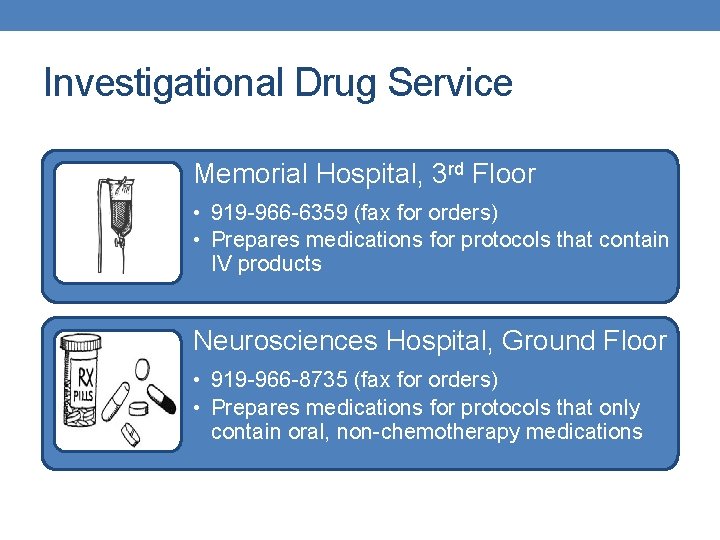
Investigational Drug Service Memorial Hospital, 3 rd Floor • 919 -966 -6359 (fax for orders) • Prepares medications for protocols that contain IV products Neurosciences Hospital, Ground Floor • 919 -966 -8735 (fax for orders) • Prepares medications for protocols that only contain oral, non-chemotherapy medications
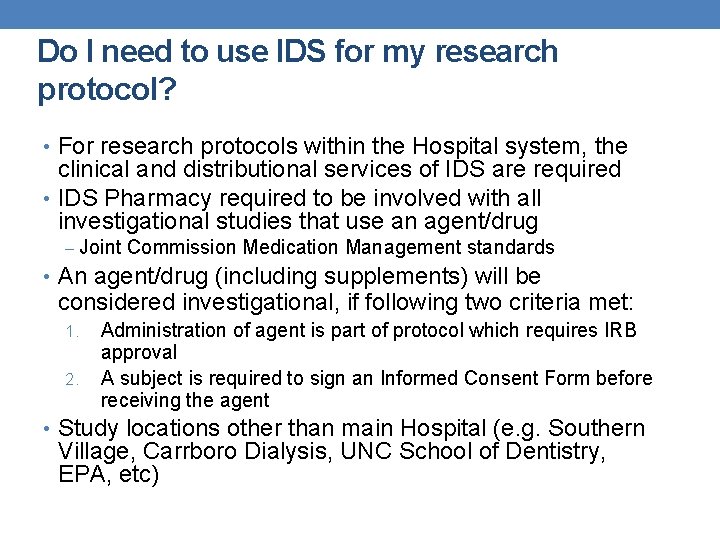
Do I need to use IDS for my research protocol? • For research protocols within the Hospital system, the clinical and distributional services of IDS are required • IDS Pharmacy required to be involved with all investigational studies that use an agent/drug – Joint Commission Medication Management standards • An agent/drug (including supplements) will be considered investigational, if following two criteria met: 1. 2. Administration of agent is part of protocol which requires IRB approval A subject is required to sign an Informed Consent Form before receiving the agent • Study locations other than main Hospital (e. g. Southern Village, Carrboro Dialysis, UNC School of Dentistry, EPA, etc)
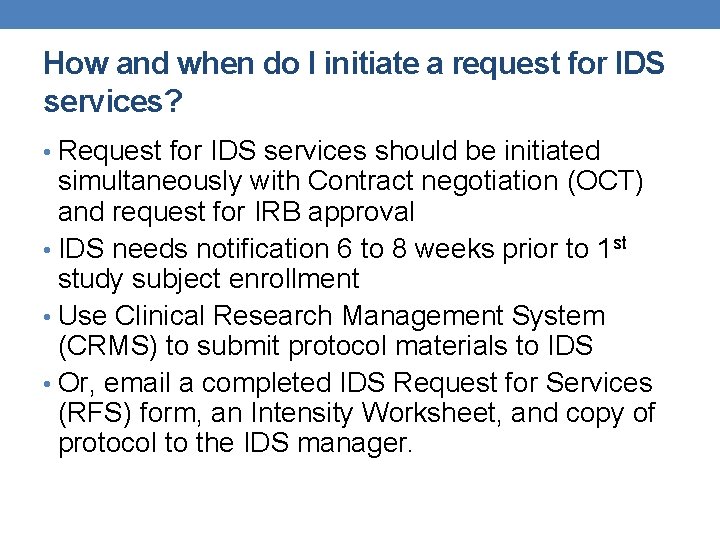
How and when do I initiate a request for IDS services? • Request for IDS services should be initiated simultaneously with Contract negotiation (OCT) and request for IRB approval • IDS needs notification 6 to 8 weeks prior to 1 st study subject enrollment • Use Clinical Research Management System (CRMS) to submit protocol materials to IDS • Or, email a completed IDS Request for Services (RFS) form, an Intensity Worksheet, and copy of protocol to the IDS manager.
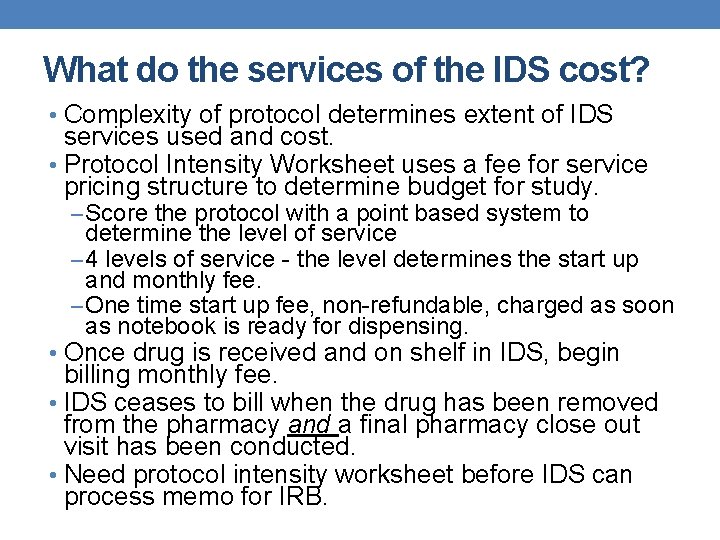
What do the services of the IDS cost? • Complexity of protocol determines extent of IDS services used and cost. • Protocol Intensity Worksheet uses a fee for service pricing structure to determine budget for study. – Score the protocol with a point based system to determine the level of service – 4 levels of service - the level determines the start up and monthly fee. – One time start up fee, non-refundable, charged as soon as notebook is ready for dispensing. • Once drug is received and on shelf in IDS, begin billing monthly fee. • IDS ceases to bill when the drug has been removed from the pharmacy and a final pharmacy close out visit has been conducted. • Need protocol intensity worksheet before IDS can process memo for IRB.
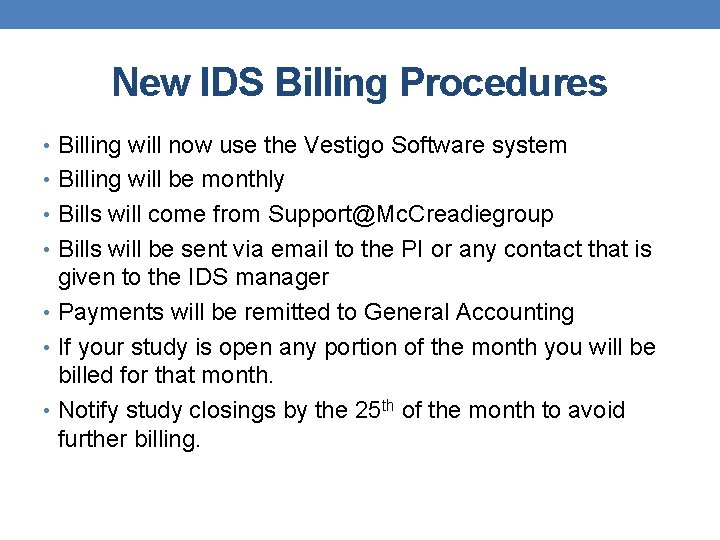
New IDS Billing Procedures • Billing will now use the Vestigo Software system • Billing will be monthly • Bills will come from Support@Mc. Creadiegroup • Bills will be sent via email to the PI or any contact that is given to the IDS manager • Payments will be remitted to General Accounting • If your study is open any portion of the month you will be billed for that month. • Notify study closings by the 25 th of the month to avoid further billing.
What types of products can be compounded by IDS? • IDS can participate in treatment and placebo blinding for solid oral dosage forms • More complex compounding (liquid formulations, suppositories, troches, patches, etc) are outsourced to a local compounding pharmacy – Compounding fees of the local pharmacy apply in addition to standard IDS fees
How are research protocols handled outside of normal business hours? • Approximately 95% of research protocols are handled during normal business hours (M-F, 0730 to 1600) • However, if a research protocol will require after hour dispensation, an assigned pharmacist can coordinate this with Hospital inpatient Pharmacy or IV room • IDS pharmacist will coordinate delivery and storage of materials to the IV room/Inpatient Pharmacy as well as provide necessary in-services to the staff
Scheduling a Monitoring Visit • In an effort to accommodate all sponsors, monitoring visits and site initiation visits must be coordinated in advance. Contact your assigned pharmacist or call IDS • Call 984 -974 -0469 or 984 -974 -3777 to schedule a monitoring visit • 2 monitoring visits allowed per day per IDS work area • Scheduled typically a month or more in advance • “Remote” monitoring visits are typically not supported by IDS
To whom and where can Clinical Trial Materials (CTM) be sent? • After contacting IDS (966 -1766) to make them aware of the incoming shipment as well as total volume of expected shipment, CTMs can be directed to the following address: Investigational Drug Services 3 rd Floor, Room N 3122 101 Manning Drive Chapel Hill, NC 27514 Phone: 984 -974 -0469 Fax: 984 -974 -6359
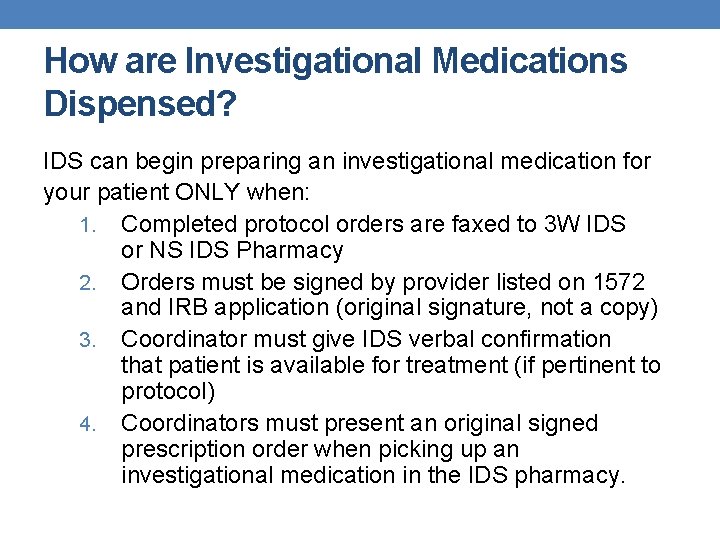
How are Investigational Medications Dispensed? IDS can begin preparing an investigational medication for your patient ONLY when: 1. Completed protocol orders are faxed to 3 W IDS or NS IDS Pharmacy 2. Orders must be signed by provider listed on 1572 and IRB application (original signature, not a copy) 3. Coordinator must give IDS verbal confirmation that patient is available for treatment (if pertinent to protocol) 4. Coordinators must present an original signed prescription order when picking up an investigational medication in the IDS pharmacy.
UNC INVESTIGATIONAL DEVICE POLICY Marie Rape, RN, BSN, CCRC Associate Director, Tra. CS Regulatory Service
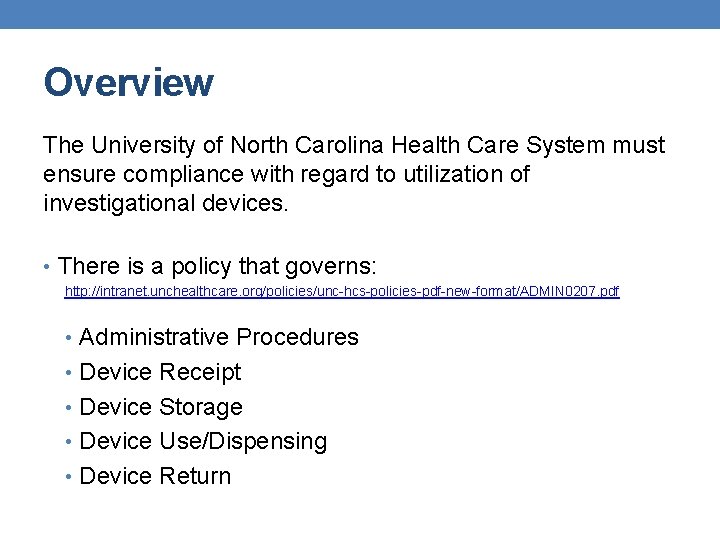
Overview The University of North Carolina Health Care System must ensure compliance with regard to utilization of investigational devices. • There is a policy that governs: http: //intranet. unchealthcare. org/policies/unc-hcs-policies-pdf-new-format/ADMIN 0207. pdf • Administrative Procedures • Device Receipt • Device Storage • Device Use/Dispensing • Device Return
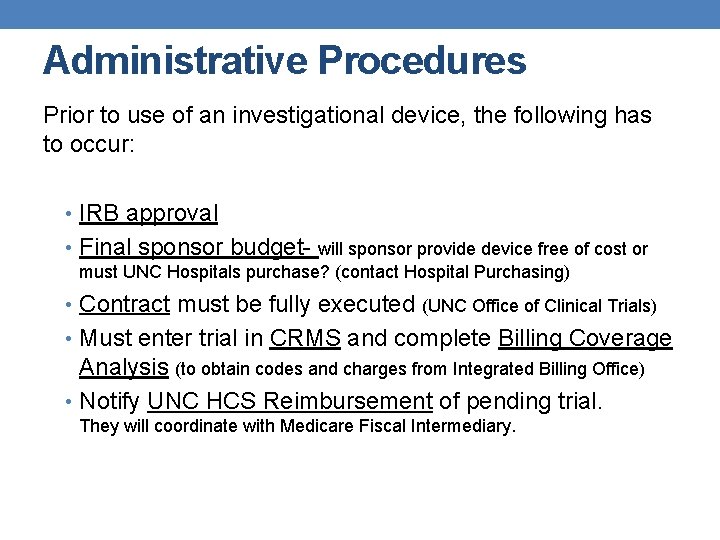
Administrative Procedures Prior to use of an investigational device, the following has to occur: • IRB approval • Final sponsor budget- will sponsor provide device free of cost or must UNC Hospitals purchase? (contact Hospital Purchasing) • Contract must be fully executed (UNC Office of Clinical Trials) • Must enter trial in CRMS and complete Billing Coverage Analysis (to obtain codes and charges from Integrated Billing Office) • Notify UNC HCS Reimbursement of pending trial. They will coordinate with Medicare Fiscal Intermediary.
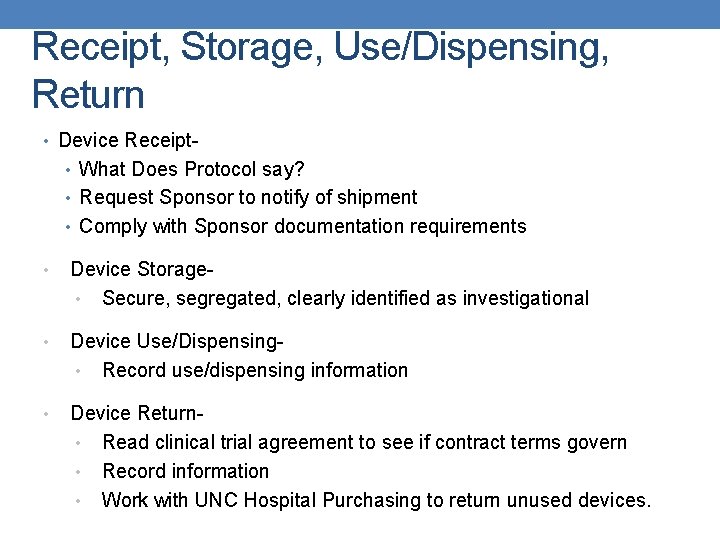
Receipt, Storage, Use/Dispensing, Return • Device Receipt • What Does Protocol say? • Request Sponsor to notify of shipment • Comply with Sponsor documentation requirements • Device Storage • Secure, segregated, clearly identified as investigational • Device Use/Dispensing • Record use/dispensing information • Device Return • Read clinical trial agreement to see if contract terms govern • Record information • Work with UNC Hospital Purchasing to return unused devices.
EPIC TRAINING, HIPAA, PRIVACY & CONFIDENTIALITY Marie Rape, RN, BSN, CCRC Associate Director, Tra. CS Regulatory Service
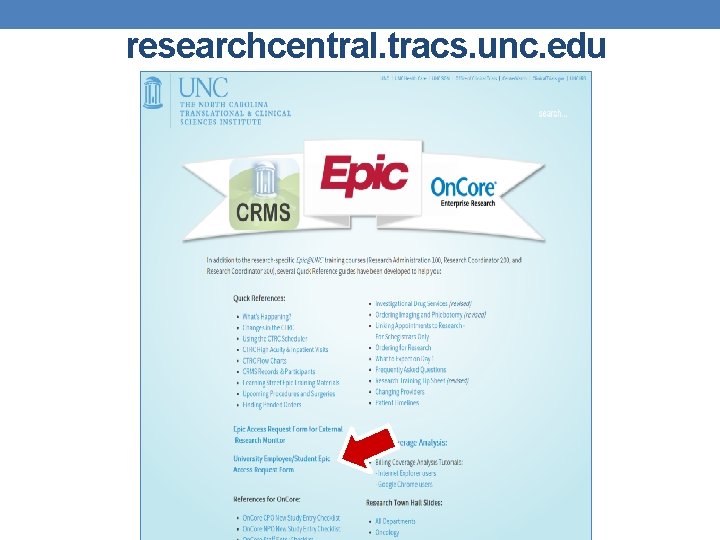
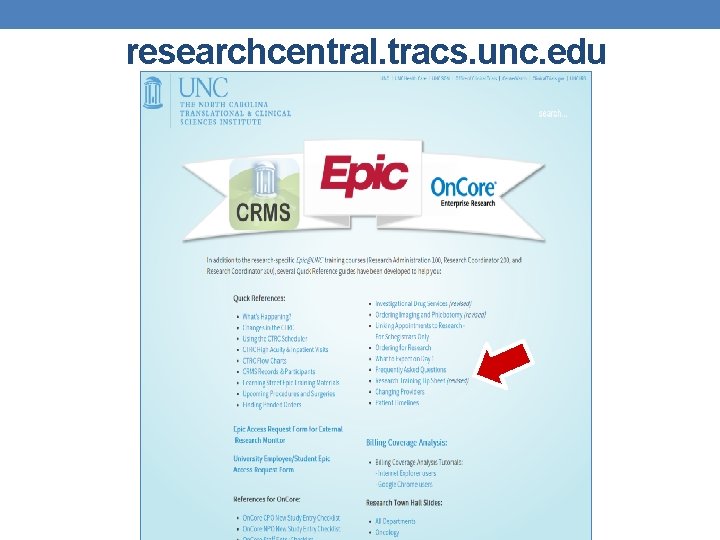
Epic, the Clinical Research Management System (CRMS), and On. Core CRMS
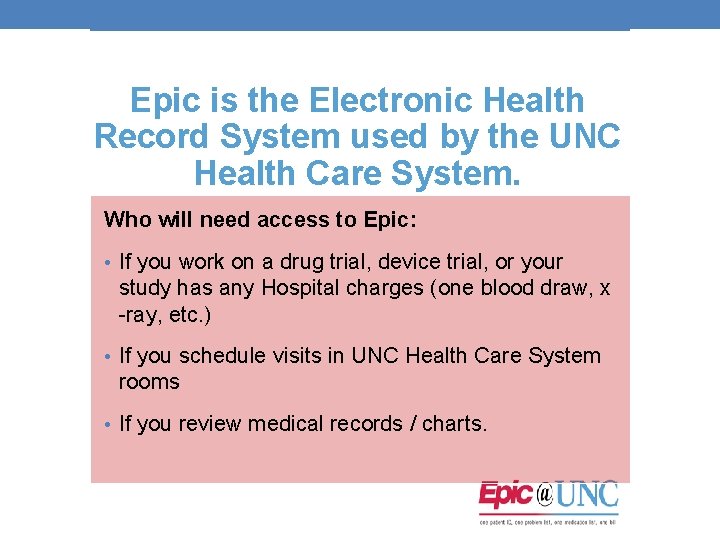
Epic is the Electronic Health Record System used by the UNC Health Care System. Who will need access to Epic: • If you work on a drug trial, device trial, or your study has any Hospital charges (one blood draw, x -ray, etc. ) • If you schedule visits in UNC Health Care System rooms • If you review medical records / charts.
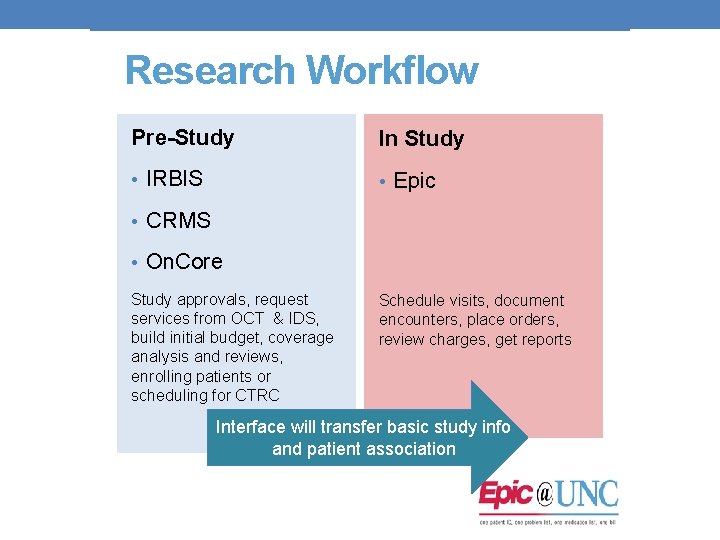
Research Workflow Pre-Study In Study • IRBIS • Epic • CRMS • On. Core Study approvals, request services from OCT & IDS, build initial budget, coverage analysis and reviews, enrolling patients or scheduling for CTRC Schedule visits, document encounters, place orders, review charges, get reports Interface will transfer basic study info and patient association
researchcentral. tracs. unc. edu
researchcentral. tracs. unc. edu
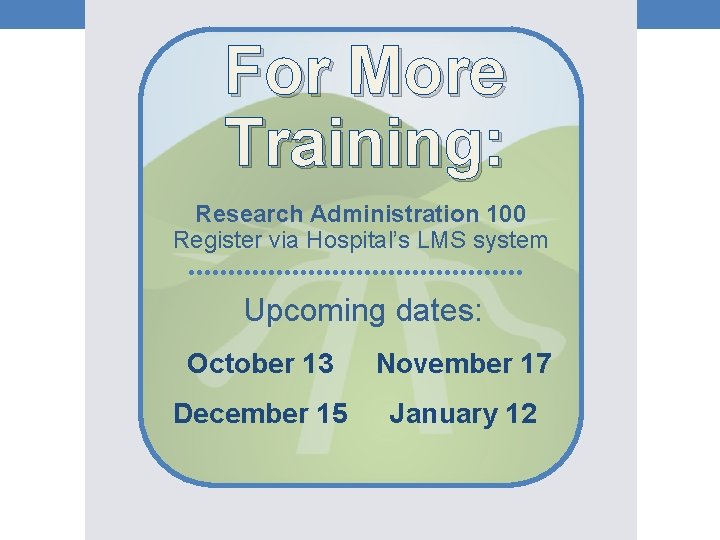
For More Training: Research Administration 100 Register via Hospital’s LMS system Upcoming dates: October 13 November 17 December 15 January 12
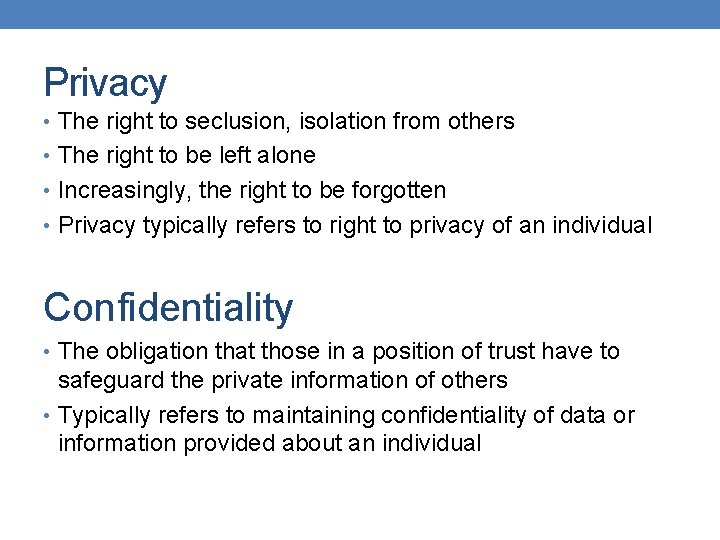
Privacy • The right to seclusion, isolation from others • The right to be left alone • Increasingly, the right to be forgotten • Privacy typically refers to right to privacy of an individual Confidentiality • The obligation that those in a position of trust have to safeguard the private information of others • Typically refers to maintaining confidentiality of data or information provided about an individual
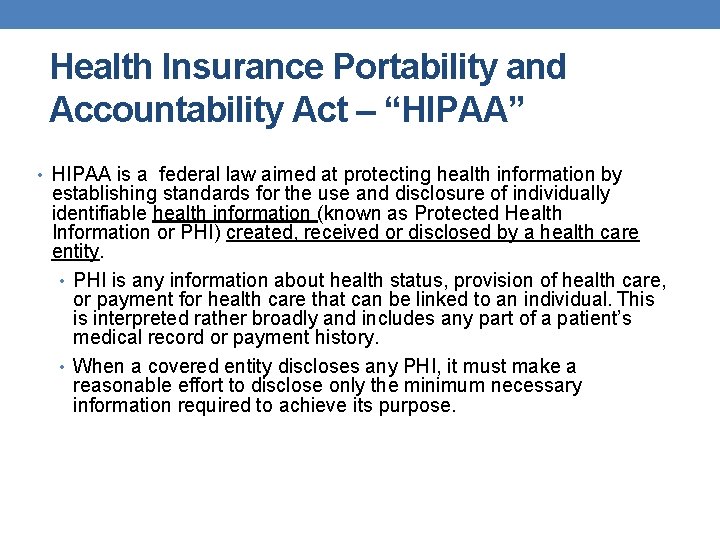
Health Insurance Portability and Accountability Act – “HIPAA” • HIPAA is a federal law aimed at protecting health information by establishing standards for the use and disclosure of individually identifiable health information (known as Protected Health Information or PHI) created, received or disclosed by a health care entity. • PHI is any information about health status, provision of health care, or payment for health care that can be linked to an individual. This is interpreted rather broadly and includes any part of a patient’s medical record or payment history. • When a covered entity discloses any PHI, it must make a reasonable effort to disclose only the minimum necessary information required to achieve its purpose.
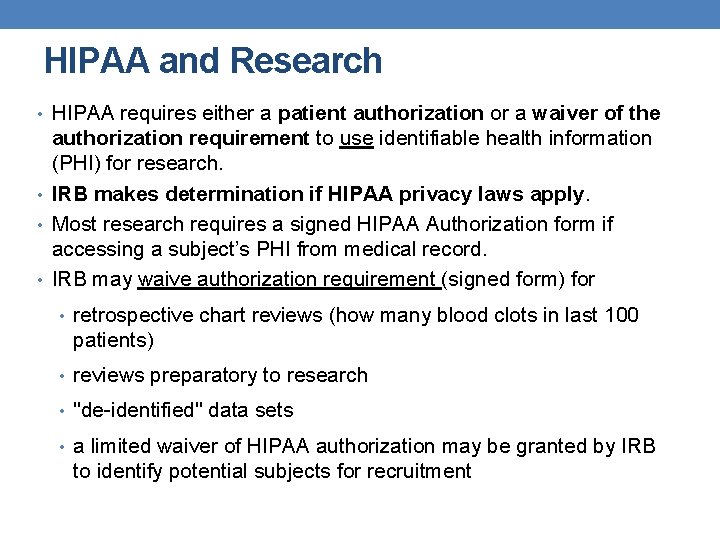
HIPAA and Research • HIPAA requires either a patient authorization or a waiver of the authorization requirement to use identifiable health information (PHI) for research. • IRB makes determination if HIPAA privacy laws apply. • Most research requires a signed HIPAA Authorization form if accessing a subject’s PHI from medical record. • IRB may waive authorization requirement (signed form) for • retrospective chart reviews (how many blood clots in last 100 patients) • reviews preparatory to research • "de-identified" data sets • a limited waiver of HIPAA authorization may be granted by IRB to identify potential subjects for recruitment
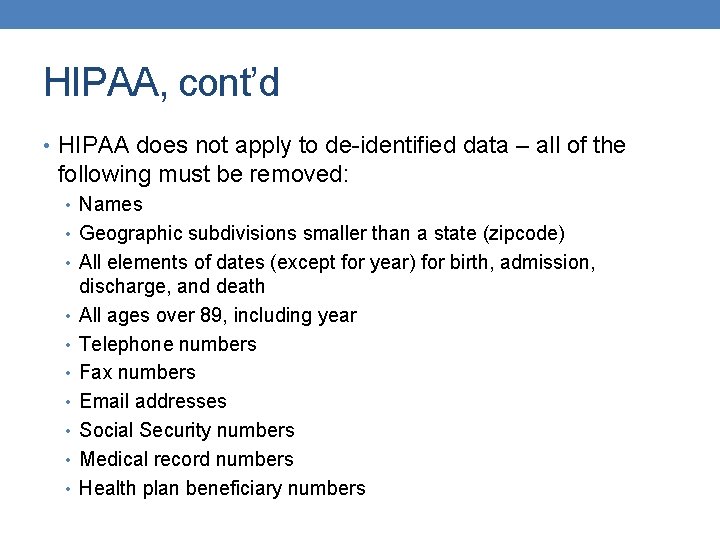
HIPAA, cont’d • HIPAA does not apply to de-identified data – all of the following must be removed: • Names • Geographic subdivisions smaller than a state (zipcode) • All elements of dates (except for year) for birth, admission, • • discharge, and death All ages over 89, including year Telephone numbers Fax numbers Email addresses Social Security numbers Medical record numbers Health plan beneficiary numbers
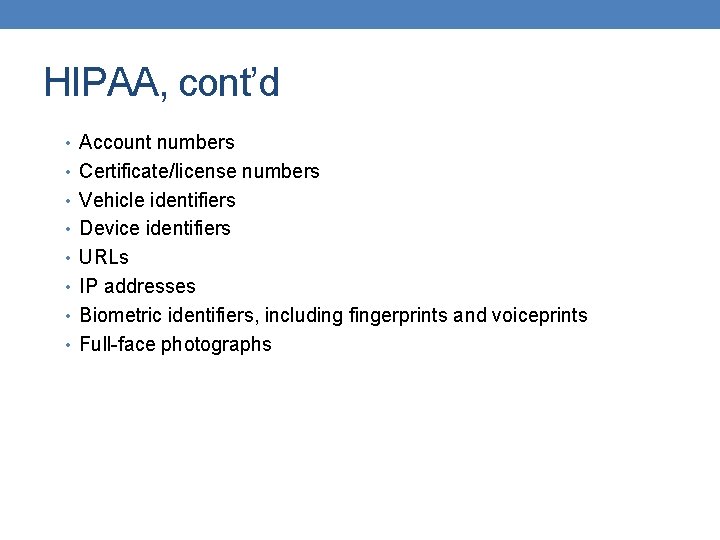
HIPAA, cont’d • Account numbers • Certificate/license numbers • Vehicle identifiers • Device identifiers • URLs • IP addresses • Biometric identifiers, including fingerprints and voiceprints • Full-face photographs
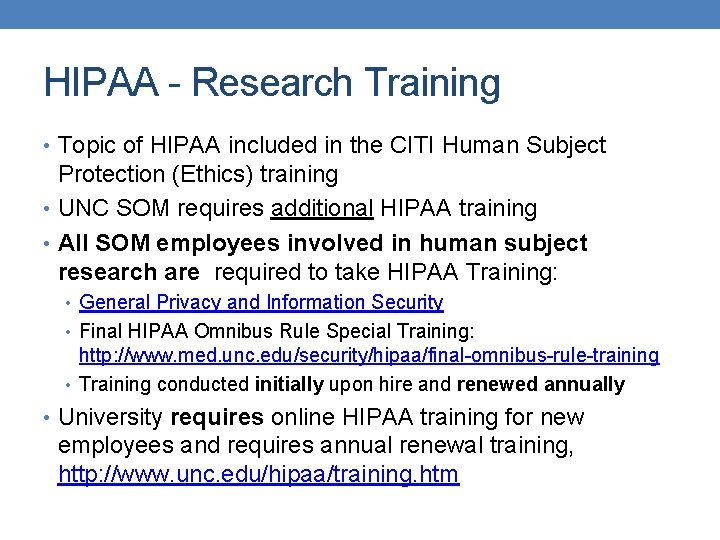
HIPAA - Research Training • Topic of HIPAA included in the CITI Human Subject Protection (Ethics) training • UNC SOM requires additional HIPAA training • All SOM employees involved in human subject research are required to take HIPAA Training: • General Privacy and Information Security • Final HIPAA Omnibus Rule Special Training: http: //www. med. unc. edu/security/hipaa/final-omnibus-rule-training • Training conducted initially upon hire and renewed annually • University requires online HIPAA training for new employees and requires annual renewal training, http: //www. unc. edu/hipaa/training. htm
UNC Oversight Structure • Privacy and Security Liaisons • HIPAA Steering Committee • Required training for use of PHI, • Limiting access to systems containing sensitive information
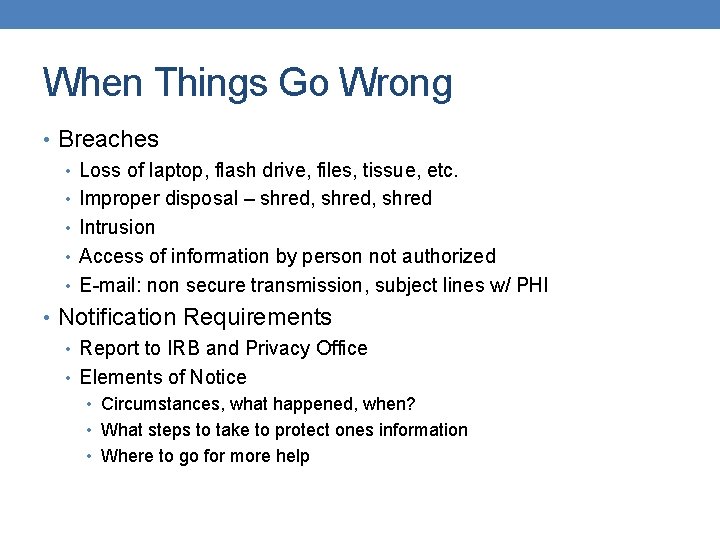
When Things Go Wrong • Breaches • Loss of laptop, flash drive, files, tissue, etc. • Improper disposal – shred, shred • Intrusion • Access of information by person not authorized • E-mail: non secure transmission, subject lines w/ PHI • Notification Requirements • Report to IRB and Privacy Office • Elements of Notice • Circumstances, what happened, when? • What steps to take to protect ones information • Where to go for more help
PLEASE VISIT TRACS. UNC. EDU / RESEARCH CENTRAL FOR A COPY OF THIS PRESENTATION & ADDITIONAL HELPFUL INFORMATION