
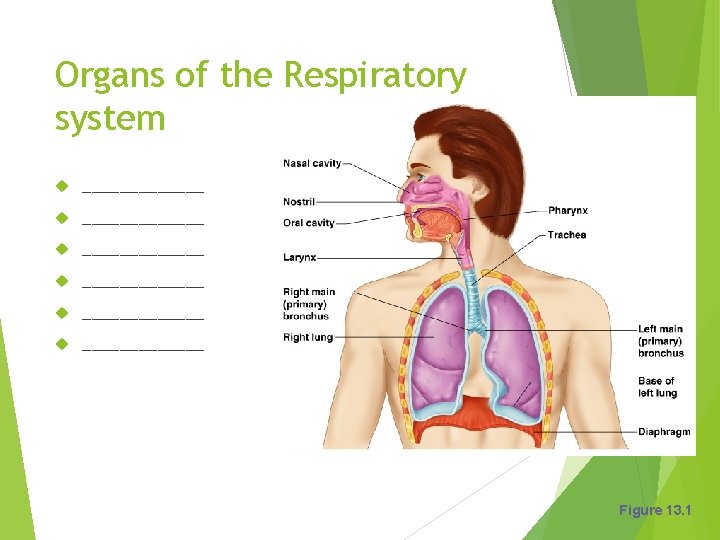
Organs of the Respiratory system Figure 13 1
- Slides: 28
Organs of the Respiratory system _____________ _____________ Figure 13. 1
Function of the Respiratory System Oversees __________between the blood and external environment Exchange of gasses takes place within the lungs in the ________ Passageways to the lungs purify, warm, and ________ the incoming air
The Nose The only ___________part of the respiratory system Air enters the nose through the external ______ (nostrils) The interior of the nose consists of a nasal cavity divided by a __________
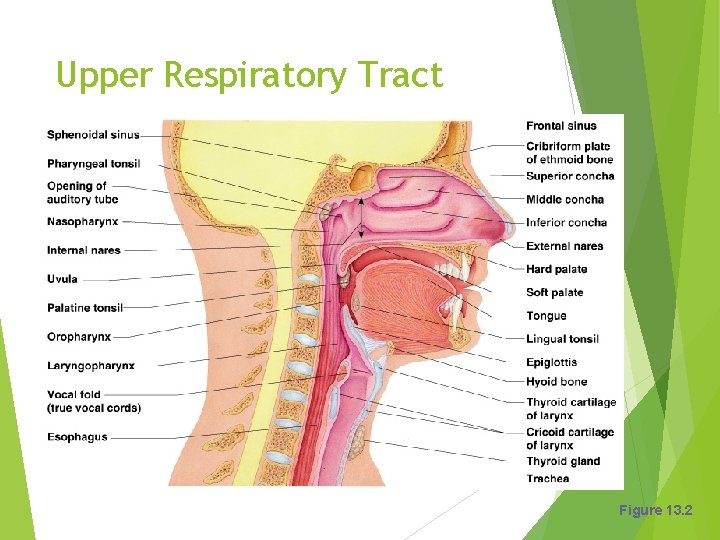
Upper Respiratory Tract Figure 13. 2
Anatomy of the Nasal Cavity Lateral walls have projections called conchae Increases __________________________ The nasal cavity is separated from the oral cavity by the Anterior hard palate (made of _________) Posterior soft palate (made of _________) palate
Paranasal Sinuses Cavities within bones surrounding the nasal cavity ______________________
Paranasal Sinuses Function of the sinuses ___________________________________________
Pharynx (Throat) Muscular passage from nasal cavity to _________ Three regions of the pharynx _________ – superior region behind nasal cavity _________ – middle region behind mouth _________ – inferior region attached to larynx Which 2 are common passageways for air and food
Larynx (Voice Box) Routes ____ and ______ into proper channels Plays a role in ________ Made of eight rigid ______ cartilages (protrudes anteriorly and is commonly referred to as the __________)and a spoon-shaped flap of elastic cartilage (________)
Structures of the Larynx ___________ Vibrate with expelled air to create sound (speech) ______ – opening between vocal cords
Trachea (Windpipe) Connects _______ with _________ Lined with ciliated mucosa Beat continuously in the opposite direction of incoming air Expel mucus loaded with dust and other debris away from lungs Walls are reinforced with _____-shaped hyaline cartilage
Primary Bronchi Formed by division of the _________ Enters the lung at the _______ (medial depression) Bronchi subdivide into smaller and smaller branches called __________
Lungs Occupy most of the ________ cavity Apex is near the ________ (superior portion) Base rests on the _________ (inferior portion) Each lung is divided into lobes by __________ Left lung – _____ lobes Right lung – _____ lobes
Coverings of the Lungs Pulmonary (visceral) _____ covers the lung surface What is the significance of this covering having fluid between its layers? What does it allow for?
Respiratory Tree Divisions Primary _________ Secondary _________ Tertiary ___________________
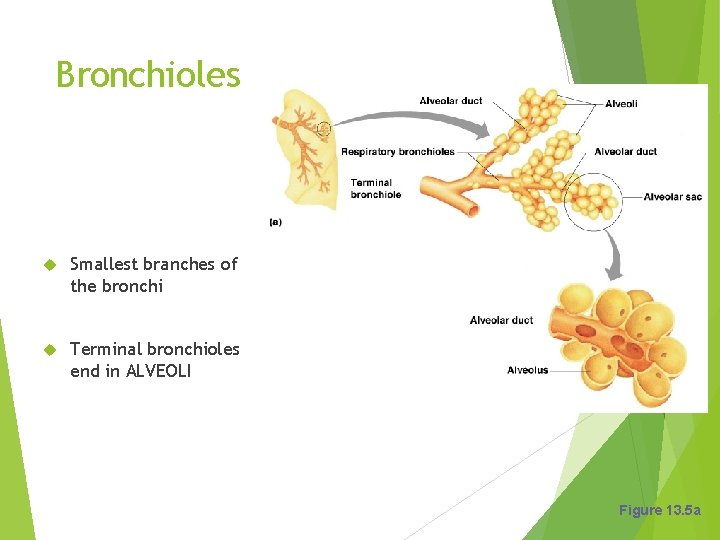
Bronchioles Smallest branches of the bronchi Terminal bronchioles end in ALVEOLI Figure 13. 5 a
Respiratory Zone Structures Respiratory bronchioli Alveolar duct Alveoli Site of ___________
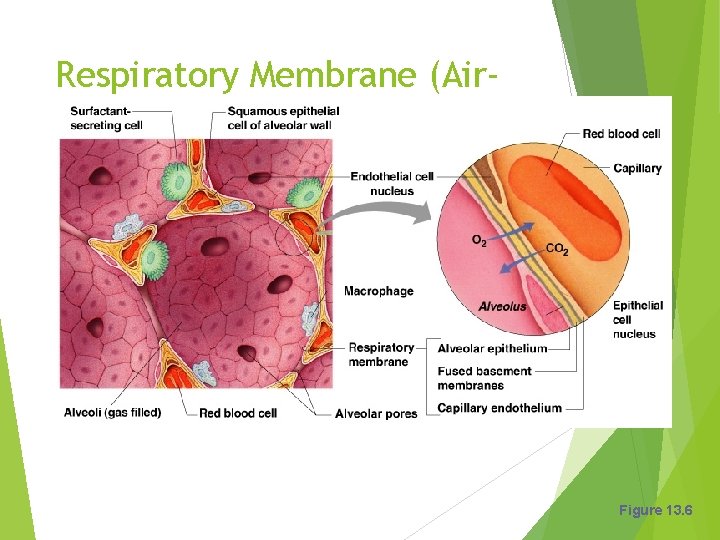
Respiratory Membrane (Air. Blood Barrier) Figure 13. 6
Gas Exchange Gas crosses the respiratory membrane by ______ Oxygen enters the ________ Carbon dioxide enters the __________ Macrophages add protection
Events of Respiration Pulmonary ventilation – moving air in and out of the _______ External respiration – gas exchange between pulmonary _______ and _______ Internal respiration – gas exchange between _____ and tissue cells in _______
Mechanics of Breathing Depends on volume changes in the _____ cavity Volume changes lead to _______ changes, which lead to the flow of gases to ensure homeostasis
Mechanics of Breathing Two phases _______ – flow of air into lung _______ – air leaving lung
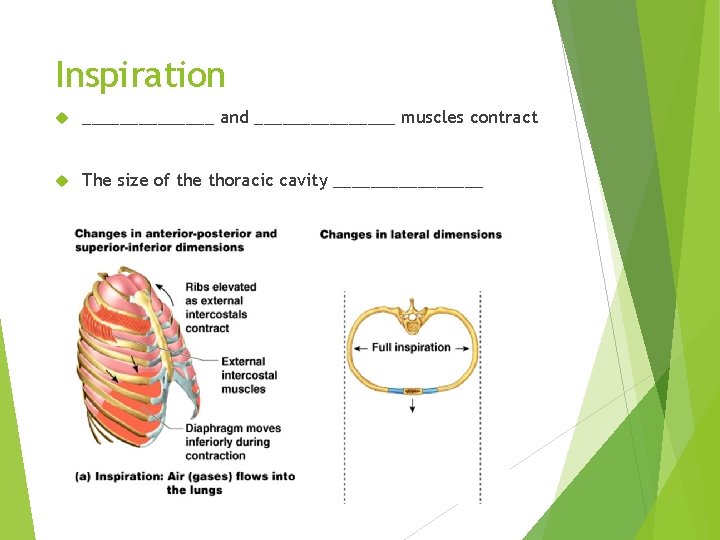
Inspiration _______ and ________ muscles contract The size of the thoracic cavity ________
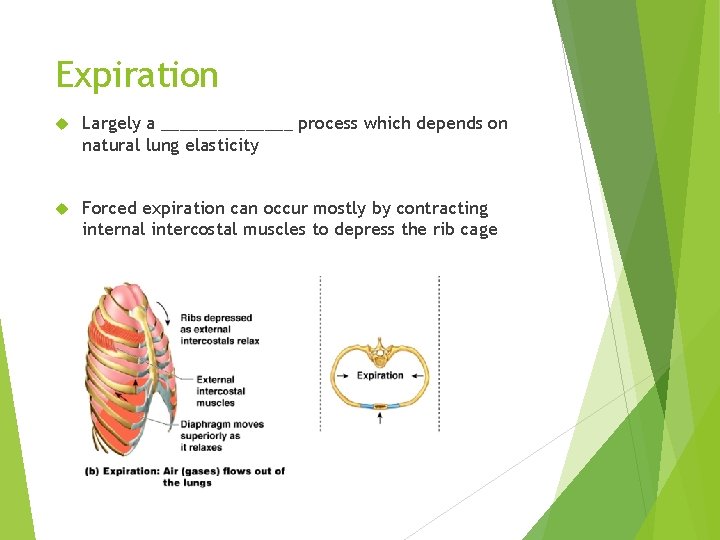
Expiration Largely a _______ process which depends on natural lung elasticity Forced expiration can occur mostly by contracting internal intercostal muscles to depress the rib cage
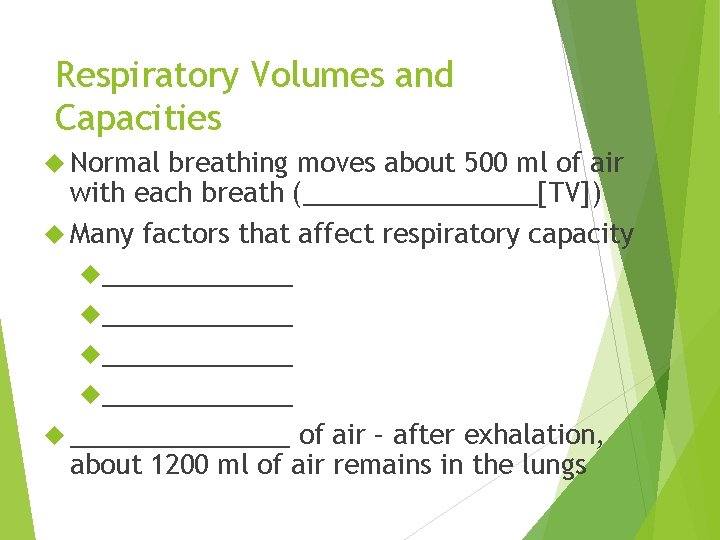
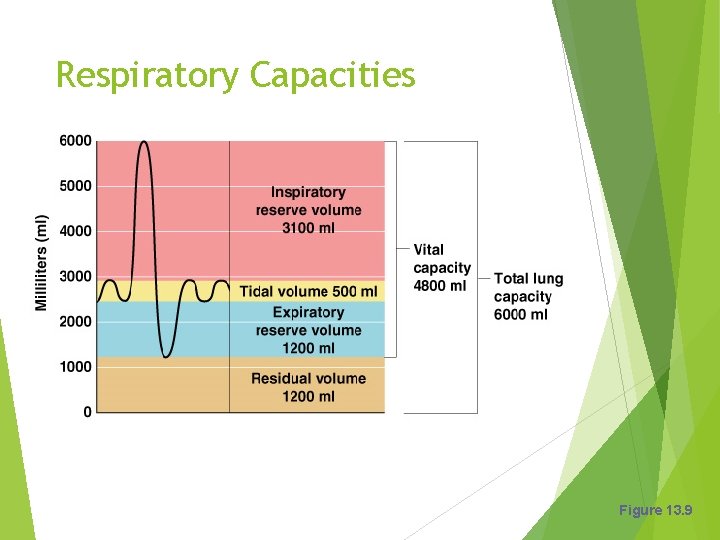
Respiratory Volumes and Capacities Normal breathing moves about 500 ml of air with each breath (________[TV]) Many factors that affect respiratory capacity _____________ ________ of air – after exhalation, about 1200 ml of air remains in the lungs
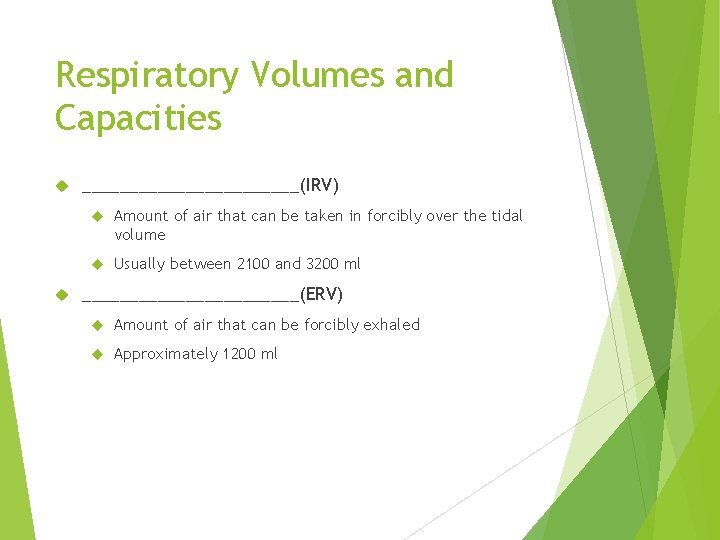
Respiratory Volumes and Capacities ____________(IRV) Amount of air that can be taken in forcibly over the tidal volume Usually between 2100 and 3200 ml ____________(ERV) Amount of air that can be forcibly exhaled Approximately 1200 ml
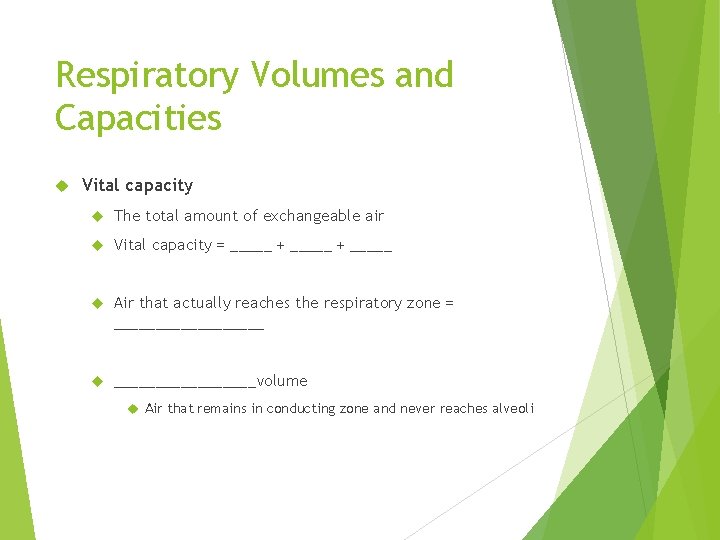
Respiratory Volumes and Capacities Vital capacity The total amount of exchangeable air Vital capacity = _____ + _____ Air that actually reaches the respiratory zone = _________volume Air that remains in conducting zone and never reaches alveoli
Respiratory Capacities Figure 13. 9