
Organometallic Compounds Chapter 13 Organometallic Compounds Chemistry of



![Hydride and Dihydrogen Complexes • Hydride complexes (e. g. [Re. H 9]2 -) –](https://slidetodoc.com/presentation_image/577a447a7daf3ac0e72e4bd7538b7190/image-21.jpg "Hydride and Dihydrogen Complexes • Hydride complexes (e. g. [Re. H 9]2 -) –")
![Carbene Complexes (M=C) • Discuss the proton NMR of Cr(CO)5[C(OCH 3)C 6 H 5].](https://slidetodoc.com/presentation_image/577a447a7daf3ac0e72e4bd7538b7190/image-34.jpg "Carbene Complexes (M=C) • Discuss the proton NMR of Cr(CO)5[C(OCH 3)C 6 H 5].")
- Slides: 40
Organometallic Compounds Chapter 13
Organometallic Compounds • Chemistry of compounds containing metalcarbon bonds. – In many complexes, both - and -bonding exist between the metal atom and carbon. • Types – Sandwich complexes, cluster compounds, and carbide clusters (to name a few).
Organometallic Compounds • The 1 st – Ziese’s compound/salt (Sec. 13 -1). – The organic molecule is attached to the metal via the electrons of the ethylene ligand. • Compounds with CO – Ni(CO)4 – Mond (purification of Ni). • The Big Boom in Organometallic Chemistry – Synthesis of ferrocene (Sec. 13 -1). – Began the era of modern organometallic chemistry.
Organic Ligands and Nomenclature • A number of ligands may bond through different number of atoms. – The number is indicated by (eta) followed by a superscript. – Ferrocene – contains the pentahaptocyclopentadienyl ligand. • hapto means to fasten Do a few others.
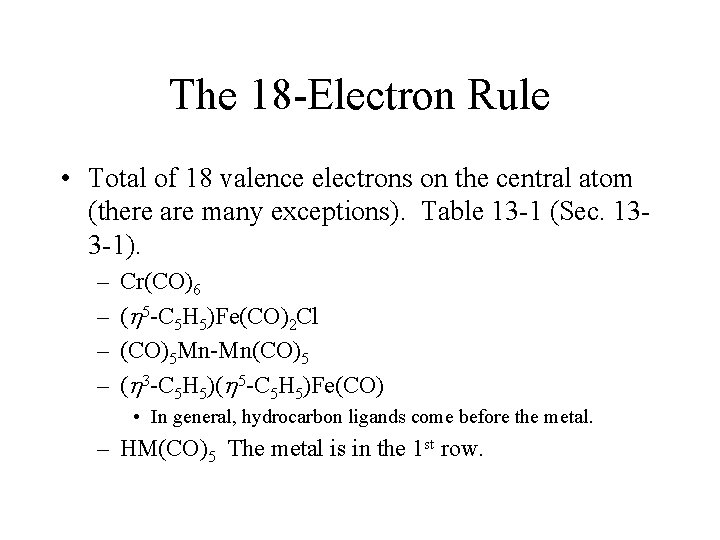
The 18 -Electron Rule • Total of 18 valence electrons on the central atom (there are many exceptions). Table 13 -1 (Sec. 133 -1). – – Cr(CO)6 ( 5 -C 5 H 5)Fe(CO)2 Cl (CO)5 Mn-Mn(CO)5 ( 3 -C 5 H 5)( 5 -C 5 H 5)Fe(CO) • In general, hydrocarbon ligands come before the metal. – HM(CO)5 The metal is in the 1 st row.
The 18 -Electron Rule • 18 electrons represent a filled valence shell for a transition metal. • Why do many complexes (if not most) violate the 18 -electron rule? – The 18 -electron rule does not consider the type of bonding and interactions. The interactions between the ligands and the metal need to be identified to determine if the complex will obey or violate the 18 -electron rule. This treatment will also identify why in many cases.
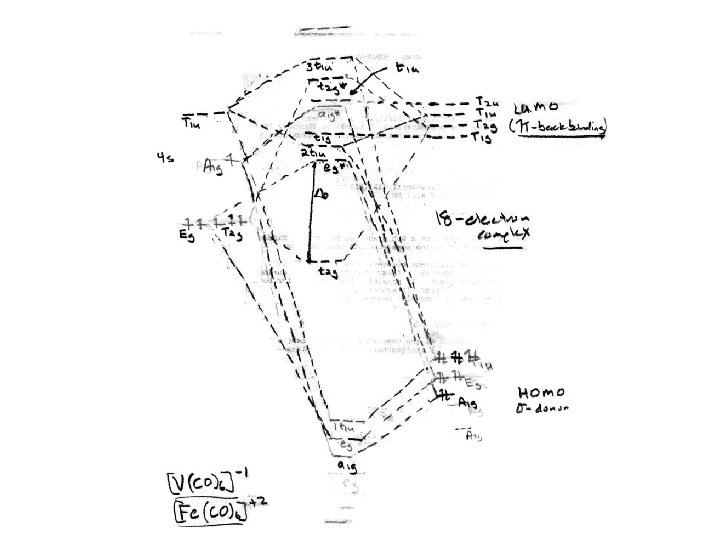
Interactions between the Ligands and the Metal • Examine the MO diagram for Cr(CO)6. – This includes interactions between the d-orbitals and the donor/ -acceptor orbitals of the six ligands. – Understand this diagram in terms and strengths of the different types of interactions. – 18 -electron is the most stable for this type of complex. Assuming the d-orbitals to be at similar energy levels, which complex would you predict to be the most stable? Complexes that possess ligands that are both strong donors and acceptors should be the most likely to obey the 18 -electron rule.
Interactions between the Ligands and the Metal • How about ligands that have different donor and acceptor characteristics? – Ethylenediamine is a donor, but not as strong as CO. Why affects does this have on the diagram studied previously? – The [Zn(en)3]2+ complex is stable. How many electrons?
Interactions between the Ligands and the Metal • How about Ti. Cl 62 -? It has 12 electrons. Can you justify this with an interaction diagram?
Interactions between the Ligands and the Metal • Square-planar complexes (16 -electron). – Examine Figure 13 -11 (Section 13 -3 -3). – The ligand is a good donor and acceptor. • Understand the interactions and influences on stabilization of the complex. – The 16 -electron square-planar complexes are mostly encountered for d 8 metals. • Oxidations states of +2 are common.
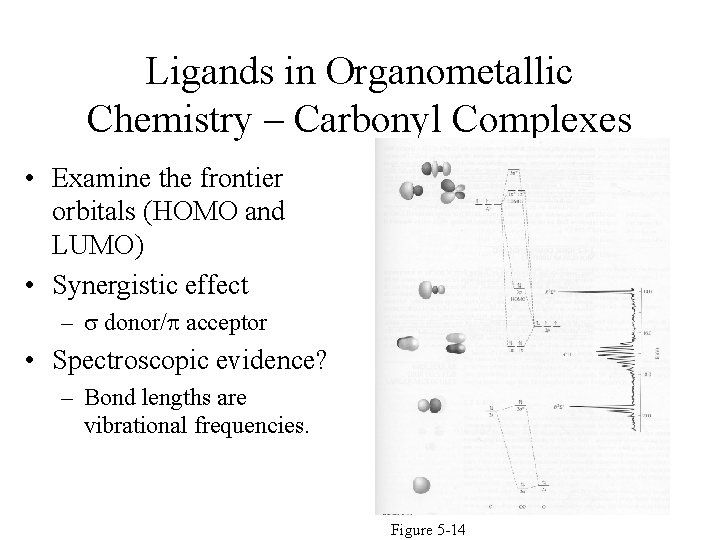
Ligands in Organometallic Chemistry – Carbonyl Complexes • Examine the frontier orbitals (HOMO and LUMO) • Synergistic effect – donor/ acceptor • Spectroscopic evidence? – Bond lengths are vibrational frequencies. Figure 5 -14
Ligands in Organometallic Chemistry – Carbonyl Complexes • How will the interaction diagram appear for a binary octahedral compound? – HOMO – These will have the same symmetry characteristics as a py orbital (previously). • red(HOMO) – A 1 g + Eg + T 1 u – LUMO – These will have the same symmetry characteristics as the px and py orbitals (previously considered). • red(LUMO) – T 1 g + T 2 g + T 1 u + T 2 u
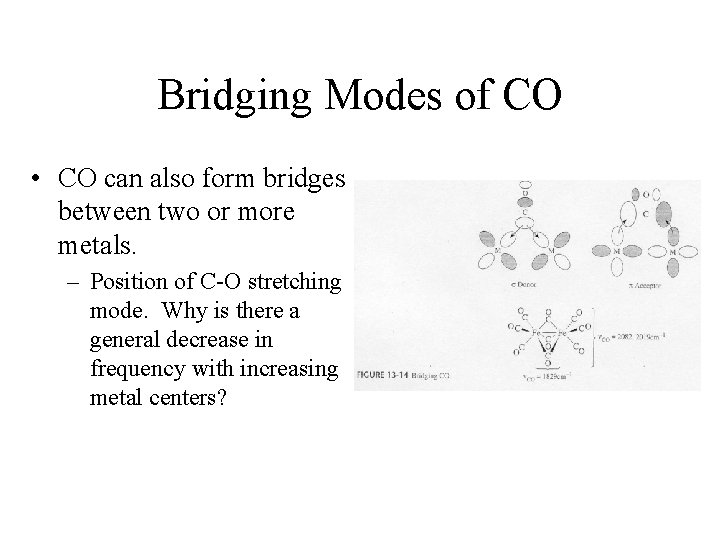
Bridging Modes of CO • CO can also form bridges between two or more metals. – Position of C-O stretching mode. Why is there a general decrease in frequency with increasing metal centers?
Ligands in Organometallic Chemistry – Carbonyl Complexes • Most binary carbonyl complexes obey the 18 -electron rule. Why? – Why doesn’t V(CO)6 form a dimer to obey the 18 -electron rule? • The tendency of CO to bridge transition metals decreases going down the periodic table. Why? No synthesis discussion.
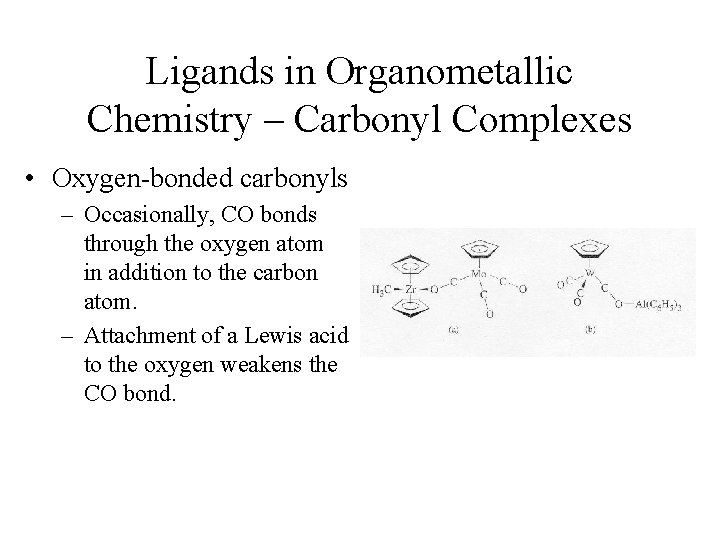
Ligands in Organometallic Chemistry – Carbonyl Complexes • Oxygen-bonded carbonyls – Occasionally, CO bonds through the oxygen atom in addition to the carbon atom. – Attachment of a Lewis acid to the oxygen weakens the CO bond.
Ligands Similar to CO • CS, CSe, CN-, and N 2 • CN- is able to bond readily to metals having higher oxidation states. – CN- is a good donor, but a weaker acceptor (cannot stabilize metals of low oxidation state). No NO complexes.
Hydride and Dihydrogen Complexes • Hydride complexes (e. g. [Re. H 9]2 -) – Only a 1 s orbital of suitable energy for bonding • Must be a interaction (minimal basis set) – Co 2(CO)8 + H 2 2 HCo(CO)4 • Dihydrogen complexes – Ziese’s salt – What are the types of possible interactions? What happens to the H-H bond? Extreme case?
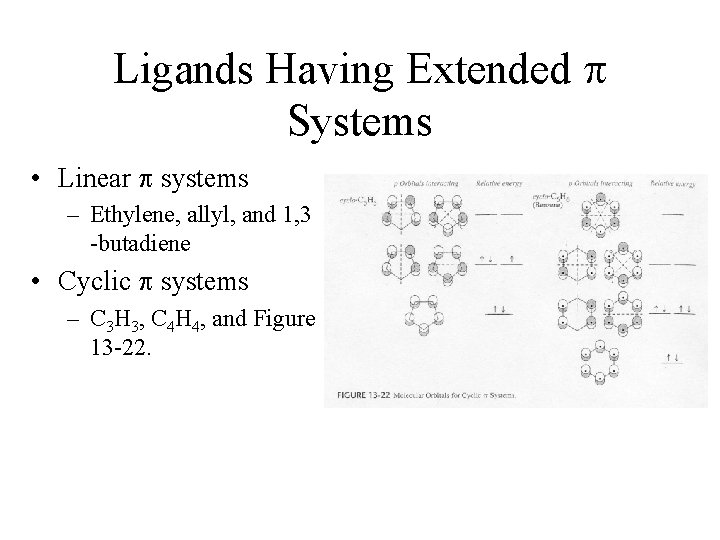
Ligands Having Extended Systems • Linear systems – Ethylene, allyl, and 1, 3 -butadiene • Cyclic systems – C 3 H 3, C 4 H 4, and Figure 13 -22.
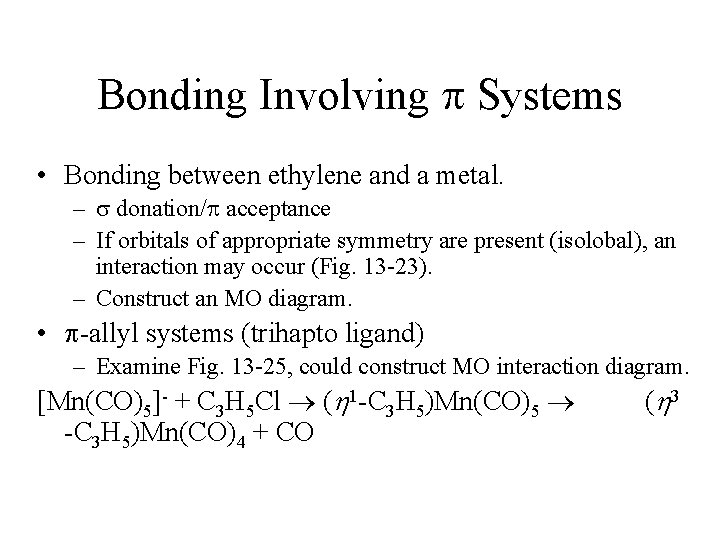
Bonding Involving Systems • Bonding between ethylene and a metal. – donation/ acceptance – If orbitals of appropriate symmetry are present (isolobal), an interaction may occur (Fig. 13 -23). – Construct an MO diagram. • -allyl systems (trihapto ligand) – Examine Fig. 13 -25, could construct MO interaction diagram. [Mn(CO)5]- + C 3 H 5 Cl ( 1 -C 3 H 5)Mn(CO)5 -C 3 H 5)Mn(CO)4 + CO ( 3
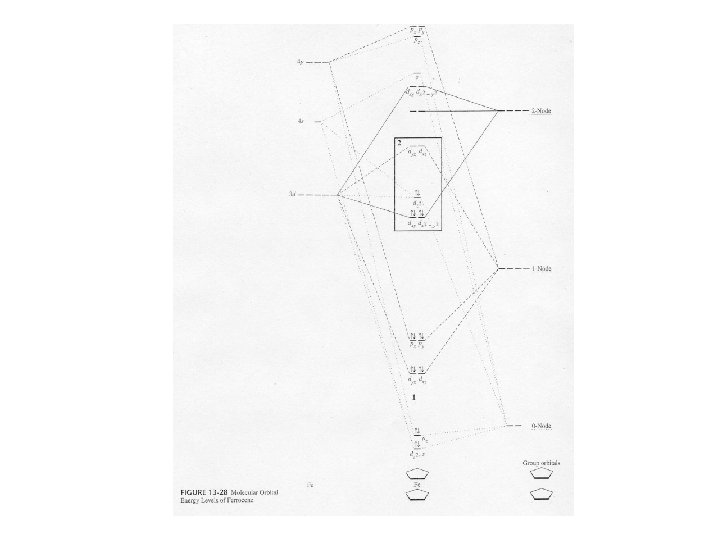
Cyclic Systems • C 5 H 5 ( 1, 3, or 5 bonding modes ( 4 can also be observed)). • Ferrocene ( 5 -C 5 H 5)2 Fe – Orbitals on the ligands and metal can interact if they have the same symmetry. – Strongest interaction is between orbitals of similar energies. – What is the point group? – Let’s give it the treatment!!
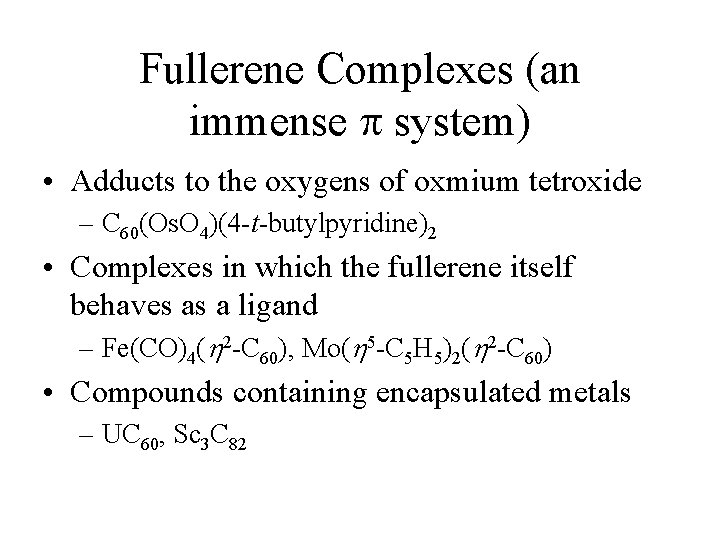
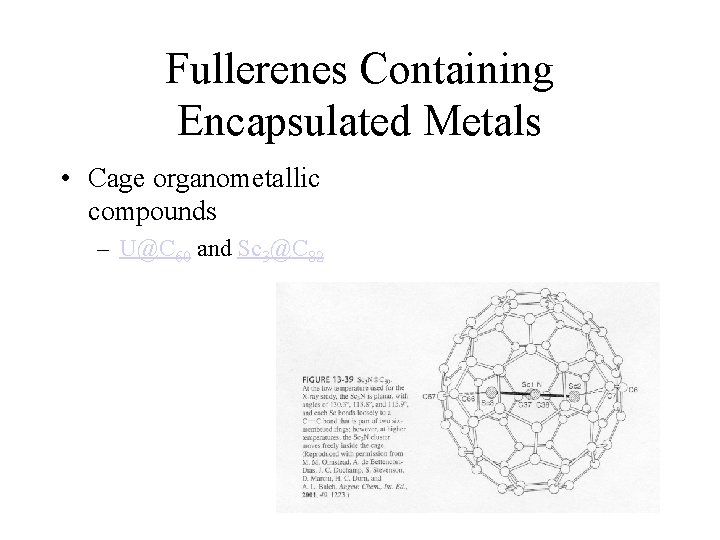
Fullerene Complexes (an immense system) • Adducts to the oxygens of oxmium tetroxide – C 60(Os. O 4)(4 -t-butylpyridine)2 • Complexes in which the fullerene itself behaves as a ligand – Fe(CO)4( 2 -C 60), Mo( 5 -C 5 H 5)2( 2 -C 60) • Compounds containing encapsulated metals – UC 60, Sc 3 C 82
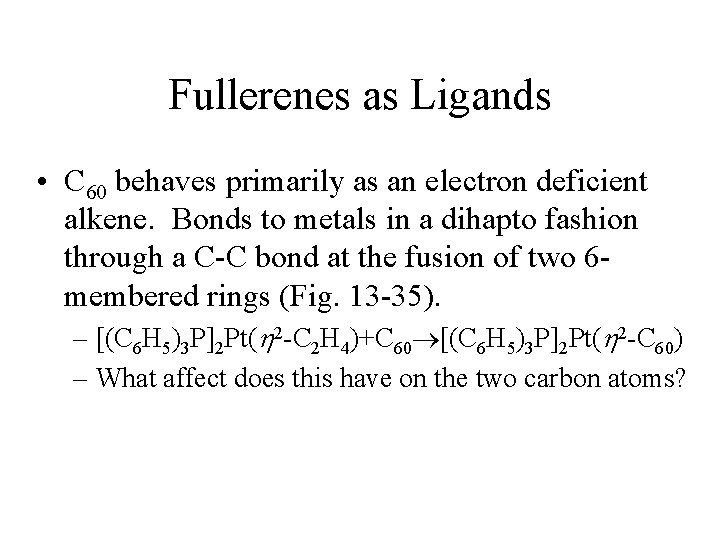
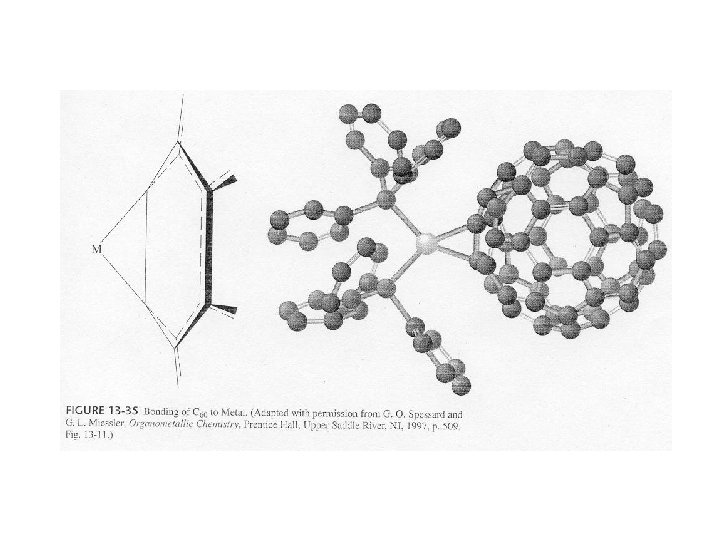
Fullerenes as Ligands • C 60 behaves primarily as an electron deficient alkene. Bonds to metals in a dihapto fashion through a C-C bond at the fusion of two 6 membered rings (Fig. 13 -35). – [(C 6 H 5)3 P]2 Pt( 2 -C 2 H 4)+C 60 [(C 6 H 5)3 P]2 Pt( 2 -C 60) – What affect does this have on the two carbon atoms?
Fullerenes Containing Encapsulated Metals • Cage organometallic compounds – U@C 60 and Sc 3@C 82
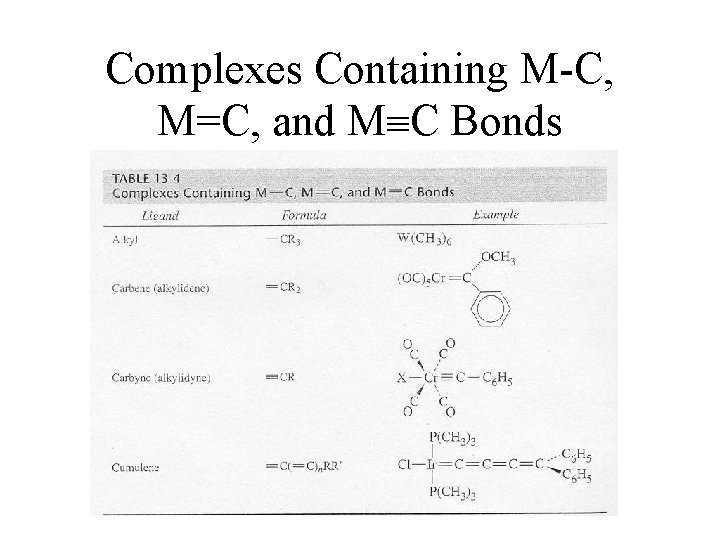
Complexes Containing M-C, M=C, and M C Bonds
Alkyl Complexes (M-C) • Grignard reagents (Mg-alkyl bonds) and methyl lithium. – Grignard reagents can be used to synthesize organometallic compounds containing an alkyl group • The interaction is largely through donation. • Metals containing only alkyl ligands are rare and usually unstable.
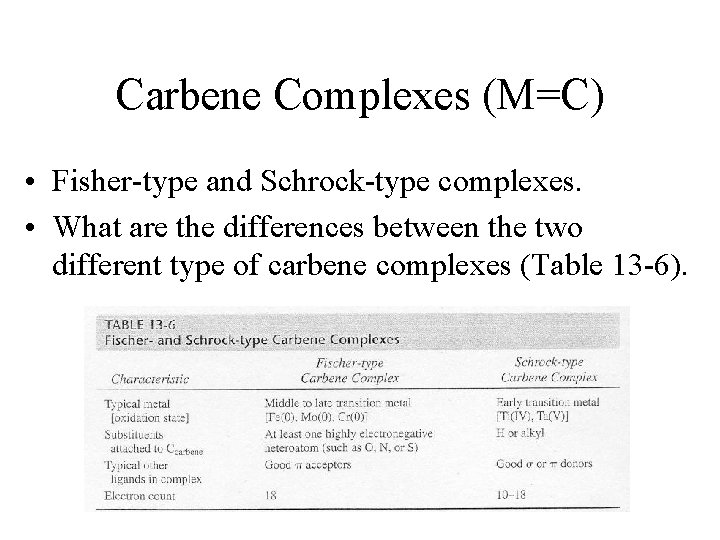
Carbene Complexes (M=C) • Fisher-type and Schrock-type complexes. • What are the differences between the two different type of carbene complexes (Table 13 -6).
Carbene Complexes (M=C) • Bonding in Fisher carbene complexes. – donation and back bonding (illustrate). – Complex is generally more stable if the carbene atom is attached to a highly electronegative atom. The electronegative atom participates in the bonding. • Similar to a -allyl system (illustrate, Fig. 13 -41). • Can be represented as a hybrid structure. – What type of spectroscopic evidence would show the existence of M=C?
Carbene Complexes (M=C) • Discuss the proton NMR of Cr(CO)5[C(OCH 3)C 6 H 5]. • At high temperatures there is one signal from the methyl protons and at low temperatures there is one signal. Why?
Carbyne (alkylidyne) Complexes (M C) • Illustrate a compound. • Type of bonding – bond, plus two bonds. • Neutral 3 -electron donor.
Spectra Analysis and Characterization of Organometallic Compounds • • • X-ray crystallography Infrared spectroscopy NMR spectroscopy Mass spectrometry Elemental analysis Others
Infrared (IR) Spectra • The number of IR bands depends on the molecular symmetry (IR active modes). – Monocarbonyl complexes – Dicarbonyl complexes • Linear and bent – Three or more carbonyl on the complex (Table 13 -7). • We will assume that all the IR active modes are visible and distinguishable. • Exercise caution when using this table.
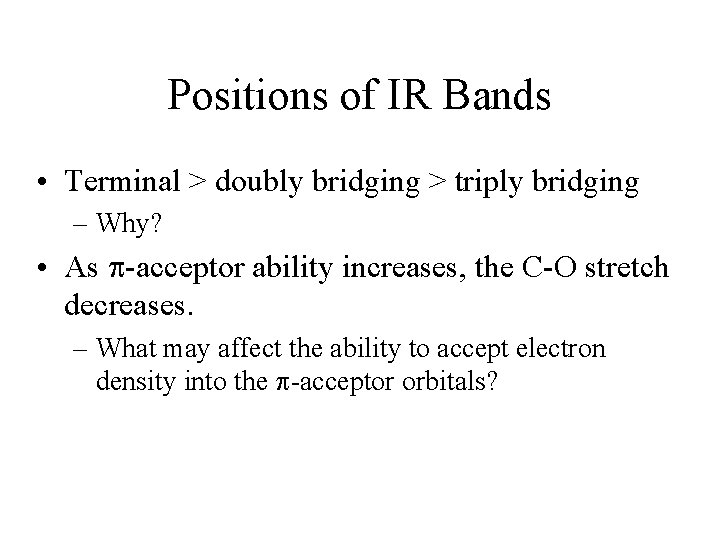
Positions of IR Bands • Terminal > doubly bridging > triply bridging – Why? • As -acceptor ability increases, the C-O stretch decreases. – What may affect the ability to accept electron density into the -acceptor orbitals?
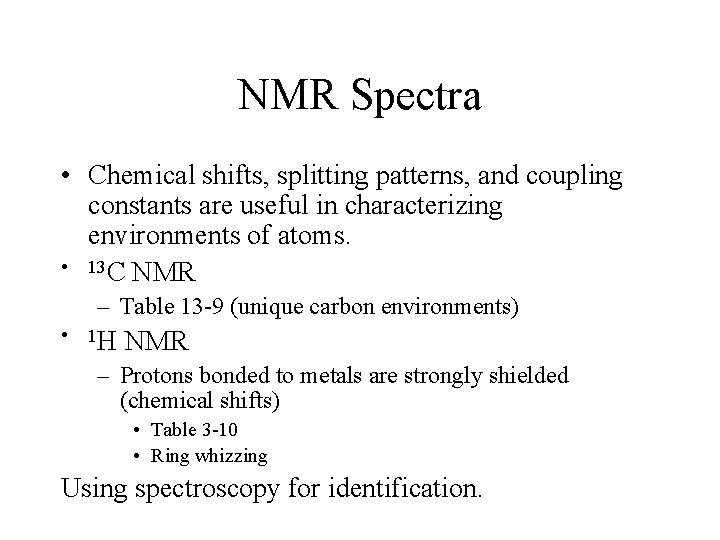
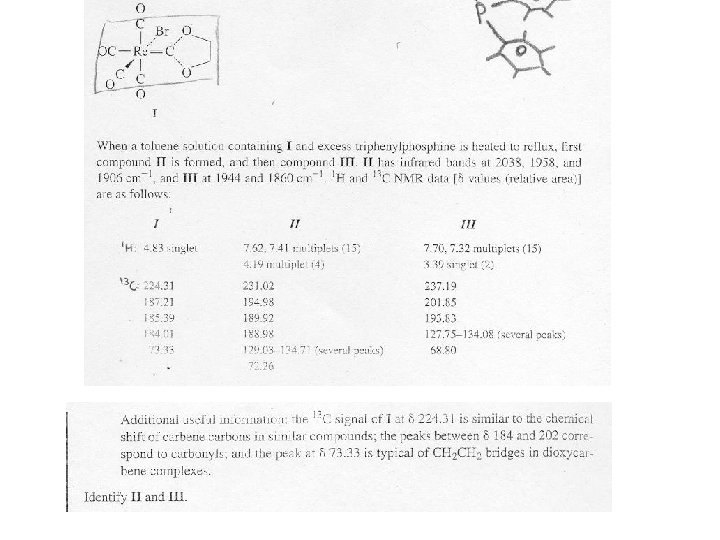
NMR Spectra • Chemical shifts, splitting patterns, and coupling constants are useful in characterizing environments of atoms. • 13 C NMR – Table 13 -9 (unique carbon environments) • 1 H NMR – Protons bonded to metals are strongly shielded (chemical shifts) • Table 3 -10 • Ring whizzing Using spectroscopy for identification.