
Organoleptic examination Determination of foreign matter Herbal Medicine
Organoleptic examination & Determination of foreign matter Herbal Medicine Research Division, NIFDS
1. Macroscopic examination Ø Visual inspection provides the simplest and quickest means by which to establish identity, purity and possibly quality Ø based on shape, size, colour, surface characteristics, texture, fracture characteristics and appearance of the cut surface • judged subjectively • substitutes or adulterants may closely resemble the genuine material • necessary to substantiate the findings by microscopy and/or physicochemical analysis.
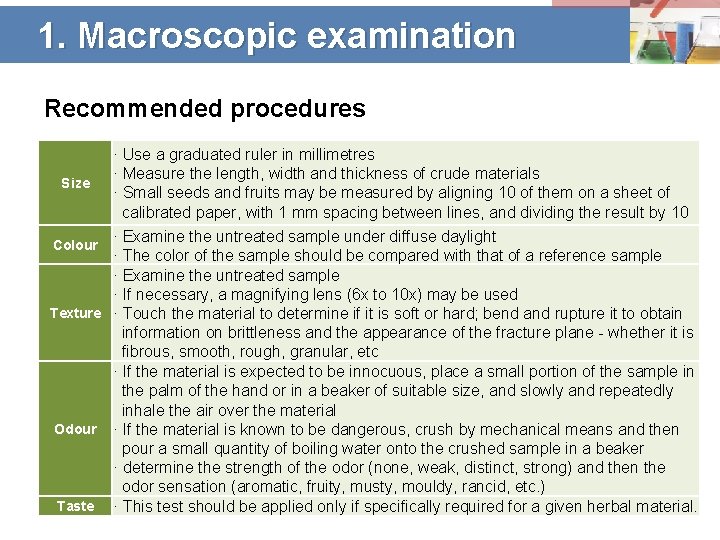
1. Macroscopic examination Recommended procedures Size · Use a graduated ruler in millimetres · Measure the length, width and thickness of crude materials · Small seeds and fruits may be measured by aligning 10 of them on a sheet of calibrated paper, with 1 mm spacing between lines, and dividing the result by 10 · Examine the untreated sample under diffuse daylight · The color of the sample should be compared with that of a reference sample · Examine the untreated sample · If necessary, a magnifying lens (6 x to 10 x) may be used Texture · Touch the material to determine if it is soft or hard; bend and rupture it to obtain information on brittleness and the appearance of the fracture plane - whether it is fibrous, smooth, rough, granular, etc · If the material is expected to be innocuous, place a small portion of the sample in the palm of the hand or in a beaker of suitable size, and slowly and repeatedly inhale the air over the material Odour · If the material is known to be dangerous, crush by mechanical means and then pour a small quantity of boiling water onto the crushed sample in a beaker · determine the strength of the odor (none, weak, distinct, strong) and then the odor sensation (aromatic, fruity, musty, mouldy, rancid, etc. ) Taste · This test should be applied only if specifically required for a given herbal material. Colour
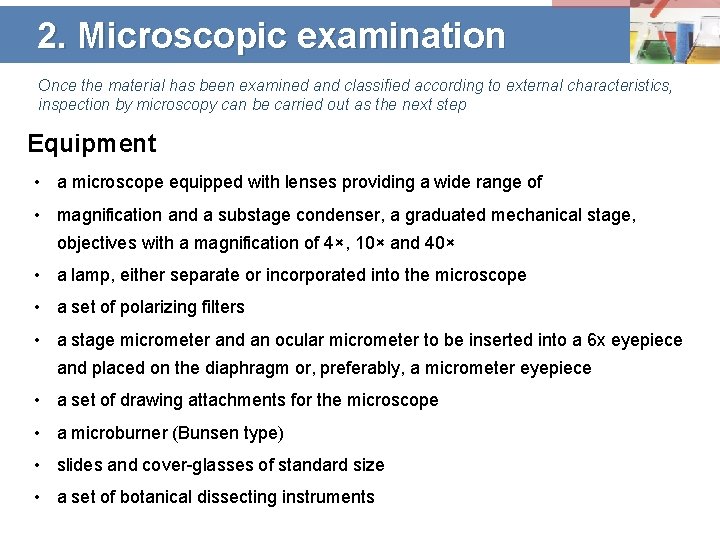
2. Microscopic examination Once the material has been examined and classified according to external characteristics, inspection by microscopy can be carried out as the next step Equipment • a microscope equipped with lenses providing a wide range of • magnification and a substage condenser, a graduated mechanical stage, objectives with a magnification of 4×, 10× and 40× • a lamp, either separate or incorporated into the microscope • a set of polarizing filters • a stage micrometer and an ocular micrometer to be inserted into a 6 x eyepiece and placed on the diaphragm or, preferably, a micrometer eyepiece • a set of drawing attachments for the microscope • a microburner (Bunsen type) • slides and cover-glasses of standard size • a set of botanical dissecting instruments
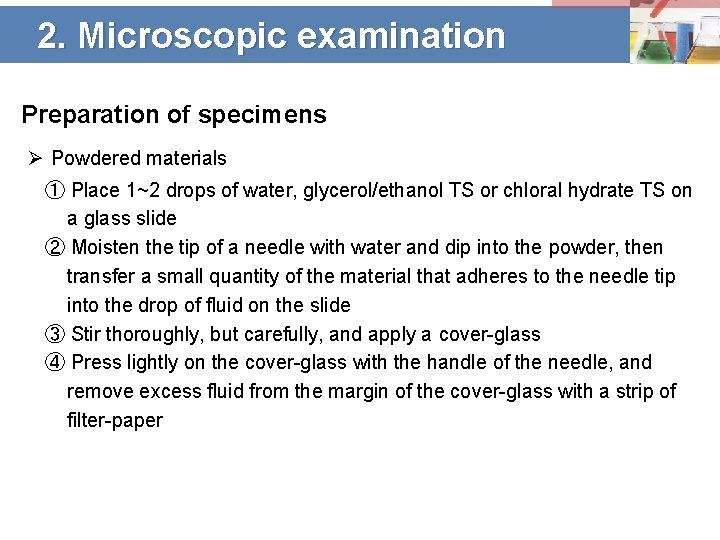
2. Microscopic examination Preparation of specimens Ø Powdered materials ① Place 1~2 drops of water, glycerol/ethanol TS or chloral hydrate TS on a glass slide ② Moisten the tip of a needle with water and dip into the powder, then transfer a small quantity of the material that adheres to the needle tip into the drop of fluid on the slide ③ Stir thoroughly, but carefully, and apply a cover-glass ④ Press lightly on the cover-glass with the handle of the needle, and remove excess fluid from the margin of the cover-glass with a strip of filter-paper
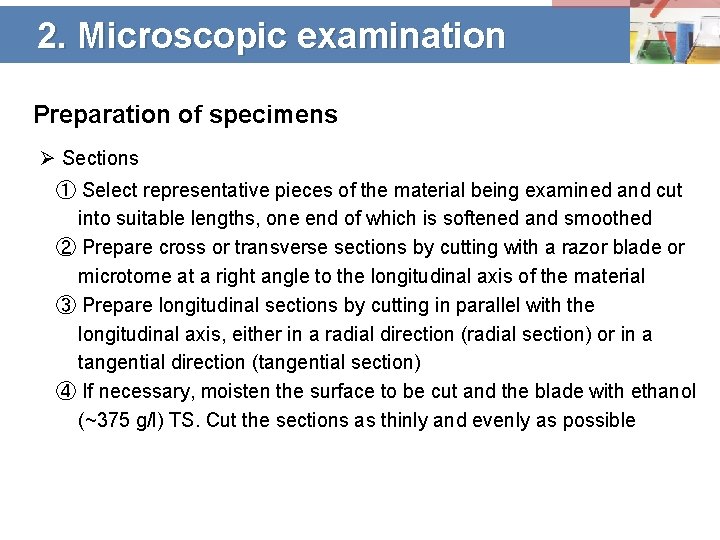
2. Microscopic examination Preparation of specimens Ø Sections ① Select representative pieces of the material being examined and cut into suitable lengths, one end of which is softened and smoothed ② Prepare cross or transverse sections by cutting with a razor blade or microtome at a right angle to the longitudinal axis of the material ③ Prepare longitudinal sections by cutting in parallel with the longitudinal axis, either in a radial direction (radial section) or in a tangential direction (tangential section) ④ If necessary, moisten the surface to be cut and the blade with ethanol (~375 g/l) TS. Cut the sections as thinly and evenly as possible
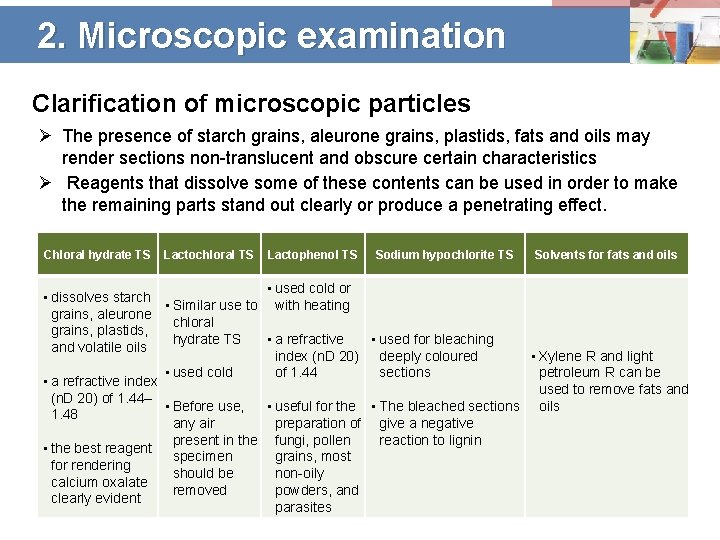
2. Microscopic examination Clarification of microscopic particles Ø The presence of starch grains, aleurone grains, plastids, fats and oils may render sections non-translucent and obscure certain characteristics Ø Reagents that dissolve some of these contents can be used in order to make the remaining parts stand out clearly or produce a penetrating effect. Chloral hydrate TS Lactochloral TS Lactophenol TS Sodium hypochlorite TS Solvents for fats and oils • used cold or • dissolves starch • Similar use to with heating grains, aleurone chloral grains, plastids, • used for bleaching hydrate TS • a refractive and volatile oils • Xylene R and light index (n. D 20) deeply coloured petroleum R can be sections • used cold of 1. 44 • a refractive index used to remove fats and (n. D 20) of 1. 44– • Before use, • useful for the • The bleached sections oils 1. 48 any air preparation of give a negative present in the fungi, pollen reaction to lignin • the best reagent specimen grains, most for rendering should be non-oily calcium oxalate removed powders, and clearly evident parasites
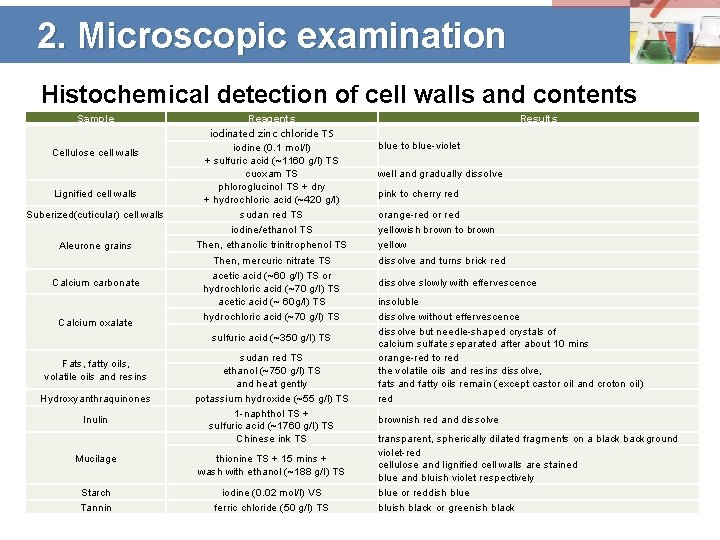
2. Microscopic examination Histochemical detection of cell walls and contents Sample Cellulose cell walls Lignified cell walls Suberized(cuticular) cell walls Aleurone grains Calcium carbonate Calcium oxalate Reagents iodinated zinc chloride TS iodine (0. 1 mol/l) + sulfuric acid (~1160 g/l) TS cuoxam TS phloroglucinol TS + dry + hydrochloric acid (~420 g/l) sudan red TS iodine/ethanol TS Then, ethanolic trinitrophenol TS Then, mercuric nitrate TS acetic acid (~60 g/l) TS or hydrochloric acid (~70 g/l) TS acetic acid (~ 60 g/l) TS hydrochloric acid (~70 g/l) TS sulfuric acid (~350 g/l) TS Fats, fatty oils, volatile oils and resins Hydroxyanthraquinones Inulin sudan red TS ethanol (~750 g/l) TS and heat gently potassium hydroxide (~55 g/l) TS 1 -naphthol TS + sulfuric acid (~1760 g/l) TS Chinese ink TS Mucilage thionine TS + 15 mins + wash with ethanol (~188 g/l) TS Starch Tannin iodine (0. 02 mol/l) VS ferric chloride (50 g/l) TS Results blue to blue-violet well and gradually dissolve pink to cherry red orange-red or red yellowish brown to brown yellow dissolve and turns brick red dissolve slowly with effervescence insoluble dissolve without effervescence dissolve but needle-shaped crystals of calcium sulfate separated after about 10 mins orange-red to red the volatile oils and resins dissolve, fats and fatty oils remain (except castor oil and croton oil) red brownish red and dissolve transparent, spherically dilated fragments on a black background violet-red cellulose and lignified cell walls are stained blue and bluish violet respectively blue or reddish blue bluish black or greenish black
2. Microscopic examination Disintegration of tissues Ø Method 1: Nitric acid and potassium chlorate ① Place the material in a test-tube containing about 5 ml of nitric acid (~500 g/l) TS and heat to boiling. ② Add a small quantity of powdered potassium chlorate R and allow to react, warming gently if necessary to maintain a slight effervescence. ③ When the tissue appears to be almost completely bleached and shows a tendency to disintegrate, apply pressure with a glass rod to the material. ④ If the material breaks, interrupt the reaction by pouring the contents of the test-tube into water. Allow the material to settle, decant it and wash it with fresh water until the acidity is removed. ⑤ Transfer the material onto a slide and tease it out with a needle. ⑥ Add 1 drop of glycerol/ ethanol TS and apply a cover-glass.
2. Microscopic examination Disintegration of tissues Ø Method 2: Nitric acid and chromic acid ① Place the material in a small dish and heat with nitro-chromic acid TS until the material breaks easily when pressure is applied with a glass rod. ② Wash the material repeatedly with water and transfer onto a slide. ③ Tease out the material, add 1 drop of glycerol/ethanol TS and apply a cover-glass. * This treatment can also be carried out on a slide. * This process is especially useful when the disintegration of the tissues of a section under the microscope needs to be observed to ascertain where isolated cells come from.
2. Microscopic examination Disintegration of tissues Ø Method 3: Caustic alkali method ① Place the material in a test-tube containing about 5 ml of potassium hydroxide (~110 g/l) TS or sodium hydroxide (~80 g/l) TS ② heat on a water-bath for 15– 30 minutes until a portion breaks easily when pressure is applied with a glass rod. ③ Decant the liquid and wash the softened material several times with fresh quantities of water. * This method is particularly useful for the disintegration of bark, seeds, leaves and flowers, facilitating the elimination of fibres, scleroids, lactiferous tissues and epidermis.
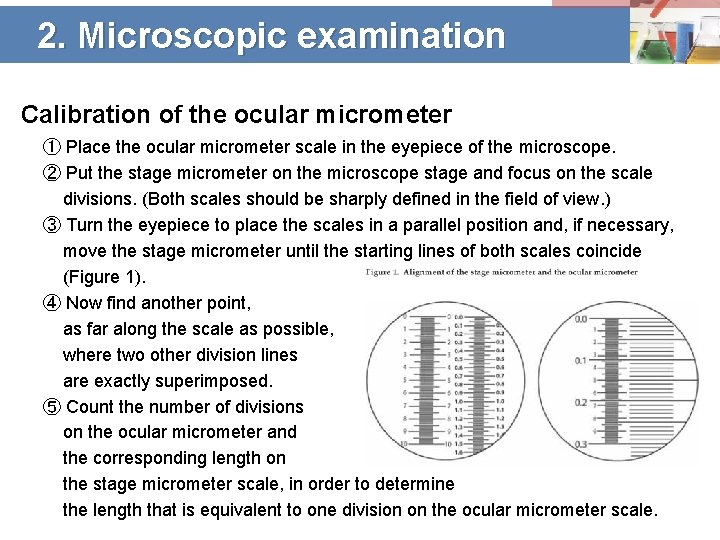
2. Microscopic examination Calibration of the ocular micrometer ① Place the ocular micrometer scale in the eyepiece of the microscope. ② Put the stage micrometer on the microscope stage and focus on the scale divisions. (Both scales should be sharply defined in the field of view. ) ③ Turn the eyepiece to place the scales in a parallel position and, if necessary, move the stage micrometer until the starting lines of both scales coincide (Figure 1). ④ Now find another point, as far along the scale as possible, where two other division lines are exactly superimposed. ⑤ Count the number of divisions on the ocular micrometer and the corresponding length on the stage micrometer scale, in order to determine the length that is equivalent to one division on the ocular micrometer scale.
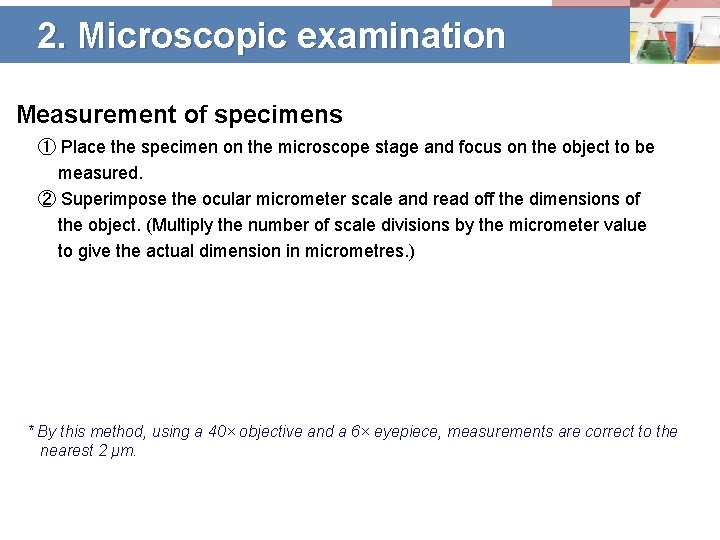
2. Microscopic examination Measurement of specimens ① Place the specimen on the microscope stage and focus on the object to be measured. ② Superimpose the ocular micrometer scale and read off the dimensions of the object. (Multiply the number of scale divisions by the micrometer value to give the actual dimension in micrometres. ) * By this method, using a 40× objective and a 6× eyepiece, measurements are correct to the nearest 2 μm.
3. Determination of foreign matter Definition of foreign matter Ø Foreign matter is material consisting of any or all of the following: - Parts of the herbal material of materials other than those named with the limits specified for the herbal material concerned - Any organism, part or product of an organism, other than that named in the specification and description of the herbal material concerned - Mineral admixtures not adhering to the herbal materials such as soil, stones, sand dust.

3. Determination of foreign matter Sample size Recommend procedures Ø Spread a sample of herbal material, taking the quantity indicated above unless otherwise specified in the test procedures for the herbal material concerned Ø Spread it in a thin layer and soft the foreign matter into groups either by visual inspection, suing magnifying lens (6 x or 10 x) or with the help of a suitable sieve, according to the requirements for the specific herbal material
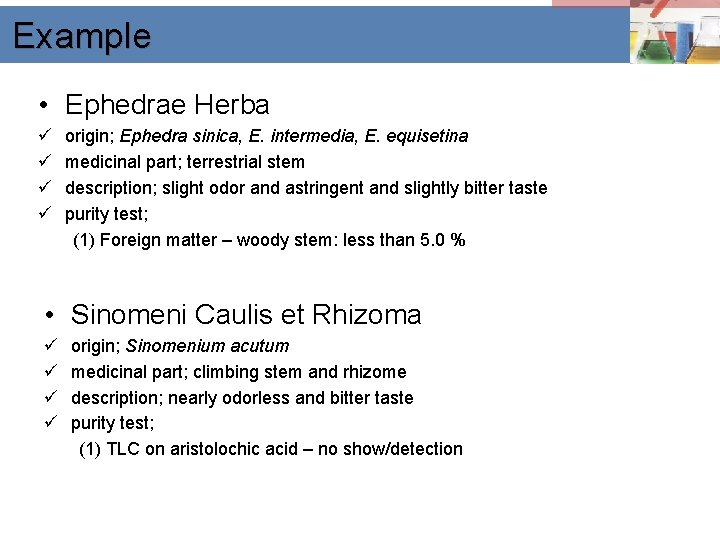
Example • Ephedrae Herba ü ü origin; Ephedra sinica, E. intermedia, E. equisetina medicinal part; terrestrial stem description; slight odor and astringent and slightly bitter taste purity test; (1) Foreign matter – woody stem: less than 5. 0 % • Sinomeni Caulis et Rhizoma ü ü origin; Sinomenium acutum medicinal part; climbing stem and rhizome description; nearly odorless and bitter taste purity test; (1) TLC on aristolochic acid – no show/detection
- Slides: 16