
Organizing Vertical Boundaries Introduction There are various approaches
Organizing Vertical Boundaries
Introduction There are various approaches in considering the merits of vertical integration n balancing transactions costs the role of market imperfections the role of asset ownership There also alternatives to vertical integration n n tapered integration joint ventures networks implicit contracts
Technical versus Agency Efficiency The firm economizes in balancing technical and agency efficiency technical efficiency n n use least-cost production techniques ignoring agency costs from incomplete contracts relates to production agency efficiency n n minimize coordination, agency and transactions costs relates to exchange
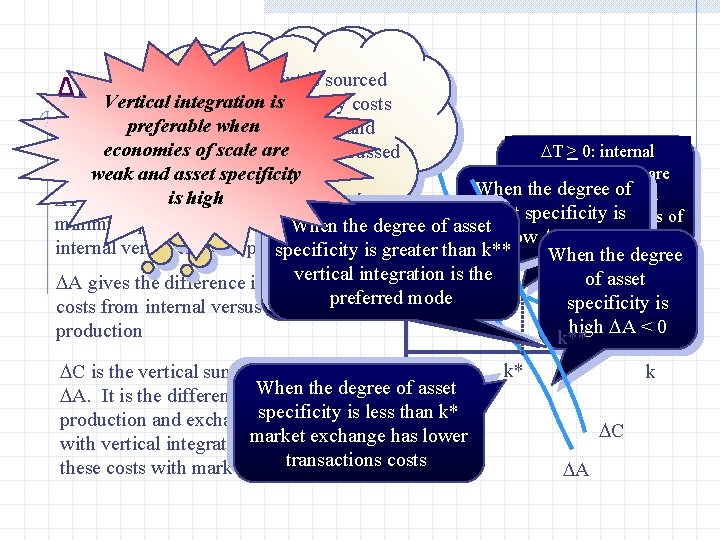
If the input purchased If the is input is sourced an outside suppliercosts Verticalfrom integration is agency internally agency include and preferable when arecosts the agency negotiation, writing and economies of scale are DT > 0: internal influence costs discussed k measures asset specificity production costs are enforcing contracts weak and asset specificity $ before When the degree never lowerofthan is high in DT gives the difference assetexternal specificity is - economies of minimum production cost from Whenthe thedegreeofofasset When low DA >scale 0 internal versus external production specificity than k** specificityisisgreater less than k** When the degree vertical integrationis isthethe market exchange of asset DA gives the difference in agency preferredmode specificity is costs from internal versus externalpreferred DT high DA < 0 production k** An illustration DC is the vertical sum of DT and When the degree of asset DA. It is the difference between is less than k* production and exchangespecificity costs with vertical integrationmarket and exchange has lower transactions costs these costs with market exchange k* k DC DA
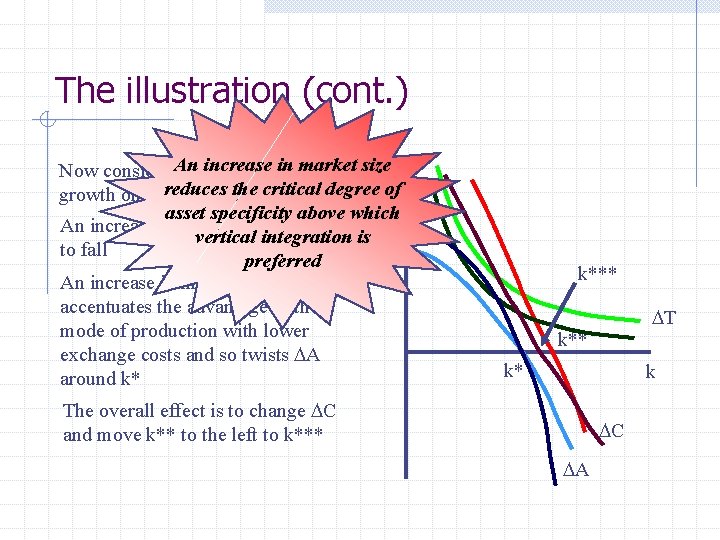
The illustration (cont. ) market size Now consider An the increase impact ofinmarket $ reduces the critical degree growth on the internal/external choice of asset specificity above which An increase in market size causes DT vertical integration is to fall preferred An increase in market size accentuates the advantage of the mode of production with lower exchange costs and so twists DA around k* k*** DT k** k* k The overall effect is to change DC and move k** to the left to k*** DC DA
Vertical integration (cont. ) Three important conclusions Scale and scope economies n gain less from vertical integration when scale and scope economies are strong Product market scale and growth n gain more from vertical integration in large and growing markets Asset specificity n gain more from vertical integration when production involves investment in relationship-specific assets Consistent with much real-world evidence
Vertical Integration and Asset Ownership Resolution of make-or-buy decision determines ownership n if right of use is granted the owner retains residual rights of control When ownership is transferred control rights are lost With complete contracts ownership does not matter n contracts specify obligations and rewards With incomplete contracts ownership affects investment in relationship-specific assets n form of integration (backward/forward) affects investment in relationship-specific assets
Asset ownership (cont. ) Possession of residual control improves bargaining power over operating decisions n n capture more of the economic value created more likely to invest in relationship-specific assets Implies that vertical integration is desirable and residual control should be exercised by: n the unit whose investment in relationship-specific assets has the greatest impact on value creation Further implies that “partial” vertical integration is possible n retain ownership of specialized machinery, dies used by outside contractors
Process Issues in Vertical Mergers The desirability of a vertical merger is affected by its impact on technical and agency efficiency It is also affected by governance issues n n n managers of the acquired unit have to cede control postmerger but they must be given decision-making power commensurate with their control over specialized resources e. g. human capital decision-making rights should be given to managers with the greatest influence in performance and profitability w if success depends on synergies associated with physical assets, centralize w if success depends on specialized knowledge of acquired managers, decentralize
Process issues (cont. ) The governance structure that emerges may well exhibit path dependence n past circumstances determine governance structure w immediate post-merger conflict undermines the potential for future cooperation n affects relationship between parent and a spun-off unit w may maintain long-term informal association n affects capacity to sell outside the vertically integrated unit w internal division does not usually have this expertise: the external market is a distraction w an acquired supplier does have this expertise: it had marketing capacity prior to acquisition
Alternatives to Vertical Integration There at least four alternatives n n tapered integration joint venture/strategic alliance collaborative relationships between buyers and sellers long-term implicit contracts
Tapered integration Mixture of vertical integration and market exchange n produce some internally and purchase the remainder w Coca-Cola and Pepsi own some bottlers and contract with others Three benefits n n n expands input and output channels without substantial capital outlay use internal costs and profits to influence external negotiations and external supplier as a yardstick to control internal division protects against the threat of hold-up by external suppliers But n sacrifices economies of scale; makes coordination more difficult; makes monitoring more difficult
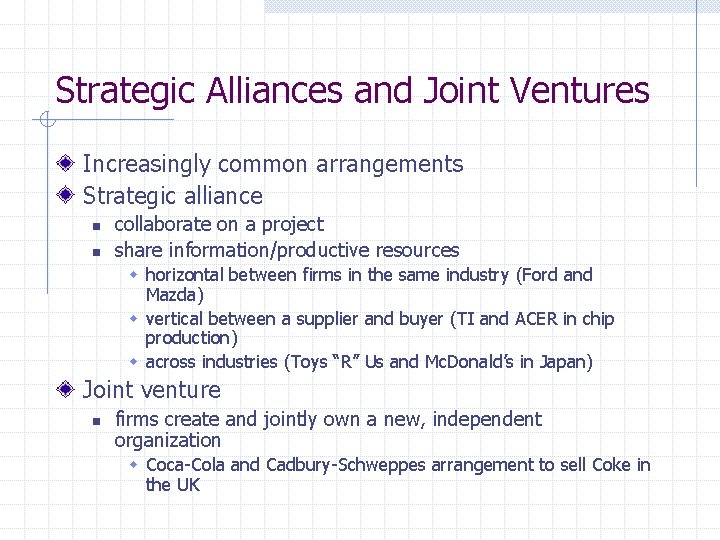
Strategic Alliances and Joint Ventures Increasingly common arrangements Strategic alliance n n collaborate on a project share information/productive resources w horizontal between firms in the same industry (Ford and Mazda) w vertical between a supplier and buyer (TI and ACER in chip production) w across industries (Toys “R” Us and Mc. Donald’s in Japan) Joint venture n firms create and jointly own a new, independent organization w Coca-Cola and Cadbury-Schweppes arrangement to sell Coke in the UK
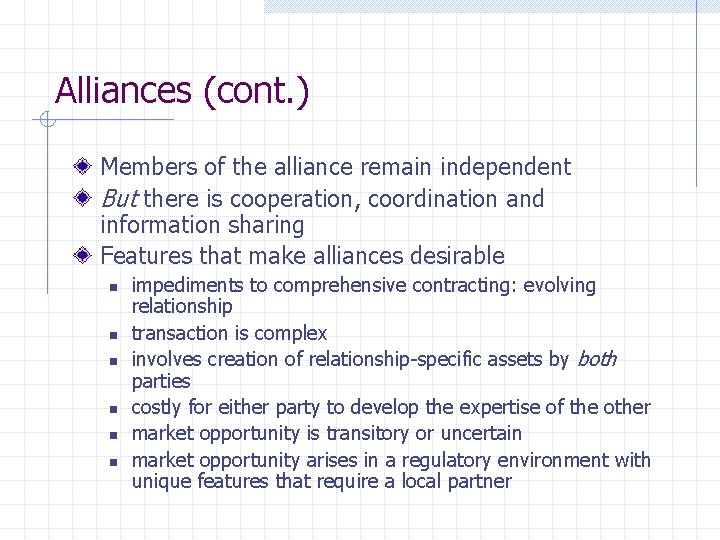
Alliances (cont. ) Members of the alliance remain independent But there is cooperation, coordination and information sharing Features that make alliances desirable n n n impediments to comprehensive contracting: evolving relationship transaction is complex involves creation of relationship-specific assets by both parties costly for either party to develop the expertise of the other market opportunity is transitory or uncertain market opportunity arises in a regulatory environment with unique features that require a local partner
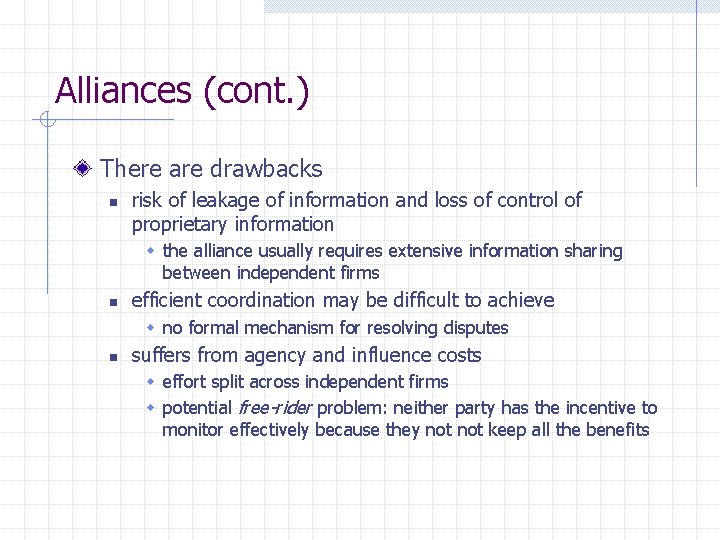
Alliances (cont. ) There are drawbacks n risk of leakage of information and loss of control of proprietary information w the alliance usually requires extensive information sharing between independent firms n efficient coordination may be difficult to achieve w no formal mechanism for resolving disputes n suffers from agency and influence costs w effort split across independent firms w potential free-rider problem: neither party has the incentive to monitor effectively because they not keep all the benefits
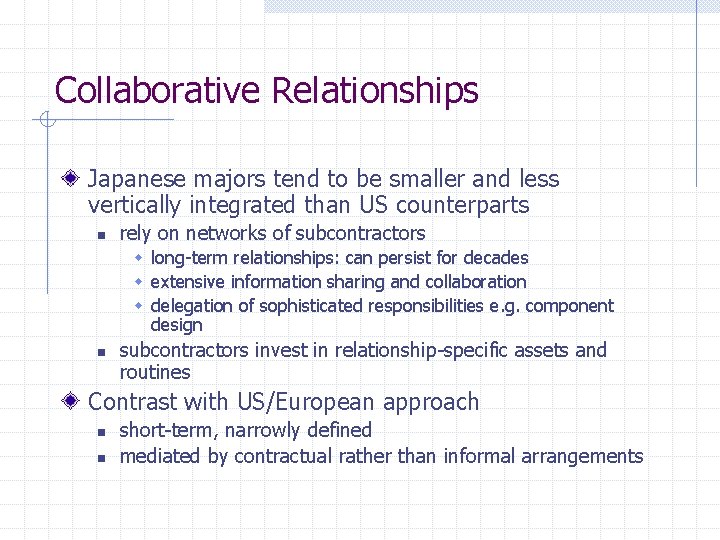
Collaborative Relationships Japanese majors tend to be smaller and less vertically integrated than US counterparts n rely on networks of subcontractors w long-term relationships: can persist for decades w extensive information sharing and collaboration w delegation of sophisticated responsibilities e. g. component design n subcontractors invest in relationship-specific assets and routines Contrast with US/European approach n n short-term, narrowly defined mediated by contractual rather than informal arrangements
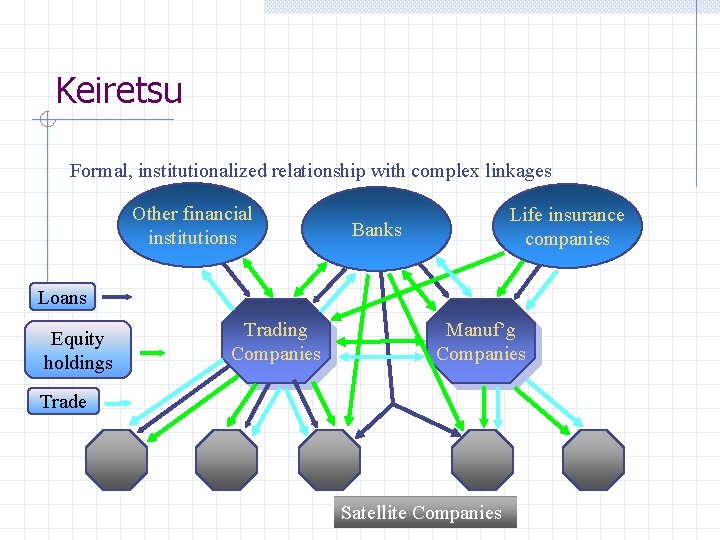
Keiretsu Formal, institutionalized relationship with complex linkages Other financial institutions Life insurance companies Banks Loans Equity holdings Trading Companies Manuf’g Companies Trade Satellite Companies
Long-Term Implicit Contracts Understandings between parties in a business relationship n n n implicit and so unenforceable in court enables coordination through formal planning and development of relationship-specific assets enforced by the underlying long-term nature of the relationship
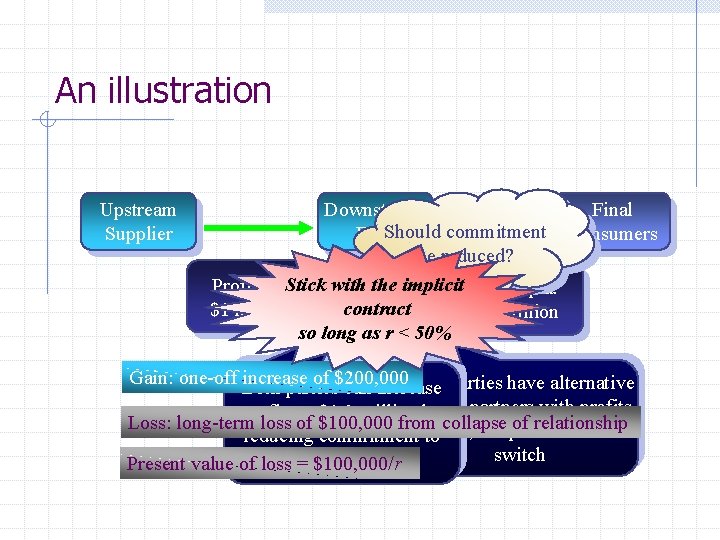
An illustration Upstream Supplier Downstream Final Should commitment Consumers Firm be reduced? Profit p. a. Stick with the implicit Profit p. a. contract $1 million so long as r < 50% Gain: one-off increase of $200, 000 Both parties have alternative Both parties can increase profits to $1. 2 milliontrading by partners with profits Loss: long-term loss of $100, 000 from collapse p. a. of relationship ofto $900, 000 if forced to reducing commitment switch the= relationship Present value of loss $100, 000/r
- Slides: 19