
ORGANIZING THE PROJECT FOR SUCCESSFUL IMPLEMENTATION Introduction Project

- Slides: 25
ORGANIZING THE PROJECT FOR SUCCESSFUL IMPLEMENTATION
Introduction Project management is the art of directing and coordinating human and material resources throughout the life of a project by using modern management techniques to achieve predetermined objectives of scope, cost, time, quality and participation satisfaction.
Introduction The success of an organization depends partly on its structure (the way in which tasks and responsibilities are formally allocated among its members) and partly on its management process (the way in which decisions are taken within the existing structure). The project organization must almost inevitably take direct responsibility for providing the necessary infrastructure and social services on new projects.
Meaning of Project Organizing The process of identifying inputs (Resources), defining roles and responsibilities, assigning roles and responsibilities, defining communication requirements and relationships (formal), preparing for implementation and achieving of project objectives. Often referred to as implementation planning where there is planning scope of the project (WBS), Time scheduling (Activity bar charts) and organizing at operational level (implementation structures).
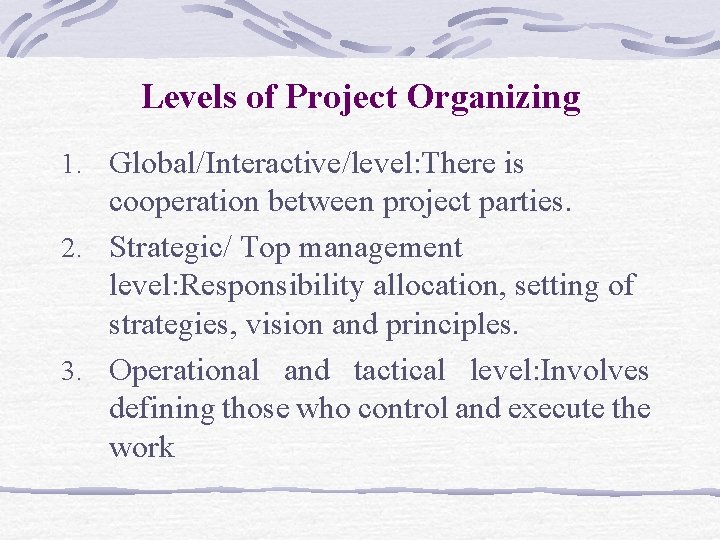
Levels of Project Organizing 1. Global/Interactive/level: There is cooperation between project parties. 2. Strategic/ Top management level: Responsibility allocation, setting of strategies, vision and principles. 3. Operational and tactical level: Involves defining those who control and execute the work
Steps in Project Organizing 1. Planning of the Project Scope management procedures must be created and enforced to prevent "never ending project" syndrome. Constant scope changes, whether increases or decreases, cause confusion among project team members. The primary focus of scope management is on defining and controlling what is and is not included in the project. The project manager must work with other departments to clearly define the project scope. If the project scope is not defined properly, required work is missed, jeopardizing the project success. On the flip side, work outside the scope of the project may be done, hurting the budget.
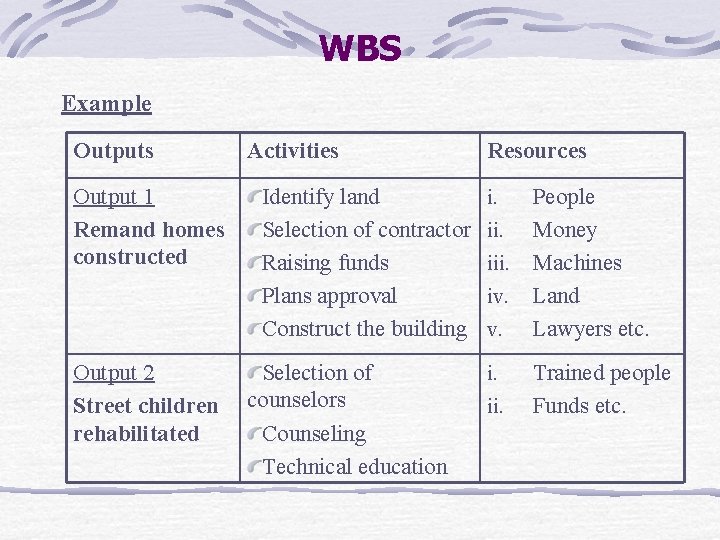
Planning of the Project Scope Project scope takes into account the extent and coverage of the project in terms of the amount of work to be done visa-viz the outputs. In determining the scope critically decide activities to achieve objectives: Ø List all activities to be performed Ø List expected end results Ø List resources to be consumed without tagging value. Ø Develop a Work Breakdown Structure shown below:
WBS Example Outputs Output 1 Remand homes constructed Output 2 Street children rehabilitated Activities Identify land Selection of contractor Raising funds Plans approval Construct the building Selection of counselors Counseling Technical education Resources People ii. Money iii. Machines iv. Land v. Lawyers etc. i. ii. Trained people Funds etc.
Steps in Project Organizing contd 2. Scheduling of Project activities Scheduling and organizing projects is one of the key issues in project management. You have lots of people, lots of sub projects, and many potentially conflicting political and organizational issues. It is extremely important to consider all of the issues and develop a clear, concise, and thorough project plan before starting the implementation. It focuses on tagging of project activities to time and estimating duration of project implementation process.
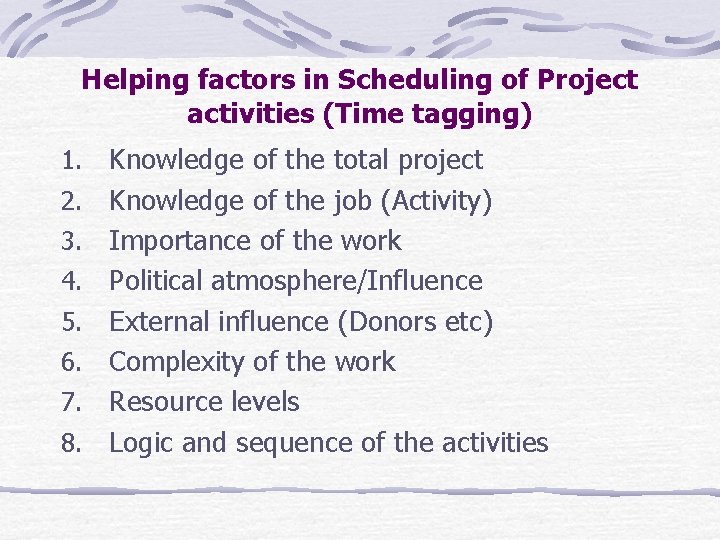
Helping factors in Scheduling of Project activities (Time tagging) 1. 2. 3. 4. 5. 6. 7. 8. Knowledge of the total project Knowledge of the job (Activity) Importance of the work Political atmosphere/Influence External influence (Donors etc) Complexity of the work Resource levels Logic and sequence of the activities
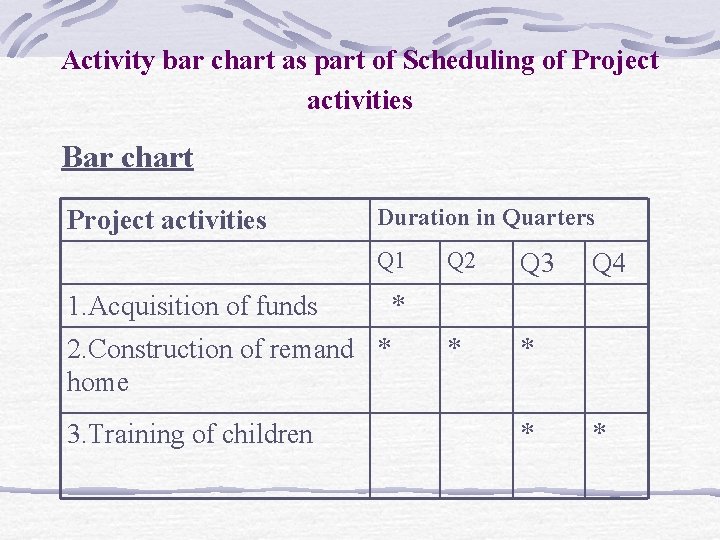
Activity bar chart as part of Scheduling of Project activities Bar chart Project activities Duration in Quarters Q 1 1. Acquisition of funds Q 3 * * Q 4 * 2. Construction of remand * home 3. Training of children Q 2 * *
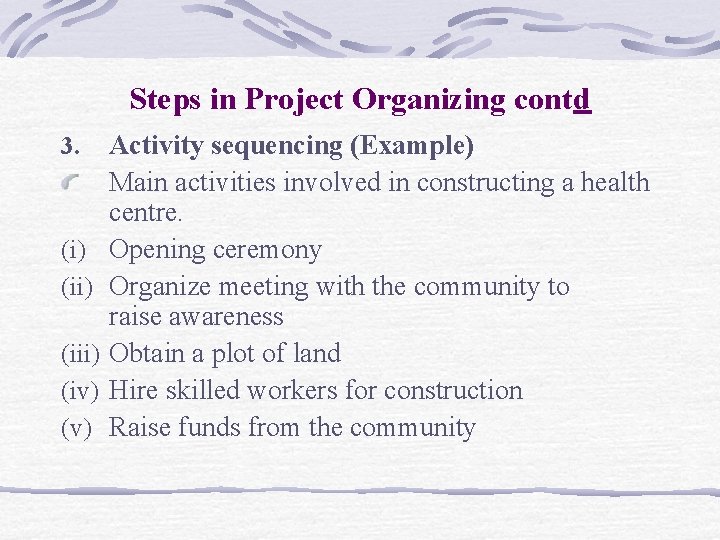
Steps in Project Organizing contd 3. (i) (iii) (iv) (v) Activity sequencing (Example) Main activities involved in constructing a health centre. Opening ceremony Organize meeting with the community to raise awareness Obtain a plot of land Hire skilled workers for construction Raise funds from the community
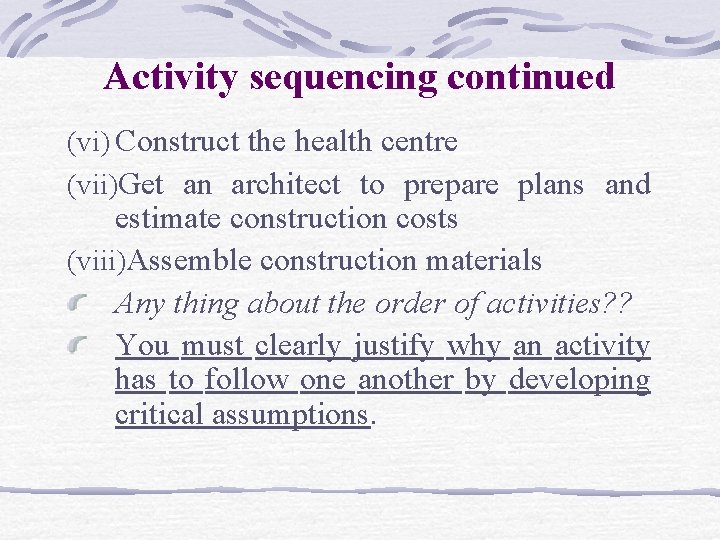
Activity sequencing continued (vi) Construct the health centre (vii)Get an architect to prepare plans and estimate construction costs (viii)Assemble construction materials Any thing about the order of activities? ? You must clearly justify why an activity has to follow one another by developing critical assumptions.
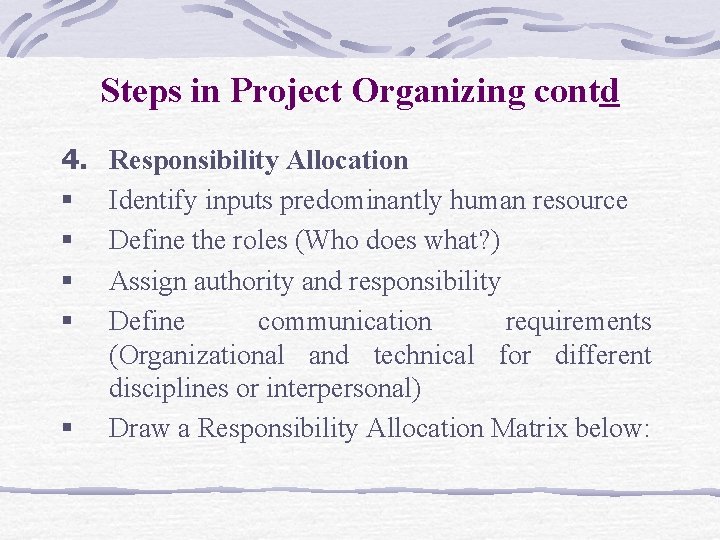
Steps in Project Organizing contd 4. Responsibility Allocation § Identify inputs predominantly human resource § Define the roles (Who does what? ) § Assign authority and responsibility § Define communication requirements (Organizational and technical for different disciplines or interpersonal) § Draw a Responsibility Allocation Matrix below:
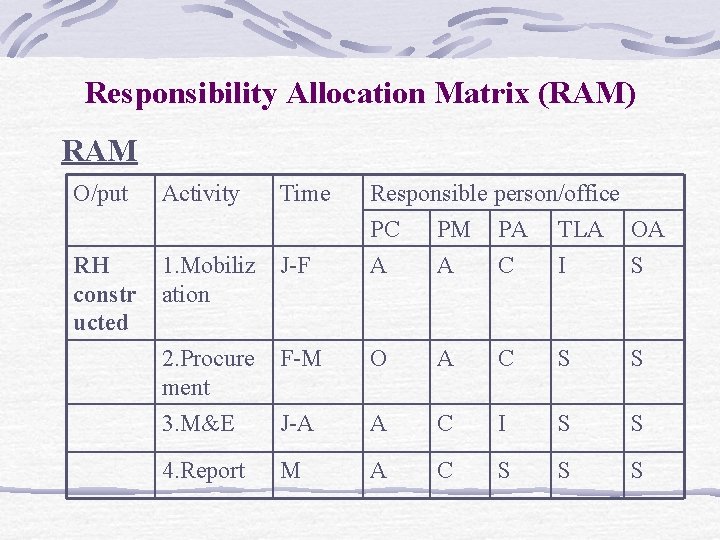
Responsibility Allocation Matrix (RAM) RAM O/put RH constr ucted Activity Time Responsible person/office 1. Mobiliz ation J-F PC A PM A PA C TLA I OA S 2. Procure ment 3. M&E F-M O A C S S J-A A C I S S 4. Report M A C S S S
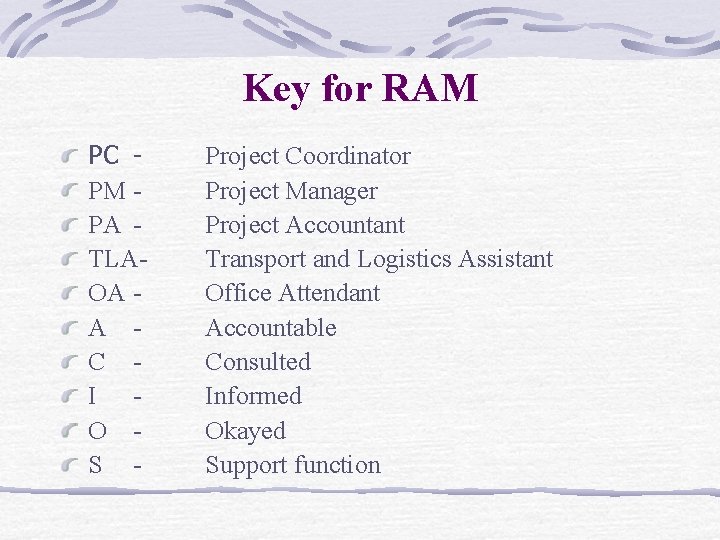
Key for RAM PC PM PA TLAOA A C I O S - Project Coordinator Project Manager Project Accountant Transport and Logistics Assistant Office Attendant Accountable Consulted Informed Okayed Support function
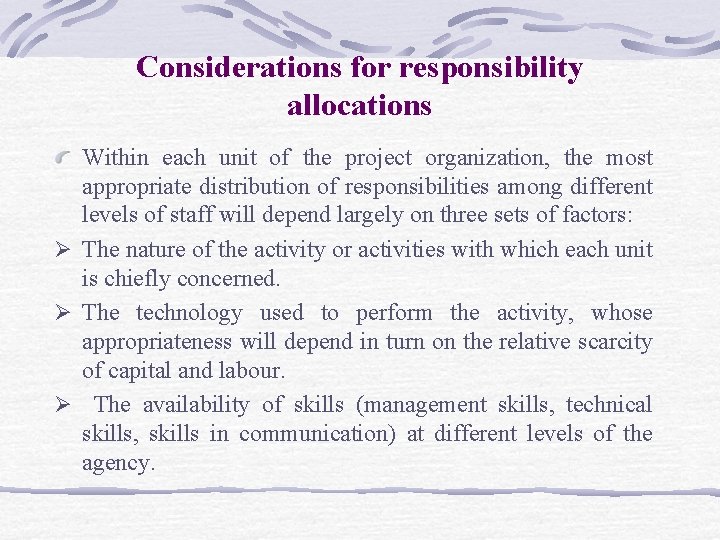
Considerations for responsibility allocations Within each unit of the project organization, the most appropriate distribution of responsibilities among different levels of staff will depend largely on three sets of factors: Ø The nature of the activity or activities with which each unit is chiefly concerned. Ø The technology used to perform the activity, whose appropriateness will depend in turn on the relative scarcity of capital and labour. Ø The availability of skills (management skills, technical skills, skills in communication) at different levels of the agency.
Steps in Project Organizing contd 5. The project Implementation Network analysis Assign time to the activities and determine the preceding and succeeding activities. For example: A company is to initiate a project to study the feasibility of a new product. The end result of the feasibility project will be a report recommending the action to be taken on the new product. The activities to be carried out to complete the feasibility are detailed below:
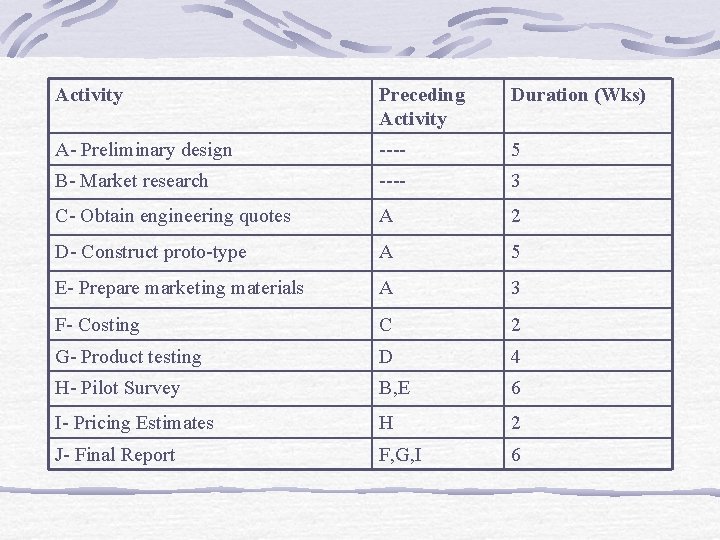
Activity Preceding Activity Duration (Wks) A- Preliminary design ---- 5 B- Market research ---- 3 C- Obtain engineering quotes A 2 D- Construct proto-type A 5 E- Prepare marketing materials A 3 F- Costing C 2 G- Product testing D 4 H- Pilot Survey B, E 6 I- Pricing Estimates H 2 J- Final Report F, G, I 6
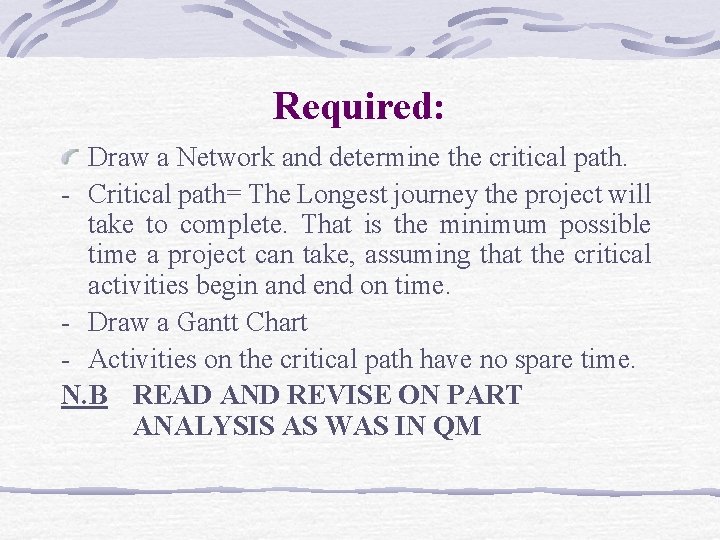
Required: Draw a Network and determine the critical path. - Critical path= The Longest journey the project will take to complete. That is the minimum possible time a project can take, assuming that the critical activities begin and end on time. - Draw a Gantt Chart - Activities on the critical path have no spare time. N. B READ AND REVISE ON PART ANALYSIS AS WAS IN QM
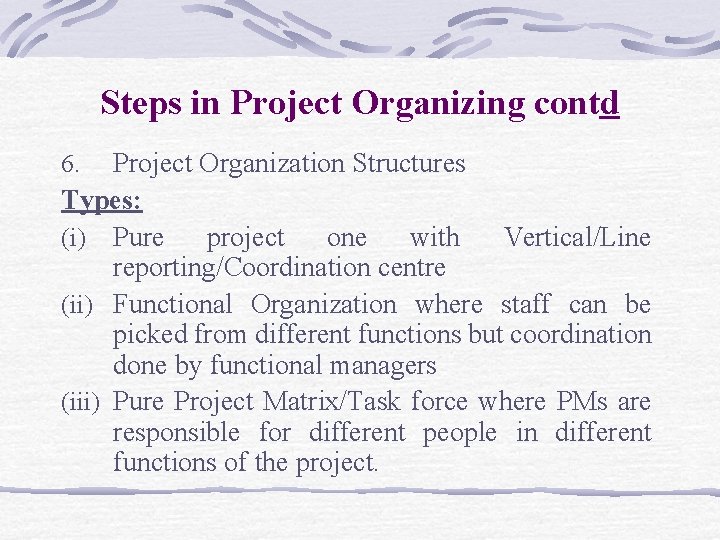
Steps in Project Organizing contd Project Organization Structures Types: (i) Pure project one with Vertical/Line reporting/Coordination centre (ii) Functional Organization where staff can be picked from different functions but coordination done by functional managers (iii) Pure Project Matrix/Task force where PMs are responsible for different people in different functions of the project. 6.
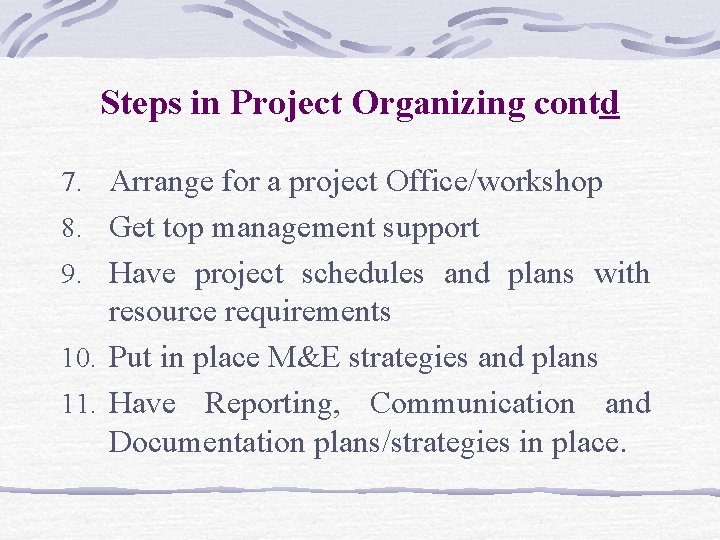
Steps in Project Organizing contd 7. Arrange for a project Office/workshop 8. Get top management support 9. Have project schedules and plans with resource requirements 10. Put in place M&E strategies and plans 11. Have Reporting, Communication and Documentation plans/strategies in place.
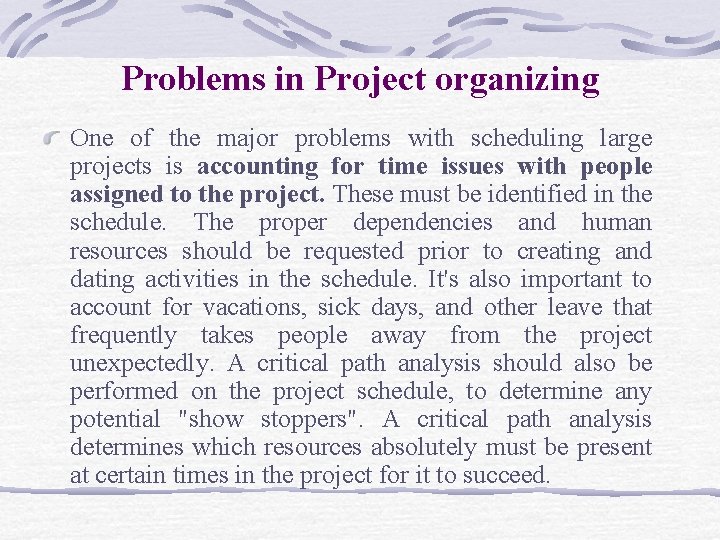
Problems in Project organizing One of the major problems with scheduling large projects is accounting for time issues with people assigned to the project. These must be identified in the schedule. The proper dependencies and human resources should be requested prior to creating and dating activities in the schedule. It's also important to account for vacations, sick days, and other leave that frequently takes people away from the project unexpectedly. A critical path analysis should also be performed on the project schedule, to determine any potential "show stoppers". A critical path analysis determines which resources absolutely must be present at certain times in the project for it to succeed.
Problems in Project organizing contd Brainstorming EXERCISE
END THANK YOU