
Organizing the Elements In the periodic table the
Organizing the Elements In the periodic table, the elements are arranged by increasing atomic number and by changes in physical and chemical properties from left to right. • In the late 1800 s, Dmitri Mendeleev, a Russian chemist, searched for a way to organize the elements. • When he arranged all the elements known at that time in order of increasing atomic masses, he discovered a pattern. • Because the pattern repeated, it was considered to be periodic. Today, this arrangement is called a periodic table of elements. Copyright © Mc. Graw-Hill Education The Periodic Table
The Atom and the Periodic Table • The vertical columns in the periodic table are called groups, or families, and are numbered 1 through 18. • Elements in each group have similar properties. Copyright © Mc. Graw-Hill Education The Periodic Table
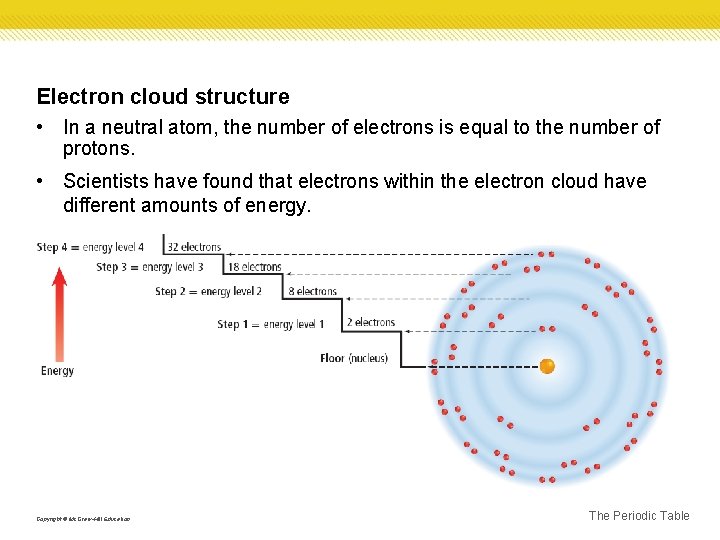
Electron cloud structure • In a neutral atom, the number of electrons is equal to the number of protons. • Scientists have found that electrons within the electron cloud have different amounts of energy. Copyright © Mc. Graw-Hill Education The Periodic Table
Energy levels • Energy levels closer to the nucleus have less energy than those levels that are farther away. • Electrons fill these energy levels from the inner levels (closer to the nucleus) to the outer levels (farther from the nucleus). • Elements that are in the same group have the same number of electrons in their outer energy level. • It is the number of electrons in the outer energy level that determines the chemical properties of the element. Copyright © Mc. Graw-Hill Education The Periodic Table

Energy levels • The maximum number of electrons that can be contained in each of the first four levels is shown. • A complete and stable outer energy level will contain eight electrons. Copyright © Mc. Graw-Hill Education The Periodic Table
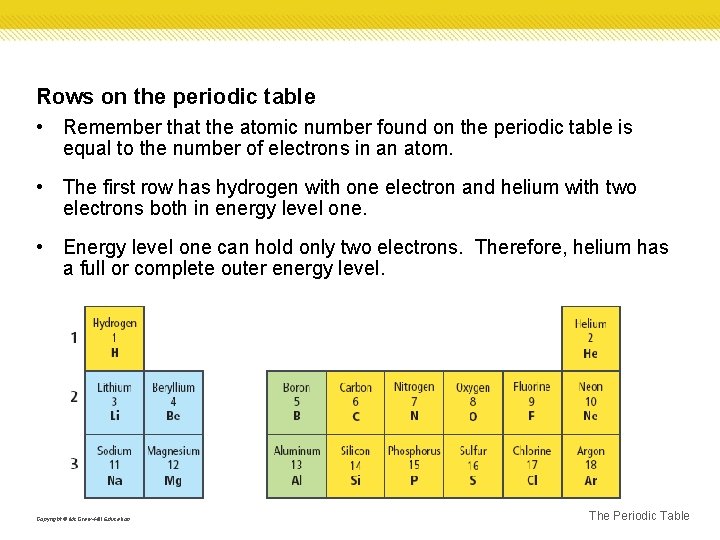
Rows on the periodic table • Remember that the atomic number found on the periodic table is equal to the number of electrons in an atom. • The first row has hydrogen with one electron and helium with two electrons both in energy level one. • Energy level one can hold only two electrons. Therefore, helium has a full or complete outer energy level. Copyright © Mc. Graw-Hill Education The Periodic Table
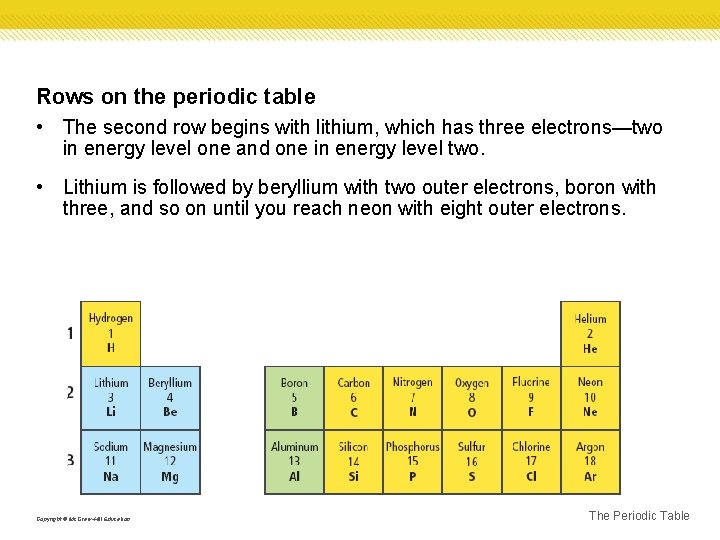
Rows on the periodic table • The second row begins with lithium, which has three electrons—two in energy level one and one in energy level two. • Lithium is followed by beryllium with two outer electrons, boron with three, and so on until you reach neon with eight outer electrons. Copyright © Mc. Graw-Hill Education The Periodic Table
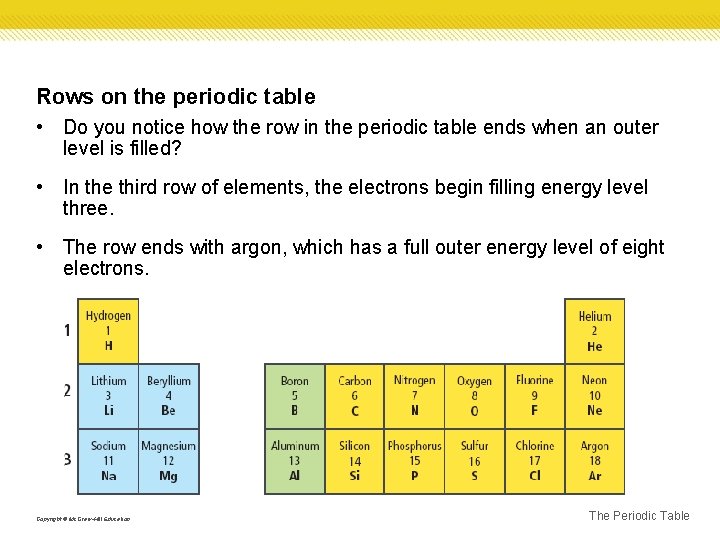
Rows on the periodic table • Do you notice how the row in the periodic table ends when an outer level is filled? • In the third row of elements, the electrons begin filling energy level three. • The row ends with argon, which has a full outer energy level of eight electrons. Copyright © Mc. Graw-Hill Education The Periodic Table
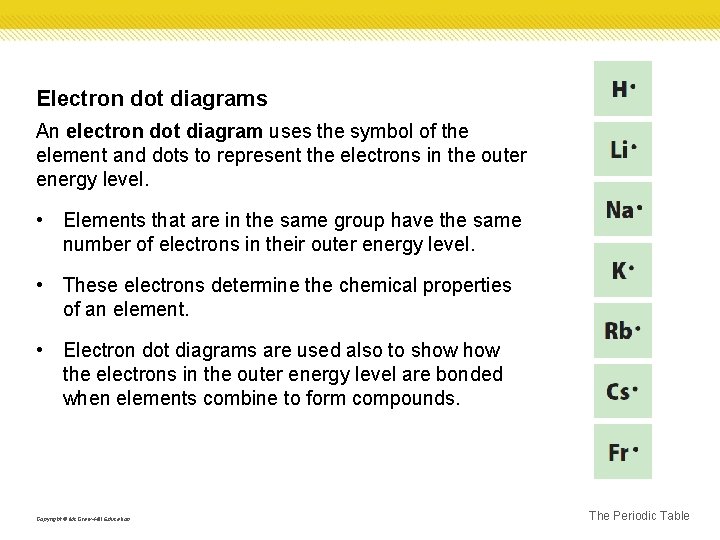
Electron dot diagrams An electron dot diagram uses the symbol of the element and dots to represent the electrons in the outer energy level. • Elements that are in the same group have the same number of electrons in their outer energy level. • These electrons determine the chemical properties of an element. • Electron dot diagrams are used also to show the electrons in the outer energy level are bonded when elements combine to form compounds. Copyright © Mc. Graw-Hill Education The Periodic Table
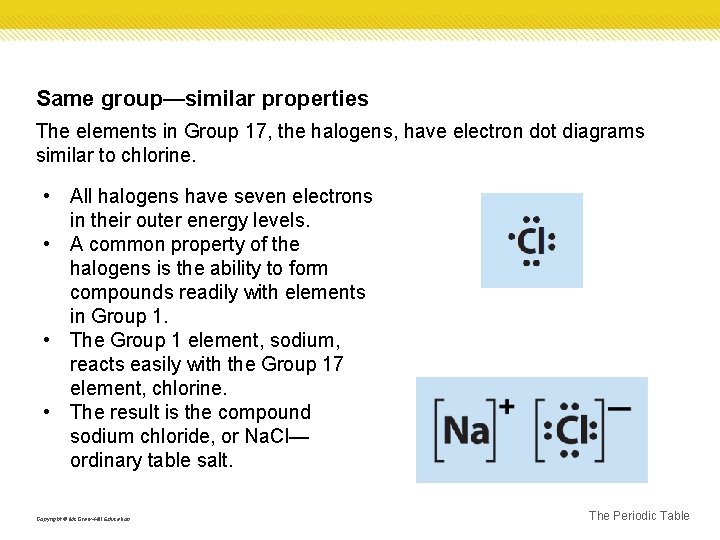
Same group—similar properties The elements in Group 17, the halogens, have electron dot diagrams similar to chlorine. • All halogens have seven electrons in their outer energy levels. • A common property of the halogens is the ability to form compounds readily with elements in Group 1. • The Group 1 element, sodium, reacts easily with the Group 17 element, chlorine. • The result is the compound sodium chloride, or Na. Cl— ordinary table salt. Copyright © Mc. Graw-Hill Education The Periodic Table
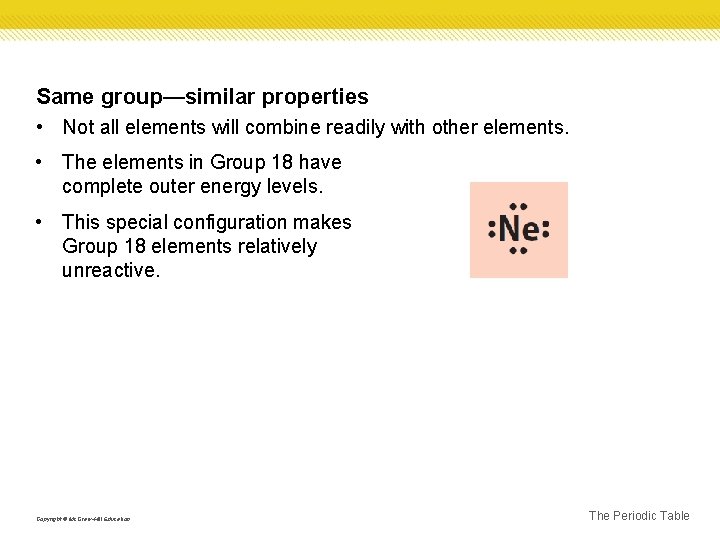
Same group—similar properties • Not all elements will combine readily with other elements. • The elements in Group 18 have complete outer energy levels. • This special configuration makes Group 18 elements relatively unreactive. Copyright © Mc. Graw-Hill Education The Periodic Table
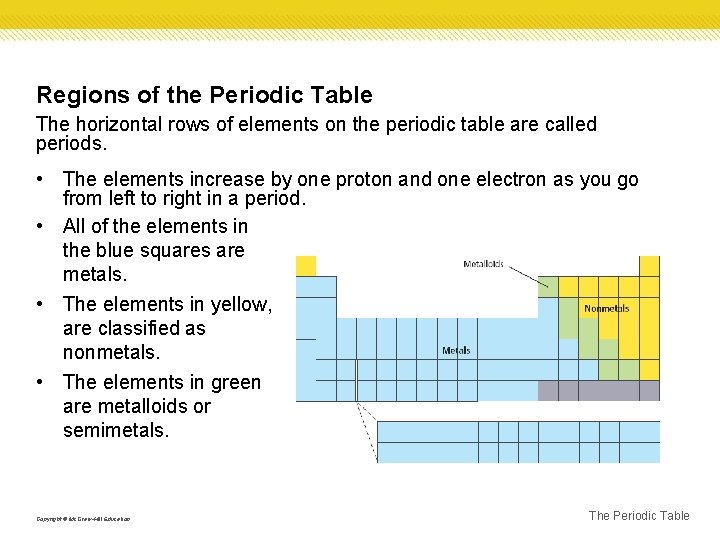
Regions of the Periodic Table The horizontal rows of elements on the periodic table are called periods. • The elements increase by one proton and one electron as you go from left to right in a period. • All of the elements in the blue squares are metals. • The elements in yellow, are classified as nonmetals. • The elements in green are metalloids or semimetals. Copyright © Mc. Graw-Hill Education The Periodic Table
Review Essential Questions • How is the periodic table organized? • What are the trends on the periodic table? • What are the properties of metals, nonmetals, and metalloids? Vocabulary • periodic table • period Copyright © Mc. Graw-Hill Education • group • electron dot diagram The Periodic Table
- Slides: 13