
Organizing is what you do before you do
"Organizing is what you do before you do something, so that when you do it, it is not all mixed up. " ~ A. A. Milne SORTING Lecture 11 CS 2110 – Fall 2017

Prelim 1 2 It's on Tuesday Evening (3/13) Two Sessions: 5: 30 -7: 00 PM: netid aa. . ks 7: 30 -9: 00 PM: netid kt. . zz If you have a conflict with your assigned time but can make the other time, fill out conflict assignment on CMS BY TOMORROW Three Rooms: We will email you Tuesday morning with your room Bring your Cornell ID!!!

Prelim 1 3 Recitation 5: prelim review Review Session: Sunday 3/11, 1 -3 pm in Kimball B 11 Study guide on course website
Why Sorting? 4 Sorting is useful Database indexing Operations research Compression There are lots of ways to sort There isn't one right answer You need to be able to figure out the options and decide which one is right for your application. Today, we'll learn about several different algorithms (and how to derive them)
Some Sorting Algorithms 5 Insertion sort Selection sort Merge sort Quick sort
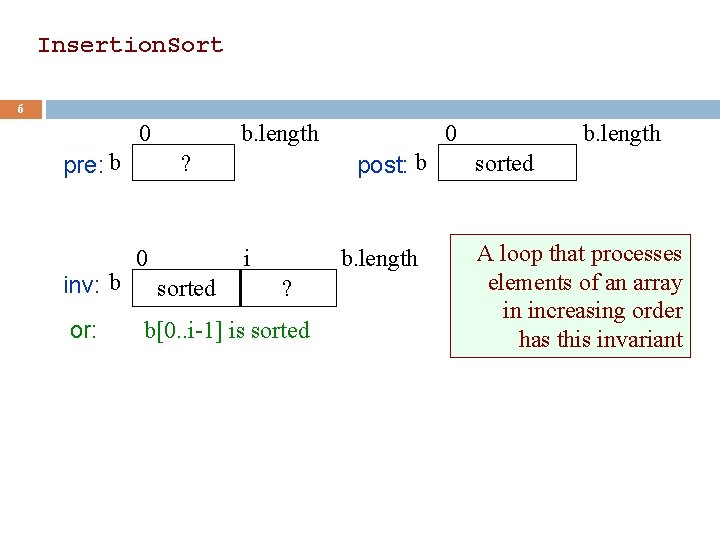
Insertion. Sort 6 0 pre: b inv: b or: b. length post: b ? 0 i sorted 0 b. length ? b[0. . i-1] is sorted b. length sorted A loop that processes elements of an array in increasing order has this invariant
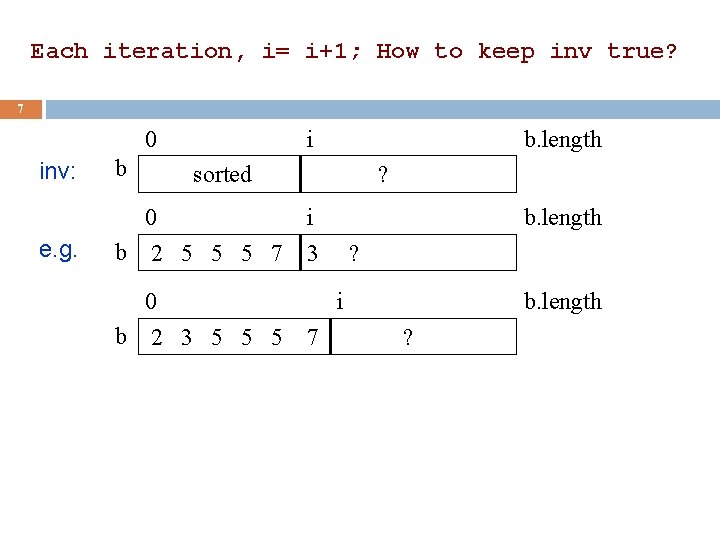
Each iteration, i= i+1; How to keep inv true? 7 0 i inv: b e. g. 0 b 2 5 5 5 7 sorted ? i 3 0 b b. length 2 3 5 5 5 b. length ? i 7 b. length ?
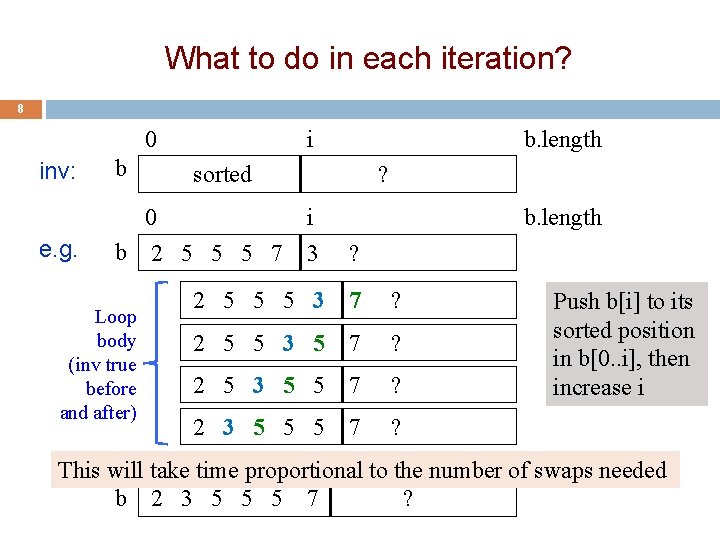
What to do in each iteration? 8 0 i inv: b e. g. 0 b 2 5 5 5 7 Loop body (inv true before and after) b. length sorted ? i 3 b. length ? 2 5 5 5 3 7 ? 2 5 5 3 5 7 ? 2 5 3 5 5 7 ? 2 3 5 5 5 7 ? Push b[i] to its sorted position in b[0. . i], then increase i i to the number ofb. length This will 0 take time proportional swaps needed b 2 3 5 5 5 7 ?
![Insertion Sort 9 // sort b[], an array of int // inv: b[0. .](http://slidetodoc.com/presentation_image_h2/d698df9dfb05634a5d87b87226092f56/image-9.jpg "Insertion Sort 9 // sort b[], an array of int // inv: b[0. .")
Insertion Sort 9 // sort b[], an array of int // inv: b[0. . i-1] is sorted for (int i= 0; i < b. length; i= i+1) { // Push b[i] down to its sorted // position in b[0. . i] Present algorithm like this } Note English statement in body. Abstraction. Says what to do, not how. This is the best way to present it. We expect you to present it this way when asked. Later, can show to implement that with an inner loop
![Insertion Sort 10 // sort b[], an array of int // inv: b[0. .](http://slidetodoc.com/presentation_image_h2/d698df9dfb05634a5d87b87226092f56/image-10.jpg "Insertion Sort 10 // sort b[], an array of int // inv: b[0. .")
Insertion Sort 10 // sort b[], an array of int // inv: b[0. . i-1] is sorted for (int i= 0; i < b. length; i= i+1) { // Push b[i] down to its sorted // position in b[0. . i] int k= i; while (k > 0 && b[k] < b[k-1]) { Swap b[k] and b[k-1] k= k– 1; } } invariant P: b[0. . i] is sorted except that b[k] may be < b[k-1] k i 2 5 3 5 5 7 ? example start? stop? progress? maintain invariant?
![Insertion Sort 11 // sort b[], an array of int // inv: b[0. .](http://slidetodoc.com/presentation_image_h2/d698df9dfb05634a5d87b87226092f56/image-11.jpg "Insertion Sort 11 // sort b[], an array of int // inv: b[0. .")
Insertion Sort 11 // sort b[], an array of int // inv: b[0. . i-1] is sorted for (int i= 0; i < b. length; i= i+1) { // Push b[i] down to its sorted // position in b[0. . i]} Pushing b[i] down can take i swaps. Worst case takes 1 + 2 + 3 + … n-1 = (n-1)*n/2 Swaps. Let n = b. length Worst-case: O(n 2) (reverse-sorted input) Best-case: O(n) (sorted input) Expected case: O(n 2)
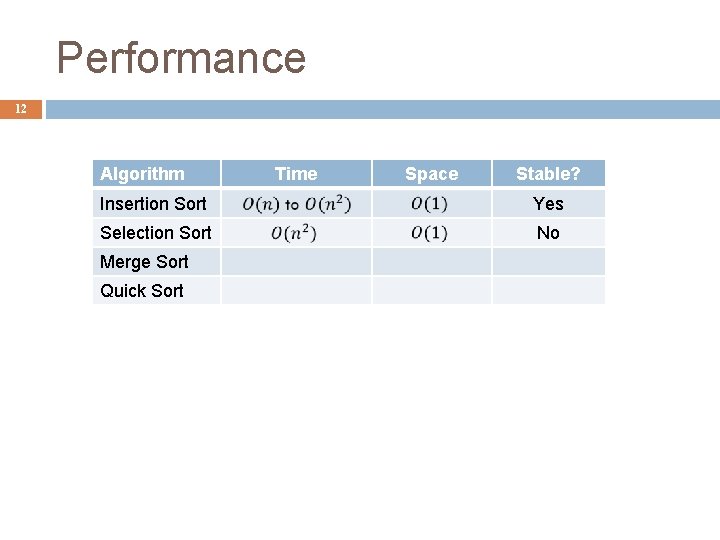
Performance 12 Algorithm Time Space Stable? Insertion Sort Yes Selection Sort Merge Sort No Merge Sort Quick Sort
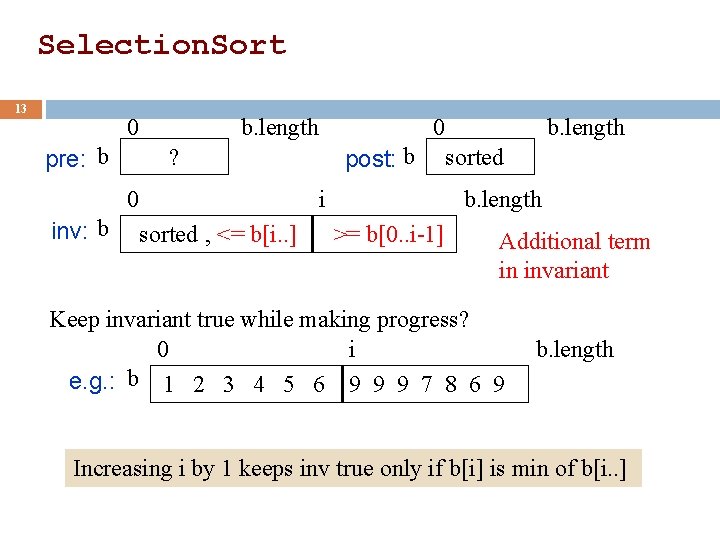
Selection. Sort 13 0 pre: b b. length post: b ? 0 inv: b 0 i sorted , <= b[i. . ] b. length sorted b. length >= b[0. . i-1] Additional term in invariant Keep invariant true while making progress? 0 i e. g. : b 1 2 3 4 5 6 9 9 9 7 8 6 9 b. length Increasing i by 1 keeps inv true only if b[i] is min of b[i. . ]
![Selection. Sort 14 //sort b[], an array of int // inv: b[0. . i-1]](http://slidetodoc.com/presentation_image_h2/d698df9dfb05634a5d87b87226092f56/image-14.jpg "Selection. Sort 14 //sort b[], an array of int // inv: b[0. . i-1]")
Selection. Sort 14 //sort b[], an array of int // inv: b[0. . i-1] sorted AND // b[0. . i-1] <= b[i. . ] for (int i= 0; i < b. length; i= i+1) { int m= index of minimum of b[i. . ]; Swap b[i] and b[m]; } 0 i b sorted, smaller values Another common way for people to sort cards Runtime with n = b. length § Worst-case O(n 2) § Best-case O(n 2) § Expected-case O(n 2) length larger values Each iteration, swap min value of this section into b[i]
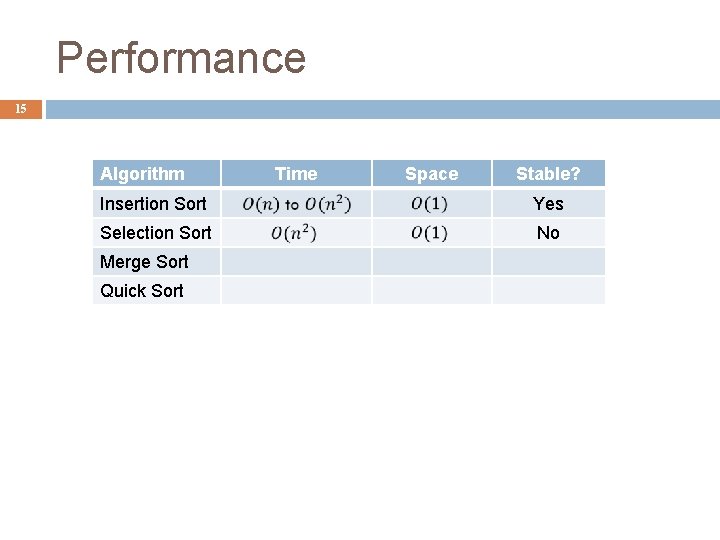
Performance 15 Algorithm Time Space Stable? Insertion Sort Yes Selection Sort No Merge Sort Quick Sort
![Merge two adjacent sorted segments 16 /* Sort b[h. . k]. Precondition: b[h. .](http://slidetodoc.com/presentation_image_h2/d698df9dfb05634a5d87b87226092f56/image-16.jpg "Merge two adjacent sorted segments 16 /* Sort b[h. . k]. Precondition: b[h. .")
Merge two adjacent sorted segments 16 /* Sort b[h. . k]. Precondition: b[h. . t] and b[t+1. . k] are sorted. */ public static merge(int[] b, int h, int t, int k) { } h t k b 4 7 7 8 9 3 4 7 8 h t sorted k sorted h b 3 4 4 7 7 7 8 8 9 k merged, sorted
![Merge two adjacent sorted segments 17 /* Sort b[h. . k]. Precondition: b[h. .](http://slidetodoc.com/presentation_image_h2/d698df9dfb05634a5d87b87226092f56/image-17.jpg "Merge two adjacent sorted segments 17 /* Sort b[h. . k]. Precondition: b[h. .")
Merge two adjacent sorted segments 17 /* Sort b[h. . k]. Precondition: b[h. . t] and b[t+1. . k] are sorted. */ public static merge(int[] b, int h, int t, int k) { Copy b[h. . t] into a new array c; Merge c and b[t+1. . k] into b[h. . k]; h t k } sorted h k merged, sorted
![Merge two adjacent sorted segments 18 // Merge sorted c and b[t+1. . k]](http://slidetodoc.com/presentation_image_h2/d698df9dfb05634a5d87b87226092f56/image-18.jpg "Merge two adjacent sorted segments 18 // Merge sorted c and b[t+1. . k]")
Merge two adjacent sorted segments 18 // Merge sorted c and b[t+1. . k] into b[h. . k] h t 0 t-h pre: b c x ? y post: b invariant: h b c 0 h k k x and y, sorted head of x u ? i tail of x c. length v k tail of y head of x and head of y, sorted x, y are sorted
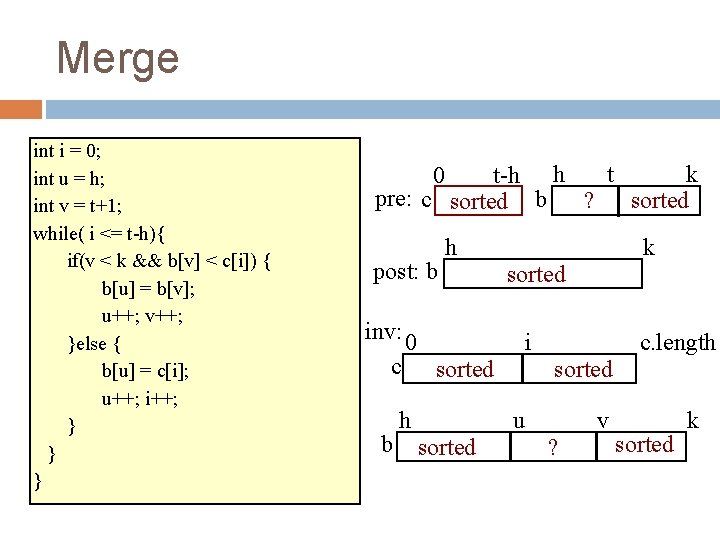
Merge 19 int i = 0; int u = h; int v = t+1; while( i <= t-h){ if(v < k && b[v] < c[i]) { b[u] = b[v]; u++; v++; }else { b[u] = c[i]; u++; i++; } } } t k t-h h pre: c sorted b ? sorted 0 post: b h k sorted inv: 0 c sorted b h i c. length sorted u sorted v ? sorted k
![Mergesort 20 /** Sort b[h. . k] */ public static void mergesort(int[] b, int](http://slidetodoc.com/presentation_image_h2/d698df9dfb05634a5d87b87226092f56/image-20.jpg "Mergesort 20 /** Sort b[h. . k] */ public static void mergesort(int[] b, int")
Mergesort 20 /** Sort b[h. . k] */ public static void mergesort(int[] b, int h, int k]) { if (size b[h. . k] < 2) return; h t k sorted int t= (h+k)/2; mergesort(b, h, t); mergesort(b, t+1, k); h k merged, sorted merge(b, h, t, k); }
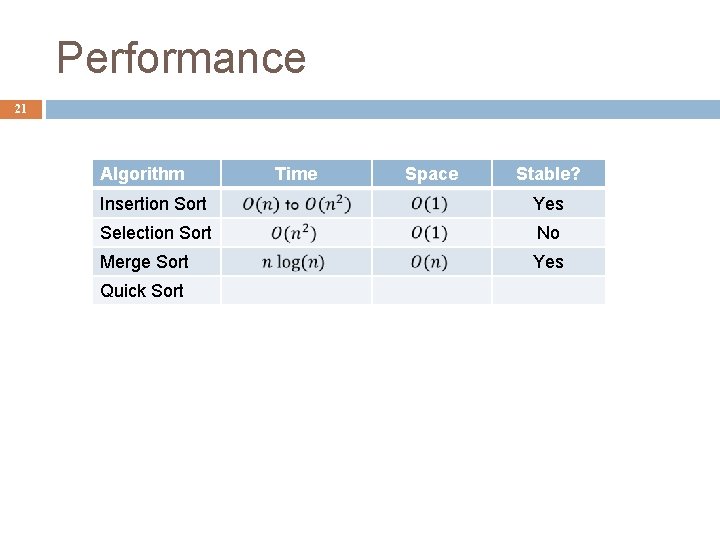
Performance 21 Algorithm Time Space Stable? Insertion Sort Yes Selection Sort Merge Sort No Yes Merge Sort Quick Sort Yes

Quick. Sort 22 Quicksort developed by Sir Tony Hoare (he was knighted by the Queen of England for his contributions to education and CS). 83 years old. Developed Quicksort in 1958. But he could not explain it to his colleague, so he gave up on it. Later, he saw a draft of the new language Algol 58 (which became Algol 60). It had recursive procedures. First time in a procedural programming language. “Ah!, ” he said. “I know how to write it better now. ” 15 minutes later, his colleague also understood it.
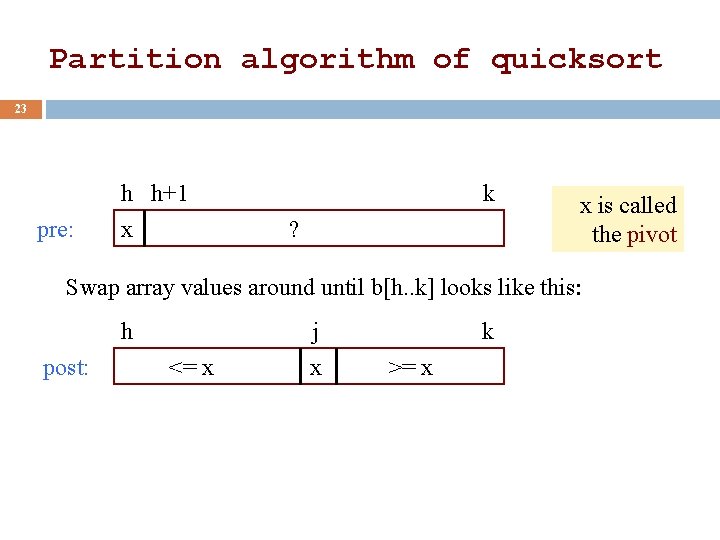
Partition algorithm of quicksort 23 h h+1 pre: x k ? x is called the pivot Swap array values around until b[h. . k] looks like this: h post: j <= x x k >= x
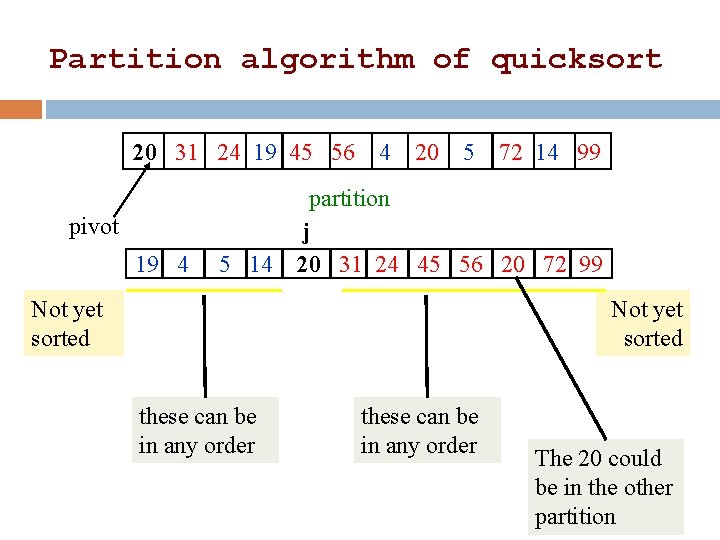
Partition algorithm of quicksort 20 31 24 19 45 56 24 pivot 19 4 4 20 5 72 14 99 partition j 5 14 20 31 24 45 56 20 72 99 Not yet sorted these can be in any order The 20 could be in the other partition
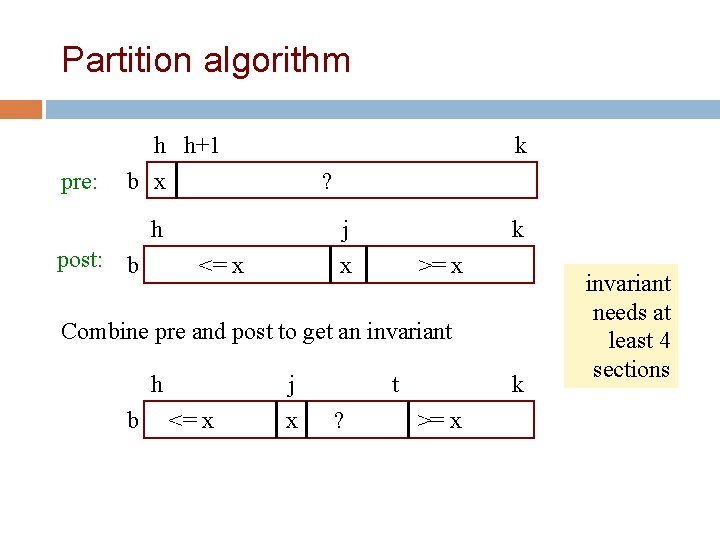
Partition algorithm 25 h h+1 pre: k b x ? h post: b j <= x k x >= x Combine pre and post to get an invariant h b j <= x x t ? k >= x invariant needs at least 4 sections
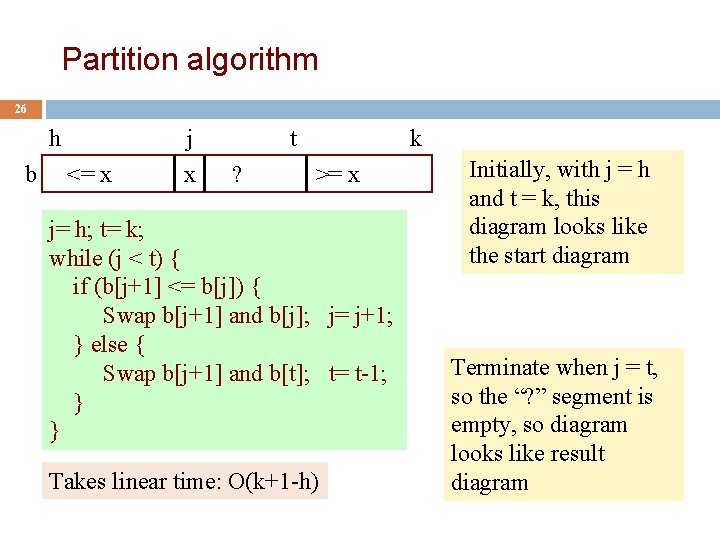
Partition algorithm 26 h b j <= x x t ? k >= x j= h; t= k; while (j < t) { if (b[j+1] <= b[j]) { Swap b[j+1] and b[j]; j= j+1; } else { Swap b[j+1] and b[t]; t= t-1; } } Takes linear time: O(k+1 -h) Initially, with j = h and t = k, this diagram looks like the start diagram Terminate when j = t, so the “? ” segment is empty, so diagram looks like result diagram
![Quick. Sort procedure 27 /** Sort b[h. . k]. */ public static void QS(int[]](http://slidetodoc.com/presentation_image_h2/d698df9dfb05634a5d87b87226092f56/image-27.jpg "Quick. Sort procedure 27 /** Sort b[h. . k]. */ public static void QS(int[]")
Quick. Sort procedure 27 /** Sort b[h. . k]. */ public static void QS(int[] b, int h, int k) { if (b[h. . k] has < 2 elements) return; Base case int j= partition(b, h, k); // We know b[h. . j– 1] <= b[j+1. . k] // Sort b[h. . j-1] and b[j+1. . k] QS(b, h, j-1); QS(b, j+1, k); Function does the partition algorithm and returns position j of pivot } h j <= x x k >= x
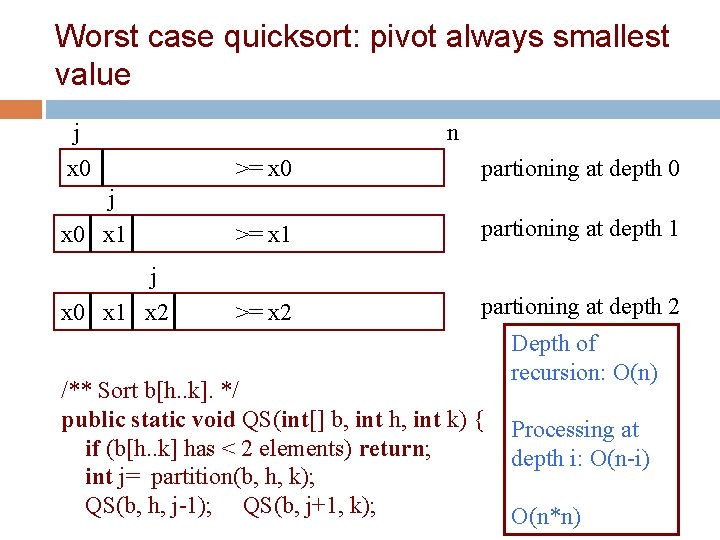
Worst case quicksort: pivot always smallest value 28 j n x 0 >= x 0 partioning at depth 0 >= x 1 partioning at depth 1 >= x 2 partioning at depth 2 j x 0 x 1 x 2 /** Sort b[h. . k]. */ public static void QS(int[] b, int h, int k) { if (b[h. . k] has < 2 elements) return; int j= partition(b, h, k); QS(b, h, j-1); QS(b, j+1, k); Depth of recursion: O(n) Processing at depth i: O(n-i) O(n*n)
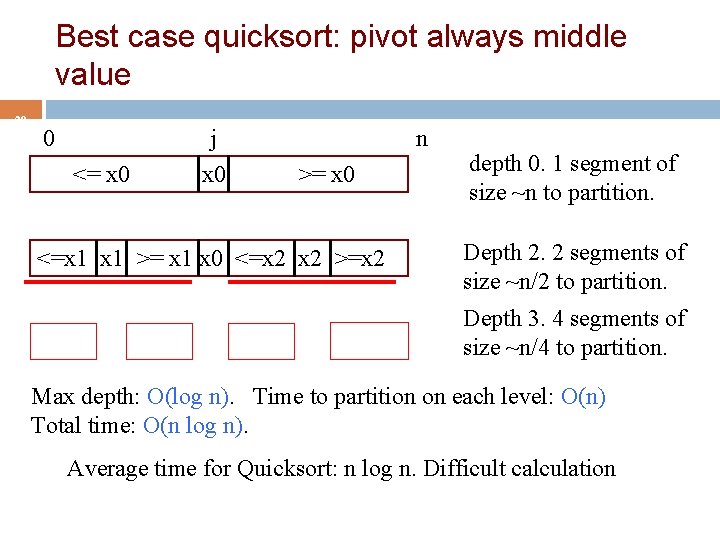
Best case quicksort: pivot always middle value 29 0 j <= x 0 n >= x 0 <=x 1 >= x 1 x 0 <=x 2 >=x 2 depth 0. 1 segment of size ~n to partition. Depth 2. 2 segments of size ~n/2 to partition. Depth 3. 4 segments of size ~n/4 to partition. Max depth: O(log n). Time to partition on each level: O(n) Total time: O(n log n). Average time for Quicksort: n log n. Difficult calculation
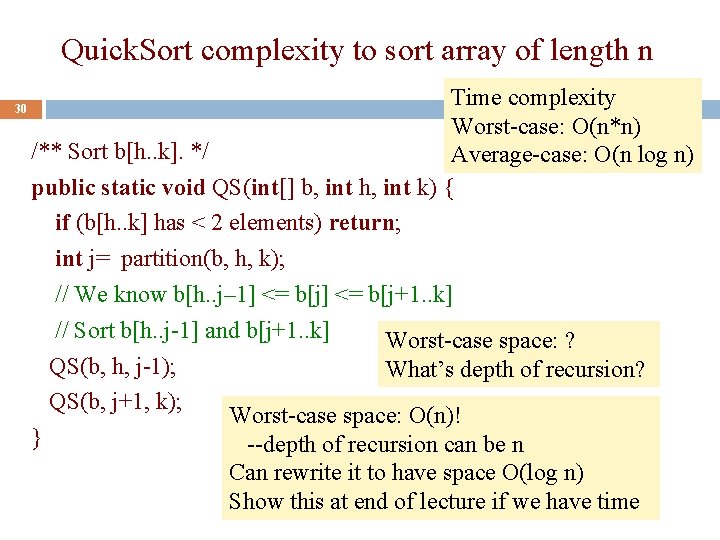
Quick. Sort complexity to sort array of length n 30 Time complexity Worst-case: O(n*n) /** Sort b[h. . k]. */ Average-case: O(n log n) public static void QS(int[] b, int h, int k) { if (b[h. . k] has < 2 elements) return; int j= partition(b, h, k); // We know b[h. . j– 1] <= b[j+1. . k] // Sort b[h. . j-1] and b[j+1. . k] Worst-case space: ? QS(b, h, j-1); What’s depth of recursion? QS(b, j+1, k); Worst-case space: O(n)! } --depth of recursion can be n Can rewrite it to have space O(log n) Show this at end of lecture if we have time
![Quick. Sort versus Merge. Sort 31 /** Sort b[h. . k] */ public static](http://slidetodoc.com/presentation_image_h2/d698df9dfb05634a5d87b87226092f56/image-31.jpg "Quick. Sort versus Merge. Sort 31 /** Sort b[h. . k] */ public static")
Quick. Sort versus Merge. Sort 31 /** Sort b[h. . k] */ public static void QS (int[] b, int h, int k) { if (k – h < 1) return; int j= partition(b, h, k); QS(b, h, j-1); QS(b, j+1, k); } /** Sort b[h. . k] */ public static void MS (int[] b, int h, int k) { if (k – h < 1) return; MS(b, h, (h+k)/2); MS(b, (h+k)/2 + 1, k); merge(b, h, (h+k)/2, k); } One processes the array then recurses. One recurses then processes the array.
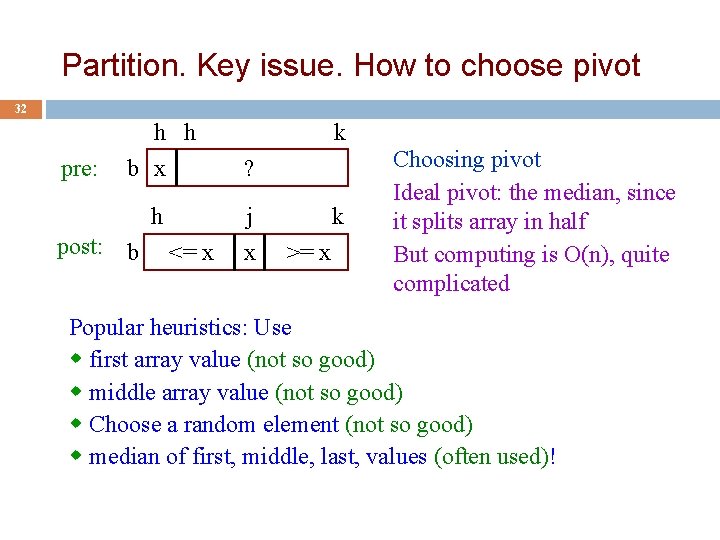
Partition. Key issue. How to choose pivot 32 h h pre: k b x ? h j post: b <= x x k >= x Choosing pivot Ideal pivot: the median, since it splits array in half But computing is O(n), quite complicated Popular heuristics: Use w first array value (not so good) w middle array value (not so good) w Choose a random element (not so good) w median of first, middle, last, values (often used)!
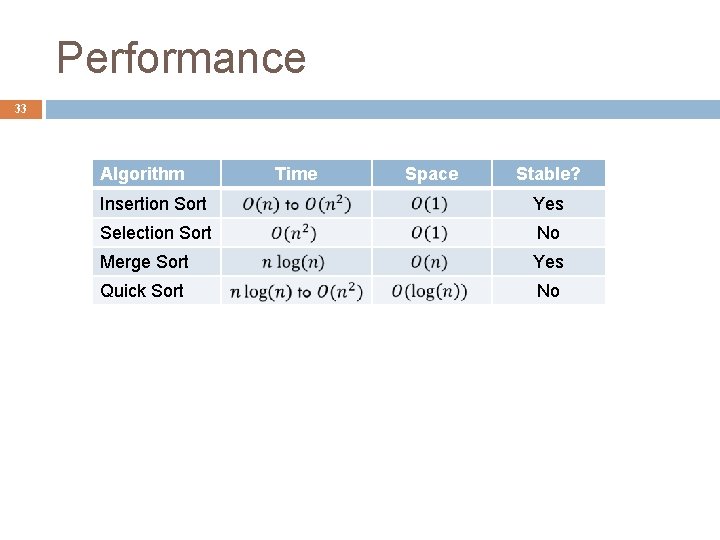
Performance 33 Algorithm Time Space Stable? Insertion Sort Yes Selection Sort No Merge Sort Yes Quick Sort No
Sorting in Java 34 Java. util. Arrays has a method Sort() implemented as a collection of overloaded methods for primitives, Sort is implemented with a version of quicksort for Objects that implement Comparable, Sort is implemented with mergesort Tradeoff between speed/space and stability/performance guarantees
Quicksort with logarithmic space 35 Problem is that if the pivot value is always the smallest (or always the largest), the depth of recursion is the size of the array to sort. Eliminate this problem by doing some of it iteratively and some recursively. We may show you this later. Not today!
![Quick. Sort with logarithmic space 36 /** Sort b[h. . k]. */ public static](http://slidetodoc.com/presentation_image_h2/d698df9dfb05634a5d87b87226092f56/image-36.jpg "Quick. Sort with logarithmic space 36 /** Sort b[h. . k]. */ public static")
Quick. Sort with logarithmic space 36 /** Sort b[h. . k]. */ public static void QS(int[] b, int h, int k) { int h 1= h; int k 1= k; // invariant b[h. . k] is sorted if b[h 1. . k 1] is sorted while (b[h 1. . k 1] has more than 1 element) { Reduce the size of b[h 1. . k 1], keeping inv true } }
![Quick. Sort with logarithmic space 37 /** Sort b[h. . k]. */ public static](http://slidetodoc.com/presentation_image_h2/d698df9dfb05634a5d87b87226092f56/image-37.jpg "Quick. Sort with logarithmic space 37 /** Sort b[h. . k]. */ public static")
Quick. Sort with logarithmic space 37 /** Sort b[h. . k]. */ public static void QS(int[] b, int h, int k) { int h 1= h; int k 1= k; // invariant b[h. . k] is sorted if b[h 1. . k 1] is sorted while (b[h 1. . k 1] has more than 1 element) { int j= partition(b, h 1, k 1); Only the smaller // b[h 1. . j-1] <= b[j+1. . k 1] segment is sorted if (b[h 1. . j-1] smaller than b[j+1. . k 1]) recursively. If b[h 1. . k 1] { QS(b, h, j-1); h 1= j+1; } has size n, the smaller else segment has size < n/2. {QS(b, j+1, k 1); k 1= j-1; } Therefore, depth of } recursion is at most log n }
- Slides: 37