
Organizing Informal Economy Challenges Initiatives of TUs Arun
- Slides: 14
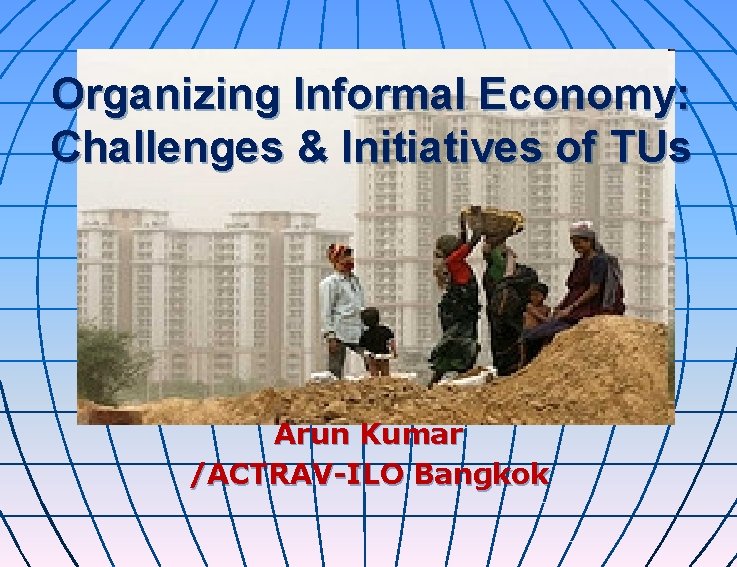
Organizing Informal Economy: Challenges & Initiatives of TUs Arun Kumar /ACTRAV-ILO Bangkok
What is Informal Economy? n n Activities (&employment) outside the purview of fiscal & labour laws? Not a homogenous sector; covers a wide variety of activities, enterprises and different types of workers with diverse employment relationships (Examples? ) Very difficult to arrive at a universally accepted 'definition' of informal sector or informal economy that would be applicable in all cases. Informal economy employment refers to & includes: - informal employment in informal enterprises n - informal employment outside informal enterprises
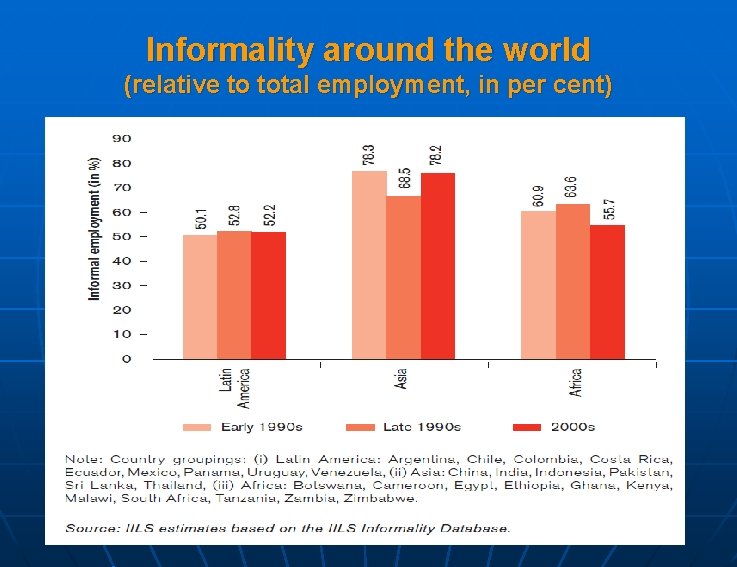
Informality around the world (relative to total employment, in per cent)
Informal Employment as % of total Non-Agricultural Employment 2004 -2010 n n n South Asia: 82% range: 62% in Sri Lanka to 84% in India [83% women, 82% men] East and Southeast Asia: 65% range: 42% in Thailand to 73% in Indonesia [64% women, 65% men – excludes China] Source: http: //wiego. org/informal-economy/statistical-picture
Organizing Infoormal Economy workers q q q Questions to be considered Why should a informal economy worker join the union? What can union give them? How have we been organizing so far? What new strategies can we develop for organizing and strengthening TUs? 5
TUS & Informal Economy n è è n n Many efforts to organize & improve conditions of work in informal economy - Union strategies & programmes include: Create organizing cell for unorganized workers Provide legal aid & legal battles for regularizing contract workers, domestic workers, migrants, Public demonstrations & demands on the govt for law Actions to eliminate employment of child labour Unions campaigns generally focus on - organizing, minimum wages, inflation compensation, social security & recognition of trade union rights Participants views…. what are their unions doing?
Hurdles in Organizing n n n Risk of denial of work & threat to livelihoods; Traditional form of organizing against a well-defined employer does not work – due to changing employers, changing work places, changing nature of work; Often the identity of the employers is hard to establish as per the existing requirements of the labour law; Inadequate coverage & rights under law (ex. home based workers, domestic workers, precarious workers); Limits of trade unions resources (cadres & finances);
Hurdles in Organizing n Women in informal economy & male dominated TUs – issues of access, understanding & gender perspective; n Inadequacies of the labour law administration as a hurdle; n Needs of the Informal economy workers & limits of TUs [micro-insurance, health care, access to markets, credit, training & welfare rather than negotiating against any one particular employer, although this is also needed in many cases] Very few trade unions play these roles or provide such social welfare services n What else?
Facing the Organizing Challenge Broadly speaking, TU Actions need to be taken at two levels q q Macro policy level – to create enabling environment for organizing In the field/workplace, at community level – where the workers are 9
Creating enabling environment ü What are the main demands of trade unions in your country? ü Campaigns at national level on issues such as – F F Right to Organise, to Union Recognition & Collective Bargaining Rights (ILO Conventions 87 & 98) Tripartitism & Social Dialogue – right to be represented in the decision making bodies F Building partnerships with other movements ü In your country context, what is needed? 10
Organizing Strategies 1. 2. TU resources limited - We cannot go out & organize each & every worker. SO, can we then think of a way to make workers come to us? Need to go beyond wage bargaining – into social welfare - linking with govt schemes for providing access to workers for social welfare programmes – such as in delivery of unemployment benefits (NORDIC and Belgian unions role) - Using group insurance schemes to provide social protection - health care, life insurance (Luxembourg, Netherlands, SEWA/India), 11
Organizing Strategies 3. 4. 5. 6. 7. Leveraging power of the other organized groups - for MNCs and those companies with Export interests in OECD countries – companies that are susceptible to consumer power – build links with international TUs (GUFs), NGOs and consumer movement. Workers in Global Supply Chains & Role of International/Global Framework Agreements Equal Pay campaign (such as in German Metal sector for agency workers through works agreement). Collective bargaining agreement to apply to workplace, and not restricted to just direct company employees Cyber space/internet as organizing tool 12
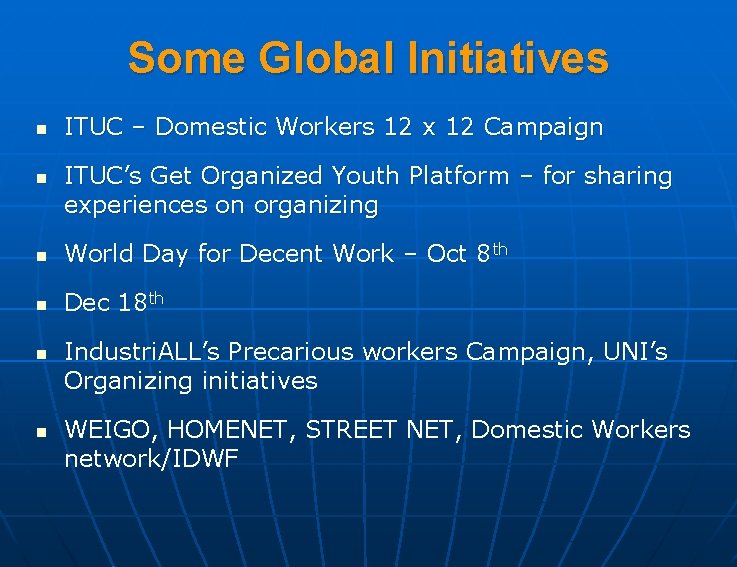
Some Global Initiatives n n ITUC – Domestic Workers 12 x 12 Campaign ITUC’s Get Organized Youth Platform – for sharing experiences on organizing n World Day for Decent Work – Oct 8 th n Dec 18 th n n Industri. ALL’s Precarious workers Campaign, UNI’s Organizing initiatives WEIGO, HOMENET, STREET NET, Domestic Workers network/IDWF
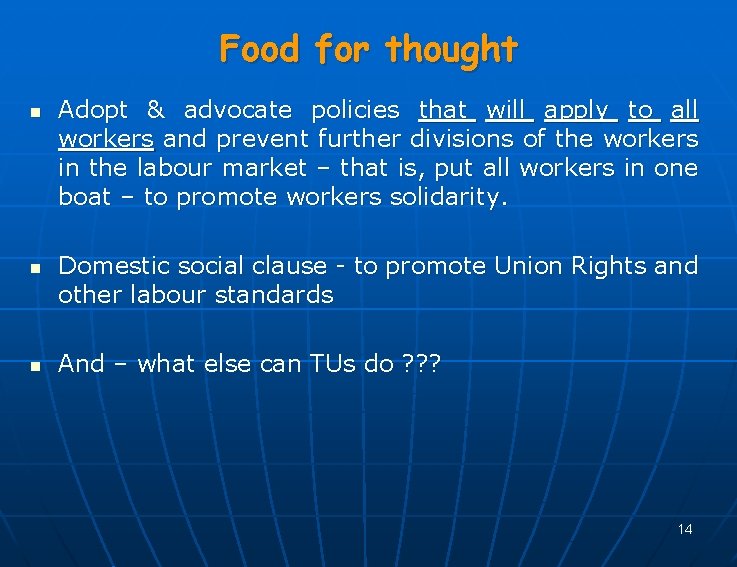
Food for thought n n n Adopt & advocate policies that will apply to all workers and prevent further divisions of the workers in the labour market – that is, put all workers in one boat – to promote workers solidarity. Domestic social clause - to promote Union Rights and other labour standards And – what else can TUs do ? ? ? 14