
Organizing for Innovation Brock Hinzmann Technology Navigator bhinzmannsbii
Organizing for Innovation Brock Hinzmann Technology Navigator bhinzmann@sbi-i. com www. strategicbusinessinsights. com/scan
45 Years of Innovation Dr. Joseph Mc. Pherson’s Long-Range Planning (SBI) reports on innovation management began in 1960 s. Stanford Research Institute (SRI International) Innovation Search in 1960 s, ‘ 70 s, ‘ 80 s; SBI’s Opportunity Discovery process today. Diffusion of Innovations, 1981, on how innovations spread within companies. Disappearance of central research labs, Internet, “New Economy, ” social networking, virtual environments, and globalization in 2000 s have brought change and uncertainty, but certainly new competition. 1
Organizing for and Managing Innovation So. C 476 2
Organizing for and Managing Innovation Models and processes to drive innovation have now proliferated to such an extent that simple strategies and one-dimensional approaches to stay atop have become infeasible. • Cocreation models attempt to design products and services in close collaboration with customers, although they can also turn customers and employees into competitors. • Crowdsourcing models outsource innovation by drawing upon a large, relatively undifferentiated group of people, including social networks, “X” prize competitions, and “grand” challenges. • Open innovation models attempt to tap into independent innovation sources, most often individual scientists, engineers, and do-it-yourself craftspeople and tinkerers. • Open source models look for intellectual property or designs that the inventors have made available free for use. • Sources of innovation that exploit new models appear now in developing economic regions in Asia, Latin America, Africa, and the Middle East. • Cities around the world attract young, talented, innovative people and create new centers of innovation to compete with each other to attract investment by the businesses that need them. So. C 476 3
Organizing for and Managing Innovation So. C 476 Staying atop innovation will require scanning a wide range of external environments and prioritizing innovations for use. Managing innovation will require understanding the cost and benefits of multiple models. A fluid organization is a networked enterprise that allows reorganization on the fly, depending on the innovation challenge and task at hand. Liquid innovation is marked by the ability to select and combine innovation concepts and models to leverage innovations across sources and geography. 4
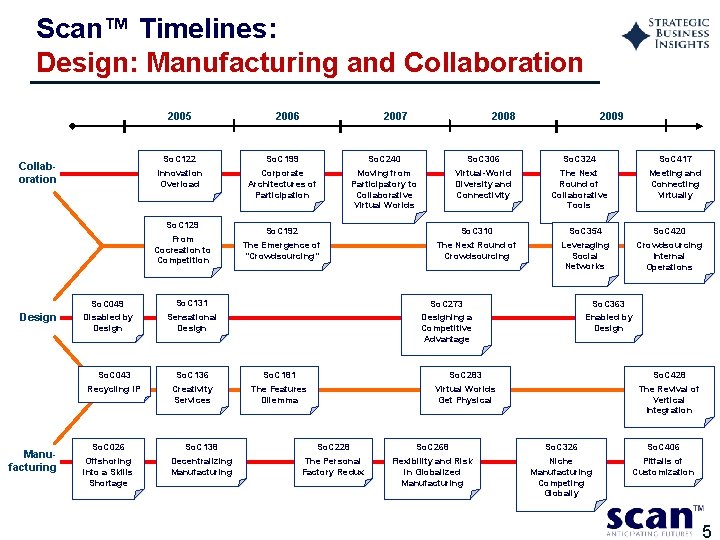
Scan™ Timelines: Design: Manufacturing and Collaboration 2005 Collaboration 2008 2009 So. C 122 So. C 199 So. C 240 So. C 306 So. C 324 So. C 417 Corporate Architectures of Participation Moving from Participatory to Collaborative Virtual Worlds Virtual-World Diversity and Connectivity The Next Round of Collaborative Tools Meeting and Connecting Virtually From Cocreation to Competition Manufacturing 2007 Innovation Overload So. C 129 Design 2006 So. C 192 So. C 310 So. C 354 So. C 420 The Emergence of “Crowdsourcing” The Next Round of Crowdsourcing Leveraging Social Networks Crowdsourcing Internal Operations So. C 049 So. C 131 So. C 273 So. C 363 Disabled by Design Sensational Designing a Competitive Advantage Enabled by Design So. C 043 So. C 136 So. C 181 So. C 283 So. C 428 Recycling IP Creativity Services The Features Dilemma Virtual Worlds Get Physical The Revival of Vertical Integration So. C 026 So. C 138 So. C 228 So. C 268 So. C 326 So. C 406 Offshoring into a Skills Shortage Decentralizing Manufacturing The Personal Factory Redux Flexibility and Risk in Globalized Manufacturing Niche Manufacturing Competing Globally Pitfalls of Customization 5
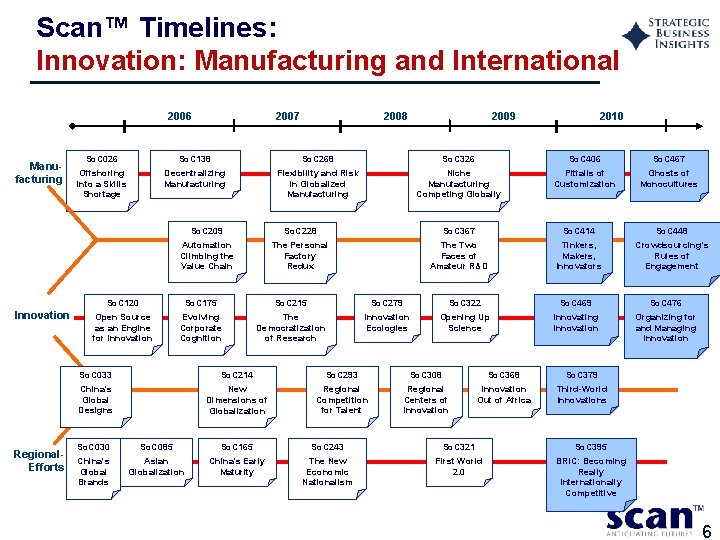
Scan™ Timelines: Innovation: Manufacturing and International 2006 Manufacturing Innovation Regional. Efforts 2007 2008 2009 2010 So. C 026 So. C 138 So. C 268 So. C 326 So. C 406 So. C 467 Offshoring into a Skills Shortage Decentralizing Manufacturing Flexibility and Risk in Globalized Manufacturing Niche Manufacturing Competing Globally Pitfalls of Customization Ghosts of Monocultures So. C 209 So. C 228 So. C 367 So. C 414 So. C 448 Automation Climbing the Value Chain The Personal Factory Redux The Two Faces of Amateur R&D Tinkers, Makers, Innovators Crowdsourcing’s Rules of Engagement So. C 120 So. C 175 So. C 215 So. C 279 So. C 322 So. C 469 So. C 476 Open Source as an Engine for Innovation Evolving Corporate Cognition The Democratization of Research Innovation Ecologies Opening Up Science Innovating Innovation Organizing for and Managing Innovation So. C 033 So. C 214 So. C 293 So. C 308 So. C 368 So. C 379 China's Global Designs New Dimensions of Globalization Regional Competition for Talent Regional Centers of Innovation Out of Africa Third-World Innovations So. C 030 So. C 085 So. C 165 So. C 243 So. C 321 So. C 395 China's Global Brands Asian Globalization China's Early Maturity The New Economic Nationalism First World 2. 0 BRIC: Becoming Really Internationally Competitive 6
Innovating Innovation So. C 469 7
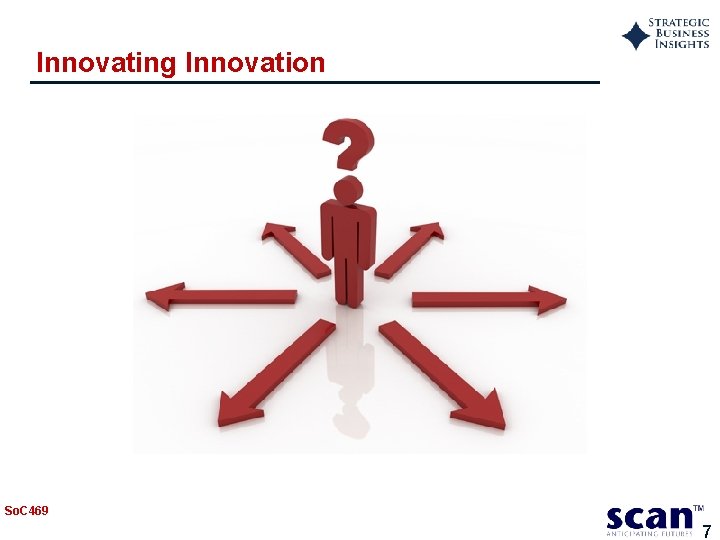
Innovating Innovation So. C 469 Some practitioners have heralded open innovation as a panacea for all innovation hurdles and shortcomings, but–despite its benefits—a more thoughtful approach to innovation is necessary. • Stefan Lindegaard explains that too many companies try and fail to copy open-innovation leaders like P&G, General Mills, or Intuit, because they do not have a strategy for how or why to work with external partners and they have no way to measure results. Companies like Apple, Cisco, and Google do not pursue open innovation. • The EU Laboranova project discovered that if companies want to change to a collaborative work environment, they need to break up their linear work processes, learn to manage the transfer of know-how, and improve the integration of sociocultural dynamics into their process, as well as hire a large number of people with a wide variation in backgrounds. • The US National Institutes of Health now requires the results of any research it funds must be made publicly available in its Pub. Med Central archive within one year. The European Research Council and the UK Wellcome Trust now have similar approaches. • Sociologists at Michigan State University found that the economic competitiveness of a city depends on the degree to which it is networked to other communities by transportation infrastructure, the Internet, videoconferencing, and collaboration, rather than its size. 8
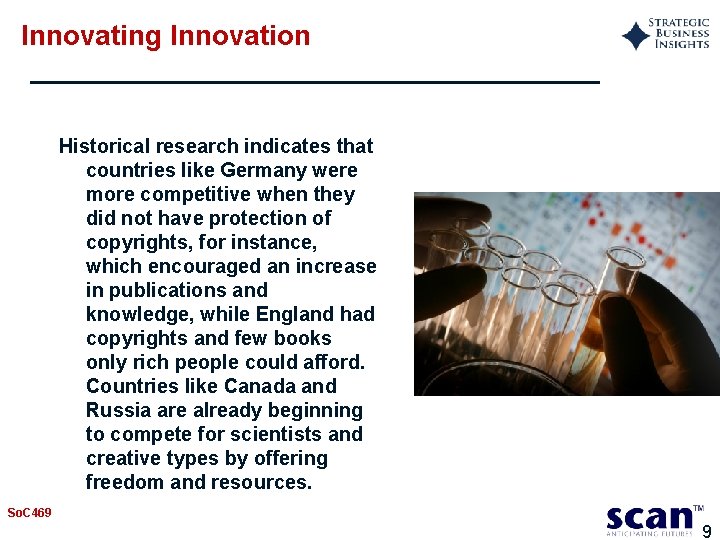
Innovating Innovation Historical research indicates that countries like Germany were more competitive when they did not have protection of copyrights, for instance, which encouraged an increase in publications and knowledge, while England had copyrights and few books only rich people could afford. Countries like Canada and Russia are already beginning to compete for scientists and creative types by offering freedom and resources. So. C 469 9
Tinkers, Makers, Innovators So. C 414 10
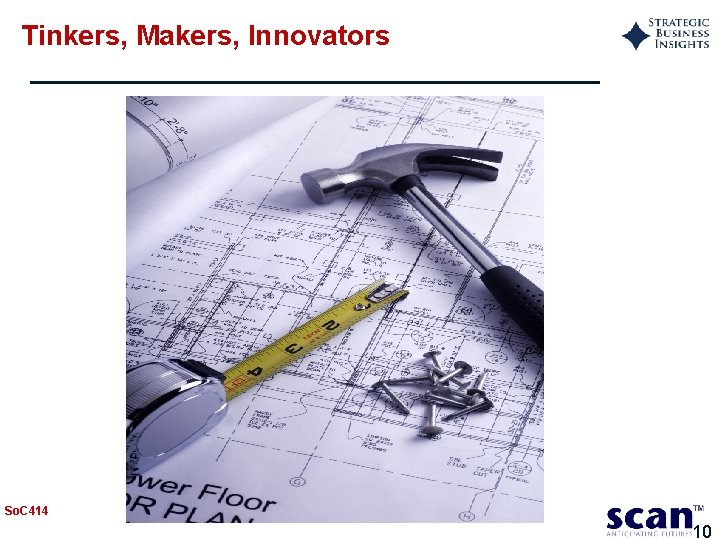
Tinkers, Makers, Innovators A wide variety of new tools enhance the ability of individuals or small groups of collaborators to create new product designs that can spread virally over the Internet. • “Hackspaces” like NYC Resistor, Tech. Shop, Hive 76, and A 2 Mech. Shop are membership-based workshops that allow do-it-yourself consumers, designers, and engineers to share welding equipment, machine tools, and 3 D printers to design and create customized products. DIYers at The Hobby. Shop can build sophisticated products, like robots. • Designers can go to Web Spaces like Thingiverse (www. thingiverse. com) to share designs and engineering fixes. A new form of innovation networking may be in the making. • US universities have seen an increase in the number of mechanical engineering degrees in recent years. Computer engineering degrees peaked in 2004. So. C 414 11
Tinkers, Makers, Innovators So. C 414 Tinkering is a niche market. Venture capitalists have shied away from manufactured products and large corporations have mostly stayed away. Inexpensive machine tools and 3 D printers might find their way to developing countries, where micro financing might help expand the capacity of small manufacturers. Large corporations might want to monitor startups to see if any useful new product ideas come out of it. 12
Pitfalls of Customization So. C 406 13
Pitfalls of Customization can be off-putting and an inefficient use of scarce resources. • The British Broadcasting Corporation discontinued the option to customize the BBC Web site because users do not have the time to customize it and found it more annoying than a generic Web site is. It also caused BBC technical complications, copyright and legal issues, and advertisement integration problems. • Kevin Kelly is an author who writes that Wikipedia, Flikr, and Twitter indicate the new communication culture prefers speed and brevity. Twitter enables users to reach a mass audience without customizing their message. Micro communication is less formal, but also less personal. • Some consumers believe customization has a negative impact on the environment and prefer conservation (So. C 383, “Next-Generation Consumers”). • An increasing number of consumers participate in community rentals and leases of products and sharing, in order to avoid the personal monetary cost and time consumption in the ownership of some personal items (So. C 390, “Community Values Trump Individualism”). So. C 406 14
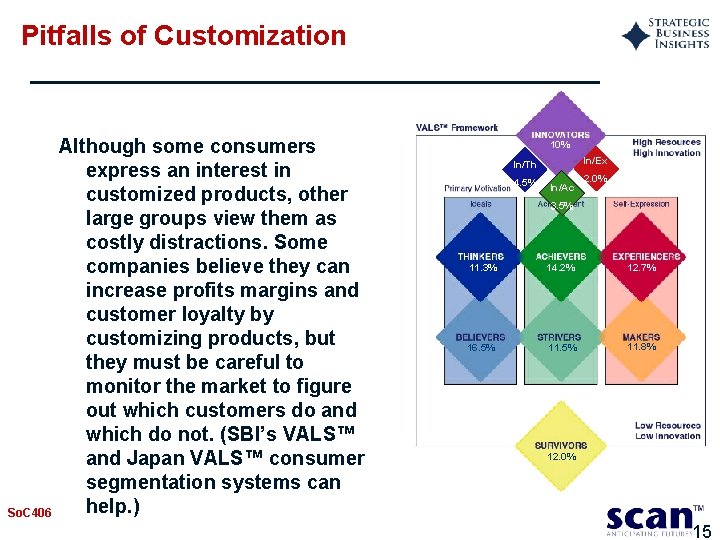
Pitfalls of Customization So. C 406 Although some consumers express an interest in customized products, other large groups view them as costly distractions. Some companies believe they can increase profits margins and customer loyalty by customizing products, but they must be careful to monitor the market to figure out which customers do and which do not. (SBI’s VALS™ and Japan VALS™ consumer segmentation systems can help. ) 10% In/Th 4. 5% In/Ex 2. 0% In/Ac 3. 5% 11. 3% 14. 2% 12. 7% 16. 5% 11. 8% 12. 0% 15

Ghosts of Monocultures So. C 467 16
Ghosts of Monocultures So. C 467 Corporations that need to break out of a management groupthink may consider how biological monocultures are similar. • Wheat accounts for 20% of human global caloric intake, but it relies on a specific strain that resists wheat rust and may be under threat of a new form of the disease. • US reliance on fossil fuels makes it dependent on imports and results in pollution, including acid rain, which is apparently due more to fossil-fuel -based agrichemicals than to coal-fired power plants. • The British beer brewing industry was in decline until a consumer movement, Campaign For Real Ale, led to an increase in the number and types of breweries and industry revenues and profits from premium beers. • John Chambers, CEO of Cisco Systems, has decentralized Cisco’s management structure into nine councils and 50 boards, who must now collaborate, which he believes is the only way to achieve large revenue increases in multiple business simultaneously. • The Miami University Department of Psychology found that science, technology, engineering, and mathematics fields are anticommunal societies, the male-dominated culture blocks the careers of women, who are more likely to think communally (promote the well-being of others). 17
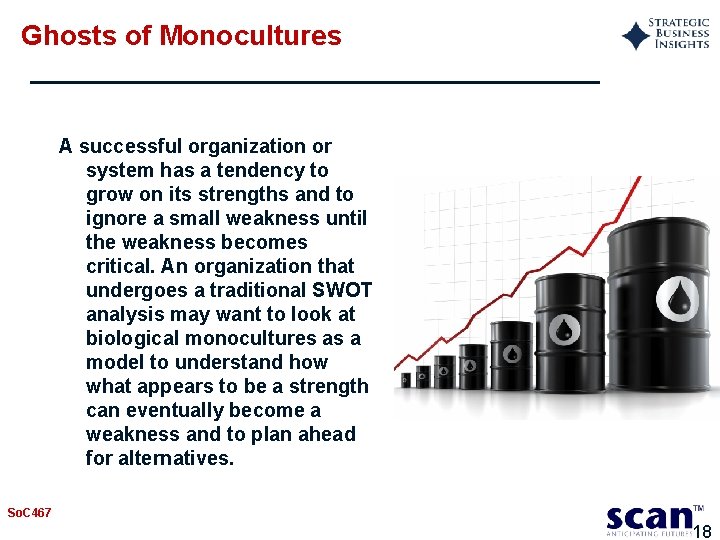
Ghosts of Monocultures A successful organization or system has a tendency to grow on its strengths and to ignore a small weakness until the weakness becomes critical. An organization that undergoes a traditional SWOT analysis may want to look at biological monocultures as a model to understand how what appears to be a strength can eventually become a weakness and to plan ahead for alternatives. So. C 467 18
Third-World Innovations So. C 379 19
Third-World Innovations So. C 379 New business models, hyperefficient approaches to using existing infrastructures, and effective combinations of technology components are all innovations that companies in developed countries should search for globally. • Mc. Kinsey & Company has identified four trends that could reverse the direction of innovation, including: An educated, inexpensive, but creative workforce in some developing countries; alternative distribution and marketing models; demand for culture-specific products; and suppliers that are ready to enter developed markets. • Many major automobile manufacturers have closed their Southern California designs centers while they opened new centers in China and India. • China is now the biggest market for cell phones and Africa is the fastestgrowing. Mobile Internet services are now emerging in Russia, Indonesia, India, and South Africa, including speech-based interfaces where users are illiterate. • John Kao, author of Innovation Nation, says small or developing countries are taking various approaches to grow innovative industries, which can serve as alternative models to corporations, including: Focused-factory; brute-force; “Hollyworld”; and large-scale ecosystem. 20
Third-World Innovations Although it is unlikely that developed countries will yield innovative leadership to developing ones anytime soon, the crucial innovation necessary to establish a particularly company’s competitive advantage might turn up in emerging markets. So. C 379 21
BRIC: Becoming Really Internationally Competitive So. C 395 22
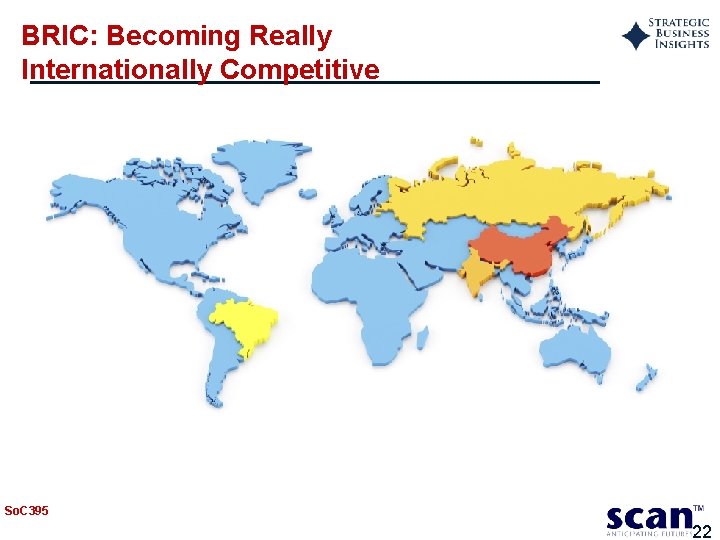
BRIC: Becoming Really Internationally Competitive The BRIC countries (Brazil, Russia, India, and China) are likely to play a much larger role on the global stage than they did even a few years ago. • At their first Economic Summit, in 2009, the BRIC leaders said a need exists for “a stable, predictable and more diversified international monetary system” and that they have a greater representation in it than they have had previously. • The 2009 BP Statistical Review of World Energy points out that the developing world now consumes more energy than the OECD nations do and that this will greatly affect prices and will pose new challenges for energy security and climate change. • BRIC countries are collaborating as equal partners in important science and technology projects, such as Japan and India’s joint space-research projects. Chinese companies are forming joint ventures with or acquiring companies in developed countries, including Japan and the United States. • BRIC nations are becoming attractive places to work for immigrants after gaining education and work experience in developed countries, which enables many of them to obtain executive management positions when they return to their native countries. So. C 395 23
BRIC: Becoming Really Internationally Competitive BRIC nations will demand greater influence on global government policy issues, which could transform the international business landscape, including in science and technology focus, competition for natural resources, competition for work talent, and the multinational treaties and agreements that affect business relies on intellectual property rights, patents, trade, and security. So. C 395 24
Crowdsourcing’s Rules of Engagement So. C 448 25
Crowdsourcing’s Rules of Engagement Crowdsourcing allows companies to capture information about the needs and problems of customers, but undue emphasis on outside input can leave companies with an overwhelming amount of irrelevant, misleading, and conflicting ideas. • Jaron Lanier, University of California, Berkeley, claims crowdsourcing easily leads to design by committee, which just adds features without keeping the complexity of the overall product and business concept in mind. • Nokia acknowledges that in order to avoid having its online Design by Community project turn into “some kind of unwieldy beast, ” it changes the variables it puts to the public vote each week. • Helmut Traitler, head of Innovation Partnerships at Nestec, says he practices a form of “targeted” open innovation by selecting specific contractors and design firms that his company learns to trust. • Harvard and MIT researchers conclude that radical innovation requires a detailed knowledge of an individual company’s organizational structures, process equipment, and so forth, for which crowdsourcing is uninformed and, thus, is best left to small companies or groups. So. C 448 26
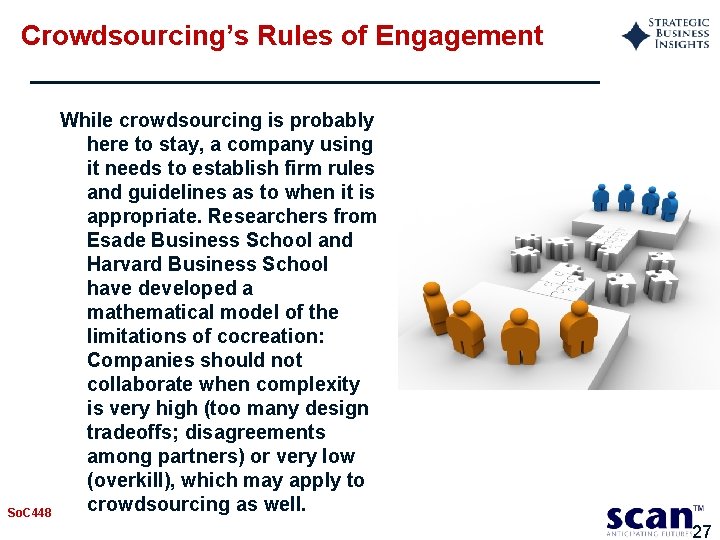
Crowdsourcing’s Rules of Engagement So. C 448 While crowdsourcing is probably here to stay, a company using it needs to establish firm rules and guidelines as to when it is appropriate. Researchers from Esade Business School and Harvard Business School have developed a mathematical model of the limitations of cocreation: Companies should not collaborate when complexity is very high (too many design tradeoffs; disagreements among partners) or very low (overkill), which may apply to crowdsourcing as well. 27
Scanning the Road Ahead Technology will change how people create, innovate and compete. Globalization will bring new competitors and new partners. Competitors will try every approach, explore every opportunity, exploit every weakness. No single approach to innovation will guarantee success. Each change reminds us that the future is uncertain; Scan provides early alerts to potential change. Opportunity Discovery, Scenarios, and Roadmapping help each competitive challenge to have an optimum approach and a strategic fit. 28
- Slides: 29