
Organizing for Action Chapter Seven 2013 by Mc
Organizing for Action Chapter Seven © 2013 by Mc. Graw-Hill Education. This is proprietary material solely for authorized instructor use. Not authorized for sale or distribution in any manner. This document may not be copied, scanned, duplicated, forwarded, distributed, or posted on a website, in whole or part.
Organizational Structure ª An organization’s success often depends on the way work and responsibilities are organized. ª This chapter focuses on organization structure. ª Organizational Structure The vertical and horizontal configuration of departments, authority, and jobs within a company. • Is concerned with questions such as, ”Who reports to whom? ” and “Who does what? ” and “Where is the work done? ”. 7 -373
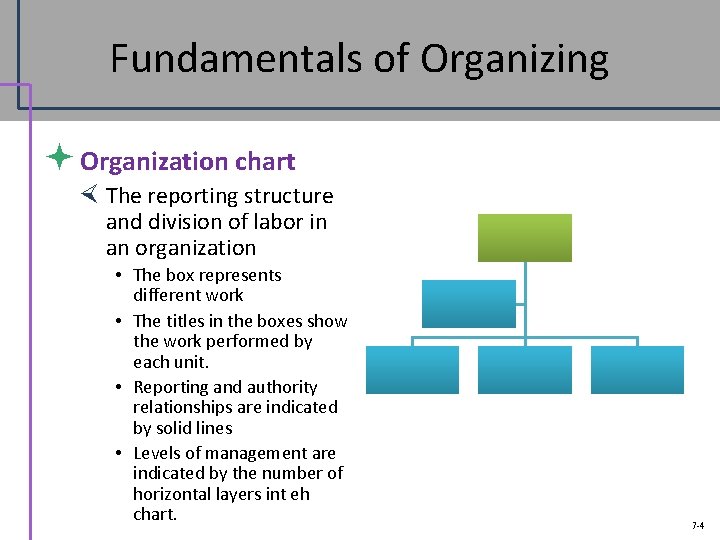
Fundamentals of Organizing ª Organization chart The reporting structure and division of labor in an organization • The box represents different work • The titles in the boxes show the work performed by each unit. • Reporting and authority relationships are indicated by solid lines • Levels of management are indicated by the number of horizontal layers int eh chart. 7 -4
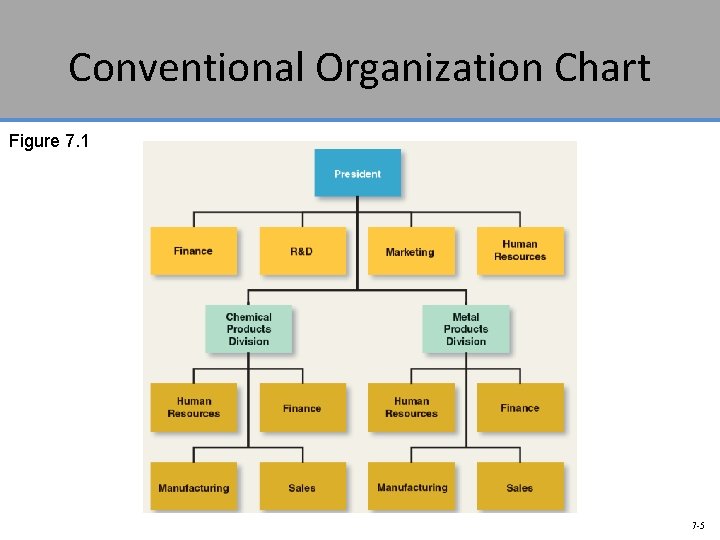
Conventional Organization Chart Figure 7. 1 7 -5
Fundamentals of Organizing ª The organization chart represents the structure of the organization Mechanistic organization • Formal, centralized, rigid organizations intended to promote internal efficiency Organic organization • Less formal, decentralized organizations that are more flexible 7 -6
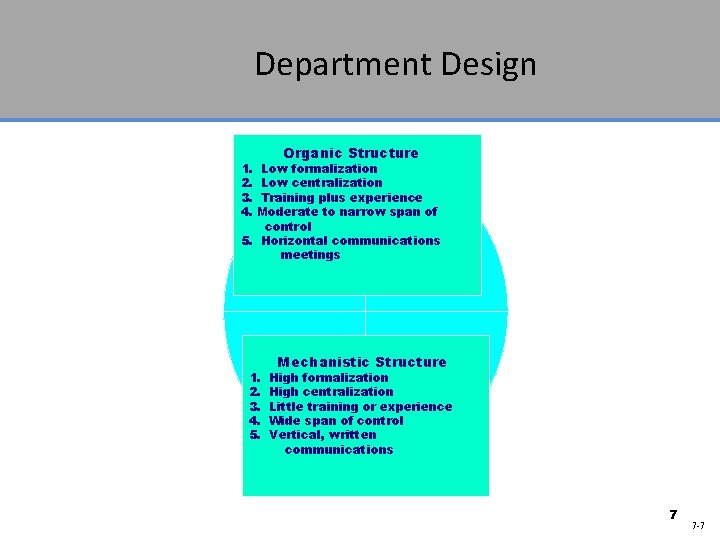
Department Design 1. 2. 3. 4. Organic Structure Low formalization Low centralization Training plus experience Moderate to narrow span of control 5. Horizontal communications meetings 1. 2. 3. 4. 5. Mechanistic Structure High formalization High centralization Little training or experience Wide span of control Vertical, written communications 7 7 -7
Fundamentals of Organizing ª Differentiation creates specialized jobs. Differentiation is an aspect of the organization’s internal environment created by job specialization and the division of labor. The organization is comprised of many different units that work on different kinds of tasks, using different skills and work methods. • Division of labor – work of the organization is subdivided into smaller tasks. • Specialization refers to the fact that different people or groups often perform specific parts of the entire task. 7 -8
Fundamentals of Organizing ª Integration coordinates employees’ efforts Integration means that these differentiated units are put back together so that work is coordinated into an overall product. Coordination refers to the procedures that link the various parts of the organization to achieve the organization’s overall mission. 7 -9
The Vertical Structure ª Authority is granted formally and informally ª Authority The legitimate right to make decisions and to tell other people what to do. Authority resides in positions rather than in people. 7 -10
Authority in Organizations ª Board of directors led by the chair, makes major decisions affecting the organization, subject to corporate charter and bylaw provisions. The board performs at least three major sets of duties: • selecting, assessing, rewarding, and perhaps replacing the CEO • determining the firm’s strategic direction and reviewing financial performance • assuring ethical, socially responsible, and legal conduct. ª Boards made up of strong, independent outsiders are more likely to provide different information and perspectives and to prevent big mistakes. 7 -11
Authority in Organizations ª The chief executive officer is personally accountable to the board and to the owners for the organization’s performance. The CEO usually holds two positions either as the chair of the board or the president of the organization. ª The top management teams These teams comprise a group of key members of the management team, which shares the authority of the CEO. Usually comprised of the CEO, president, chief operating officer, chief financial officer, and other key executives. 7 -12
Hierarchy Defines Levels of Authority ª ª ª Top management a. Hierarchy is the authority levels of the organizational pyramid. b. The CEO occupies the top position and is the senior member of top management. c. Presidents and vice presidents are also included in the top management. Middle management This is the second broad level. Made up of managers who are in charge of plants or departments. Operational management This is the lowest level of management. It includes office managers, sales managers, supervisors, and other first-line managers as well as the employees who report directly to them. 7 -13
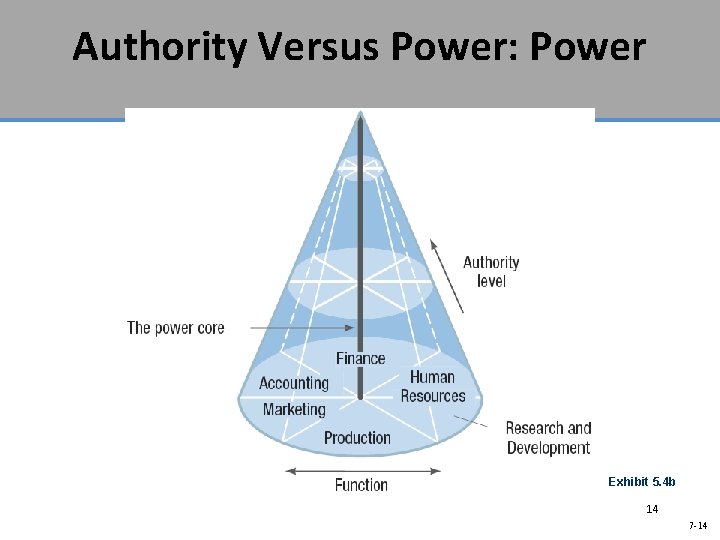
Authority Versus Power: Power Exhibit 5. 4 b 14 7 -14
Span of Control ª Span of control determines a manager’s authority ª Span of control The number of subordinates who report directly to an executive or supervisor Narrow spans build a tall organization with many reporting levels. Wide spans create a flat organization with fewer reporting levels. 7 -15
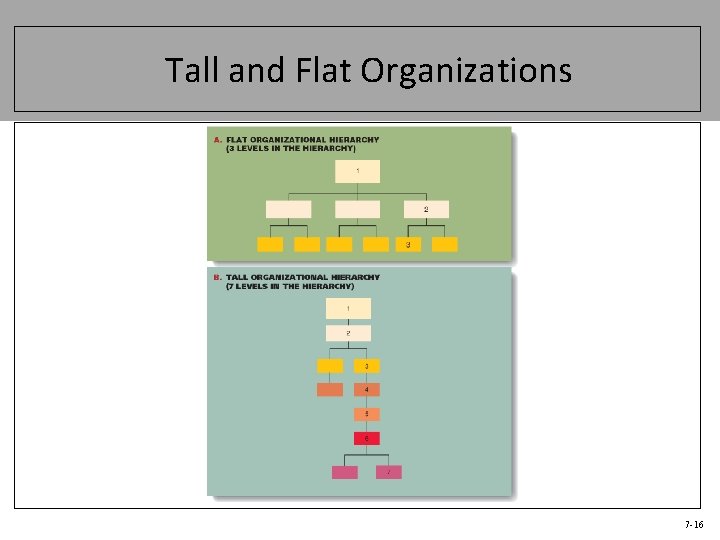
Tall and Flat Organizations 7 -16
Span of Control ª The optimal span of control depends of a number of factors: Is the work clearly defined and unambiguous? Are subordinates highly trained and have access to information? Is the manager highly capable and supportive? Are jobs similar and performance measures comparable? Do subordinates prefer autonomy to close supervisory control? ª If the answer is yes to these questions then the span can be wider; if no is the answer then the span should be narrower. 7 -17
Delegation ª Delegation The assignment of new or additional responsibilities to a subordinate How manager’s use others talents Responsibility and accountability must be looked at before delegating any authority 7 -19
Delegation ª Responsibility The assignment of a task that an employee is supposed to carry out Authority means that the person has the power and the right to make decisions, gives orders, draws upon resources, and does whatever else is necessary to fulfill the responsibility. ªAccountability The expectation that employees will perform a job, take corrective action when necessary, and report upward on the status and quality of their performance 7 -20
Advantages of Delegation ª Leverages managers’ energy and talent ª Develops managerial skills and knowledge in subordinates ª Conserves managers’ most valuable asset: time ª Promotes subordinates’ sense of importance and commitment to organization 7 -21
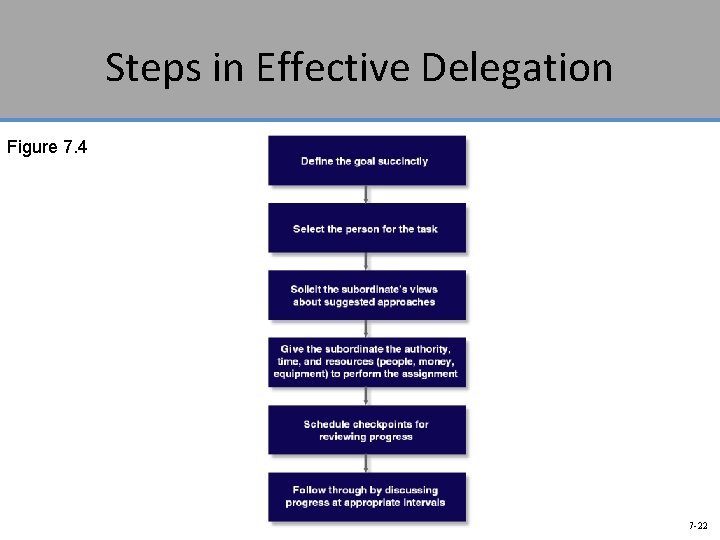
Steps in Effective Delegation Figure 7. 4 7 -22
Decentralization Spreads Decision-Making Power ªCentralized organization An organization in which high-level executives make most decisions and pass them down to lower levels for implementation ªDecentralized organization An organization in which lower-level managers make important decisions 7 -23
Centralization and Decentralization of Authority • Top managers must seek the balance between centralization and decentralization of authority • Decentralizing authority: Giving lower-level managers and nonmanagerial employees the right to make important decisions about how to use organizational resources • Decentralized teams may begin to pursue their own goals at the expense of organizational goals 7 -24
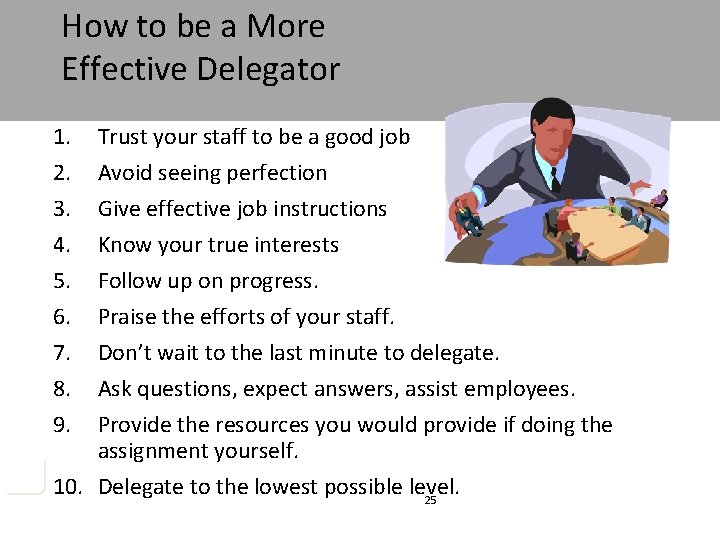
How to be a More Effective Delegator 1. 2. 3. 4. 5. 6. 7. 8. 9. Trust your staff to be a good job Avoid seeing perfection Give effective job instructions Know your true interests Follow up on progress. Praise the efforts of your staff. Don’t wait to the last minute to delegate. Ask questions, expect answers, assist employees. Provide the resources you would provide if doing the assignment yourself. 10. Delegate to the lowest possible level. 25
The Horizontal Structure ª As the task of an organization becomes increasingly complex, the organization inevitably must be subdivided or departmentalized into smaller units or departments. Line departments are units that deal directly with the organization’s primary goods and services; they make things, sell things, or provide customer service. Staff departments are those that provide specialized or professional skills that support line departments such as research, legal, accounting, public relations, and human resources department. 7 -26
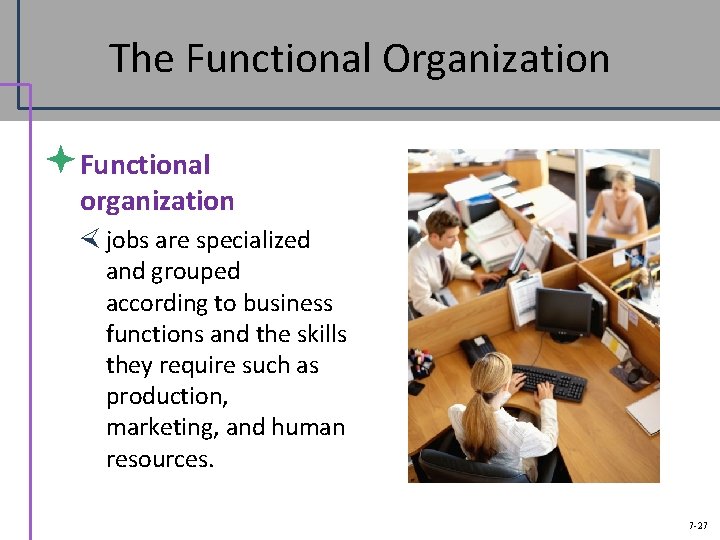
The Functional Organization ªFunctional organization jobs are specialized and grouped according to business functions and the skills they require such as production, marketing, and human resources. 7 -27
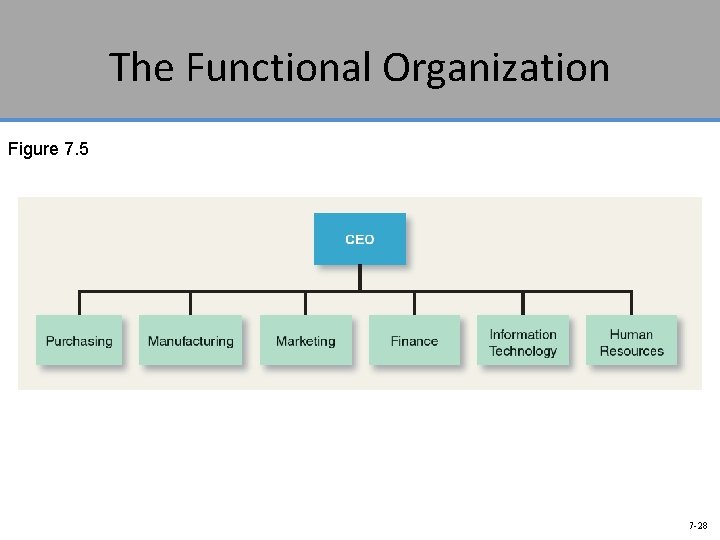
The Functional Organization Figure 7. 5 7 -28
Advantages of Functional Organizations 1. Economies of scale can be realized 2. Effective monitoring of the environment 3. Performance standards better maintained 4. Greater opportunity for specialized training and skill 5. 6. development Technical specialists are relatively free of administrative work Decision making and lines of communication are simple and clearly understood 7 -29
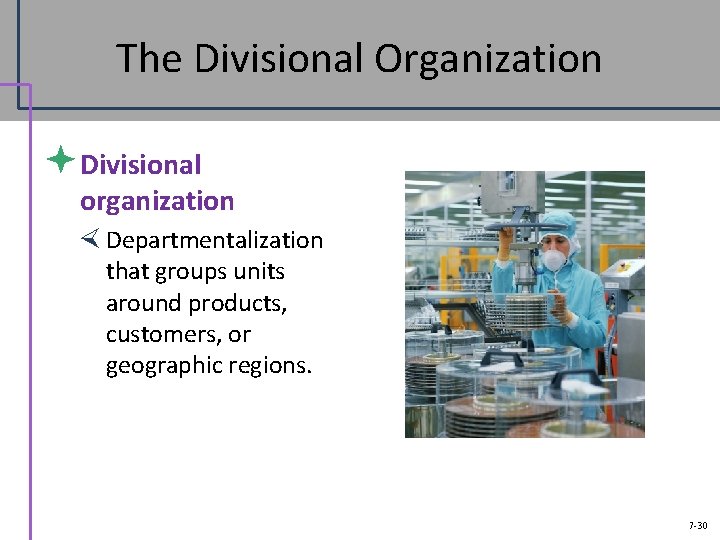
The Divisional Organization ªDivisional organization Departmentalization that groups units around products, customers, or geographic regions. 7 -30
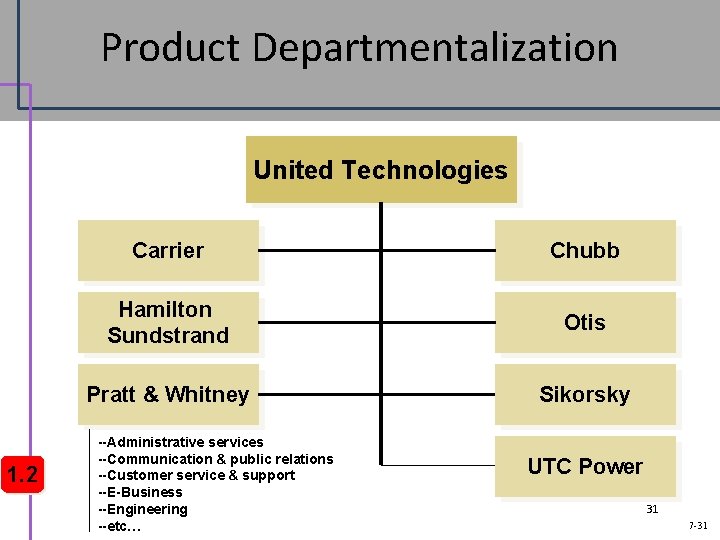
Product Departmentalization United Technologies 1. 2 Carrier Chubb Hamilton Sundstrand Otis Pratt & Whitney Sikorsky --Administrative services --Communication & public relations --Customer service & support --E-Business --Engineering --etc… UTC Power 31 7 -31
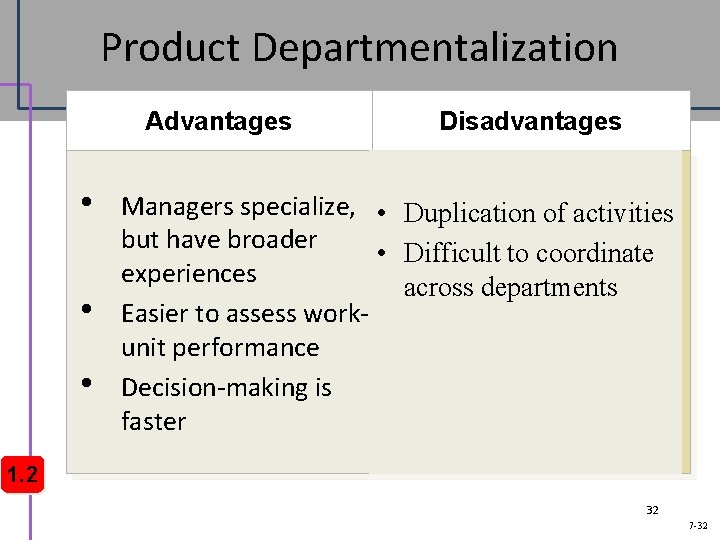
Product Departmentalization Advantages • • • Disadvantages Managers specialize, • Duplication of activities but have broader • Difficult to coordinate experiences across departments Easier to assess workunit performance Decision-making is faster 1. 2 32 7 -32
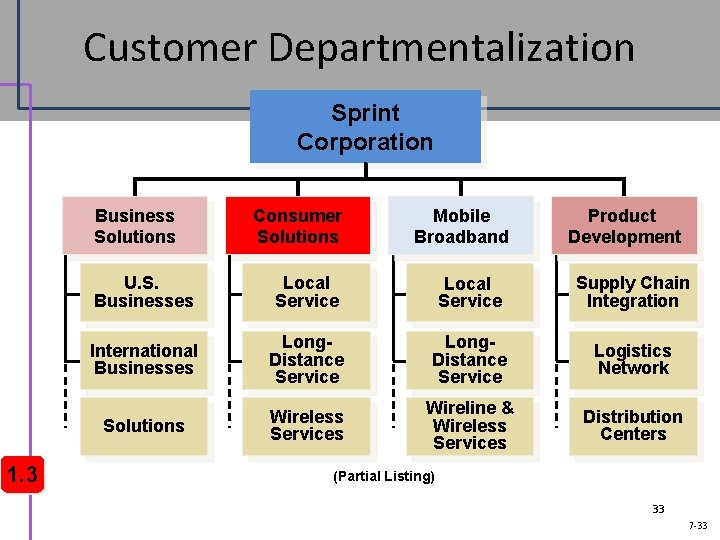
Customer Departmentalization Sprint Corporation Business Solutions 1. 3 Consumer Solutions Mobile Broadband Product Development U. S. Businesses Local Service Supply Chain Integration International Businesses Long. Distance Service Logistics Network Solutions Wireless Services Wireline & Wireless Services Distribution Centers (Partial Listing) 33 7 -33
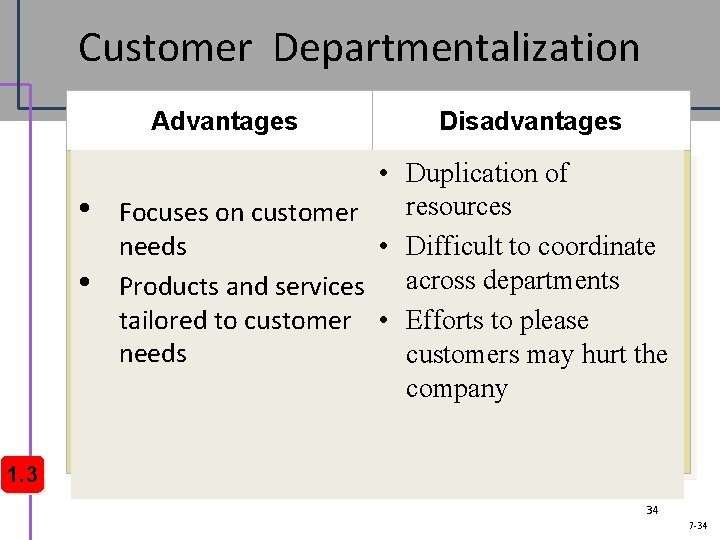
Customer Departmentalization Advantages • • Disadvantages • Duplication of resources Focuses on customer needs • Difficult to coordinate Products and services across departments tailored to customer • Efforts to please needs customers may hurt the company 1. 3 34 7 -34
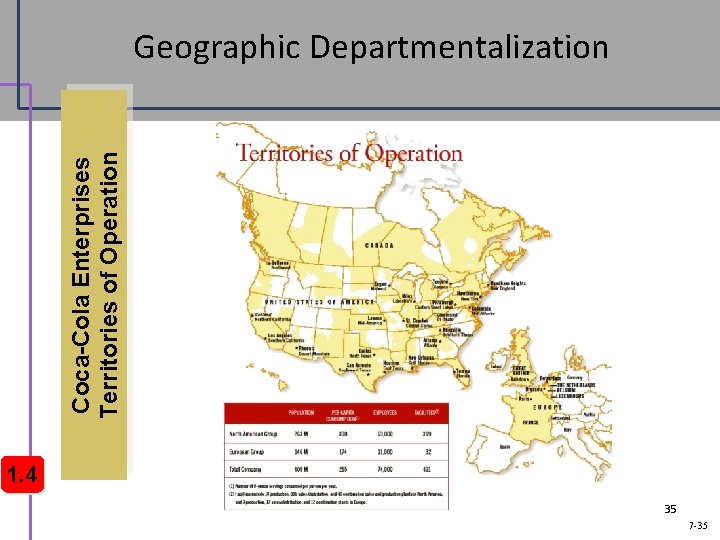
Coca-Cola Enterprises Territories of Operation Geographic Departmentalization 1. 4 35 7 -35
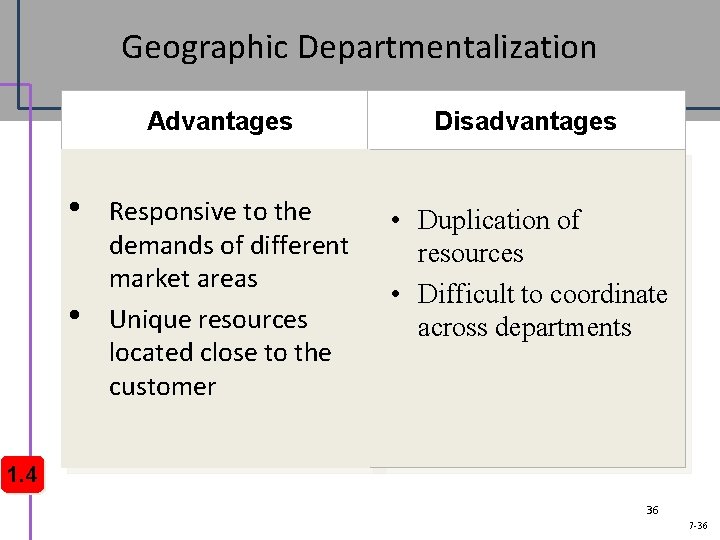
Geographic Departmentalization Advantages • • Responsive to the demands of different market areas Unique resources located close to the customer Disadvantages • Duplication of resources • Difficult to coordinate across departments 1. 4 36 7 -36
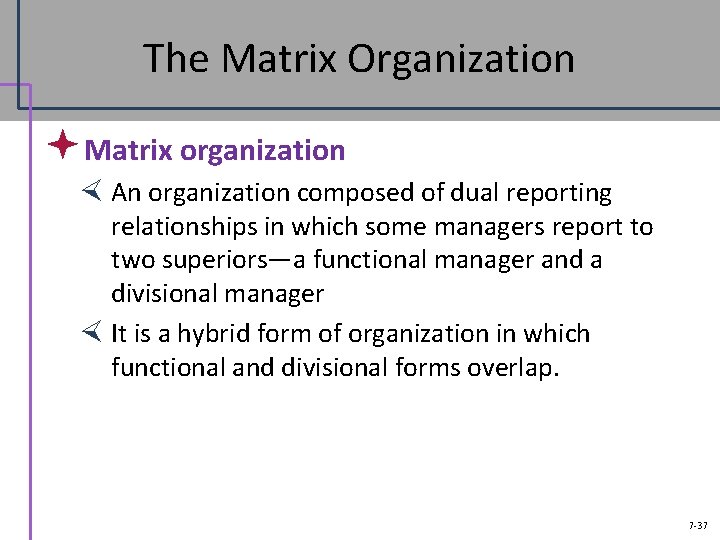
The Matrix Organization ª Matrix organization An organization composed of dual reporting relationships in which some managers report to two superiors—a functional manager and a divisional manager It is a hybrid form of organization in which functional and divisional forms overlap. 7 -37
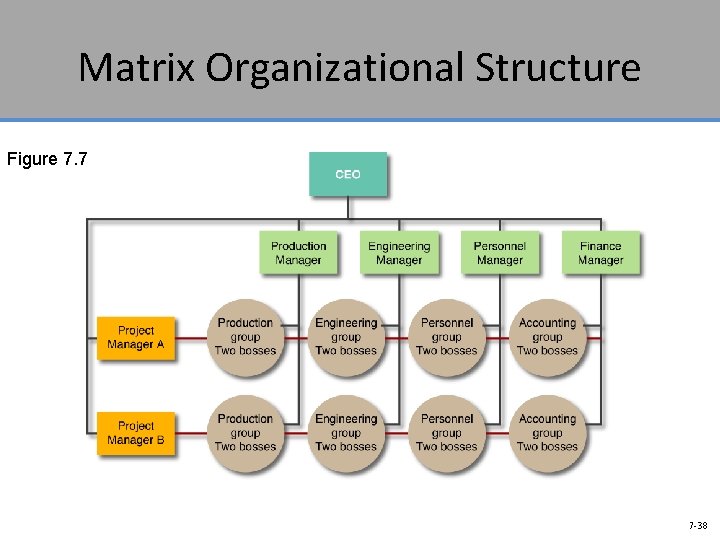
Matrix Organizational Structure Figure 7. 7 7 -38
Advantages of a Matrix Design ª Cross-functional problem solving leads to betterinformed and more creative decisions ª Decision making is decentralized ª Extensive communications networks help process large amounts of information ª Higher management levels are not overloaded with operational decisions ª Resource utilization is efficient 7 -39
Disadvantages of a Matrix Design ª Confusion can arise because people do not have a single superior ª Encourages managers who share subordinates to jockey for power, so conflict can occur. ª Can lead to slower decision making ª Too much democracy can lead to not enough action 7 -40
The Network Organization ª Network organization A collection of independent, mostly single- function firms that collaborate on a good or service The dynamic network is also called the modular or virtual corporation. It is a very flexible version of the network organization. 7 -41
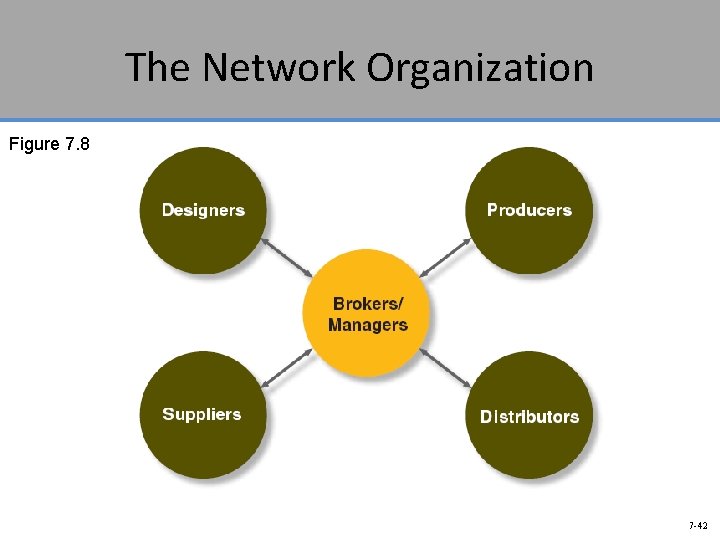
The Network Organization Figure 7. 8 7 -42
The Network Organization ª Successful networks offer flexibility, innovation, quick responses to threats and opportunities, and reduced costs and risks. ª But to be successful, they must choose the right specialty choose collaborators that are also excellent, but provide complementary strengths make certain that all parties fully understand the strategic goals of the partnership be able to trust all parties with strategic information and trust that collaborators will deliver, even when business demands are heavy. 7 -43
Organizational Integration ª Besides structuring the organization around differentiation-the way the organization is composed of different jobs and tasks, and the way they fit on an organization chartmanagers also need to consider integration and coordination-the way all parts of the organization work together. 7 -45
Standardization Coordinates Work ª Standardization establishing common rules and procedures that apply uniformly to everyone. These rules and procedures should apply to most (if not all) situations. ª Formalization The presence of rules and regulations governing how people in the organization interact. 7 -46
Plans Set a Common Direction ª Coordination by plan It does not require the same high degree of stability and routinization required for coordination by standardization. Interdependent units are required to meet deadlines and objectives that contribute to a common goal Employees are free to modify and adapt their actions, as long as deadlines and targets required. 7 -47
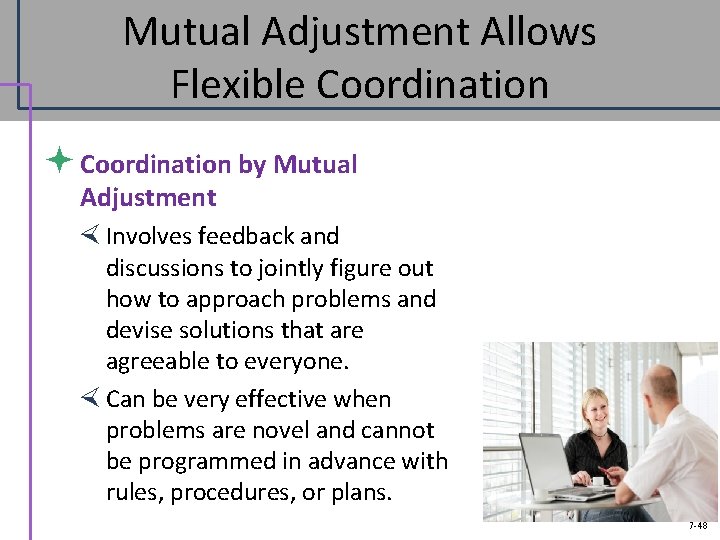
Mutual Adjustment Allows Flexible Coordination ª Coordination by Mutual Adjustment Involves feedback and discussions to jointly figure out how to approach problems and devise solutions that are agreeable to everyone. Can be very effective when problems are novel and cannot be programmed in advance with rules, procedures, or plans. 7 -48
Coordination requires communication ª To cope with high uncertainty and heavy information demands, managers use two general strategies: Reducing the need for information • Slack resources-EXTRA RESOURCES ORGANIZATIONS RELY ON IN A PINCH Increasing information processing capability • Investing in information systems • Engaging in knowledge management 7 -49
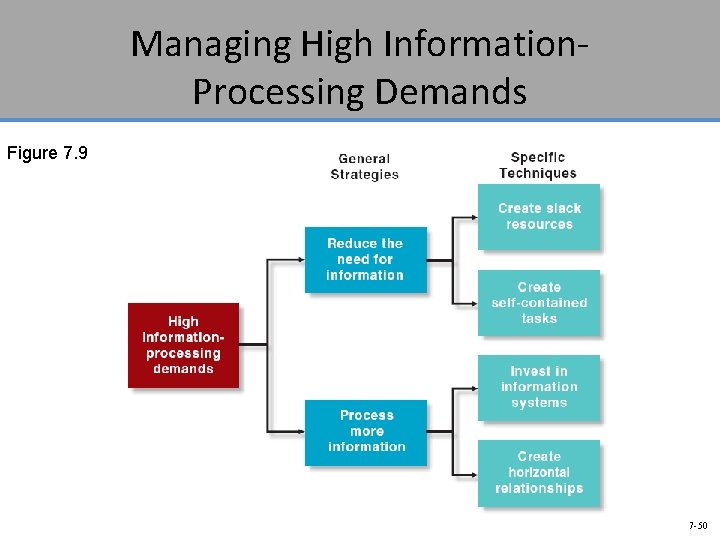
Managing High Information. Processing Demands Figure 7. 9 7 -50
Organizational Agility ª Strategies promote organizational agility Organizing around core competencies • A well-understood, well-developed core competence can enhance a company’s responsiveness and competitiveness. • Managers who want to strengthen their firms’ competitiveness via core competencies need to focus on several related issues: – Identify existing core competencies. – Acquire or build core competencies that will be important for the future. – Keep investing in competencies so that the firm remains worldclass and better than competitors. – Extend competencies to find new applications and opportunities for the markets of tomorrow. 7 -51
Strategic Alliances ª A strategic alliance is a formal relationship created with the purpose of joint pursuit of mutual goals. In a strategic alliance, individual organizations share administrative authority, form social links, and accept joint ownership. The best alliances are true partnerships that meet these criteria: – – – – Individual excellence - both partners add value. Importance - both partners contribute to meeting strategic objectives. Interdependence - both partners need each other. Investment - partners devote resources to the relationship. Information - partners communicate openly. Integration - partners develop shared ways of operating. Institutionalization - relationship has formal status Integrity - both partners are trustworthy 7 -52
Learning organizations ª A learning organization is an organization skilled at creating, acquiring, and transferring knowledge, and modifying its behavior to reflect new knowledge and insights. People engage in disciplined thinking and attention to details Employees search constantly for new knowledge and ways to apply it. They carefully review success and failures. They benchmark They share information throughout the organization 7 -53
High Involvement Organization ª A high-involvement organization or participative management is one in which top management ensures that there is consensus about the direction in which the business is heading. Organizational form is a flat, decentralized structure built around a customer, product or service. 7 -54
Organizational Size ª The case for large organizations: Scale economies - lower costs per unit of production Economies of scope – economies in which materials and processes employed in one product can be used to make other, related products. ª The case for small organizations: As firms get larger customers begin to view their products as having lower quality. Small companies can: – – move fast provide quality goods and services to targeted market niches inspire greater involvement from their people outmaneuver big bureaucracies. 7 -55
Organizational Size ª Being big and small To avoid problems of growth and size, companies decentralize decision making and organize around small, adaptive, team-based work units. ª Downsizing Companies downsize in an attempt to gain the responsiveness of a small company. Downsizing is the planned elimination of positions or jobs. ª Rightsizing a successful effort to achieve an appropriate size at which the company performs most effectively. 7 -56
Organizational Size ª To ease the pain of downsizing firms engage in a number of positive practices such as: • Choose positions to be eliminated based on careful analysis and strategic thinking. • Train people to cope with the new situation. • Identify and protect talented people. • Give special attention and help to those who have lost their jobs. • Communicate constantly with people about the process. • Emphasize positive future and people’s new roles in attaining it. 7 -57
Agile Organizations Focus on Customers ª ª ª Total quality management (TQM) is an integrative approach to management that supports the attainment of customer satisfaction through a wide variety of tools and techniques that result in high-quality goods and services. Commitment to total quality requires a thorough, extensive, integrated approach to organizing. ISO 9000 is a series of quality standards developed by a committee working under the International Organization for Standardization to improve total quality in all businesses for the benefit of producers and consumers. 7 -58
Deming’s “ 14 points” of Quality • • • • Create constancy of purpose Adopt the new philosophy Cease dependence on mass inspection End the practice of awarding business based on price tag alone Improve constantly the system of production and service Institute training and retraining Institute leadership Drive out fear Break down barriers among departments Eliminate slogans, exhortations and arbitrary targets Eliminate numerical quotas Remove barriers to pride in workmanship Institute a vigorous program of education and retraining Take action to accomplish the transformation 7 -59
Technology can support agility Technology configurations Small batch technologies – when goods or services are provided in very low volume or small batches, a company that does such work is called a job shop. Large batch technologies or mass production technologies produce goods and services in high volume. Continuous process technologies are a process that is highly automated and has a continuous production flow. 7 -60
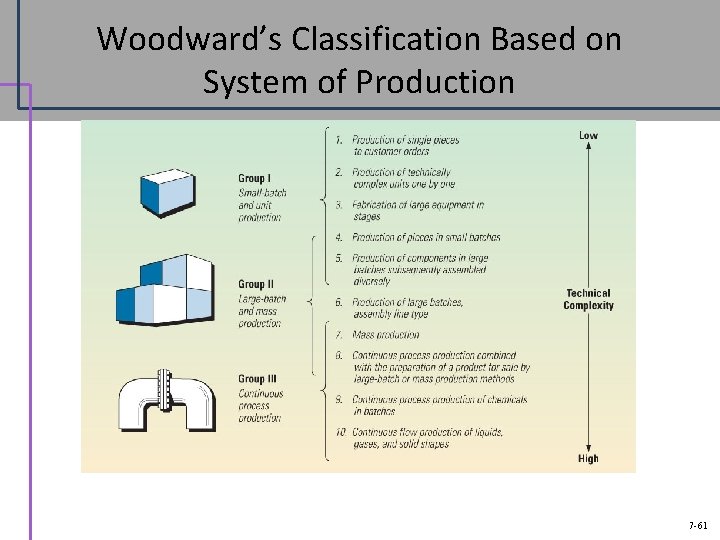
Woodward’s Classification Based on System of Production 61 7 -61
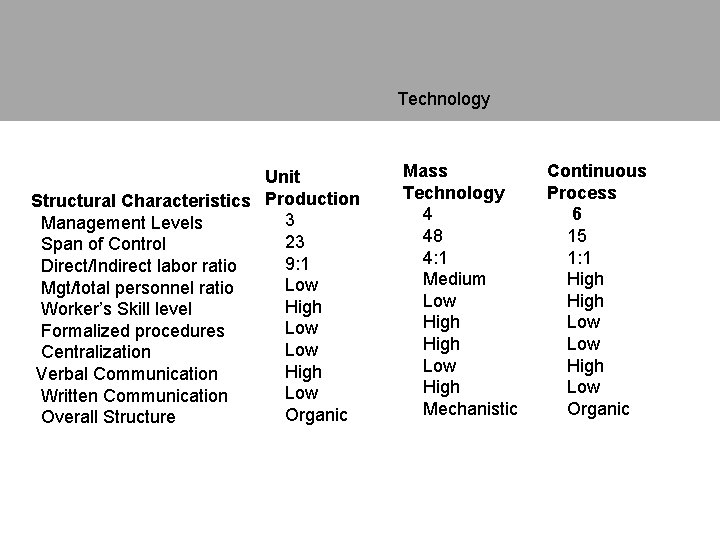
Technology Unit Structural Characteristics Production 3 Management Levels 23 Span of Control 9: 1 Direct/Indirect labor ratio Low Mgt/total personnel ratio High Worker’s Skill level Low Formalized procedures Low Centralization High Verbal Communication Low Written Communication Organic Overall Structure 62 Mass Technology 4 48 4: 1 Medium Low High Mechanistic Continuous Process 6 15 1: 1 High Low Organic
Organizing for Flexible Manufacturing ª Mass customization is the production of varied, individually customized products at the low cost of standardized, mass-produced products. Companies organize around a dynamic network of relatively independent operating units with each unit performing a specific process or task called a module. Computer-integrated manufacturing encompasses the use of computer-aided design and computeraided manufacturing to sequence and optimize a number of production processes. Flexible factories are manufacturing plants that have short production runs, are organized around 7 -63 products, and use decentralized scheduling. 7 -63
ª Lean manufacturing is an operation that strives to achieve the highest possible productivity and total quality, cost effectively, by eliminating unnecessary steps in the production process and continually strives for improvement. For the lean approach to result in a more effective operation, the following conditions must be met: People are broadly trained rather than specialized. Communication is informal and horizontal among line workers. Equipment is general purpose. Work is organized in teams, or cells, that produce a group of similar products. – Supplier relationships are long-term and cooperative. – Product development is concurrent, not sequential, and is done by cross-functional teams. – – 7 -64
Organizing for Speed: Time-based Competition ª Just-in-time operations (JIT) is a system that calls for subassemblies and components to be manufactured in very small lots and delivered to the next stage of the production process just as they are needed. Simultaneous engineering is a design approach in which all relevant functions cooperate jointly and continually in a maximum effort aimed at producing high-quality production that meets customers’ needs. 7 -65
Video: Starbucks ª Why did Howard Schultz return to Starbucks as CEO? ª What restructuring actions did Schultz take? 7 -66
- Slides: 63