
Organizing Chaos Development of a ConsensusBased EOS Classification
Organizing Chaos: Development of a Consensus-Based EOS Classification Schema Brendan A Williams BA; Behrooz A Akbarnia MD; Laurel C Blakemore MD; Randal R Betz MD; John M Flynn, MD; Charles E Johnston II MD; Richard E Mc. Carthy MD; David P Roye Jr MD; David L Skaggs MD; John T Smith MD; Brian D Snyder MD Ph. D; Paul D Sponseller MD MBA; Peter F Sturm MD; George H Thompson MD; Muharrem Yazici MD; Michael G. Vitale MD MPH Funded by the Chest Wall and Spinal Deformity Study Group Columbia Orthopaedics
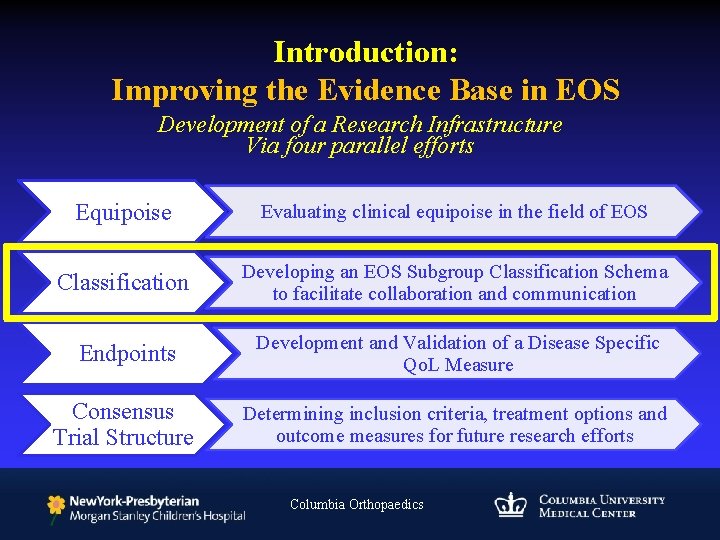
Introduction: Improving the Evidence Base in EOS Development of a Research Infrastructure Via four parallel efforts Equipoise Evaluating clinical equipoise in the field of EOS Classification Developing an EOS Subgroup Classification Schema to facilitate collaboration and communication Endpoints Development and Validation of a Disease Specific Qo. L Measure Consensus Trial Structure Determining inclusion criteria, treatment options and outcome measures for future research efforts Columbia Orthopaedics
Introduction: Challenges to EOS Classification • Heterogeneous population – Wide range of ages – Wide variety of etiologies – Variable severity of deformity – Co-morbidities – Various stages of treatment • Finding a balance between practicality and descriptive ability (i. e. groupers vs. splitters) Columbia Orthopaedics
Purpose To utilize formal consensus methods to develop a novel Early Onset Scoliosis Classification System that will be: • Comprehensive: Widely applicable • Practical: Simple enough for day to day use • Prognostic: Predict outcome • Guiding: Direct management Columbia Orthopaedics
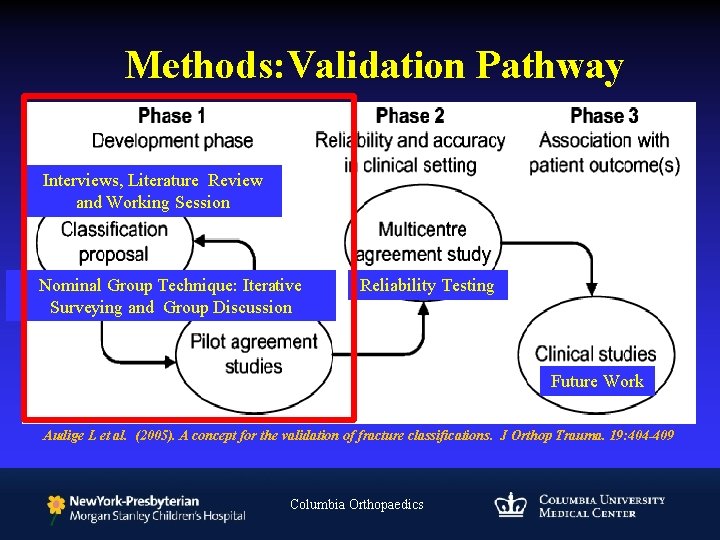
Methods: Validation Pathway Interviews, Literature Review and Working Session Nominal Group Technique: Iterative Surveying and Group Discussion Reliability Testing Future Work Audige L et al. (2005). A concept for the validation of fracture classifications. J Orthop Trauma. 19: 404 -409 Columbia Orthopaedics
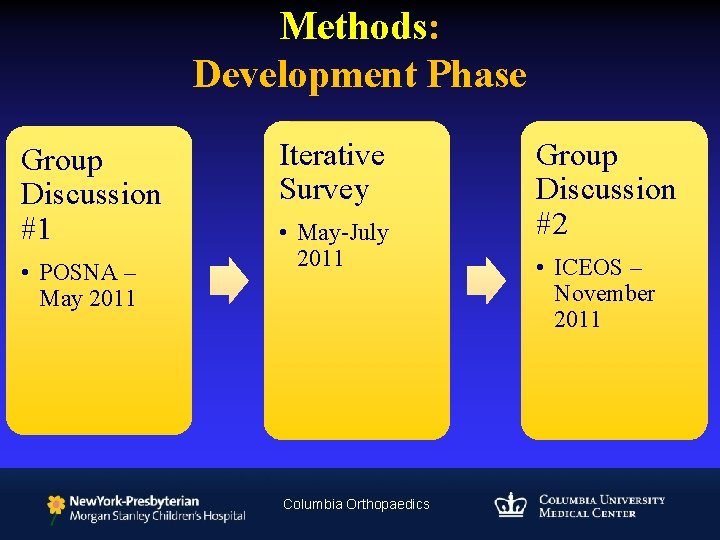
Methods: Development Phase Group Discussion #1 • POSNA – May 2011 Iterative Survey • May-July 2011 Columbia Orthopaedics Group Discussion #2 • ICEOS – November 2011
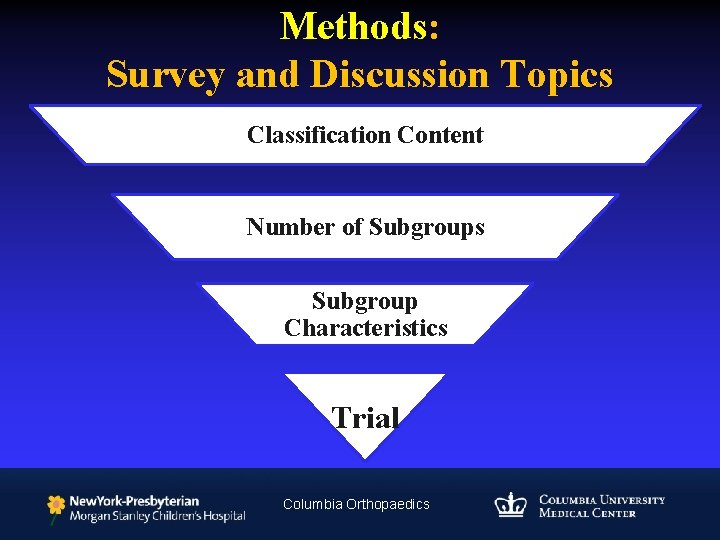
Methods: Survey and Discussion Topics Classification Content Number of Subgroups Subgroup Characteristics Trial Columbia Orthopaedics
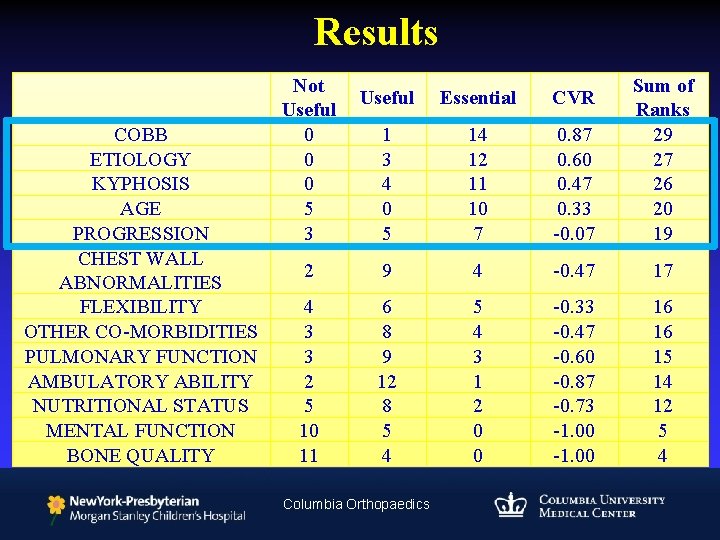
Results COBB ETIOLOGY KYPHOSIS AGE PROGRESSION CHEST WALL ABNORMALITIES FLEXIBILITY OTHER CO-MORBIDITIES PULMONARY FUNCTION AMBULATORY ABILITY NUTRITIONAL STATUS MENTAL FUNCTION BONE QUALITY Not Useful 0 0 0 5 3 Useful Essential CVR 1 3 4 0 5 14 12 11 10 7 0. 87 0. 60 0. 47 0. 33 -0. 07 Sum of Ranks 29 27 26 20 19 2 9 4 -0. 47 17 4 3 3 2 5 10 11 6 8 9 12 8 5 4 3 1 2 0 0 -0. 33 -0. 47 -0. 60 -0. 87 -0. 73 -1. 00 16 16 15 14 12 5 4 Columbia Orthopaedics
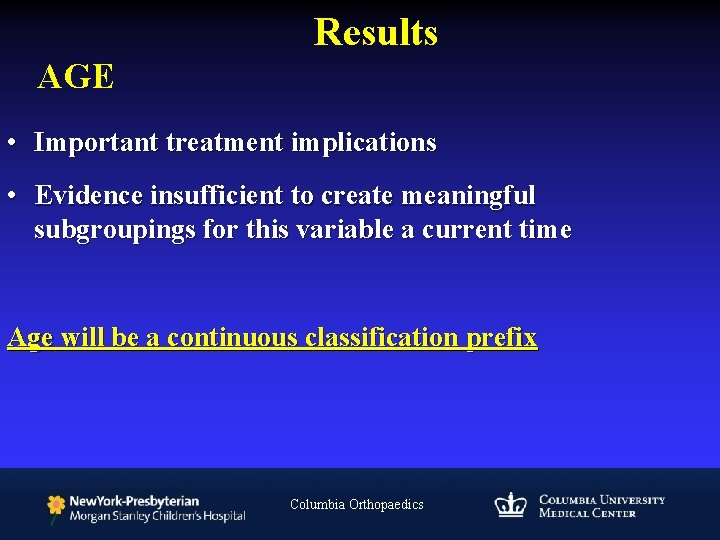
Results AGE • Important treatment implications • Evidence insufficient to create meaningful subgroupings for this variable a current time Age will be a continuous classification prefix Columbia Orthopaedics
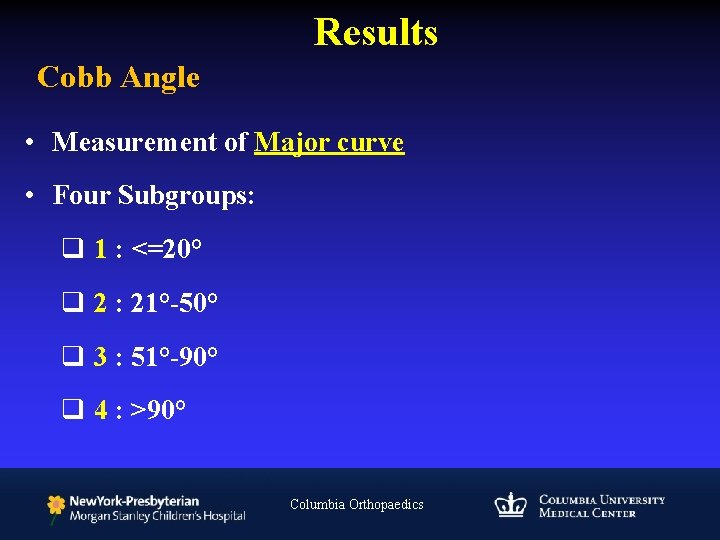
Results Cobb Angle • Measurement of Major curve • Four Subgroups: q 1 : <=20° q 2 : 21°-50° q 3 : 51°-90° q 4 : >90° Columbia Orthopaedics
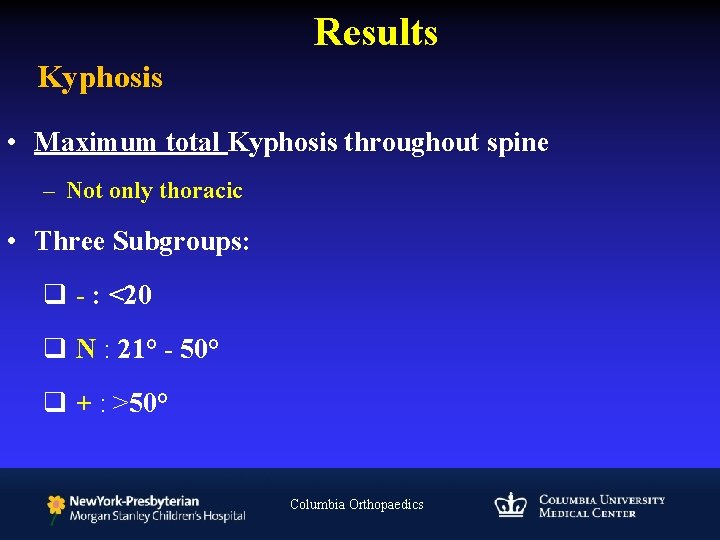
Results Kyphosis • Maximum total Kyphosis throughout spine – Not only thoracic • Three Subgroups: q - : <20 q N : 21° - 50° q + : >50° Columbia Orthopaedics
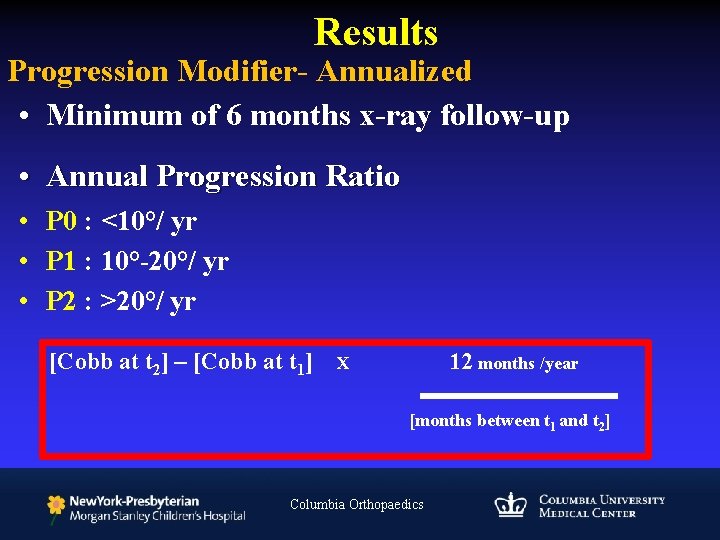
Results Progression Modifier- Annualized • Minimum of 6 months x-ray follow-up • Annual Progression Ratio • P 0 : <10°/ yr • P 1 : 10°-20°/ yr • P 2 : >20°/ yr [Cobb at t 2] – [Cobb at t 1] 12 months /year X [months between t 1 and t 2] Columbia Orthopaedics
Results Etiology • Most challenging variable to sub-group based on heterogenous patient population • Has gone through multiple transformations based on study group feedback Columbia Orthopaedics
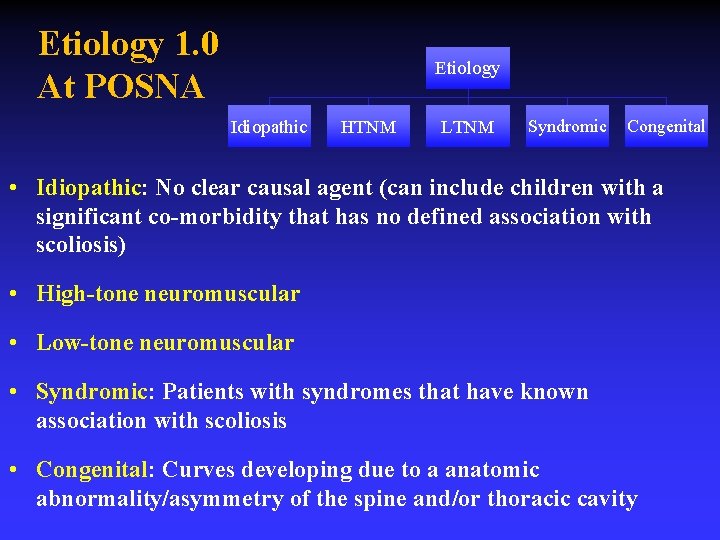
Etiology 1. 0 At POSNA Etiology Idiopathic HTNM LTNM Syndromic Congenital • Idiopathic: No clear causal agent (can include children with a significant co-morbidity that has no defined association with scoliosis) • High-tone neuromuscular • Low-tone neuromuscular • Syndromic: Patients with syndromes that have known association with scoliosis • Congenital: Curves developing due to a anatomic abnormality/asymmetry of the spine and/or thoracic cavity
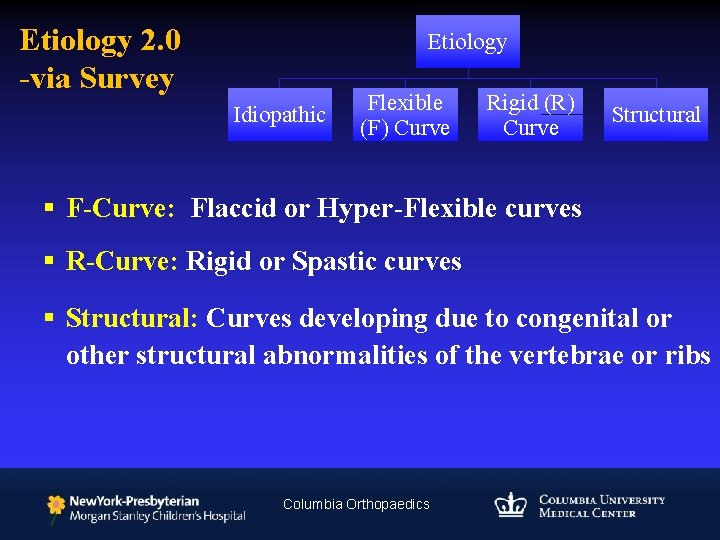
Etiology 2. 0 -via Survey Etiology Idiopathic Flexible (F) Curve Rigid (R) Curve Structural § F-Curve: Flaccid or Hyper-Flexible curves § R-Curve: Rigid or Spastic curves § Structural: Curves developing due to congenital or other structural abnormalities of the vertebrae or ribs Columbia Orthopaedics
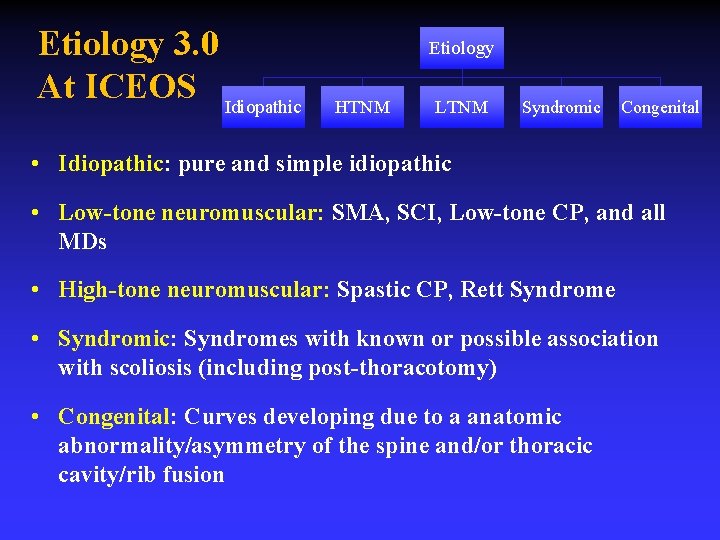
Etiology 3. 0 At ICEOS Idiopathic Etiology HTNM LTNM Syndromic Congenital • Idiopathic: pure and simple idiopathic • Low-tone neuromuscular: SMA, SCI, Low-tone CP, and all MDs • High-tone neuromuscular: Spastic CP, Rett Syndrome • Syndromic: Syndromes with known or possible association with scoliosis (including post-thoracotomy) • Congenital: Curves developing due to a anatomic abnormality/asymmetry of the spine and/or thoracic cavity/rib fusion
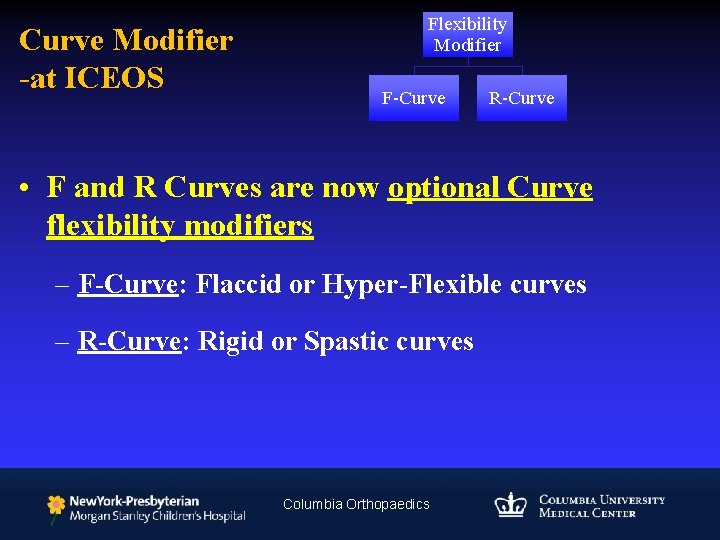
Curve Modifier -at ICEOS Flexibility Modifier F-Curve R-Curve • F and R Curves are now optional Curve flexibility modifiers – F-Curve: Flaccid or Hyper-Flexible curves – R-Curve: Rigid or Spastic curves Columbia Orthopaedics
![Final Classification Age [Prefix] Etiology Idiopathic Syndromic Continuous variable Cobb Angle (Major Curve) Flexibility](http://slidetodoc.com/presentation_image/372ac0548066e61619550fe3a746f192/image-18.jpg "Final Classification Age [Prefix] Etiology Idiopathic Syndromic Continuous variable Cobb Angle (Major Curve) Flexibility")
Final Classification Age [Prefix] Etiology Idiopathic Syndromic Continuous variable Cobb Angle (Major Curve) Flexibility Modifier (optional) 1: <20º F-Curve Congenital 5 yo Progression Modifier (optional) (-) <20º P 0: <10º/yr N: 21 -50º P 1: 10 -20º/ yr (+): >50º P 2: >20º/yr 2: 21 -50º Low-tone NM High-tone NM Maximum Total Kyphosis 3: 51 -90º R-Curve 4: >90º I 2 f. N P 2
Discussion • Agreed to keep Age prefix, Etiology, Cobb Angle, Flexibility Modifier, Kyphosis, Progression Modifier • Will ideally help to: – Simplify provider communication – Facilitate and organize ongoing research efforts – Improve outcomes by guiding management
Limitations • Unable to capture the full clinical picture – Some descriptive ability sacrificed for practicality • Based on a small (expert) group’s opinion (N=15) – …group consensus still better than one viewpoint Columbia Orthopaedics
Discussion • Keep in mind: This is a work in Progress! – We expect it to evolve over time as all Classifications do • Our hope is that this classification will help standardize EOS management and improve the quality of care for this vulnerable population Columbia Orthopaedics
Next Steps • Test intra- and inter-observer reliability of schema • Assess clinical utility by applying classification to past cases • Utilize in ongoing research infrastructure efforts Columbia Orthopaedics
Division of Pediatric Orthopaedic Surgery Thank You Michael G. Vitale, MD MPH mgv 1@columbia. edu Columbia Orthopaedics
- Slides: 23