
Organizing and Evaluating Mechanistic Evidence IRIS Systematic Review
- Slides: 18
Organizing and Evaluating Mechanistic Evidence: IRIS Systematic Review Methodology U. S. EPA Office of Research and Development Board of Scientific Counselors Subcommittee Chemical Safety for Sustainability and Health and Environmental Risk Assessment National Research Programs Catherine Gibbons Center for Public Health & Environmental Assessment Chemical & Pollutant Assessment Division February 4, 2021
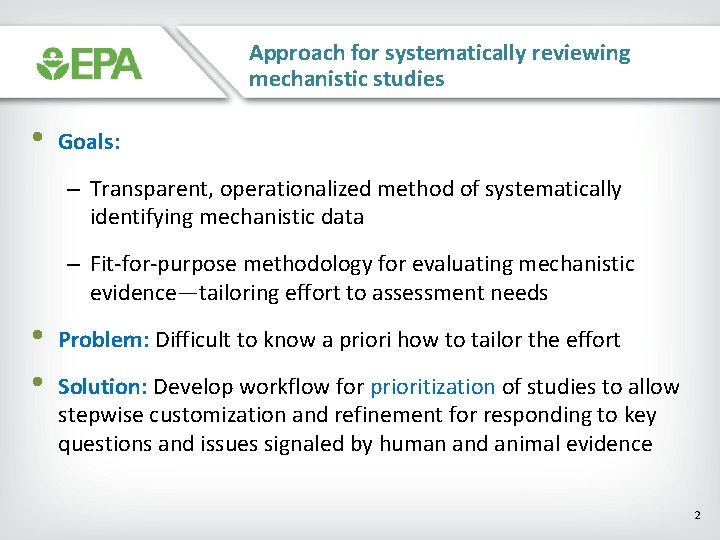
Approach for systematically reviewing mechanistic studies • Goals: – Transparent, operationalized method of systematically identifying mechanistic data – Fit-for-purpose methodology for evaluating mechanistic evidence—tailoring effort to assessment needs • • Problem: Difficult to know a priori how to tailor the effort Solution: Develop workflow for prioritization of studies to allow stepwise customization and refinement for responding to key questions and issues signaled by human and animal evidence 2
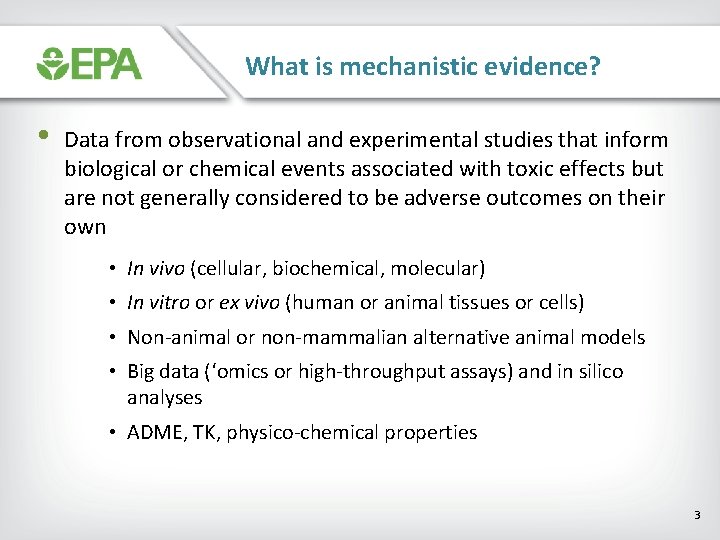
What is mechanistic evidence? • Data from observational and experimental studies that inform biological or chemical events associated with toxic effects but are not generally considered to be adverse outcomes on their own • In vivo (cellular, biochemical, molecular) • In vitro or ex vivo (human or animal tissues or cells) • Non-animal or non-mammalian alternative animal models • Big data (‘omics or high-throughput assays) and in silico analyses • ADME, TK, physico-chemical properties 3
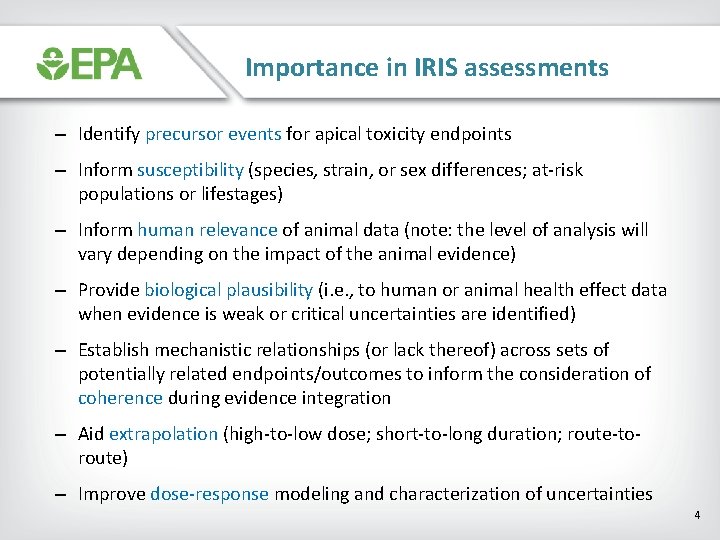
Importance in IRIS assessments – Identify precursor events for apical toxicity endpoints – Inform susceptibility (species, strain, or sex differences; at-risk populations or lifestages) – Inform human relevance of animal data (note: the level of analysis will vary depending on the impact of the animal evidence) – Provide biological plausibility (i. e. , to human or animal health effect data when evidence is weak or critical uncertainties are identified) – Establish mechanistic relationships (or lack thereof) across sets of potentially related endpoints/outcomes to inform the consideration of coherence during evidence integration – Aid extrapolation (high-to-low dose; short-to-long duration; route-toroute) – Improve dose-response modeling and characterization of uncertainties 4
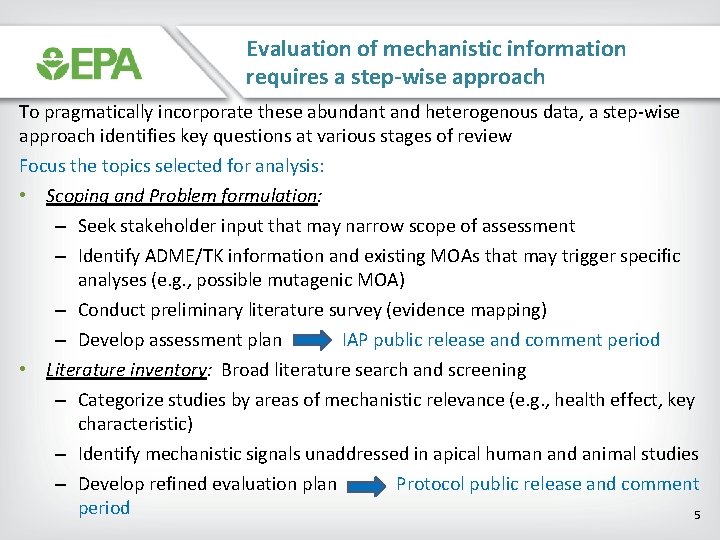
Evaluation of mechanistic information requires a step-wise approach To pragmatically incorporate these abundant and heterogenous data, a step-wise approach identifies key questions at various stages of review Focus the topics selected for analysis: • Scoping and Problem formulation: – Seek stakeholder input that may narrow scope of assessment – Identify ADME/TK information and existing MOAs that may trigger specific analyses (e. g. , possible mutagenic MOA) – Conduct preliminary literature survey (evidence mapping) – Develop assessment plan IAP public release and comment period • Literature inventory: Broad literature search and screening – Categorize studies by areas of mechanistic relevance (e. g. , health effect, key characteristic) – Identify mechanistic signals unaddressed in apical human and animal studies – Develop refined evaluation plan Protocol public release and comment period 5
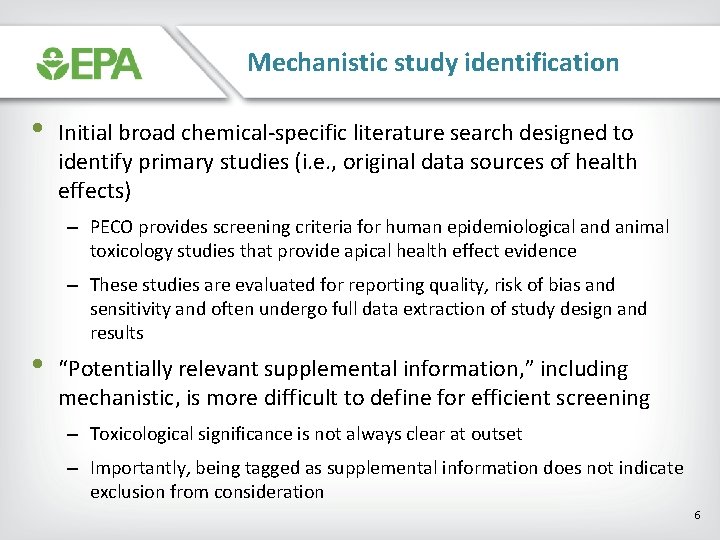
Mechanistic study identification • Initial broad chemical-specific literature search designed to identify primary studies (i. e. , original data sources of health effects) – PECO provides screening criteria for human epidemiological and animal toxicology studies that provide apical health effect evidence • – These studies are evaluated for reporting quality, risk of bias and sensitivity and often undergo full data extraction of study design and results “Potentially relevant supplemental information, ” including mechanistic, is more difficult to define for efficient screening – Toxicological significance is not always clear at outset – Importantly, being tagged as supplemental information does not indicate exclusion from consideration 6
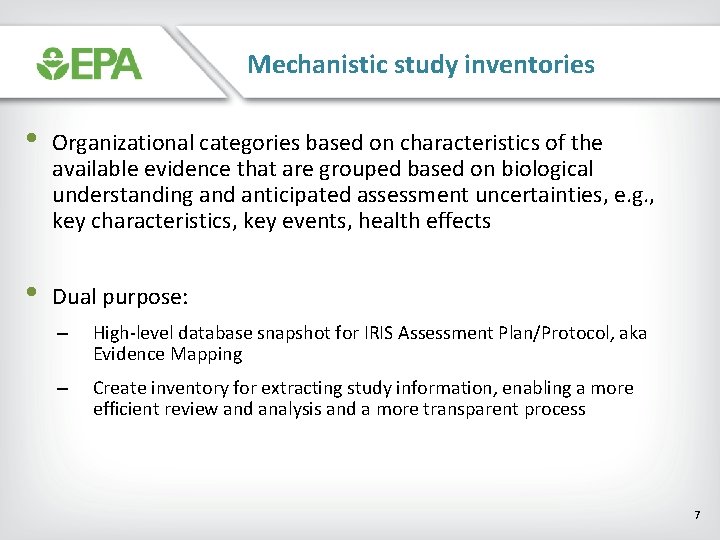
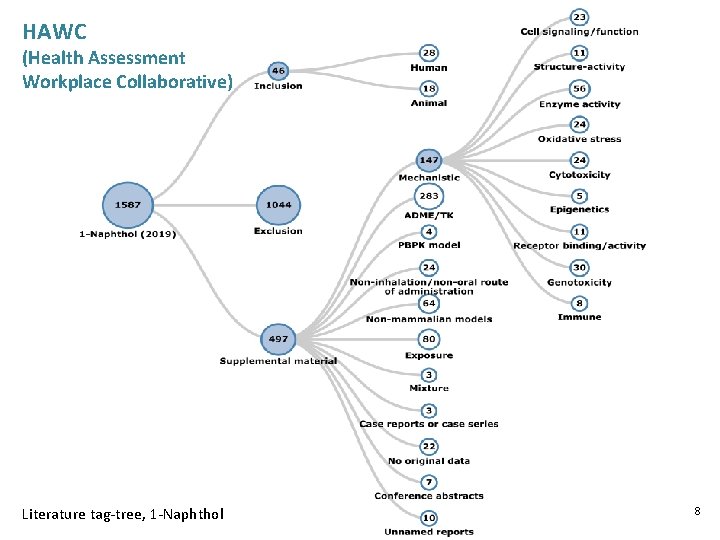
Mechanistic study inventories • Organizational categories based on characteristics of the available evidence that are grouped based on biological understanding and anticipated assessment uncertainties, e. g. , key characteristics, key events, health effects • Dual purpose: – High-level database snapshot for IRIS Assessment Plan/Protocol, aka Evidence Mapping – Create inventory for extracting study information, enabling a more efficient review and analysis and a more transparent process 7
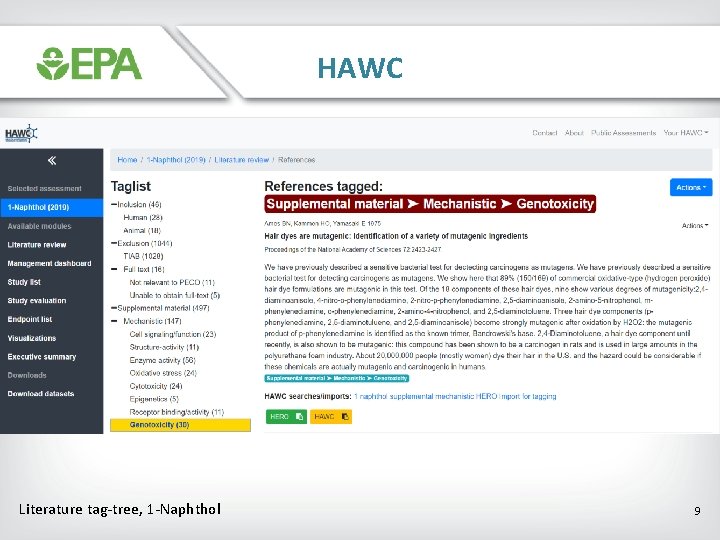
HAWC (Health Assessment Workplace Collaborative) Literature tag-tree, 1 -Naphthol 8
HAWC Literature tag-tree, 1 -Naphthol 9
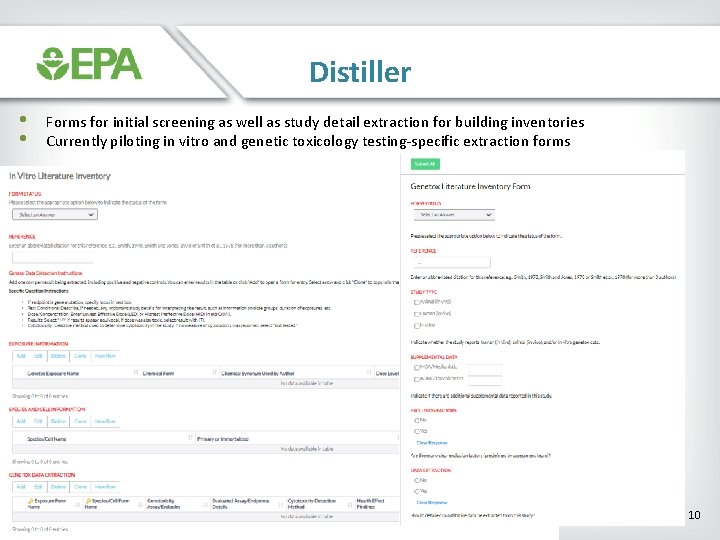
Distiller • • Forms for initial screening as well as study detail extraction for building inventories Currently piloting in vitro and genetic toxicology testing-specific extraction forms 10
Narrow the focus for mechanistic syntheses • Focused approach primarily driven by whether uncertainties exist in the human and animal evidence base • Areas of focus for mechanistic analyses determined by: – – • Key science issues identified during problem formulation Health effects indicated by human and animal evidence The level of potential influence for making hazard ID and doseresponse decisions Known MOAs and pathways of toxicity Flexible approach – – Syntheses can range from a high-level summary to a detailed MOA analysis with mechanistic study evaluations Determined by availability of adequate chemical-specific data 11
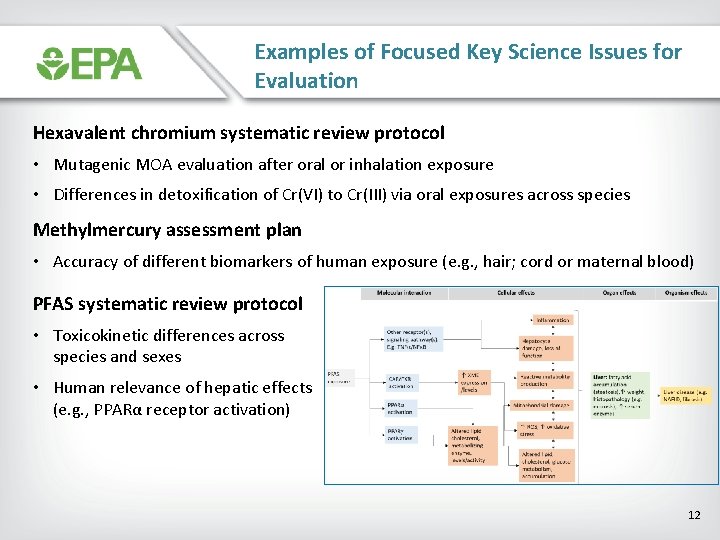
Examples of Focused Key Science Issues for Evaluation Hexavalent chromium systematic review protocol • Mutagenic MOA evaluation after oral or inhalation exposure • Differences in detoxification of Cr(VI) to Cr(III) via oral exposures across species Methylmercury assessment plan • Accuracy of different biomarkers of human exposure (e. g. , hair; cord or maternal blood) PFAS systematic review protocol • Toxicokinetic differences across species and sexes • Human relevance of hepatic effects (e. g. , PPARα receptor activation) 12
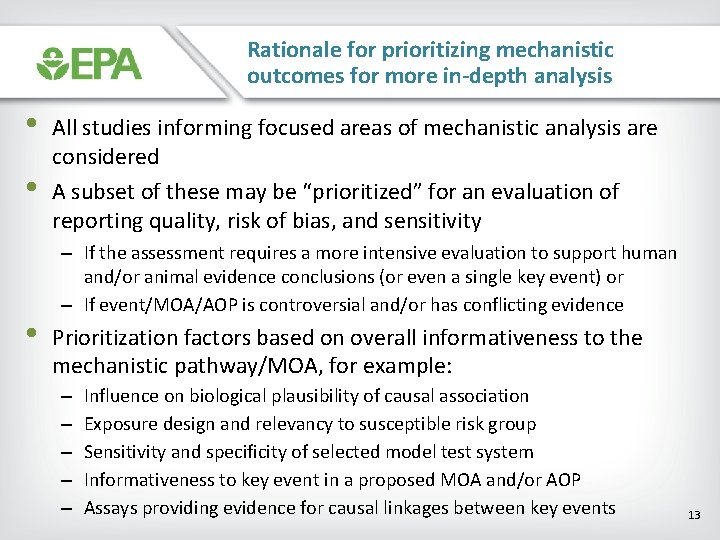
Rationale for prioritizing mechanistic outcomes for more in-depth analysis • • • All studies informing focused areas of mechanistic analysis are considered A subset of these may be “prioritized” for an evaluation of reporting quality, risk of bias, and sensitivity – If the assessment requires a more intensive evaluation to support human and/or animal evidence conclusions (or even a single key event) or – If event/MOA/AOP is controversial and/or has conflicting evidence Prioritization factors based on overall informativeness to the mechanistic pathway/MOA, for example: – – – Influence on biological plausibility of causal association Exposure design and relevancy to susceptible risk group Sensitivity and specificity of selected model test system Informativeness to key event in a proposed MOA and/or AOP Assays providing evidence for causal linkages between key events 13
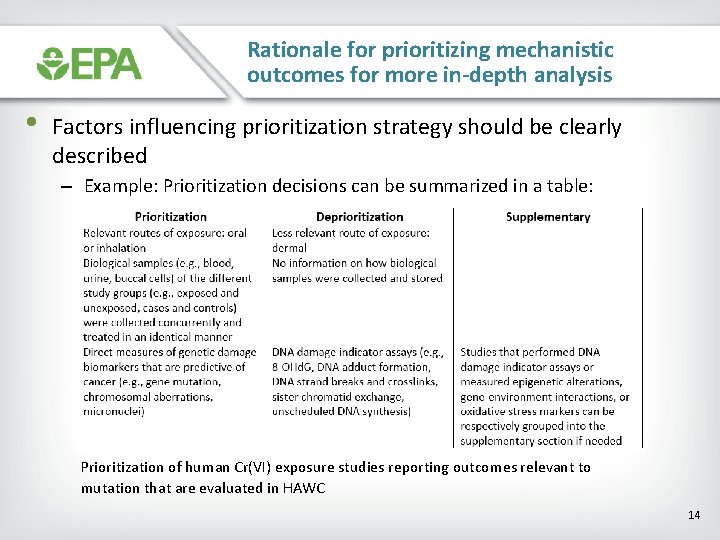
Rationale for prioritizing mechanistic outcomes for more in-depth analysis • Factors influencing prioritization strategy should be clearly described – Example: Prioritization decisions can be summarized in a table: Prioritization of human Cr(VI) exposure studies reporting outcomes relevant to mutation that are evaluated in HAWC 14
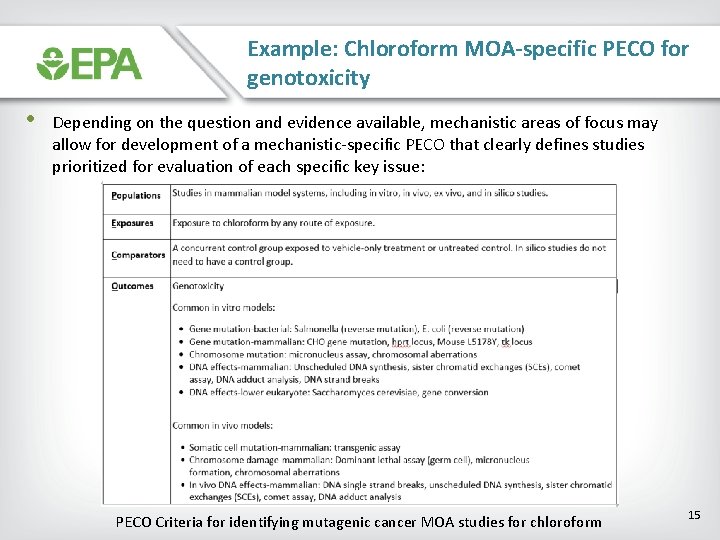
Example: Chloroform MOA-specific PECO for genotoxicity • Depending on the question and evidence available, mechanistic areas of focus may allow for development of a mechanistic-specific PECO that clearly defines studies prioritized for evaluation of each specific key issue: PECO Criteria for identifying mutagenic cancer MOA studies for chloroform 15
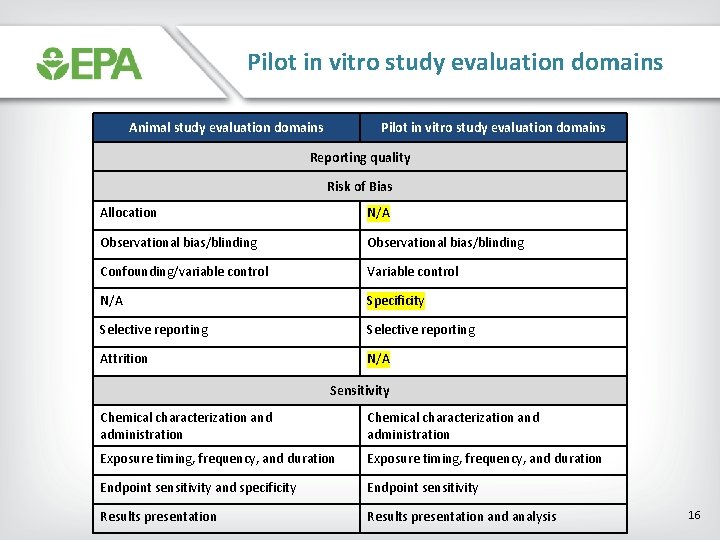
Pilot in vitro study evaluation domains Animal study evaluation domains Pilot in vitro study evaluation domains Reporting quality Risk of Bias Allocation N/A Observational bias/blinding Confounding/variable control Variable control N/A Specificity Selective reporting Attrition N/A Sensitivity Chemical characterization and administration Exposure timing, frequency, and duration Endpoint sensitivity and specificity Endpoint sensitivity Results presentation and analysis 16
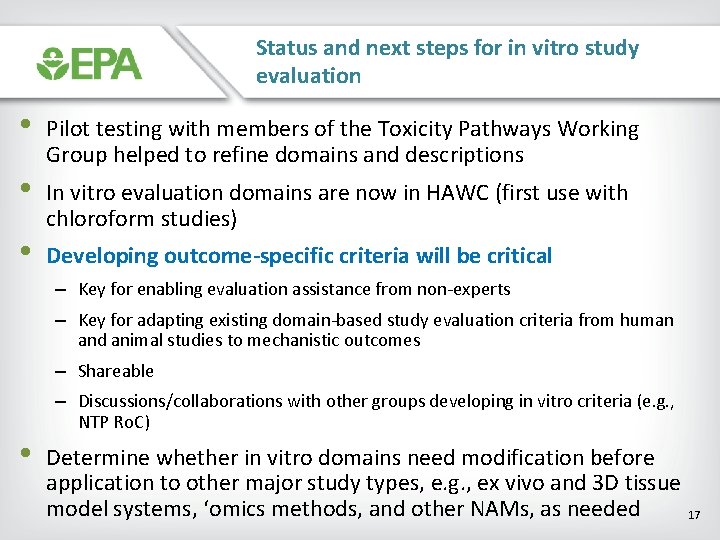
Status and next steps for in vitro study evaluation • • • Pilot testing with members of the Toxicity Pathways Working Group helped to refine domains and descriptions In vitro evaluation domains are now in HAWC (first use with chloroform studies) Developing outcome-specific criteria will be critical – Key for enabling evaluation assistance from non-experts – Key for adapting existing domain-based study evaluation criteria from human and animal studies to mechanistic outcomes – Shareable • – Discussions/collaborations with other groups developing in vitro criteria (e. g. , NTP Ro. C) Determine whether in vitro domains need modification before application to other major study types, e. g. , ex vivo and 3 D tissue model systems, ‘omics methods, and other NAMs, as needed 17
Thank you IRIS Program Planning Kris Thayer James Avery Vicki Soto Dahnish Shams HERA Beth Owens Samantha Jones CPAD SR Approaches Xabier Arzuaga Vince Cogliano Glinda Cooper Laura Dishaw Barbara Glenn Karen Hogan April Luke Andrew Kraft Beth Radke Kris Thayer George Woodall Erin Yost 18