
Organizations Tenth Edition Behavior Structure Processes Gibson Ivancevich
Organizations Tenth Edition Behavior Structure Processes Gibson Ivancevich Donnelly Chapter 18 Managing Organizational Change and Development Learning Objectives After completing Chapter 18, you should be able to: Define The concept and practice of organizational development Describe Sources of change and alternative change management approaches Discuss The ethical issues that arise in organizational development practice Compare Alternative interventions that management can implement to improve performance Identify The important steps in organizational development programs Irwin/Mc. Graw-Hill 1 © The Mc. Graw-Hill Companies, Inc. 2000
Tenth Edition Organizations Behavior Structure Processes Gibson Ivancevich Donnelly Chapter Outline u. Alternative Change Management Approaches u. Organizational Development u. Learning Principles & Change Agents u. A Model for Managing Organizational Development u. Forces for Change u. Diagnosis of a Problem & Interventions u. Overcoming Limiting Conditions u. Implementing & Evaluating the Program u. Ethical Issues u. Guidelines for Managing Change through OD Irwin/Mc. Graw-Hill 2 © The Mc. Graw-Hill Companies, Inc. 2000

Organizations Tenth Edition Behavior Structure Processes Gibson Ivancevich Donnelly CHANGE MANAGEMENT APPROACHES Managing change through power Managing change through reason Managing change through education Irwin/Mc. Graw-Hill 3 © The Mc. Graw-Hill Companies, Inc. 2000
Organizations Tenth Edition Behavior Structure Processes Gibson Ivancevich Donnelly ORGANIZATIONAL DEVELOPMENT A planned, managed, systematic process to change the culture, systems, & behavior of an organization. It seeks to improve the organization’s effectiveness in solving its problems & achieving its objectives. Irwin/Mc. Graw-Hill 4 © The Mc. Graw-Hill Companies, Inc. 2000
Organizations Tenth Edition Behavior Structure Processes Gibson Ivancevich Donnelly OD LEARNING PRINCIPLES u Unfreezing old learning requires people who want to learn new ways to think & act. u Movement to new learning requires training, demonstration, & empowerment. u Refreezing the learned behavior occurs through applying reinforcement & feedback. Irwin/Mc. Graw-Hill 5 © The Mc. Graw-Hill Companies, Inc. 2000
Tenth Edition Organizations Behavior Structure Processes Gibson Ivancevich Donnelly OD CHANGE AGENTS A change agent is a person or group who enters an organization to facilitate a change process External change agents are temporary employees, usually a university professor or private consultant Internal change agents are ongoing employees who know something about the organization External-internal change agents make up a change team put together by the organization Irwin/Mc. Graw-Hill 6 © The Mc. Graw-Hill Companies, Inc. 2000
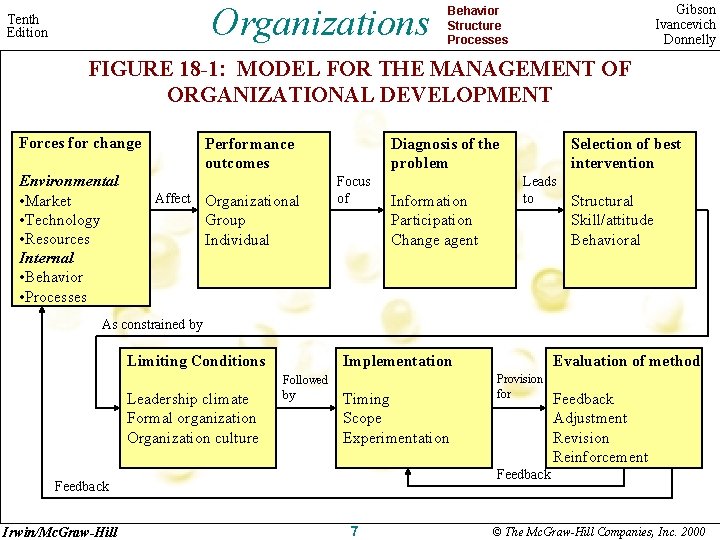
Organizations Tenth Edition Gibson Ivancevich Donnelly Behavior Structure Processes FIGURE 18 -1: MODEL FOR THE MANAGEMENT OF ORGANIZATIONAL DEVELOPMENT Forces for change Environmental • Market • Technology • Resources Internal • Behavior • Processes Performance outcomes Affect Organizational Group Individual Diagnosis of the problem Focus of Information Participation Change agent Selection of best intervention Leads to Structural Skill/attitude Behavioral As constrained by Limiting Conditions Leadership climate Formal organization Organization culture Implementation Followed by Timing Scope Experimentation Provision for Feedback Adjustment Revision Reinforcement Feedback Irwin/Mc. Graw-Hill Evaluation of method 7 © The Mc. Graw-Hill Companies, Inc. 2000
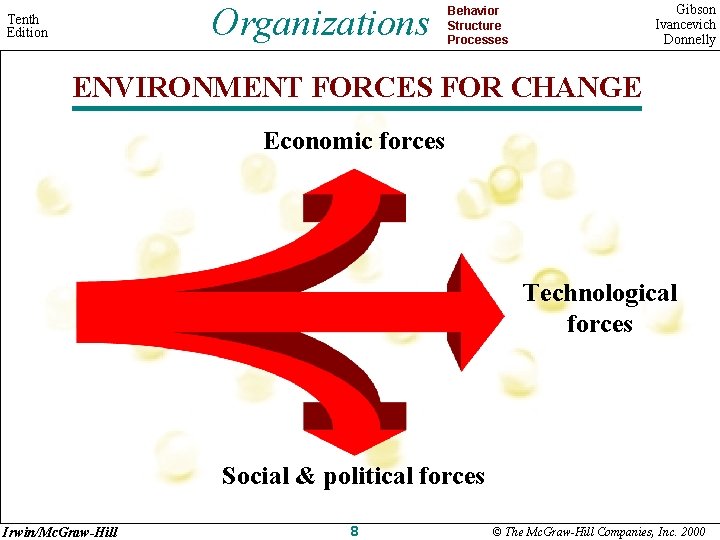
Organizations Tenth Edition Gibson Ivancevich Donnelly Behavior Structure Processes ENVIRONMENT FORCES FOR CHANGE Economic forces Technological forces Social & political forces Irwin/Mc. Graw-Hill 8 © The Mc. Graw-Hill Companies, Inc. 2000
Organizations Tenth Edition Behavior Structure Processes Gibson Ivancevich Donnelly QUESTIONS FOR DIAGNOSING THE PROBLEM 4 What is the problem distinct from the symptoms of the problem? 4 What must be changed to resolve the problem? 4 What outcomes are expected from the change, & how will these outcomes be measured? Irwin/Mc. Graw-Hill 9 © The Mc. Graw-Hill Companies, Inc. 2000
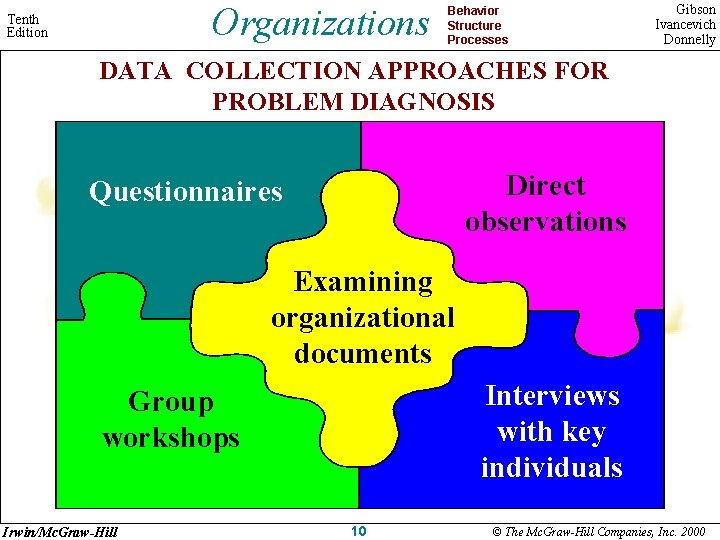
Organizations Tenth Edition Behavior Structure Processes Gibson Ivancevich Donnelly DATA COLLECTION APPROACHES FOR PROBLEM DIAGNOSIS Direct observations Questionnaires Examining organizational documents Interviews with key individuals Group workshops Irwin/Mc. Graw-Hill 10 © The Mc. Graw-Hill Companies, Inc. 2000
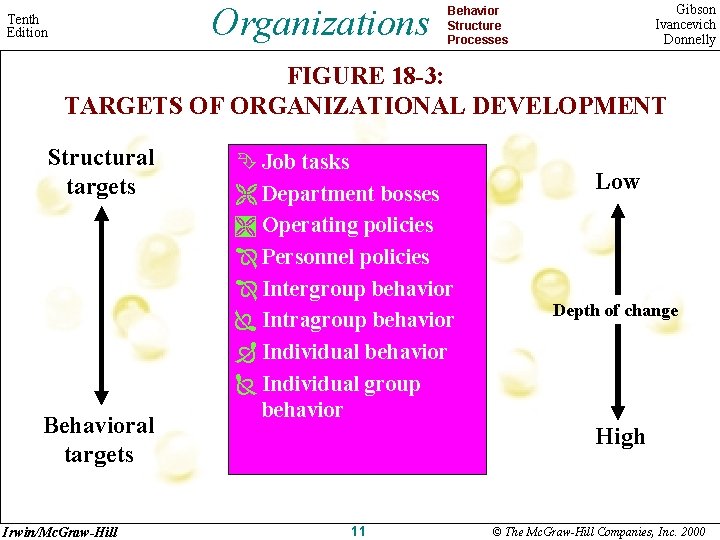
Organizations Tenth Edition Gibson Ivancevich Donnelly Behavior Structure Processes FIGURE 18 -3: TARGETS OF ORGANIZATIONAL DEVELOPMENT Structural targets Behavioral targets Irwin/Mc. Graw-Hill Ê Job tasks Ë Department bosses Ì Operating policies Î Personnel policies Î Intergroup behavior Ï Intragroup behavior Ð Individual behavior Ñ Individual group behavior Low Depth of change High 11 © The Mc. Graw-Hill Companies, Inc. 2000
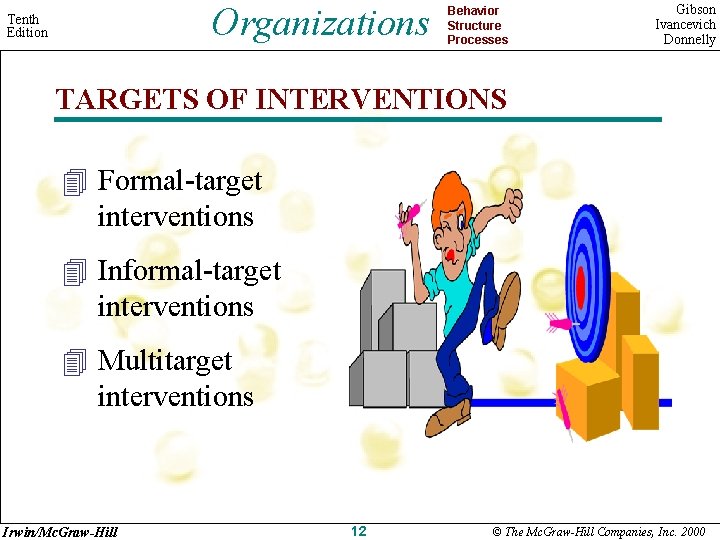
Organizations Tenth Edition Behavior Structure Processes Gibson Ivancevich Donnelly TARGETS OF INTERVENTIONS 4 Formal-target interventions 4 Informal-target interventions 4 Multitarget interventions Irwin/Mc. Graw-Hill 12 © The Mc. Graw-Hill Companies, Inc. 2000

Tenth Edition Organizations Behavior Structure Processes Gibson Ivancevich Donnelly LIMITING CONDITIONS OF AN INTERVENTION Leadership climate: Managers’ leadership style & administrative practices. Formal organization: Top management’s philosophy & policies, legal precedent, organizational structure, & control systems. Organizational culture: The pattern of beliefs resulting from group norms, values, & informal activities. Irwin/Mc. Graw-Hill 13 © The Mc. Graw-Hill Companies, Inc. 2000
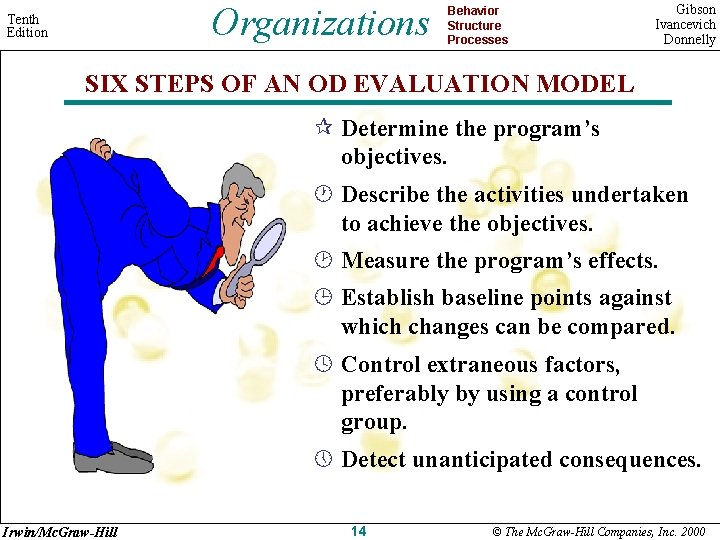
Organizations Tenth Edition Behavior Structure Processes Gibson Ivancevich Donnelly SIX STEPS OF AN OD EVALUATION MODEL ¶ Determine the program’s objectives. · Describe the activities undertaken to achieve the objectives. ¸ Measure the program’s effects. ¹ Establish baseline points against which changes can be compared. º Control extraneous factors, preferably by using a control group. » Detect unanticipated consequences. Irwin/Mc. Graw-Hill 14 © The Mc. Graw-Hill Companies, Inc. 2000
Organizations Tenth Edition Behavior Structure Processes Gibson Ivancevich Donnelly SOME GUIDELINES FOR MANAGING CHANGE THROUGH OD Ê All involved must have high and visible commitment to the effort Ë People who are involved need advance information Ì The effort must be connected to other parts of the organization Í The effort needs to be directed by line managers and assisted by a change agent if necessary Î The effort must be based on good diagnosis and must be consistent with the conditions in the organization Ï Management must remain committed to the effort Ð Evaluation is essential Ñ People must see the relationship between the effort and the goals Ò The change agent must be clearly competent Irwin/Mc. Graw-Hill 15 © The Mc. Graw-Hill Companies, Inc. 2000
- Slides: 15