
Organizations as Organisms From Images of Organization by
Organizations as Organisms From “Images of Organization” by G. Morgan
Systems Theory “The essential nature of matter lies not in objects, but in interconnections”
Assumptions from Systems Theory • A system is a set of units that connect to form a whole. • The whole system functions because of interdependence of its parts. • Systems have input, output, control, and feedback processes. • Living systems are more complex than mechanical systems.
Living Systems Life: a property of improbably complexity possessed by an entity that works to keep itself out of equilibrium with its environment. R. Dawkins (1986)
8 Characteristics of Living Things: (Biology 101) • Living things – are organized – work together to form increasingly higher levels of complexity. – metabolize – maintain internal environment. – grow – respond – reproduce – evolve
Characteristics of Living Systems • Living systems learn constantly (are adaptive). • Living systems are self-organizing. • Life is systems-thinking. • Living systems are webbed with feedback (reciprocal modification) • Living systems are interconnected. • Living systems are self-referential • Living systems are autopoetic.
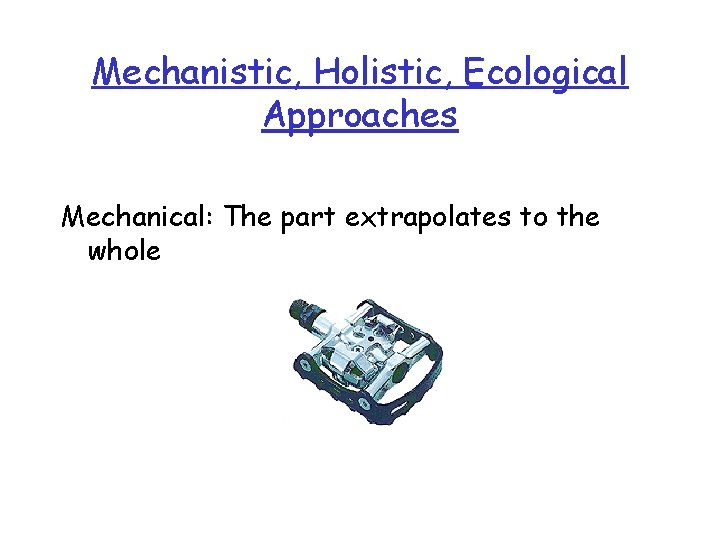
Mechanistic, Holistic, Ecological Approaches Mechanical: The part extrapolates to the whole
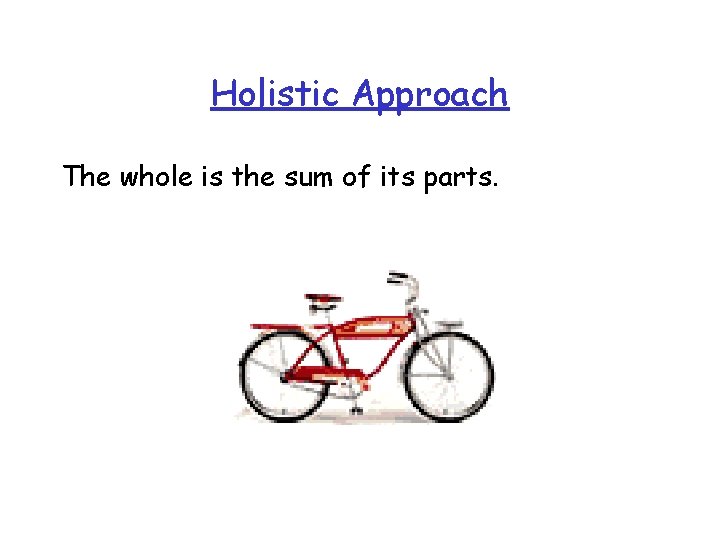
Holistic Approach The whole is the sum of its parts.
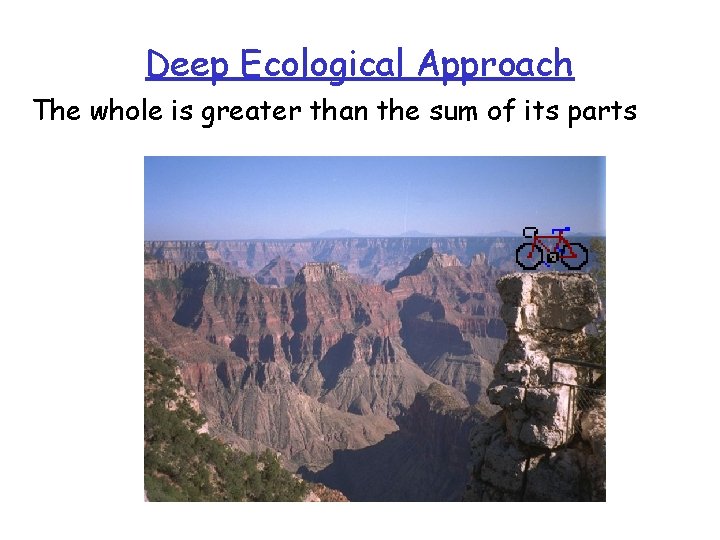
Deep Ecological Approach The whole is greater than the sum of its parts
Organic Approach
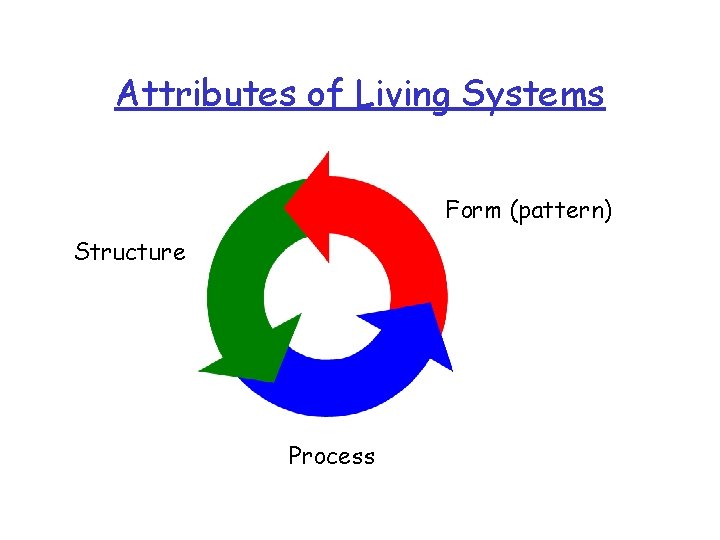
Attributes of Living Systems Form (pattern) Structure Process
Organisms vs. Machines • • • Open versus closed Dynamic versus static Fluid versus bounded Adaptive versus rigid Complex versus simple Quantum versus Newtonian Non-linear versus linear Organic versus mechanistic Interrelationships versus objects Chaotic pendulum versus clock
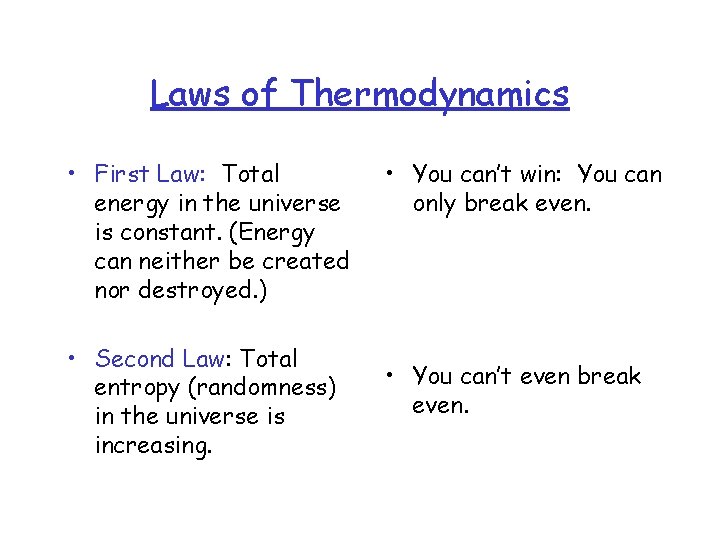
Laws of Thermodynamics • First Law: Total energy in the universe is constant. (Energy can neither be created nor destroyed. ) • Second Law: Total entropy (randomness) in the universe is increasing. • You can’t win: You can only break even. • You can’t even break even.
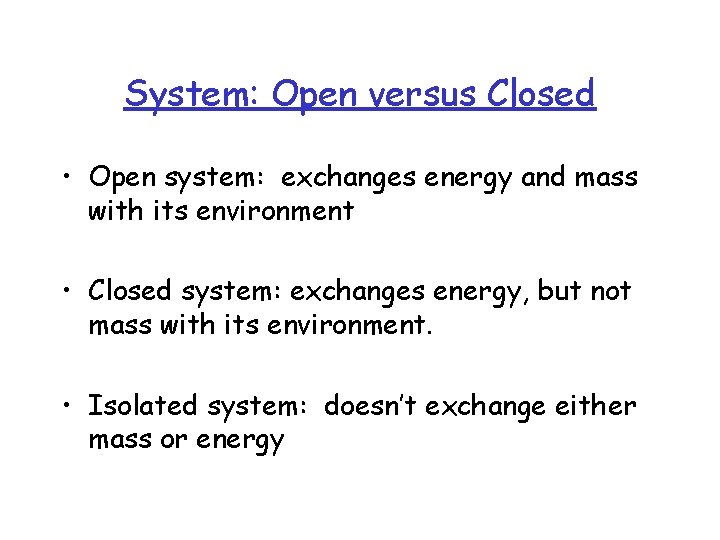
System: Open versus Closed • Open system: exchanges energy and mass with its environment • Closed system: exchanges energy, but not mass with its environment. • Isolated system: doesn’t exchange either mass or energy
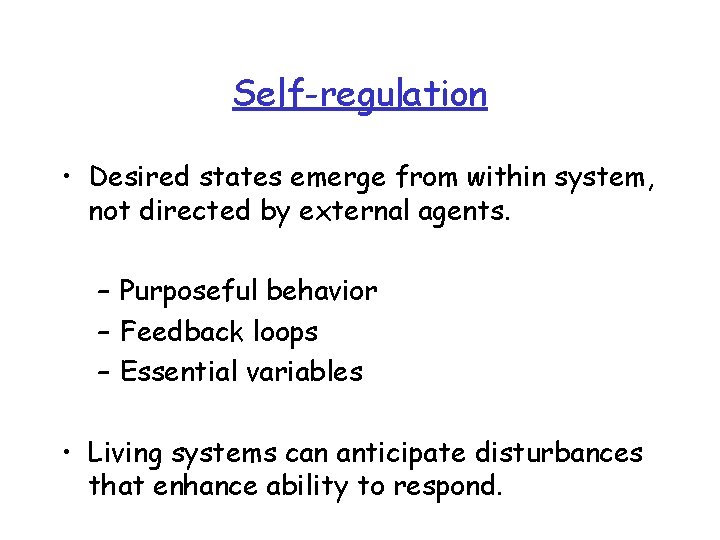
Self-regulation • Desired states emerge from within system, not directed by external agents. – Purposeful behavior – Feedback loops – Essential variables • Living systems can anticipate disturbances that enhance ability to respond.
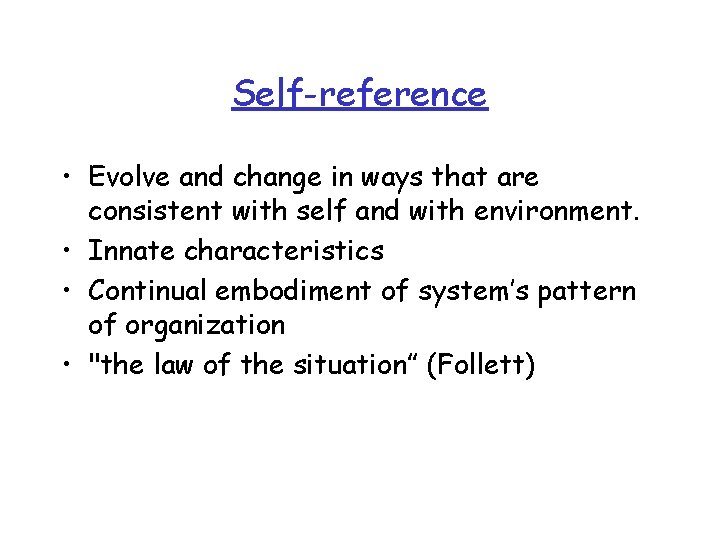
Self-reference • Evolve and change in ways that are consistent with self and with environment. • Innate characteristics • Continual embodiment of system’s pattern of organization • "the law of the situation” (Follett)
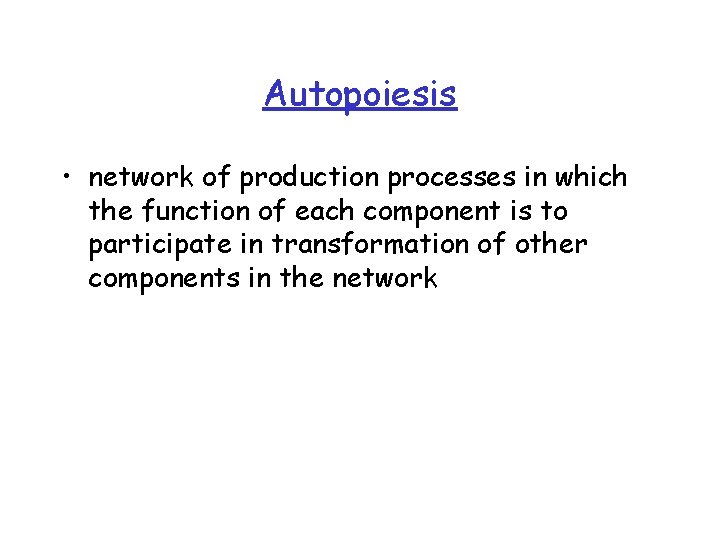
Autopoiesis • network of production processes in which the function of each component is to participate in transformation of other components in the network
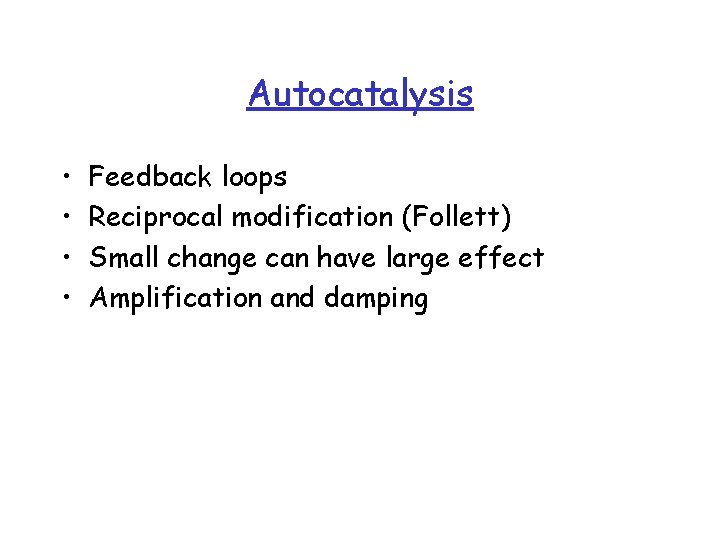
Autocatalysis • • Feedback loops Reciprocal modification (Follett) Small change can have large effect Amplification and damping
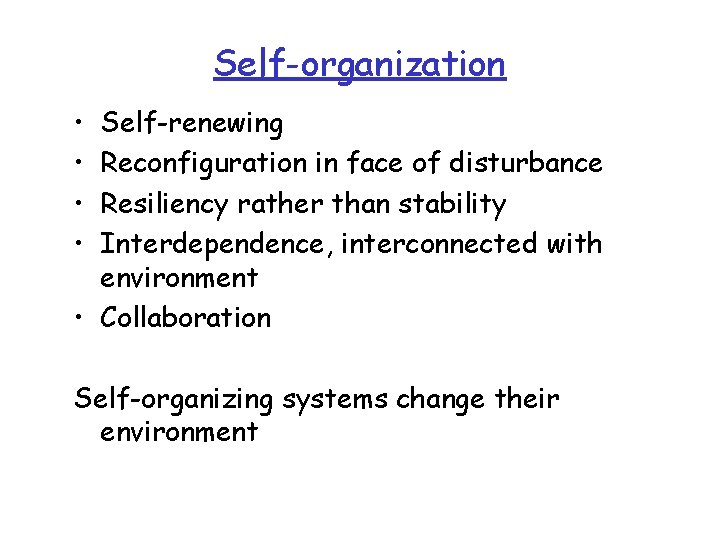
Self-organization • • Self-renewing Reconfiguration in face of disturbance Resiliency rather than stability Interdependence, interconnected with environment • Collaboration Self-organizing systems change their environment
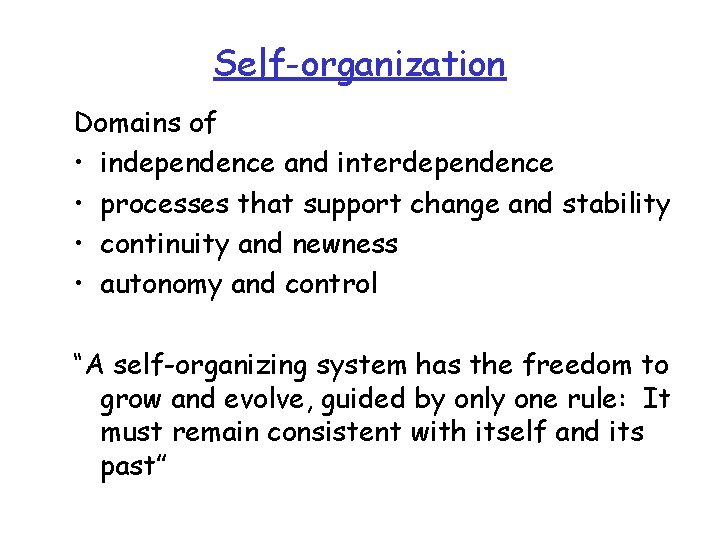
Self-organization Domains of • independence and interdependence • processes that support change and stability • continuity and newness • autonomy and control “A self-organizing system has the freedom to grow and evolve, guided by only one rule: It must remain consistent with itself and its past”
Question: • How can you hold a hundred tons of water in the air with no visible means of support?
You build a cloud
Equilibrium • A condition in which all acting forces are canceled by others resulting in a stable, balanced, or unchanging system. • (Physics) The condition of a system in which the resultant of all acting forces is zero. • Thermodynamic: DG = 0
Equilibrium • End state in evolution of isolated systems, point at which the system has exhausted all of its capacity for change, done its work, and dissipated its productive capacity into useless entropy. At equilibrium, nothing left for the system to do…. it can produce nothing. (Wheatley, p. 76. ) • Spontaneity/capacity for change (demo)
Entropy: The arrow of time • In a closed system, entropy can never decrease • Measure of disorder • Measure of capacity to change • “Mixedupness” (W. Gibbs) • Complex to simple • Order to disorder
Models of Change and Adaptivity • • Evolution (Darwin): change is continuous and intrinsic natural selection selective reproduction genetic drift genetic variation random mutation “survival of the fittest” (NOT!)
Change and Adaptivity • • • Punctuated Equilibrium (Gould) equilibrium punctured by short periods of intense change and reconfiguration stable structures at equilibrium change is disruptive, rare event chaos theory occurs in small, isolated populations
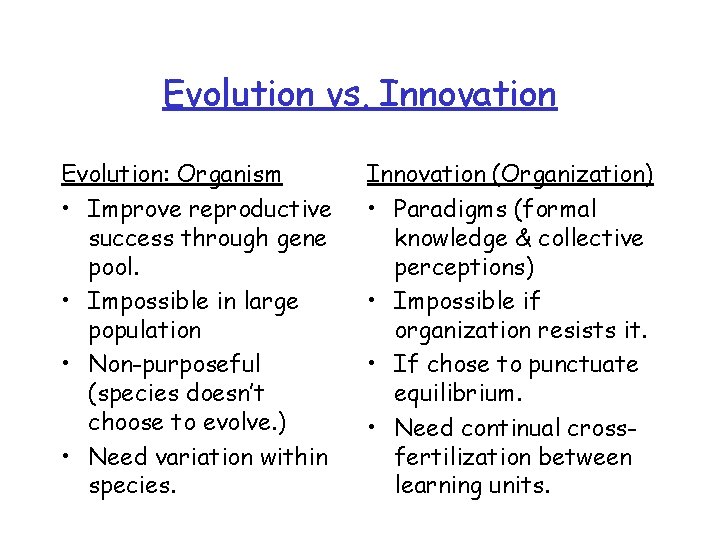
Evolution vs. Innovation Evolution: Organism • Improve reproductive success through gene pool. • Impossible in large population • Non-purposeful (species doesn’t choose to evolve. ) • Need variation within species. Innovation (Organization) • Paradigms (formal knowledge & collective perceptions) • Impossible if organization resists it. • If chose to punctuate equilibrium. • Need continual crossfertilization between learning units.
Evolution vs. Innovation Evolution: Organism • occurs only in small isolated populations • mutations • no interbreeding between species • cannot pass on acquired characteristics • competition for survival Innovation (Organization) • occurs only in small isolated populations • entreprenurialship • merge and blend at will (but NIH) • changes passed on through cultural and educational programs. • Competition and cooperation
Complex Adaptive Theory • • Dynamic systems Non-linear Network dynamics Multiple levels of organization and structure • Bounded instability: – stable equilibrium or explosive instability • Generative complexity in boundary between rigidity and randomness
Dissipative Structures (Prigogine) • Systems that maintain themselves in a stable state but are far from equilibrium • Use disequilibrium to avoid deterioration • Continual influx of energy flow, but overall structure is maintained. • Continuously import energy and discard entropy • Self-organizing systems • Dissipate energy in order to recreate new forms of organization
Dissipative Structures (Prigogine) • Self-amplifying feedback loops push system farther from equilibrium until reaches threshold of stability • Change agent has huge effect • Bifurcation points: crossroads between death and transformation • path not predictable, but self-referential • Increasing complexity
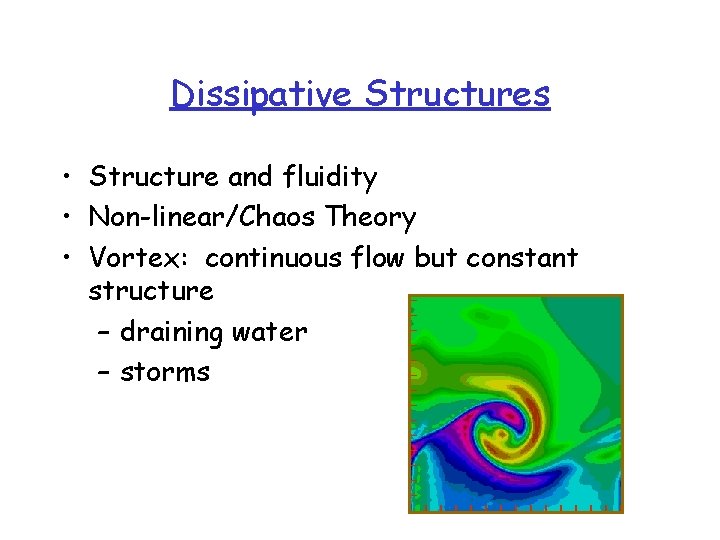
Dissipative Structures • Structure and fluidity • Non-linear/Chaos Theory • Vortex: continuous flow but constant structure – draining water – storms
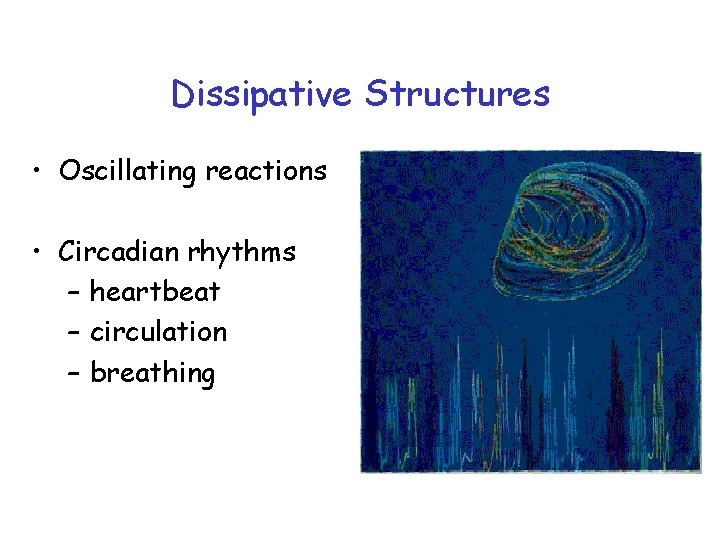
Dissipative Structures • Oscillating reactions • Circadian rhythms – heartbeat – circulation – breathing
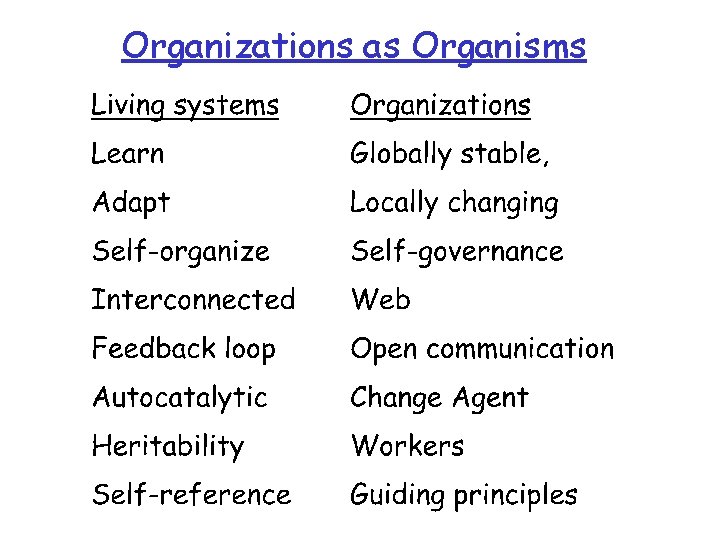
Organizations as Organisms
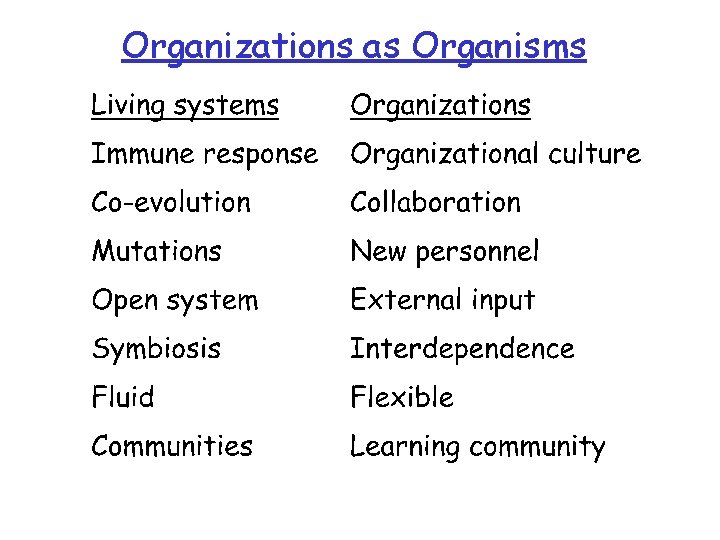
Organizations as Organisms
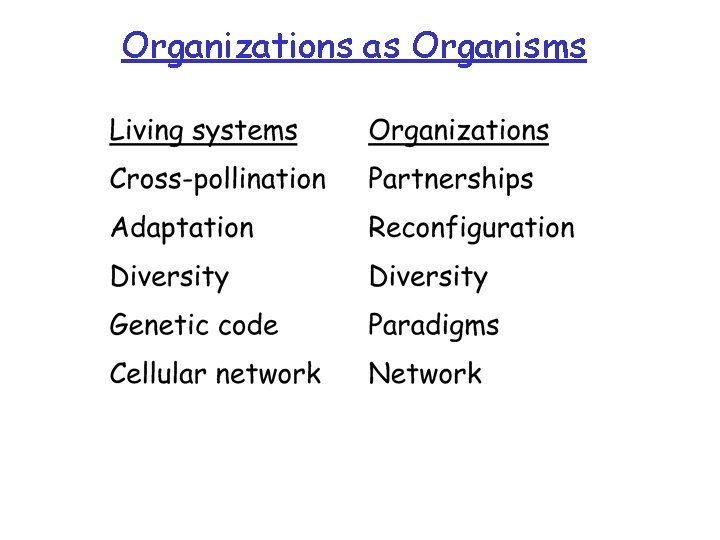
Organizations as Organisms
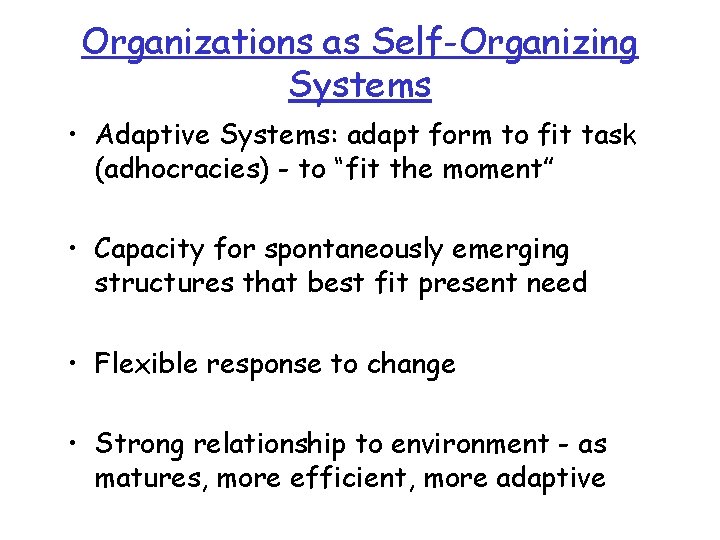
Organizations as Self-Organizing Systems • Adaptive Systems: adapt form to fit task (adhocracies) - to “fit the moment” • Capacity for spontaneously emerging structures that best fit present need • Flexible response to change • Strong relationship to environment - as matures, more efficient, more adaptive
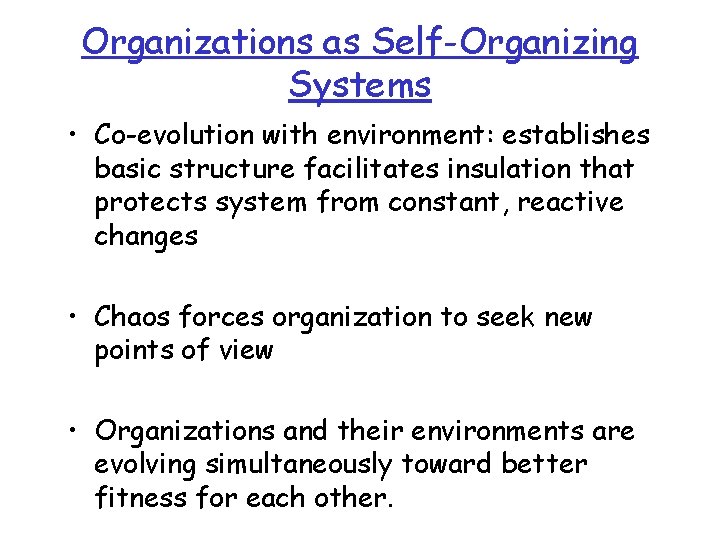
Organizations as Self-Organizing Systems • Co-evolution with environment: establishes basic structure facilitates insulation that protects system from constant, reactive changes • Chaos forces organization to seek new points of view • Organizations and their environments are evolving simultaneously toward better fitness for each other.
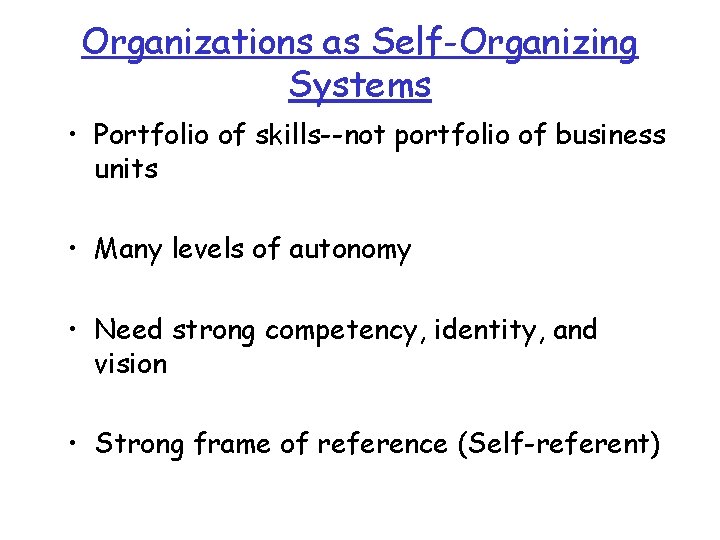
Organizations as Self-Organizing Systems • Portfolio of skills--not portfolio of business units • Many levels of autonomy • Need strong competency, identity, and vision • Strong frame of reference (Self-referent)
Organizations as Dissipative Systems Hypercycles – multiple feedback loops – catalytic cycles – self-replication
Organizational Change • When system is far from equilibrium, creative individual can have a huge impact – amplification of feedback loop – presence of lone fluctuation gets amplified – autocatalysis • Bifurcation points
Learning Organizations and Punctuated Equilibrium • • Respond to environmental changes Tolerate stress Compete effectively Exploit new niches Take risks Develop symbiotic relationships Evolve or perish?
Characteristics of Successful Organizations • • Self-organizing or self-renewing Adaptive Flexible to internal and external change Feedback loops – reflection, self-awareness, information • Globally stable with local fluctuations • Open system • Self-referential
Living Systems Theory and Transformational Leadership • • • Organizational beliefs (genetic code) Feedback loop: reciprocal modification Guiding principles, shared vision Straddle both continuity and discontinuity Adaptable Aware of environment Reflective and synnoetic Self-transcendent Adhocracy
Transformational Leadership • Entreprenurial • Visionary • Build sustainable niche in emergent economic systems • Leader’s task is to communicate shared values and guiding principles, keep them in the forefront, and allow individuals in the system random, chaotic-looking meanderings. (Wheatley, p. 133)
Strengths of the Metaphor • Focus on relationships and connectedness – within organization – between organizations – with environment • Change and diffusion theory – provides model for innovation
Weaknesses of the Metaphor • Emphasis on cooperation rather than competition • Need additional theories to use metaphor effectively – Living Systems Theory – Complex Adaptivity Theory – Punctuated Equilibrium – Non-linear Math and Chaos Theory
The Web of Interconnectedness “. . . Whatever befalls the earth, befalls the sons and daughters of the earth. Man did not weave the web of life; he is merely a strand in it. Whatever he does to the web, he does to himself” in F. Capra, “The Web of Life”, 1996.
- Slides: 49