
Organizational Structure Change Culture and Control B 189
Organizational Structure, Change, Culture and Control B 189
Agenda • Organizational Structure • Adaptation and Change • Control
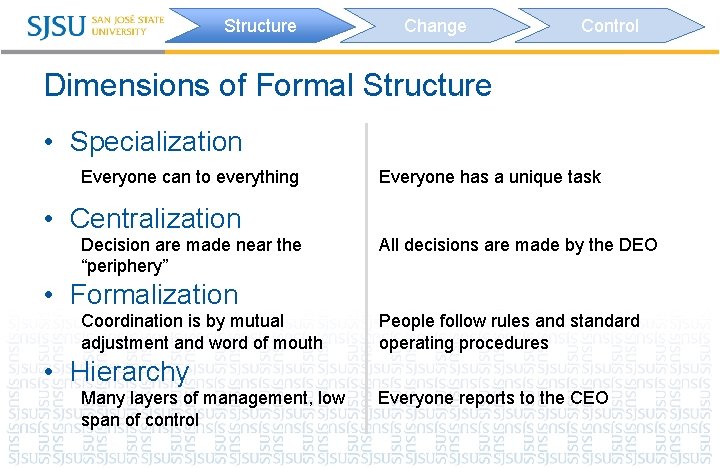
Structure Change Control Dimensions of Formal Structure • Specialization Everyone can to everything Everyone has a unique task • Centralization Decision are made near the “periphery” All decisions are made by the DEO • Formalization Coordination is by mutual adjustment and word of mouth People follow rules and standard operating procedures • Hierarchy Many layers of management, low span of control Everyone reports to the CEO
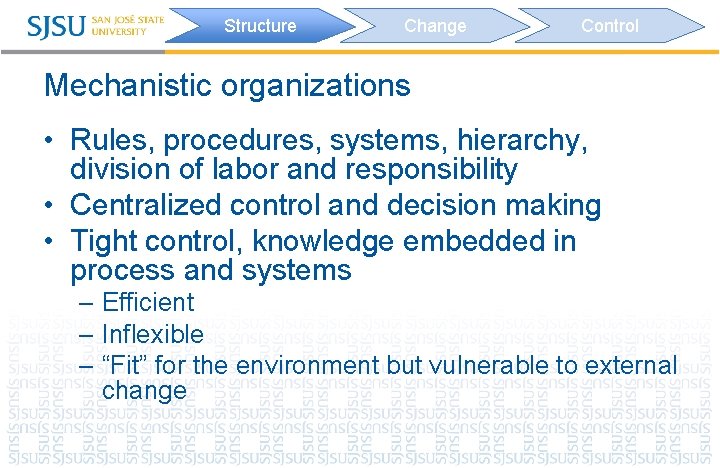
Structure Change Control Mechanistic organizations • Rules, procedures, systems, hierarchy, division of labor and responsibility • Centralized control and decision making • Tight control, knowledge embedded in process and systems – Efficient – Inflexible – “Fit” for the environment but vulnerable to external change
Structure Change Control Organic structure • • Flexibility and adaptability Devolved decision making Flatter hierarchy Culture and values in place of rigid rules policies, and procedures (SOPs) – – Allows and encourages experimentation Education, training and socialization Is more costly (less efficient) Greater variance in response, less consistency / predictability
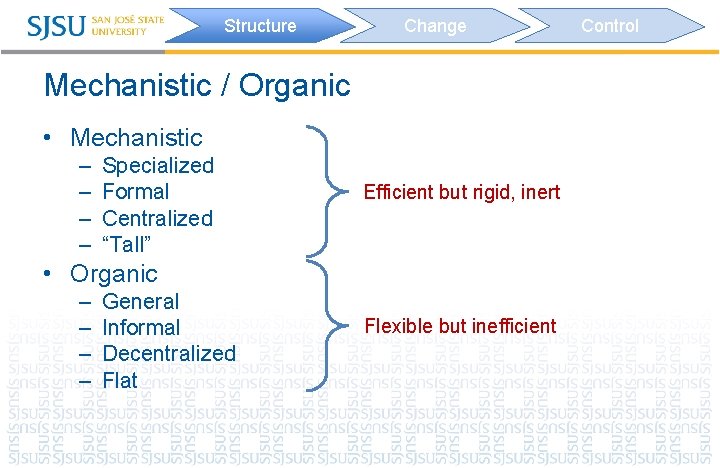
Structure Change Mechanistic / Organic • Mechanistic – – Specialized Formal Centralized “Tall” Efficient but rigid, inert • Organic – – General Informal Decentralized Flat Flexible but inefficient Control
Structure Organizational Form • Functional (U-form) • Multi-divisional (M-form) • Conglomerate • Matrix Change Control
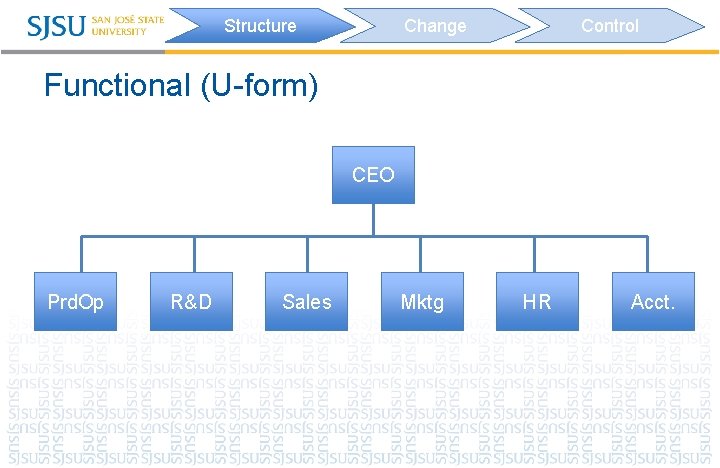
Structure Change Control Functional (U-form) CEO Prd. Op R&D Sales Mktg HR Acct.
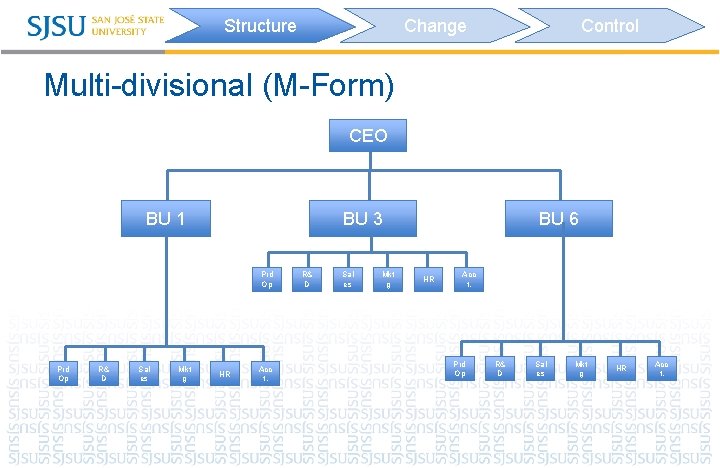
Structure Change Control Multi-divisional (M-Form) CEO BU 1 BU 3 Prd Op R& D Sal es Mkt g HR Acc t. R& D Sal es Mkt g BU 6 HR Acc t. Prd Op R& D Sal es Mkt g HR Acc t.
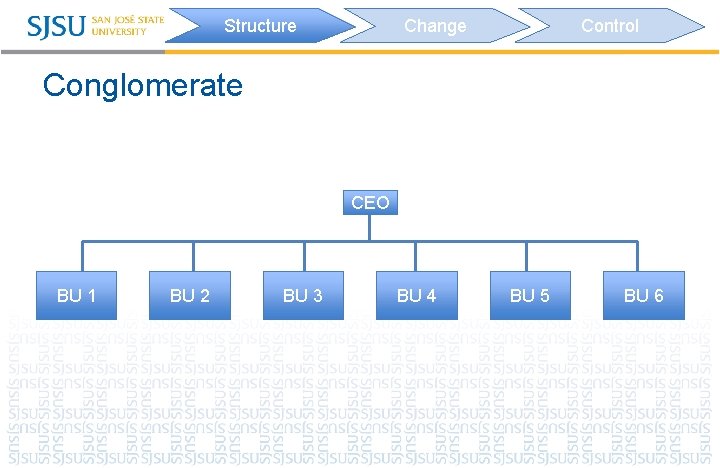
Structure Change Control Conglomerate CEO BU 1 BU 2 BU 3 BU 4 BU 5 BU 6
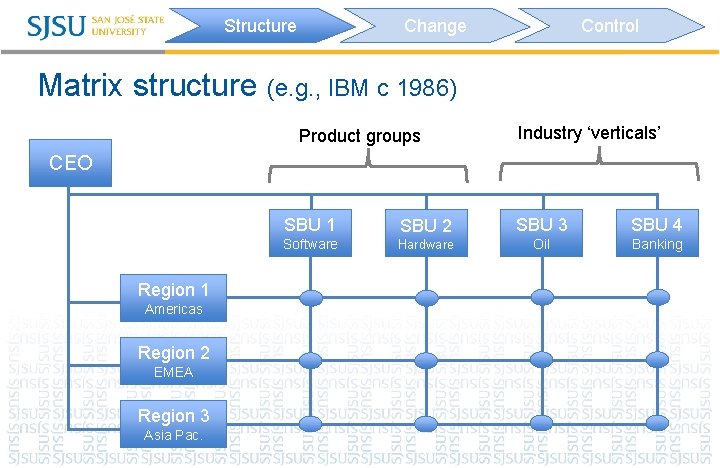
Structure Change Control Matrix structure (e. g. , IBM c 1986) Product groups Industry ‘verticals’ CEO Region 1 Americas Region 2 EMEA Region 3 Asia Pac. SBU 1 SBU 2 SBU 3 SBU 4 Software Hardware Oil Banking
Structure Change Control Adaptation, “Fit” and Inertia • Organizations adapt to their environments. – become well adapted to their environment (‘fit’) – Unnecessary activities are curtailed – Skilled people are replaced with less skilled ones and SOPs – They become efficient – Those that don’t adapt die • Efficient organizations are vulnerable to environmental shocks
Structure Change Control Exploration, Exploitation • Organizations learn by doing – Everyone follows the organizations rules to some degree (socialization) – Some ‘random’ behaviors generate serendipitous outcomes (exploration) – Those whose aggregate performance is high get to re-write the rules (org. learning) March, J. G. , Org Science, 1991
Structure Change Exploration, Exploitation • Exploitation – Refinement of what works – Organizational learning (transfer of best practice) – Leads to greater efficiency • Exploration – Fosters the development of a range of capabilities – Is costly (and therefore inefficient) • “Exploiters” will drive out “Explorers” in a stable environment • Balancing exploration with exploitation matters – “Ambidexterity? ” Control
Structure Change Control Exploration, Exploitation • Implications of March’s theory – When the environment is changing, some resistance to organizational / peer pressure helps – Turnover brings in new ‘blood’ and new ideas – Organization’s shouldn’t dictate where exploration should occur. – Meritocracy beats seniority – Past success matters less than recent success – Be neither too egalitarian or too elitist March, J. G. , Org Science, 1991, Rodan S. A, SJM, 2005
Structure Change Control Organizational Change • Organizational change is – Costly – Difficult • In concentrated industries firms change… slowly • In fragmented industries firms may not change, but un-fit firms are replaced by new fitter ones
Structure “Soft” control • Culture – Values – Norms • Social control • Intrinsic motivation Change Control
Structure Change “Hard” controls and incentives • Input controls – Policies, procedures, systems – Budgets • Outcome controls – Piece-work – Sales commission – Stock options • Extrinsic motivation Control
Structure Change Control Organizational culture • Provides an aid to decision making and action – The “HP way” – Logic of appropriateness – Can be both good and bad • Founder imprinting • Sustained through socialization – Training, myths and stories • Hard to change
Structure Change Control Principals and Agent • Owners are ‘principals’ • Managers are agents working for the owners • In small firms and until the public stock corporation, owners were managers • Today, shareholders must “trust” managers are working in their best interests… but are they? • This is the “principal-agent” problem
Structure Change Control Incentive structures • Stock options – align senior managers interests with shareholders • Bonuses and objective based compensation – Guides those with less direct influence over share price
Summary • Organizational Structure – Specialization, formalization, centralization, heirarchy – Mechanistic / organic – U-form M-form, Conglomerate, Matrix • Adaptation and Change – Exploration, exploitation, and inertia – Evolution and fit – Organization or population level change • Control – Hard vs. soft, culture vs. incentives – Principals and agents

- Slides: 23