
Organizational people and cultural issues in crossborder MA
Organizational, people and cultural issues in cross-border M&A Brigid Sutcliffe Siddall & Company World Services Group 11 April 2008 E-mail: brigid. sutcliffe@siddall. co. uk Website: www. siddall. co. uk Tel: +44 20 8392 5900 &
About Siddall & Company Founded in 1979 Specialist management consultancy Making crossborder mergers & acquisitions work Engagements in Europe, US, China, India & Africa Member of Institute of Business Consultancy World Services Group, 11 April 2008 2
Structure l Context: The M&A landscape l M&A deals: Organizational, people and cultural problems l How can acquirers avoid the problems and increase the chances of success? World Services Group, 11 April 2008 3
M&A is still an essential part of corporate strategy l Huge M&A volumes: Ø Value of global M&A in 2006 was $3. 5 trillion Ø 50% is cross-border M&A l Possible impact of the “credit crunch”? l M&A is an important tool in corporate strategy to achieve Ø Growth Ø Geographic expansion / presence in emerging markets Ø Expansion into adjacent or upstream/downstream product markets Ø Access to new technologies Ø Cost reduction/efficiencies World Services Group, 11 April 2008 4
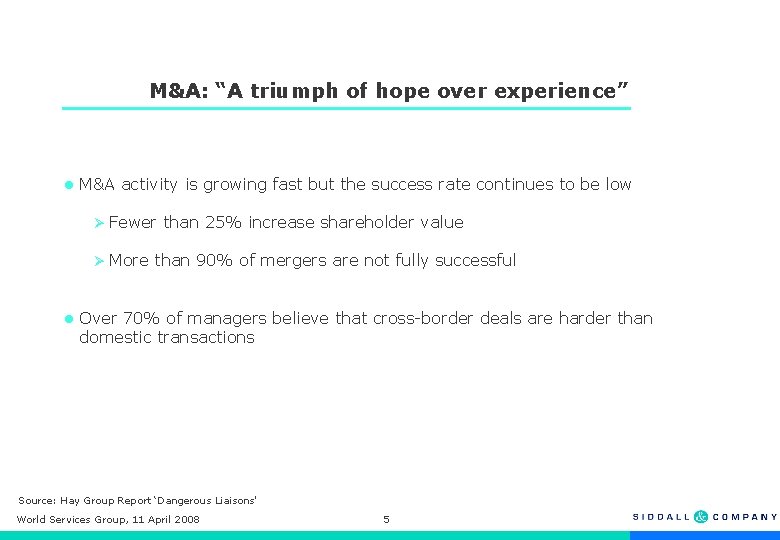
M&A: “A triumph of hope over experience” l M&A activity is growing fast but the success rate continues to be low Ø Fewer than 25% increase shareholder value Ø More than 90% of mergers are not fully successful l Over 70% of managers believe that cross-border deals are harder than domestic transactions Source: Hay Group Report ‘Dangerous Liaisons' World Services Group, 11 April 2008 5
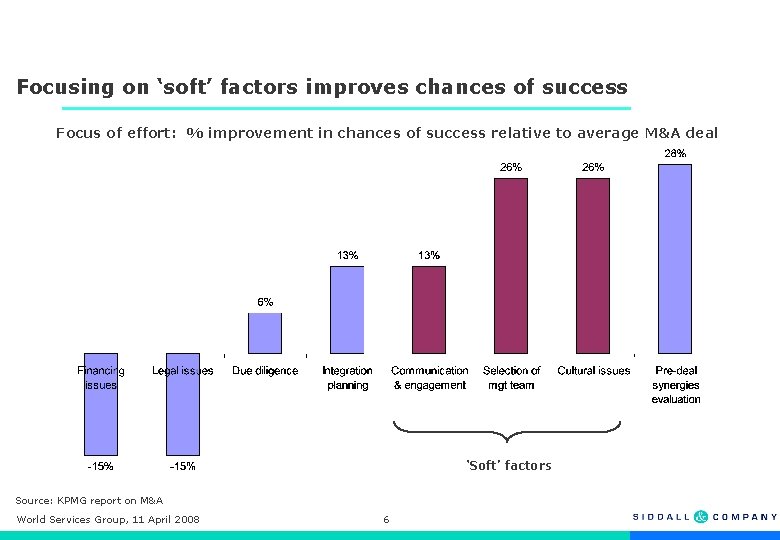
Focusing on ‘soft’ factors improves chances of success Focus of effort: % improvement in chances of success relative to average M&A deal ‘Soft’ factors Source: KPMG report on M&A World Services Group, 11 April 2008 6
Structure l Context: The M&A landscape l M&A deals: Organizational, people and cultural problems l How can acquirers avoid the problems and increase the chances of success? World Services Group, 11 April 2008 7
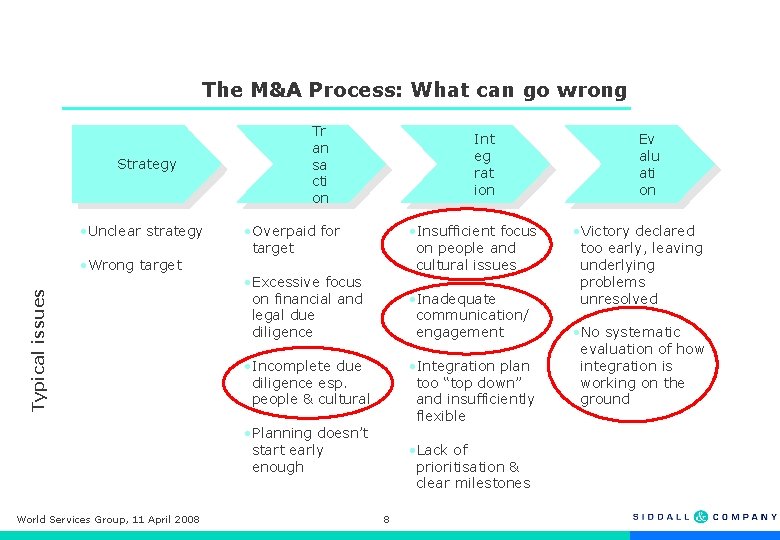
The M&A Process: What can go wrong Strategy • Unclear strategy Typical issues • Wrong target Tr an sa cti on Int eg rat ion • Overpaid for target • Insufficient focus on people and cultural issues • Excessive focus on financial and legal due diligence • Inadequate communication/ engagement • Incomplete due diligence esp. people & cultural • Integration plan too “top down” and insufficiently flexible • Planning doesn’t start early enough World Services Group, 11 April 2008 • Lack of prioritisation & clear milestones 8 Ev alu ati on • Victory declared too early, leaving underlying problems unresolved • No systematic evaluation of how integration is working on the ground
Reasons for M&A failure l Critical omissions in due diligence and post-merger integration strategies l Firms prioritise financial and systems due diligence and not ‘intangibles’ l Insufficient focus on ‘intangibles’ (business culture, human capital, organisational structure and corporate governance) makes failure more likely l Result: Lack of engagement and commitment Ø Over 75% of acquired company employees opposed their mergers, and half of them did so actively Ø 30%+ of business leaders were dissatisfied with the post-merger climate World Services Group, 11 April 2008 9
How culture clashes scupper M&A deals: Examples l Some high profile examples: Wal-Mart in Germany, Daimler/Chrysler l Acquisitions of founder-managed businesses: Ø Existing culture may be deeply embedded, idiosyncratic and personality- based l Acquisitions by low-margin, volume businesses of high-margin, customised businesses: Ø Very different people, focus, KPIs etc (Ford/Jaguar, Ford/Volvo) l Acquisitions of marketing-led businesses by engineering-led businesses (BP/Burmah Castrol) l Apparently similar businesses with very different and embedded national or other cultures Ø Insufficient effort put into understanding differences Ø Insufficient effort put into integrating the businesses Ø Deutsche Bank/Morgan Grenfell World Services Group, 11 April 2008 10
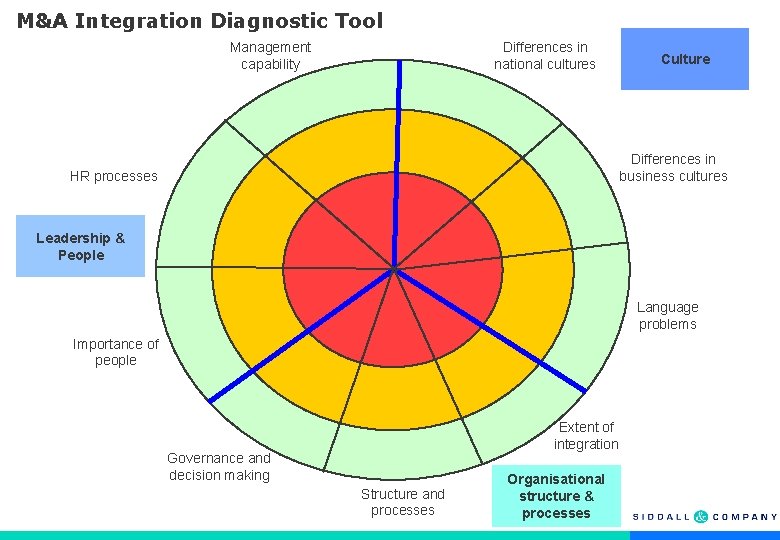
M&A Integration Diagnostic Tool Management capability Differences in national cultures Culture Differences in business cultures HR processes Leadership & People Language problems Importance of people Extent of integration Governance and decision making Structure and processes Organisational structure & processes
Good management of soft factors builds value Cisco: l Pro-active employee retention, including top management and buddy system l Communicate a vision of the merged entity and role for the target’s employees l Communicate the advantages: resources, autonomy, part of a ‘winning team’ l Result: Most acquisitions have added value to Cisco Renault-Nissan: l Obstacles to success: language, decision-making processes, communications patterns, accountability systems and labour/management relations l Integration plan aimed at mitigating the cultural backlash and planning recovery l Result: Nissan business was returned to profit World Services Group, 11 April 2008 12
Structure l Context: The M&A landscape l M&A deals: Organizational, people and cultural problems l How can acquirers avoid the problems and increase the chances of success? World Services Group, 11 April 2008 13
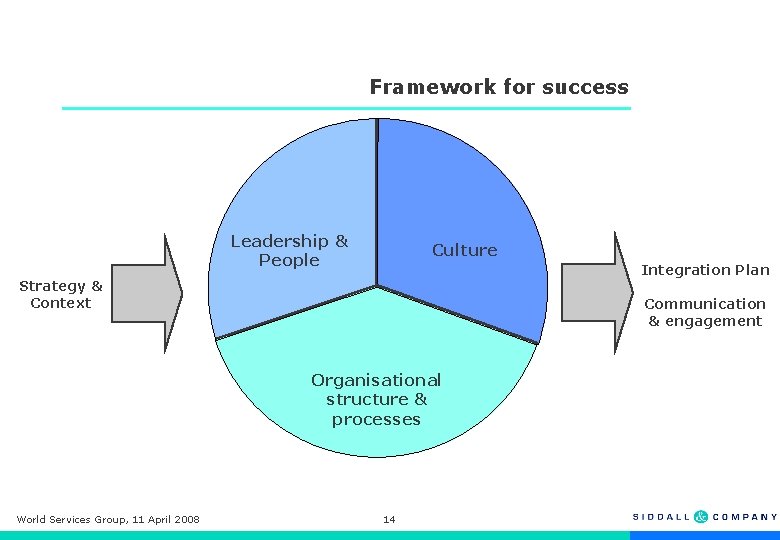
Framework for success Leadership & People Culture Integration Plan Strategy & Context Communication & engagement Organisational structure & processes World Services Group, 11 April 2008 14
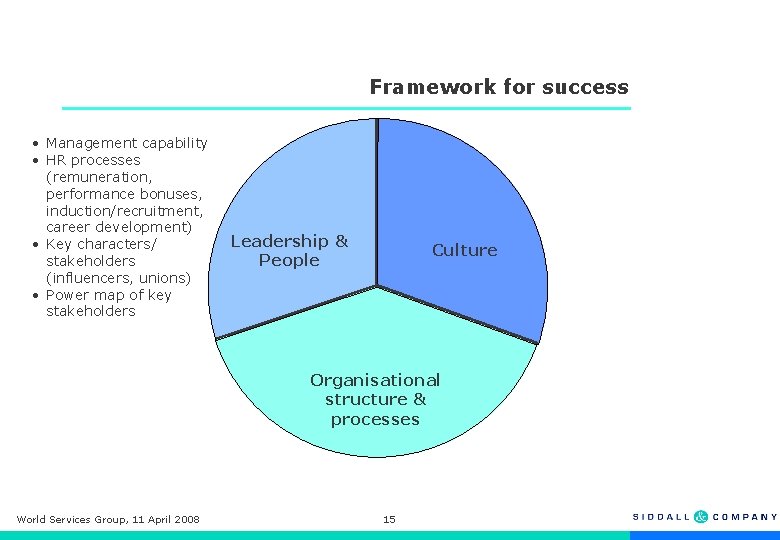
Framework for success • Management capability • HR processes (remuneration, performance bonuses, induction/recruitment, career development) • Key characters/ stakeholders (influencers, unions) • Power map of key stakeholders Leadership & People Culture Organisational structure & processes World Services Group, 11 April 2008 15
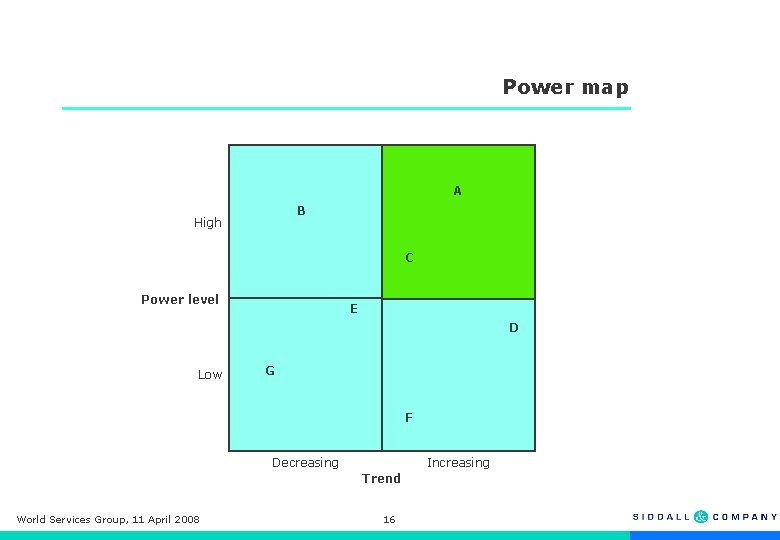
Power map A B High C Power level E D Low G F Decreasing Increasing Trend World Services Group, 11 April 2008 16
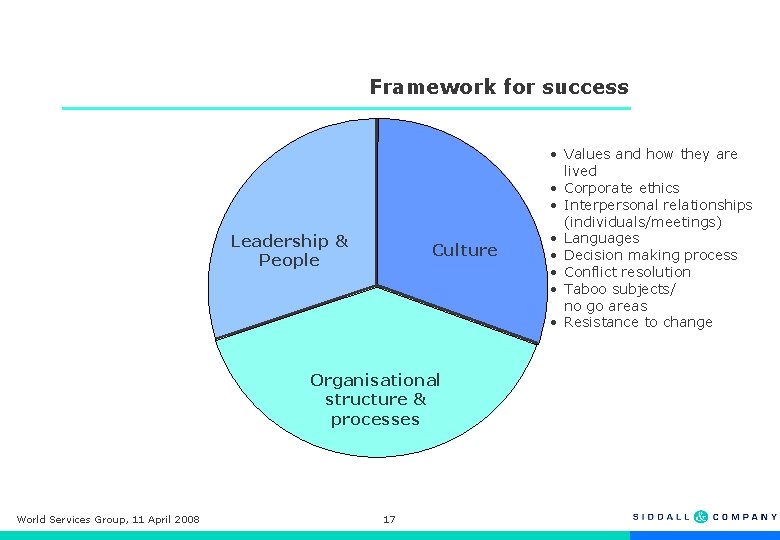
Framework for success Leadership & People Culture Organisational structure & processes World Services Group, 11 April 2008 17 • Values and how they are lived • Corporate ethics • Interpersonal relationships (individuals/meetings) • Languages • Decision making process • Conflict resolution • Taboo subjects/ no go areas • Resistance to change
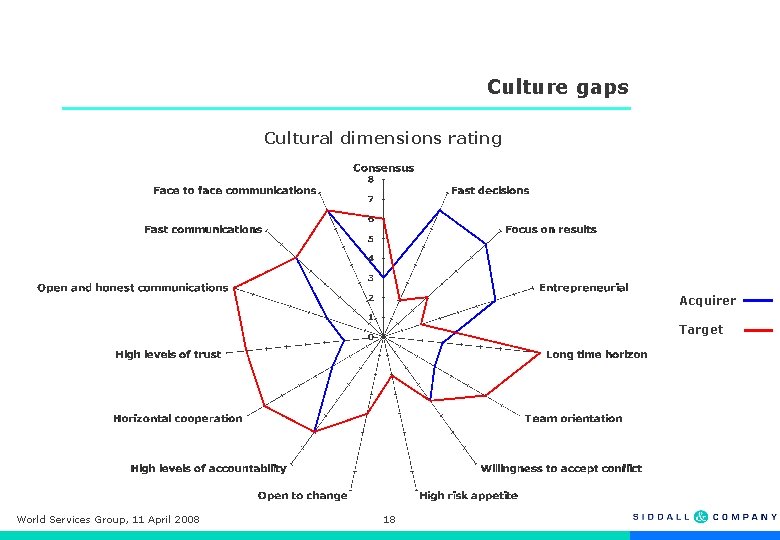
Culture gaps Cultural dimensions rating Acquirer Target World Services Group, 11 April 2008 18
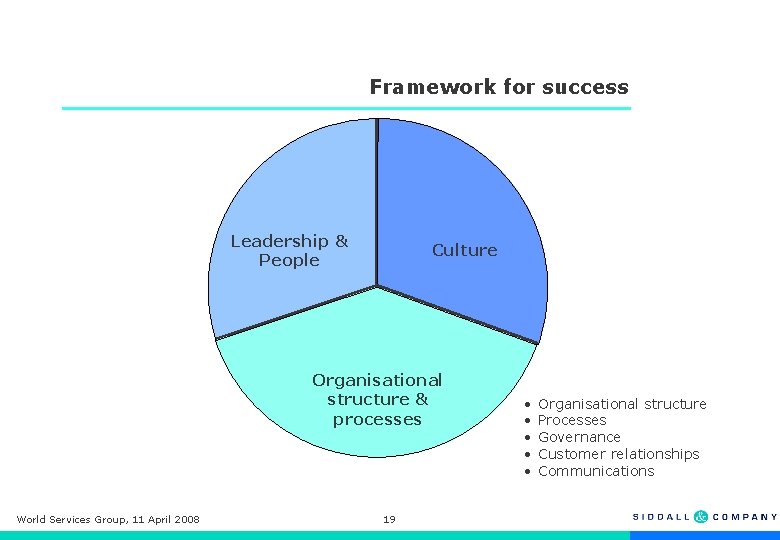
Framework for success Leadership & People Culture Organisational structure & processes World Services Group, 11 April 2008 19 • • • Organisational structure Processes Governance Customer relationships Communications
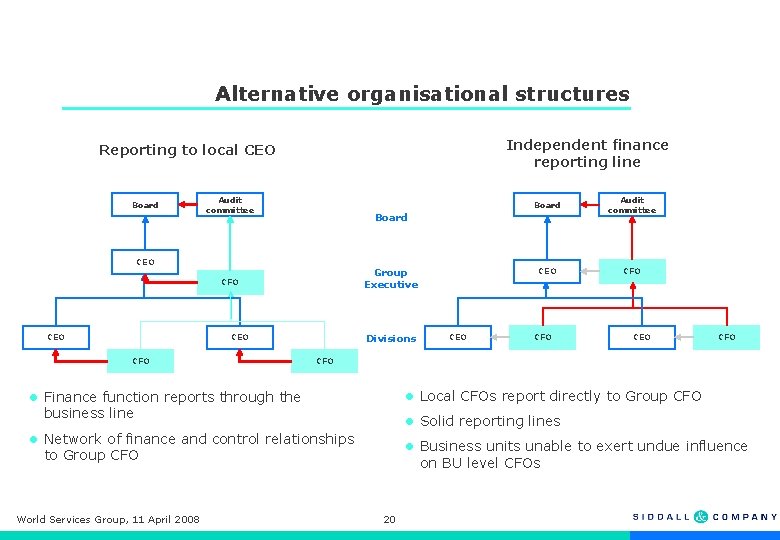
Alternative organisational structures Independent finance reporting line Reporting to local CEO Board Audit committee Group Executive CFO Divisions CEO CFO CFO l Local CFOs report directly to Group CFO l Finance function reports through the business line l Solid reporting lines l Network of finance and control relationships l Business units unable to exert undue influence to Group CFO World Services Group, 11 April 2008 Audit committee Board CEO Board on BU level CFOs 20
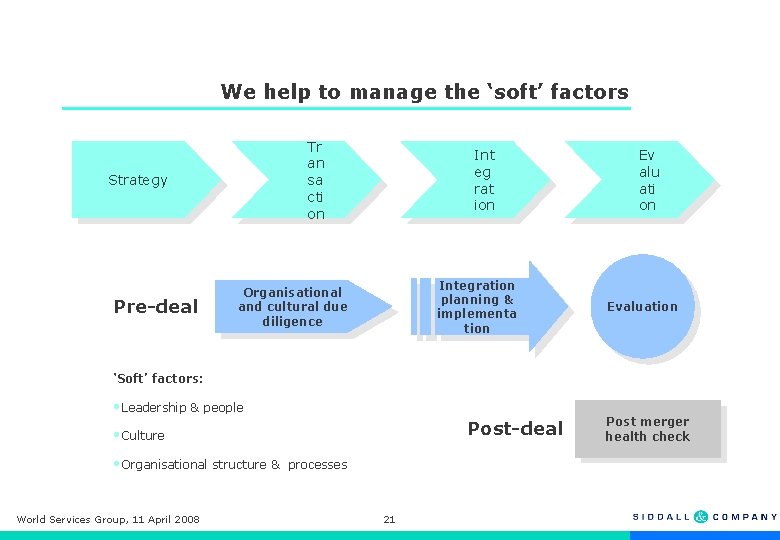
We help to manage the ‘soft’ factors Tr an sa cti on Strategy Pre-deal Int eg rat ion Integration planning & implementa tion Organisational and cultural due diligence Ev alu ati on Evaluation ‘Soft’ factors: • Leadership & people Post-deal • Culture • Organisational structure & processes World Services Group, 11 April 2008 21 Post merger health check
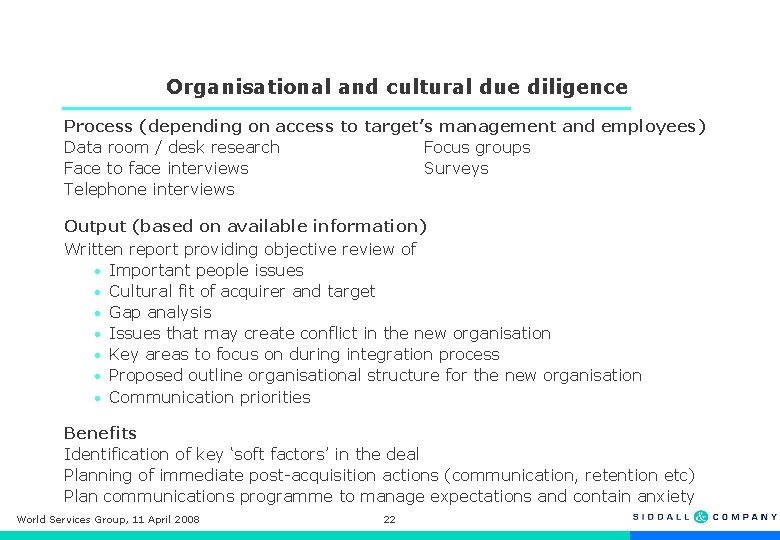
Organisational and cultural due diligence Process (depending on access to target’s management and employees) Data room / desk research Focus groups Face to face interviews Surveys Telephone interviews Output (based on available information) Written report providing objective review of • Important people issues • Cultural fit of acquirer and target • Gap analysis • Issues that may create conflict in the new organisation • Key areas to focus on during integration process • Proposed outline organisational structure for the new organisation • Communication priorities Benefits Identification of key ‘soft factors’ in the deal Planning of immediate post-acquisition actions (communication, retention etc) Plan communications programme to manage expectations and contain anxiety World Services Group, 11 April 2008 22
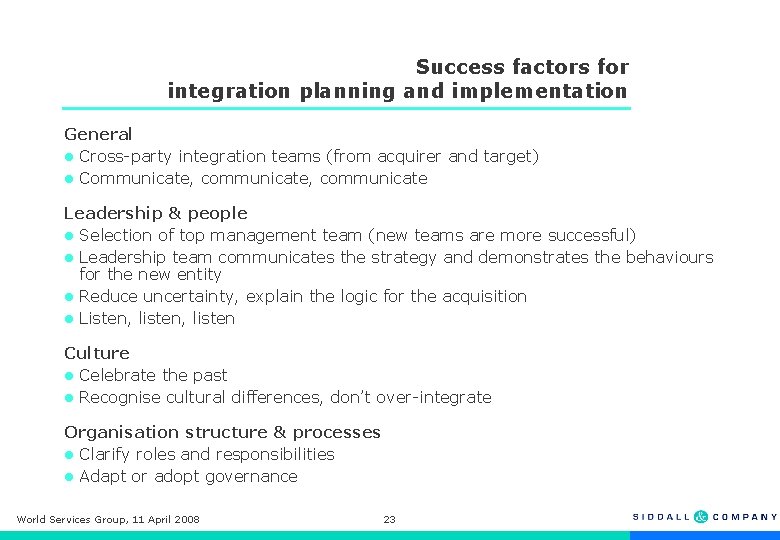
Success factors for integration planning and implementation General l Cross-party integration teams (from acquirer and target) l Communicate, communicate Leadership & people l Selection of top management team (new teams are more successful) l Leadership team communicates the strategy and demonstrates the behaviours for the new entity l Reduce uncertainty, explain the logic for the acquisition l Listen, listen Culture l Celebrate the past l Recognise cultural differences, don’t over-integrate Organisation structure & processes l Clarify roles and responsibilities l Adapt or adopt governance World Services Group, 11 April 2008 23
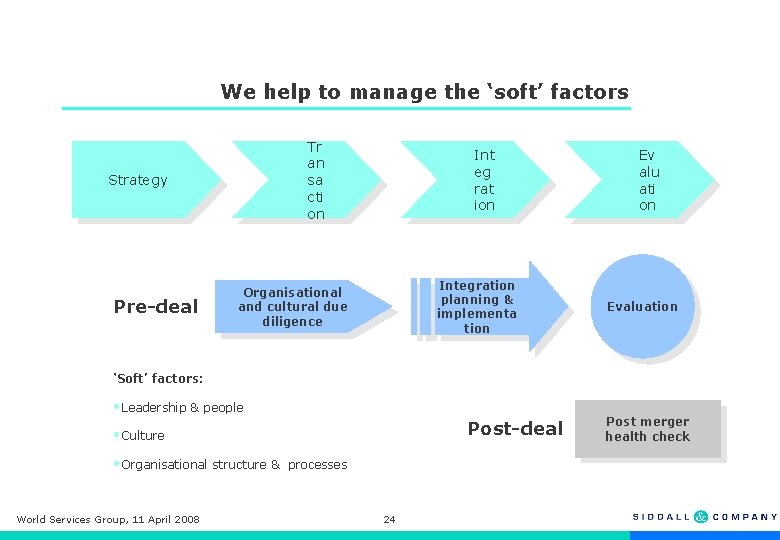
We help to manage the ‘soft’ factors Tr an sa cti on Strategy Pre-deal Int eg rat ion Integration planning & implementa tion Organisational and cultural due diligence Ev alu ati on Evaluation ‘Soft’ factors: • Leadership & people Post-deal • Culture • Organisational structure & processes World Services Group, 11 April 2008 24 Post merger health check
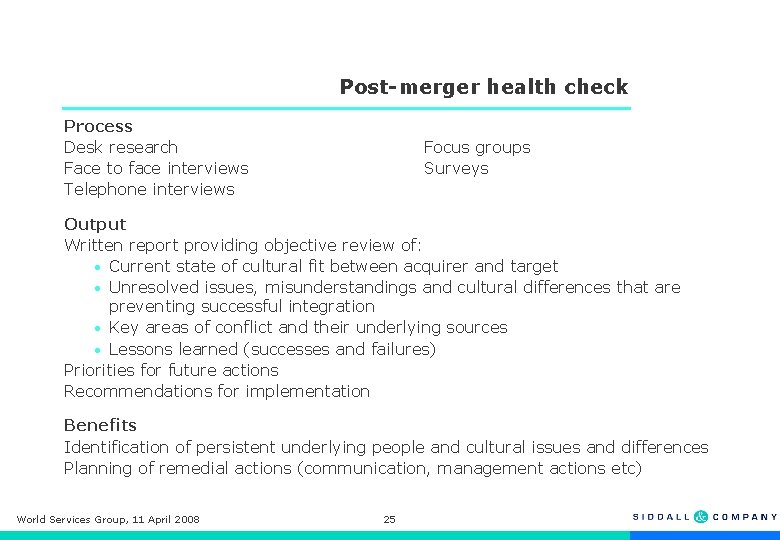
Post-merger health check Process Desk research Face to face interviews Telephone interviews Focus groups Surveys Output Written report providing objective review of: • Current state of cultural fit between acquirer and target • Unresolved issues, misunderstandings and cultural differences that are preventing successful integration • Key areas of conflict and their underlying sources • Lessons learned (successes and failures) Priorities for future actions Recommendations for implementation Benefits Identification of persistent underlying people and cultural issues and differences Planning of remedial actions (communication, management actions etc) World Services Group, 11 April 2008 25
Case study: Post-merger health check The client International chemical specialities manufacturer with a turnover of € 500 m operating in over 30 countries The problem They had recently acquired a US-based global company, which would enable them to strengthen their presence in a different market segment. The integration of the two companies was well planned and seemed to have been well executed. However, after some months, it became clear that there were serious tensions over the ‘soft’ factors • • • Persistence of “them” and “us” culture Poor communication across the two companies Confusion over roles and responsibilities Each organisation felt that its way was superior, both were unwilling to change Poor morale which could have resulted in some key senior people leaving World Services Group, 11 April 2008 26
Case study: Post-merger health check continued The health check process We conducted confidential interviews with the senior management team from both companies. This process allowed us to gain valuable insights into their concerns about the unresolved issues, misunderstandings and cultural differences which were getting in the way of a successful integration. These issues were analysed an objective report was presented, highlighting people’s experiences of the integration process between the two companies, clearly identifying the specific difficulties and problem areas behind the tensions. The outcome • • • Underlying problems identified and objectively articulated early Platform created to enable both parties to address the problems Clear process developed to resolve them With one exception, the original management team stayed on The acquisition is now a successful autonomous division within the Chemical specialities group World Services Group, 11 April 2008 27
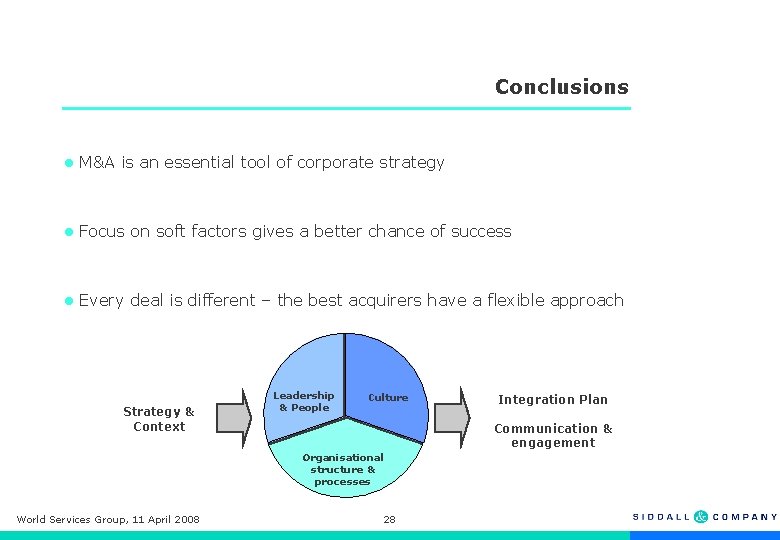
Conclusions l M&A is an essential tool of corporate strategy l Focus on soft factors gives a better chance of success l Every deal is different – the best acquirers have a flexible approach Strategy & Context Leadership & People Culture Communication & engagement Organisational structure & processes World Services Group, 11 April 2008 Integration Plan 28
Siddall & Company - Making cross-border M&A work Any questions? World Services Group, 11 April 2008 29
- Slides: 29