
Organizational Objective Unit 1 3 Importance of Objectives
Organizational Objective Unit 1. 3
Importance of Objectives Setting a target is Vital to Business Organizational aims and objectives are set for several reasons: ◦ They serve to give businesses a sense of direction, purpose and unity. ◦ They form the foundation for business decisionmaking. ◦ They can help to encourage strategic thinking. ◦ They provide the basis for measuring and controlling the performance of the workforce, the management of the whole business.
Importance of Obj. (Cont. ) Objectives can be set at several levels: ◦ Corporate objectives – deals with the whole organization’s goals Ex. Business survival, Growth and Profit maximization ◦ Departmental Objectives – specific objectives for the various sections of a business. Consistent with corporate objectives ◦ Individual Objectives- targets that are set for and/or by individual employees. Ex. Performance Appraisal
Aims / Aims – the general long term goals of an organization Often expressed within the mission statement ◦ Ex. Aim for the stars. Objectives are short term Objectives
Short Term /Long Term Short Term goals can be achieved within a short time frame. ◦ Ex. One day, one week or one month Ex. Passing the Biology Chapter Exam next week. Long Term Goals can be achieved with a longer time frame. ◦ Ex. one semester, one year, five years, or twenty years Graduation is considered a long term.
Mission / Vision Mission- have a clear purpose Mission Statement – a simple declaration that broadly states the purpose for the business. Vision – have an image of an Ideal situation Vision Statements – outlines where a business wants to be in the future
Differences Vision Focus on the very long term goals. Mission focuses on the medium to long term goals. Mission statements are updated more frequently. Vision statements do not focus on a particular target. Show what could be possible. Mission highlights the values of the business.
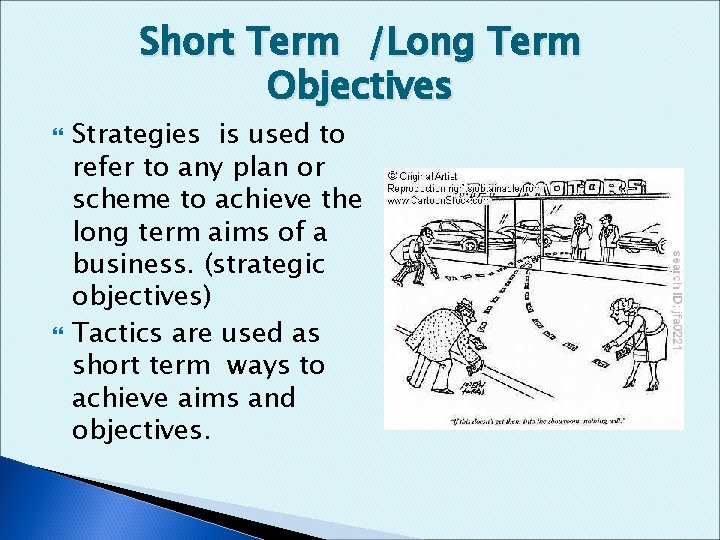
Short Term /Long Term Objectives Strategies is used to refer to any plan or scheme to achieve the long term aims of a business. (strategic objectives) Tactics are used as short term ways to achieve aims and objectives.
Levels of Strategy Operational – day to day methods used to improve the efficiency of an organization. ◦ Ex. Restaurant looks a way to reduce wait time and maintain quality Generic – are those that affect the business as a whole. Corporate – aimed at the long term objectives of a business ◦ Ex. Mergers and Acquisition
Tactical (Operational) Objectives Tactical Obj. – Short Term objectives that affect a segment of the organization, such as a department Survival – tactical objective for many businesses Sales Revenue Maximization – business strive to maximize sales in order to establish themselves in the market
Strategic Objectives Refer to the long term aim of a business organization. ◦ Ex. What to target in the coming years? Types of Strategic Objectives ◦ Profit Maximization – number one objective to obtain a large amount of profit. ◦ Growth – seen by the increase of sales or by market share. Economic of Scale – Bulk size purchases for less Market Power - Being the biggest business in the nation causing a monopoly Reduced Risk – Working with foreign markets
Strategic Objectives (Cont. ) ◦ Image and Reputation - comments and ads, and media setting whether a business is decent ◦ Market Standing – extent to which a firm has presence within a marketplace Ex. Microsoft has the market for computer software Ex. Wal-Mart largest employer in the United States
Ethical Objectives Ethics – the moral principles that guide decision-making and strategy Morals – concerned with what is wrong and right Ethical Objectives: ◦ Reducing pollution by using environmentally friendly production processes. ◦ Increase of recycling waste material ◦ Offering sufficient rest breaks during their work shift ◦ Fairer conditions of trade with less economic developed countries
Unethical Behavior Financial Dishonesty Environmental neglect Exploitation of the workforce Exploitation of Suppliers Exploitation of consumers Advantages of Ethical Behavior Improved corporate image Increased customer loyalty Cost Cutting Improved staff motivation Improved Staff Morales
Social Responsibility Advantage Providing accurate information and labeling Active Community work Having Consideration for the environment Adhering to fair employment practices Disadvantages Compliance Cost Lower Profit Stakeholder Conflict
Corporate Social Responsibility (CSR) CSR - Businesses that act morally towards their stake holders Roles of businesses in delivering social responsibility: ◦ Free Market(or non-compliance) Economic belief that profit generates for the owner ◦ Altruistic To act in an unselfish and humanitarian manner ◦ Strategic Belief that a businesses needs to be socially responsible if necessary to gain a profit
Social Auditing Social Auditing – independent assessment on the affect on society Environmental Auditing – examines the affects on the environment Policy may include: ◦ ◦ ◦ Renewable and sustainable resources Reputable and social responsible supplier Systems that cater for well being of employees Establishment of ethical code of conduct Methods to monitor management and employee
Organizational Strategies S – Specific – Needs to be precise M- Measureable - Quantifiable A – Agreed – Accepted and understood R – Realistic - Has to be obtainable T – Time Constrained – Set Time Frame
Vocabulary Aims are the long-term goals of a business, Corporate social responsibility (CSR) refers to the consideration of ethical and environmental issue relating to business activity. Ethics are the moral values that determine and affect business behavior and decision-making Mission statement refers to the declaration of an organization’s overall purpose. SMART Objectives mean that well-set objectives ought to be specific, measurable , agreed, realistic and timed.
Vocabulary (Cont. ) Social audit refers to an independent assessment of how an organization’s actions affect society. Social responsibility refers to a business being conscientiously concerned about the well-being of the general public as a whole. Strategy refers to the various methods that businesses can use in an attempt to achieve their mission or vision. Tactics refers to the short-term methods that firms can use to achieve their objectives. Vision statement refers to an organization’s longterm aspirations
Review Questions 1. 2. 3. 4. 5. 6. What are the objectives important to business organizations? What is the purpose of a mission statement? How do mission statements and vision statements differ from one another? Differentiate between ‘strategic objectives’ and ‘tactical objective’. How might objectives of organizations in the public sector differ from those in private sector? When might survival be an important organizational objective?
Review Questions 7. 8. 9. 10. What are internal and external factors affect changes in organizational objectives? Why might a business consider the objectives of the local community in which it operates? What is ‘social auditing’ and why might a business choose to carry out a social audit despite the cost of doing so? What does it mean to get SMART objectives?
Higher Level Review Questions 11. 12. Why do objectives have changing significance in different situations? Outline two recent changes in the society’s expectations of business behavior.
- Slides: 23