
Organizational Life Cycles Size and Decline BA 152
Organizational Life Cycles, Size, and Decline BA 152
Industry Life Cycles n Industry Evolution – Entry strategies n n – First movers Followers Survival strategies n n Specialist Generalist
Entry Strategies n Entering the market early – – – Pick of environmental resources Rapid growth Better chances of survival
Entry Strategies n Entering the market later – – Reduces operational uncertainty Correct way to compete is apparent Lower R&D investment Survival as the more efficient producer
Survival Strategies n Specialists n n n Concentrate skills in a single niche Develop core competencies Can provide better customer service and superior products, but Trouble if the niche disappears or others enter. n Generalists n n Spread skills across many niches Providing greater brand recognition Can succeed when environment is uncertain, If risk is spread across a number of niches

Organizational Life Cycle n Stages of Life Cycle Development – Pre-Birth Stage n first idea n commitment and early planning n implementation – – Entrepreneurial Stage Collectivity Stage Formalization Stage Elaboration Stage

Organizational Characteristics During the Life Cycle n ENTREPRENEURIAL STAGE: – Personal control systems – Innovation by owner/manager – Goal: Survival – Management style: Entrepreneurial – Crisis: Lack of/Need for leadership
Organizational Characteristics During the Life Cycle n COLLECTIVITY STAGE: – Personal rewards aimed at individuals who contribute to organizational success – Innovation from employees and managers – Goal: Growth – Management style: Charismatic, directive – Crisis: Lack of/need for delegation
Organization Growth: Is Bigger Better? n Pressures for Growth – – Organization goals Economies of scale Executive advancement Economic health
Size and Structural Characteristics As Organizations get bigger: • Complexity increases • Centralization decreases • Formalization increases • Flexibility decreases
Large Vs. Small: How can you be both? Structural reorganization (split up) n Smaller headquarters staff (decentralize) n Subsidiaries/spin-offs that can act small n Skunkworks to develop new products n Support intrapreneurship within the firm n
Bigger may not be better! n Growth is difficult to maintain. A $100 K company has to generate $10 K to grow by 10%. n A $100 B company has to generate $10 B to grow by the same 10% n In the 1990 s, what percentage of publiclytraded firms increased their revenues and profit by an average of 10% a year? n Growth can stretch a firm too thin. n A 20% growth rate per year means a firm doubles in size in less than four years. n
Bigger may not be better! n What determines a firm’s size? n Market Cap? n Employees? n Profits? n Market share? n Revenues? n The wrong choice can lead to seriously negative consequences.
Organizational Characteristics During the Life Cycle n FORMALIZATION STAGE: – Impersonal rewards through formalized systems – Innovation from separate innovative groups – Goal: Internal stability/market expansion – Management style: Delegation with control – Crisis: Too much red tape

Organizational Characteristics During the Life Cycle n ELABORATION STAGE: – Extensive rewards tailored to product and department success – Innovation by institutionalized R & D – Goal: Image/reputation-building – Management style: Team approach – Crisis: Lack of/need for revitalization

Organization Life Cycle Large Streamlining Development of Teamwork Size Continued maturity Addition of Internal Systems Provision of Clear Direction Crisis: Too much red tape Creativity Crisis: Need for delegation with control Small Decline Crisis: Need for revitalization Crisis: Need for Leadership Entrepreneurial Collectivity Formalization Elaboration ? ? ? ? ?
Organizational Decline and Downsizing: The Causes n Organizational Atrophy – – n Organizational Vulnerability – – – n Loss of ability to respond to changing environment Inefficient, bureaucratic, fat, and happy Loss of resources Loss of market share Loss of legitimacy Environmental decline – – – Stagnating economy Flat/shrinking market Increased competition
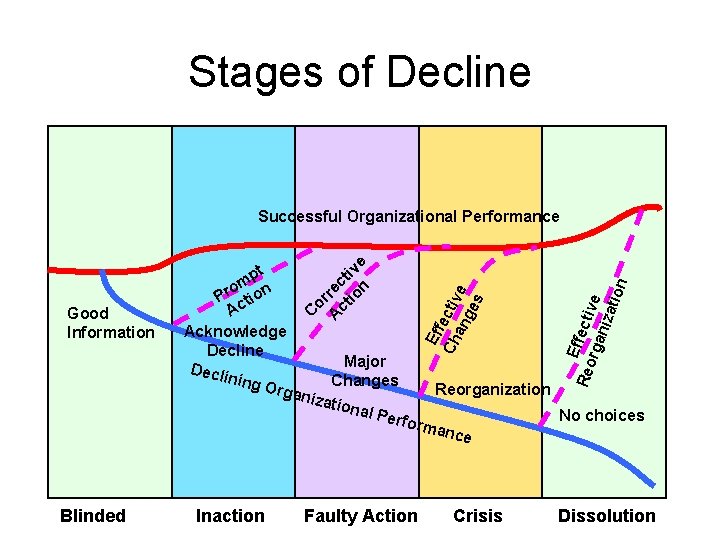
Stages of Decline Eff Ch ectiv an ge e s C or A rec ct t io ive n Good Information t p om Pr tion Ac Acknowledge Decline Major Decl ining Changes Orga nizat ional Perfo Reorganization No choices rman Blinded Inaction Faulty Action E Reo ffecti rga ve niza tion Successful Organizational Performance ce Crisis Dissolution
Managing the Downsizing n n Implementation approaches must be a function of the severity and speed of decline. Implementation issues to consider – – – Consider voluntary programs with incentives (but be careful - who might leave? ) Over communicate - “The best surprise is no surprise. ” Allow employees to leave with dignity Assist those leaving Use ceremonies to reduce anger/confusion Remember those who stay!
Next Time Sunflower, Inc.
- Slides: 20