
Organizational Design Diagnosis and Development Session 20 Technostructural

- Slides: 19
Organizational Design, Diagnosis, and Development Session 20 Techno-structural Interventions, III Work Design
Objectives • To overview trends in the field of work design • To become familiar with the engineering approach To review principles of job rotation and job enlargement • To review the application of Herzberg’s Two factor theory to job design • To review Hackman and Oldham’s Job Characteristics theory
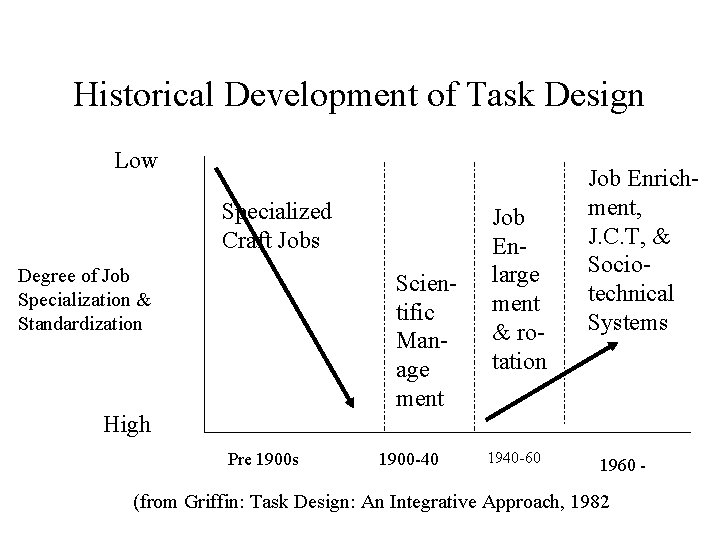
Historical Development of Task Design Low Specialized Craft Jobs Degree of Job Specialization & Standardization Scientific Manage ment High Pre 1900 s 1900 -40 Job Enlarge ment & rotation 1940 -60 Job Enrichment, J. C. T, & Sociotechnical Systems 1960 - (from Griffin: Task Design: An Integrative Approach, 1982
Trends in Job Design • The era of craft workers • The impact of industrialization and mechanization • Engineering approach: Scientific Management and Taylorism • From fractionalization to enlargement • Contemporary perspectives
Jobs in the Craft Era • Craft jobs encompass a specialization but not fractionalization • Mechanization breaks jobs into tasks – Babbage (1832) argues specialization for decreasing learning time, waste and fewer tool changes. Also skill gets automated due to repetition
Taylor and Scientific Management • The use of work study/measurement to determine a fair quota was a step forward for both management and the workers. • Taylor puts a focus on systematically analyzing jobs and redesigning for effective use of personnel and technology
Some Major Principles of Scientific Management • Time studies • Functional or specialized supervision • Standardization of tools and implements • Standardization of work methods • Separate Planning function
Frank & Lillian Gilbreth • • The efficiency experts Goal of saving wasted motion and thus fatigue Applied cinematography to studies Wanted “happy workers” at all levels – Naturally, the savings that accrue must benefit everyone, but saving lies at the root of fatigue elimination, and if every member of the organization, including the manager and the stockholders, is getting more "Happiness Minutes, ” you are surely working along the right lines. "
Job Rotation • Changing task assignments, not changing task itself. Move worker from one job to another to combat boredom • Used at Ford, Prudential, American Cyanamid • Consequences: – Positive: Increase worker flexibility – Negative: Motivation and productivity not enhanced
Job Enlargement • Job enlargement first used on 1940 s. It involves horizontal expansion of tasks. – Lengthen cycle time – More task variety – Some responsibility • Programs at IBM, Social Security, Maytag • Consequences – Positive: some enhanced satisfaction & quality of production – Negative: No relationship to individual productivity, no real change in job, higher training costs
Two Factor Theory • Herzberg’s Theory developed from research into causes of job satisfaction and dissatisfaction with engineers and accountants • Used critical incidents as the research method • Content analysis of the incidents yielded a set of satisfiers and dissatisfiers
Herzberg’s Satisfiers • Motivators – personal growth – recognition – responsibility – promotion opportunities – achievement
Herzberg’s Dissatisfiers • Hygiene – supervision – pay – company policies – working conditions – co-workers – job security
Impact of Two Factor Theory on Job Design • Motivators influenced concepts of job enrichment • Hygiene factors influenced concepts of quality of work life
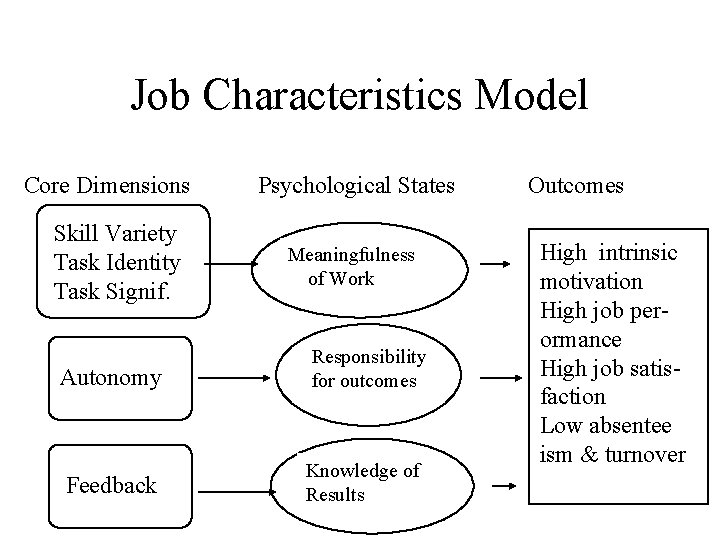
Job Characteristics Model Core Dimensions Skill Variety Task Identity Task Signif. Psychological States Meaningfulness of Work Autonomy Responsibility for outcomes Feedback Knowledge of Results Outcomes High intrinsic motivation High job perormance High job satisfaction Low absentee ism & turnover
Moderating Variables for the Job Characteristics Model • Growth need strength – job is a vehicle for personal growth, sense of achievement, avenue for feeling success • Knowledge and skills • Satisfaction with extrinsic aspects of work
Implementing Concepts for the Job Characteristics Model • Combine tasks: Effects skill variety, task identity, & task significance • Group tasks into natural work units: Effects task significance and task identity • Give workers contact with customers: Effects skill variety, autonomy, feedback • Vertically load jobs: Effects autonomy • Open feedback channels: Effects feedback • Match personal growth needs to job
Criticisms of the Job Characteristics Model • Job characteristics are not distinct • Link to critical psychological states is not clear • Individual differences have an important effect • Job outcomes are not clearly linked to job characteristics
Backwards & Forwards • Summing up: Today we covered centuries in job design from the craft era to modern times. Along the way we reviewed the era of scientific management, job rotation and enlargement and the Job Characteristics Theory • Looking Ahead: Next time we continue with job design and consider some contemporary approaches as well as the implications of modern manufacturing and information technologies on job design.