
Organizational Communication Topics Communication Channels Effective Meeting Managing
- Slides: 14
Organizational Communication Topics : Communication Channels, Effective Meeting, Managing Conflict, MR JAMSARI JAMALUDDIN - JJ 1
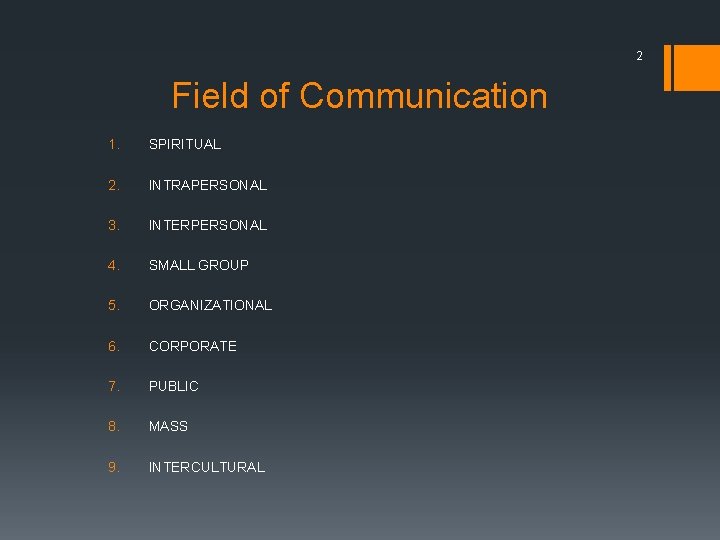
2 Field of Communication 1. SPIRITUAL 2. INTRAPERSONAL 3. INTERPERSONAL 4. SMALL GROUP 5. ORGANIZATIONAL 6. CORPORATE 7. PUBLIC 8. MASS 9. INTERCULTURAL
3 Definition Organizational Communication § A process by which activities of a society are collected and coordinated to reach the goals of both individuals and the collective group. § It is a subfield of general communications studies and is often a component to effective management in a workplace environment.
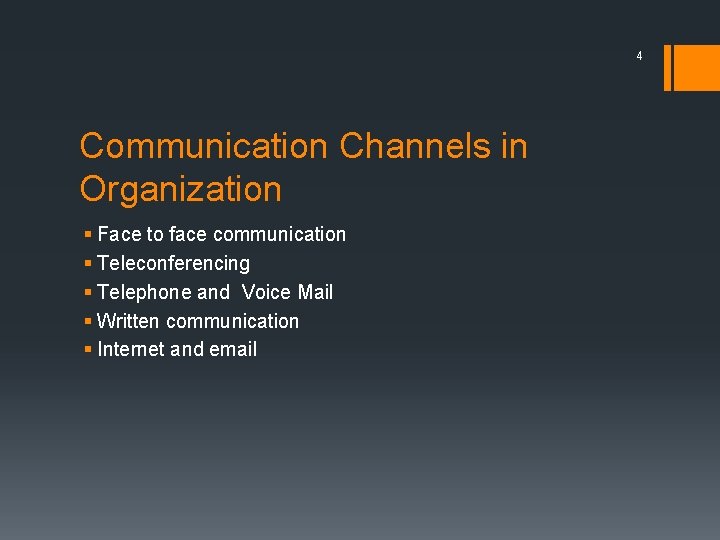
4 Communication Channels in Organization § Face to face communication § Teleconferencing § Telephone and Voice Mail § Written communication § Internet and email
5 Face to face communication § Interpersonal communication § Small group communication § The Advantages : § Richness § in person, a wide array of nonverbal cues help you better understand another person. § Seeing and hearing others can help answer questions as below § Is the customer in a hurry? § Is your boss angry? § Is a colleague joking or serious ?
6 § Speed § once you make contact with your audience, there’s no time lag between the transmission if a message and its perception § Example : if you need the funds in an account released now, face-face to communication is better channel rather than letter or memo. § Control § § § Respond to questions as soon as possible Can rephrase or elaborate when the listeners seem confused Control the time Have more command over the receiver’s attention Permits instantaneous feedback § Personal quality § Potential to create personal bonds
7 § The disadvantages are below: § § Difficult to arrange the members Personal contact is expensive Time consuming Antagonizes one or more of the members
8 Teleconferencing and videoconferencing § Also called conference calls § Allow users in distant locations to have a meeting § Widespread operations § Decision making § Low cost and very effective § Examples : Yahoo messenger,
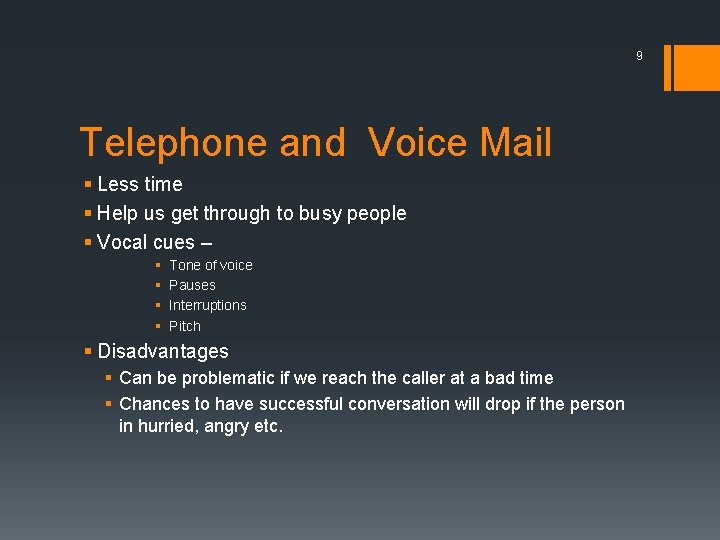
9 Telephone and Voice Mail § Less time § Help us get through to busy people § Vocal cues – § § Tone of voice Pauses Interruptions Pitch § Disadvantages § Can be problematic if we reach the caller at a bad time § Chances to have successful conversation will drop if the person in hurried, angry etc.
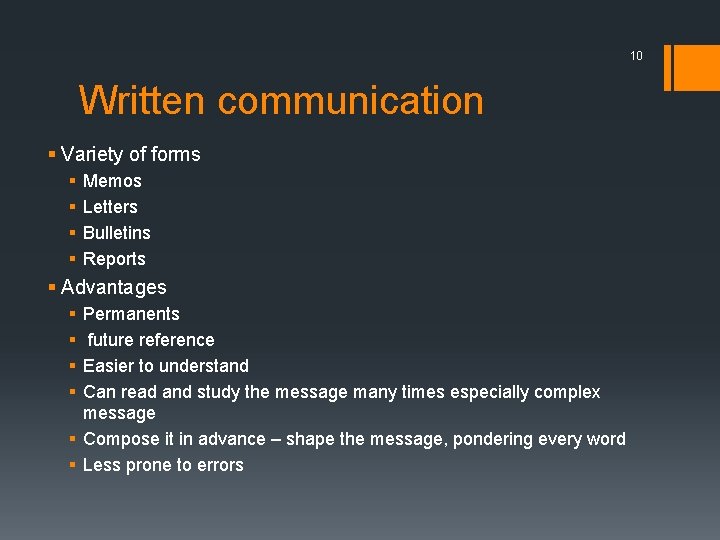
10 Written communication § Variety of forms § § Memos Letters Bulletins Reports § Advantages § § Permanents future reference Easier to understand Can read and study the message many times especially complex message § Compose it in advance – shape the message, pondering every word § Less prone to errors
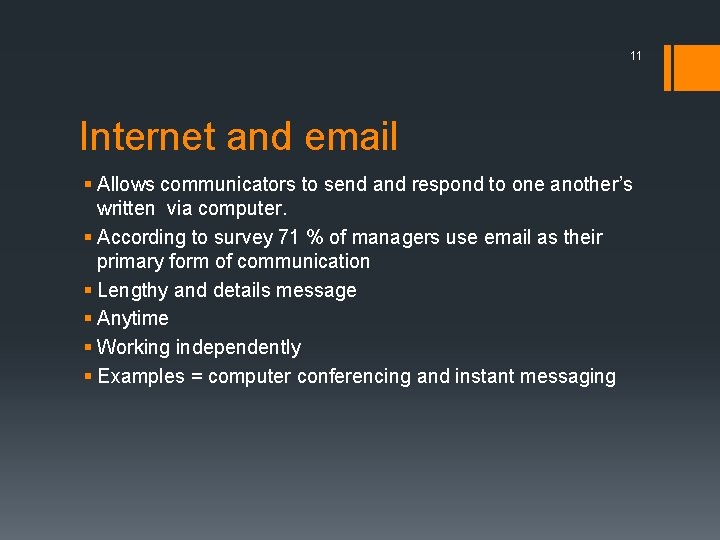
11 Internet and email § Allows communicators to send and respond to one another’s written via computer. § According to survey 71 % of managers use email as their primary form of communication § Lengthy and details message § Anytime § Working independently § Examples = computer conferencing and instant messaging
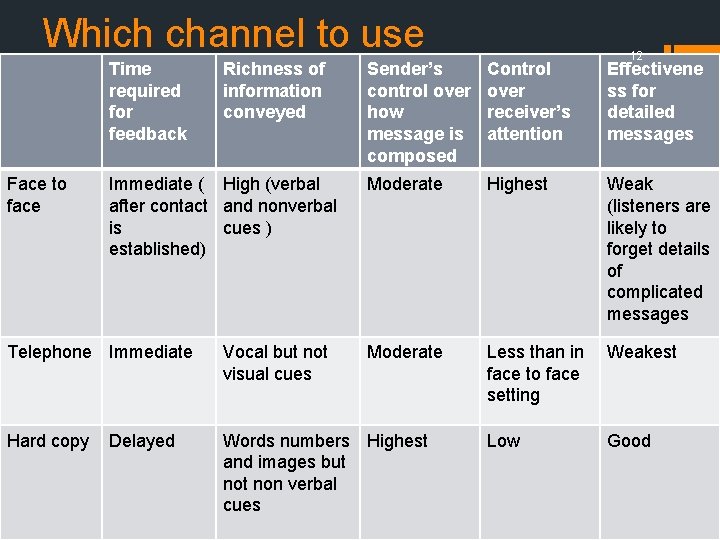
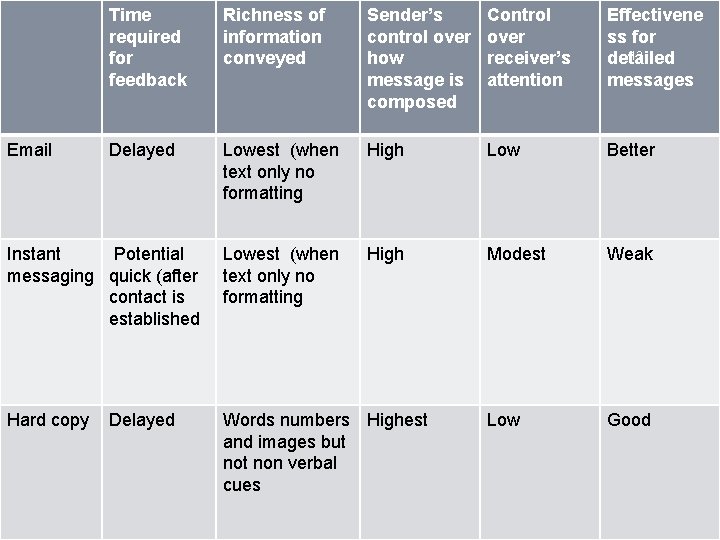
Which channel to use Time required for feedback Face to face Richness of information conveyed Immediate ( High (verbal after contact and nonverbal is cues ) established) Sender’s control over how message is composed Control over receiver’s attention Effectivene ss for detailed messages Moderate Highest Weak (listeners are likely to forget details of complicated messages Moderate Less than in face to face setting Weakest Low Good Telephone Immediate Vocal but not visual cues Hard copy Words numbers Highest and images but non verbal cues Delayed 12
Time required for feedback Richness of information conveyed Sender’s control over how message is composed Control over receiver’s attention Effectivene ss for 13 detailed messages Delayed Lowest (when text only no formatting High Low Better Instant Potential messaging quick (after contact is established Lowest (when text only no formatting High Modest Weak Hard copy Words numbers Highest and images but non verbal cues Low Good Email Delayed
14 Thank You See You Again