
Organizational Communication Approaches and Processes Katherine Miller Chapter
- Slides: 12
Organizational Communication: Approaches and Processes Katherine Miller Chapter 10 Organizational Leadership Lesley Goodman
Introduction • Importance of Leadership in Organizations During Times of Change as Well as Times of Normal Operation • Models of Leadership • Role Communication Plays in Leadership Process
Models of Leadership • Early idea that leaders are “born, not made” • Particular qualities associated with leaders: intelligence, self-confidence, determination, integrity, and sociability • Critique of trait and style approaches found that different people might be differently suited for various leadership situations
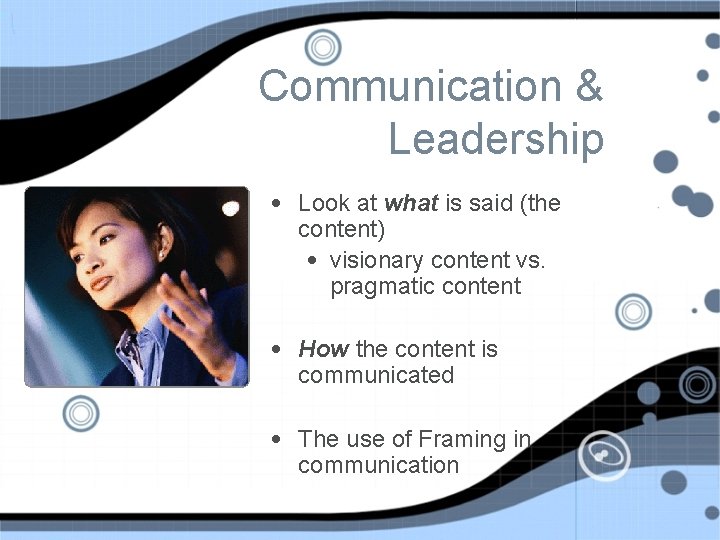
Communication & Leadership • Look at what is said (the content) • visionary content vs. pragmatic content • How the content is communicated • The use of Framing in communication
Table 10. 4: Approaches to Change & Leadership Processes Classical • Change is viewed negatively, unless that change is carefully controlled by management. Leadership is seen as tied exclusively to management and based on defined traits and abilities that only managers have.
Table 10. 4 Approaches cont. Human Relations • Change is seen as a human process in which factors of employee satisfaction are taken into account. Leaders are encouraged to emphasize needs of workers to foster work satisfaction.
Table 10. 4 Approaches cont. Human Resources • Change is seen as a crucial step through which the organization can harness the skills and abilities of employees. Employees are encouraged to participate in the change process, and skills of leaders are adapted to specific situations.
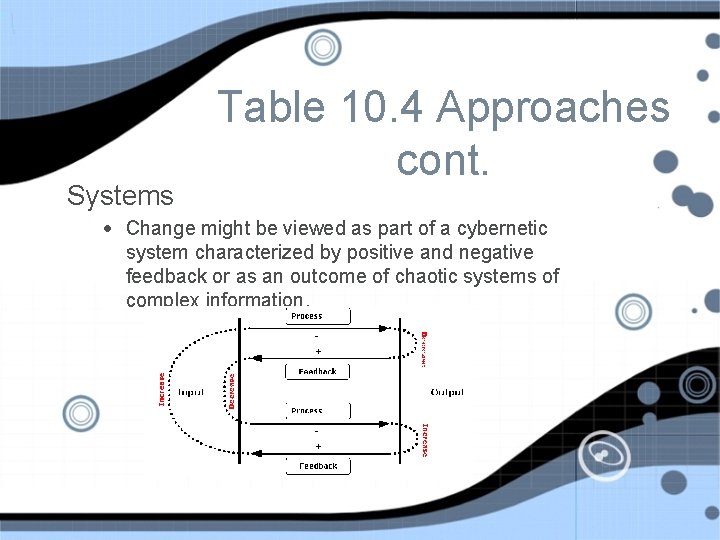
Systems Table 10. 4 Approaches cont. • Change might be viewed as part of a cybernetic system characterized by positive and negative feedback or as an outcome of chaotic systems of complex information.
Table 10. 4 Approaches cont. Cultural • Change practices are seen as reflections of organizational values and assumptions. Effective change and effective leadership will depend on an understanding of prevailing cultural and subcultural beliefs.
Table 10. 4 Approaches cont. Critical • Planned organizational change and leadership can be viewed as mechanisms through which management establishes and maintains a relationship of power and authority over employees. Truly democratic change, however, can enhance employee voice in the organization.
Summary • Communication is important in organizational change • The role of leader is very important in organizations especially during times of change • Good leaders understand organizational culture
Reference Miller, Katherine (2009). Organizational Communication: Approaches and Processes (5 th Edition). Belmont, CA: Wadsworth-Cengage Learning.