
Organizational Change Management Key Principles and Practices Jeanne



- Slides: 7
Organizational Change Management Key Principles and Practices Jeanne Hartley MGT 450
What is Change Management? ¡ It consists of: l l l The task of managing change (from a reactive or a proactive stance) An area of professional practice (with considerable variation of knowledge and skills between practitioners) A body of knowledge (consisting of models, methods, techniques and other tools)
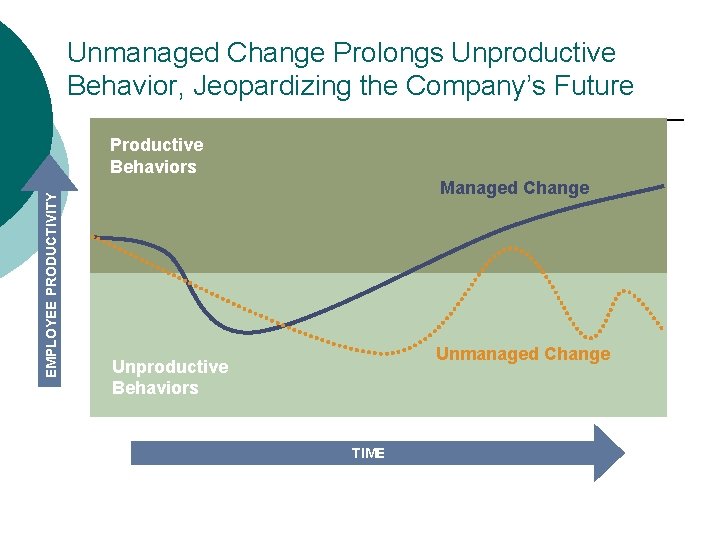
Unmanaged Change Prolongs Unproductive Behavior, Jeopardizing the Company’s Future EMPLOYEE PRODUCTIVITY Productive Behaviors Managed Change Unmanaged Change Unproductive Behaviors TIME
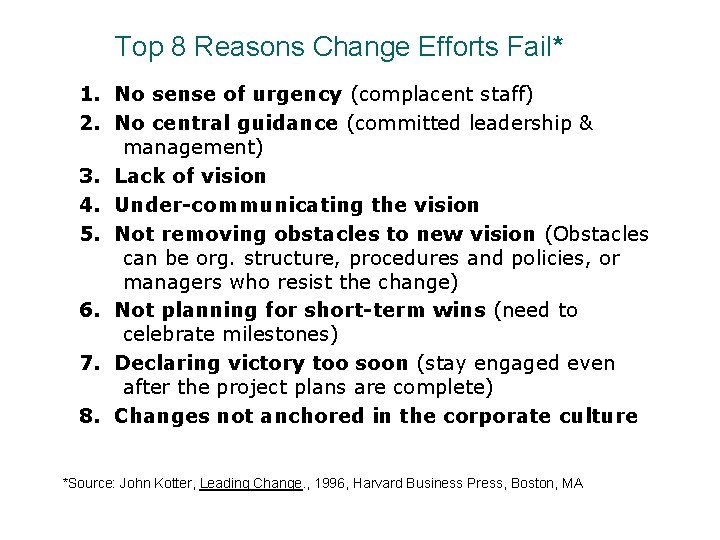
Top 8 Reasons Change Efforts Fail* 1. No sense of urgency (complacent staff) 2. No central guidance (committed leadership & management) 3. Lack of vision 4. Under-communicating the vision 5. Not removing obstacles to new vision (Obstacles can be org. structure, procedures and policies, or managers who resist the change) 6. Not planning for short-term wins (need to celebrate milestones) 7. Declaring victory too soon (stay engaged even after the project plans are complete) 8. Changes not anchored in the corporate culture *Source: John Kotter, Leading Change. , 1996, Harvard Business Press, Boston, MA
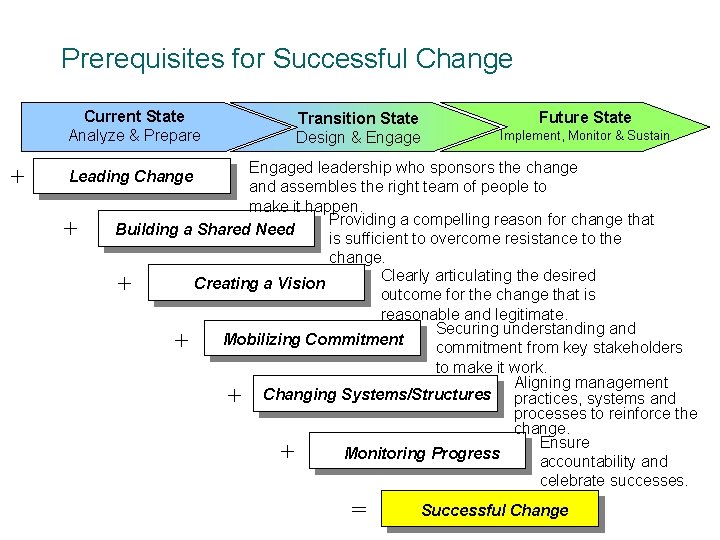
The Accelerated Change Process Leading Change Building a Shared Need Creating a Vision Mobilizing Commitment Changing Systems/Structures Monitoring Progress Current State Transition State Future State Analyze & Prepare Design & Engage Implement, Monitor & Sustain
Prerequisites for Successful Change Current State Analyze & Prepare + Transition State Design & Engage Future State Implement, Monitor & Sustain Engaged leadership who sponsors the change and assembles the right team of people to make it happen. Providing a compelling reason for change that Building a Shared Need is sufficient to overcome resistance to the change. Clearly articulating the desired Creating a Vision + outcome for the change that is reasonable and legitimate. Securing understanding and Mobilizing Commitment + commitment from key stakeholders to make it work. Aligning management + Changing Systems/Structures practices, systems and processes to reinforce the change. Ensure Monitoring Progress + accountability and celebrate successes. Leading Change + = Successful Change
Change Management Sources • Richard Beckhard, Managing Change in Organizations, 1997, Jossey-Bass Publishers, San Francisco, California. • Richard Beckhard and Wendy Pritchard, Changing the Essence: The Art of Creating and Leading Fundamental Change in Organizations, 1991, Jossey-Bass Publishers, San Francisco, California. • General Electric, Change Acceleration Process (CAP), 2002, GE Crotonville. • John Kotter, Leading Change. , 1996, Harvard Business Press, Boston, Massachusetts. • Noel Tichy and Stratford Sherman, Control Your Own Destiny or Someone Else Will; Lessons on Mastering Change – from the Principles Jack Welch is Using to Revolutionize GE, 1994, Harper Business Publishers, New York. • Edgar H. Schein, The Corporate Culture Survival Guide; Sense and Nonsense About Culture Change, 1999, Jossey-Bass Publishers, San Francisco, California. • Rick Mauer, Building Capacity for Change, 2000, Mauer & Associates, Arlington, Virginia. • Jon R. Katzenbach and Douglas K. Smith, The Wisdom of Teams: Creating the High Performance Organization, 1993, Harper Business, New York.