
Organizational Behavior Seventeenth Edition Chapter 8 Motivation From
Organizational Behavior Seventeenth Edition Chapter 8 Motivation: From Concepts to Applications Copyright © 2017, 2015, 2013 Pearson Education, Inc. All Rights Reserved.
Learning Objectives 8. 1 Describe how the job characteristics model motivates by changing the work environment. 8. 2 Compare the main ways jobs can be redesigned. 8. 3 Explain how specific alternative work arrangements can motivate employees. 8. 4 Describe how employee involvement measures can motivate employees. 8. 5 Demonstrate how the different types of variable-pay programs can increase employee motivation. 8. 6 Show flexible benefits turn benefits into motivators. 8. 7 Identify the motivational benefits of intrinsic rewards. Copyright © 2017, 2015, 2013 Pearson Education, Inc. All Rights Reserved.
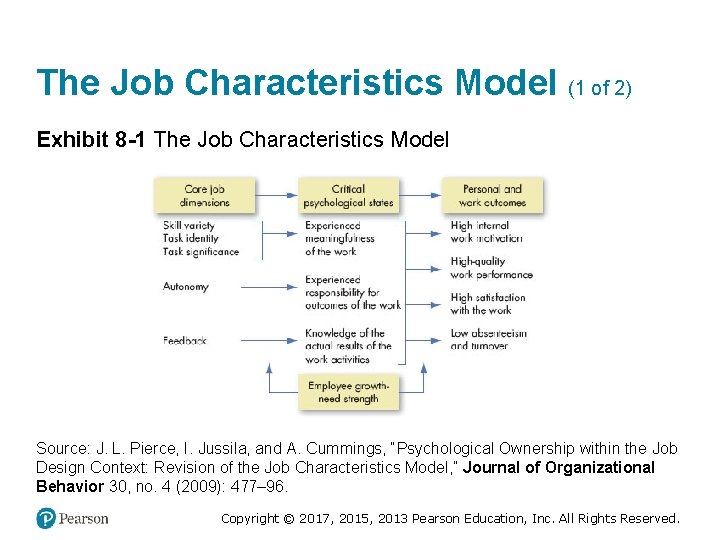
The Job Characteristics Model (1 of 2) Exhibit 8 -1 The Job Characteristics Model Source: J. L. Pierce, I. Jussila, and A. Cummings, “Psychological Ownership within the Job Design Context: Revision of the Job Characteristics Model, ” Journal of Organizational Behavior 30, no. 4 (2009): 477– 96. Copyright © 2017, 2015, 2013 Pearson Education, Inc. All Rights Reserved.
The Job Characteristics Model (2 of 2) • The core dimensions of the job characteristics model (JCM) can be combined into a single predictive index called the motivating potential score (MPS). • Evidence supports the JCM concept that the presence of a set of job characteristics does generate higher and more satisfying job performance. • A few studies have tested the JCM in different cultures, but the results aren’t very consistent. Copyright © 2017, 2015, 2013 Pearson Education, Inc. All Rights Reserved.
Compare the Main Ways Jobs Can Be Redesigned (1 of 2) • Repetitive jobs provide little variety, autonomy, or motivation. • Job Rotation – Referred to as cross-training. – Periodic shifting from one task to another. – Strengths: reduces boredom, increases motivation, and helps employees better understand their work contributions. – Weaknesses: creates disruptions, requires extra time for supervisors addressing questions and training time, and reduced efficiencies. Copyright © 2017, 2015, 2013 Pearson Education, Inc. All Rights Reserved.
Compare the Main Ways Jobs Can Be Redesigned (2 of 2) • Relational Job Design – To make jobs more prosocially motivating: § Connect employees with the beneficiaries of their work. § Meet beneficiaries firsthand. Copyright © 2017, 2015, 2013 Pearson Education, Inc. All Rights Reserved.
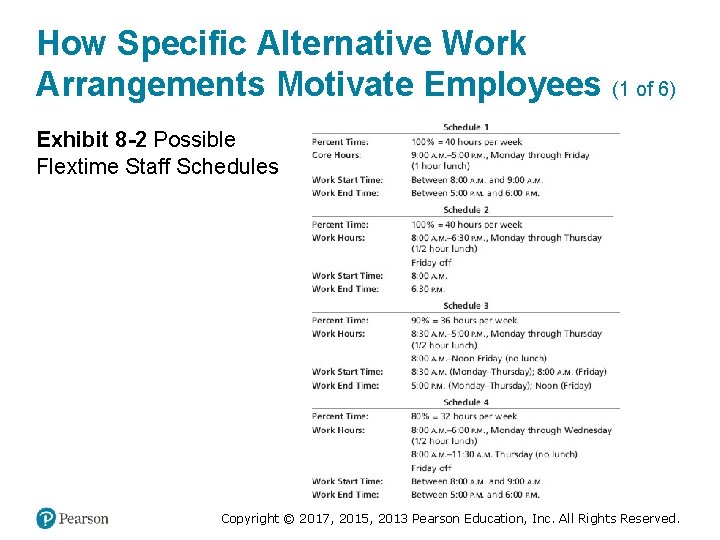
How Specific Alternative Work Arrangements Motivate Employees (1 of 6) Exhibit 8 -2 Possible Flextime Staff Schedules Copyright © 2017, 2015, 2013 Pearson Education, Inc. All Rights Reserved.
How Specific Alternative Work Arrangements Motivate Employees (2 of 6) • Job Sharing – Two or more people split a 40 -hour-a-week job. § Declining in use. § Can be difficult to find compatible pairs of employees who can successfully coordinate the intricacies of one job. § Increases flexibility and can increase motivation and satisfaction when a 40 -hour-a-week job is just not practical. Copyright © 2017, 2015, 2013 Pearson Education, Inc. All Rights Reserved.
How Specific Alternative Work Arrangements Motivate Employees (3 of 6) • Telecommuting – Employees who do their work at home at least two days a week on a computer that is linked to their office. § Virtual office § Some well-known organizations actively discourage telecommuting, but for most organizations it remains popular. Copyright © 2017, 2015, 2013 Pearson Education, Inc. All Rights Reserved.
How Specific Alternative Work Arrangements Motivate Employees (4 of 6) • Telecommuting Advantages – Larger labor pool – Higher productivity – Improved morale – Reduced office-space costs Copyright © 2017, 2015, 2013 Pearson Education, Inc. All Rights Reserved.
How Specific Alternative Work Arrangements Motivate Employees (5 of 6) • Telecommuting Disadvantages – Employer § Less direct supervision of employees. § Difficult to coordinate teamwork. § Difficult to evaluate non-quantitative performance. – Employee § May not be noticed for his or her efforts. Copyright © 2017, 2015, 2013 Pearson Education, Inc. All Rights Reserved.
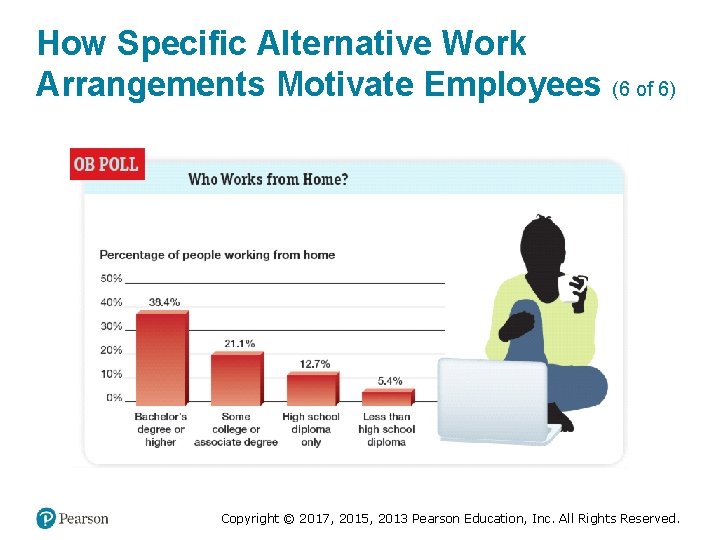
How Specific Alternative Work Arrangements Motivate Employees (6 of 6) Copyright © 2017, 2015, 2013 Pearson Education, Inc. All Rights Reserved.

Employee Involvement and Employee Motivation (1 of 3) • Employee Involvement: a participative process that uses employees’ input to increase their commitment to the organization’s success. • Examples of Employee Involvement Programs – Participative management – Representative participation Copyright © 2017, 2015, 2013 Pearson Education, Inc. All Rights Reserved.
Employee Involvement and Employee Motivation (2 of 3) • Participative management – Joint decision making. – Acts as a panacea for poor morale and low productivity. – Trust and confidence in leaders is essential. – Studies of the participation-performance have yielded mixed results. Copyright © 2017, 2015, 2013 Pearson Education, Inc. All Rights Reserved.
Employee Involvement and Employee Motivation (3 of 3) • Representative participation – Workers are represented by a small group of employees who actually participate in decision making. – Almost every country in Western Europe requires representative participation. – The two most common forms: § Works councils § Board representatives Copyright © 2017, 2015, 2013 Pearson Education, Inc. All Rights Reserved.
Variable-Pay Programs and Employee Motivation (1 of 8) • What to Pay: – Complex process that entails balancing internal equity and external equity. – Some organizations prefer to pay leaders by paying above market. – Paying more may net better-qualified and more highly motivated employees who may stay with the firm longer. Copyright © 2017, 2015, 2013 Pearson Education, Inc. All Rights Reserved.
Variable-Pay Programs and Employee Motivation (2 of 8) • How to Pay: – Variable pay programs: § Piece-rate plans § Merit-based pay § Bonuses § Profit sharing § Employee stock ownership plans – Earnings therefore fluctuate up and down. Copyright © 2017, 2015, 2013 Pearson Education, Inc. All Rights Reserved.
Variable-Pay Programs and Employee Motivation (3 of 8) • Piece-Rate Pay – A pure piece-rate plan provides no base salary and pays the employee only for what he or she produces. – Limitation: not a feasible approach for many jobs. – The main concern for both individual and team piecerate workers is financial risk. Copyright © 2017, 2015, 2013 Pearson Education, Inc. All Rights Reserved.
Variable-Pay Programs and Employee Motivation (4 of 8) • Merit-Based Pay – Allows employers to differentiate pay based on performance. – Creates perceptions of relationships between performance and rewards. – Limitations: § Based on annual performance appraisals. § Merit pool fluctuates. § Union resistance. Copyright © 2017, 2015, 2013 Pearson Education, Inc. All Rights Reserved.
Variable-Pay Programs and Employee Motivation (5 of 8) • Bonuses – An annual bonus is a significant component of total compensation for many jobs. – Increasingly include lower-ranking employees. § Many companies now routinely reward production employees with bonuses when profits improve. – Downside: employees’ pay is more vulnerable to cuts. Copyright © 2017, 2015, 2013 Pearson Education, Inc. All Rights Reserved.
Variable-Pay Programs and Employee Motivation (6 of 8) • Profit-Sharing Plans – Organization-wide programs that distribute compensation based on some established formula centered around a company’s profitability. – Appear to have positive effects on employee attitudes at the organizational level. § Employees have a feeling of psychological ownership. Copyright © 2017, 2015, 2013 Pearson Education, Inc. All Rights Reserved.
Variable-Pay Programs and Employee Motivation (7 of 8) • Employee Stock Ownership Plan (ESOP) – A company-established benefit plan in which employees acquire stock, often at below-market prices, as part of their benefits. – Increases employee satisfaction and innovation. § Employees need to psychologically experience ownership. – Can reduce unethical behavior. Copyright © 2017, 2015, 2013 Pearson Education, Inc. All Rights Reserved.
Variable-Pay Programs and Employee Motivation (8 of 8) • Evaluation of Variable Pay – Do variable-pay programs increase motivation and productivity? § Generally, yes, but that doesn’t mean everyone is equally motivated by them. Copyright © 2017, 2015, 2013 Pearson Education, Inc. All Rights Reserved.
Show How Flexible Benefits Turn Benefits Into Motivators • Developing a Benefits Package – Flexible benefits individualize rewards. – Allow each employee to choose the compensation package that best satisfies his or her current needs and situation. § Today, almost all major corporations in the United States offer flexible benefits. § However, it may be surprising that their usage is not yet global. Copyright © 2017, 2015, 2013 Pearson Education, Inc. All Rights Reserved.
Identify the Motivational Benefits of Intrinsic Rewards • Employee Recognition Programs – Organizations are increasingly recognizing that important work rewards can be both intrinsic and extrinsic. – Rewards are intrinsic in the form of employee recognition programs and extrinsic in the form of compensation systems. Copyright © 2017, 2015, 2013 Pearson Education, Inc. All Rights Reserved.
Implications for Managers (1 of 3) • Recognize individual differences. – Spend the time necessary to understand what’s important to each employee. – Design jobs to align with individual needs and maximize their motivation potential. • Use goals and feedback. – You should give employees firm, specific goals, and they should get feedback on how well they are faring in pursuit of those goals. Copyright © 2017, 2015, 2013 Pearson Education, Inc. All Rights Reserved.
Implications for Managers (2 of 3) • Allow employees to participate in decisions that affect them. – Employees can contribute to setting work goals, choosing their own benefits packages, and solving productivity and quality problems. • Link rewards to performance. – Rewards should be contingent on performance, and employees must perceive the link between the two. Copyright © 2017, 2015, 2013 Pearson Education, Inc. All Rights Reserved.
Implications for Managers (3 of 3) • Check the system for equity. – Employees should perceive that experience, skills, abilities, effort, and other obvious inputs explain differences in performance and hence in pay, job assignments, and other obvious rewards. Copyright © 2017, 2015, 2013 Pearson Education, Inc. All Rights Reserved.
Copyright © 2017, 2015, 2013 Pearson Education, Inc. All Rights Reserved.
- Slides: 29