
ORGANIZATIONAL BEHAVIOR Definition o OB is defined as

ORGANIZATIONAL BEHAVIOR

Definition o OB is defined as a systematic study of actions and reactions of individuals, groups and sub systems
Challenges faced by Managers o Improving quality & Productivity o Improving Customer service o Improving People Skills o Stimulating Innovation & Change o Coping with temporariness o Working in Net-worked Organizations o Helping employees balance work – life conflict o Creating positive Work environment o Improving ethical behavior
Why Study OB o To learn about yourself and how to deal with others o You are a part of an organization & will continue… o You are expected to work in teams o You may want to be managers o Understand Organizational Events o Predict Organizational Events o Influence Organizational Events
Bases of Organizational Behavior 1) Psychology 2) Sociology 3) Social Psychology 4) Anthropology 5) Political Science
Changing trends in Business o Globalization o Workforce Diversity o Employment Relationship o Information Technology o Lots of Teams o Business Ethics
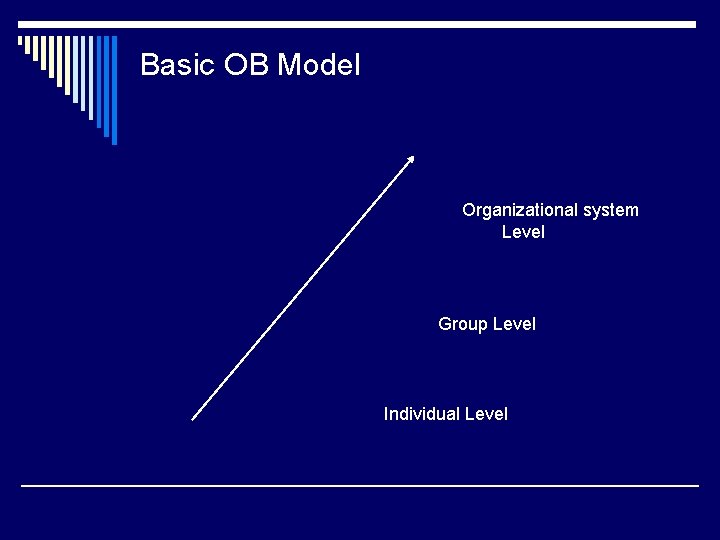
Basic OB Model Organizational system Level Group Level Individual Level
Challenges in the Individual level o Individual differences o Job Satisfaction o Motivation o Empowerment o Behaving Ethically
Challenges in the Group Level o Working with Others o Work force Diversity
Challenges in the Organizational Level o Productivity o Developing Effective Employees o Efficiency o Putting people First o Global Competition o Managing & Working in a multi Cultural World
Organizational Citizenship Behavior o Discretionary Behavior that is not part of an employer’s job requirement, but that nevertheless promotes the effective functioning of the Organization
Putting People First o Putting People 1 st generates a committed workforce and positively affects the bottom line o People will work harder when they feel they have more control and say in their work
How to put people first o Provide employment security o Hire well o Create self managed teams o Pay well o Provide extensive training o Reduce status differences o Share information about organizational performance
Organizational Behavior Models o Autocratic Model o Custodial Model o Supportive Model o Collegial Model
The Rigour of OB o OB looks at consistencies. _ What is common about behavior and helps predictability o OB looks beyond Common sense _ Systematic study, based on scientific evidence o OB has a few absolutes o OB takes a Contingency approach _ Considers behavior in context
OB Looks at Consistencies o What is common about behaviour, and helps predictability? n n Certainly there are differences among individuals. Placed in similar situations, all people don’t act exactly alike. o However, there are certain fundamental consistencies underlying the behaviour of all individuals.
OB Looks Beyond Common Sense o Systematic study n Looking at relationships, attempting to attribute causes and effects and drawing conclusions based on scientific evidence p Behaviour is generally predictable. p There are differences between individuals. p There are fundamental consistencies. p There are rules (written and unwritten) in almost every setting.
OB Has Few Absolutes o There are few simple and universal principles that explain organizational behaviour. o Human beings are very complex. o Humans are not alike, which limits the ability to make simple, accurate, and sweeping generalizations.
OB Takes a Contingency Approach o Considers behaviour within the context in which it occurs.
- Slides: 19