
ORGANIZATIONAL BEHAVIOR Chapter 16 ORGANIZATION STRUCTURE ORB Chapter
ORGANIZATIONAL BEHAVIOR Chapter 16 ORGANIZATION STRUCTURE ORB Chapter 16 1
Organizational Structure How job tasks are formally divided, grouped, and coordinated Key Elements • Work specialization • Departmentalization • Chain of command • Span of control • Centralization and decentralization • Formalization ORB Chapter 16 2

Key Design Questions and Answers for Designing the Proper Organization Structure The Key Question The Answer Is Provided by 1. To what degree articles subdivided into separate jobs? Work specialization 2. On what basis will jobs be grouped together? Departmentalization 3. To whom do individuals and groups report? Chain of command 4. How many individuals can a manager efficiently and effectively direct? Span of control 5. Where does decision-making authority lie? Centralization and decentralization 6. To what degree will there be rules and regulations to direct employees and managers? Formalization ORB Chapter 16 E X H I B I T 16– 1 3
Organizational Structure Work Specialization The degree to which tasks in the organization are subdivided into separate jobs Division of Labor • Makes efficient use of employee skills • Increases employee skills through repetition • Increases productivity • Specialized training is more efficient ORB Chapter 16 4
What Is Organizational Structure Departmentalization The basis by which jobs are grouped together Grouping Activities by: • Function • Product • Geography • Process • Customer ORB Chapter 16 5
Organizational Structure Authority The rights inherent in a managerial position to give orders and to expect the orders to be obeyed Chain of Command The unbroken line of authority that extends from the top of the organization to the lowest echelon and clarifies who reports to whom Unity of Command A subordinate should have only one superior to whom he or she is directly responsible ORB Chapter 16 6
Organizational Structure Span of Control The number of subordinates a manager can efficiently and effectively direct Concept Wider spans of management increase organizational efficiency Narrow Span Drawbacks • Expense of additional layers of management • Increased complexity of vertical communication • Encouragement of overly tight supervision and discouragement of employee autonomy ORB Chapter 16 7
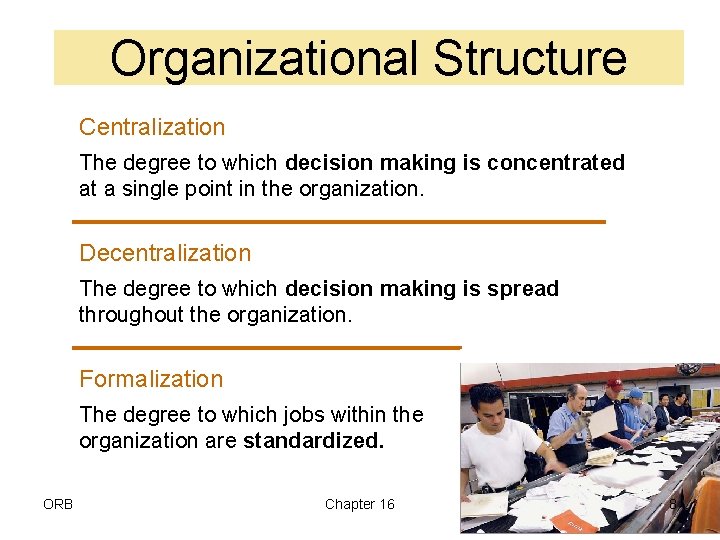
Organizational Structure Centralization The degree to which decision making is concentrated at a single point in the organization. Decentralization The degree to which decision making is spread throughout the organization. Formalization The degree to which jobs within the organization are standardized. ORB Chapter 16 8
Why Do Structures Differ? Mechanistic Model A structure characterized by extensive departmentalization, high formalization, a limited information network, and centralization ORB Chapter 16 9
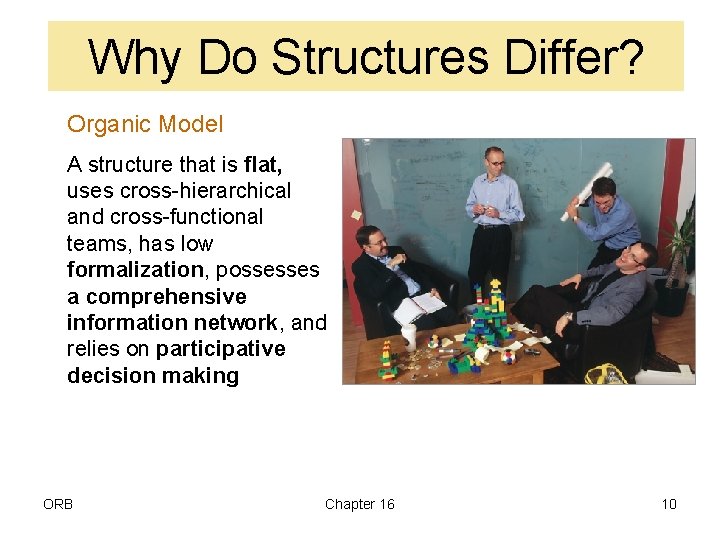
Why Do Structures Differ? Organic Model A structure that is flat, uses cross-hierarchical and cross-functional teams, has low formalization, possesses a comprehensive information network, and relies on participative decision making ORB Chapter 16 10
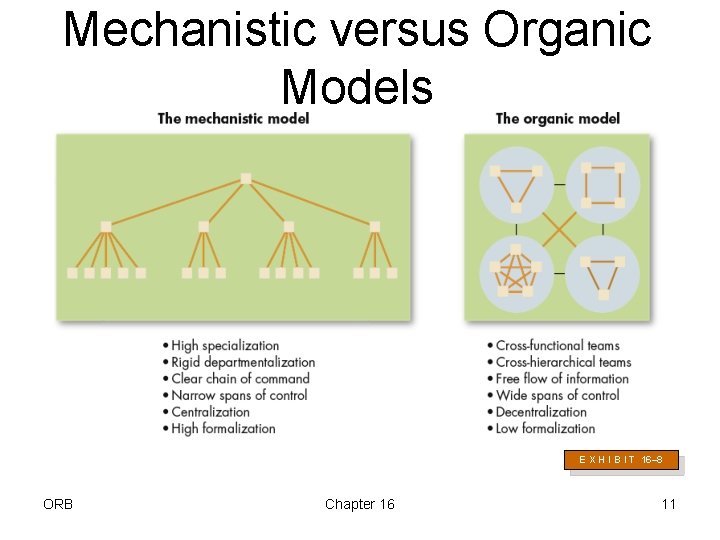
Mechanistic versus Organic Models E X H I B I T 16– 8 ORB Chapter 16 11
Why Do Structures Differ? Size How the size of an organization affects its structure. As an organization grows larger, it becomes more mechanistic. Characteristics of large organizations: • More specialization • More vertical levels • More rules and regulations ORB Chapter 16 12
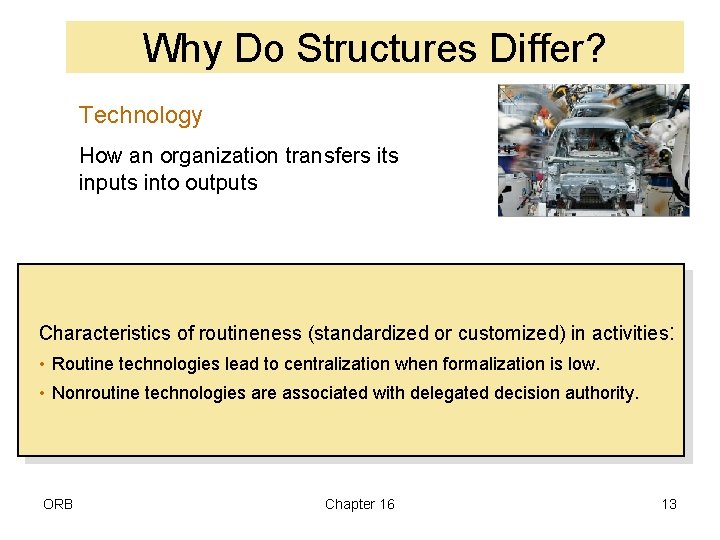
Why Do Structures Differ? Technology How an organization transfers its inputs into outputs Characteristics of routineness (standardized or customized) in activities: • Routine technologies lead to centralization when formalization is low. • Nonroutine technologies are associated with delegated decision authority. ORB Chapter 16 13
Why Do Structures Differ? Environment Institutions or forces outside the organization that potentially affect the organization’s performance Key Dimensions • Capacity: The degree to which an environment can support growth • Volatility: The degree of instability in the environment • Complexity: The degree of heterogeneity and concentration among environmental elements ORB Chapter 16 14
ORGANIZATIONAL BEHAVIOR Chapter 17 ORGANIZATION CULTURE ORB Chapter 16 15
What Is Organizational Culture? Organizational Culture A common perception held by the organization’s members; a system of shared meaning Characteristics 1. Innovation and risk taking 2. Attention to detail 3. Outcome orientation 4. People orientation 5. Team orientation 6. Aggressiveness 7. Stability ORB Chapter 16 16
Contrasting Organizational Cultures Organization A This organization is a manufacturing firm. Managers are expected to fully document all decisions; and “good managers” are those who can provide detailed data to support their recommendations. Creative decisions that incur significant change or risk are not encouraged. Because managers of failed projects are openly criticized and penalized, managers try not to implement ideas that deviate much from the status quo. One lower-level manager quoted an often used phrase in the company: “If it ain’t broke, don’t fix it. ” There are extensive rules and regulations in this firm that employees are required to follow. Managers supervise employees closely to ensure there are no deviations. Management is concerned with high productivity, regardless of the impact on employee morale or turnover. Work activities are designed around individuals. There are distinct departments and lines of authority, and employees are expected to minimize formal contact with other employees outside their functional area or line of command. Performance evaluations and rewards emphasize individual effort, although seniority tends to be the primary factor in the determination of pay raises and promotions. E X H I B I T 17– 1 ORB Chapter 16 17
Contrasting Organizational Cultures Organization B This organization is also a manufacturing firm. Here, however, management encourages and rewards risk taking and change. Decisions based on intuition are valued as much as those that are well rationalized. Management prides itself on its history of experimenting with new technologies and its success in regularly introducing innovation products. Managers or employees who have a good idea are encouraged to “run with it. ” And failures are treated as “learning experiences. ” The company prides itself on being market-driven and rapidly responsive to the changing needs of its customers. There are few rules and regulations for employees to follow, and supervision is loose because management believes that its employees are hardworking and trustworthy. Management is concerned with high productivity, but believes that this comes through treating its people right. The company is proud of its reputation as being a good place to work. Job activities are designed around work teams, and team members are encouraged to interact with people across functions and authority levels. Employees talk positively about the competition between teams. Individuals and teams have goals, and bonuses are based on achievement of these outcomes. Employees are given considerable autonomy in choosing the means by which the goals are attained. E X H I B I T 17– 1 (cont’d) ORB Chapter 16 18
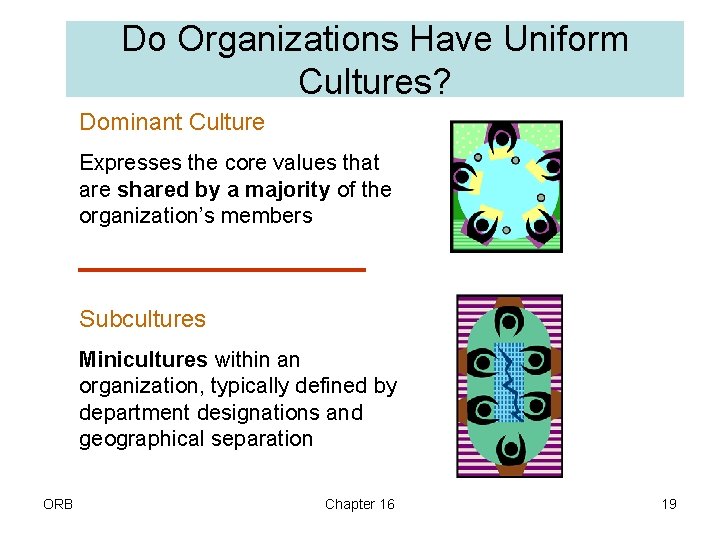
Do Organizations Have Uniform Cultures? Dominant Culture Expresses the core values that are shared by a majority of the organization’s members Subcultures Minicultures within an organization, typically defined by department designations and geographical separation ORB Chapter 16 19
Do Organizations Have Uniform Cultures? Core Values The primary or dominant values that are accepted throughout the organization Strong Culture A culture in which the core values are intensely held and widely shared ORB Chapter 16 20
What Is Organizational Culture? • Culture versus Formalization – A strong culture increases behavioral consistency and can act as a substitute formalization. • Organizational Culture versus National Culture – National culture has a greater impact on employees than does their organization’s culture. – Nationals selected to work foreign companies may be atypical of the local/native population. ORB Chapter 16 21
What Do Cultures Do? Culture’s Functions 1. Defines the boundary between one organization and others 2. Conveys a sense of identity for its members 3. Facilitates the generation of commitment to something larger than self-interest 4. Enhances the stability of the social system ORB Chapter 16 22
What Do Cultures Do? Culture as a Liability 1. Barrier to change 2. Barrier to diversity 3. Barrier to acquisitions and mergers ORB Chapter 16 23
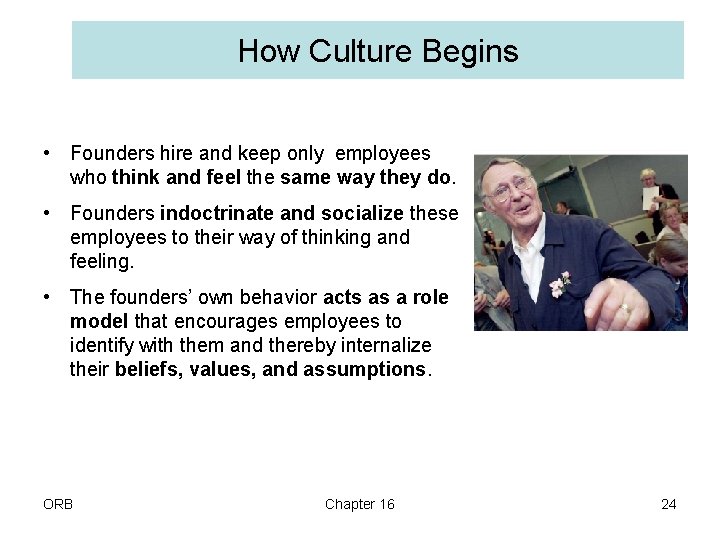
How Culture Begins • Founders hire and keep only employees who think and feel the same way they do. • Founders indoctrinate and socialize these employees to their way of thinking and feeling. • The founders’ own behavior acts as a role model that encourages employees to identify with them and thereby internalize their beliefs, values, and assumptions. ORB Chapter 16 24
Keeping Culture Alive • Selection – Concern with how well the candidates will fit into the organization – Provides information to candidates about the organization • Top Management – Senior executives help establish behavioral norms that are adopted by the organization • Socialization – The process that helps new employees adapt to the organization’s culture ORB Chapter 16 25
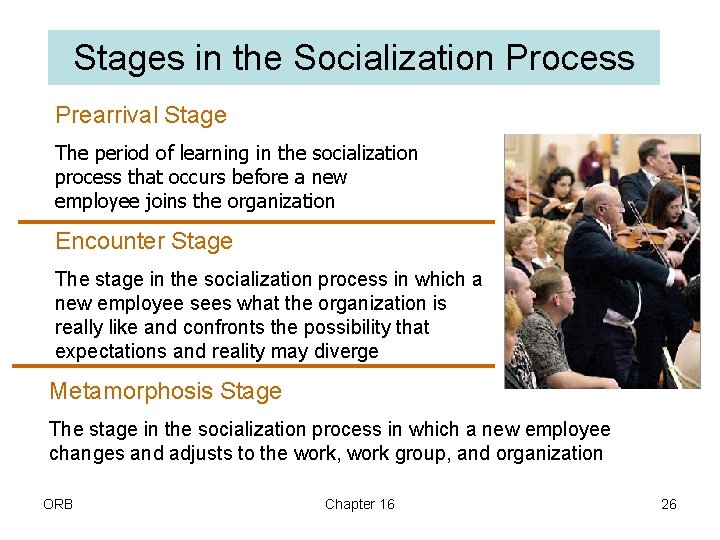
Stages in the Socialization Process Prearrival Stage The period of learning in the socialization process that occurs before a new employee joins the organization Encounter Stage The stage in the socialization process in which a new employee sees what the organization is really like and confronts the possibility that expectations and reality may diverge Metamorphosis Stage The stage in the socialization process in which a new employee changes and adjusts to the work, work group, and organization ORB Chapter 16 26
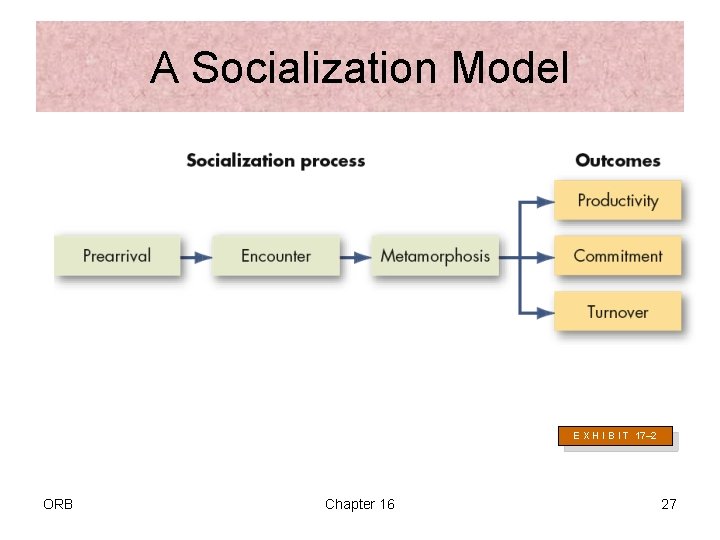
A Socialization Model E X H I B I T 17– 2 ORB Chapter 16 27
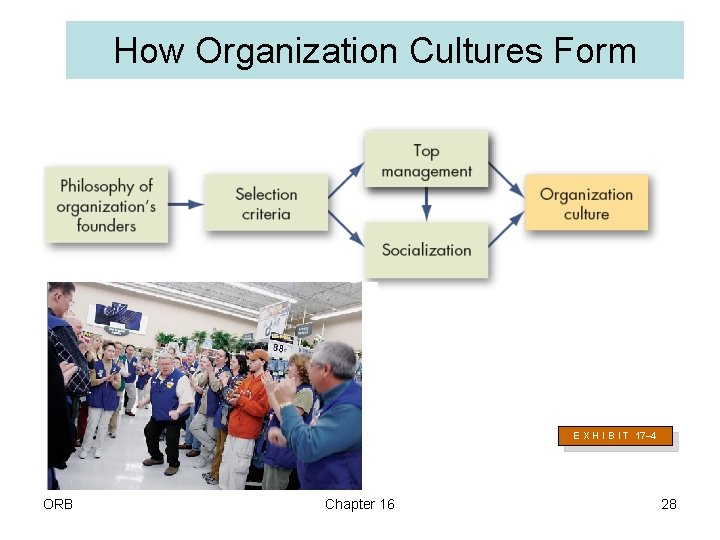
How Organization Cultures Form E X H I B I T 17– 4 ORB Chapter 16 28
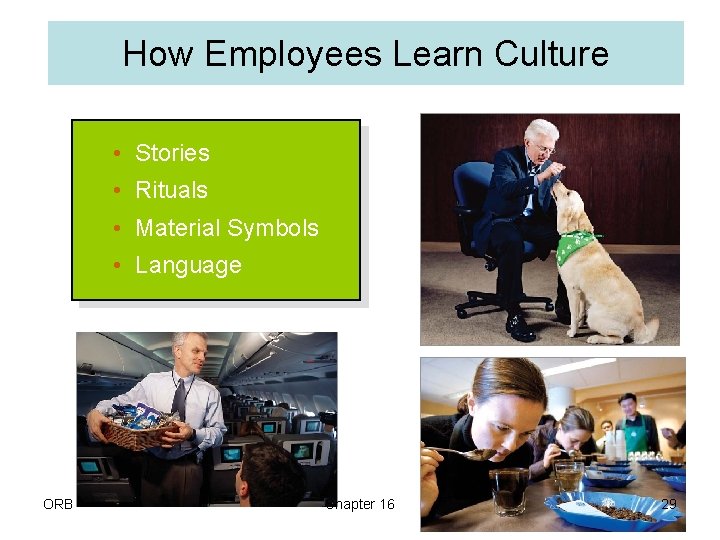
How Employees Learn Culture • Stories • Rituals • Material Symbols • Language ORB Chapter 16 29
Creating An Ethical Organizational Culture • Characteristics of Organizations that Develop High Ethical Standards – High tolerance for risk – Low to moderate in aggressiveness – Focus on means as well as outcomes • Managerial Practices Promoting an Ethical Culture – Being a visible role model – Communicating ethical expectations – Providing ethical training – Rewarding ethical acts and punishing unethical ones – Providing protective mechanisms ORB Chapter 16 30
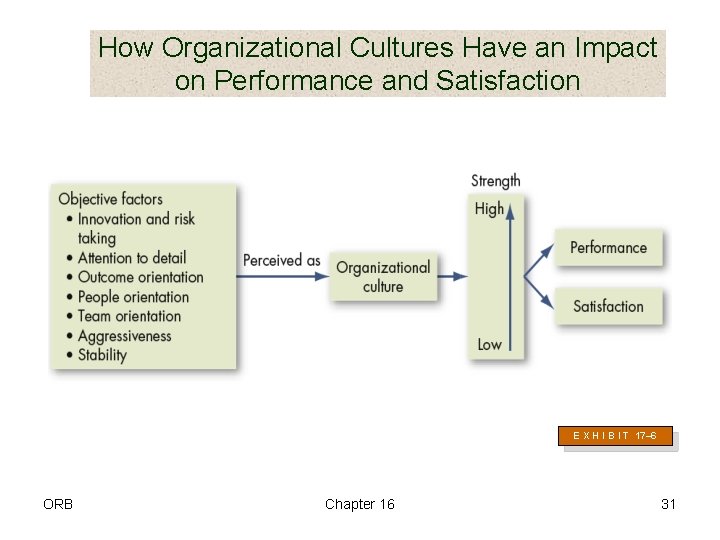
How Organizational Cultures Have an Impact on Performance and Satisfaction E X H I B I T 17– 6 ORB Chapter 16 31
- Slides: 31