
Organizational Behavior 15 th Ed Chapter 1 Robbins
Organizational Behavior 15 th Ed Chapter 1 Robbins and Judge What Is Organizational Behavior? Copyright © 2013 Pearson Education, Inc. publishing as Prentice Hall 1 -1
Chapter 1 Learning Objectives After studying this chapter you should be able to: • Demonstrate the importance of interpersonal skills in the workplace. • Describe the manager’s functions, roles and skills. • Define organizational behavior (OB). • Show the value to OB of systematic study. • Identify the major behavioral science disciplines that contribute to OB. • Demonstrate why few absolutes apply to OB. • Identify the challenges and opportunities managers have in applying OB concepts. • Compare three levels of analysis in this book’s OB model. Copyright © 2013 Pearson Education, Inc. publishing as Prentice Hall 1 -2
Demonstrate the importance of LO 1 interpersonal skills in the workplace Interpersonal Skills Result In… – Understanding OB helping to determine manager effectiveness – Leadership and communication skills that are critical as a person progresses in a career – Lower turnover of quality employees – Higher quality applications for recruitment – Better financial performance Copyright © 2013 Pearson Education, Inc. publishing as Prentice Hall 1 -3
LO 2 Describe the manager’s functions, roles and skills. • Manager: Someone who gets things done through other people in organizations. – Organization: A consciously coordinated social unit composed of two or more people that functions on a relatively continuous basis to achieve a common goal or set of goals. – Planning, organizing, leading, and controlling are the most often studied. • Mintzberg concluded that managers perform ten different, highly interrelated roles or sets of behaviors attributable to their jobs. Copyright © 2013 Pearson Education, Inc. publishing as Prentice Hall i 1 -4
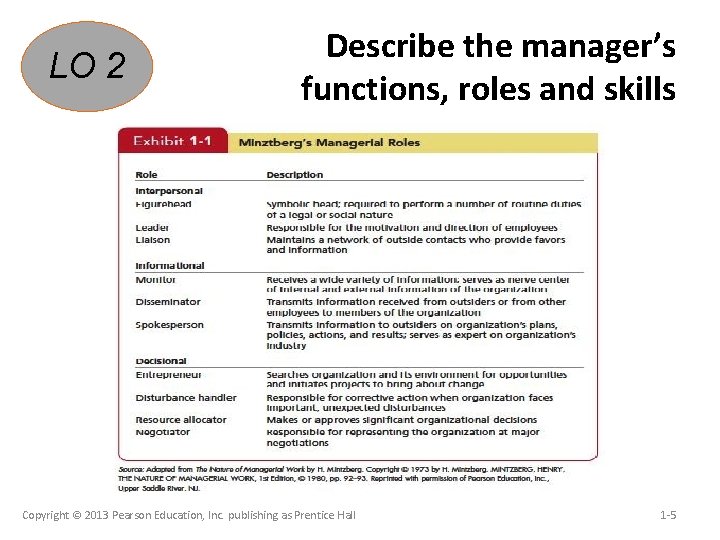
LO 2 Describe the manager’s functions, roles and skills Insert Exhibit 1. 1 Copyright © 2013 Pearson Education, Inc. publishing as Prentice Hall 1 -5
LO 2 Describe the manager’s functions, roles and skills – Management Skills • Technical Skills --The ability to apply specialized knowledge or expertise. All jobs require some specialized expertise, and many people develop their technical skills on the job. • Human Skills -- Ability to work with, understand, and motivate other people, both individually and in groups, describes human skills. • Conceptual Skills -- The mental ability to analyze and diagnose complex situations. Copyright © 2013 Pearson Education, Inc. publishing as Prentice Hall 1 -6
LO 2 Effective Versus Successful Managerial Activities • Luthans and associates found that all managers engage in four managerial activities. – Traditional management. – Communication. – Human resource management. – Networking. Copyright © 2013 Pearson Education, Inc. publishing as Prentice Hall 1 -7
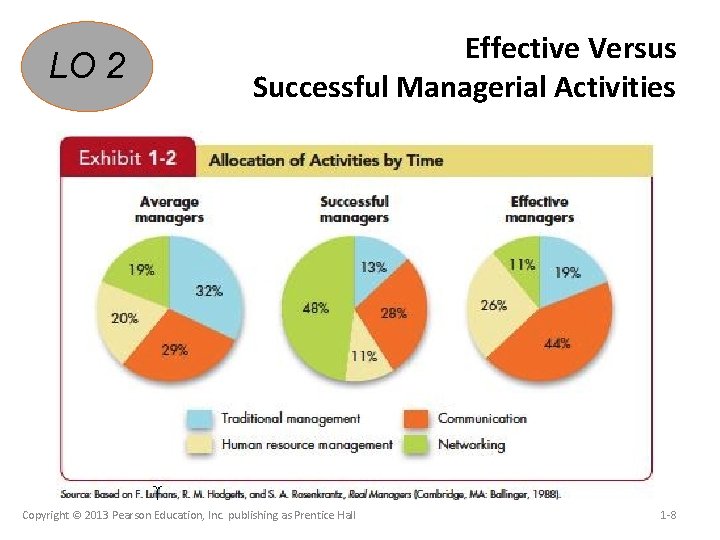
LO 2 Effective Versus Successful Managerial Activities Insert Exhibit 1. 2 Copyright © 2013 Pearson Education, Inc. publishing as Prentice Hall 1 -8
Define LO 3 “Organizational Behavior” (OB) • OB is a field of study that investigates the impact that individuals, groups, and structure have on behavior within organizations for the purpose of applying such knowledge toward improving an organization’s effectiveness. Copyright © 2013 Pearson Education, Inc. publishing as Prentice Hall 1 -9
LO 4 Show the value to OB of systematic study • Systematic Study of Behavior • Behavior generally is predictable if we know how the person perceived the situation and what is important to him or her. • Evidence-Based Management (EBM) • Complements systematic study. • Argues for managers to make decisions on evidence. • Intuition • Systematic study and EBM add to intuition, or those “gut feelings” about “why I do what I do” and “what makes others tick. ” • If we make all decisions with intuition or gut instinct, we’re likely working with incomplete information. Copyright © 2013 Pearson Education, Inc. publishing as Prentice Hall 1 -10 .
Identify the major behavioral science LO 5 disciplines that contribute to OB • Organizational behavior is an applied behavioral science that is built upon contributions from a number of behavioral disciplines. Copyright © 2013 Pearson Education, Inc. publishing as Prentice Hall 1 -11

Identify the major behavioral science LO 5 disciplines that contribute to OB Insert Exhibit 1. 3 Copyright © 2013 Pearson Education, Inc. publishing as Prentice Hall 1 -12
Identify the major behavioral science LO 5 disciplines that contribute to OB • Psychology – Psychology is the science that seeks to measure, explain, and sometimes change the behavior of humans and other animals. • Social Psychology – Social psychology blends the concepts of psychology and sociology. Copyright © 2013 Pearson Education, Inc. publishing as Prentice Hall 1 -13
Identify the major behavioral science LO 5 disciplines that contribute to OB. • Sociology – Sociologists study the social system in which individuals fill their roles; that is, sociology studies people in relation to their fellow human beings. • Anthropology – Anthropology is the study of societies to learn about human beings and their activities. Copyright © 2013 Pearson Education, Inc. publishing as Prentice Hall 1 -14
LO 6 Few absolutes apply to OB • There are few, if any, simple and universal principles that explain organizational behavior. • Contingency variables—situational factors are variables that moderate the relationship between the independent and dependent variables. Copyright © 2013 Pearson Education, Inc. publishing as Prentice Hall 1 -15

LO 6 Few absolutes apply to OB Situational factors that make the main relationship between two variables change—e. g. , the relationship may hold for one condition but not another. Copyright © 2013 Pearson Education, Inc. publishing as Prentice Hall 1 -16
LO 7 Identify the challenges and opportunities of OB concepts – Responding to Economic Pressure • In economic tough times, effective management is an asset. • In good times, understanding how to reward, satisfy, and retain employees is at a premium. In bad times, issues like stress, decision making, and coping come to the fore. Copyright © 2013 Pearson Education, Inc. publishing as Prentice Hall 1 -17
LO 7 Identify the challenges and opportunities of OB concepts – Responding to Globalization • increased Foreign Assignments • working with People from Different Cultures Copyright © 2013 Pearson Education, Inc. publishing as Prentice Hall 1 -18
LO 7 Identify the challenges and opportunities of OB concepts – Managing Workforce Diversity • Workforce diversity acknowledges a – workforce of women and men; – many racial and ethnic groups; – individuals with a variety of physical or psychological abilities; – and people who differ in age and sexual orientation. Copyright © 2013 Pearson Education, Inc. publishing as Prentice Hall 1 -19
LO 7 Identify the challenges and opportunities of OB concepts – Improving Customer Service • Today the majority of employees in developed countries work in service jobs. • Employee attitudes and behavior are associated with customer satisfaction. Copyright © 2013 Pearson Education, Inc. publishing as Prentice Hall 1 -20
LO 7 Identify the challenges and opportunities of OB concepts – Improving People Skills • People skills are essential to managerial effectiveness. • OB provides the concepts and theories that allow managers to predict employee behavior in given situations. Copyright © 2013 Pearson Education, Inc. publishing as Prentice Hall 1 -21
LO 7 Identify the challenges and opportunities of OB concepts – Stimulating Innovation and Change • Successful organizations must foster innovation and master the art of change. • Employees can be the impetus for innovation and change or a major stumbling block. • Managers must stimulate employees’ creativity and tolerance for change. Copyright © 2013 Pearson Education, Inc. publishing as Prentice Hall 1 -22
LO 7 Identify the challenges and opportunities of OB concepts – Coping with “Temporariness” • Organizations must be flexible and fast in order to survive. • Managers and employees must learn to cope with temporariness. • Learning to live with flexibility, spontaneity, and unpredictability. • OB provides help in understanding a work world of continual change, how to overcome resistance to change, and how to create an organizational culture that thrives on change. Copyright © 2013 Pearson Education, Inc. publishing as Prentice Hall 1 -23
LO 7 Identify the challenges and opportunities of OB concepts – Working in Networked Organizations • Networked organizations are becoming more pronounced. • A manager’s job is fundamentally different in networked organizations. Challenges of motivating and leading “online” require different techniques. Copyright © 2013 Pearson Education, Inc. publishing as Prentice Hall 1 -24
LO 7 Identify the challenges and opportunities of OB concepts – Helping Employees Balance Work-Life Conflicts • The creation of the global workforce means work no longer sleeps. • Communication technology has provided a vehicle for working at any time or any place. • Employees are working longer hours per week. • The lifestyles of families have changed—creating conflict. • Balancing work and life demands now surpasses job security as an employee priority. Copyright © 2013 Pearson Education, Inc. publishing as Prentice Hall 1 -25
LO 7 Identify the challenges and opportunities of OB concepts – Creating a Positive Work Environment • Organizations have realized creating a positive work environment can be a competitive advantage. • Positive organizational scholarship or behavior studies what is ‘good’ about organizations. • This field of study focuses on employees’ strengths versus their limitations as employees share situations in which they performed at their personal best. Copyright © 2013 Pearson Education, Inc. publishing as Prentice Hall 1 -26
LO 7 Identify the challenges and opportunities of OB concepts – Improving Ethical Behavior • Ethical dilemmas are situations in which an individual is required to define right and wrong conduct. • Good ethical behavior is not so easily defined. • Organizations are distributing codes of ethics to guide employees through ethical dilemmas. • Managers need to create an ethically healthy climate. Copyright © 2013 Pearson Education, Inc. publishing as Prentice Hall 1 -27
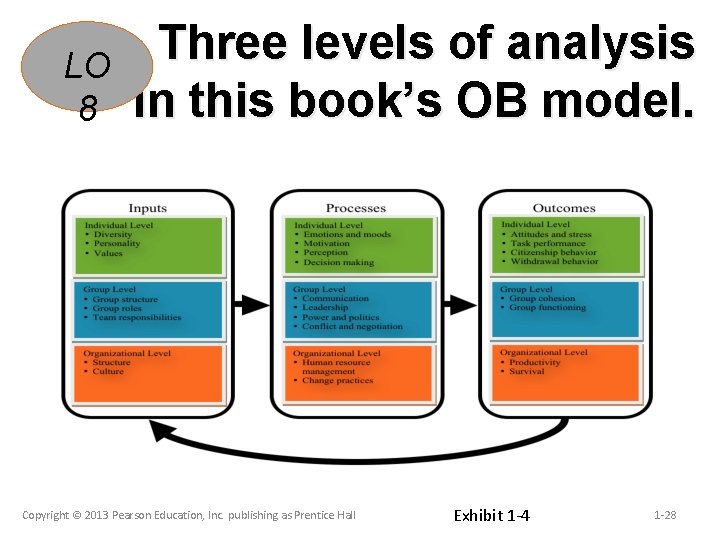
LO 8 Three levels of analysis in this book’s OB model. Copyright © 2013 Pearson Education, Inc. publishing as Prentice Hall Exhibit 1 -4 1 -28

LO 8 Three levels of analysis in this book’s OB model. • Inputs are the variables like personality, group structure, and organizational culture that lead to processes. • Group structure, roles, and team responsibilities are typically assigned immediately before or after a group is formed. Copyright © 2013 Pearson Education, Inc. publishing as Prentice Hall 1 -29
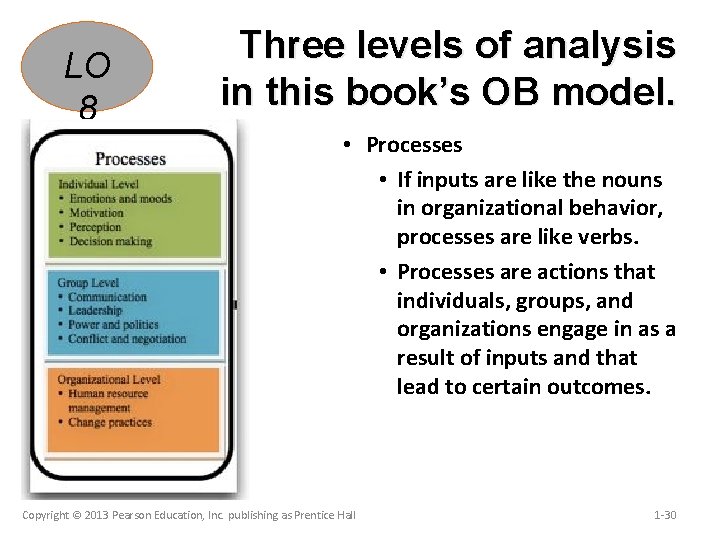
LO 8 Three levels of analysis in this book’s OB model. • Processes • If inputs are like the nouns in organizational behavior, processes are like verbs. • Processes are actions that individuals, groups, and organizations engage in as a result of inputs and that lead to certain outcomes. Copyright © 2013 Pearson Education, Inc. publishing as Prentice Hall 1 -30
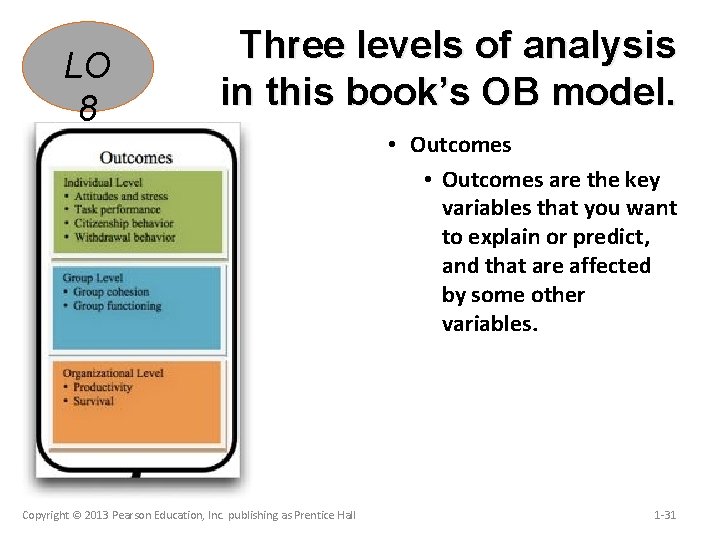
LO 8 Three levels of analysis in this book’s OB model. • Outcomes are the key variables that you want to explain or predict, and that are affected by some other variables. Copyright © 2013 Pearson Education, Inc. publishing as Prentice Hall 1 -31
LO 8 Variables of Interest • Attitudes and stress – Employee attitudes are the evaluations employees make, ranging from positive to negative, about objects, people, or events. – Stress is an unpleasant psychological process that occurs in response to environmental pressures. • Task performance – The combination of effectiveness and efficiency at doing your core job tasks is a reflection of your level of task performance. Copyright © 2013 Pearson Education, Inc. publishing as Prentice Hall 1 -32
LO 8 Variables of Interest – Citizenship behavior • The discretionary behavior that is not part of an employee’s formal job requirements, and that contributes to the psychological and social environment of the workplace, is called citizenship behavior. – Withdrawal behavior • Withdrawal behavior is the set of actions that employees take to separate themselves from the organization. Copyright © 2013 Pearson Education, Inc. publishing as Prentice Hall 1 -33
LO 8 Variables of Interest • Group cohesion – Group cohesion is the extent to which members of a group support and validate one another at work. • Group functioning – Group functioning refers to the quantity and quality of a group’s work output. Copyright © 2013 Pearson Education, Inc. publishing as Prentice Hall 1 -34
LO 8 Variables of Interest • Productivity – An organization is productive if it achieves its goals by transforming inputs into outputs at the lowest cost. This requires both effectiveness and efficiency. • Survival – The final outcome we will consider is organizational survival, which is simply evidence that the organization is able to exist and grow over the long term. Copyright © 2013 Pearson Education, Inc. publishing as Prentice Hall 1 -35
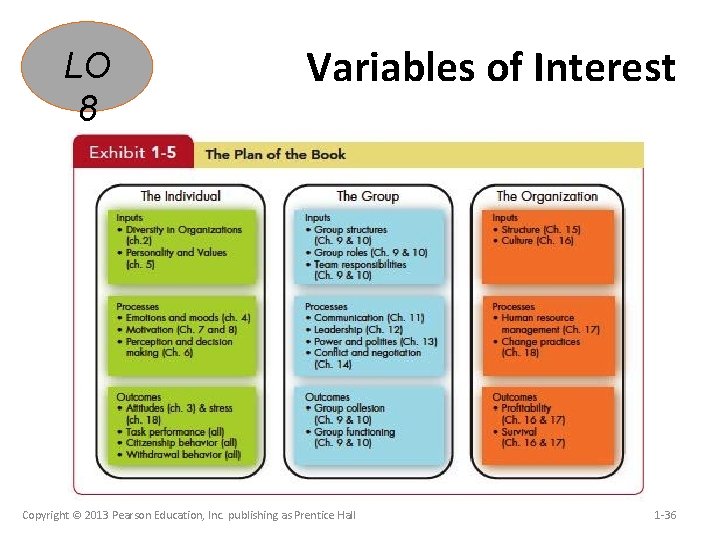
LO 8 Variables of Interest Insert Exhibit 1. 5 Copyright © 2013 Pearson Education, Inc. publishing as Prentice Hall 1 -36
Managerial Summary • Organizational behavior uses systematic study to improve predictions of behavior over intuition alone. • Because people are different, we need to look at OB in a contingency framework, using situational variables to explain cause-andeffect relationships. • Organizational behavior offers specific insights to improve a manager’s people skills. Copyright © 2013 Pearson Education, Inc. publishing as Prentice Hall 1 -37
Managerial Summary • It helps managers to see the value of workforce diversity and practices that may need to be changed in different countries. • It can improve quality and employee productivity by showing managers how to empower their people, and help employees balance work–life conflicts. • It can help managers cope in a world of temporariness and learn how to stimulate innovation. • Finally, OB can guide managers in creating an ethically healthy work climate. Copyright © 2013 Pearson Education, Inc. publishing as Prentice Hall 1 -38
- Slides: 38