
Organizational Behavior 10 Prof Luo Fan Management School
Organizational Behavior 10 Prof. Luo, Fan Management School, Wuhan University of Technology Email: sailluof@126. com
10. Communication 1 v. The communication process v. Barriers to effective communication 2 v. Importance of effective listening skills 3 v. Cross-cultural communication v. Communication Barriers and Cultural 4 Context Management School, Wuhan University of Technology
Teaching Plan v Objects Help the students understanding different types of communication, the function of communication and barriers to effective communication, so as to help the students overcome the potential problems in cross-cultural communication. v Teaching Emphases v Barriers to Effective Communication, Cross-cultural communication v Learning difficulty The application of communication and how to prove the effectiveness of communication. v Methods Lecture; Case Discussion; Team Training
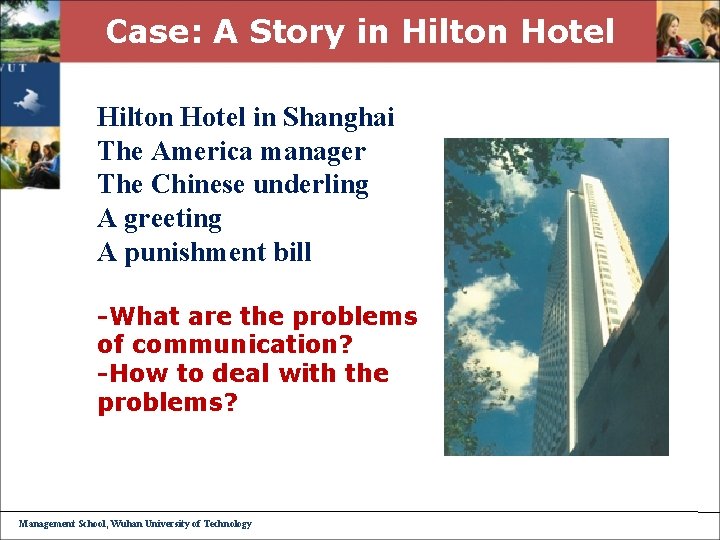
Case: A Story in Hilton Hotel in Shanghai The America manager The Chinese underling A greeting A punishment bill -What are the problems of communication? -How to deal with the problems? Management School, Wuhan University of Technology
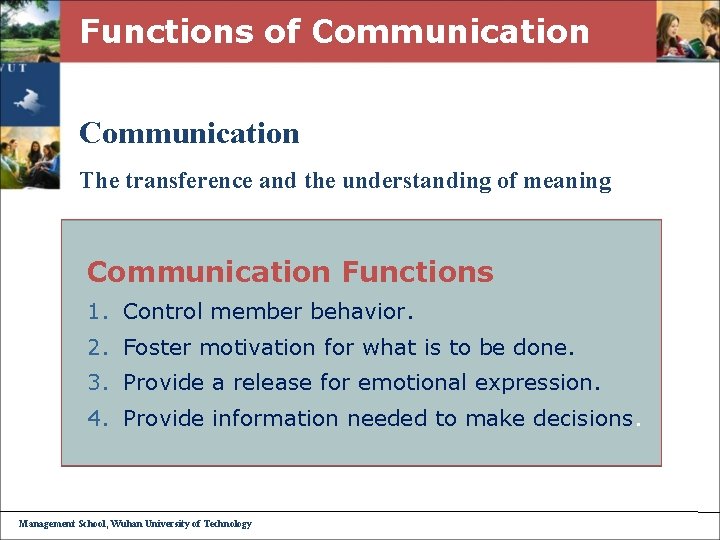
Functions of Communication The transference and the understanding of meaning Communication Functions 1. Control member behavior. 2. Foster motivation for what is to be done. 3. Provide a release for emotional expression. 4. Provide information needed to make decisions. Management School, Wuhan University of Technology
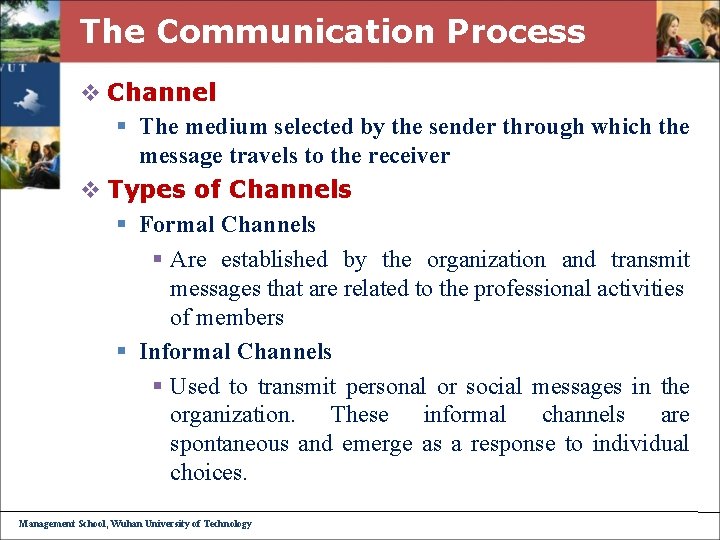
The Communication Process v Channel § The medium selected by the sender through which the message travels to the receiver v Types of Channels § Formal Channels § Are established by the organization and transmit messages that are related to the professional activities of members § Informal Channels § Used to transmit personal or social messages in the organization. These informal channels are spontaneous and emerge as a response to individual choices. Management School, Wuhan University of Technology
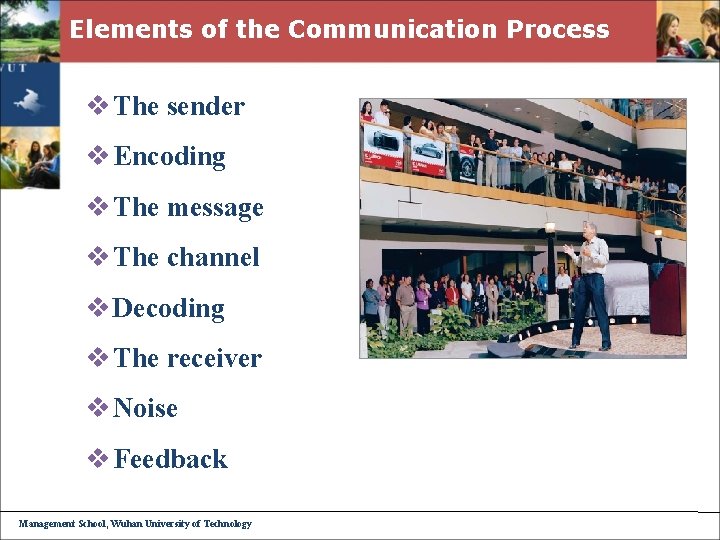
Elements of the Communication Process v The sender v Encoding v The message v The channel v Decoding v The receiver v Noise v Feedback Management School, Wuhan University of Technology

The Communication Process Model Communication Process The steps between a source and a receiver that result in the transference and understanding of meaning Management School, Wuhan University of Technology
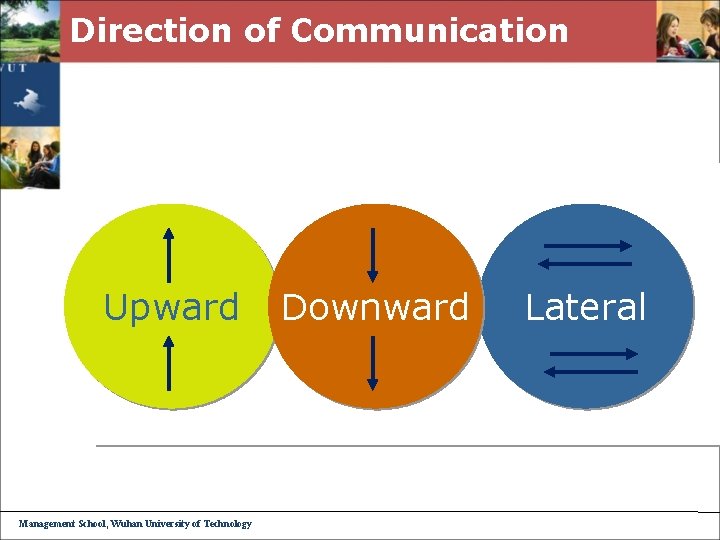
Direction of Communication Upward Management School, Wuhan University of Technology Downward Lateral
Interpersonal Communication v Oral Communication § Advantages: Speed and feedback § Disadvantage: Distortion of the message v Written Communication § Advantages: Tangible and verifiable § Disadvantages: Time-consuming and lacks feedback v Nonverbal Communication § Advantages: Supports other communications and provides observable expression of emotions and feelings § Disadvantage: Misperception of body language or gestures can influence receiver’s interpretation of message Management School, Wuhan University of Technology
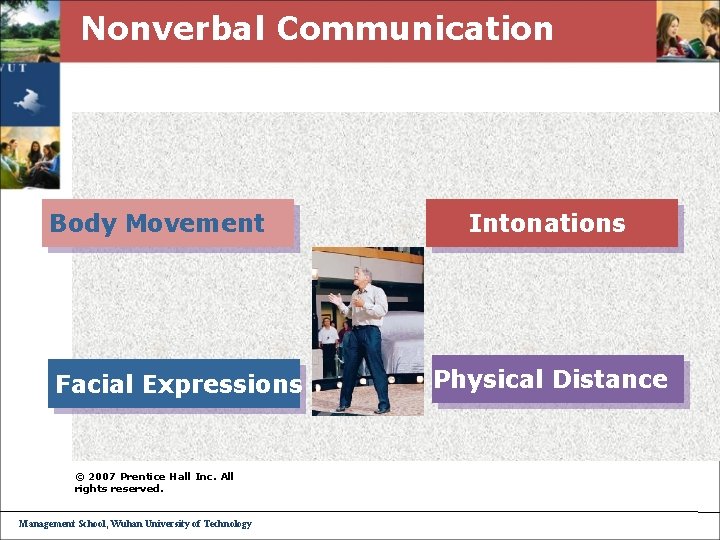
Nonverbal Communication Body Movement Facial Expressions © 2007 Prentice Hall Inc. All rights reserved. Management School, Wuhan University of Technology Intonations Physical Distance
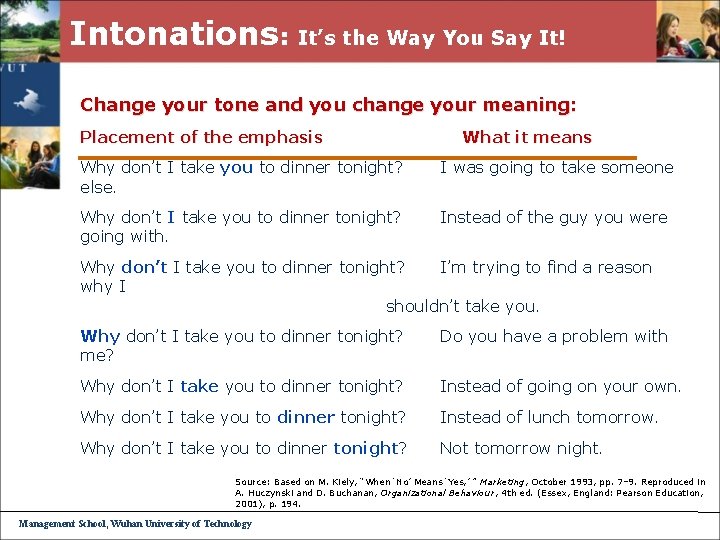
Intonations: It’s the Way You Say It! Change your tone and you change your meaning: Placement of the emphasis What it means Why don’t I take you to dinner tonight? else. I was going to take someone Why don’t I take you to dinner tonight? going with. Instead of the guy you were Why don’t I take you to dinner tonight? I’m trying to find a reason why I shouldn’t take you. Why don’t I take you to dinner tonight? me? Do you have a problem with Why don’t I take you to dinner tonight? Instead of going on your own. Why don’t I take you to dinner tonight? Instead of lunch tomorrow. Why don’t I take you to dinner tonight? Not tomorrow night. Source: Based on M. Kiely, “When ‘No’ Means ‘Yes, ’ ” Marketing, October 1993, pp. 7– 9. Reproduced in A. Huczynski and D. Buchanan, Organizational Behaviour, 4 th ed. (Essex, England: Pearson Education, 2001), p. 194. Management School, Wuhan University of Technology
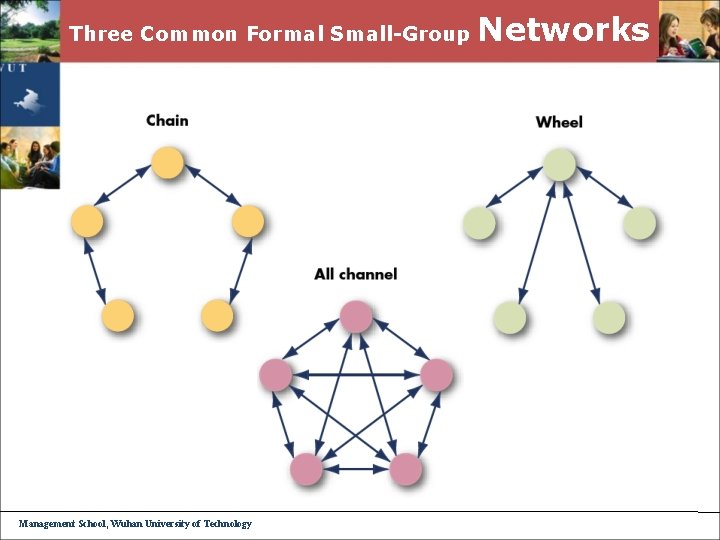
Three Common Formal Small-Group Management School, Wuhan University of Technology Networks
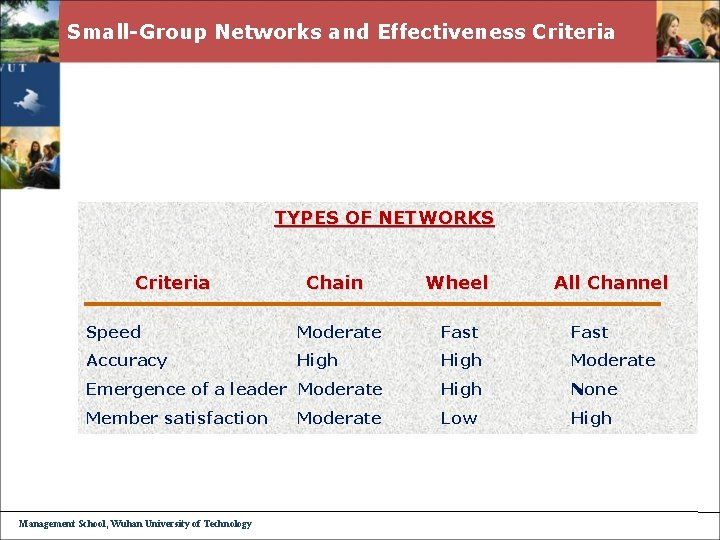
Small-Group Networks and Effectiveness Criteria TYPES OF NETWORKS Criteria Chain Wheel Speed Moderate Fast Accuracy High Moderate Emergence of a leader Moderate High None Member satisfaction Low High Management School, Wuhan University of Technology Moderate All Channel
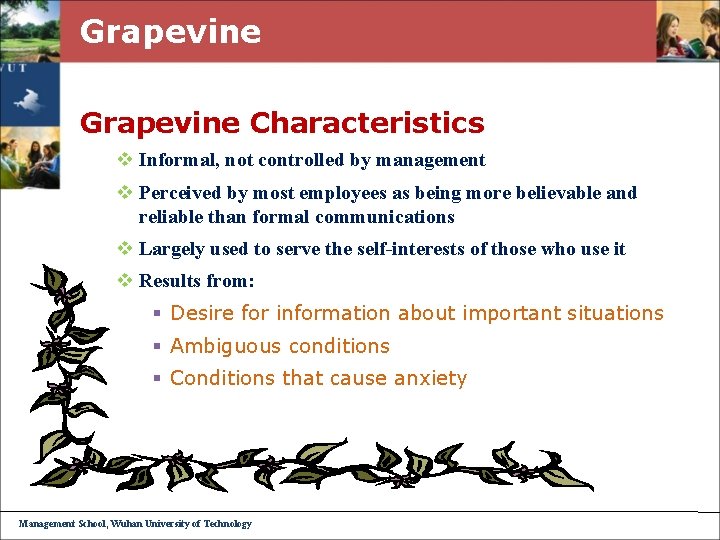
Grapevine Characteristics v Informal, not controlled by management v Perceived by most employees as being more believable and reliable than formal communications v Largely used to serve the self-interests of those who use it v Results from: § Desire for information about important situations § Ambiguous conditions § Conditions that cause anxiety Management School, Wuhan University of Technology
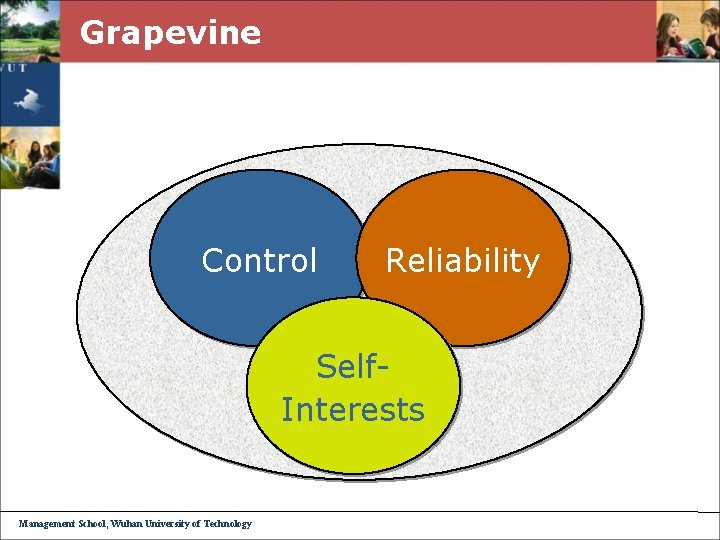
Grapevine Control Reliability Self. Interests Management School, Wuhan University of Technology
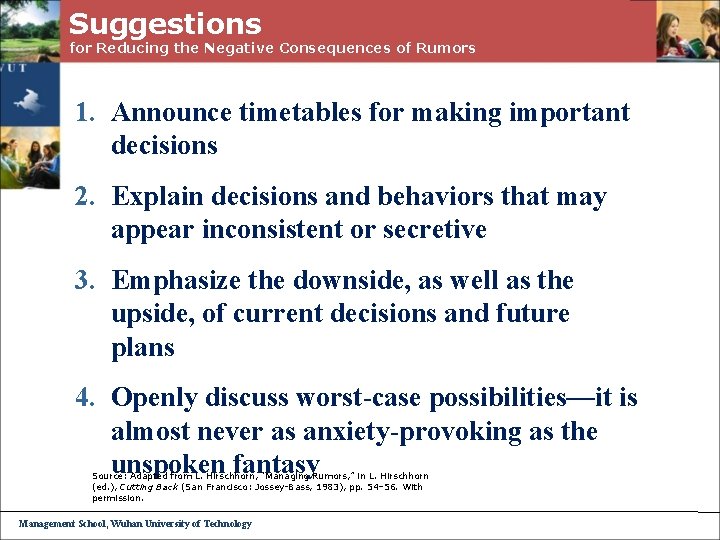
Suggestions for Reducing the Negative Consequences of Rumors 1. Announce timetables for making important decisions 2. Explain decisions and behaviors that may appear inconsistent or secretive 3. Emphasize the downside, as well as the upside, of current decisions and future plans 4. Openly discuss worst-case possibilities—it is almost never as anxiety-provoking as the unspoken fantasy Source: Adapted from L. Hirschhorn, “Managing Rumors, ” in L. Hirschhorn (ed. ), Cutting Back (San Francisco: Jossey-Bass, 1983), pp. 54– 56. With permission. Management School, Wuhan University of Technology
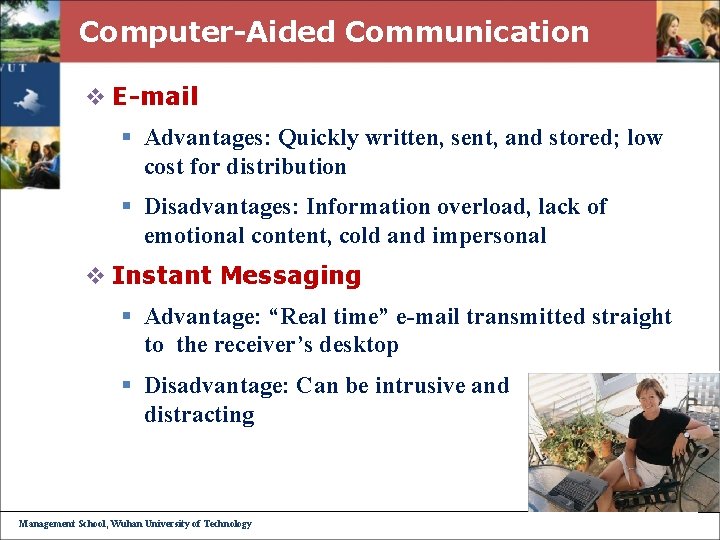
Computer-Aided Communication v E-mail § Advantages: Quickly written, sent, and stored; low cost for distribution § Disadvantages: Information overload, lack of emotional content, cold and impersonal v Instant Messaging § Advantage: “Real time” e-mail transmitted straight to the receiver’s desktop § Disadvantage: Can be intrusive and distracting Management School, Wuhan University of Technology
Computer-Aided Communication v Intranet § A private organization-wide information network v Extranet § An information network connecting employees with external suppliers, customers, and strategic partners v Videoconferencing § An extension of an intranet or extranet that permits face-to-face virtual meetings via video links Management School, Wuhan University of Technology
Knowledge Management (KM) Knowledge Management A process of organizing and distributing an organization’s collective wisdom so the right information gets to the right people at the right time Why KM Is Important: Intellectual assets are as important as physical assets. When individuals leave, their knowledge and experience goes with them. A KM system reduces redundancy and makes the organization more efficient. Management School, Wuhan University of Technology
Choice of Communication Channel Richness The amount of information that can be transmitted during a communication episode Characteristics of Rich Channels 1. Handle multiple cues simultaneously 2. Facilitate rapid feedback 3. Are very personal in context Management School, Wuhan University of Technology
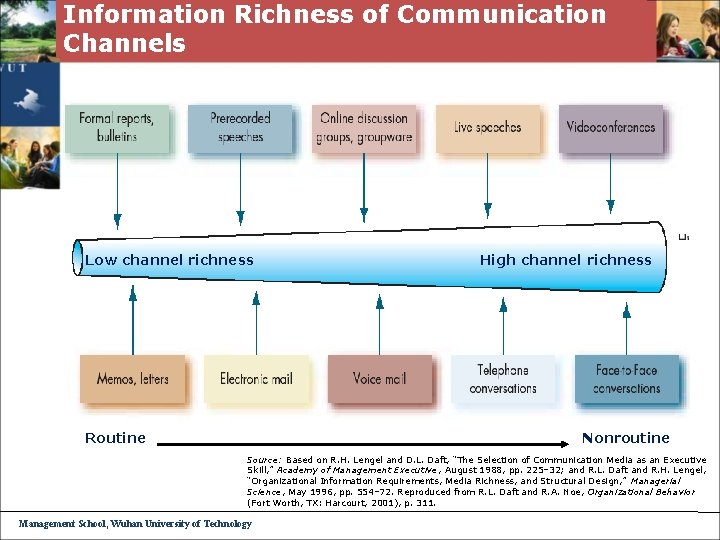
Information Richness of Communication Channels Low channel richness Routine High channel richness Nonroutine Source: Based on R. H. Lengel and D. L. Daft, “The Selection of Communication Media as an Executive Skill, ” Academy of Management Executive, August 1988, pp. 225– 32; and R. L. Daft and R. H. Lengel, “Organizational Information Requirements, Media Richness, and Structural Design, ” Managerial Science, May 1996, pp. 554– 72. Reproduced from R. L. Daft and R. A. Noe, Organizational Behavior (Fort Worth, TX: Harcourt, 2001), p. 311. Management School, Wuhan University of Technology
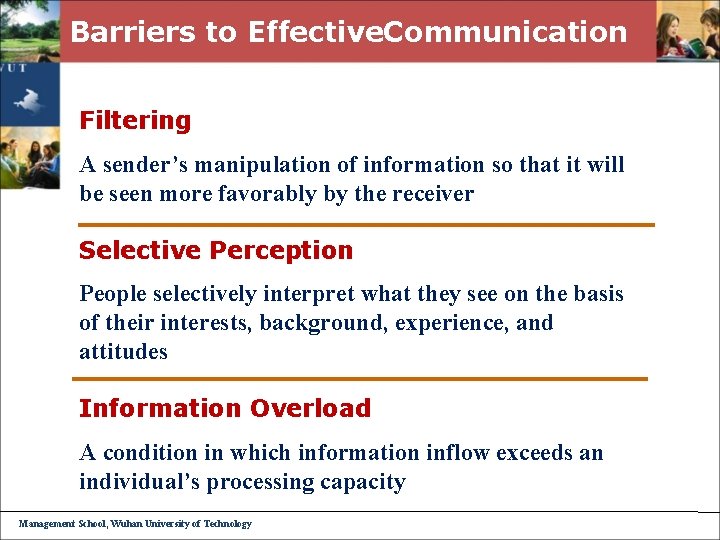
Barriers to Effective. Communication Filtering A sender’s manipulation of information so that it will be seen more favorably by the receiver Selective Perception People selectively interpret what they see on the basis of their interests, background, experience, and attitudes Information Overload A condition in which information inflow exceeds an individual’s processing capacity Management School, Wuhan University of Technology
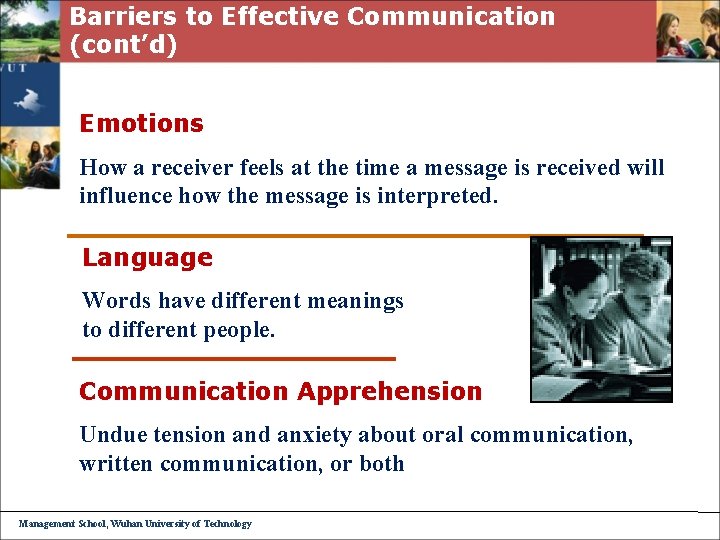
Barriers to Effective Communication (cont’d) Emotions How a receiver feels at the time a message is received will influence how the message is interpreted. Language Words have different meanings to different people. Communication Apprehension Undue tension and anxiety about oral communication, written communication, or both Management School, Wuhan University of Technology
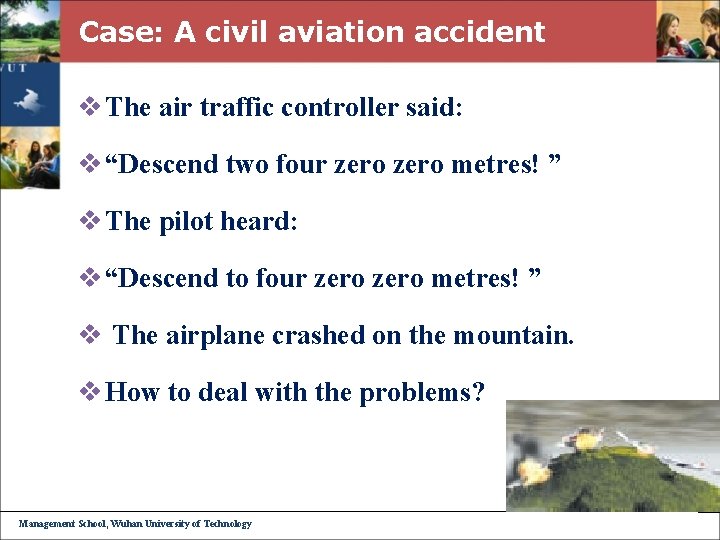
Case: A civil aviation accident v The air traffic controller said: v “Descend two four zero metres! ” v The pilot heard: v “Descend to four zero metres! ” v The airplane crashed on the mountain. v How to deal with the problems? Management School, Wuhan University of Technology
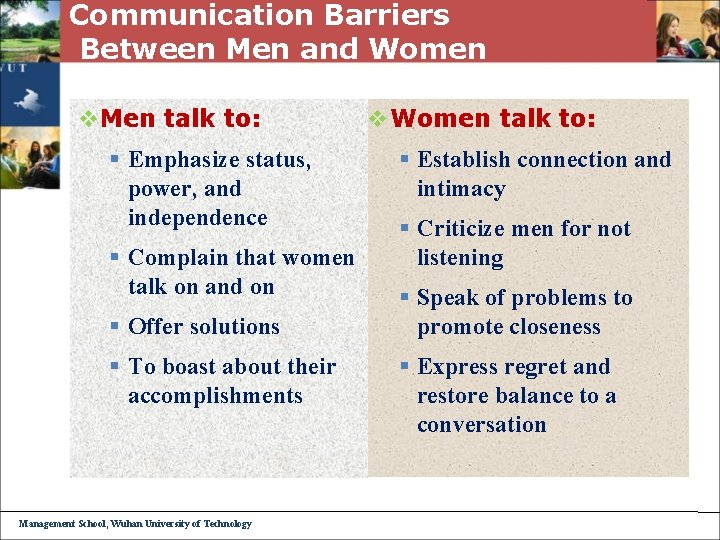
Communication Barriers Between Men and Women v. Men talk to: § Emphasize status, power, and independence § Complain that women talk on and on § Offer solutions § To boast about their accomplishments Management School, Wuhan University of Technology v. Women talk to: § Establish connection and intimacy § Criticize men for not listening § Speak of problems to promote closeness § Express regret and restore balance to a conversation
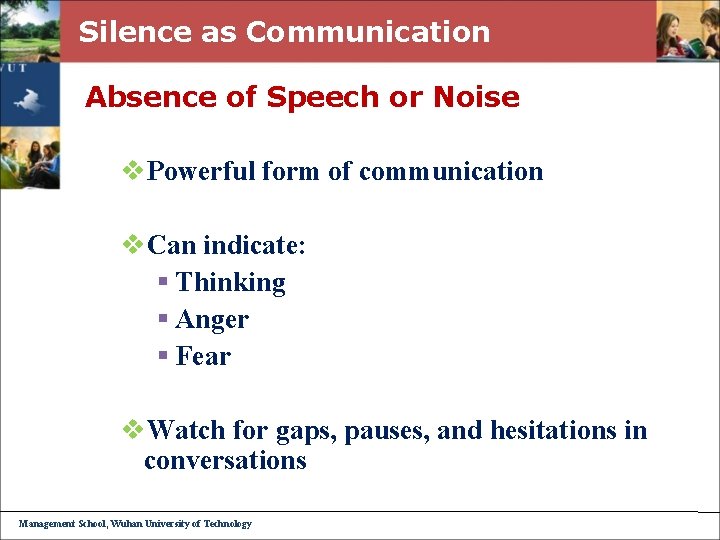
Silence as Communication Absence of Speech or Noise v. Powerful form of communication v. Can indicate: § Thinking § Anger § Fear v. Watch for gaps, pauses, and hesitations in conversations Management School, Wuhan University of Technology
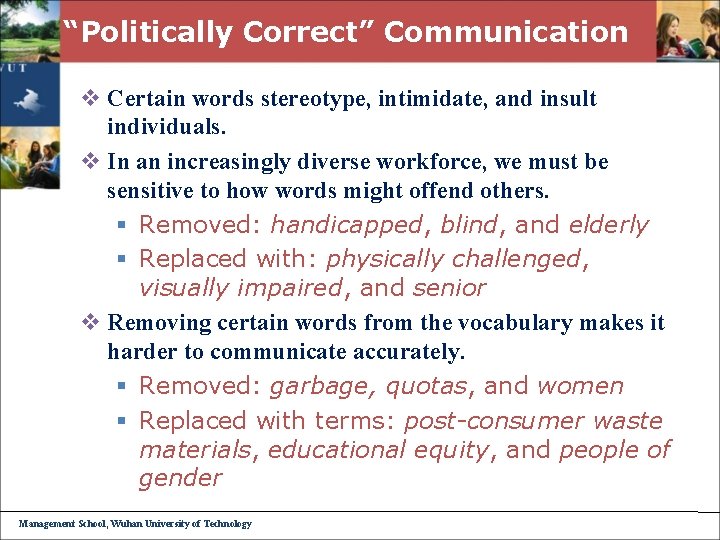
“Politically Correct” Communication v Certain words stereotype, intimidate, and insult individuals. v In an increasingly diverse workforce, we must be sensitive to how words might offend others. § Removed: handicapped, blind, and elderly § Replaced with: physically challenged, visually impaired, and senior v Removing certain words from the vocabulary makes it harder to communicate accurately. § Removed: garbage, quotas, and women § Replaced with terms: post-consumer waste materials, educational equity, and people of gender Management School, Wuhan University of Technology
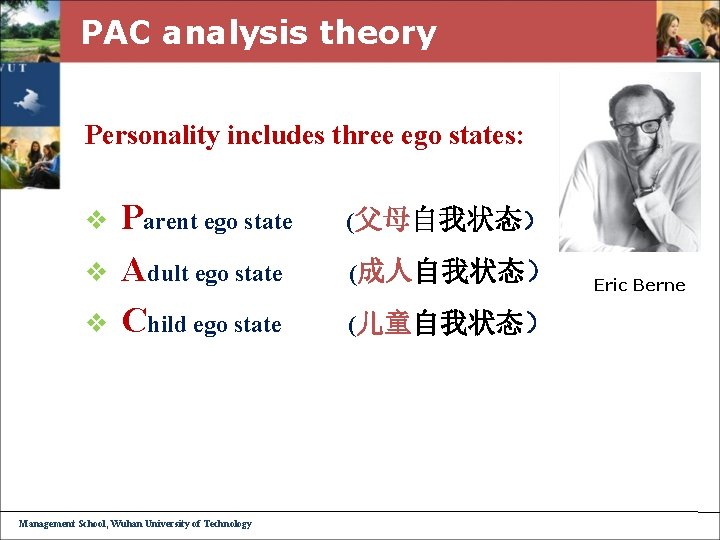
PAC analysis theory Personality includes three ego states: v v v Parent ego state Adult ego state Child ego state Management School, Wuhan University of Technology (父母自我状态) (成人自我状态) (儿童自我状态) Eric Berne
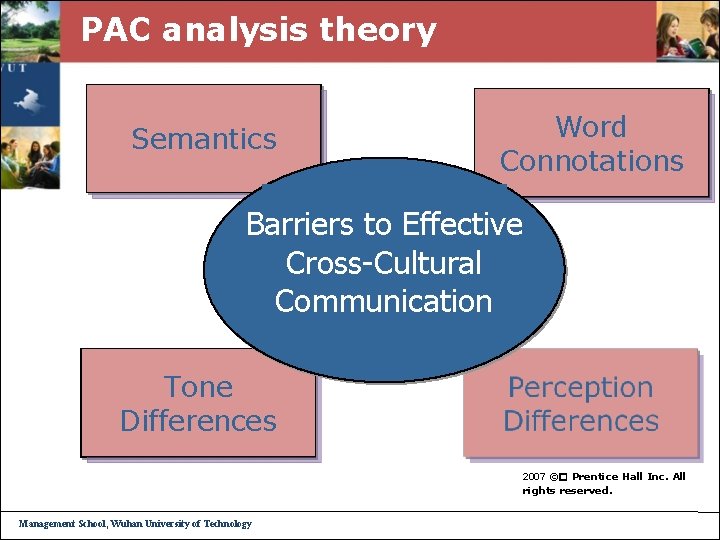
PAC analysis theory Semantics Word Connotations Barriers to Effective Cross-Cultural Communication Tone Differences 2007 ©� Prentice Hall Inc. All rights reserved. Management School, Wuhan University of Technology
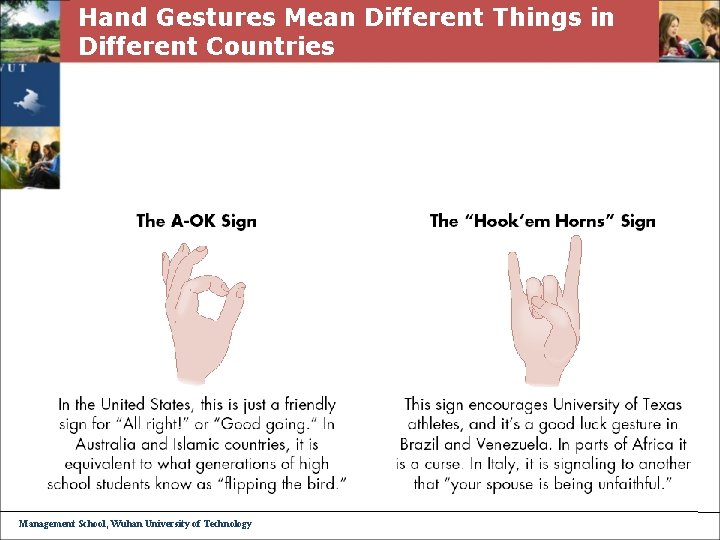
Hand Gestures Mean Different Things in Different Countries Management School, Wuhan University of Technology
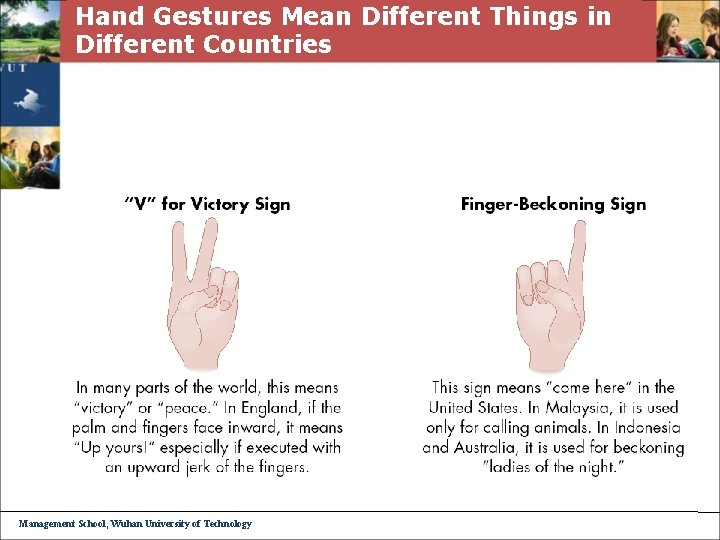
Hand Gestures Mean Different Things in Different Countries Management School, Wuhan University of Technology
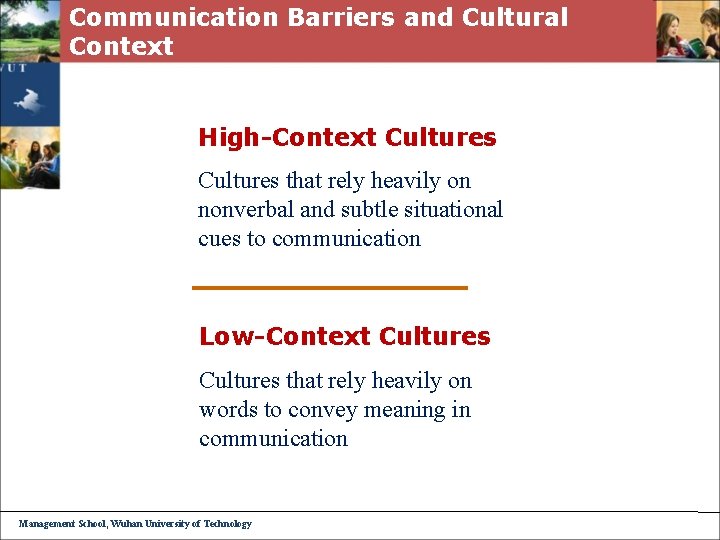
Communication Barriers and Cultural Context High-Context Cultures that rely heavily on nonverbal and subtle situational cues to communication Low-Context Cultures that rely heavily on words to convey meaning in communication Management School, Wuhan University of Technology
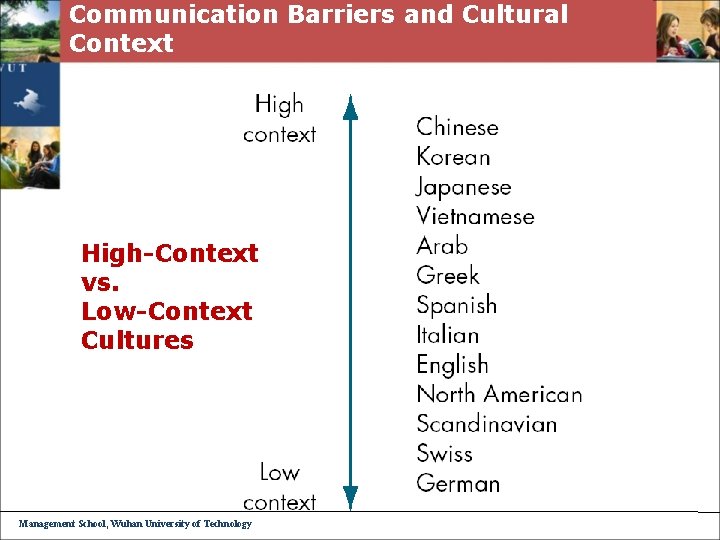
Communication Barriers and Cultural Context High-Context vs. Low-Context Cultures Management School, Wuhan University of Technology
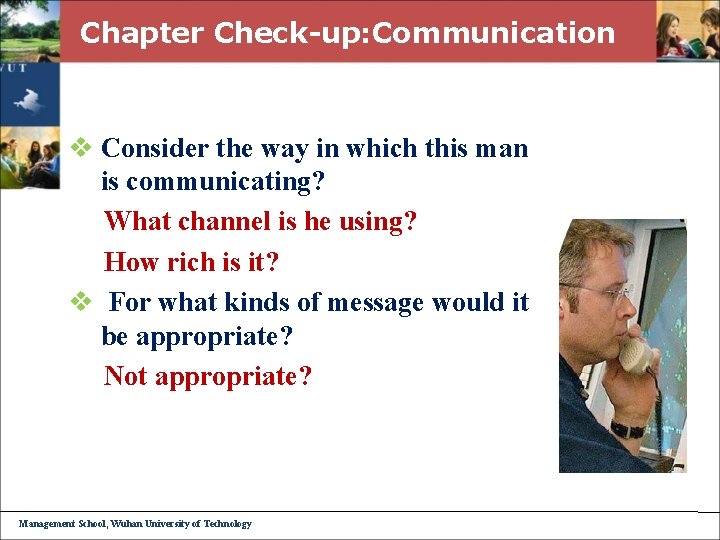
Chapter Check-up: Communication v Consider the way in which this man is communicating? What channel is he using? How rich is it? v For what kinds of message would it be appropriate? Not appropriate? Management School, Wuhan University of Technology
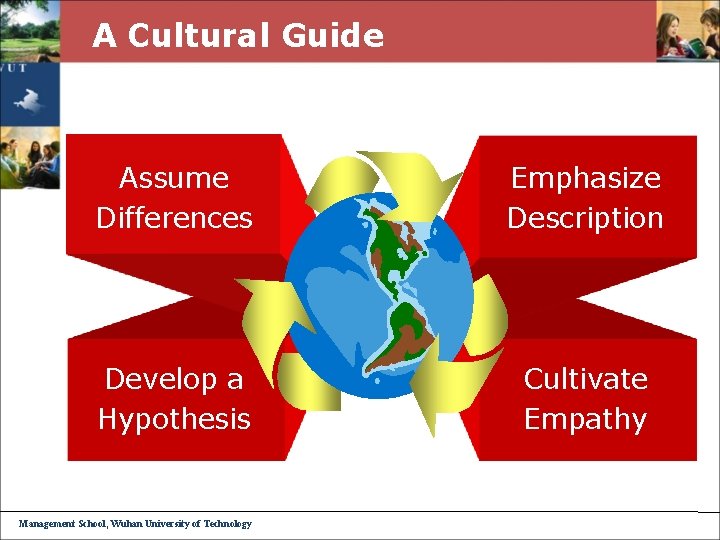
A Cultural Guide Assume Differences Emphasize Description Develop a Hypothesis Cultivate Empathy Management School, Wuhan University of Technology
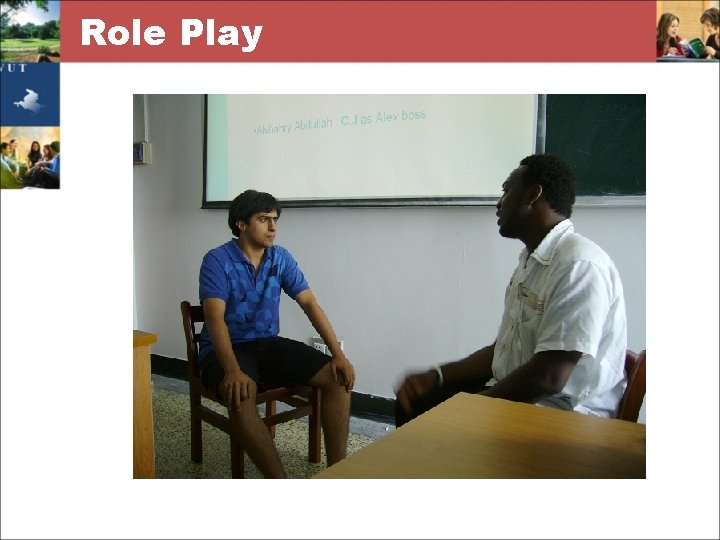
Case: Who Should be a Marketing Manager? v Simulation Training v Two roles: v Li, the general manager in the company v Wang, the general manager in the subsidiary company v Two candidates: v Lu, the assistant HR manager in the company v Ding, the assistant marketing manager in the subsidiary company v Questions: v Who Should be a marketing Manager? Why? v How to communicate with the leader?
Role Play

Wuhan University of Technology Email: sailluof@126. com
- Slides: 39