
Organizational and Managerial Communication Issues Management and Environmental

- Slides: 28
Organizational and Managerial Communication Issues Management and Environmental Scanning Chapter 7 Peggy Simcic Brønn 1
BUSINESS AS AN ECONOMIC INSTITUTION z. Little acknowledgement of external environment z. Produce goods z. Provide employment z. Pay dividends z. Success measured in economic terms Peggy Simcic Brønn 2
BUSINESS AS SOCIO-POLITICAL INSTITUTION z 1960’s - economic growth producing detrimental side effects z. Emphasis on protecting human health, not environment per se Peggy Simcic Brønn 3
RISE OF PUBLIC ISSUES z. Public demand collective action and there is disagreement on solution ycivil rights yfeminist movement yconsumer movement yecology movement Peggy Simcic Brønn 4
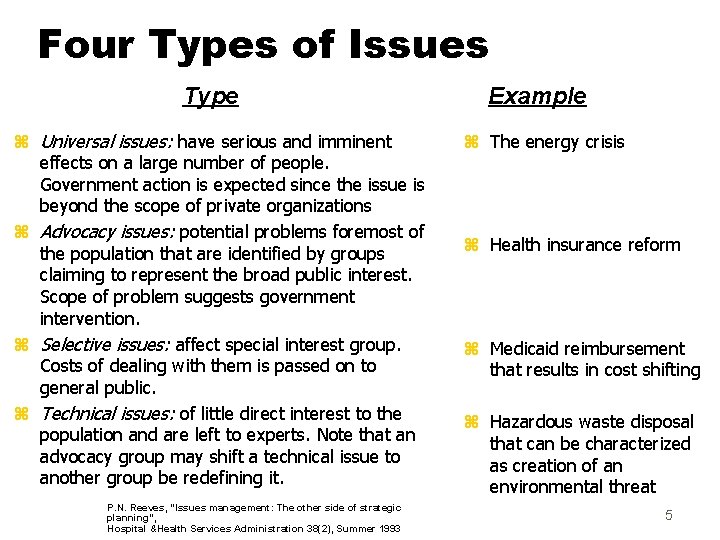
Four Types of Issues Type z Universal issues: have serious and imminent effects on a large number of people. Government action is expected since the issue is beyond the scope of private organizations z Advocacy issues: potential problems foremost of the population that are identified by groups claiming to represent the broad public interest. Scope of problem suggests government intervention. z Selective issues: affect special interest group. Costs of dealing with them is passed on to general public. z Technical issues: of little direct interest to the population and are left to experts. Note that an advocacy group may shift a technical issue to another group be redefining it. P. N. Reeves, “Issues management: The other side of strategic planning”, Hospital &Health Services Administration 38(2), Summer 1993 Example z The energy crisis z Health insurance reform z Medicaid reimbursement that results in cost shifting z Hazardous waste disposal that can be characterized as creation of an environmental threat 5
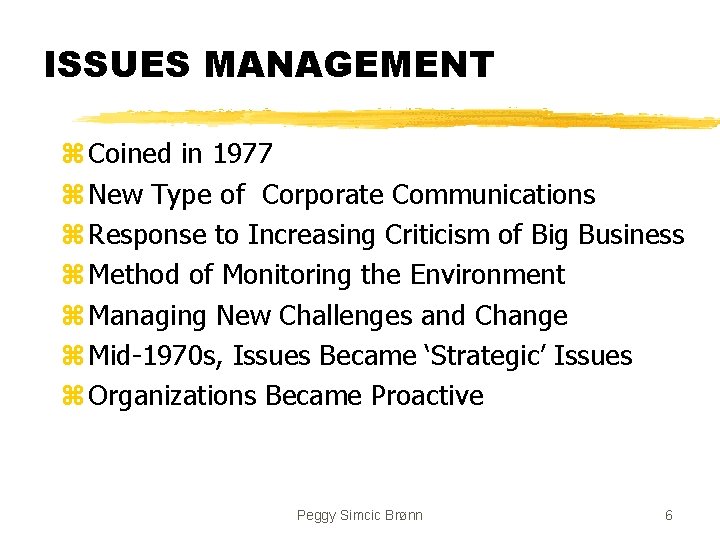
ISSUES MANAGEMENT z Coined in 1977 z New Type of Corporate Communications z Response to Increasing Criticism of Big Business z Method of Monitoring the Environment z Managing New Challenges and Change z Mid-1970 s, Issues Became ‘Strategic’ Issues z Organizations Became Proactive Peggy Simcic Brønn 6
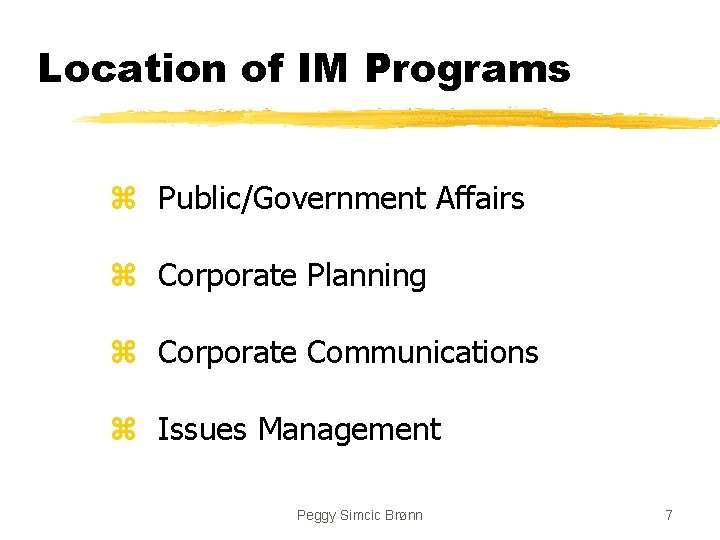
Location of IM Programs z Public/Government Affairs z Corporate Planning z Corporate Communications z Issues Management Peggy Simcic Brønn 7
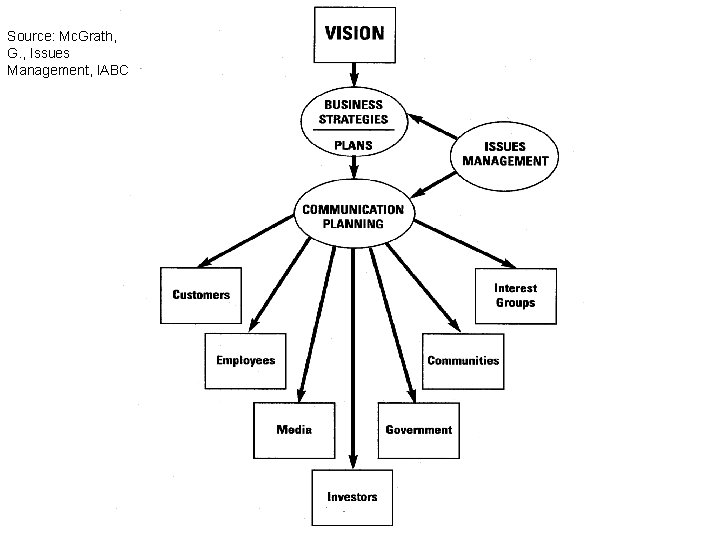
Source: Mc. Grath, G. , Issues Management, IABC
Issues Management Process The Chase-Jones Model Issues Identification Theory and Research Performance Evaluation Issues Analysis Judgement and Priority Setting Results Program Design Implementation Peggy Simcic Brønn Policy Options Policy and Strategy Selection 9
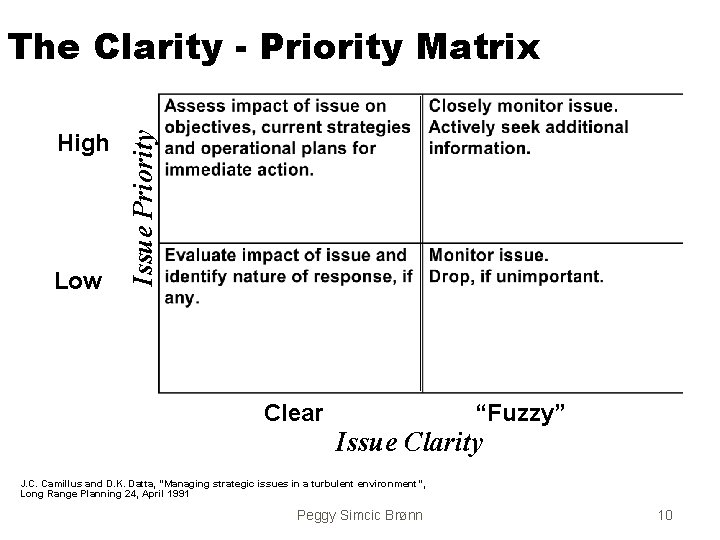
High Low Issue Priority The Clarity - Priority Matrix Clear “Fuzzy” Issue Clarity J. C. Camillus and D. K. Datta, “Managing strategic issues in a turbulent environment”, Long Range Planning 24, April 1991 Peggy Simcic Brønn 10
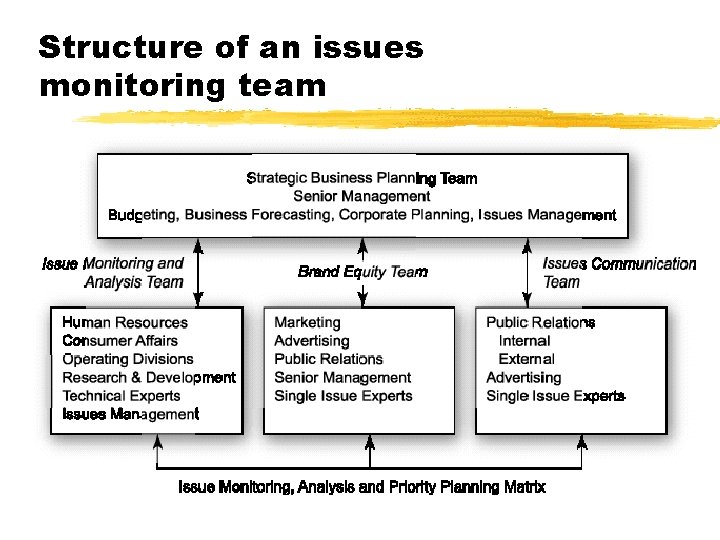
Structure of an issues monitoring team
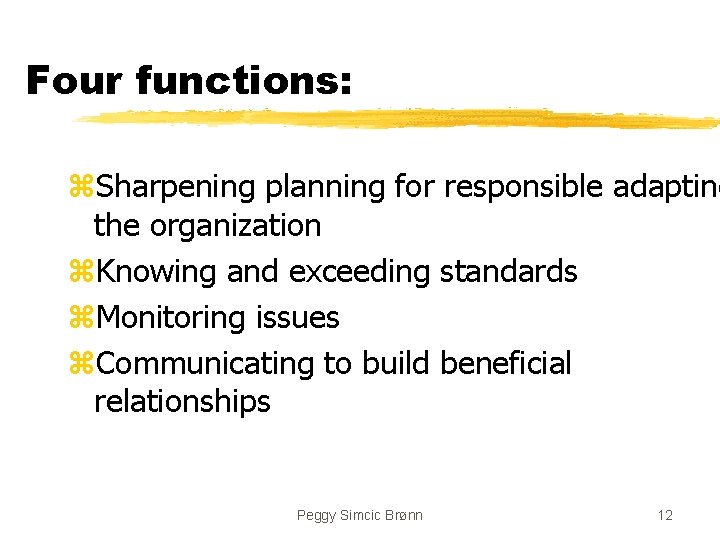
Four functions: z. Sharpening planning for responsible adapting the organization z. Knowing and exceeding standards z. Monitoring issues z. Communicating to build beneficial relationships Peggy Simcic Brønn 12
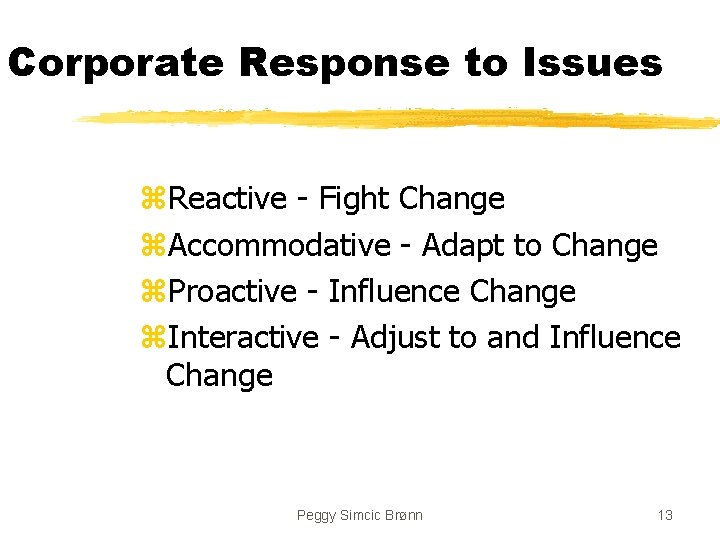
Corporate Response to Issues z. Reactive - Fight Change z. Accommodative - Adapt to Change z. Proactive - Influence Change z. Interactive - Adjust to and Influence Change Peggy Simcic Brønn 13
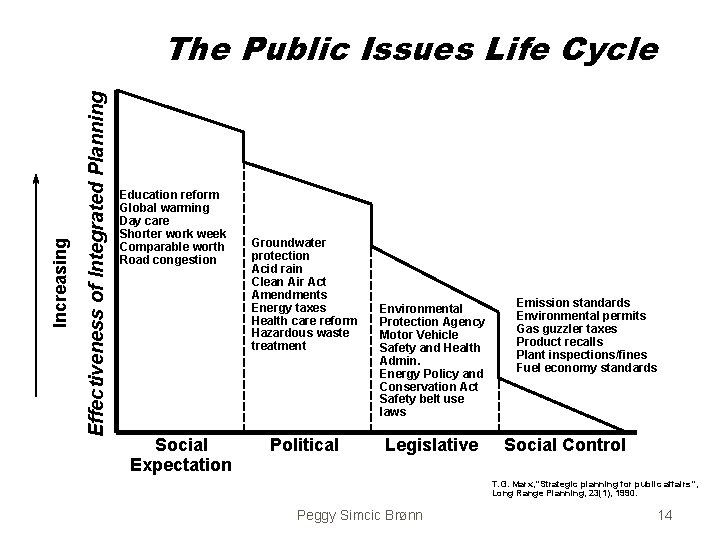
Effectiveness of Integrated Planning Increasing The Public Issues Life Cycle Education reform Global warming Day care Shorter work week Comparable worth Road congestion Social Expectation Groundwater protection Acid rain Clean Air Act Amendments Energy taxes Health care reform Hazardous waste treatment Political Environmental Protection Agency Motor Vehicle Safety and Health Admin. Energy Policy and Conservation Act Safety belt use laws Legislative Emission standards Environmental permits Gas guzzler taxes Product recalls Plant inspections/fines Fuel economy standards Social Control T. G. Marx, ”Strategic planning for public affairs”, Long Range Planning, 23(1), 1990. Peggy Simcic Brønn 14
IM and Corporate Image z IM now includes fostering and maintaining corporate image z Tied to behavior of organization and communication management z Integrity of the organizational identity
ORGANIZATIONS HAVE TWO CHOICES z. Reactive business strategy ypursue own financial goals ybe forced by external agents to change z. Proactive business strategy yactively seek operations that limit consequences yopen up dialogue with external agents Peggy Simcic Brønn 16
Environmental Scanning A methodology for collecting and analyzing information about every sector of the external environment that can help management to plan for the organization’s future. Chun Wei Choo. . . A radar-like vigilance used to spot potential or actual issues at their earliest point of development. (Heath) Peggy Simcic Brønn 17
Added value of scanning z. Promotes education and mind-stretching experiences for management. z. Assists in formulating of policy and strategy. z. Promotes the development of operational programs and action plans. z. Provides a frame of reference for budgets. Peggy Simcic Brønn 18
Organizational environment z. Does the company accept new ideas, concepts and processes? z. Are there open communications channels? z. Is the company capturing environmental information that is readily available`? Peggy Simcic Brønn 19
Organizational environment z. Are the linkages of change to the company’s operations properly assessed? z. Is environmental intelligence integrated into strategic planning? Peggy Simcic Brønn 20
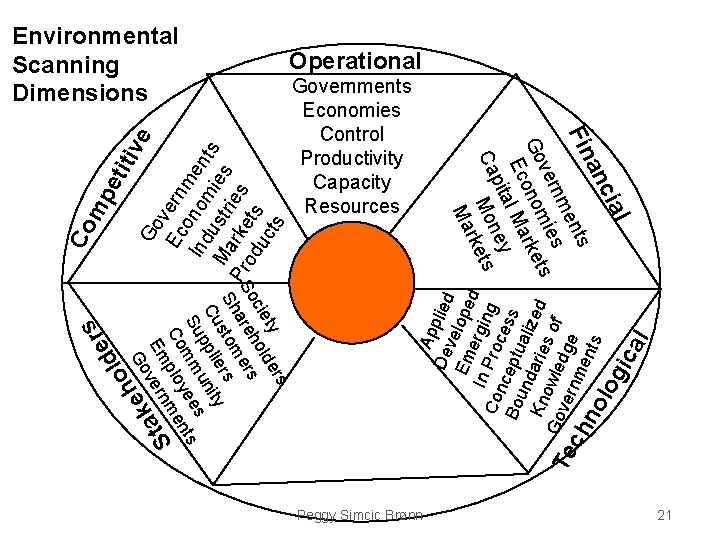
ho Peggy Simcic Brønn l ica log Ap De plied v Em elope In P ergin d g Co nce roces s Bo und ptuali Kn arie zed ow so G l e o Te ver dge f ch nme nts no S s ty der cie ol So areh ers Sh stom ers Cu ppli unity Su mm yees nts Co plo me Em vern Go e k ta s tiv eti e Go Ec vern m Ind ono en m t Ma ustr ies s Pr rke ies od ts uc ts ial nc Governments Economies Control Productivity Capacity Resources a ts Fin en nm ies ver s Go onom rket Ec l Ma pita ey Ca Mon ets rk Ma r e ld Co mp Environmental Scanning Dimensions Operational 21
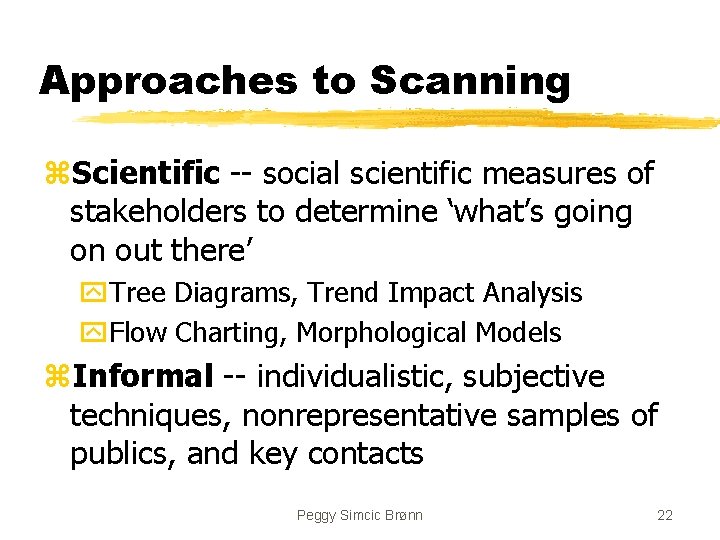
Approaches to Scanning z. Scientific -- social scientific measures of stakeholders to determine ‘what’s going on out there’ y. Tree Diagrams, Trend Impact Analysis y. Flow Charting, Morphological Models z. Informal -- individualistic, subjective techniques, nonrepresentative samples of publics, and key contacts Peggy Simcic Brønn 22
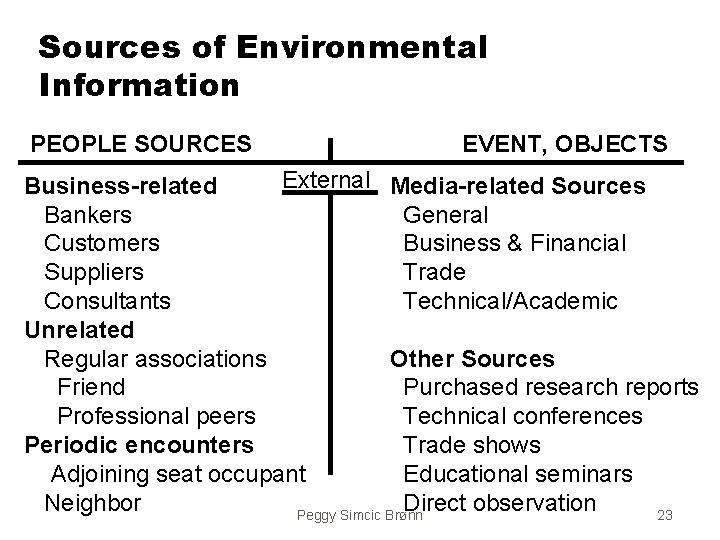
Sources of Environmental Information PEOPLE SOURCES EVENT, OBJECTS External Media-related Sources Business-related Bankers General Customers Business & Financial Suppliers Trade Consultants Technical/Academic Unrelated Regular associations Other Sources Friend Purchased research reports Professional peers Technical conferences Periodic encounters Trade shows Adjoining seat occupant Educational seminars Neighbor Direct observation Peggy Simcic Brønn 23
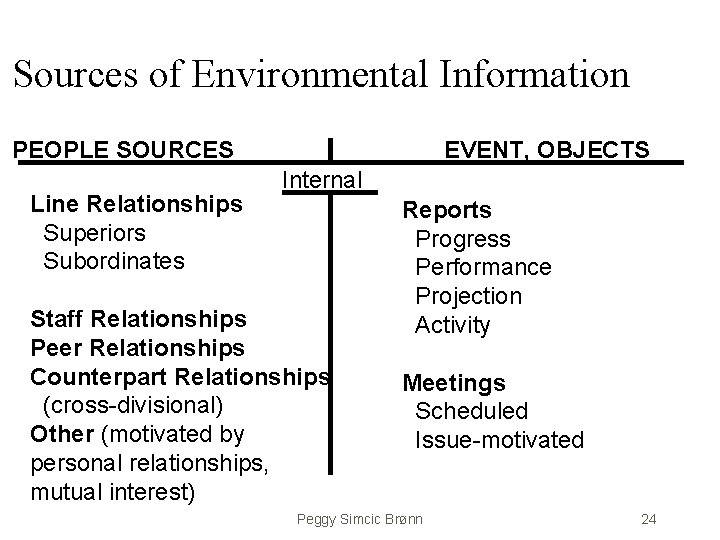
Sources of Environmental Information PEOPLE SOURCES Line Relationships Superiors Subordinates EVENT, OBJECTS Internal Staff Relationships Peer Relationships Counterpart Relationships (cross-divisional) Other (motivated by personal relationships, mutual interest) Reports Progress Performance Projection Activity Meetings Scheduled Issue-motivated Peggy Simcic Brønn 24
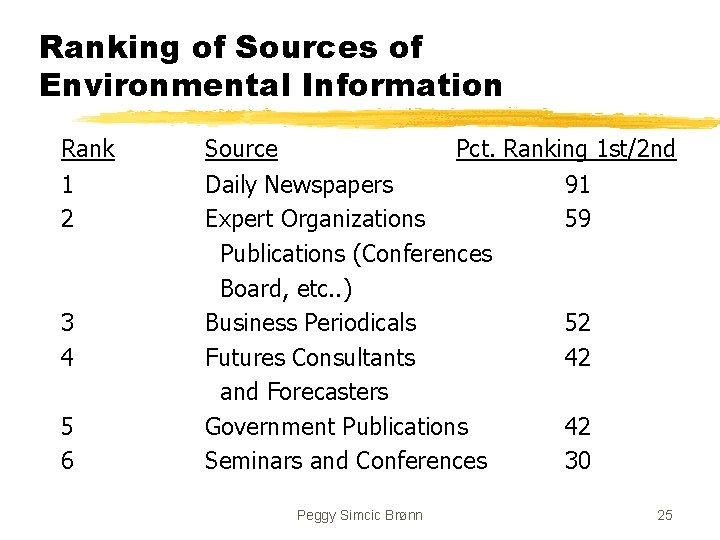
Ranking of Sources of Environmental Information Rank 1 2 3 4 5 6 Source Pct. Ranking 1 st/2 nd Daily Newspapers 91 Expert Organizations 59 Publications (Conferences Board, etc. . ) Business Periodicals 52 Futures Consultants 42 and Forecasters Government Publications 42 Seminars and Conferences 30 Peggy Simcic Brønn 25
Best Practices z. Planning and manage scanning as a strategic activity z. Implement scanning as a formal system z. Partner with domain experts and IT specialists in designing system z. Manage information as the core of the scanning function
Starting to think about the future z. Read utopian and science fiction. z. Read magazines like The Futurist and Futures. Borrow the authors’ predictions. z. Monitor the writings of politicians and social scientists. z. Watch out for mention of areas of people who adopt innovation early. J. D. Stoffels Peggy Simcic Brønn 27
Two cases z Playtex Company and the Sippy Cup z Intel