
Organization Theories and Application Narisa Pacis Lyngel Joie

- Slides: 14
Organization Theories and Application Narisa Pacis Lyngel Joie Grande
Organizational design the manner in which a management achieves the right combination of differentiation and integration of the organization’s operations, in response to the level of uncertainty in its external environment.
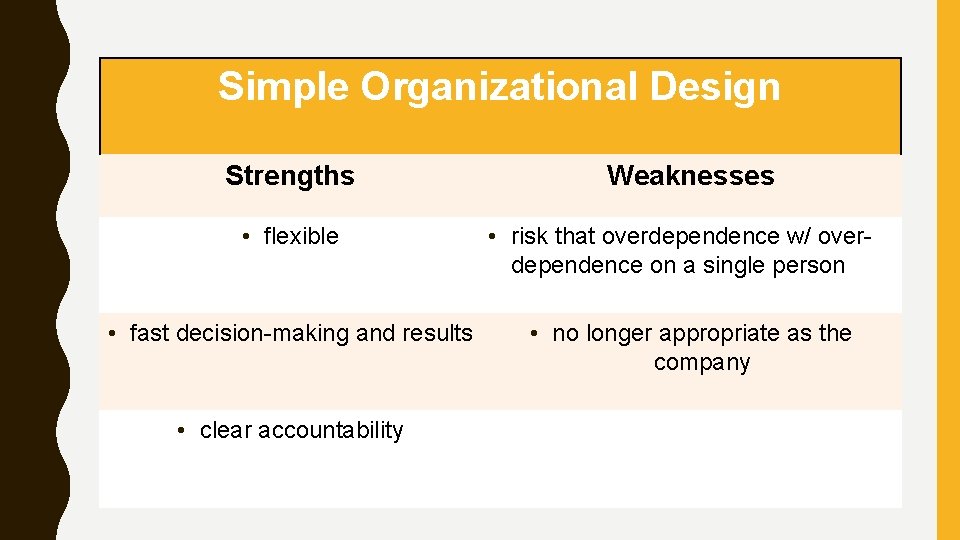
Traditional organizational design theories include: Simple This organizational design has few departments, wide span of control or a big number of subordinates directly reporting to a manager; has a centralized authority figure and has very little formalization of work usually used by companies that start out as entrepreneurial ventures.
According to Robins and Coulter(2009) there are two main classification of theories regarding organizational design : traditional and modern Traditional- pertains to the usual or old • Simple • Functional • Divisional Modern- refers to contemporary or new design theories • Team Design • Matrix-Project Design • Boundary-less Design
Simple Organizational Design Strengths • flexible • fast decision-making and results • clear accountability Weaknesses • risk that overdependence w/ overdependence on a single person • no longer appropriate as the company
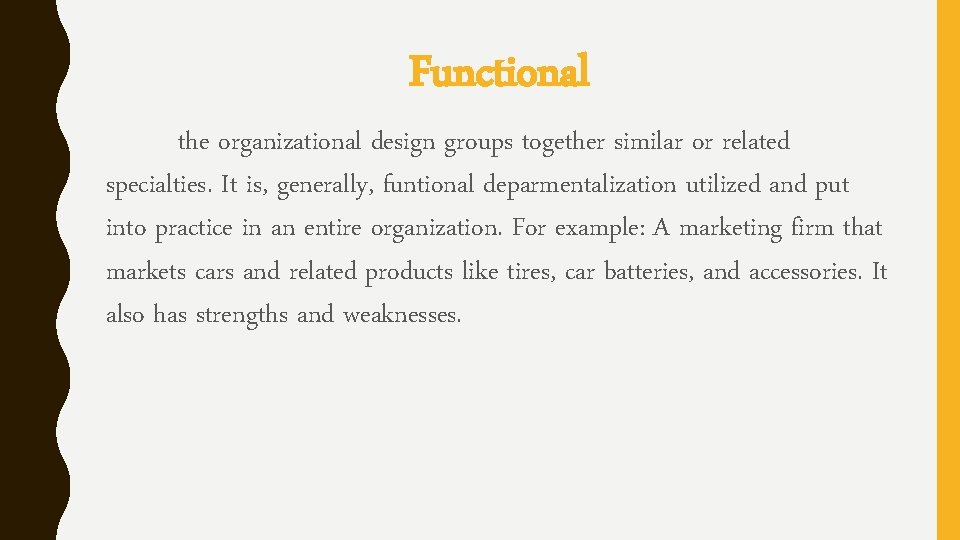
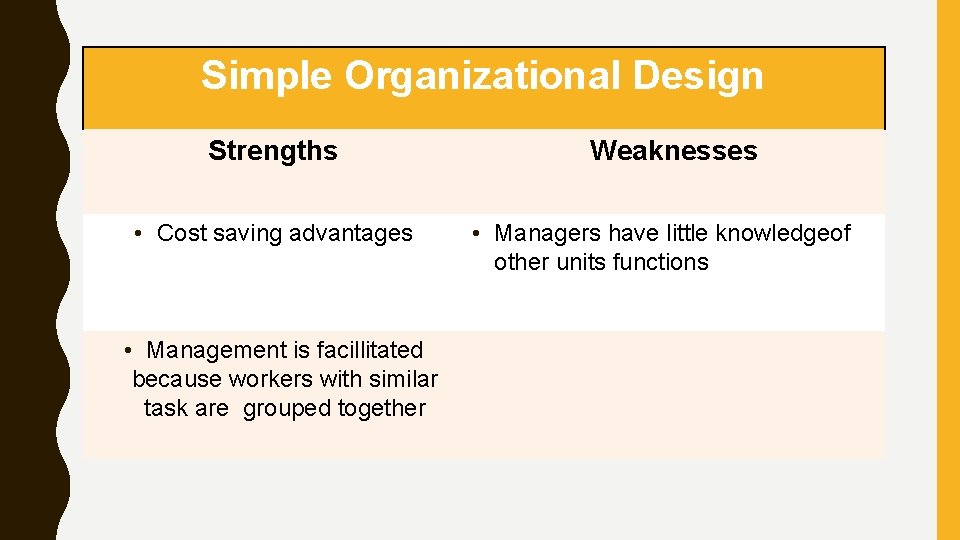
Functional the organizational design groups together similar or related specialties. It is, generally, funtional deparmentalization utilized and put into practice in an entire organization. For example: A marketing firm that markets cars and related products like tires, car batteries, and accessories. It also has strengths and weaknesses.
Simple Organizational Design Strengths • Cost saving advantages • Management is facillitated because workers with similar task are grouped together Weaknesses • Managers have little knowledgeof other units functions
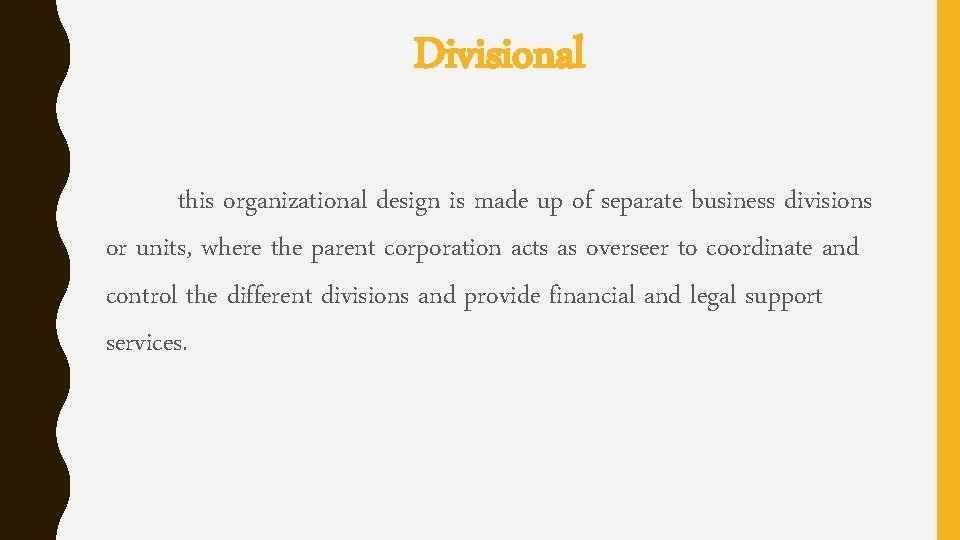
Divisional this organizational design is made up of separate business divisions or units, where the parent corporation acts as overseer to coordinate and control the different divisions and provide financial and legal support services.
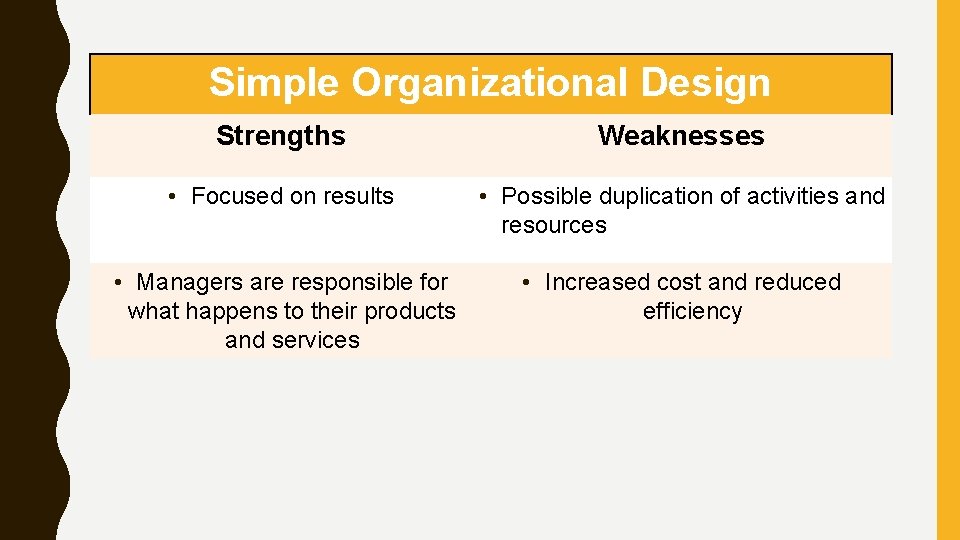
Simple Organizational Design Strengths Weaknesses • Focused on results • Possible duplication of activities and resources • Managers are responsible for what happens to their products and services • Increased cost and reduced efficiency
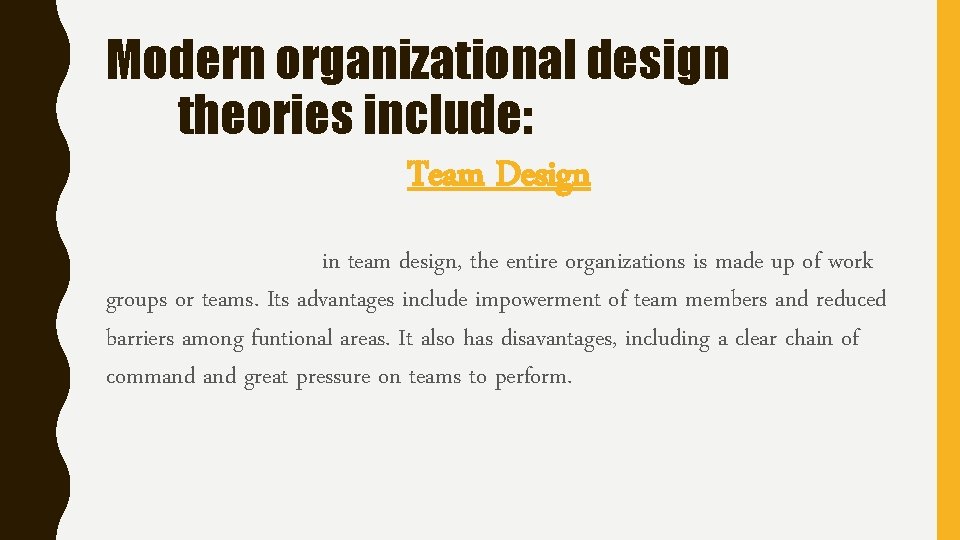
Modern organizational design theories include: Team Design in team design, the entire organizations is made up of work groups or teams. Its advantages include impowerment of team members and reduced barriers among funtional areas. It also has disavantages, including a clear chain of command great pressure on teams to perform.
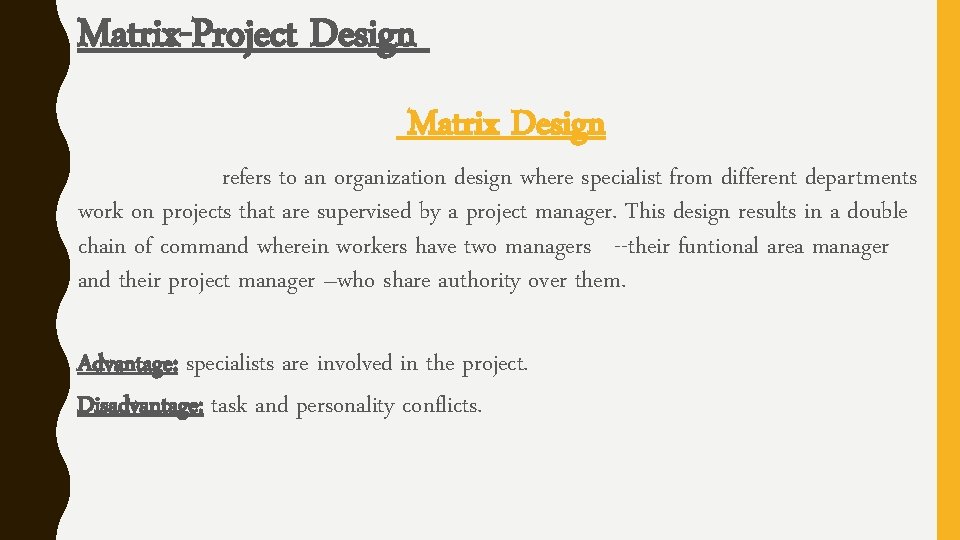
Matrix-Project Design Matrix Design refers to an organization design where specialist from different departments work on projects that are supervised by a project manager. This design results in a double chain of command wherein workers have two managers --their funtional area manager and their project manager –who share authority over them. Advantage: specialists are involved in the project. Disadvantage: task and personality conflicts.
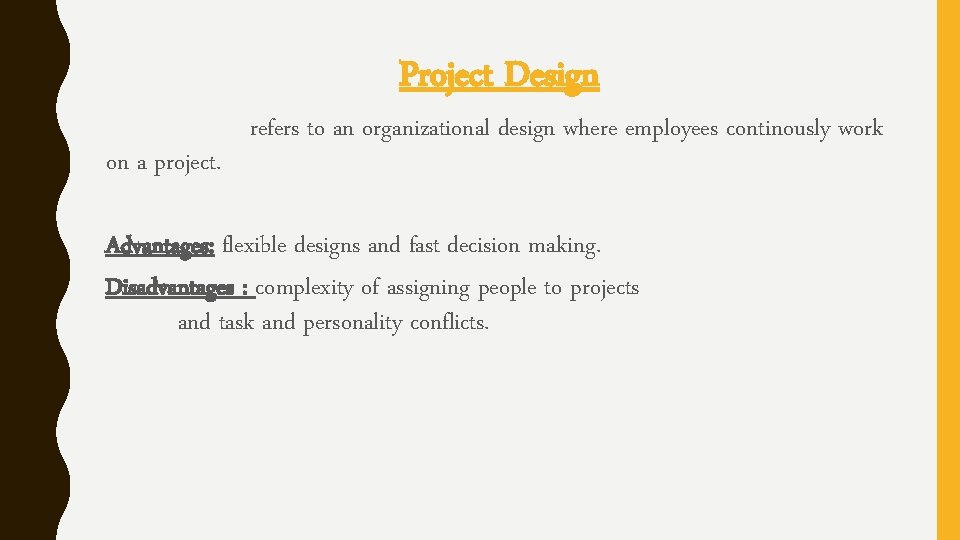
Project Design on a project. refers to an organizational design where employees continously work Advantages: flexible designs and fast decision making. Disadvantages : complexity of assigning people to projects and task and personality conflicts.
Boundary-less Design this is another modern design organizational design where the design is not defined or limited by vertical, horizontal, and external boundaries. In other words, there are no hierachical levels that separate employees, no departmentaliztion, and no boundaries that separate the organization from customers, suppliers, and others stakeholders. Advantages: being highly flexible and responsive Disadvantages : lack of control and problems in communication
Thank You!