
Organization OrganizationCoherence It is important for all the
- Slides: 9
Organization
Organization=Coherence • It is important for all the details in an essay to cohere, or stick together, so the reader will be able to move smoothly from one bit of supporting information to the next.
Common Methods of Organization 1 - Time or Chronological Order: details are listed as they occur in time using words like: first, to begin with, next, then, after, before, finally, and so on.
Common Methods of Organization 2 - Emphatic Order (Saving the best till last): A way to put emphasis on the most interesting or important detail by placing it in the last part of a paragraph or in the final supporting paragraph of an essay. Usually with words like: Last of all, most important, and finally. • Some essays use a combination of time order and emphatic order.
Transitions & Transitional Sentences • Transitions signal the direction of a writer’s thought. They are like the road signs that guide travelers.
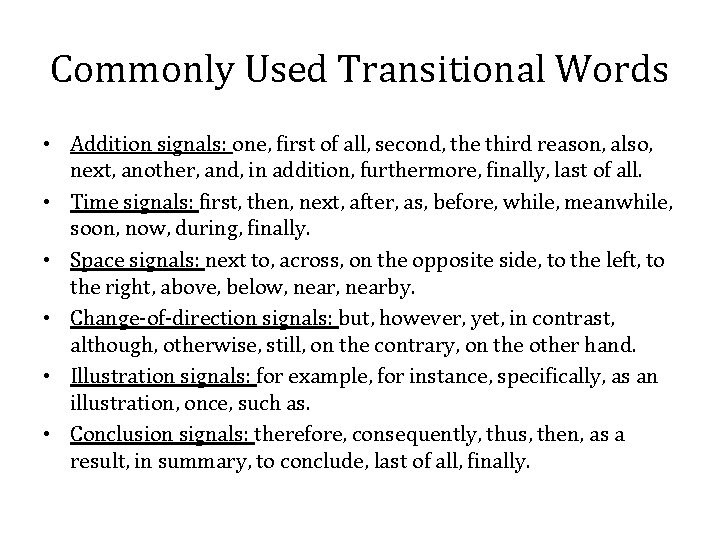
Commonly Used Transitional Words • Addition signals: one, first of all, second, the third reason, also, next, another, and, in addition, furthermore, finally, last of all. • Time signals: first, then, next, after, as, before, while, meanwhile, soon, now, during, finally. • Space signals: next to, across, on the opposite side, to the left, to the right, above, below, nearby. • Change-of-direction signals: but, however, yet, in contrast, although, otherwise, still, on the contrary, on the other hand. • Illustration signals: for example, for instance, specifically, as an illustration, once, such as. • Conclusion signals: therefore, consequently, thus, then, as a result, in summary, to conclude, last of all, finally.
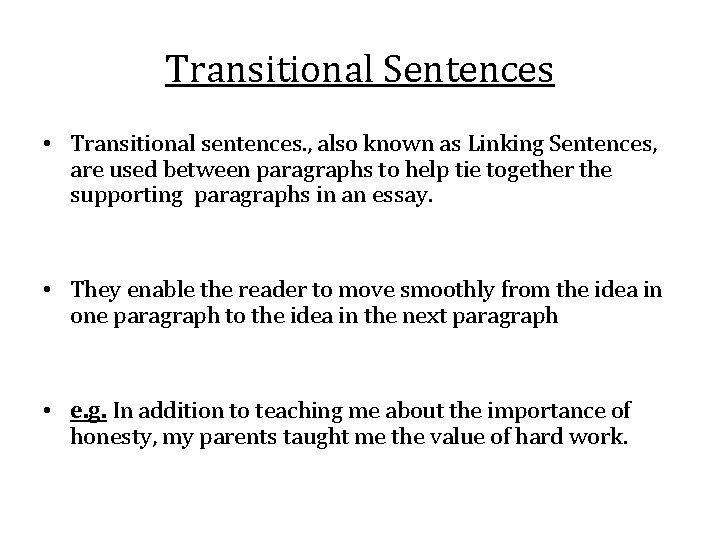
Transitional Sentences • Transitional sentences. , also known as Linking Sentences, are used between paragraphs to help tie together the supporting paragraphs in an essay. • They enable the reader to move smoothly from the idea in one paragraph to the idea in the next paragraph • e. g. In addition to teaching me about the importance of honesty, my parents taught me the value of hard work.
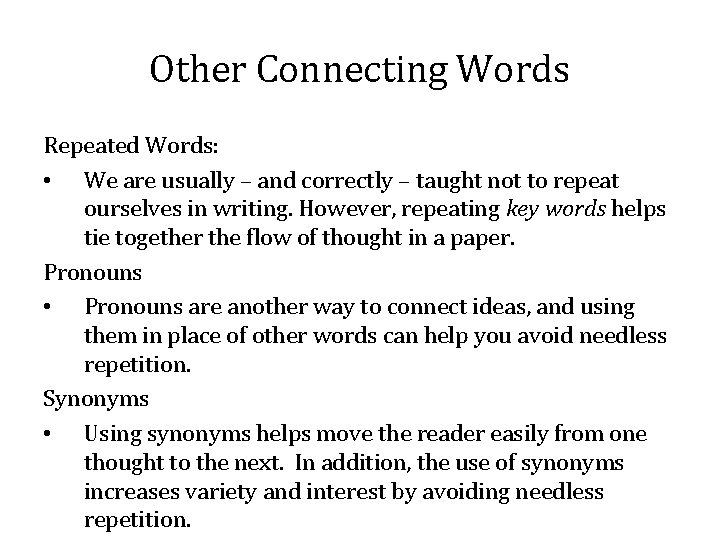
Other Connecting Words Repeated Words: • We are usually – and correctly – taught not to repeat ourselves in writing. However, repeating key words helps tie together the flow of thought in a paper. Pronouns • Pronouns are another way to connect ideas, and using them in place of other words can help you avoid needless repetition. Synonyms • Using synonyms helps move the reader easily from one thought to the next. In addition, the use of synonyms increases variety and interest by avoiding needless repetition.
Sources • Langan, John. College Writing Skills with Readings.