
Organization Organizational Structure What is Organization A social

![Dissolution of Corporation [partnership] A corporation can be dissolved: § When it willingly applies](https://slidetodoc.com/presentation_image_h/c885182929be713cd6bb812e247e6142/image-25.jpg "Dissolution of Corporation [partnership] A corporation can be dissolved: § When it willingly applies")

- Slides: 45
Organization & Organizational Structure
What is Organization? § A social unit of people that is structured and managed to meet a need or to pursue collective goals. § All organizations have a management structure that determines relationships between the different activities and the members, and subdivides and assigns roles, responsibilities and authority to carry out different tasks. § Organizations are open systems --they affect and are affected by their environment.
Social Organization § Social organization is a pattern of relationships between and among individuals and social group. § Characteristics of social organization can include qualities such as leadership, structure, division of labor, communication systems and so on.
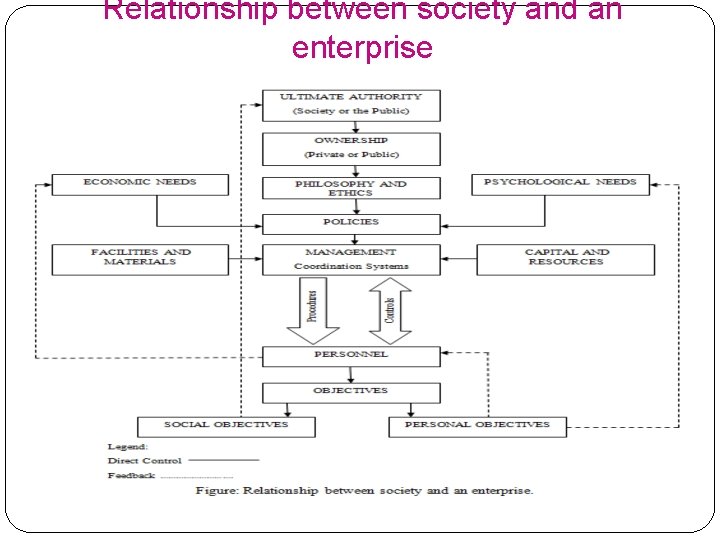
Relationship between society and an enterprise
Ultimate authority: § Leads by professional or business enterprise. It can also by society or the public. § Property rights and professional privileges are derived from and controlled by ultimate authority through two mechanisms. Those are: § Laws § Marketing Process § A brief study of pharmaceutical law confirms the degree to which laws and regulations control the practice of pharmacy and indeed the entire pharmaceutical industry as well.
Ownership: § An individual, a partnership or a corporation. § Followed by a set of ethical principles and philosophy of conduct. Policies: § Policies is the combination of economic needs and psychological needs of the owner and provide the basis for the formulation of the policies under which the firm will operate. Management: § Coordination system is developed to achieve the perceived objectives of the firm. § Involves both coordination of capital and other resources and personnel. § In a systematic way, procedures and control mechanisms are developed.
Legal Organizations § A decision is the form of business enterprise which will be operated. § Forms of legal organization. a. Sole proprietorship or single ownership b. Partnership or Co-partnership c. Corporation
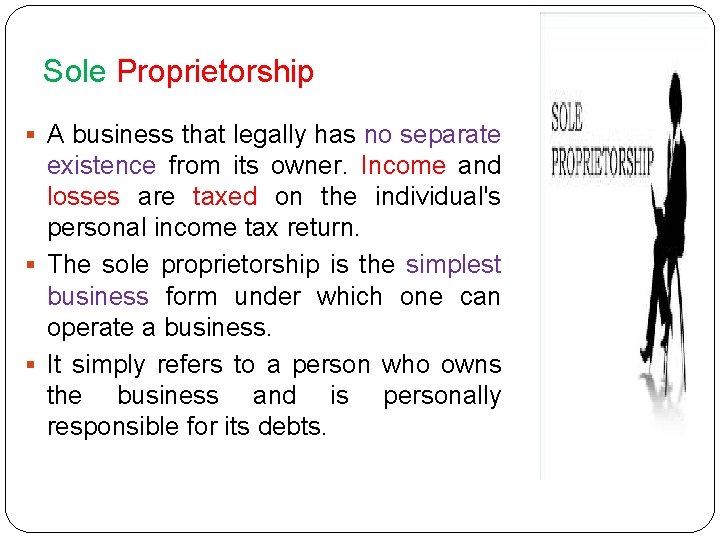
Sole Proprietorship § A business that legally has no separate existence from its owner. Income and losses are taxed on the individual's personal income tax return. § The sole proprietorship is the simplest business form under which one can operate a business. § It simply refers to a person who owns the business and is personally responsible for its debts.
Sole Proprietorship Advantages: § Easy to establish as it does not require to complete any legal § § § formality. Simplicity of organization. The expenses in starting the business are minimal. Owner is free to make all decisions. This type of ownership is simple, easy to operate and extremely flexible. The owner enjoys all the profits. Minimum legal restriction are associated with this form of ownership.
Sole Proprietorship Disadvantages § The owner is liable for all obligations and debts of the business. § The business may not be successful if the owner has limited money, lacks ability and necessary experience to run the business. § Because of relatively unstable nature of the business, it is difficult to raise capital for expanding the business. § There is limited opportunity for employees as regards monetary rewards(e. g. , profit sharing, bonus, etc) and promotions. § If business fails , creditors can take the personal property as well as the business property of the owner to settle their claims.
PARTNERSHIP A partnership is a type of business entity in which partners (owners) share with each other the profits or losses of the business.
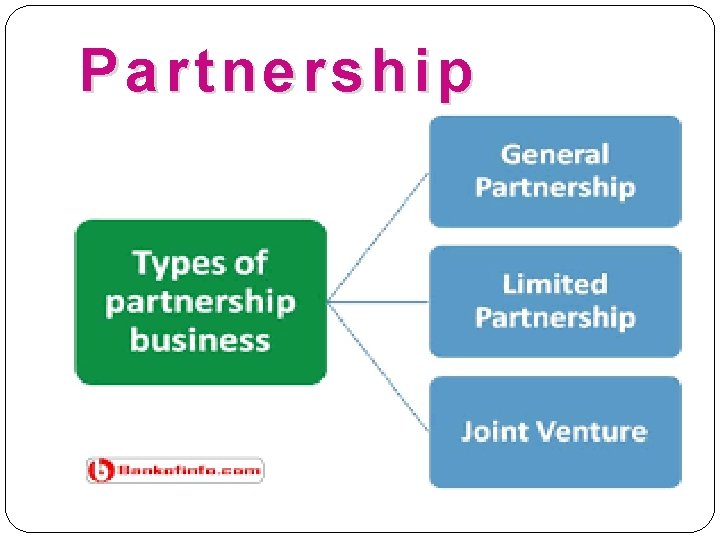
Part nership
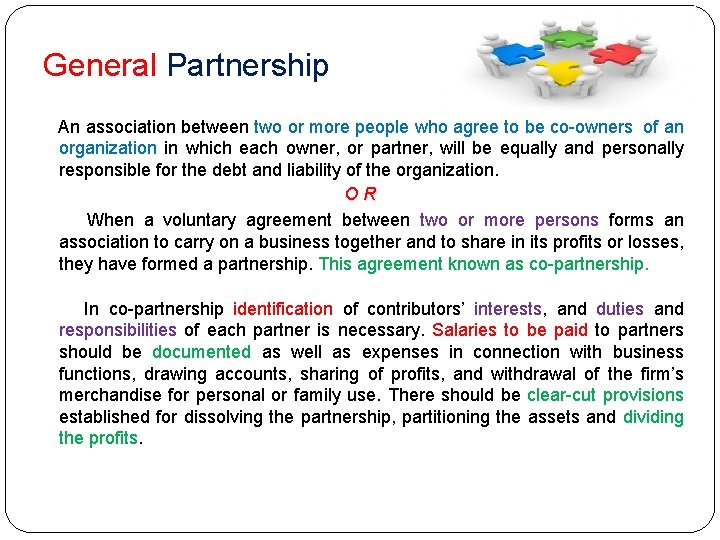
General Partnership An association between two or more people who agree to be co-owners of an organization in which each owner, or partner, will be equally and personally responsible for the debt and liability of the organization. OR When a voluntary agreement between two or more persons forms an association to carry on a business together and to share in its profits or losses, they have formed a partnership. This agreement known as co-partnership. In co-partnership identification of contributors’ interests, and duties and responsibilities of each partner is necessary. Salaries to be paid to partners should be documented as well as expenses in connection with business functions, drawing accounts, sharing of profits, and withdrawal of the firm’s merchandise for personal or family use. There should be clear-cut provisions established for dissolving the partnership, partitioning the assets and dividing the profits.
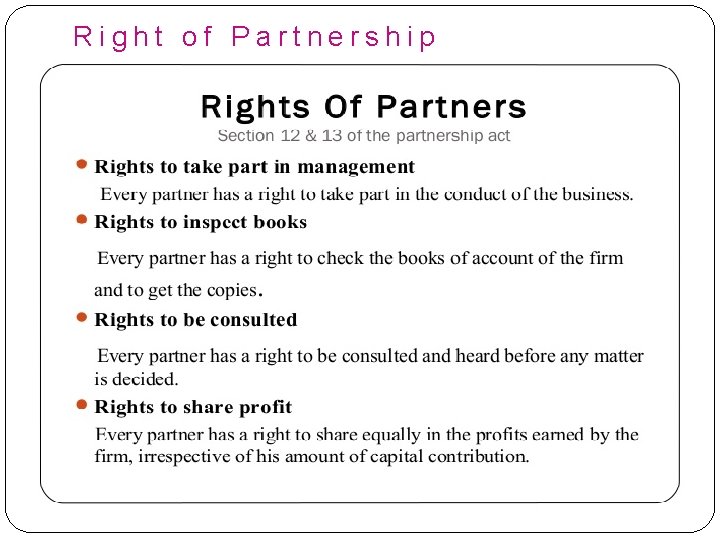
Right of Partnership
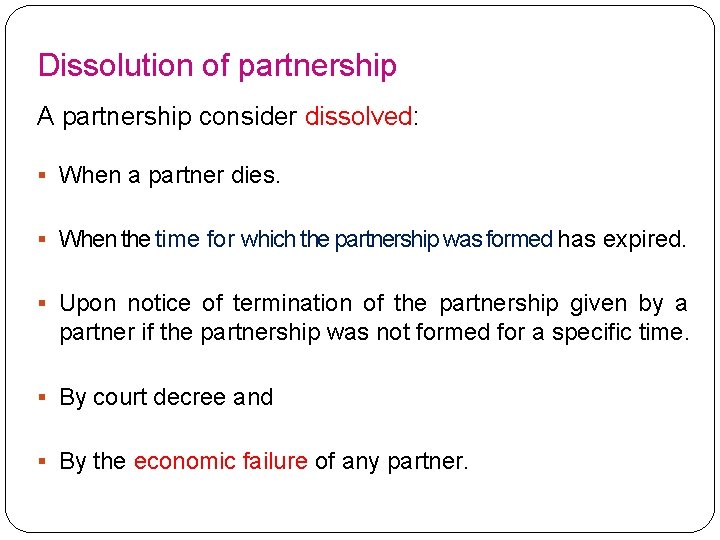
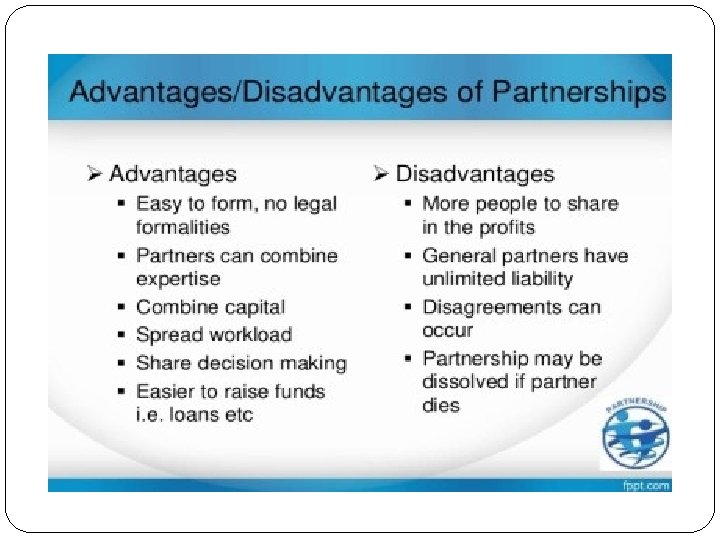
Dissolution of partnership A partnership consider dissolved: § When a partner dies. § When the time for which the partnership was formed has expired. § Upon notice of termination of the partnership given by a partner if the partnership was not formed for a specific time. § By court decree and § By the economic failure of any partner.
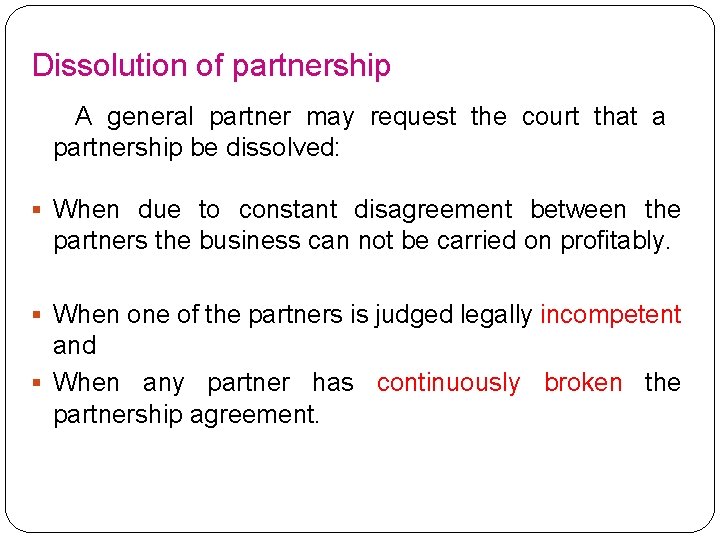
Dissolution of partnership A general partner may request the court that a partnership be dissolved: § When due to constant disagreement between the partners the business can not be carried on profitably. § When one of the partners is judged legally incompetent and § When any partner has continuously broken the partnership agreement.
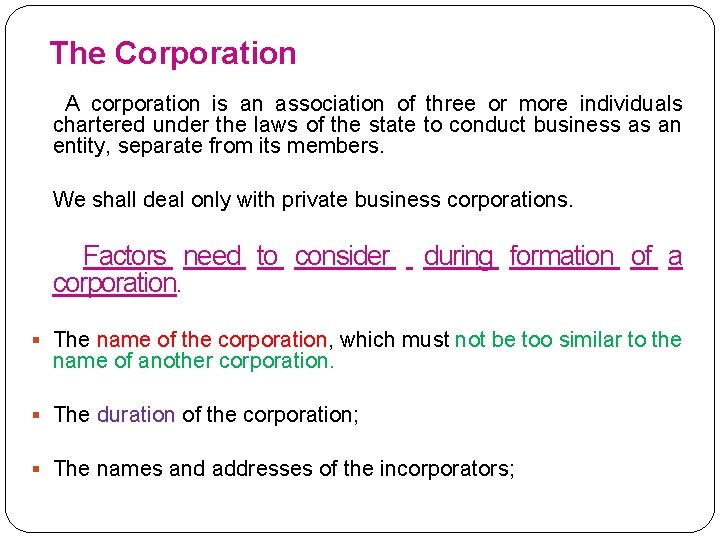
The Corporation A corporation is an association of three or more individuals chartered under the laws of the state to conduct business as an entity, separate from its members. We shall deal only with private business corporations. Factors need to consider during formation of a corporation. § The name of the corporation, which must not be too similar to the name of another corporation. § The duration of the corporation; § The names and addresses of the incorporators;
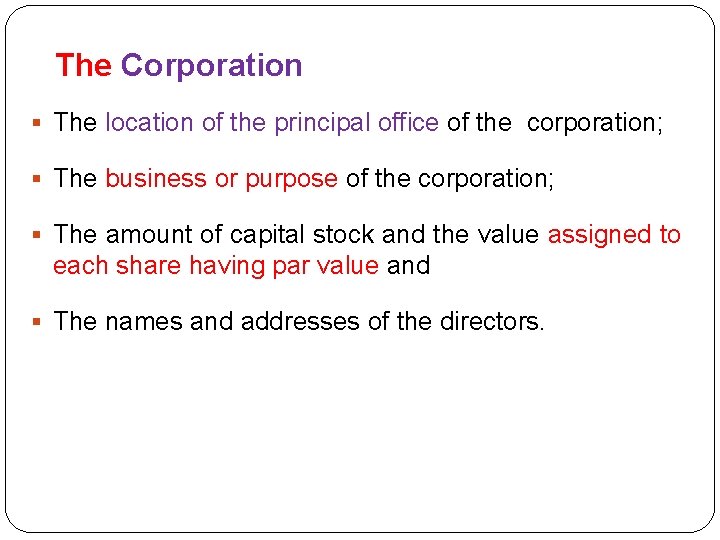
The Corporation § The location of the principal office of the corporation; § The business or purpose of the corporation; § The amount of capital stock and the value assigned to each share having par value and § The names and addresses of the directors.
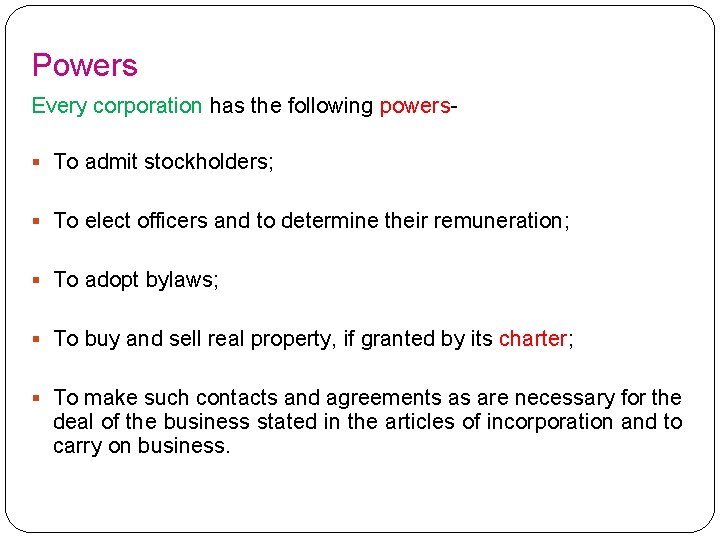
Powers Every corporation has the following powers§ To admit stockholders; § To elect officers and to determine their remuneration; § To adopt bylaws; § To buy and sell real property, if granted by its charter; § To make such contacts and agreements as are necessary for the deal of the business stated in the articles of incorporation and to carry on business.
Board of directors The board of directors are the agents who manage the corporation. They in turn elect the officers who are removable at the pleasure of the board. There must be at least three directors. The board of directors are responsible only to the stockholders, who elect them by a number vote of those present at a meeting called for such a purpose.
Stockholders A stockholder is a person, partnership, or another corporation that owns one or more shares of stock in a corporation. A stockholder may vote on any major question or decision affecting the corporation and he may vote in person or by proxy. A stockholder also has the right to prevention. When a corporation increases the number of shares of authorized stock, the stockholders have a prior right to purchase the increased shares. This is called the right of prevention. The ratio of new shares, which any stockholder has the right to purchase, is proportional to the number of shares currently held.
Stocks and dividends Stocks are of two classes. § Common stocks § Preferred / Ideal stocks A common stock is the usual class issued in the formation of a corporation. The owner of a common stock has one vote for each share, and receives a dividend on the basis of the number of shares he owns. Dividends can be paid only from the surplus or earnings. The owner of a preferred stock does not have the right to vote. The dividend for a preferred stock is predetermined as a percentage of its par value, and such dividends are paid before dividends may be declared for common stock-hence the term, preferred stock.
Dissolution of Corporation [partnership] A corporation can be dissolved: § When it willingly applies for dissolution; § When it fails to abide by its charter; § When two years have elapsed and it has not conducted the business for which it was organized; § When it reaches the time limit for which it was organized. § When it fails to pay the government taxes for three years.
Advantages § The duration is unending unless the articles of incorporation specify otherwise. § As an entity separate and distinct from its members, the death of any or all of its members does not affect its existence or its operation; § It permits the attraction of capital in small or large amounts from countless sources and § Liability of investors is limited to the amount of their investment.
Disadvantages § More governmental regulation than the proprietorship or partnership. § More tax have to pay to government.
PRIVATE LIMITED COMPANY § A Company whose ownership is private. § Private companies may issue stock and have shareholders. However, their shares do not trade on public exchanges and are not issued through an initial public offer(IPO).
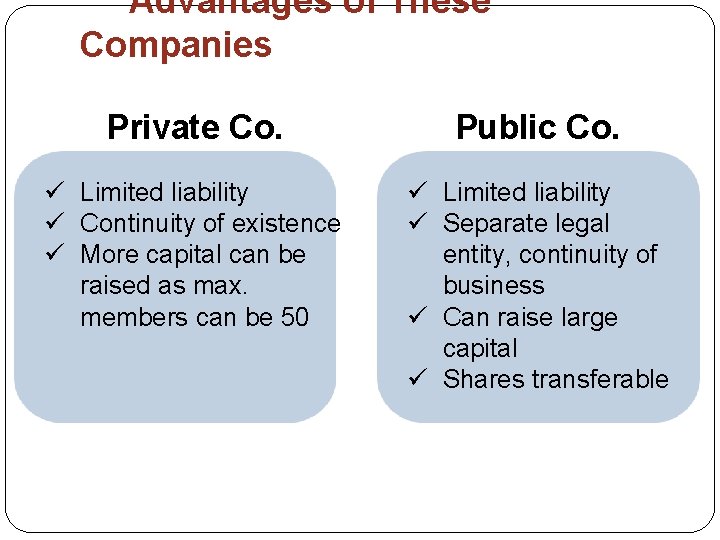
ADVANTAGES… § Limited Liability: It means that if the company experience financial distress because of normal business activity, the personal assets of shareholders will not be at risk of being seized by creditors. § Continuity of existence: Business is not affected by the status of the owner. § Minimum number of shareholders need to start the business are only. § More capital can be raised as the maximum number of shareholders allowed is 50. § Scope of expansion is higher because easy to raise capital from financial institutions and the advantage of limited liability.
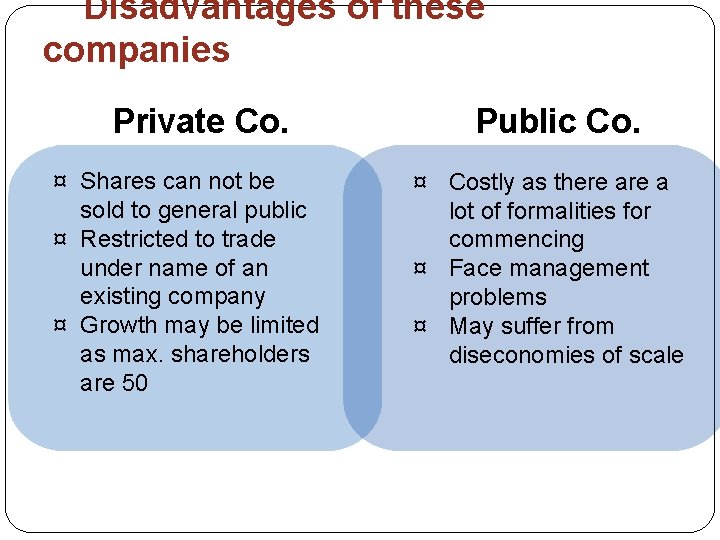
DISADVANTAGES… § Growth may be limited because maximum shareholders allowed are only 50. § The shares in a private limited company cannot be sold or transferred to anyone else without the agreement of other shareholders. § There is poor protection to minority members because private company enjoys several exemption from various provisions of the Companies Act.
PUBLIC LIMITED COMPANY Has limited liability and can sell shares to the general public to raise finance.
ADVANTAGES: § § § Limited liabilities Separate legal unit Large capital No restriction of shares High status
DISADVANTAGES: § § § Complicated legal formalities More regulations and controls Difficult to control Selling shares to public is expensive lose control
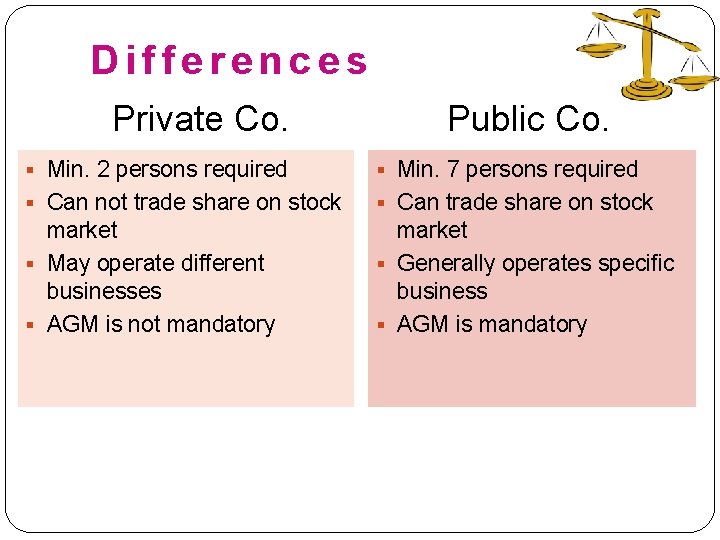
Differences Private Co. Public Co. § Min. 2 persons required § Min. 7 persons required § Can not trade share on stock § Can trade share on stock market § May operate different businesses § AGM is not mandatory market § Generally operates specific business § AGM is mandatory
Advantages of These Companies Private Co. Public Co. ü Limited liability ü Continuity of existence ü More capital can be raised as max. members can be 50 ü Limited liability ü Separate legal entity, continuity of business ü Can raise large capital ü Shares transferable
Disadvantages of these companies Private Co. ¤ Shares can not be sold to general public ¤ Restricted to trade under name of an existing company ¤ Growth may be limited as max. shareholders are 50 Public Co. ¤ Costly as there a lot of formalities for commencing ¤ Face management problems ¤ May suffer from diseconomies of scale
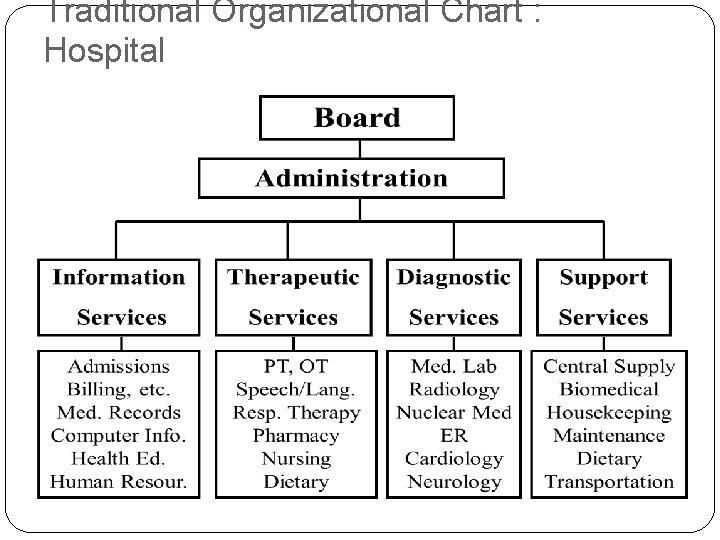
Traditional Organizational Chart : Hospital
Organizational Structure of a Hospital Organizational Structure : Refers to levels of management within a Hospital. § The structure helps one understand the hospital’s chain of command. § Organizational structure varies from hospital to hospital. § Large hospitals have complex organizational structures. § Smaller hospitals tend to have
Organizational Structure : Grouping of hospital departments within the Structure: Company departments are grouped in order to promote efficiency of facility. Grouping is generally done according to similarity of duties. Common Categorical Grouping: § Administrative Services. § Informational Services. § Therapeutic Services. § Diagnostic Services. § Support Services.
Administrative Services § Hospital Administrators. § Vice President(s), Executive Assistants, Department Heads. § Business people who “run the hospital. ” § Oversee budgeting and finance. § Establish hospital policies and procedures. § Often perform public relation duties.
Informational Services q Document and process information Includes: Admissions. Billing & Collection. Medical Records. Computer Information Systems. Health Education. Human Resources.
Therapeutic Services : Provides treatment to patients. Includes following departments: § Physical Therapy - treatment to improve large muscle mobility. § Occupational Therapy - treatment goal is to help patient regain fine motor skills. § Speech/Language Pathology -identify, evaluate , treat speech / language disorders. § Respiratory Therapy - treat patients with heart & lung disease. § Medical Psychology - concerned with mental well-being of
Diagnostic Services : Determines the cause (s) of illness or injury. Includes: § Medical Laboratory - studies body tissues. § Medical Imaging - radiology, MRI, Ultra Sound. § Emergency Medicine - provides emergency diagnoses & treatment.
Support Services Provides support for entire hospital. Includes: § Central Supply - orders, receives, stocks & distributes equipment & supplies. § Biomedical Technology - design, build repair, medical equipment. § Housekeeping & Maintenance - maintain safe, clean environment.