
ORGANIZATION OF TOURISM THE FUNDAMENTALS OF THE EXCURSION
- Slides: 26
ORGANIZATION OF TOURISM: THE FUNDAMENTALS OF THE EXCURSION ACTIVITY, THE FUNDAMENTALS OF THE ANIMATION ACTIVITY Lecturer: Akhmedova Olena Olegivna Ph. D in Public Administration
THEME 1. FUNDAMENTALS OF THE EXCURSION ACTIVITY 1. 1. History and evolution of guided tours. 1. 2. The formation and development of the excursion activity in Ukraine (the topic is to be considered individually and presented at the seminar). 1. 3. The notion of the excursion (tour-guiding) theory. 1. 4. The advantages of excursion (tour-guiding) method of cognition. Guided tours can be found at more or less all places where tourism exists
INTRODUCTION POINTS F O R D I S C U S S I O N Have you ever been on a guided tour? Why did you go on the tour? Was it with your school, group mates or when you were on holiday? What was the environment of the tour, where did the tour take place – in a city, museum, art gallery or somewhere else? To discuss the difference and similarity between the notions “excursion” and “guided tour” (Within the tourism literature, terms such as ‘tour guide’, ‘tourist guide’, ‘tour leader’, ‘tour manager’, ‘tour escort’ and ‘courier’ are sometimes used synonymously. The literature and industry terminology indicates that the use of these terms varies from country to country, region to region, between the public and private sectors and also within the tourism industry itself. In this course, a tour guide is defined as a person, usually a professional, who guides groups (and sometimes individuals) around venues or places of interest such as natural areas, historic buildings and sites, and landscapes of a city or a region; and interprets the cultural and natural heritage in an inspiring and entertaining manner, in the language of the visitor’s choice (adapted from the European Federation of Tourist Guide Associations [EFTGA]). It must be acknowledged, however, that the World Federation of Tourist Guide Associations (WFTGA) and the EFTGA consider the designation of ‘tour guide’ as inappropriate, unflattering and a misnomer, as the term can refer to a book, a brochure or a robotic tour guide. This is why the term ‘tourist guide’ rather than ‘tour guide’ is used extensively throughout Europe and the United Kingdom, defined as ‘a person who guides visitors in the language of their choice and interprets the cultural and natural heritage of an area, [and who] normally possesses an areaspecific qualification usually issued and/or recognised by the appropriate authority’ (WFTGA, 2013). In many countries, the term ‘tour guiding’ is used to refer to the work undertaken by tour guides, managers, leaders and escorts who move between destinations and who work beyond site- or area-specific guiding.
As previously mentioned, a ‘tour guide’ is a person, usually a professional, who guides groups or individual visitors or tourists around venues or places of interest such as natural areas, historic buildings and sites, and landscapes of a city or a region; and who interprets the cultural and natural heritage in an inspiring and entertaining manner. In many studies the term ‘tour guide’ is used even though the guides may be working in a specific setting, for example in a city. The term ‘generalist guide’ is used to identify guides who do not specialise in a particular tourism environment, setting or genre. The term ‘specialist guide’ is used for guides who work in very specific settings and thus may require specialist knowledge and skills, such as heritage, adventure, ecotour or nature guides (For example, Antarctic tour guide). It is acknowledged that there are subtle differences between all these terms and the use of certain terms often reflects the different tourism genres, guiding settings, countries and employing organisations.
Tour guides can be found at every tourism destination, and nearly everyone both within and outside the tourism industry is familiar with the term and the persona of a ‘tour guide’. Few, however, fully understand what a tour guide does and what constitutes ‘tour guiding’. Whether employed by tour operators, resorts, lodges, attractions, theme parks, museums, protected area management agencies, zoos, visitor centres or selfemployed, tour guides are often viewed by other stakeholders as an important part of, and sometimes as the key player in, the tourism product and experience. However, it is only quite recently that scholars and researchers have turned their attention to the subject of tour guides and tour guiding.
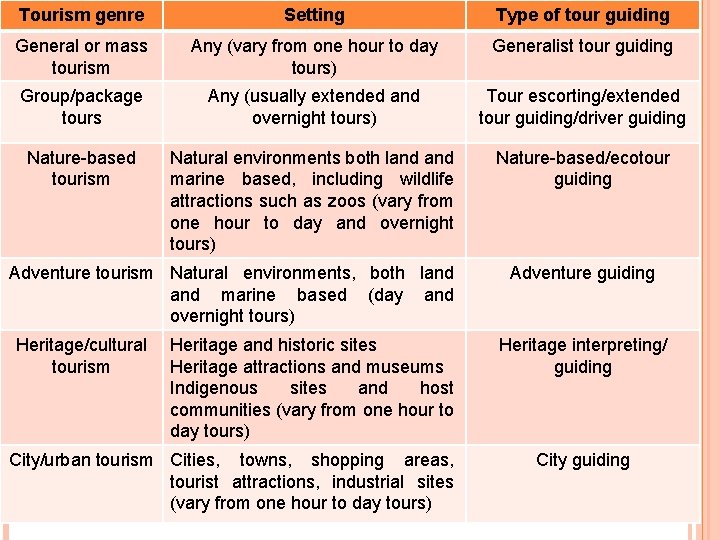
TOURISM GENRE Encompassed in the term ‘tour guide’ are many types of guides working across a wide range of environments and settings. Guided tours can be categorised using a number of different criteria, including purpose, settings and environments, subject matter, length, types of clients and activity, reflecting the heterogeneity of the guiding industry. Unfortunately, there is no agreed upon typology of guided tours based on these or any other characteristics. A number of types of guiding can be viewed as aligning with wellknown tourism genres and settings :
Tourism genre Setting Type of tour guiding General or mass tourism Any (vary from one hour to day tours) Generalist tour guiding Group/package tours Any (usually extended and overnight tours) Tour escorting/extended tour guiding/driver guiding Nature-based tourism Natural environments both land marine based, including wildlife attractions such as zoos (vary from one hour to day and overnight tours) Nature-based/ecotour guiding Adventure tourism Natural environments, both land marine based (day and overnight tours) Heritage/cultural tourism Heritage and historic sites Heritage attractions and museums Indigenous sites and host communities (vary from one hour to day tours) City/urban tourism Cities, towns, shopping areas, tourist attractions, industrial sites (vary from one hour to day tours) Adventure guiding Heritage interpreting/ guiding City guiding
This typology aims to reflect a contemporary picture of tour guiding; however, it is important to acknowledge that an individual tour guide does not necessarily work in just one genre nor undertake just one type of guiding. It is difficult to group some guides into specific categories as their roles and responsibilities are complex and may vary with a number of variables, such as site, season or employment. The diversity of guides in this typology reflects a number of factors, such as the increasing segmentation and specialisation of the tourism sector changing visitor/tourist motivations and demands, the increasing demand for tourism professionals (particularly guides) and the recognition that guides play a key role in the visitor experience.
Many scholars have argued that the tour guide plays a pivotal role in the experience of visitors or tourists who join a guided tour, potentially making or breaking the tour and the experience. Researchers acknowledge the instrumental role of the guide in ensuring that the tour runs smoothly and is a safe, logistical success, but increasingly emphasise the many mediatory and interpretive aspects of guiding. This in turn has drawn attention to the importance of the communicative competency of guides, including the application of best practice principles in interpretation and intercultural communication. The guide’s role in fostering sustainability has also come under scrutiny, particularly in influencing and monitoring visitors’ behaviour in contexts such as ecotourism and nature-based tourism and in delivering messages that impact post-visit attitudes and behaviour. Research has also begun to explore and measure the influence of these and other aspects of guiding on visitor satisfaction. In part to maintain and improve satisfaction but also to contribute to sustainability, the academic literature on tour guiding has examined the strengths and weaknesses of guide training and education initiatives and has evaluated training approaches that can further enhance the performance of tour guides. Finally, professional associations, professional certification, licensing and codes of practice have been researched for their potential to achieve quality assurance outcomes and to ensure that guides are recognised and rewarded for achieving these outcomes.
Researchers of the tour guiding also seeks to: • explore how tour guiding theory and practice from a range of disciplines have evolved over time and what factors have contributed to this; • critically examine tour guiding research, methods, findings to date and examine the gaps; • consolidate and synthesise the knowledge base on tour guiding and foreshadow how current and future trends and issues might impact on tour guiding research and practice in the 21 st century; • discuss a wide range of contexts in which guided tours are conducted, ranging from city streets to heritage and wildlife tourism attractions, from high-end tourist lodging establishments to national park campgrounds, and from highly developed destinations to very remote ones in both developed and developing countries.
1. 1. HISTORY AND EVOLUTION OF GUIDED TOURS Guiding is probably one of the world’s oldest professions, with early historical accounts referring to pathfinders and ciceroni (an old term for a guide, one who conducts visitors and sightseers to museums, galleries, etc. , and explains matters of archaeological, antiquarian, historic or artistic interest. The word is presumably taken from Marcus Tullius Cicero, as a type of learning and eloquence), who were antecedents of the contemporary guide. In the 5 th century BC, Herodotus, an extensive traveller and writer, depended not only on guides but also more specifically on guides who spoke his language. Although Herodotus was critical of some guides, they were essential ‘at a site such as Olympia, where there was a … forest of statues… the accumulation of hundreds of dedications … a tourist was helpless without a guide’. According to Cohen (1985), the origins of the modern tour guide were in the 17 th and 18 th centuries with the advent of the ‘Grand Tour’. This new form of tourism emerged as a direct outcome of the quest for learning that followed on from the Renaissance period. British male aristocrats were encouraged to travel as part of their education. This form of tourism involved visiting the major cultural centres of Europe accompanied by a tutor or guide and frequently took three or more years. These tours were the predecessor of the modern study tours that are most often organised by educational institutions and led by expert guides.
The 19 th century saw the development of group pleasure travel through the initiatives of Thomas Cook, who was the tour guide/tour manager of many of these excursions. According to Hall (1995), Cook’s concept of group travel, together with improved transportation and other social and technological developments, marked the start of mass tourism. This development brought with it the need for service personnel in all aspects of the tourism industry, including hotels, restaurants, tour operations, attractions and transport services. These personnel included tour guides who were responsible for escorting groups and individuals, and interpreting the natural and cultural heritage of the area. Thus was the birth of the modern tour guide, and as such Cook is sometimes referred to as the ‘patron saint (покровитель) of modern tour guides’ (Pond, 1993). In the early 20 th century, nature guides like Enos Mills (an American naturalist, author and the main figure behind the creation of Rocky Mountain National Park) were leading visitors through the North American wilderness and laying the foundations for the profession of interpretation. Mills did not believe his only role was to guide people through the wilderness safely: ‘A nature guide is not a guide in the ordinary sense of the word, and is not a teacher. At all times, however, he is rightfully associated with information and with some form of education. But nature guiding as we see it, is more inspirational than informational’.
The first licensed guides in the United States were guides who escorted friends and relatives around the battlefield of Gettysburg. Licensing of these guides started in 1915 under the War Department and continues today under the National Park Service. These guides are renowned for being professional and well trained. In recent decades, guided tours have been viewed as a means of visiting a destination or experiencing a place economically, efficiently and safely, particularly for inexperienced travellers. Guided tours are often stereotyped as being highly choreographed experiences involving passive group members who have little or no say in the tour itinerary and style. Many guided tours today continue to be offered as predefined experiences, appealing to some visitors who want a safe, cheap and quick way to ‘see the sites and sights’. They may be particularly attractive when visiting a destination or undertaking an activity for the first time, or when going somewhere (such as Antarctica) or doing something that requires specialist transportation, equipment or skills (such as whale watching). Sometimes a guided tour is the only way to experience a site or destination, for example one cannot swim with wild dolphins or visit the Galapagos Islands without a guide, and Chinese visitors cannot travel outside China on an approved destination status (ADS) tour without a local guide.
However, as tourism has become a more globalised phenomenon, contemporary guided tours have developed into diverse, multifaceted, context-specific and adaptable products, offering benefits beyond safety and convenience. For example, individuals and groups of visitors can arrange a personalised guided tour by hiring a taxi-driver guide, and tour clients can plan their own itineraries and choose their own guide as part of a personal, business or conference trip. Guided tours can have opt-in and opt-out segments, for example guided coach-based tours may include optional shopping or walking tours. The educational component of a tour can also be variable and can be customised to particular market segments and even to individuals, using technology such as smartphones and headsets that allow individuals to listen (or not listen) to commentary, choose the commentary language and in some cases interact with the content. Finally, tour clients can choose a guided tour not to buffer but to facilitate engagement and a more authentic experience with a destination, its environment and its host population. Importantly, guided tours are now differentiated in terms of both product and market, ranging from very inexpensive to very expensive, and catering to first-time through to very experienced travellers. With the introduction of technology such as wireless internet, Geographic Information Systems and Global Positioning Systems there is now a blurring between guided and non-guided tours as visitors move between one and the other during their holiday.
In addition to moving with the times, guided tours are embedded in the social, cultural and political contexts in which they occur, and thus may look very different from one destination to the next. Up to the present ‘the phenomenon of guiding has been connected to a variety of questions through its intimate relations to innovation, politics and economy, social interactions and power relations, culture and indigenous tourism and local versus global’. The role that individual tour guides sometimes choose to play, either consciously or unconsciously, as political instruments is also discussed nowadays. (For example: An early study into the political context and politicising of tour guiding by government was Mitchell’s (1996) investigation of tour guides as vehicles for the creation of the government’s desired image of Malta. Mitchell’s ethnographic study revealed the role of guides as being less about communication and more about promotion. Guides were trained and more or less compelled (via compulsory licensing) to present images of Malta that ‘perpetuate national claims to Europeanness’. These included privileging cultural and social elements of the past such as food, architecture, modes of transport and religion that depict Malta’s links to Europe, thereby promoting its inclusion in the European Union. )
Although such highly politicised tour guiding policies and practices may be relatively rare, they exist elsewhere. Direct force by policing and law enforcement, and indirect force through mechanisms such as training and licensing, can influence and create uniformity in the way that guides arrange their tours, select objects and places of interest, and deliver their tours. At least two in-depth studies of guiding (Bras, 2000; Dahles, 2002) confirm this to be the case in Indonesia. Tour guiding in Indonesia under Suharto’s New Order regime, revealed the use of Indonesian tour guides by government policies to extol particular state ideologies. Guides were government trained to present an official authorised narrative. For fear of losing their jobs, guides kept visitors away from the ‘backstage’ of undesirable aspects of a destination, so guides played an important role in constructing local identity and limiting opportunities for visitors to meet local people. The Suharto (Indonesian president) government also regulated tour guiding through licensing, certification, training, pay and benefits. For example, the content of training focused on state ideology, national culture, history, language, defence and national security. Finally, tours were marketed and managed in ways that controlled how guides could conduct their tours and the content of their commentaries. The government-sanctioned ‘ideal’ guide was more of an information giver than an interpreter, with guides operating standardised and carefully staged tours with little or no consideration of the needs and interests of visitors.
In another part of the world there are differences in perspectives of Palestinian and Israeli guides. While guides in Israel are, in theory, free to construct and modify their narratives depending on the group, the Israeli government influences the actions and commentary of the guides in subversive and indirect ways. The Israeli guides are privileged through regular training offerings, while Palestinian guides have limited access to training and licenses. Both types of guides have to tailor their commentaries and tours to accommodate the nationalist vision to what visitors want to see and hear. The Israeli guides build up sympathy for their cause in their commentaries and the places they take visitors, portraying Palestinians as dangerous terrorists, in part to increase the dependency of visitors on Israeli guides. They avoid the Palestinian areas and contact with Palestinian people. In contrast, the Palestinian guides are limited in how they can present their points of view and that of Palestine. If they talk about the politics of the region, they may be reported and lose their licence, so they tend to veil their Arabic or Palestinian identities. In contrast to the Israeli guides, they try to expose visitors to the Palestinian areas, though, they avoid making any commentary for fear of losing their licence.
1. 3. THE NOTION OF THE EXCURSION (TOUR-GUIDING) THEORY. In the literal translation the Greek word "theory" means the observation, examination, investigation. This term is considered in several senses: 1) theory - a generalization of the experience of social life which reflects the objective laws of nature and society; 2) theory - a set of generalized positions, forming a science or one of its sections; 3) theory - a system of ideas in one of the branches of knowledge; 4) theory - the highest, the most advanced form of organization of scientific knowledge which gives a holistic view of the laws of the existing links in a certain area.
When we consider the excursion theory, we: a) model how should an excursion (a tour guiding) be performed ideally, b) understand the mechanism of excursion influence on human consciousness, c) comprehend the basic features and peculiarities of excursions (tour guiding), d) define quality criteria of excursions (tour guiding), the means to improve their effectiveness, e) formulate theoretical foundations of excursions (tour guiding). Excursion theory is a set of concepts: functions of the excursion, its main features and aspects, peculiarities of demonstration and narration; excursion method, classification of excursions; differentiation approach to the tour guiding, methodology and technique, elements of the excursion pedagogy and logics, the elements of a tour guide’s proficiency.
Development of excursion (a tour guiding) theory in Ukraine, which at that time was a part of former Soviet Union, was initiated in 1920, and continues nowadays. In the first period of its development it was based on the principles of the school of pedagogy. Classification of excursions, their features and functions, the very process of sightseeing were determined and based on the trips for school children. At that time, scientists and methodologists based their investigations on the objectives and requirements of the secondary school. The exception was the museum tours where attempts were made to understand the excursion theory as applied to all excursionists (adults and children). But until the mid-1970 s the excursion theory was not developed.
More intensive development of the excursion theory began in the 1970 s. This is explained by the creation of the Central Research Laboratory for Tourism and Excursions and special courses for tourism, excursion and tour guiding workers. A course of lectures "The theory and practice of the tour guiding" was created in the Institute for Advanced Training. The content of the course was presented in the textbooks written by B. V. Yemelyanov and published by the Central Bureau of information "Tourist": "Fundamentals of Excursion Activity" (1981, 1985), "Methods of preparing and conducting tours" (1980), "Organization of the tour agencies" (1979, 1987), “Tour guiding of the population" (1983), “Excursion as an integral part of the ideological education" (1984), "The professional skills of the guides"(1986). The development of the excursion theory was also associated with the expansion of the services, the changing role of trips, their transformation from purely recreational and entertainment into integral part of the ideological, educational and cultural work with the population.
Excursion (tour-guiding) theory is a set of views, ideas, methodology, functions, thesis and provisions which are the basis of the tour guiding business in the country. “The theory arises from practice, but it just summarizes the experience, and goes much further, revealing new relations and new sides of the object. ” B. V. Yemelyanov
1. 4. THE ADVANTAGES OF EXCURSION (TOUR-GUIDING) METHOD OF COGNITION. In practice various methods of cognition are used: inductive, deductive, analytical, synthetic, methods of abstraction, analogy, modelling, generalization, experiment, etc. All these methods are to some extent used while carrying out an excursion. The term "method" has some definitions: 1: a procedure or process for attaining an object: such as a (1) : a systematic procedure, technique, or mode of inquiry employed by or proper to a particular discipline or art (2) : a systematic plan followed in presenting material for instruction <the lecture method> b (1) : a way, technique, or process of or for doing something <often slow in their business methods > (2) : a body of skills or techniques <in the art of the novel, heavily armed with method> 2 : a discipline that deals with the principles and techniques of scientific inquiry 3 a: orderly arrangement, development, or classification : PLAN <The book is completely lacking in method. > b : the habitual practice of orderliness and regularity <time enough to do everything if only you used method >
During pedagogical and cultural-educational activity the method is a basis of new knowledge acquiring and formation of moral qualities of the person. The excursion method is directed at the study of the main thing in a theme. The basis for naming an excursion method as a complex one is that in it the methods of teaching and methods of education are integrally combined. The scientist I. Ado marked the following advantages of the excursion method: - a research element in the work of pupils (students); - alive, concrete and vivid study of the past; - the complex perception of the object; - increased interest to work and on the basis of this a more profound and strong mastering of the material.
Thus, the excursion method is a basis of excursion process and represents a set of ways and perceptions of delivering the knowledge about something. The fundamentals of this are: the presentation; an obligatory combination of two elements demonstration and narration; optimum interaction of three components - the guide, excursion objects and tourists; movement of tourists along the certain route with the purpose of objects study in a place of their natural arrangement. Complex character of the excursion method finds its expression in mechanisms of delivering the knowledge by the guide and mastering of this knowledge by the tourists. The purpose of the excursion method is teaching (transfer of the certain system of knowledge) and education (formation of a comprehensively developed person). Unlike educational institutions, the process of learning during an excursion goes on in the process of communication with the sightseeing objects, through the guide’s narration and his behaviour while demonstrating the objects. Through his story the guide delivers certain knowledge, produces a certain approach to the explanation of natural phenomena, brings in the understanding of the course and logic of society, leads to the evaluation of historical events.
TOPICS FOR DISCUSSION AND PRESENTATIONS 1. The history of tour-guiding and excursion activity development in Ukraine. Classification of periods. (Group work: 9 periods for several students) 2. The concept of the tour-guiding and excursion theory. 3. The importance of tour-guiding and excursion theory in the development of tourism business. 4. Peculiarities of the tour-guiding and excursion business development at the present stage. 5. The legal foundations of the tour guiding in Ukraine.