
Organization Levels of Motor Systems Spinal cord and
- Slides: 19
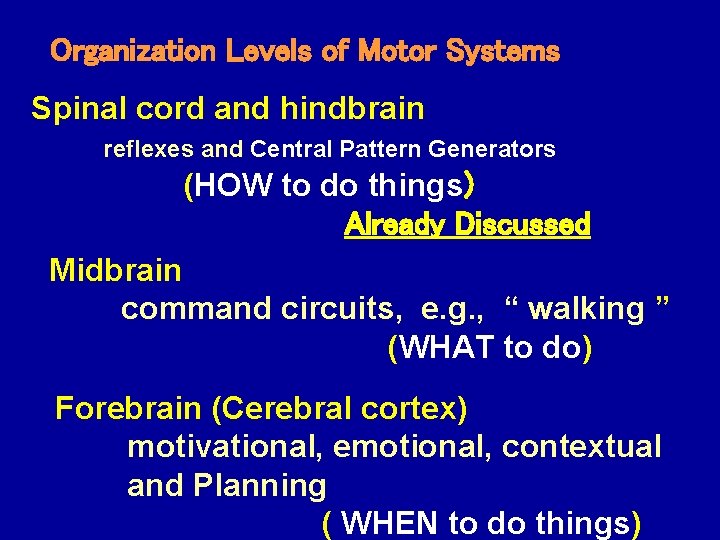
Organization Levels of Motor Systems Spinal cord and hindbrain reflexes and Central Pattern Generators (HOW to do things) Already Discussed Midbrain command circuits, e. g. , “ walking ” (WHAT to do) Forebrain (Cerebral cortex) motivational, emotional, contextual and Planning ( WHEN to do things)
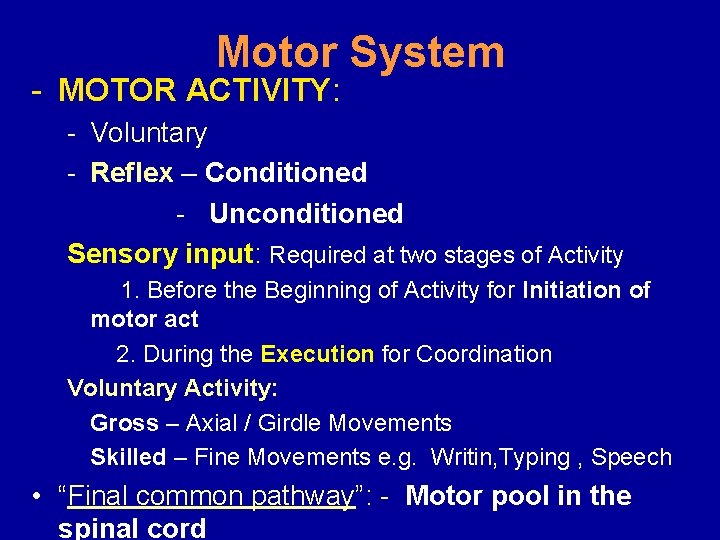
Motor System - MOTOR ACTIVITY: - Voluntary - Reflex – Conditioned - Unconditioned Sensory input: Required at two stages of Activity 1. Before the Beginning of Activity for Initiation of motor act 2. During the Execution for Coordination Voluntary Activity: Gross – Axial / Girdle Movements Skilled – Fine Movements e. g. Writin, Typing , Speech • “Final common pathway”: - Motor pool in the spinal cord
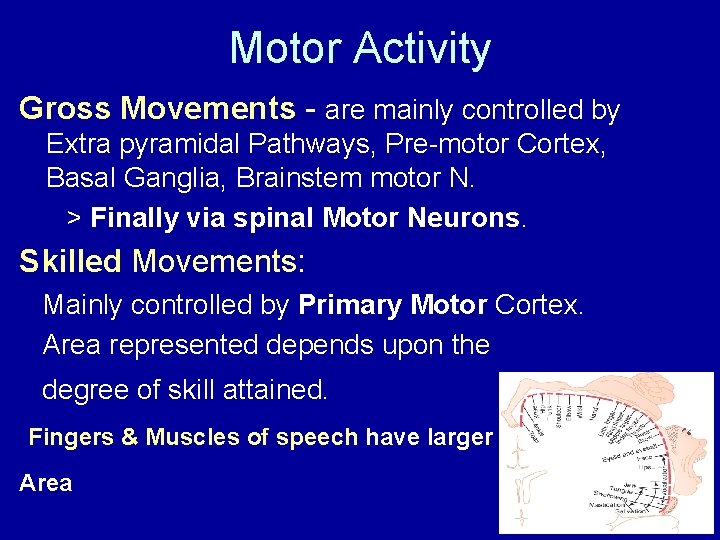
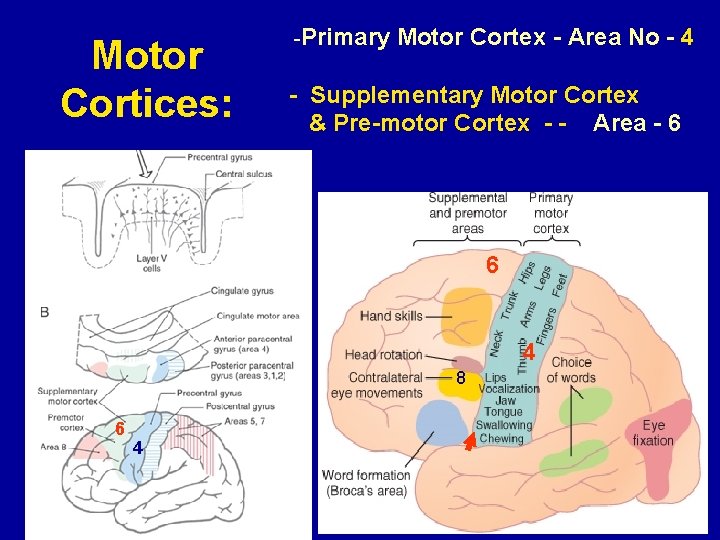
Motor Activity Gross Movements - are mainly controlled by Extra pyramidal Pathways, Pre-motor Cortex, Basal Ganglia, Brainstem motor N. > Finally via spinal Motor Neurons. Skilled Movements: Mainly controlled by Primary Motor Cortex. Area represented depends upon the degree of skill attained. Fingers & Muscles of speech have larger Area
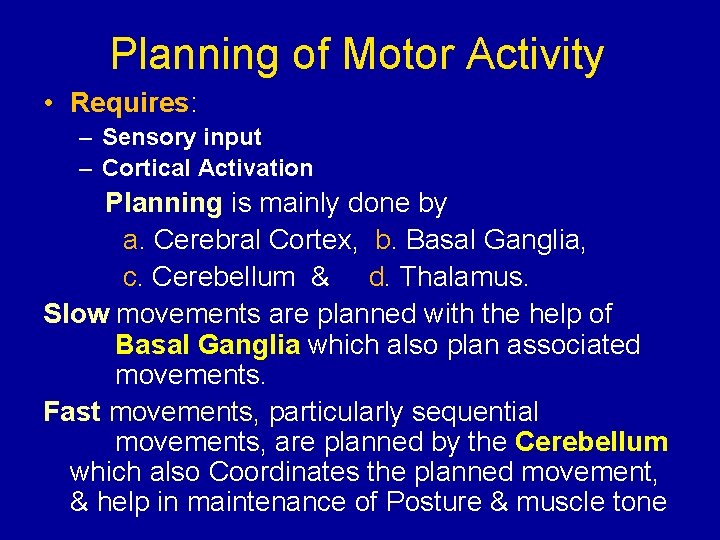
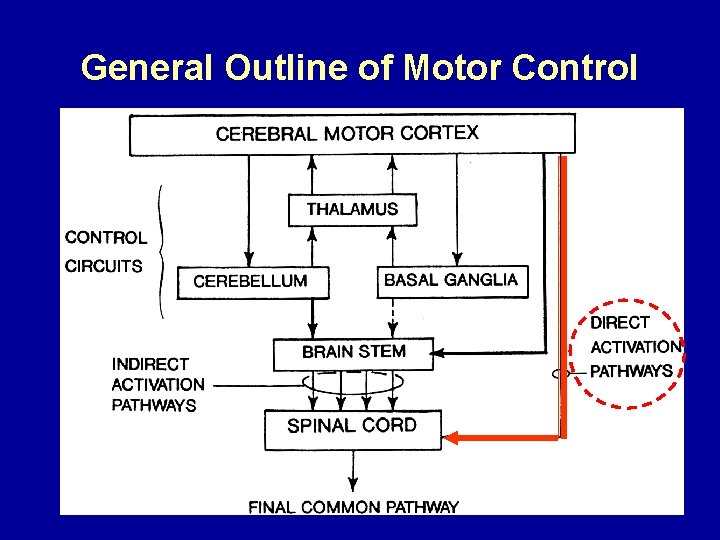
Planning of Motor Activity • Requires: – Sensory input – Cortical Activation Planning is mainly done by a. Cerebral Cortex, b. Basal Ganglia, c. Cerebellum & d. Thalamus. Slow movements are planned with the help of Basal Ganglia which also plan associated movements. Fast movements, particularly sequential movements, are planned by the Cerebellum which also Coordinates the planned movement, & help in maintenance of Posture & muscle tone
General Outline of Motor Control
Motor Cortices: -Primary Motor Cortex - Area No - 4 - Supplementary Motor Cortex & Pre-motor Cortex - - Area - 6 6 4 8 6 4
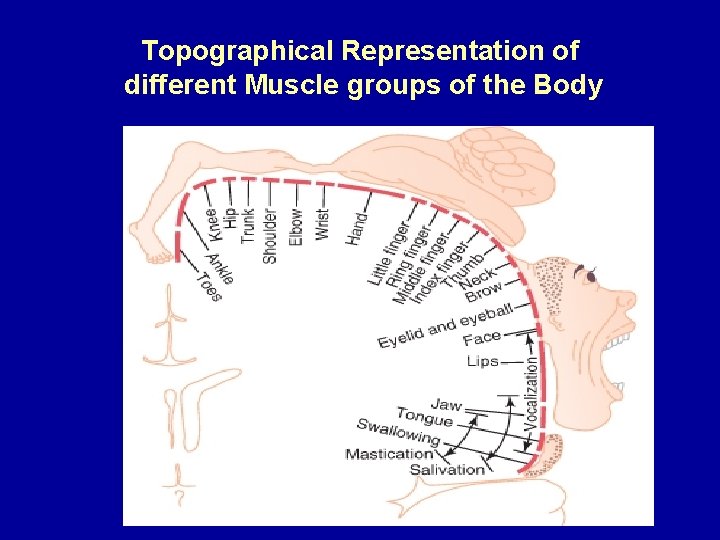
Topographical Representation of different Muscle groups of the Body
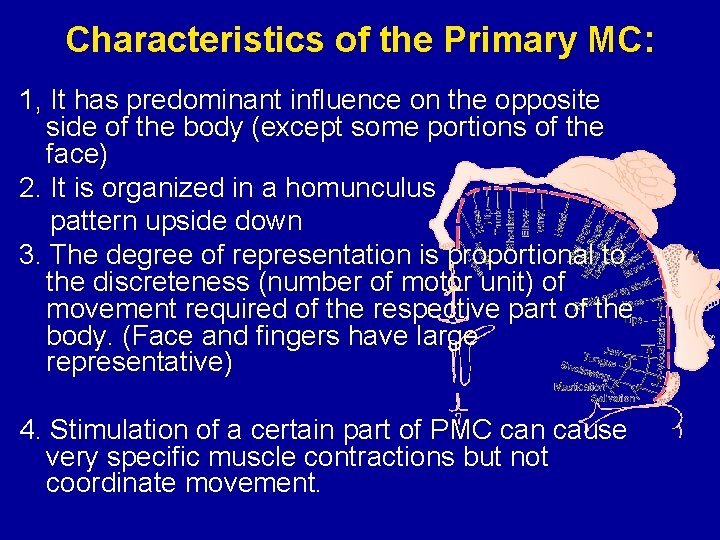
Characteristics of the Primary MC: 1, It has predominant influence on the opposite side of the body (except some portions of the face) 2. It is organized in a homunculus pattern upside down 3. The degree of representation is proportional to the discreteness (number of motor unit) of movement required of the respective part of the body. (Face and fingers have large representative) 4. Stimulation of a certain part of PMC can cause very specific muscle contractions but not coordinate movement.
Function of Primary Motor Cortex Excitation of single motor Neuron of the Primary motor Cortex excites a specific fine movement rather than single muscle on the opposite side. Destruction of this area leads to loss of voluntary control of discrete fine movements involving specially hands and fingers on the opposite side
Function of Supplementary motor cortex - Provide Bilateral Contraction of muscles through Primary motor Cortex. - It is primarily involved in programming motor sequences requiring use of bilateral group of muscles. - Mainly concerned with complex motor activity which need planning.
Functions of Pre-motor Cortex • Setting background posture at the start of Planned movement and with getting the individual ready to perform the movement. e. g. to position the shoulder & arms so that hands and fingers are properly oriented for typing Hammering or climbing the tree etc.
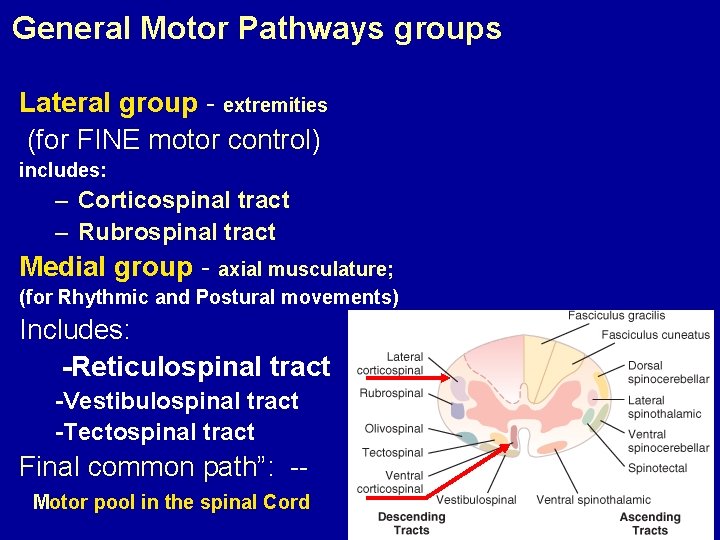
General Motor Pathways groups Lateral group - extremities (for FINE motor control) includes: – Corticospinal tract – Rubrospinal tract Medial group - axial musculature; (for Rhythmic and Postural movements) Includes: -Reticulospinal tract -Vestibulospinal tract -Tectospinal tract Final common path”: -Motor pool in the spinal Cord
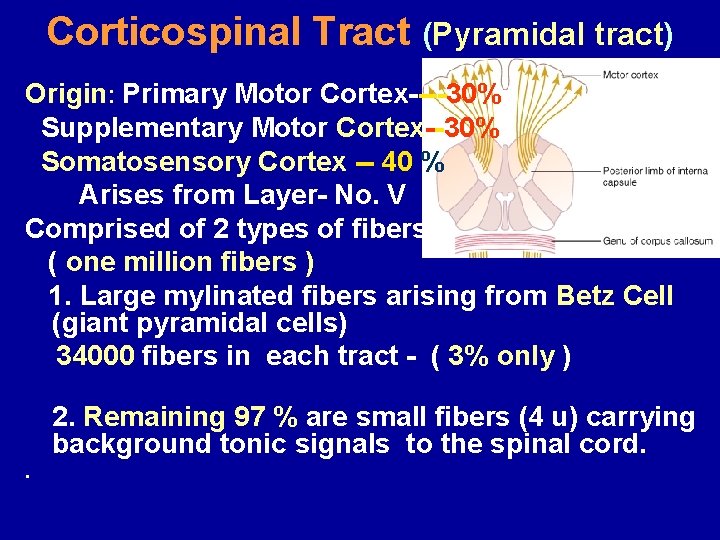
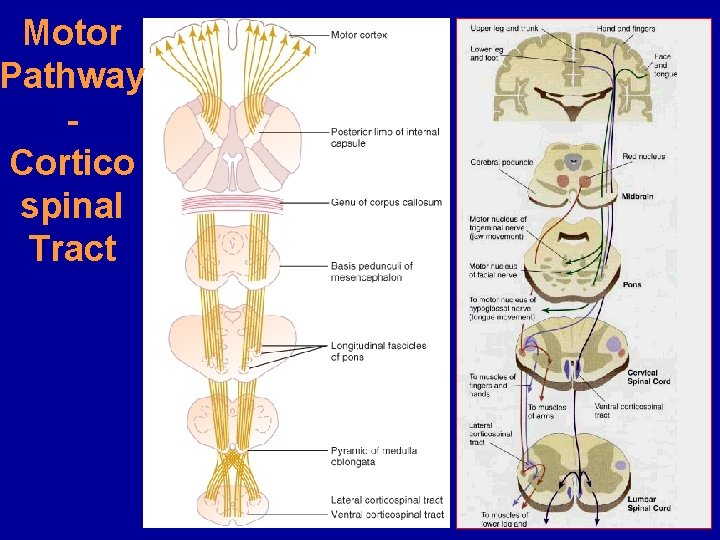
Corticospinal Tract (Pyramidal tract) Origin: Primary Motor Cortex----30% Supplementary Motor Cortex--30% Somatosensory Cortex -- 40 % Arises from Layer- No. V Comprised of 2 types of fibers ( one million fibers ) 1. Large mylinated fibers arising from Betz Cell (giant pyramidal cells) 34000 fibers in each tract - ( 3% only ) 2. Remaining 97 % are small fibers (4 u) carrying background tonic signals to the spinal cord. .
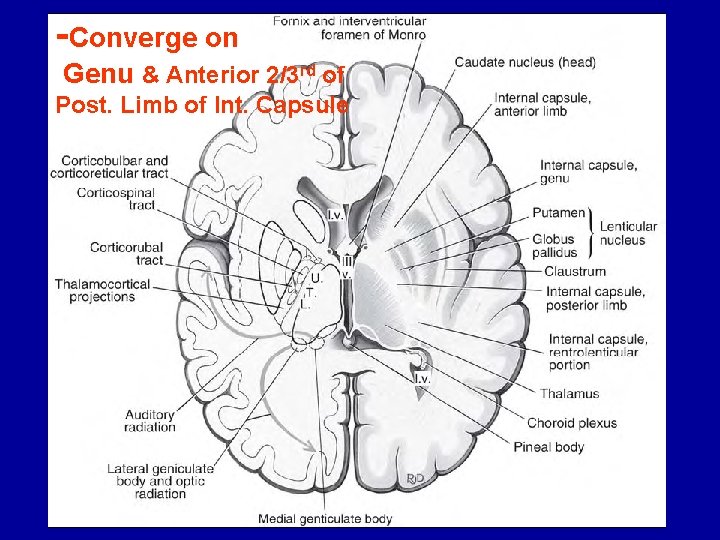
-Converge on Genu & Anterior 2/3 rd of Post. Limb of Int. Capsule
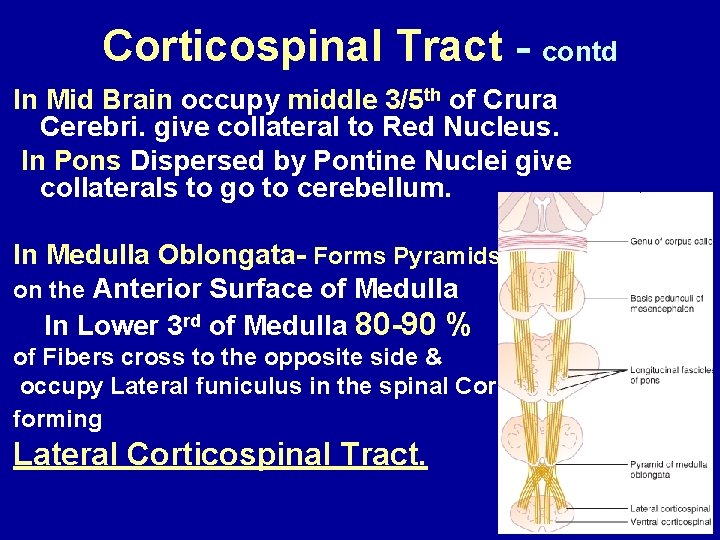
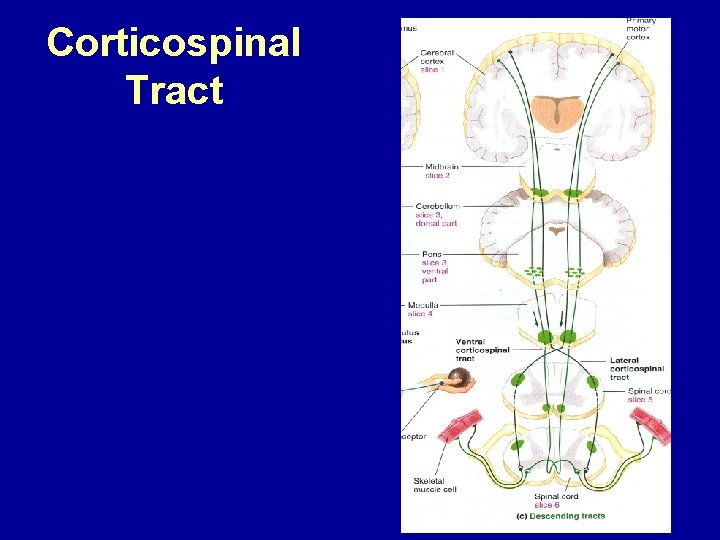
Corticospinal Tract - contd In Mid Brain occupy middle 3/5 th of Crura Cerebri. give collateral to Red Nucleus. In Pons Dispersed by Pontine Nuclei give collaterals to go to cerebellum. In Medulla Oblongata- Forms Pyramids on the Anterior Surface of Medulla In Lower 3 rd of Medulla 80 -90 % of Fibers cross to the opposite side & occupy Lateral funiculus in the spinal Cord forming Lateral Corticospinal Tract.
Corticospinal Tract
Corticospinal Tract (Pyramidal Tract) contd. Descends and Relay on ά- Motor Neurons at different levels directly ( mainly in Cervical Region of the spinal cord) or through Internuncial Neurons. – 45% leave in cervical Region 20% in the trunk & 35 % for lower limb. 10 -20% of Uncrossed fibers descends in the Ant. Funiculus- forming Ant Corticospinal Tract. Arcuate & Inf. Olive Also get collaterals & go to Cerebellum
Motor Pathway Cortico spinal Tract
Functions of Pyramidal Tract • Voluntary control of fine skilled motor activities in collaboration with basal ganglia and cerebellum. • Dynamic Vs Static Pyramidal discharge (from cerebral cortex) -Vertical Columns. • There are Greater %age of static Neurons in Motor cortex than Red Nucleus. • Ventral Corticospinal Tract is concerned with Bilateral control of Motor activity