
Organization and Teamwork Chapter 8 Business in Action
Organization and Teamwork Chapter 8 Business in Action 6 e Bovée/Thill
Learning Objectives 1. Explain the major decisions needed to 2. 3. design an organization structure Define four major types of organization structures Explain how a team differs from a group and describe the six most common forms of teams Copyright © 2013 Pearson Education, Inc. publishing as Prentice Hall 8 -2
Learning Objectives (cont. ) 4. Highlight the advantages and disadvantages of 5. 6. working in teams and list the characteristics of effective teams Review the five stages of team development and explain why conflict can arise in team settings Explain the concept of an unstructured organization and identify the major benefits and challenges of taking this approach Copyright © 2013 Pearson Education, Inc. publishing as Prentice Hall 8 -3
Designing an Effective Organization Structure ª Organization Structure 9 A framework that enables managers to divide responsibilities, ensure employee accountability, and distribute the decisionmaking authority ª Organization Chart 9 A diagram that shows how employees and tasks are grouped and where the lines of communication and authority flow Copyright © 2013 Pearson Education, Inc. publishing as Prentice Hall 8 -4
Designing an Effective Organization Structure (cont. ) ª Agile Organization 9 A company whose structure, policies, and capabilities allow employees to respond quickly to customer needs and changes in the business environment Copyright © 2013 Pearson Education, Inc. publishing as Prentice Hall 8 -5
Identifying Core Competencies ª Core Competencies 9 Activities that a company considers central and vital to its business Copyright © 2013 Pearson Education, Inc. publishing as Prentice Hall 8 -6
Identifying Job Responsibilities ª Work Specialization 9 specialization in or responsibility for some portion of an organization’s overall work tasks 9 also called division of labor Copyright © 2013 Pearson Education, Inc. publishing as Prentice Hall 8 -7
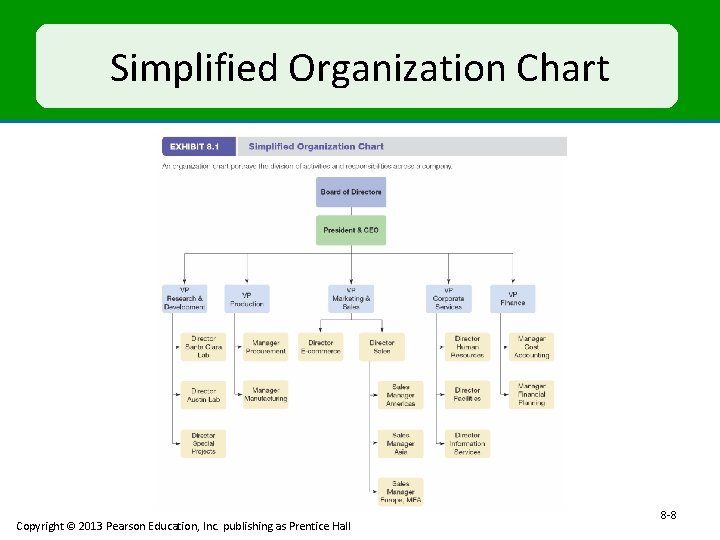
Simplified Organization Chart Copyright © 2013 Pearson Education, Inc. publishing as Prentice Hall 8 -8
Defining the Chain of Command ª Chain of Command 9 A pathway for the flow of authority from one management level to the next Copyright © 2013 Pearson Education, Inc. publishing as Prentice Hall ª Line Organization 9 A chain of command system that establishes a clear line of authority flowing from the top down 8 -9
Defining the Chain of Command ª Line-and-Staff Organization 9 An organization system that has a clear chain of command but that also includes functional groups of people who provide advice and specialized services Copyright © 2013 Pearson Education, Inc. publishing as Prentice Hall 8 -10
Defining the Chain of Command ª Span of Management 9 The number of people under one manager’s control 9 also known as span of control Copyright © 2013 Pearson Education, Inc. publishing as Prentice Hall 8 -11
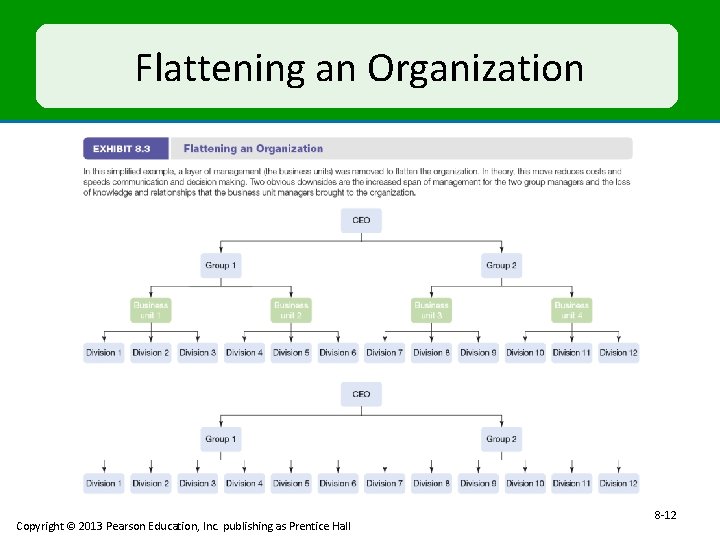
Flattening an Organization Copyright © 2013 Pearson Education, Inc. publishing as Prentice Hall 8 -12
Centralization Versus Decentralization ª Centralization 9 Concentration of decision-making authority at the top of an organization Copyright © 2013 Pearson Education, Inc. publishing as Prentice Hall ª Decentralization 9 Delegation of decision-making authority to employees in lowerlevel positions 8 -13
Organizing the Workforce ª Departmentalization 9 Grouping people within an organization according to function, division, matrix, or network Copyright © 2013 Pearson Education, Inc. publishing as Prentice Hall 8 -14
Organizing the Workforce ª Functional ª Divisional Structure 9 Grouping workers according to the similarity in their skills, resource use, and expertise 9 Grouping departments according to similarities in product, process, customer, or geography Copyright © 2013 Pearson Education, Inc. publishing as Prentice Hall 8 -15
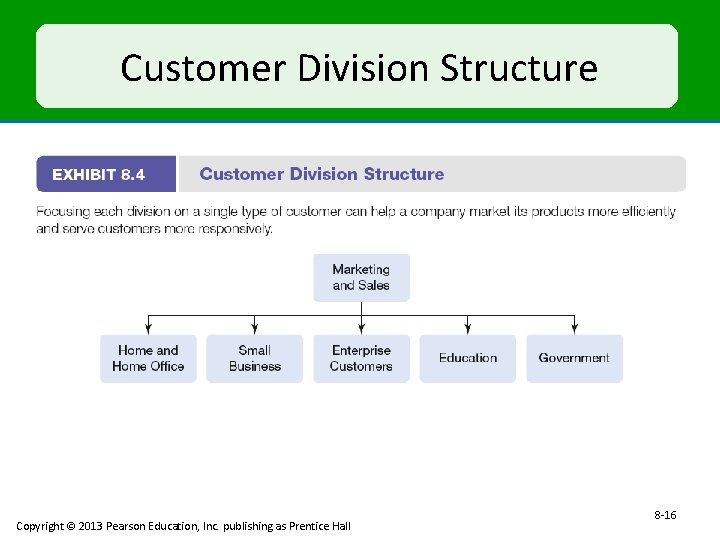
Customer Division Structure Copyright © 2013 Pearson Education, Inc. publishing as Prentice Hall 8 -16
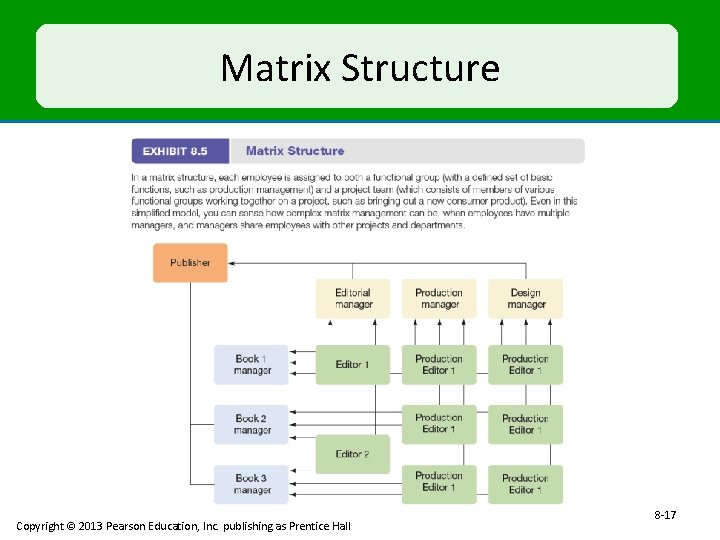
Matrix Structure Copyright © 2013 Pearson Education, Inc. publishing as Prentice Hall 8 -17
Matrix Structure ª Matrix Structure 9 A structure in which employees are assigned to both a functional group and a project team (thus using functional and divisional patterns simultaneously) Copyright © 2013 Pearson Education, Inc. publishing as Prentice Hall 8 -18
Network Structure ª Network Structure 9 A structure in which individual companies are connected electronically to perform selected tasks for a small headquarters organization 9 Also called virtual organization Copyright © 2013 Pearson Education, Inc. publishing as Prentice Hall 8 -19
Organizing in Teams ª Team 9 A unit of two or more people who share a mission and collective responsibility as they work together to achieve a goal Copyright © 2013 Pearson Education, Inc. publishing as Prentice Hall 8 -20
Types of Teams ª Problem-Solving Team 9 A team that meets to find ways of improving quality, efficiency, and the work environment ª Self-Managed Team 9 A team in which members are responsible for an entire process or operation Copyright © 2013 Pearson Education, Inc. publishing as Prentice Hall 8 -21
Types of Teams ª Functional Team 9 A team whose members come from a single functional department which is based on the organization’s vertical structure ª Cross-Functional Team 9 A team that draws together employees from different functional areas Copyright © 2013 Pearson Education, Inc. publishing as Prentice Hall 8 -22
Cross-functional Teams ª Task Force 9 A team of people from several departments who are temporarily brought together to address a specific issue Copyright © 2013 Pearson Education, Inc. publishing as Prentice Hall ª Committee 9 A team that may become a permanent part of the organization and is designed to deal with regularly recurring tasks 8 -23
Types of Teams ª Virtual Team 9 A team that uses communication technology to bring together geographically distant employees to achieve goals Copyright © 2013 Pearson Education, Inc. publishing as Prentice Hall 8 -24
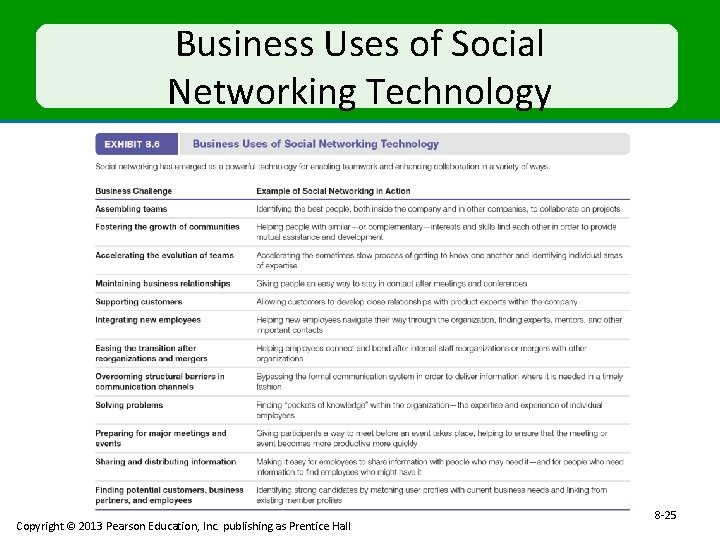
Business Uses of Social Networking Technology Copyright © 2013 Pearson Education, Inc. publishing as Prentice Hall 8 -25
Advantages of Working on Teams ª Higher quality decisions ª Increased diversity of views ª Increased commitment to solutions and changes ª Lower levels of stress and destructive internal competition ª Improved flexibility and responsiveness Copyright © 2013 Pearson Education, Inc. publishing as Prentice Hall 8 -26
Disadvantages of Working on Teams Inefficiency Groupthink Diminished individual motivation Structural disruption Excessive workloads Copyright © 2013 Pearson Education, Inc. publishing as Prentice Hall 8 -27
Characteristics of Effective Teams ª Clear sense of purpose ª Open and honest communication ª Creative thinking ª Accountability ª Focus ª Decision by consensus Copyright © 2013 Pearson Education, Inc. publishing as Prentice Hall 8 -28
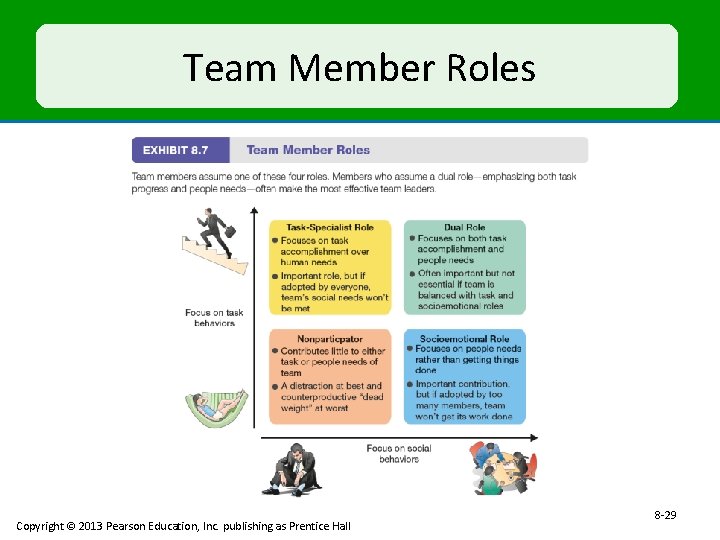
Team Member Roles Copyright © 2013 Pearson Education, Inc. publishing as Prentice Hall 8 -29
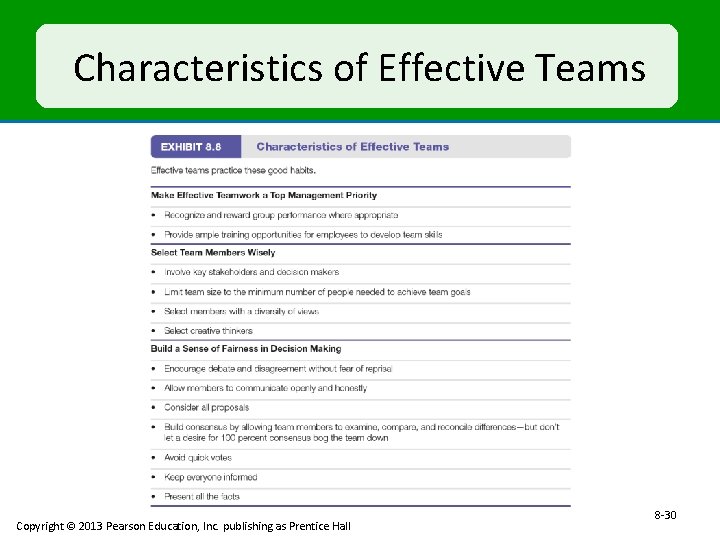
Characteristics of Effective Teams Copyright © 2013 Pearson Education, Inc. publishing as Prentice Hall 8 -30
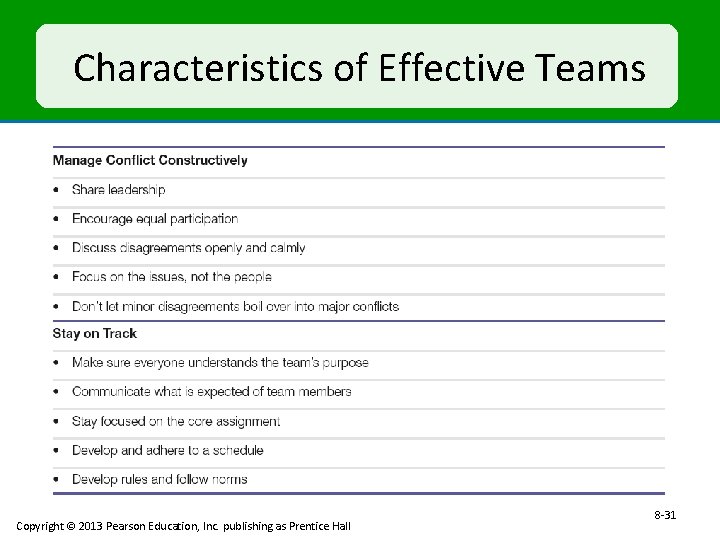
Characteristics of Effective Teams Copyright © 2013 Pearson Education, Inc. publishing as Prentice Hall 8 -31
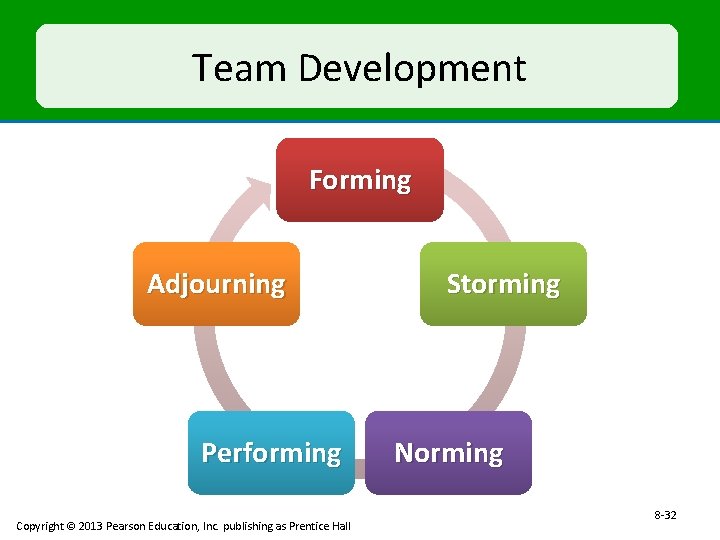
Team Development Forming Adjourning Performing Copyright © 2013 Pearson Education, Inc. publishing as Prentice Hall Storming Norming 8 -32
Team Development ª Cohesiveness 9 A measure of how committed team members are to their team’s goals Copyright © 2013 Pearson Education, Inc. publishing as Prentice Hall ª Norms 9 Informal standards of conduct that guide team behavior 8 -33
Team Conflict ª Constructive Conflict 9 Brings important issues into the open, increases the involvement of team members, and generates creative ideas for solving a problem ª Destructive Conflict 9 Diverts energy from more important issues, destroys the morale of teams or individual team members, or polarizes or divides the team Copyright © 2013 Pearson Education, Inc. publishing as Prentice Hall 8 -34
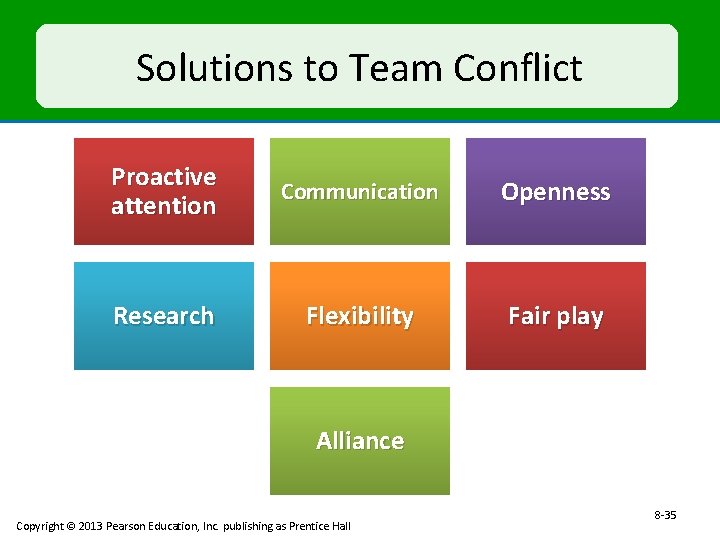
Solutions to Team Conflict Proactive attention Communication Openness Research Flexibility Fair play Alliance Copyright © 2013 Pearson Education, Inc. publishing as Prentice Hall 8 -35
Managing an Unstructured Organization ª Unstructured Organization 9 An organization that doesn’t have a conventional structure but instead assembles talent as needed from the open market; the virtual and networked organizational concepts taken to the extreme Copyright © 2013 Pearson Education, Inc. publishing as Prentice Hall 8 -36
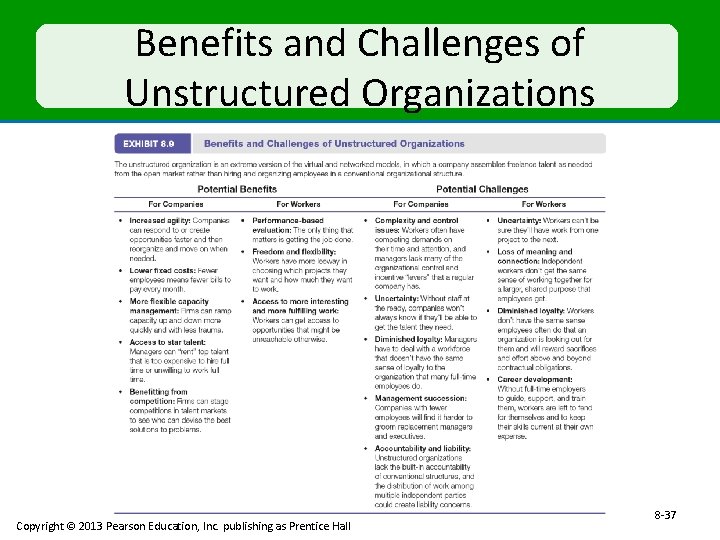
Benefits and Challenges of Unstructured Organizations Copyright © 2013 Pearson Education, Inc. publishing as Prentice Hall 8 -37
Applying What You’ve Learned 1. Explain the major decisions needed to 2. 3. design an organization structure Define four major types of organization structure Explain how a team differs from a group and describe the six most common forms of teams Copyright © 2013 Pearson Education, Inc. publishing as Prentice Hall 8 -38
Applying What You’ve Learned (cont. ) 4. Highlight the advantages and disadvantages of 5. 6. working in teams and list the characteristics of effective teams Review the five stages of team development and explain why conflict can arise in team settings Explain the concept of an unstructured organization and identify the major benefits and challenges of taking this approach Copyright © 2013 Pearson Education, Inc. publishing as Prentice Hall 8 -39
Copyright © 2013 Pearson Education, Inc. publishing as Prentice Hall 8 -40 40
- Slides: 40