
ORGANIZATION AND MANAGEMENT Bikash Adhikari bikashadh 044gmail com
ORGANIZATION AND MANAGEMENT Bikash Adhikari bikashadh 044@gmail. com Acknowledgement: Khem Gyawali Mechanical Engineer Organization and Management
Objective of the course management concepts in organizations especially the following: 1. Acquire knowledge in the field of organizational management and internal organization of companies required for managing an enterprise. 2. Acquire knowledge in the field of personnel management, motivation and leadership for developing managerial skills 3. Gain knowledge for starting a small scale unit independently 4. Gain knowledge on case study and management information system. 2
Course outline 1. Introduction (20 hours) 1. 1 Organization (2 hours) Ø System approach applied to Organization Ø Necessity of Organization Ø Principles of Organization Ø Formal and Informal Organizations 1. 2 Management (4 hours) Ø Functions of Management Ø Levels of Management Ø Managerial Skills Ø Importance of Management Ø Models of Management 3
Course outline 1. Introduction (20 hours) 1. 3 Theory of Management (6 hours) Ø Scientific Management Approach Ø Administrative Management Approach Ø Behavioral Management Approach Ø Modern Management Theories 1. 4 Forms of Ownership (2 hours) Ø Single Ownership Ø Partnership Ø Joint Stock Company Ø Co – operative Societies Ø Public Corporations 4
Course outline 1. Introduction (20 hours) 1. 5 Organizational Structure (2 hours) Ø Line Organization Ø Functional Organization Ø Line and Staff Organization Ø Committee Organization 1. 6 Purchasing and Marketing Management (4 hours) Ø Purchasing Ø Functions of Purchasing Department Ø Methods of Purchasing Ø Marketing Ø Functions of Marketing Ø Advertising 5
Course outline 2. Personnel Management (8 hours) 2. 1 Introduction 2. 2 Functions of Personnel Management 2. 3 Development of Personnel Policy 2. 4 Manpower Planning 2. 5 Recruitment and Selection of manpower 2. 6 Training and Development of manpower 2. 7 Job Analysis, Job Evaluation and Merit Rating 2. 8 Wages and Incentives 6
Course outline 3. Motivation, Leadership and Entrepreneurship (10 hours) 3. 1 Motivation ( 2 hours) Ø Human needs Ø Maslow’s Hierarchy of needs Ø Motivation Ø Types of Motivation Ø Attitude Motivation; Group Motivation; Executive Motivation Ø Techniques of Motivation Ø Motivation Theories Mc. Gregor’s Theory X – Y Fear and Punishment Theory Alderfer’s ERG Theory Mac. Clelland’s Theory of learned needs Herzberg’s Hygiene Maintenance Theory Vroom’s Expectancy/ Valency Theory 7
Course outline 3. Motivation, Leadership and Entrepreneurship (10 hours) 3. 2 Leadership (6 hours) Ø Qualities of a good Leader Ø Leadership Style Ø Blakes and Mouton’s Managerial Grid Ø Leadership Approach Ø Leadership Theories 3. 3 Entrepreneurship (2 hours) Ø Entrepreneurship Development Ø Entrepreneurial Characteristics Ø Need for Promotion of Entrepreneurship Ø Steps for establishing small scale unit 8
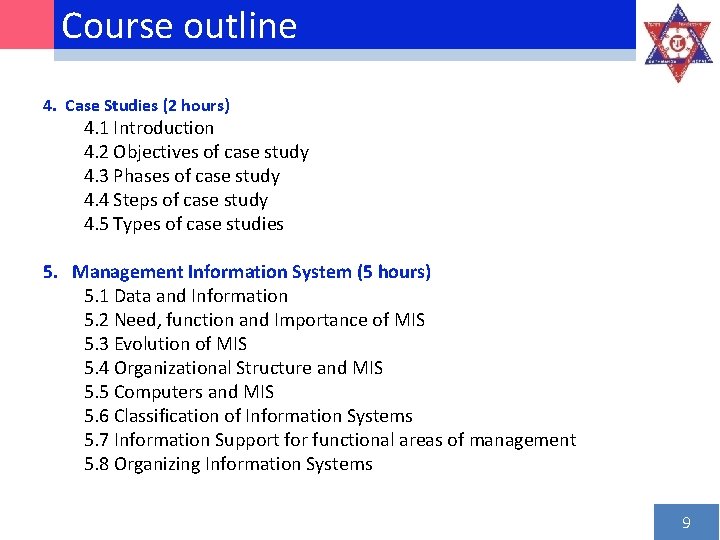
Course outline 4. Case Studies (2 hours) 4. 1 Introduction 4. 2 Objectives of case study 4. 3 Phases of case study 4. 4 Steps of case study 4. 5 Types of case studies 5. Management Information System (5 hours) 5. 1 Data and Information 5. 2 Need, function and Importance of MIS 5. 3 Evolution of MIS 5. 4 Organizational Structure and MIS 5. 5 Computers and MIS 5. 6 Classification of Information Systems 5. 7 Information Support for functional areas of management 5. 8 Organizing Information Systems 9
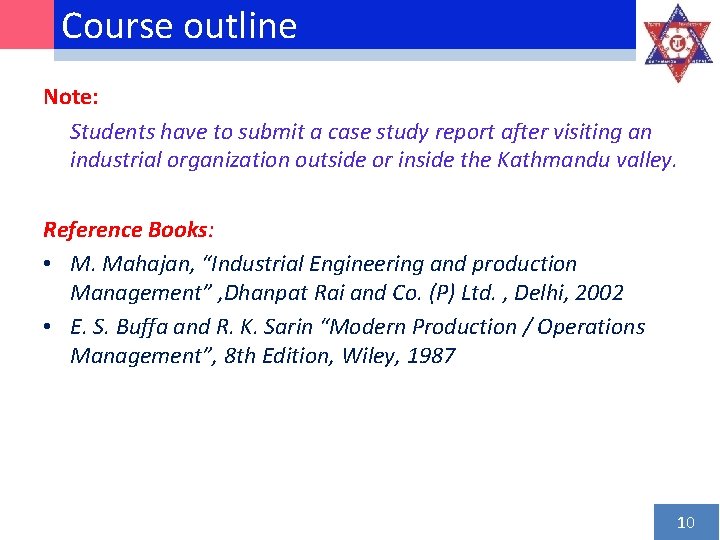
Course outline Note: Students have to submit a case study report after visiting an industrial organization outside or inside the Kathmandu valley. Reference Books: • M. Mahajan, “Industrial Engineering and production Management” , Dhanpat Rai and Co. (P) Ltd. , Delhi, 2002 • E. S. Buffa and R. K. Sarin “Modern Production / Operations Management”, 8 th Edition, Wiley, 1987 10
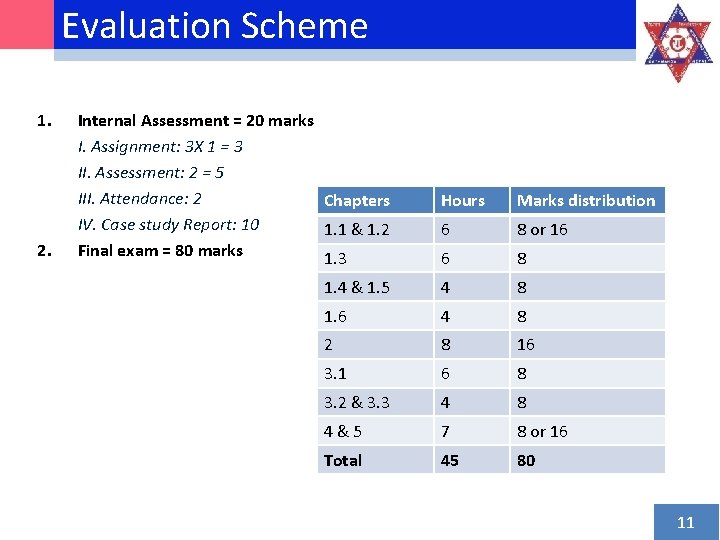
Evaluation Scheme 1. 2. Internal Assessment = 20 marks I. Assignment: 3 X 1 = 3 II. Assessment: 2 = 5 III. Attendance: 2 Chapters IV. Case study Report: 10 1. 1 & 1. 2 Final exam = 80 marks 1. 3 Hours Marks distribution 6 8 or 16 6 8 1. 4 & 1. 5 4 8 1. 6 4 8 2 8 16 3. 1 6 8 3. 2 & 3. 3 4 8 4&5 7 8 or 16 Total 45 80 11
Chapter 1 INTRODUCTION ‘There is nothing in a caterpillar that tells you it is going to be a butterfly. ’
Organization- course outline Ø System approach applied to organization Ø Necessity of organization Ø Principles of organization Ø Formal and Informal organizations 13
1. Organization “Organization is the form of every human association for the attainment of a common purpose” - Mooney and Reiley. ‘An organization is a collection of people working together in a coordinated and structured fashion to achieve one or more goals. ’ In common parlance: Organization is a process of identifying and grouping the work to be performed, defining and delegating responsibility and authority and establishing relationships for the purpose of enabling people to work most effectively together in accomplishing objectives. 14
1. Organizations Role in Society • Organizations exist to allow accomplishment of work that could not be achieved by people alone. • As long as the goals of an organization are appropriate, society will allow them to exist and they can contribute to society. Organizations and People • Organizations are strongly influenced by the people that form part of them. • Organizations can take in part of the personality of the people within them and their attitudes, perceptions and behaviors affect how an organization will operate. Organizations Require Management • Organizations use management to accomplish the work that is required to achieve the goals. 15
Historical development of organization The concept of organization grew along with growth of economic activities. Major stages of economic growth are: 1. Pre- industrial era I. Self- sufficiency era (as in village area) II. Commercial stage with marketable surplus a. b. Barter system (exchange system) Money system III. Development of means of transportation (railways, ships etc. ) 16
Historical development of organization 2. Modern industrial era I. Industrial revolution (development of lathe, shaping machine; James Watt – steam engine) II. Development of corporate form of business (limited liability) III. Managerial revolution (concept of modern management, scientific management) IV. Technological development (Mechanization and Automation) V. Economic Liberalization VI. Globalization (multinational company) - GATT (General Agreement on Tariff and Trade, Geneva 1948) - WTO (World Trade Organization, Geneva 1955) - ISO (International Organization for Standardization, Geneva 1947) - SAFTA (South Asian Free Trade Agreement) 17
I. System approach applied to organization 18
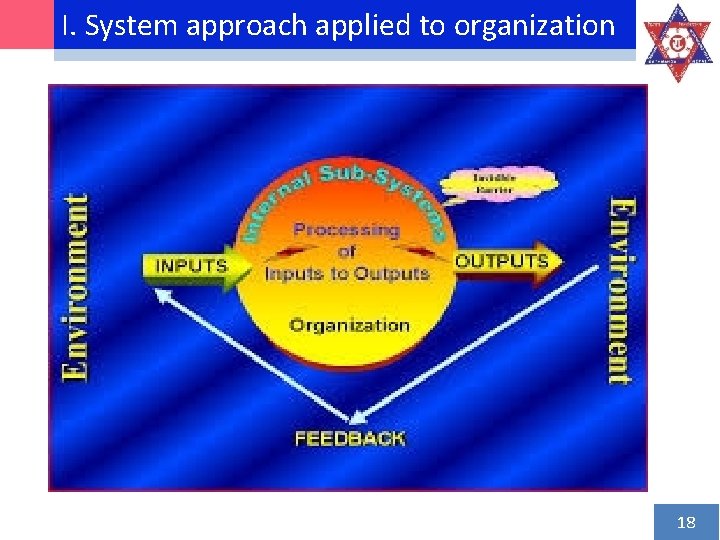
I. System approach applied to organization • If a company has to change business processes or deploy new technology in order to stay competitive, then people, jobs descriptions and skill sets must also change or adjust. Such adjustments may affect the morale or general attitude of the organization. A system approach of organization methodology is applied to "smooth over" these issues as the organization goes through such changes • According to Dr H. L. Kaila, author of "Human Resource Management, " the system approach of organization involves three basic steps: planning for change, assessing change forces and implementing the changes. In other words, management need a holistic approach. A system approach of organization methodology can also be referred to as a change management plan. 19
I. System approach applied to organization Properly applied, a system approach of organization methodology can position a company to compete effectively in the global economy. Once the methodology or change management plan is in place, organizations can adapt quickly to change and more forward with minimum down time. Ø Inputs: Men Material Machines Money Ø Outputs: Product Services Ø External Environment: Social Political Cultural Ø Internal Environment: Board of directors Employees Methods Culture 20
II. Necessity of organization The increasing size of the manufacturing plant, introduction of most complex methods of production, tough competition between the enterprise and labor problems has necessitated every factory to be well organized, in order to produce required quantity of the products of the required quality, at the required time with the minimum production cost. “Take away all our money, great works, ore mines, and coke ovens but leave our organization and in few years. I shall have established myself. In fact the success and failures of any enterprise largely depends on the nature of organization. ” – A. Carngie, an American Industrialist 21
II. Necessity of organization • • A good organization is therefore necessary for the following reasons: Complexity of Industry Growing competition Optimum utilization of resources Reduced labor problem Fixation of authority and responsibility Co-ordination and directing efforts Facilitates Administration Stimulates Creativity 22
III. Principle of organization Some of the important principles to be followed for developing sound and efficient organization structure are: • Organizational structure - The way managers design their firms to achieve their organization’s mission and goals. The objectives must be clearly defined for the entire enterprise, for each department and even for each position in the organization structure. There must be unity of objectives so that all efforts can be concentrated on achieving the set goals- at minimum cost. • Division of Labor and Departmentalization – Division of labor - Degree to which tasks are subdivided into separate jobs. – Specialization can lead to efficiency and increased performance, but if jobs become too specialized and boring, performance can decrease. – Departmentalization – Grouping of related activities into units. 23
III. Principle of organization • Chain of Command – Line of authority from the top to the bottom of the organization. – Tells you who your boss is and who to go to for help. – To work quickly, employees at all levels need to communicate directly, and who the boss is can change according to the task to be performed. • Span of Management – It is the number of employees reporting to a manager. – The number of employees reporting to one manager affects the number of levels of managers. – With downsizing, the trend has clearly been to increase the span of management. 24
III. Principle of organization • Centralized and Decentralized Authority – With centralized authority, top managers make important decisions. – With decentralized authority, middle and first-line managers make important decisions where the action is. – Decentralization allows more input into decision making and greater employee commitment to carrying out the decisions. • Coordination – With the division of labor and departmentalization comes the need to coordinate the work of all departments. – Is difficult with wider spans of management and decentralization. 25
III. Principle of organization • Simplicity The organization structure should be simple with minimum number of levels. If the organization structure has a large number of levels, the problem of effective co- ordination and communication may arise. • Flexibility The organizational structure should be flexible enough to permit slight alternations and expansions whenever needed, due to changed circumstances. • Communication Not only executive should pass down information to the subordinates , there should be feedback i. e. , replies should come from those who receive information. For better results it should have free two-way communications. These principles are not rigid and they must be used as per local circumstances. 26
IV. Formal and Informal Organizations Formal Organizations It refers to the organization structure deliberately created by management for achieving the objectives of enterprise. It is a network of official authority responsibility relationships and communication follows. It is an official and rational structure. Definition : -: According to Chester Bernard , “Formal organization is a system of consciously coordinated activities of two or more persons towards a common objectives. The essence of formal organization is conscious common purpose and formal organization comes into existence when persons (A) are able to communicate with each other (B) are willing to act and (C) share a purpose. ” 27
IV. Formal and Informal Organizations Informal organization It refers to the pattern of activity interactions and human relationship which emerge spontaneously due to social and psychological forces operating at the work place. It arises naturally on the basis of friendship or some common interest which may or may not be related with work. Definition : According to Chester Bernard , “ Informal organization is joint personal activity with out conscious common purpose though contributing to joint result. ” 28
IV. Formal and Informal Organizations • Origin: Formal organization is created deliberately and consciously by management. Informal organization emerges spontaneously on account of socio psychological forces operating at the work place. • Purpose: Formal organization is created for achieving the legitimate objective of the organization. Informal organization is created by the members of the organization for their social and psychological satisfaction. • Size: Formal group may be quite large in size. Informal groups tent to be small. 29
IV. Formal and Informal Organizations • Nature of group: Formal groups are stable and may continue for a very long period of time. Informal groups were quite unstable in nature. • Number of group: Generally the number of informal group is greater than the number of the formal group. • Authority: Formal organization is bound together by a hierarchical structure. In Informal organization all members are equal. 30
IV. Formal and Informal Organizations • Behavior of Members: In formal organization behavior of the members were governed by formal rules and regulations. In the informal organization the behavior of the members is governed by norms beliefs and value of the group. • Communication: In formal organization, communication normally flows through the prescribed chain of command. In informal organization communications pass through the informal channels. • Abolition: Management can abolish the formal groups at any time. Management has no control over informal groups which are the creation of natural desire of human beings to interact. 31
IV. Formal and Informal Organizations • Leadership: In informal organization, leadership is vested in managers. In informal organization, leadership is not associated with manager ship. • Status: There are sharp status differentials among the members of formal organization, which inhibit free interaction and socialization. In informal organization there may be social ranking among people but these do not prevent free interaction among people. 32
Organization and Management 33
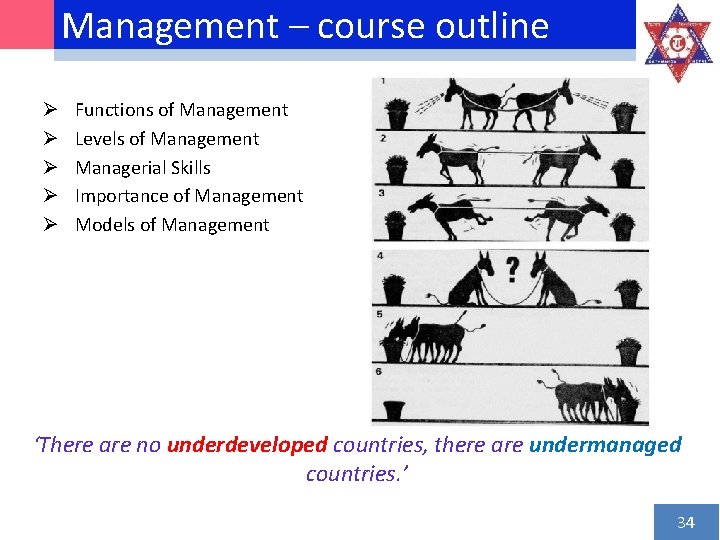
Management – course outline Ø Ø Ø Functions of Management Levels of Management Managerial Skills Importance of Management Models of Management ‘There are no underdeveloped countries, there are undermanaged countries. ’ 34
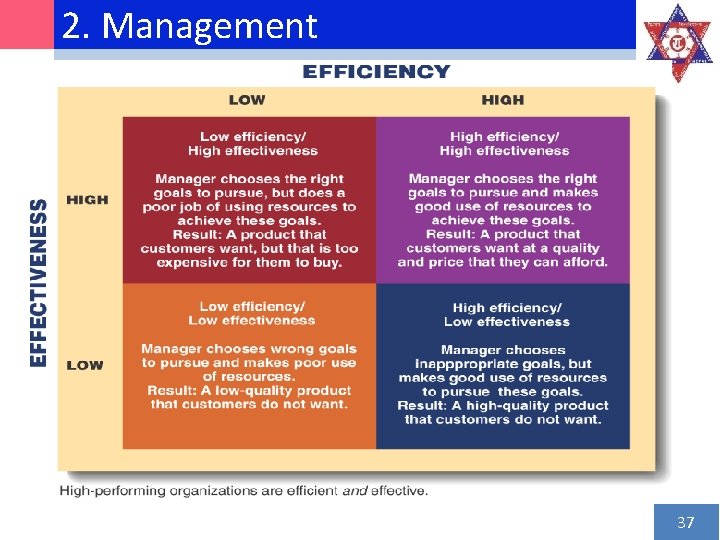
2. Management • Management may be defined as the planning, organizing, leading, and controlling of human and other resources to achieve organizational goals effectively and efficiently - Resources include people, skills, know-how and experience, machinery, raw materials, computers and IT, patents, financial capital, and loyal customers and employees - Goals include profit Levels or maximum cost levels, maintenance or growth of financial strength, quality standards, guest employee & management concerns, professional obligations, societal concerns • A precise definition of management can be stated as: “Management is a social process involving co-ordination of human and material resources through the functions of planning, organizing, staffing, leading and controlling in order to accomplish stated objectives. ” 35
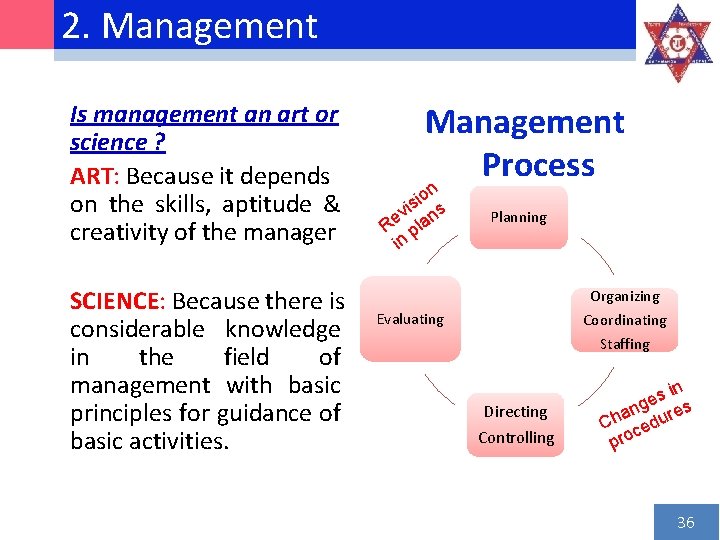
2. Management Is management an art or science ? ART: Because it depends on the skills, aptitude & creativity of the manager SCIENCE: Because there is considerable knowledge in the field of management with basic principles for guidance of basic activities. Management Process n o i is s v n Re pla in Planning Organizing Coordinating Evaluating Staffing Directing Controlling in s e g es n a r Ch cedu pro 36
2. Management 37
Administration Vs Management • Administration: Concerned with laying down of corporate policy, obtaining finance, production & distribution. • Management: Concerned with actual execution of policies within limits set by administration. • Organization: Combines the work in such a way with individuals/groups that duties formed provide best possible application of available effort. 38
I. Functions of Management is an ongoing activity consisting of number of functions. These are: A. Planning B. Organizing C. Staffing D. Directing E. Motivating F. Controlling G. Co-ordinating H. Communicating 39
A. Planning is the most basic of all management functions. Planning means thinking before doing. In other words, planning is the preparation for action. Planning includes forecasting, formulation of objectives, policies, programs, schedules, procedures and budget. “Planning is deciding in advance what to do, how to do it, when to do it and who is to do it. Planning bridges the gap from where we are, to where we want to go. It makes it possible for things to occur which would not otherwise happen” - Koontz and O’Donnell 40
A. Planning Objectives of Planning a. To help in effective forecasting. b. To provide certainty in the activities. c. To provide performance standards. d. To give a specific direction to the organization. e. To help in tuning organization with the environment. f. To provide economy in the management. 41
A. Planning Steps in Planning a. Determination of objectives. b. Establish planning premises and constraints. c. Decide the planning period. d. Collection, classification and processing of information. e. Deciding alternative courses of action. f. Evaluation of alternative. g. Selection of best plan. h. Subsidiary plans to aid master plan. i. Controlling plans. 42
A. Planning Advantages of Planning a. Maximum utilization of resources. b. Reduces uncertainty. c. Basis for managerial action. d. Basis for control. e. Encourages innovation and creativity. Limitations of Planning a. Limitations of forecast. b. Costly affair. c. Influence of external factors. d. Resistance to change. e. Rigidity and inflexibility. 43
A. Planning Elements/Components of Planning a. Goals: relatively long run targets. b. Objectives: ends towards which the activities of an organization are targeted. c. Policies: provides the framework for executive action. d. Rules: simplest type of plan chosen from alternatives. e. Procedures: means of implementing a policy. f. Programs: step by step approach to guide action. g. Schedule: when each of series of action should take place. h. Budget: projection defining anticipated costs. 44
B. Organizing involves identification and grouping the activities to be performed and dividing them among the individuals and creating authority and responsibility, relationship among them. Organization, in fact is a back bone of management, which establishes relationship between people, work and resources. Steps in Organizing a. Determination of activities. b. Division of activities. c. Fitting individuals into jobs. d. Developing relationships in terms of authorities and responsibilities. 45
C. Staffing involves filling the positions needed in the organization structure by appointing competent and qualified persons for the jobs. Steps in Staffing a. Recruitment b. Selection c. Placement d. Training e. Development of personnel f. Developing system for remuneration of personnel and evaluating their performance. 46
D. Directing involves motivating, guiding and supervising subordinates towards company objectives. Only giving orders is not directing. Good planning may ensure the achievement of the predetermined objectives only when the human efforts, largely diverse are co-ordinated, guided and directed for the accomplishment of the objectives. Directing is that part of the management process which actuates the organizational members to work effectively and efficiently for the attainment of organizational objectives. Steps in Directing a. Issue of orders and instructions. b. Guidance and training of subordinates. c. Supervision of subordinates’ work. 47
E. Motivating Motivation means inspiring people to intensify their desire and willingness to perform their duties effectively and co-operate for the achievement of common objectives of the business. “Motivation is the act of stimulating some one or oneself to get a desired course of action, to push the right button to get desired action. ” Fundamentals of Motivation The first fundamental thing is that a person wants to exist and survive and for this he needs basic necessities of life e. g. food, cloth, shelter, education and medical aid etc. The second fundamental of motivation is the desire to achieve a goal, for satisfaction or bliss. Basically, people are motivated to put in sincere efforts if they are assured of fulfilling their needs. Such as psychological needs, social needs, security needs, ego (needs for self -respect) etc. 48
E. Motivating Classification of Motivation a. Internal Motivation: E. g. Interests, emotional attachments, burning desires, fighting spirits for noble cause etc. b. External Motivation: E. g. Attractive salary, bonus, praise, incentive, punishment, fear of loss of job etc. Essentials of Sound Motivation System a. Good wages. b. Good financial incentive scheme. c. Opportunities for achievement, growth, motivation. d. Human relations. e. Good working conditions. f. Job satisfaction. g. Job security. 49
F. Controlling It management literature, the word “Control” has a special meaning. It means setting standards, measuring actual performance, and taking corrective action. “Controlling implies measurements of accomplishment against the standard and the correction of deviations to ensure attainment of objectives according to plans. ” - Koontz and O’Donell Steps in Controlling a. Setting standards. b. Checking and reporting on performance. c. Taking corrective action. Types of Control: based on objectives a. Physical Control: quantity and quality of products b. Financial Control: cost per unit production, cost of material, labor expenses etc. c. Budgetary Control: physical and financial standards for future are determined and results are compared against these pre-determined standards. 50
G. Co-ordinating Co-ordination may be defined as on-going process whereby a manager develops an integrated, orderly and synchronized pattern of group effort among his subordinates and tries to attain unity of effort in the pursuit of a common purpose. “Co-ordination is the orderly management of group effort, to provide unity of action in the pursuit of common purpose” – Alan C. Reiley and James D. Mooney Types of Co-ordination a. Internal Co-ordination b. External Co-ordination c. Vertical Co-ordination d. Horizontal Co-ordination 51
H. Communicating Communication is the process by which instructions, ideas, thoughts or information are transmitted, received and understand, by the persons working in organization. Components of Communication a. Sender b. Message c. Receiver d. Feedback The sender must appropriately prepare the message to be transmitted to the receiver. The receiver must understand the message clearly. Communication is never complete until the sender knows that the message has been received and understood either through feedback or observation of the receiver’s behavior. 52
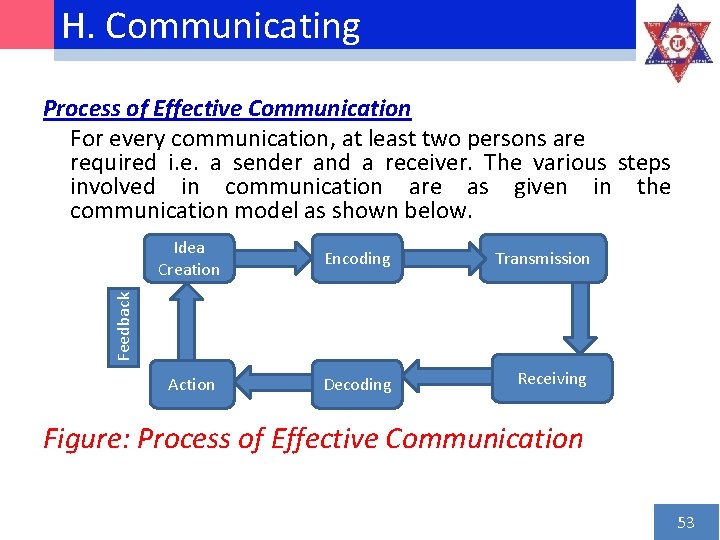
H. Communicating Process of Effective Communication For every communication, at least two persons are required i. e. a sender and a receiver. The various steps involved in communication are as given in the communication model as shown below. Encoding Transmission Action Decoding Receiving Feedback Idea Creation Figure: Process of Effective Communication 53
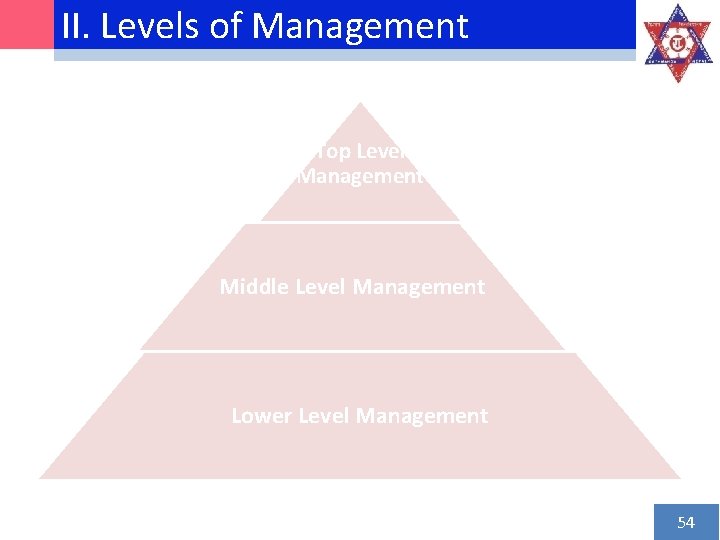
II. Levels of Management Top Level Management Middle Level Management Lower Level Management 54
II. Levels of Management Top level Management: • Responsible for the performance of all departments and have cross-departmental responsibility. • Establish organizational goals and monitor middle managers • Decide how different departments should interact • Ultimately responsible for the success or failure of an organization • Includes Board of Directors, CEO, Chairman, Officer etc. 55
II. Levels of Management Middle level Management: • Responsible for finding the best way to organize human and other resources to achieve organizational goals • Establish organizational goals and monitor middle managers • Includes Head of Department, Section officer etc. Lower level Management: • Responsible for daily supervision of the non-managerial employees who perform many of the specific activities necessary to produce goods and services. • Includes Foreman, Supervisor, Inspector, Superintendent, Workers 56
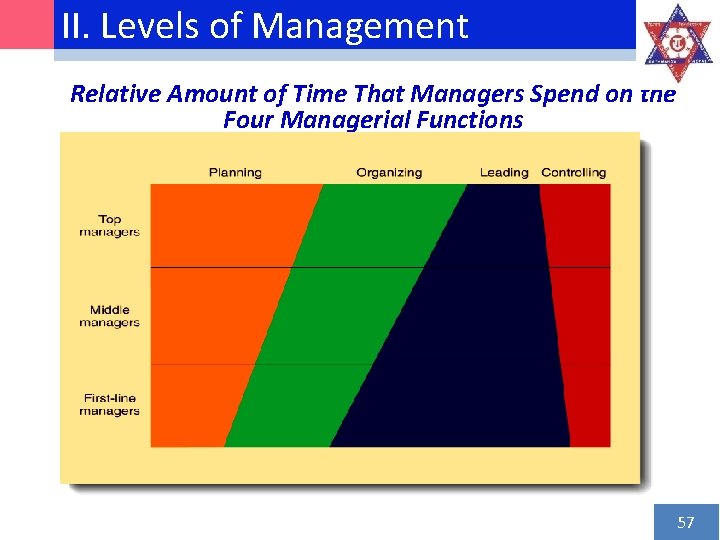
II. Levels of Management Relative Amount of Time That Managers Spend on the Four Managerial Functions 57
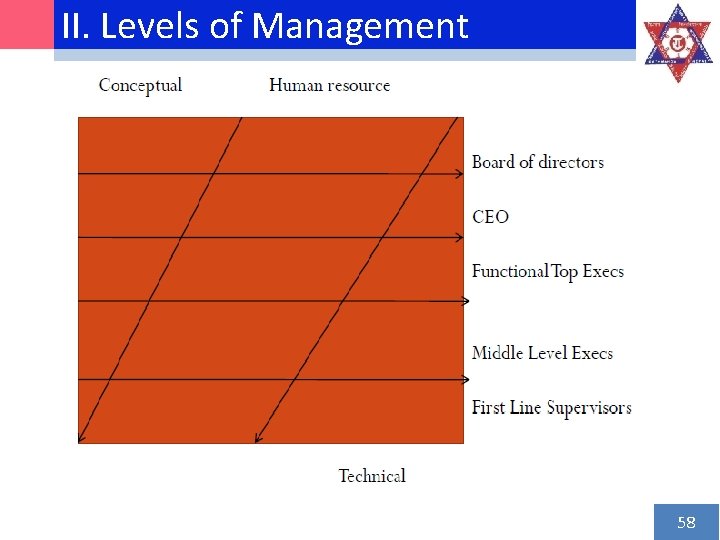
II. Levels of Management 58
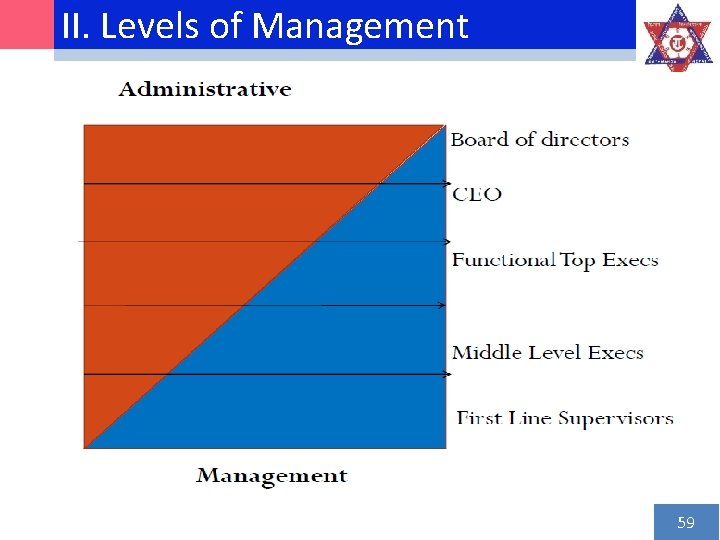
II. Levels of Management 59
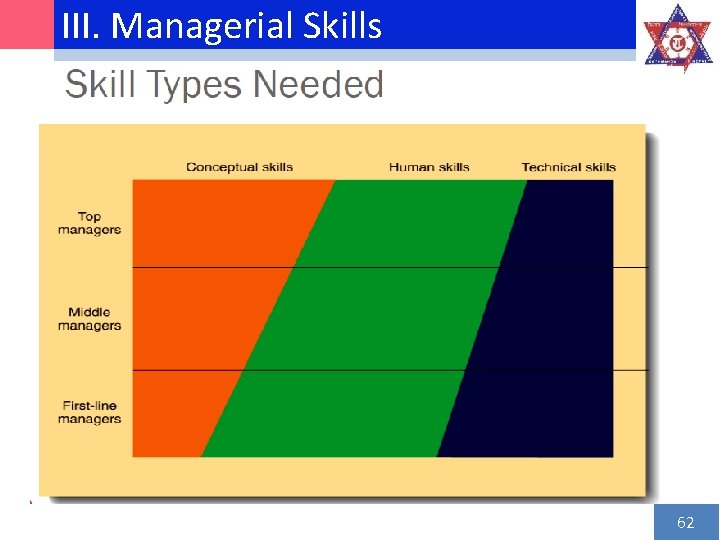
III. Managerial Skills Managerial skills is the ability of a manager to make a smooth functioning team of people working under him. It involves obligation to make effective utilization of human and material resources. It requires sound judgment to handle complex situations. The skills required of a successful manager, whether he is working in a business organization, an educational institute or a hospital can be classified as under: a. Technical Skills b. Conceptual Skills c. Human Relation Skills 60
III. Managerial Skills • Conceptual skills: The ability to analyze and diagnose a situation and distinguish between cause and effect. - Decision making skills: ability to take timely and accurate decisions. - Organizational skills: ability to place right men for the right job. • Human skills: The ability to understand, alter, lead, and control the behavior of other individuals and groups. - Communicating skills: ability to pass on information. - Motivating skills: ability to inspire the subordinates. - Leadership skills: ability to inspire confidence and trust in the subordinates. • Technical skills: Job-specific skills required to perform a particular type of work or occupation at a high level. - ability to use methods, processes, tools, equipment, techniques and knowledge of a specialized field. 61
III. Managerial Skills 62
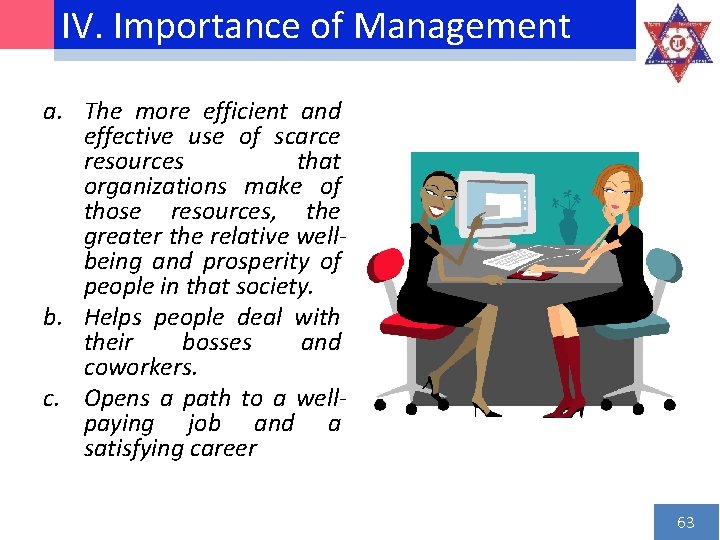
IV. Importance of Management a. The more efficient and effective use of scarce resources that organizations make of those resources, the greater the relative wellbeing and prosperity of people in that society. b. Helps people deal with their bosses and coworkers. c. Opens a path to a wellpaying job and a satisfying career 63
V. Models of Management Based on the different practices, there are seven different models of management. 1. Hierarchical management Model 2. Task oriented management model 3. Allocational management model 4. Transactional management model 5. Team effort management model 6. Knowledge oriented management model 7. Goal concentrates management model 64
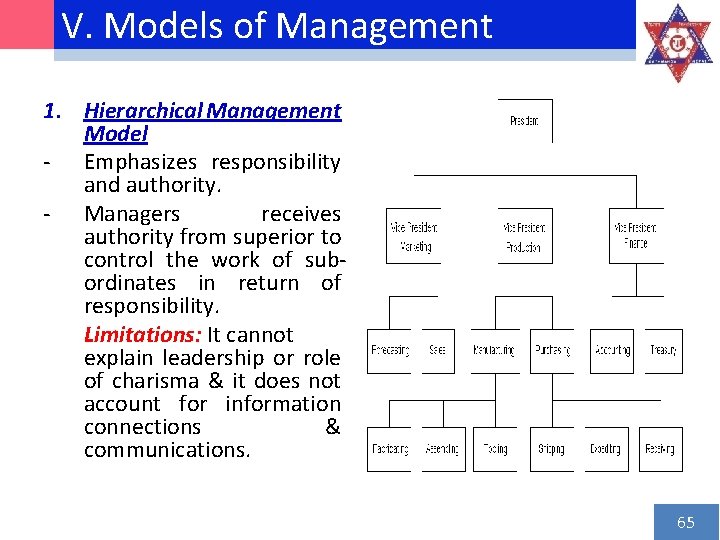
V. Models of Management 1. Hierarchical Management Model - Emphasizes responsibility and authority. - Managers receives authority from superior to control the work of subordinates in return of responsibility. Limitations: It cannot explain leadership or role of charisma & it does not account for information connections & communications. 65
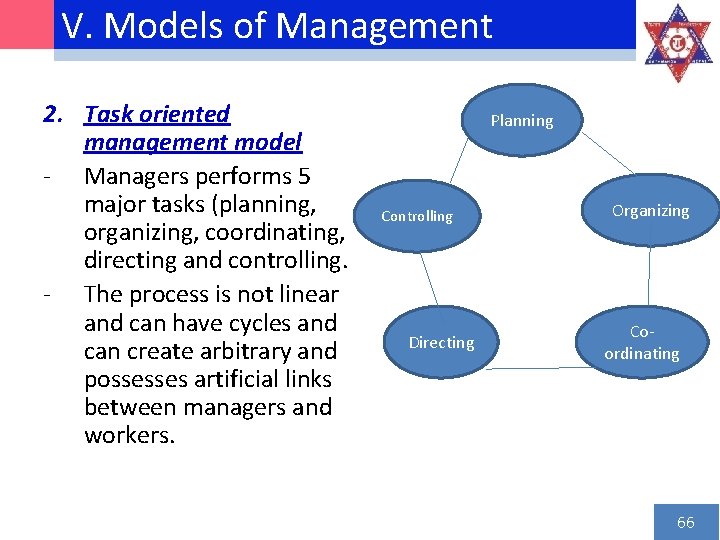
V. Models of Management 2. Task oriented management model - Managers performs 5 major tasks (planning, organizing, coordinating, directing and controlling. - The process is not linear and can have cycles and can create arbitrary and possesses artificial links between managers and workers. Planning Controlling Directing Organizing Coordinating 66
V. Models of Management 3. - - Allocational management model A resource manager obtains, allocates, shares, monitors consumption and return resources keeping the ‘cup topped up’ as necessary. It does not provide a true process view of management. It distinguishes among the type of resources and stages of resources and recognizes the nature of the organization. 67
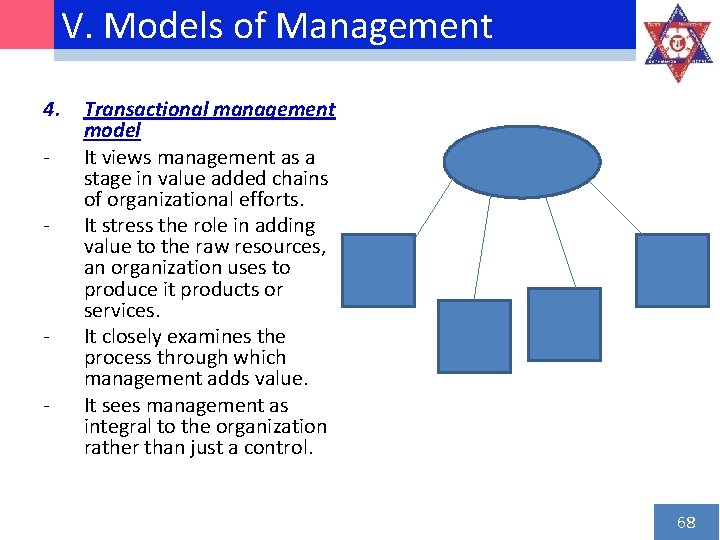
V. Models of Management 4. - - Transactional management model It views management as a stage in value added chains of organizational efforts. It stress the role in adding value to the raw resources, an organization uses to produce it products or services. It closely examines the process through which management adds value. It sees management as integral to the organization rather than just a control. 68
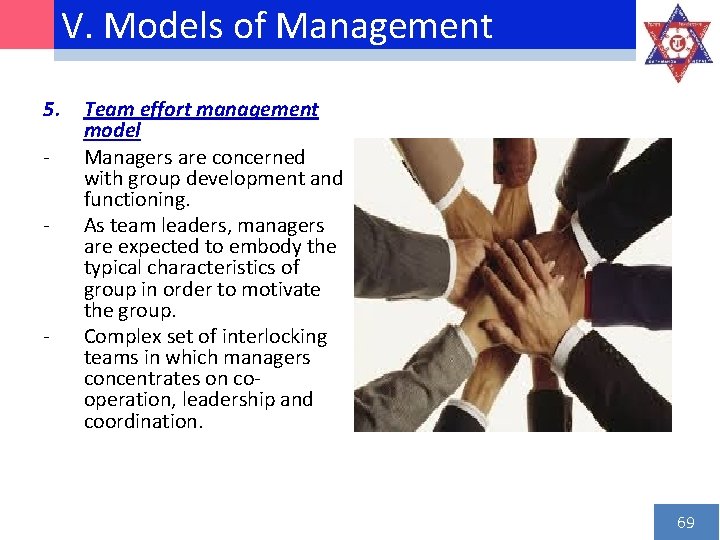
V. Models of Management 5. - - Team effort management model Managers are concerned with group development and functioning. As team leaders, managers are expected to embody the typical characteristics of group in order to motivate the group. Complex set of interlocking teams in which managers concentrates on cooperation, leadership and coordination. 69
V. Models of Management 6. - - Knowledge oriented management model Concentrates on the development and use of management knowledge. Management develops knowledge and this knowledge is diffused to the monitoring relationship, teaching, coaching and active training. Advantages: Organization must learn to adapt and win in changing environment. ? 70
V. Models of Management 7. - - Goal concentrates management model Focuses on role management and goals in actions. Views management as a control function, incorporates resource management. Managers receive information from internal and external environment & order adjustments so that an original plan can be adhered to goals in actions. 71
72
3. Theory of management – course outline Ø Scientific Management Approach Ø Administrative Management Approach Ø Behavioral Management Approach Ø Modern Management Theories 73
3. Theory of Management • • Management can be divided into following categories based on the approaches. Scientific Management Approach Administrative Management Approach Behavioral Management Approach Modern Management Theories 74
I. Scientific Management Approach As a term Scientific Management was first used in USA in 1910 by Louis Brandies. As a process, it was first visualized in UK in 1832 by Charles Babbage. The utility of scientific methods to problems of management was first of all introduced by F. W. Taylor in America (1865 -1915). He is regarded as a “Father of Scientific Management”. Scientific management may be defined as ‘art of knowing exactly what is to be done and the best way of doing it”. 75
I. Scientific Management Approach It is the result of applying scientific knowledge and the scientific methods to the various aspects of management and the problems that arise from them. It tries to make the best use of production resources (men, materials, machines, capital etc. ) Principles of Scientific Management i. Development of science for each element of work. ii. Scientific selection, placement and training of workers. iii. Division of labor. 76
I. Scientific Management Approach Principles of Scientific Management (contd…) iii. Standardization of methods, procedures, tools and equipment. iv. Use of time and motion study. v. Differential wage system. vi. Co-operation between labor and management. vii. Principle of management by exception. 77
II. Administrative Management Approach Administrative theory of management was initiated by H. Fayol, a French engineer-cum-manager in Europe and his followers contributed a lot to the administrative theory of management. H. Fayol is known as a “Father of Modern Management”. He established the pattern of management and the pyramidal form of organization. He pointed out the technical ability is more dominating on the lower level of management whereas managerial ability is more important on the higher level of management. 78
II. Administrative Management Approach i. iii. iv. v. vi. Fayol analyzed the process of management and divided the activities of an industrial undertaking six groups: Technical activities (production, manufacture, adaptation) Commercial activities (purchasing, selling and exchange) Financial activities (optimum use of capital) Security (protection of property and persons) Accounting (stock taking, balance sheet, costing, statistics) Managerial (planning, organizing, commanding, coordinating and controlling) 79
II. Administrative Management Approach Principles of Administrative management theory i. Division of work ii. Authority and responsibility iii. Discipline iv. Unity of command v. Unity of Direction vi. Emphasis on subordination of personal interests to general or common interest. vii. Adequate remuneration to personnel. 80
II. Administrative Management Approach Principles of Administrative management theory viii. Centralization. ix. Scaler chain or line of authority. x. Order xi. Equity xii. Stability of workers xiii. Initiative. xiv. Team spirit. 81
II. Administrative Management Approach Contribution of Frank Gilbreth (father of motion study) Ø He introduced process chart and concluded that fatigue can be reduced considerably by allowing rest periods, planning seating arrangement, improving working conditions and by using principles of motion economy. Contribution of Gantt Ø He developed a Gantt chart which is still used as a scheduling technique to have a immediate comparison between the planned work and the actual progress of the work. So as to enable the management to take corrective action if there is a significant deviation. 82
III. Behavioral Management Approach Scientific management theory concentrated on physical resources rather than human resources. Prof. Elton Mayo has stated that an organization is essentially a social system and not merely technoeconomic system. Knowledge of human nature can solve many problems of management. He stressed that successful human relations approach can easily create harmony in an organization, higher employee satisfaction and therefore higher operational efficiency and productivity. 83
III. Behavioral Management Approach A. H. Maslow developed a need hierarchy to explain human behavior within an organization. The knowledge of individual and group behavior enables to develop suitable work atmosphere or situations which can increase productivity as well as employee satisfaction. Behavioral approaches have clearly pointed out that job conditions and the job itself are the motivators that can satisfy the needs of both employees and the organization. These motivators are recognition, sense of belonging, challenging job, independence, participation achievement, enlargement and enrichment of job itself. 84
III. Behavioral Management Approach Elements of Behavioral Theory i. The Individual: This theory stressed that individual difference must be recognized. Each individual has feelings, emotions, perception and attitudes; and ever changing psychology. ii. Work Group: The management must recognize the importance of informal organization (work group) and it must be integrated intelligently with formal organization. This theory recognizes the vital effect of group psychology and behavior on motivation and productivity. iii. Participative management: This theory advocated worker participation in management. It allows labor to participate in decision making and problem solving primarily to increase productivity. 85
IV. Modern Management Theories Modern management theories started after 1950. There are four streams under the modern management theory: i. Quantitative approach to management. ii. System approach to management. iii. Contingency approach to management. iv. Operational approach to management. 86
i) Quantitative approach to management The scientific approach of Taylor could be classified as an early form of quantitative approach to management. The basic approach is the construction of a quantitative model. The construction of the model expresses the effectiveness of the system under study as a function of a set of variables at least one of which is subject to control. Essential features of quantitative approach: a. Management must make use of mathematical tools and techniques (e. g. . Use of equations) for problem solving. b. Operational research, mathematical tools, simulation and model building are the basic methodologies developed by this approach. It has helped the management in systematizing thinking. 87
ii) System approach to management The system approach is the recent contribution to management thought developed in the late 1960 s. The prominent contributors to this approach are Kenneth, Boulding, Johnson, Rosen Zweig and Churchman. In relation to organization, system is defined as, ‘an established arrangement of components which leads to accomplishment of particular objectives as per plan’. PLAN 1. Objectives 2. Policies 3. Procedures 4. Programs 5. Schedules 6. Methods INPUTS 1. Information (Technology) 2. Energy (motive power) 3. Materials or Goods PROCESS Conversion of inputs to outputs (Men-Machine system) OUTPUT 1. Information (for consulting firm) 2. Energy (for power generation comp. ) 3. Materials (products) 88
iii) Contingency approach to management The major contributors to this thought are Joan Woodward, Fiedler, Lorsch and Lawrence. The contingency approach to management is based upon the fact there is no one best way to handle any of the managerial problems. The application of management principles and practices should be appropriate to specific situations (existing circumstances) in order to achieve best possible result. Process, behavioral, quantitative and systems tools of management should be applied situationally. There are three major parts of the overall conceptual framework for contingency management: a. Environment. b. Management concepts, principles and techniques. c. Contingent relationship between a) and b) above 89
iv) Operational approach to management Knootz, O’Donnell and Weihrich eminent writers of management have adopted the operational approach to management. The operational approach regards management as a universally applicable body of knowledge that can be brought to bear all the levels of managing and in all types of enterprises. The approach further recognizes that the actual problems which mangers face and the environment in which they operate may vary between different enterprises and levels and it also recognizes that the application of science by a perspective practioner must take this into account in drawing and designing practical problem. 90
Characteristics of modern management thought i. The system approach. ii. Dynamic nature. iii. Multi-disciplinary. iv. Multivariable in thought. v. Multi-motivated in action. vi. Multi-level and Multi-dimensional. vii. Adaptive viii. It is probabilistic in approach. 91

92
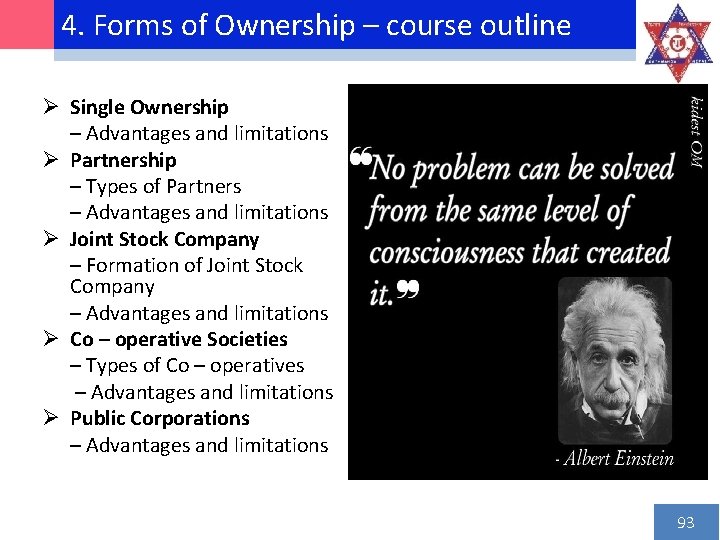
4. Forms of Ownership – course outline Ø Single Ownership – Advantages and limitations Ø Partnership – Types of Partners – Advantages and limitations Ø Joint Stock Company – Formation of Joint Stock Company – Advantages and limitations Ø Co – operative Societies – Types of Co – operatives – Advantages and limitations Ø Public Corporations – Advantages and limitations 93
4. Forms of Ownership A firm is an ownership organization which combines the factors of production (men, materials, and machines) in a plant for the purpose of producing goods or services and selling them at profit. The types of ownership selected depends upon the following factors: i. Size and nature of the business to be started. ii. Technical difficulties. iii. Market competition and scope of the articles in the market. iv. Capital required to start the business and means to collect funds. v. Limitations and restrictions put forth by the Govt. in connection with grant of loans, foreign exchange and such other things. 94
4. Forms of Ownership • • • The different forms of ownership found in practice are illustrated below: Single Ownership Partnership Joint Stock Company Co – operative Societies Public Corporations 95
4. Forms of Ownership Evaluation Criteria • Tax consideration • Liability exposure • Start-up and future capital requirement • Control • Managerial ability • Business goals • Management succession plans • Cost of formation 96
I. Single Ownership It is the simplest and oldest form of organization. A business owned and managed by one individual; the business and the owner are one and the same in the eyes of the law. This form of ownership is most satisfactory in small scale industries, agriculture, cottage industries, commercial shops, handicrafts etc. 97
I. Single Ownership Advantages q Simple to create q Better labor relationship. q Least costly form q Profit incentive q Total decision-making q No special legal restrictions q Easy to discontinue q Flexibility q Quality production 98
I. Single Ownership Limitations q Unlimited personal liability q Limited skills and abilities q Feelings of isolation q Limited access to capital q Lack of continuity of business q Small income and short life q Cannot compete with a big business 99
II. Partnership A person may posses exceptional business ability, experience, talent but no capital, he can have a financing partner. A financier may need a managerial expert as well as a technical expert and all of them may combine to set up a business with common ownership and management by mutual agreement to form a partnership business. An association of two or more people who co-own a business for the purpose of making a profit 100
II. Partnership Types of Partners • General partners: partners who participate in the working of the firm and are responsible jointly with other partners, for all liabilities, obligations and defects of the firm are the general partners. • Limited partners: the liability for debts of the limited partners is limited to the extent of their contributed capital. They are not entitled to interfere in the administration of the firm. • Active or managing partners: who take active part in the management and formulation of policies. Sometimes they get salaries in addition to the normal profits as partners 101
II. Partnership Types of Partners • Sleeping and silent partners: they simply contribute their capital in the business and get their share in the profit of the firm. They are liable for all liabilities of the firm as partners. • Nominal partners: they lend their reputed name for the company’s reputation. They do not invest money and do not take active part in the management. • Minor partners: those whose age is below 18. 102
II. Partnership Advantages q Easy to establish q Complementary skills q Division of profits q Larger pool of capital q Ability to attract limited partners q Little governmental regulation q Flexibility q Taxation q Prompt decisions q Divisions of labor 103
II. Partnership Disadvantages q Unlimited liability of at least one q Difficulty in disposing of interest q Lack of continuity q Potential for personality and authority conflicts q Partners bound by law of agency q Less secrecy q Short life 104
III. Joint Stock Company In this type, capital is contributed by a large number of persons, in the form of shares of different values. Persons who purchase the shares are called shareholders, and the managing body known as “Board of Directors” is elected by the shareholders. The shares are transferable. Characteristics of Joint Stock Company i. Created by registering under the company act. ii. Separate legal existence. iii. Perpetual life and stable. iv. Common seal. v. Limited liability. Types of Joint Stock Company i. Private limited company: Max. number of shareholders 50 generally within friends and relatives where transfer of shares is limited to members only. ii. Public limited company: Min. number required is 7 and offers shares to general public. Shares are transferable without any prior approval. 105
III. Joint Stock Company Formation of Joint Stock Company. An entrepreneur (promoter) prepares a scheme of business, he secures the co-operation of at least six more persons, because the maximum number of persons to form a company is seven. The promoters of the company prepare the following documents. a. Memorandum of association. b. Articles of association. c. A list of persons who have consented to be the Directors of the company along with the consent in writing of such persons. d. A declaration by an advocate to the effect that all the requirements of the Act have been fulfilled. e. Name and address of promoters 106
III. Joint Stock Company Advantages i. Limited liability. ii. Huge capital. iii. Economies of large scale. iv. Democratic. v. Permanent existence. vi. Legal control. vii. Share transferable. Disadvantages i. Exploit shareholders. ii. Legal complexities. iii. Delay in decisions. iv. Favourisms. v. Difficult labor relations 107
IV. Co-operative Societies Co-operative societies is a form of organization where in persons irrespective of caste, creed, and religion, voluntarily associate together as human beings on the basis of equality for the fulfillment of their common economic interests. Co-operative spirit is the heart of a co-operative society. “Each shall work for all and all for each” is the motto of co-operation. Characteristics: i. Voluntary organization. ii. Open membership. iii. Economic and Democratic management. iv. Profit is not important. v. Spirit of Co-operation. vi. Unity. vii. Common Interest. viii. Co-operative status. 108
IV. Co-operative Societies Types of Co-operative societies 1. Producers co-operative society: the workers wish to be their own masters the business owned by them. E. g. agricultural and cottage industries. 2. Consumers co-operative society: a store is opened in which articles of common use are stocked and sold at reasonable prices. 3. Housing co-operative society: they are formed for the purpose of getting plots or constructing houses for the needy persons. Government provides facilities for this purpose. 4. Credit co-operative society: its objective is to finance the poor cultivators by providing loans at low rate of interest for the development of land, purchase of agricultural machinery, fertilizers etc. 109
IV. Co-operative Societies Advantages 1. Protect interests of weak people. 2. Elimination of middle man. 3. Services motive. 4. Democratic nature. 5. Sense of co-operation. Disadvantages 1. Lack of co-ordination. 2. Chances of undue advantages. 3. Favourism. 4. Limited capital. 5. Inefficient management. 6. Political influence. 110
V. Public Corporations A separate legal entity apart from its owners which receives the right to exist from the state in which it is incorporated. q Domestic q Foreign q Alien q Publicly held q Closely held 111
V. Public Corporations Certificate of Incorporation q Name q Statement of purpose q Time horizon q Names and addresses of incorporators q Place of business q Capital stock authorization’ q Capital required at time of incorporation q Provisions for preemptive rights q Restrictions on transferring shares q Names and addresses of officers q By-laws 112
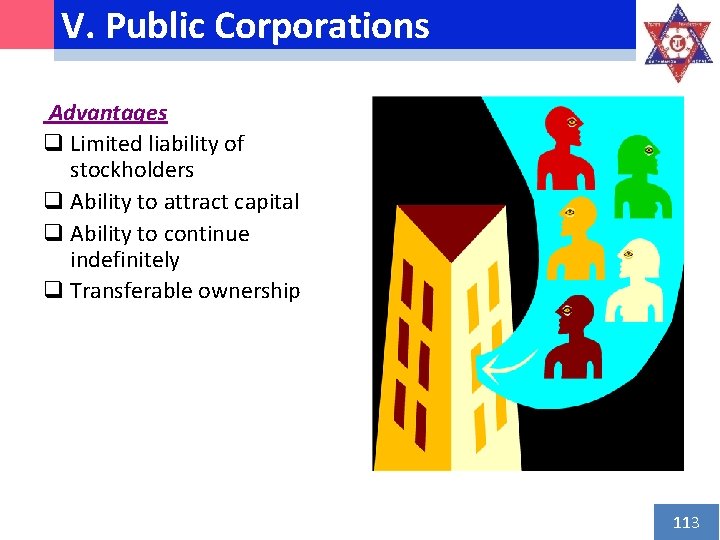
V. Public Corporations Advantages q Limited liability of stockholders q Ability to attract capital q Ability to continue indefinitely q Transferable ownership 113
V. Public Corporations Disadvantages q Cost and time in incorporating q Double taxation q Potential for diminished incentives q Legal requirements and red tape q Potential loss of control 114

115
Organizational Structure – course outline Ø Line Organization – Advantages and disadvantages Ø Functional Organization – Advantages and disadvantages Ø Line and Staff Organization – Advantages and disadvantages Ø Committee Organization – Advantages and disadvantages 116
5. Organizational Structure The organization structure is a skeleton or a framework that divides the total activities into related groups, develops superior and subordinate relationship among the persons by prescribing the authorities. Thus, it indicates the hierarchy (persons arranged according to rank), authority structure and reporting relationships (who should report to whom). The organizational structure differs from industry to industry. It usually depends upon: i. Size of the organization. ii. Nature of the product being manufactured. iii. Complexity of the problems being faced. 117
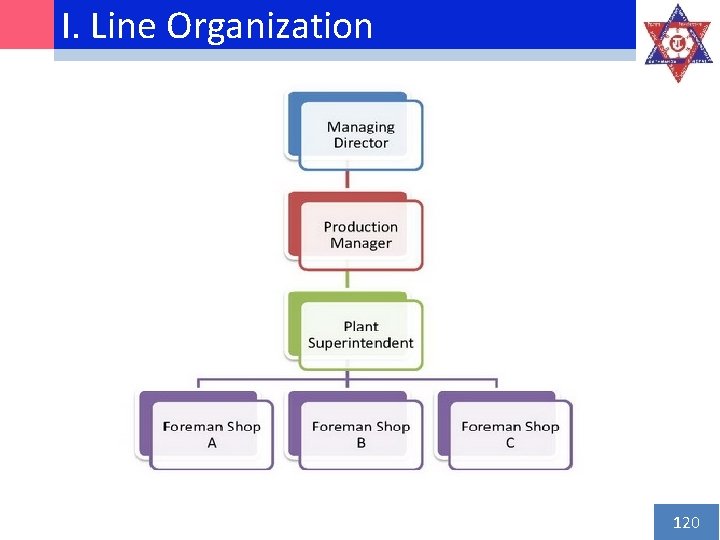
I. Line Organization This is the simplest and earliest type of organization. It is also called as Military or Scalar organization. In this type of organization, the line of authority flows directly from top to bottom and the line of responsibility from bottom to top in opposite direction. In line organization, the business activities are divided into three groups: i. Finance or accounts ii. Production iii. Sales (distribution) 118
I. Line Organization Each of these departments is subdivided into certain self-contained departments or sections. Each departmental head has complete control over his section and he is fully authorized to select his labor, staff, purchases of raw materials, stores and to set the standards of output etc. The responsibility of each departmental head is clearly defined. Each department works as a self -supporting unit. 119
I. Line Organization 120
I. Line Organization Advantages 1. Simplicity. 2. Clear cut authority and responsibility. 3. Strong in discipline. 4. Unity of command. 5. Quick decisions. 6. Rapid communication. 7. Co-ordination. 8. Development of allround activities. Disadvantages 1. Undue reliance. 2. Personal limitation. 3. Overload of work. 4. Dictatorial way. 5. Duplication of work. 6. Unsuitable for large concerns. 7. Scope of favourism. 8. Wastage of materials and man hours. 121
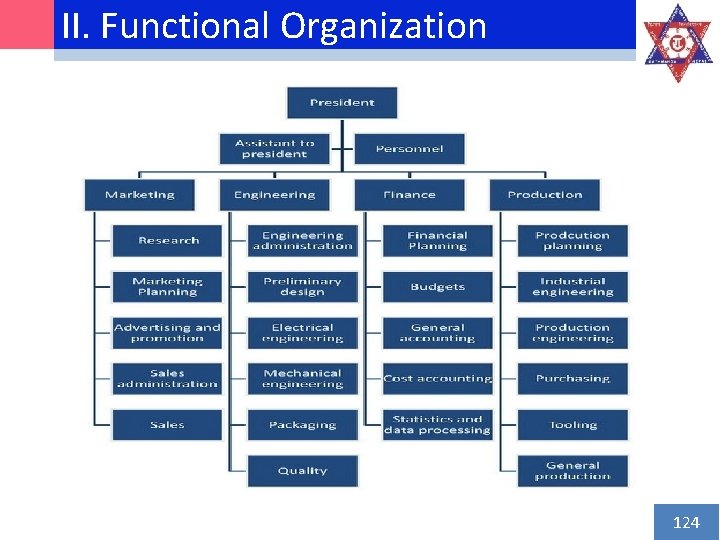
II. Functional Organization F. W. Taylor suggested functional organization, because it was difficult to find all-round persons qualified to work at middle management levels in the line organization. Functional organization divides managerial activities, so that each head from the works manager down has few functions to perform as possible and is able to become specialist in these. Authority from top to down is delegated according to the function. In this type of organization specialists like production engineer, design engineer, maintenance engineer, purchase officer etc. are employed. 122
II. Functional Organization Each specialist is supposed to give his functional advice to all other foreman and workers. Taylor divided the responsibility of shop supervision among several foreman, each specially qualified and in charge of certain aspect of work. Each specialist is authorized to give orders to workers, but only in regard of his field of specialization. 123
II. Functional Organization 124
II. Functional Organization Advantages 1. Separation of work. 2. Specialization. 3. Narrow range with high depth. 4. Ease in selection and training. 5. Reduction in prime cost. 6. Scope for growth and development of business. 7. Standardized operations. 8. Standardization. Disadvantages 1. Indiscipline. 2. Shifting of responsibility. 3. Kills the initiative of workers. 4. Overlapping of authority. 5. Lack of co-ordination between functions. 6. Increase in cost. 125
III. Line and Staff Organization Line and staff organization is that in which the line heads are assisted by specialist staff. If the firm is too large, managers cannot give careful attention to every aspect of management. They are busy with ordinary task of production and selling. Hence staff is deputed to do the work of investigation, research, recording and advising to managers. Thus the staff brings specialization by assisting the line officers. 126
III. Line and Staff Organization The line maintains discipline and stability, staff provided experts information and helps to improve overall efficiency. Thus the staff are thinkers while the line are doers. Usually the staff has no administrative authority. They serve only in advisory capacity in their field of specialization. In big steel plants, heavy electrical electricity boards, large manufacturing plants etc. 127
III. Line and Staff Organization 128
III. Line and Staff Organization Advantages 1. Planned specialization. 2. Well defined authority and responsibility. 3. Availability of specialized knowledge. 4. Adaptability to progressive business. 5. Less wastage. 6. Improved quality. Disadvantages 1. Chances of misinterpretation. 2. Chances of friction. 3. Ineffective staff in the absence of authority. 4. Expensive 5. Lethargic staff officer in the absence of accountability. 6. Loss of initiative by line executive 129
IV. Committee Organization Committees have come to be recognized as a formal part of organization structure and they are found at all levels of management hierarchy in all large companies. Thus committees are not separate type organizations. A committee is a formally organized group of individuals formed for the purpose of giving advice on certain important problems, which cannot usually be solved by an individual. 130
IV. Committee Organization The committee members meet repeatedly, discuss, decide and recommend solution to certain problems of the organization. The committees may be of different types as follows: 1. Ad-hoc committee: formed temporarily for some specific temporary function only. 1. Permanent committee: formed when the nature of work is of repetitive type. E. g. research committee, purchase committee etc. 131
IV. Committee Organization Advantages 1. Problem is looked from more than one point of view. 2. Co-ordination. 3. Helps to adopt new ideas, innovations. 4. Promotes united actions. 5. Democratic and participative management. Disadvantages 1. Delay in decision making. 2. Compromise. 3. Non-uniformity in final decision. 4. Costly structure. 132
133
Purchasing and Marketing Management – course outline Ø Purchasing – Introduction Ø Functions of Purchasing Department Ø Methods of Purchasing Ø Marketing – Introduction Ø Functions of Marketing Ø Advertising 134
I. Purchasing- Introduction Purchasing is the first phase of materials management. Procurement is a function responsible for getting the materials, supplies and equipments of right quality, in the right quantities from the right source, at the right prices and at the right time popularly known as the five R’s of the art of efficient purchasing. ‘Purchasing is the procuring of materials, supplies, machines, tools and services required for equipment, maintenance and operation of a manufacturing plant. ’ – Alford and Beatty. 135
I. Purchasing- Introduction In a manufacturing firm the purchases can be classified as raw materials, components, consumable stores and supplies, office supplies, spares and tools, machines and equipment. Duties, functions and responsibilities of purchase department differ from industry to industry. Broadly, they can be stated as below: 1. Maintain records of materials indicating materials that can be used as substitute. 2. Maintain records of reliable source of supply and prices for each type of material required in the organization. 136
II. Functions of Purchasing Department 3. Review material specifications with a view to simplifying and standardizing them. 4. Calling quotations. 5. Analyze quotations and making contacts with right sources of supply. 6. Placing order and necessary follow up of supplies. 7. Maintain records of all purchases. 8. To make sure through inspection that right quality of material in right quantity has been purchased. 9. Checking and approving choices. 137
II. Functions of Purchasing Department 10. Checking requisitions. 11. To prepare purchase budget. 12. To ensure that the material is purchased at right time and at economical rates. 13. To prepare up-to-date list of materials required for different departments/sections. 14. To maintain uninterrupted supply of materials to various production sections. 15. To act as liaison between the vendors and different departments of the concern such as production, quality control, finance, maintenance etc. 138
II. Functions of Purchasing Department 16. To ensure prompt payment to vendors. This will help to improve vendor-vendee relations and increase in reputation of the firm. 17. To handle sub-contracts at the time of high business activity. 18. Develop new sources of supply. 19. To maintain inventory at optimum level. 20. To take decision about disposal of salvage and a scrap. 139
III. Methods of Purchasing The materials, parts, tools, equipment, supplies etc. required in the industry are purchased by different methods. Depending upon the size of the industry, nature of the material and quantity of the materials required, the different methods of purchasing are: 1. Purchasing by requirements: This method is also called as ‘hand-to-mouth buying’. In this method materials are purchased whenever the need arises. 140
III. Methods of Purchasing 2. Purchasing for specified period: In this method the standard materials like oils, coolants, stationary and other materials required regularly for the operation and maintenance of the plants, offices and other departments are purchased in quantities sufficient for specific future period, production schedules are usually the controlling factors in determination of the period. 3. Market purchasing: This method takes the full advantages of prevailing market conditions and price fluctuations. The material requirements based on production planning are calculated and market trends are analyzed before making purchases. The materials are purchased in advance of future need when the prices are low and likely to rise in future. 141
III. Methods of Purchasing 4. Speculative purchasing: It is an attempt to gain considerable profit by buying an excess of materials when prices are considered to be at low point. Unlike market purchasing, it makes price trends the primary factor in buying and gives less regard to the strict material requirements of the business. 5. Rate contract purchasing: In this method, contracts are given to suppliers to supply the material at agreed prices for a certain period (say 2 -3 years). The contract is subjected to review with an appropriate period of notice. Many concerns dealing in large quantities of basic materials like pig iron, steel, coal, coke etc. prefer to supply the materials on the contract basis over a period of time. 142
III. Methods of Purchasing 6. Group purchasing: In this method, the materials are purchased in groups or lots in one order instead of placing separate orders for each item. 7. Purchasing through Directorate General of supplies and disposal: This department enters into contract with various firms for supply of certain materials to government departments during the year at agreed rates. These firms have to certify that they are not supplying the same materials at rates lesser than the mentioned in the rate contract. Whenever the various government departments require the materials under rate contract, they place the orders directly to the concerned firms and purchase the material at rate contract prices. 143
IV. Marketing- Introduction Marketing is the performance of the business activities that direct the flow of goods and services from the producer to the consumer or end user. It the process of getting right product to the right place in the right quantity at the right price and right time. Marketing is the total system of interacting business activities designed to plan, promote and distribute need-satisfying products and services to existing and potential consumers. 144
IV. Marketing- Introduction It starts with the identification of a specific need on the part of the consumer and ends with the satisfaction of that need. The modern concept of marketing gives emphasis on consumer needs and freedom to choose. - customer orientation - customer’s satisfaction. 145
V. Functions of Marketing adds value to the product by the specific functions it performs. The basic functions of marketing are: 1. Involving ownership transfer. i. ii. Buying Selling i. ii. Transport Storage i. iii. iv. Standardization and Grading. Financing. Risk bearing. Market Information. 2. Involving physical distribution. 3. Facilitating (A and B functions) 146
VI. Advertising The word ‘Advertising’ has been derived from Latin term ‘adverto’. ‘ad’ means towards and ‘verto’ meaning to turn i. e. to turn the attention of the people towards the product. Advertising and promotion are integral part of the marketing effort. Advertising is the art of disseminating marketing information through various media of communication (such as newspapers, magazines, radio and T. V. ) at the expense of the company for the purpose of increasing or maintaining effective demand facilitating the sale of specific goods and services. 147
VI. Advertising It informs the customers about the product and 148
149
- Slides: 149