
Organisms capture and store free energy for use
- Slides: 17
Organisms capture and store free energy for use in biological processes Calvin Cycle
Where does the Calvin Cycle take place? �Stroma of the chloroplast – the fluid filled area outside of the thylakoid membrane
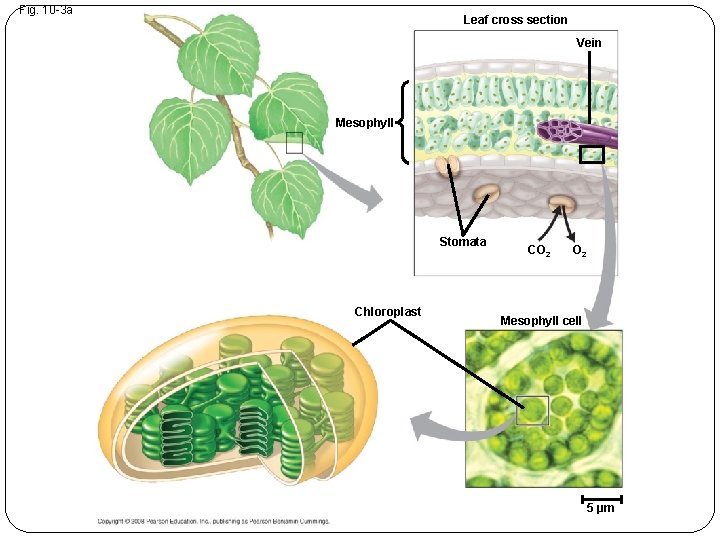
How does CO 2 enter the Calvin Cycle? �CO 2 enters through the stomata – microscopic pores in leaves �Once in the leaf the CO 2 diffuses into mesophyll cells where it can enter the chloroplast �Within the chloroplast carbon fixation takes place
Fig. 10 -3 a Leaf cross section Vein Mesophyll Stomata Chloroplast CO 2 Mesophyll cell 5 µm
What occurs during carbon fixation? �Carbon dioxide joins a five-carbon molecule called ribulose bisphophate (Ru. BP) �This reactions is catalyzed by Ru. BP carboxylase, aka Ribisco �Ribisco – the most abundant enzyme in nature �This enzyme often takes up 50% of the total chloroplast protein content �Ribisco is a slow – only catalyzing 3 molecules of substrate per second (compared to 1, 000 per second) �Unstable 6 carbon compound is formed which splits to form 2 three carbon molecules of PGA (phosphoglycerate)
How is PGA turned into sugar? �Each molecule of PGA is systematically reduced by enzyme action. �NADPH provides the hydrogen atoms and ATP provides the energy for these reactions to occur. (NADPH and ATP from Light Reactions) �PGAL (phosphoglyceraldehyde), also called G 3 P (glyceraldehyde-3 -phosphate) is the final product of the Calvin Cycle �G 3 P can be exported to the cytoplasm and combined to form fructose-6 -phosphate and glucose 1 -phosphate. �Fructose and glucose can join to form sucrose
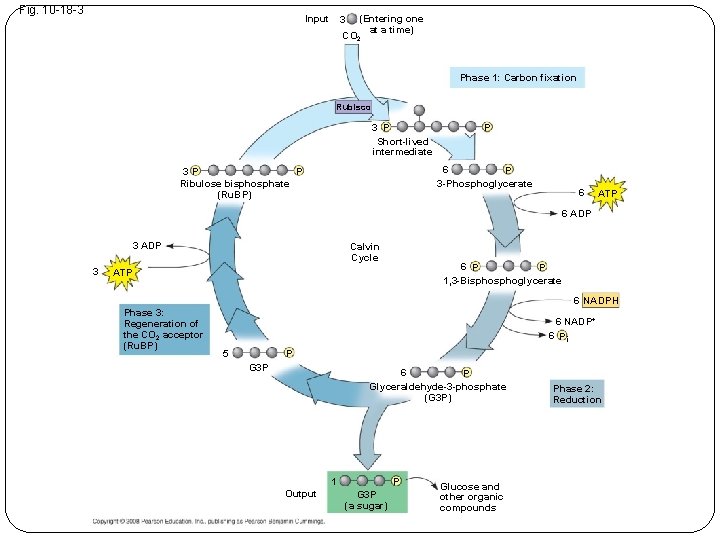
How does the Calvin Cycle get back to 5 -C Ru. BP? �For every 3 molecules of carbon dioxide fixed, 6 molecules of G 3 P are formed �Only 1 of the G 3 P exits the cycle �The other five G 3 P (3 C) molecules are used to regenerate 3 molecules of Ru. PB (5 C) using ATP from the Light Reactions
Fig. 10 -18 -3 Input 3 (Entering one at a time) CO 2 Phase 1: Carbon fixation Rubisco 3 P Short-lived intermediate P 6 P 3 -Phosphoglycerate 3 P P Ribulose bisphosphate (Ru. BP) 6 ATP 6 ADP 3 Calvin Cycle 6 P P 1, 3 -Bisphoglycerate ATP 6 NADPH Phase 3: Regeneration of the CO 2 acceptor (Ru. BP) 6 NADP+ 6 Pi P 5 G 3 P 6 P Glyceraldehyde-3 -phosphate (G 3 P) 1 Output P G 3 P (a sugar) Glucose and other organic compounds Phase 2: Reduction
Organisms use feedback mechanisms to maintain their internal environments and respond to external environmental changes Alternative Carbon Fixation Mechanisms
Why do plants need alternative mechanisms for carbon fixation? �Dehydration is a problem for plants, sometimes requiring trade-offs with other metabolic processes, especially photosynthesis �On hot, dry days, plants close stomata, which conserves H 2 O but also limits photosynthesis �The closing of stomata reduces access to CO 2 and causes O 2 to build up �These conditions favor a seemingly wasteful process called photorespiration
What is photorespiration? �In most plants (C 3 plants), initial fixation of CO 2, via rubisco, forms a three-carbon compound �In photorespiration, rubisco adds O 2 instead of CO 2 in the Calvin cycle �Photorespiration consumes O 2 and organic fuel and releases CO 2 without producing ATP or sugar
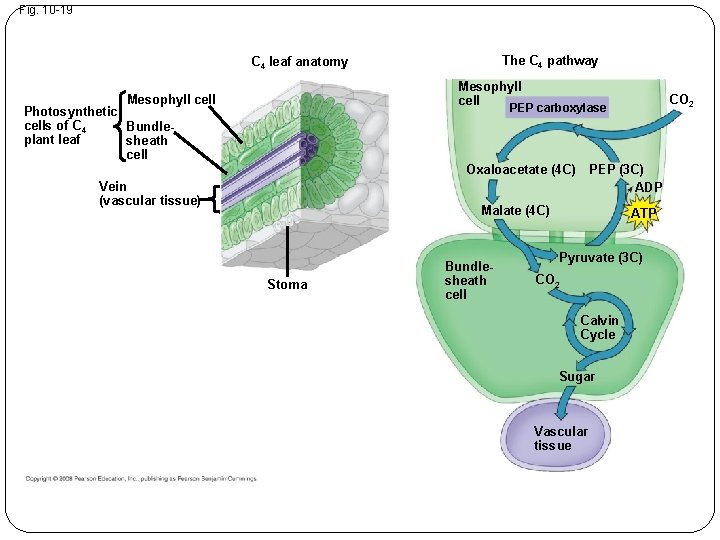
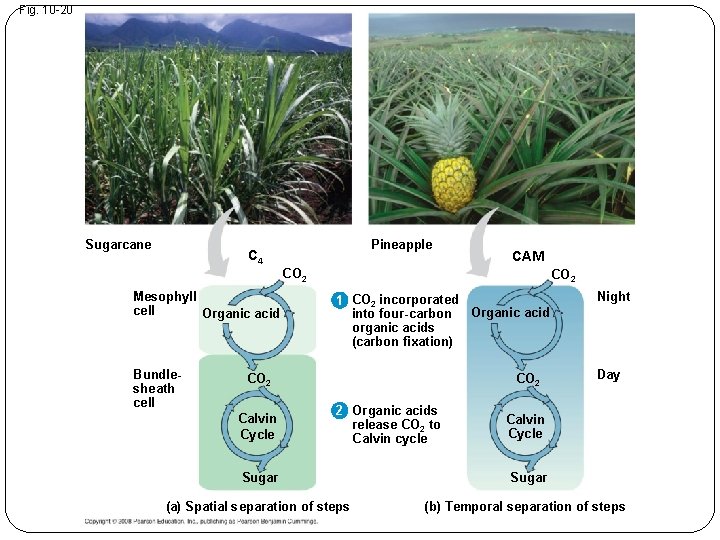
How do C 4 plants avoid photorespiration? � C 4 plants minimize the cost of photorespiration by incorporating CO 2 into four-carbon compounds in mesophyll cells � This step requires the enzyme PEP carboxylase � PEP carboxylase has a higher affinity for CO 2 than rubisco does; it can fix CO 2 even when CO 2 concentrations are low � These four-carbon compounds are exported to bundle-sheath cells, where they release CO 2 that is then used in the Calvin cycle
Fig. 10 -19 The C 4 pathway C 4 leaf anatomy Mesophyll cell Photosynthetic cells of C 4 Bundleplant leaf sheath cell CO 2 PEP carboxylase PEP (3 C) ADP Oxaloacetate (4 C) Vein (vascular tissue) Malate (4 C) Stoma Bundlesheath cell ATP Pyruvate (3 C) CO 2 Calvin Cycle Sugar Vascular tissue
How do CAM plants avoid photorespiration? �Some plants, including succulents, use crassulacean acid metabolism (CAM) to fix carbon �CAM plants open their stomata at night, incorporating CO 2 into organic acids �Stomata close during the day, and CO 2 is released from organic acids and used in the Calvin cycle
Fig. 10 -20 Sugarcane Pineapple C 4 CAM CO 2 Mesophyll cell Organic acid Bundlesheath cell CO 2 1 CO 2 incorporated into four-carbon Organic acid organic acids (carbon fixation) CO 2 Calvin Cycle CO 2 2 Organic acids release CO 2 to Calvin cycle Night Day Calvin Cycle Sugar (a) Spatial separation of steps (b) Temporal separation of steps
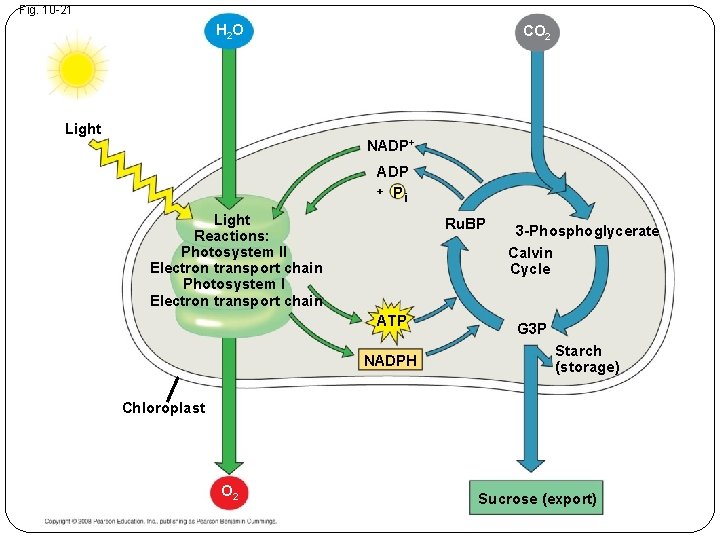
Review �The energy entering chloroplasts as sunlight gets stored as chemical energy in organic compounds �Sugar made in the chloroplasts supplies chemical energy and carbon skeletons to synthesize the organic molecules of cells �Plants store excess sugar as starch in structures such as roots, tubers, seeds, and fruits �In addition to food production, photosynthesis produces the O 2 in our atmosphere
Fig. 10 -21 H 2 O CO 2 Light NADP+ ADP + P i Light Reactions: Photosystem II Electron transport chain Photosystem I Electron transport chain Ru. BP ATP NADPH 3 -Phosphoglycerate Calvin Cycle G 3 P Starch (storage) Chloroplast O 2 Sucrose (export)