
Organism A living thing Cell The basic unit
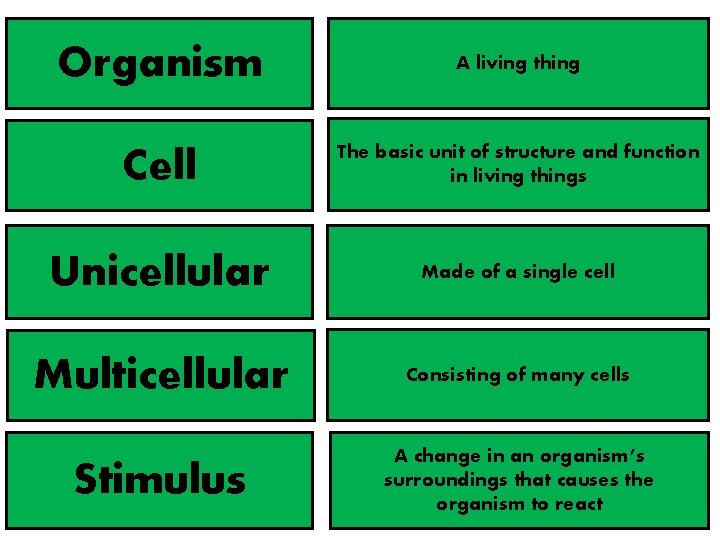
Organism A living thing Cell The basic unit of structure and function in living things Unicellular Made of a single cell Multicellular Consisting of many cells Stimulus A change in an organism’s surroundings that causes the organism to react
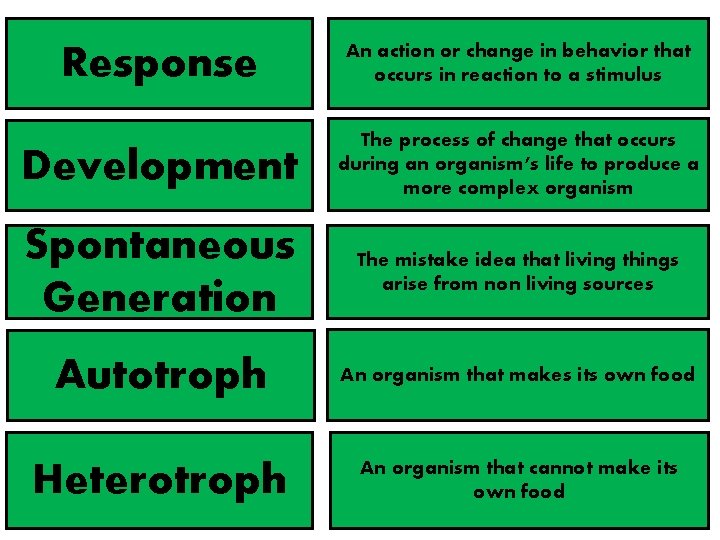
Response An action or change in behavior that occurs in reaction to a stimulus Development The process of change that occurs during an organism’s life to produce a more complex organism Spontaneous Generation The mistake idea that living things arise from non living sources Autotroph An organism that makes its own food Heterotroph An organism that cannot make its own food
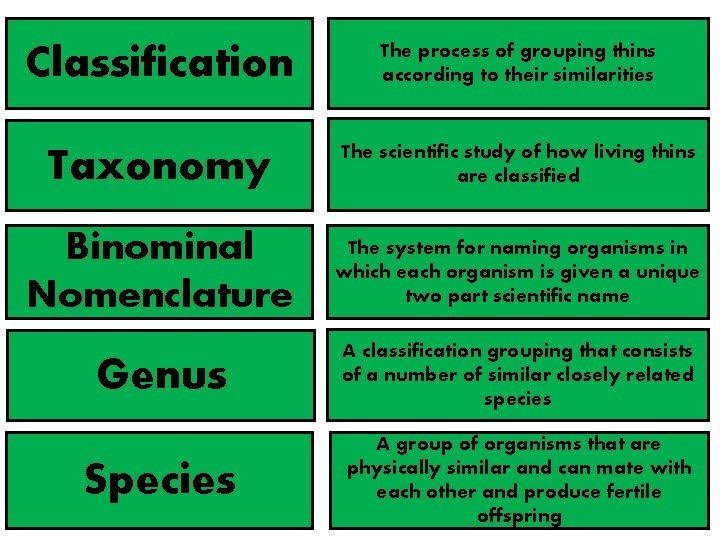
Classification The process of grouping thins according to their similarities Taxonomy The scientific study of how living thins are classified Binominal Nomenclature The system for naming organisms in which each organism is given a unique two part scientific name Genus A classification grouping that consists of a number of similar closely related species Species A group of organisms that are physically similar and can mate with each other and produce fertile offspring
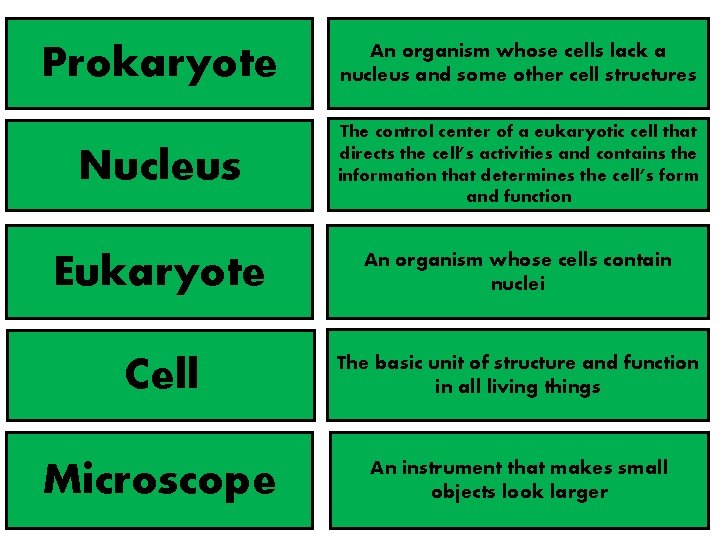
Prokaryote An organism whose cells lack a nucleus and some other cell structures Nucleus The control center of a eukaryotic cell that directs the cell’s activities and contains the information that determines the cell’s form and function Eukaryote An organism whose cells contain nuclei Cell The basic unit of structure and function in all living things Microscope An instrument that makes small objects look larger
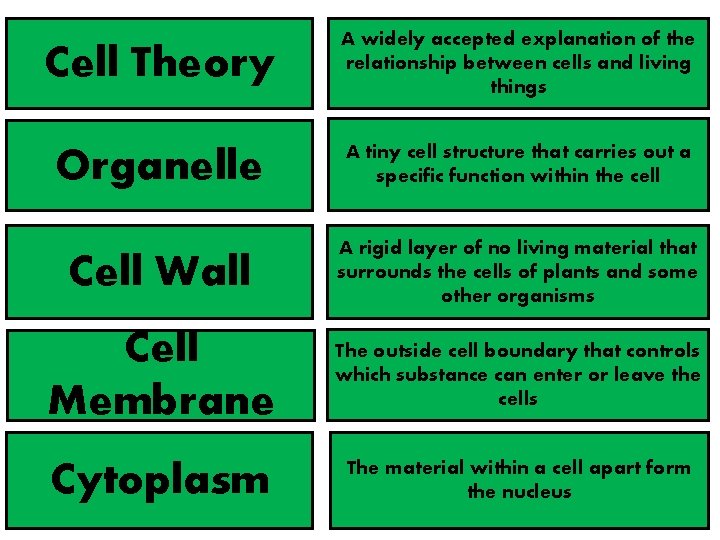
Cell Theory A widely accepted explanation of the relationship between cells and living things Organelle A tiny cell structure that carries out a specific function within the cell Cell Wall A rigid layer of no living material that surrounds the cells of plants and some other organisms Cell Membrane The outside cell boundary that controls which substance can enter or leave the cells Cytoplasm The material within a cell apart form the nucleus

Mitochondria Endoplasmic Reticulum Rod shaped cells structures that convert energy in food molecules to energy the cell can use to carry out its functions A cell structure that forms passageways in which proteins and other materials are carried through the cell Ribosome A small grain like structure in the cytoplasm of a cell where proteins are made Golgi Body A structure in a cells that receives proteins and newly formed materials from the endoplasmic reticulum, packages them, distributes them to other parts of the cell Chloroplast A structure in the cells of plants and some other organisms that captures energy from sunlight and uses it to produce food
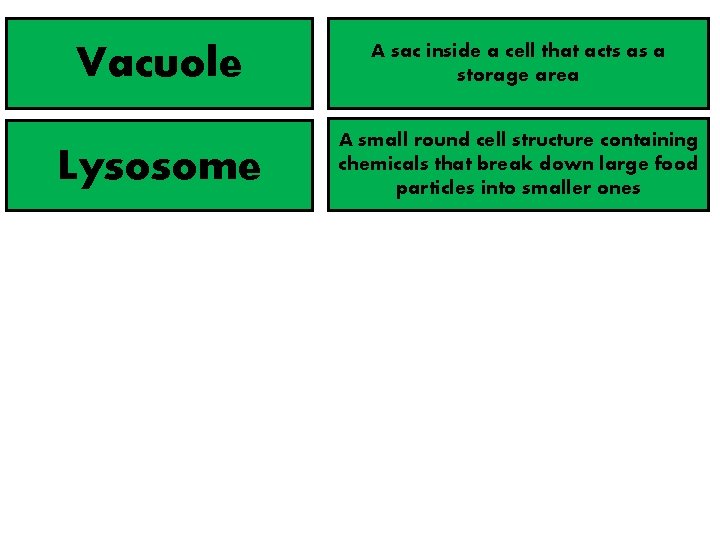
Vacuole A sac inside a cell that acts as a storage area Lysosome A small round cell structure containing chemicals that break down large food particles into smaller ones
- Slides: 7