
Organising Chapter 5 Definition Process of Identifying and


- Slides: 21
Organising Chapter 5
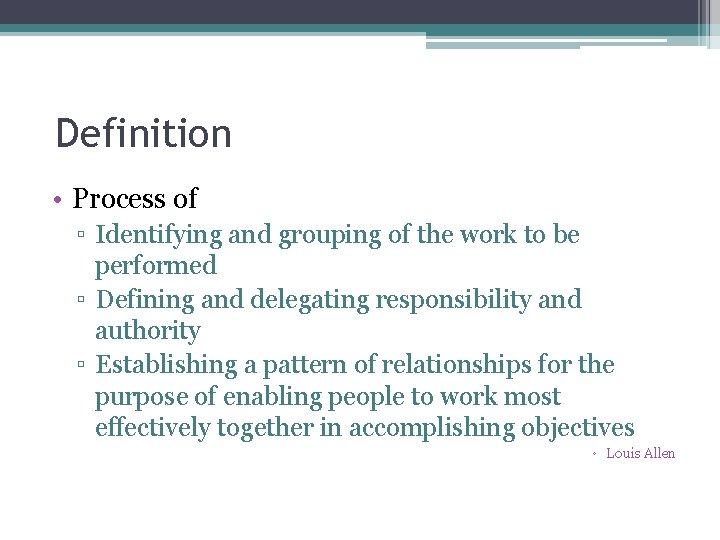
Definition • Process of ▫ Identifying and grouping of the work to be performed ▫ Defining and delegating responsibility and authority ▫ Establishing a pattern of relationships for the purpose of enabling people to work most effectively together in accomplishing objectives ◦ Louis Allen
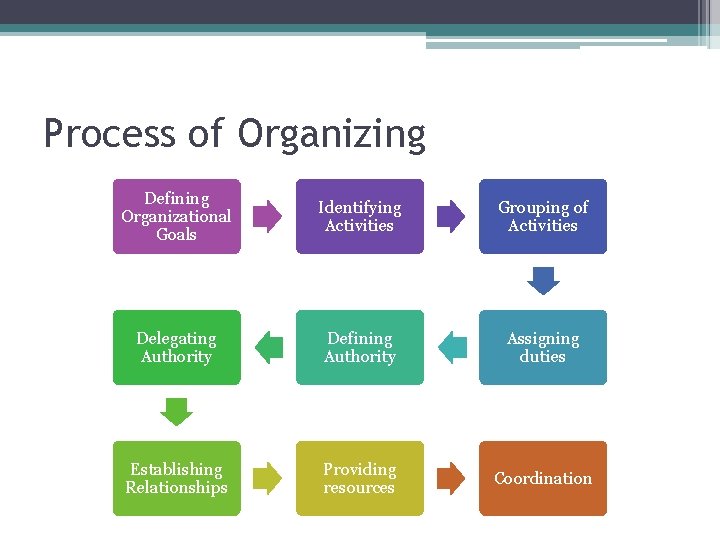
Process of Organizing Defining Organizational Goals Identifying Activities Grouping of Activities Delegating Authority Defining Authority Assigning duties Establishing Relationships Providing resources Coordination
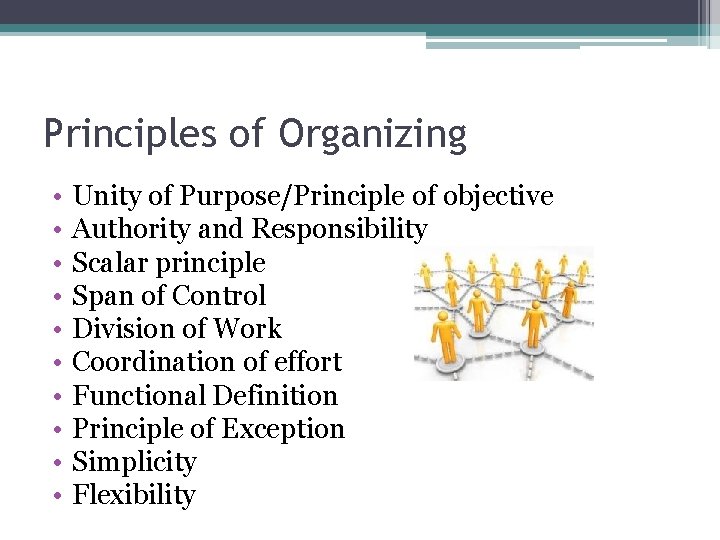
Principles of Organizing • • • Unity of Purpose/Principle of objective Authority and Responsibility Scalar principle Span of Control Division of Work Coordination of effort Functional Definition Principle of Exception Simplicity Flexibility
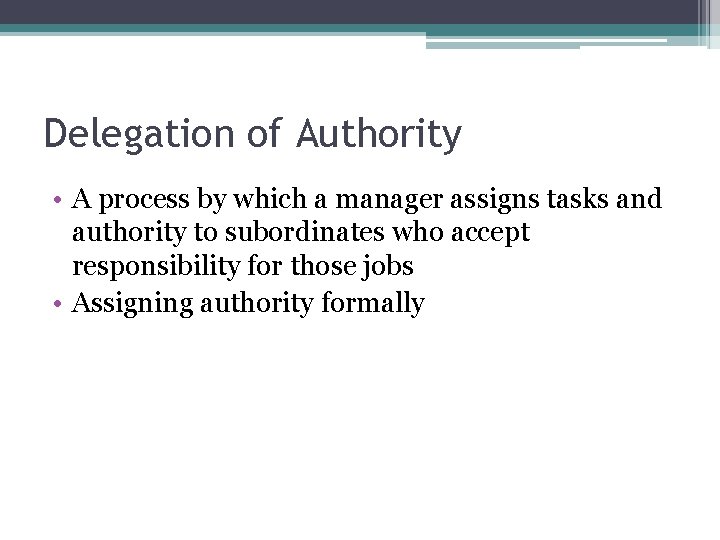
Delegation of Authority • A process by which a manager assigns tasks and authority to subordinates who accept responsibility for those jobs • Assigning authority formally
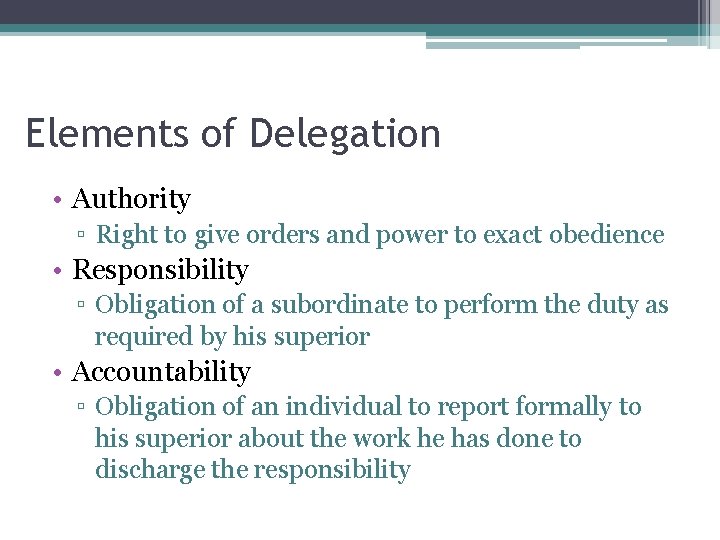
Elements of Delegation • Authority ▫ Right to give orders and power to exact obedience • Responsibility ▫ Obligation of a subordinate to perform the duty as required by his superior • Accountability ▫ Obligation of an individual to report formally to his superior about the work he has done to discharge the responsibility
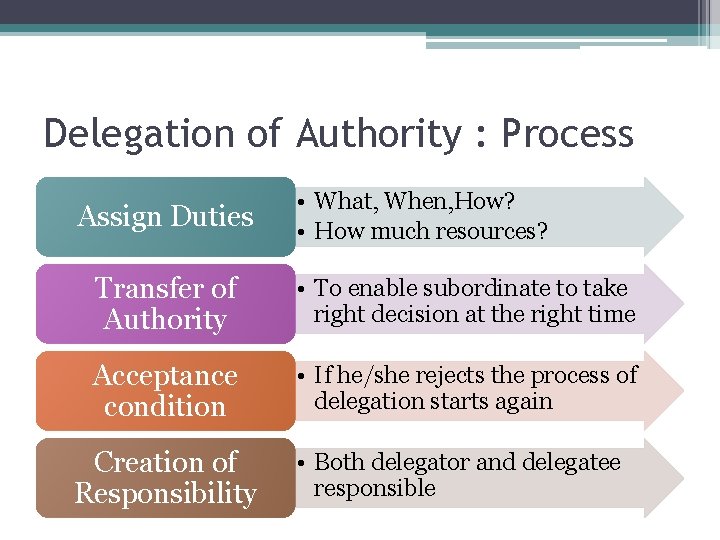
Delegation of Authority : Process Assign Duties • What, When, How? • How much resources? Transfer of Authority • To enable subordinate to take right decision at the right time Acceptance condition • If he/she rejects the process of delegation starts again Creation of Responsibility • Both delegator and delegatee responsible
Importance of Delegation • • Enables superior complete challenging jobs Allows quick action Facilitates training and development Leads to motivation Improves superior subordinate relationships Enhances team spirit Facilitates Performance Appraisal Job satisfaction
Barriers of Effective Delegation • On the part of Superior • On the part of Subordinate
Barriers of Effective Delegation Difficulties of Superior • • • Fear of being exposed Fear of losing control Lack of confidence in subordinates Lack of ability to direct Desire to dominate ‘I can do it better’ feeling
Barriers of Effective Delegation Difficulties of Subordinate • • Fear of criticism Fear of losing job Lack of information and resources Lack of self confidence Lack of incentives Undue interference by superiors Overdependence on superiors
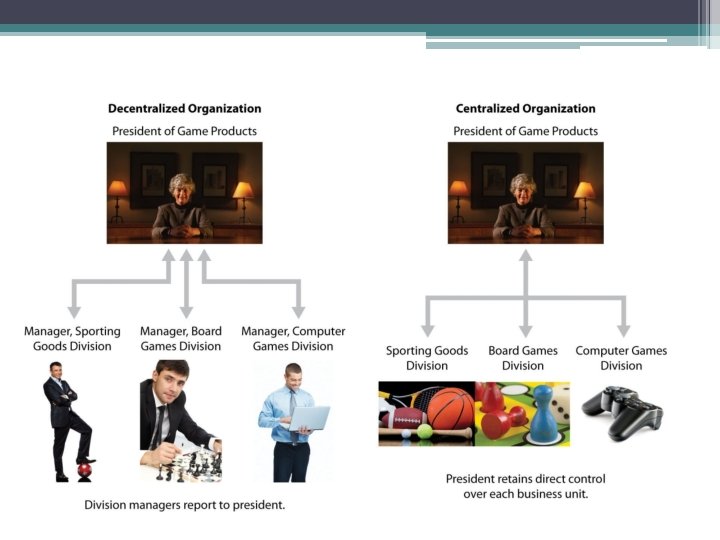
Centralization • Centralization and Decentralization refer to the location of decision making authority • Centralization: Concentration of authority at the top level of the organization • Decentralization: Dispersal of authority throughout the organization
Decentralization • Dispersing decision making authority in an organization structure • Dispersal of authority throughout the organization • Control over activities is in the hands of the manager who is given the authority • More stable than delegation • Not possible without delegation
Differences between Centralization and Decentralization • • • Nature of Decisions Size of the organization Managerial requirement Operating expenses and cost Division of labour and specialization Control
Factors affecting Centralization and Decentralization • • • History of the organization Organization’s size Nature of business Management by exception Degree of diversification of product lines Well organized control system Complication of jobs Availability of capable administrators Cost and significance of decisions Management philosophy
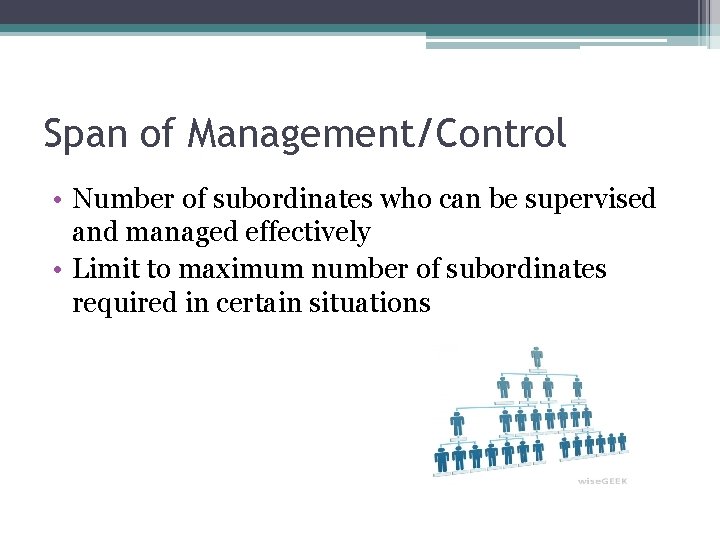
Span of Management/Control • Number of subordinates who can be supervised and managed effectively • Limit to maximum number of subordinates required in certain situations
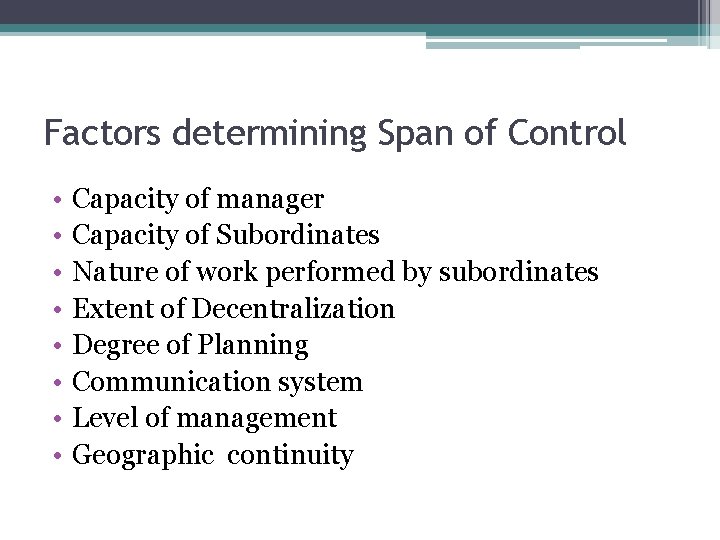
Factors determining Span of Control • • Capacity of manager Capacity of Subordinates Nature of work performed by subordinates Extent of Decentralization Degree of Planning Communication system Level of management Geographic continuity
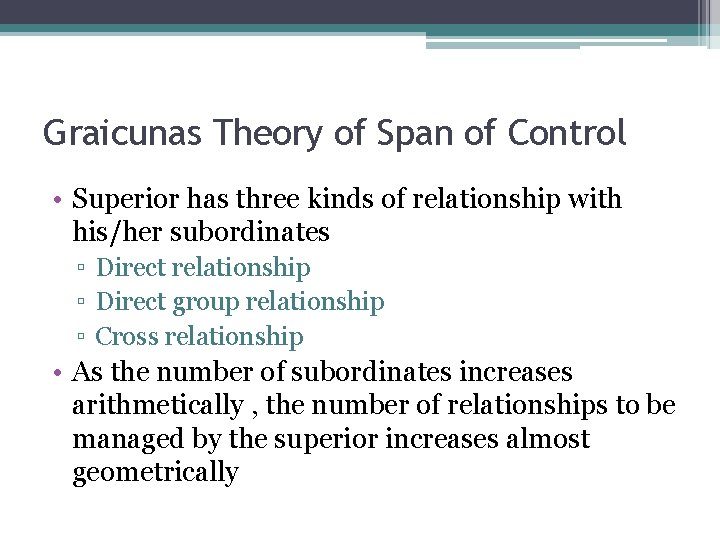
Graicunas Theory of Span of Control • Superior has three kinds of relationship with his/her subordinates ▫ Direct relationship ▫ Direct group relationship ▫ Cross relationship • As the number of subordinates increases arithmetically , the number of relationships to be managed by the superior increases almost geometrically
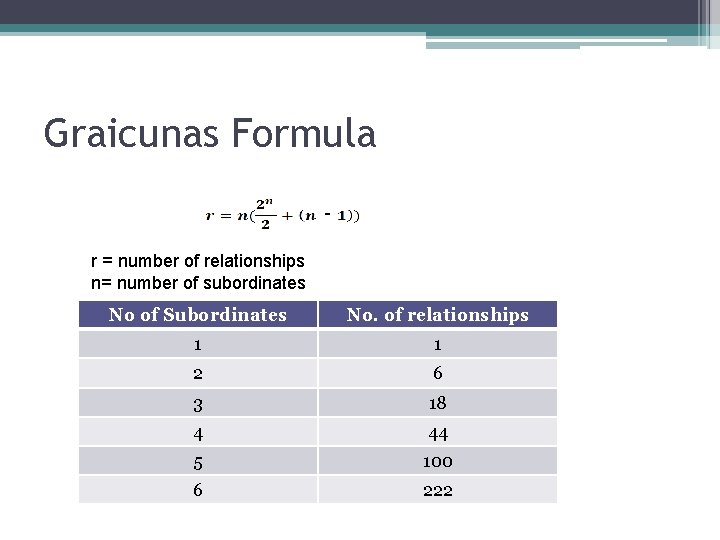
Graicunas Formula r = number of relationships n= number of subordinates No of Subordinates No. of relationships 1 1 2 6 3 18 4 44 5 100 6 222
Thanks