
Organisational hierarchies Topic 2 1 types of organisation

- Slides: 23
Organisational hierarchies Topic 2. 1: types of organisation
Learning outcomes from this Powerpoint • To understand the different types of organisational structure and how they effect team dynamics.
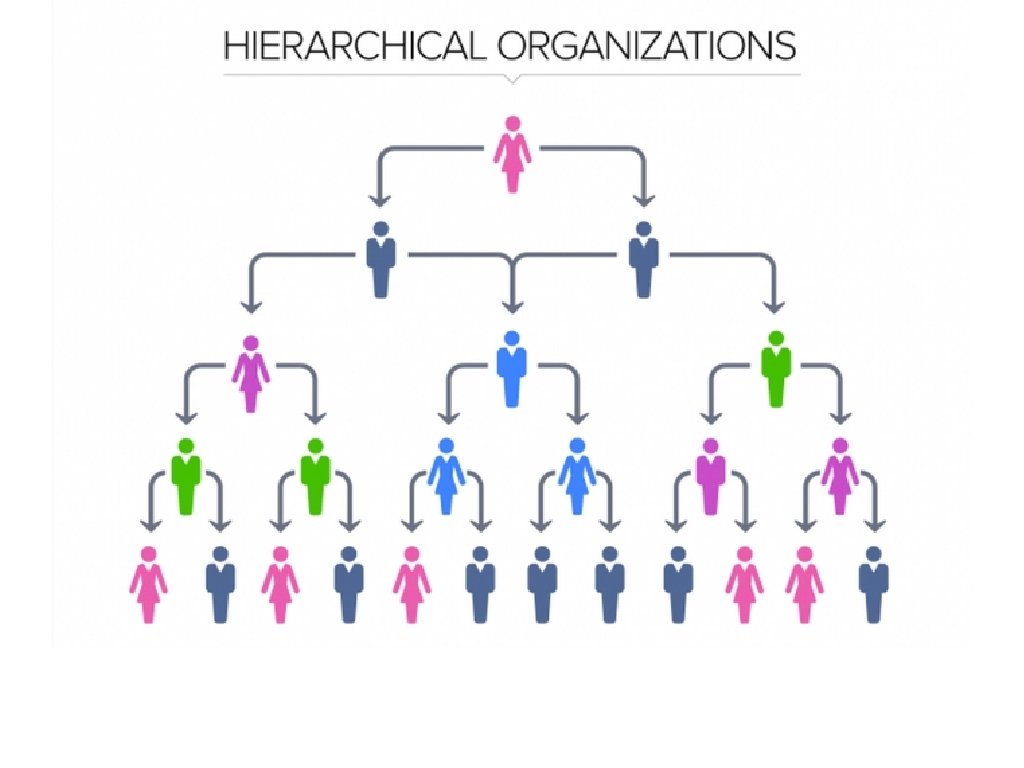
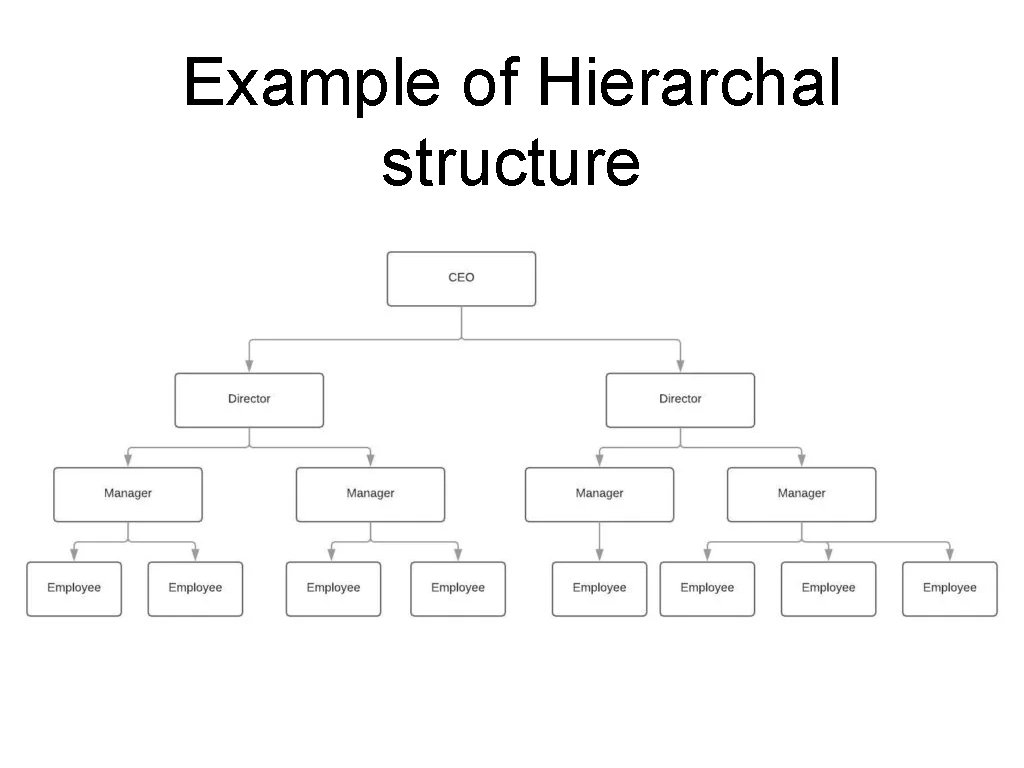
Definition of organisational hierarchies/structures • Hierarchy is a way to structure an organisation using different levels of authority and a vertical link, or chain of command, between superior ( Managers) and subordinate ( staff) levels of the organisation. • Higher levels control lower levels of the hierarchy. You can think of an organisational hierarchy as a pyramid.
Why bother with hierarchal structures in the first place? • To establish and delineate lines of communication between managers and subordinates, responsibilities, company policies and authority line. • To determine the nature and extent of how leadership is scattered within the organisation. • To ensure effectiveness in work management and work ethics, productivity level and planning and coordination. • To ensure smooth communication networks. • To give people ( managers) planning and controlling powers. • To ensure smooth functioning between departments and project teams. Haha, now does any of the above actually happen in the real world? Does this happen in your workplace? Can you provide examples, from your workplace when a hierarchal structures “works” and when doesn't ?
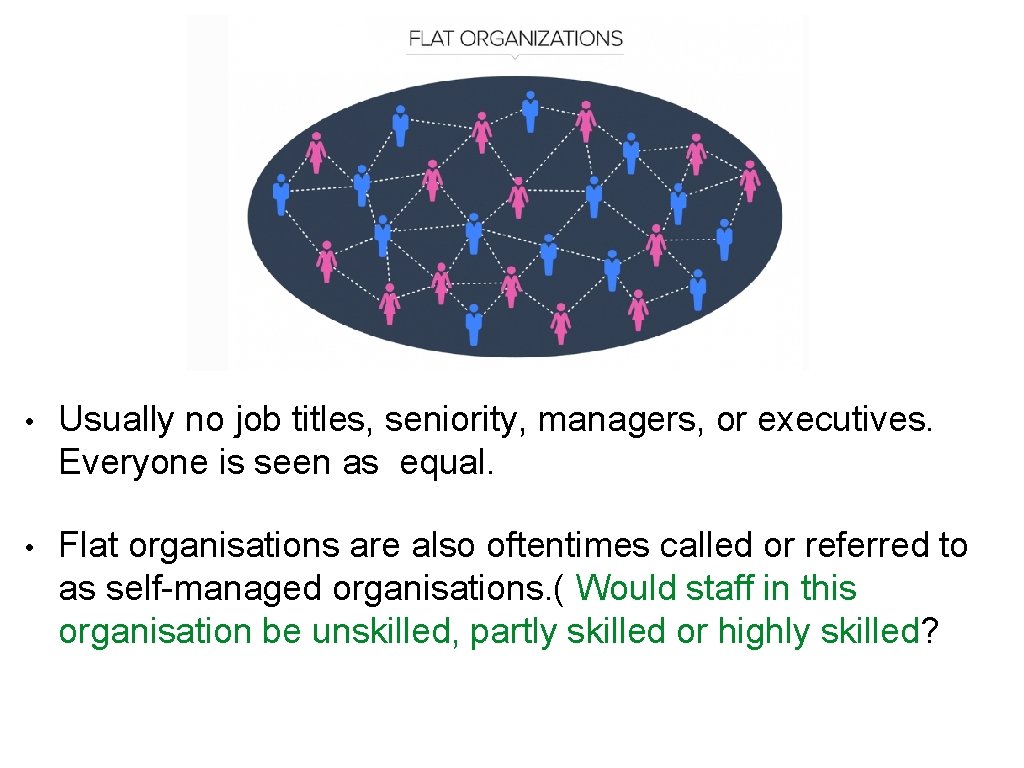
• Usually no job titles, seniority, managers, or executives. Everyone is seen as equal. • Flat organisations are also oftentimes called or referred to as self-managed organisations. ( Would staff in this organisation be unskilled, partly skilled or highly skilled?
Flat organisational structure • Flat hierarchies automatically get created ( THIS IS HUMAN NATURE) based on seniority, people who are at the company longer just tend to be viewed as being more senior. • The lack of structure can also make accountability and reliability a bit of an issue as well. (WHAT HAPPENS WHEN SOMETHING GOES WRONG, WHO DOES THE BUCK STOP WITH) • Finally, the company tends to develop cliques ( THIS IS AGAIN HUMAN NATURE) where groups of people tend to support and work with each other but oftentimes prefer to stay to themselves, this of course can cause challenges for communication and collaboration. • The big challenge with this type of an approach is that if a larger organisation decided to implement it, the process would take many years and would require enormous amounts of capital and resources to execute. Flat structure be suitable for? Small organisations, some medium size companies, or companies that are created on the idea of being flat and then scale this approach as the company grows • Do you think this structure relies of the staff having amazing communication skills and a high level of emotional intelligence. • • How would conflict be resolved in this structure? There would naturally be alot of compromise and negotiation between staff in this structure?
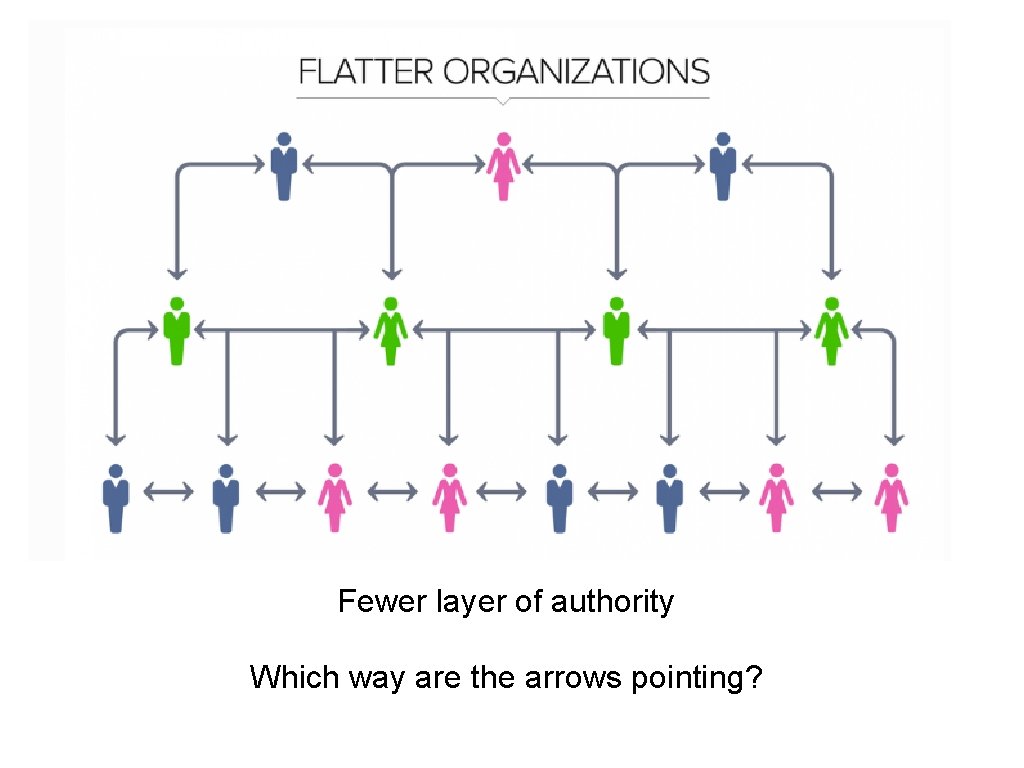
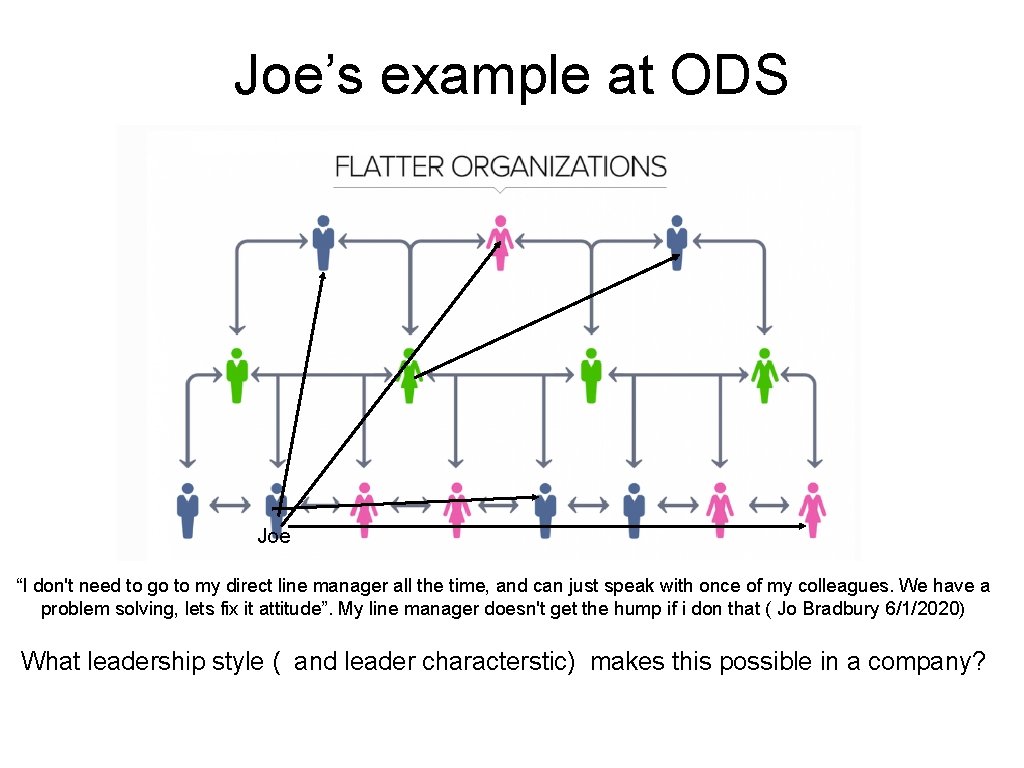
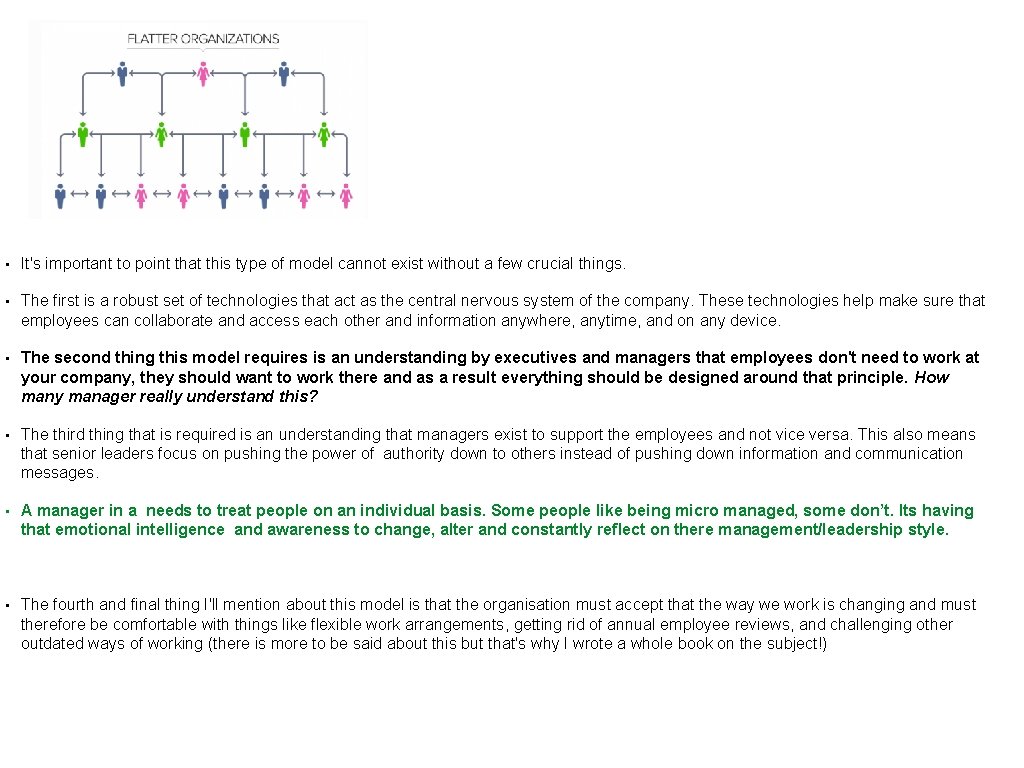
Fewer layer of authority Which way are the arrows pointing?
Joe’s example at ODS Joe “I don't need to go to my direct line manager all the time, and can just speak with once of my colleagues. We have a problem solving, lets fix it attitude”. My line manager doesn't get the hump if i don that ( Jo Bradbury 6/1/2020) What leadership style ( and leader characterstic) makes this possible in a company?
Flatter Hierarchy Taller • Unlike the traditional hierarchy which typically sees one way communication and everyone at the top with all the information and power; a "flatter" structure seeks to open up the lines of communication and collaboration while removing layers within the organisation.
Flatter Hierarchy • For larger organisations this is the most practical, scalable, and logical approach to deploy across an entire company. This is the model that most large (and many mid -size) organisations around the world are moving towards. • Nuture went from 3 employees in 2008 to 1200 employees in 2020. What organisational structure do they use now?
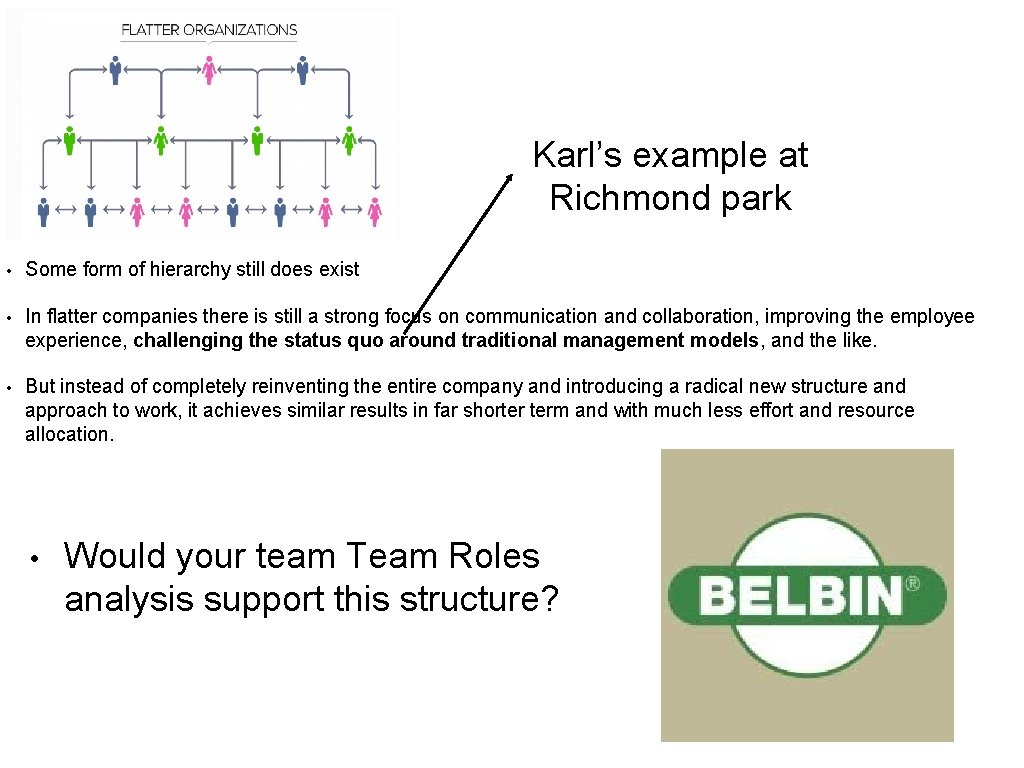
Karl’s example at Richmond park • Some form of hierarchy still does exist • In flatter companies there is still a strong focus on communication and collaboration, improving the employee experience, challenging the status quo around traditional management models, and the like. • But instead of completely reinventing the entire company and introducing a radical new structure and approach to work, it achieves similar results in far shorter term and with much less effort and resource allocation. • Would your team Team Roles analysis support this structure?
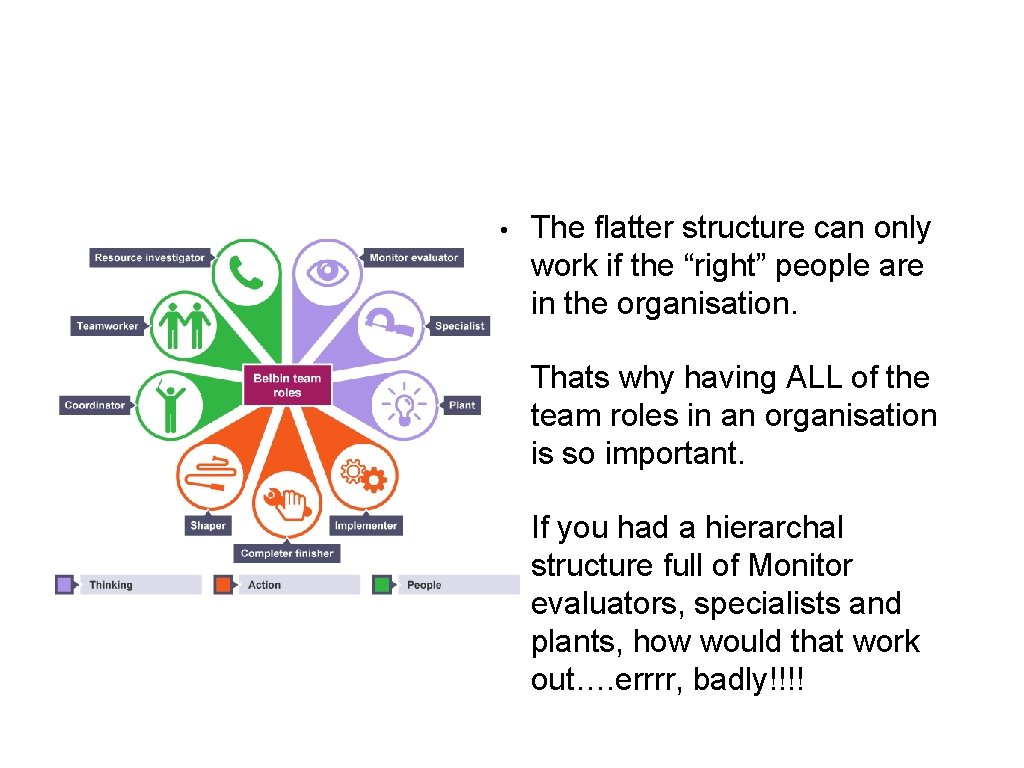
• The flatter structure can only work if the “right” people are in the organisation. • Thats why having ALL of the team roles in an organisation is so important. • If you had a hierarchal structure full of Monitor evaluators, specialists and plants, how would that work out…. errrr, badly!!!!
Flatter Structure • Suitable for Small Sized Business with limited number of staff. • One or two levels of authority and responsibility • Communication flows in all direction ( is that a good thing? ) • Communication is directly to the top management and is rather casual ( Apprenticeship department at Capel Manor College) • Employees are highly motivated as they have the responsibility to directly influence the company’s growth. ( My position at Capel Manor) (Alyce @ Grosvenor? ) • Level of complexity increases as too many people get involved in defining and deciding objectives and strategies. • More flexible. Decisions can often be made quickly and carried out smoothly. ( double edges sword? ) • Employees can lack specific boss or leader to look forward to for reporting and seeking help. ( Apprenticeship department at Capel Manor College) • Produces more generalists. ( Capel Manor at the moment? ) • Limit longterm organisation growth and opportunities. (How does Capel respond from the financial hit from COVID? ). • No / limited opportunities for promotion in flat structure. ( How do i “progress” at Capel Manor) • Organisational cost incurred is less. ( Is that true of Capel Manor) • Employees are loyal to the entire company. ( a broad statement, lets explore this)
LEANER JOURNALS • How can you apply these to your Leaner Journal
• It's important to point that this type of model cannot exist without a few crucial things. • The first is a robust set of technologies that act as the central nervous system of the company. These technologies help make sure that employees can collaborate and access each other and information anywhere, anytime, and on any device. • The second thing this model requires is an understanding by executives and managers that employees don't need to work at your company, they should want to work there and as a result everything should be designed around that principle. How many manager really understand this? • The third thing that is required is an understanding that managers exist to support the employees and not vice versa. This also means that senior leaders focus on pushing the power of authority down to others instead of pushing down information and communication messages. • A manager in a needs to treat people on an individual basis. Some people like being micro managed, some don’t. Its having that emotional intelligence and awareness to change, alter and constantly reflect on there management/leadership style. • The fourth and final thing I'll mention about this model is that the organisation must accept that the way we work is changing and must therefore be comfortable with things like flexible work arrangements, getting rid of annual employee reviews, and challenging other outdated ways of working (there is more to be said about this but that's why I wrote a whole book on the subject!)
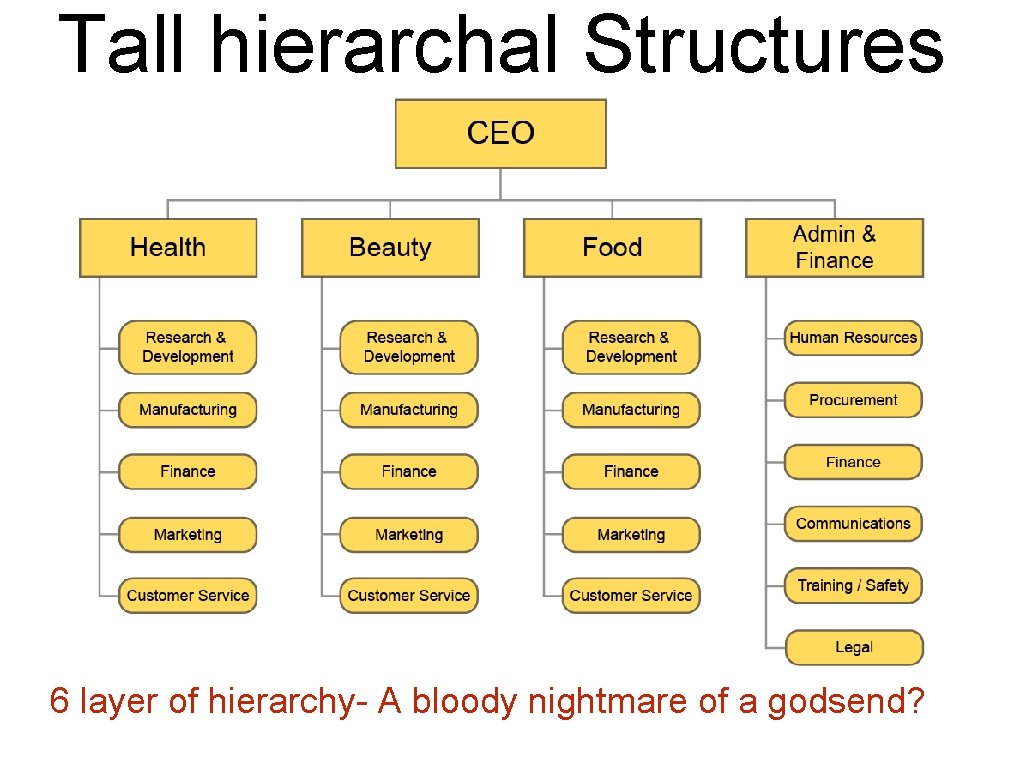
Tall hierarchal Structures 6 layer of hierarchy- A bloody nightmare of a godsend?
Pros and Cons of Tall Structure • Employees feel less motivated due to stringent communication structure and lack of influence in lower levels of the company. • Level of complexity in coordination and controlling is less as each level of managers has only fewer staff to manage and direct. • Less flexible. As directives and feed backs have to flow through various levels to reach the actual department. • More systematic as employees know whom to talk to. • Produces more skilled specialists. • Promotes development of employees by narrowing their field of focus and expertise. • Produces opportunities for promotion and leadership ( __herzberg and maslow) • Salaries for multiple layer increases cost.
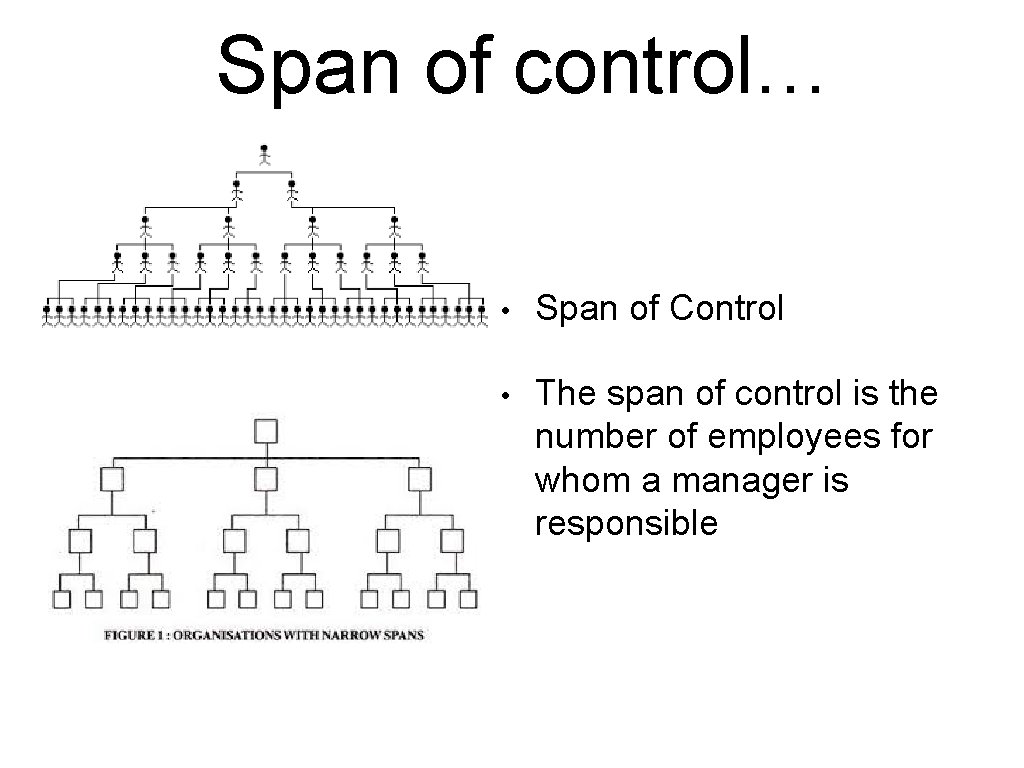
Span of control… • Span of Control • The span of control is the number of employees for whom a manager is responsible
Wide or Narrow? • Narrow- allows for closer supervision • Wide-gives staff the chance for more independence • Narrow-More layers in the hierarchy • Wide-More appropriate if labour costs are significant – reduce number of managers • Narrow-Helps more effective communication
Span of Control • Span of Control depends on; • Personality & skill / experience of the manager • Size and complexity of the business • Whether the business is centralised or decentralised SSP homework? The extent of use of clear objectives throughout a business • • Would your team Team Roles analysis support this structure?
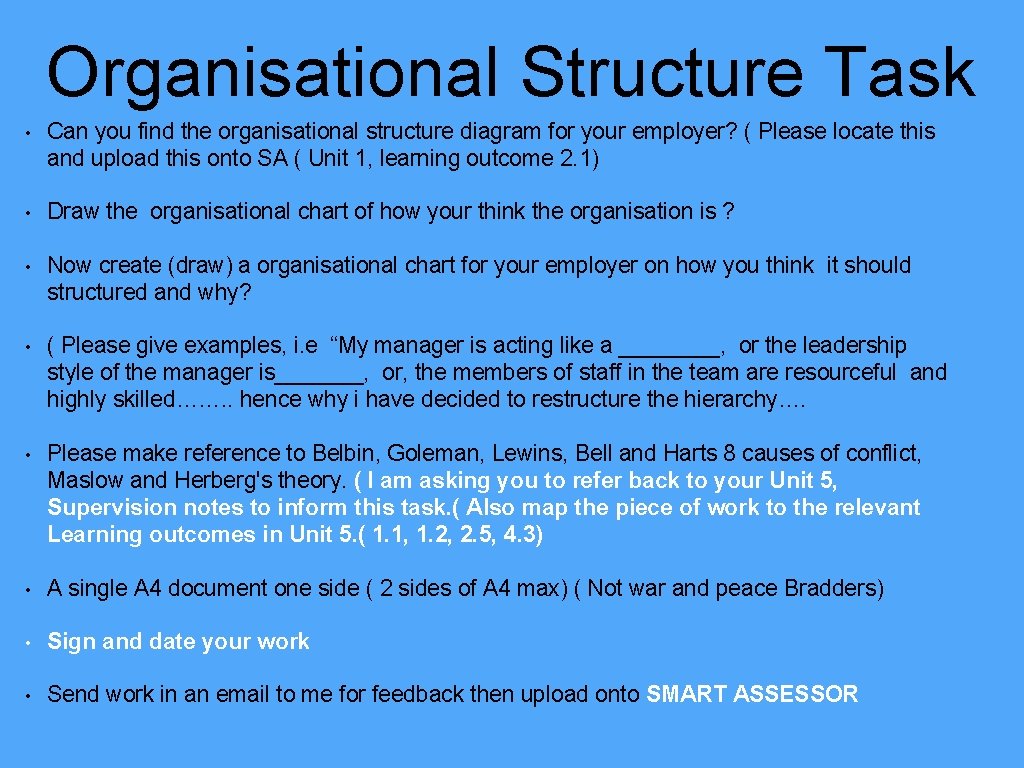
Organisational Structure Task • Can you find the organisational structure diagram for your employer? ( Please locate this and upload this onto SA ( Unit 1, learning outcome 2. 1) • Draw the organisational chart of how your think the organisation is ? • Now create (draw) a organisational chart for your employer on how you think it should structured and why? • ( Please give examples, i. e “My manager is acting like a ____, or the leadership style of the manager is_______, or, the members of staff in the team are resourceful and highly skilled……. . hence why i have decided to restructure the hierarchy…. • Please make reference to Belbin, Goleman, Lewins, Bell and Harts 8 causes of conflict, Maslow and Herberg's theory. ( I am asking you to refer back to your Unit 5, Supervision notes to inform this task. ( Also map the piece of work to the relevant Learning outcomes in Unit 5. ( 1. 1, 1. 2, 2. 5, 4. 3) • A single A 4 document one side ( 2 sides of A 4 max) ( Not war and peace Bradders) • Sign and date your work • Send work in an email to me for feedback then upload onto SMART ASSESSOR
Example of Hierarchal structure