
Organisational Diagnosis Quality Problems Quality Problems Lean Six

Organisational Diagnosis

Quality Problems
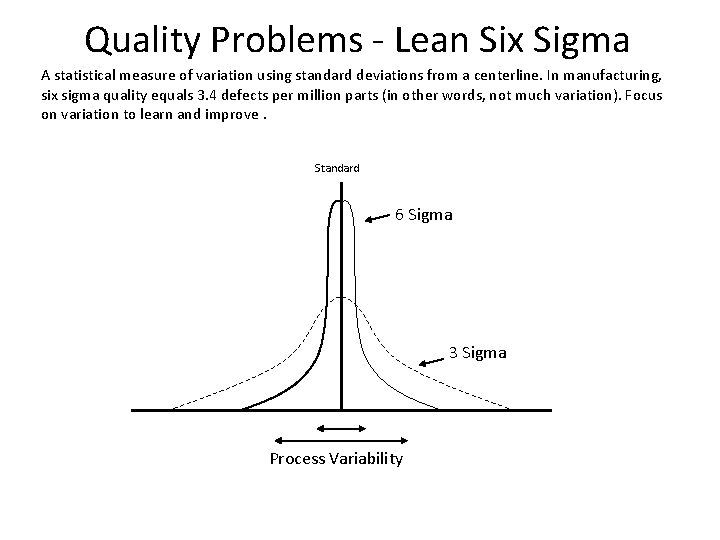
Quality Problems - Lean Six Sigma A statistical measure of variation using standard deviations from a centerline. In manufacturing, six sigma quality equals 3. 4 defects per million parts (in other words, not much variation). Focus on variation to learn and improve. Standard 6 Sigma 3 Sigma Process Variability

Quality Problems – Examples Airplane Journey Luggage Journey You arriving safely at location Suitcase arriving with you at location Versus 6 s below 0. 5 defect per million opportunities 3 s ~67, 000 defects per million opportunities

Quality Problems in Business Products are produced in business processes. Quality of produced products are constantly monitored. This is done by certain product properties to be considered as quality variables and to measure their values periodically. Variation in the values of quality variables is considered as indicator for control. (high variation = less control) < Intermezzo M&M variation > So, variation of the values of quality variables is the phenomenon to explain (explanandum) in organizational diagnosis 5
Current practice of causal analysis in business
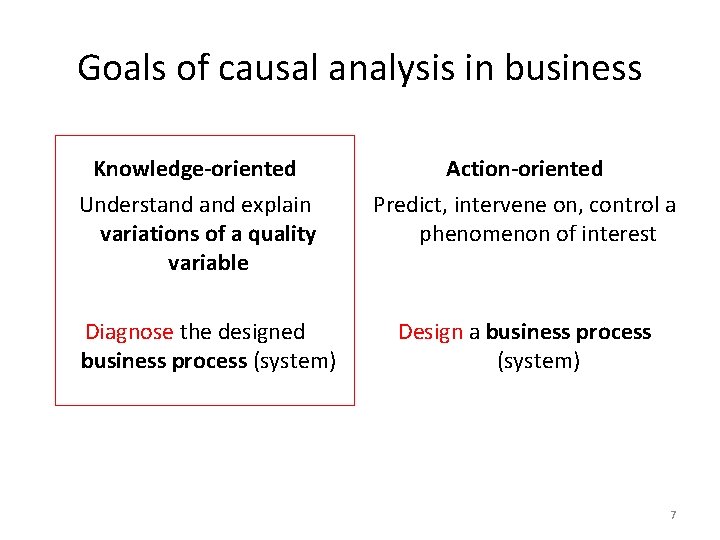
Goals of causal analysis in business Knowledge-oriented Understand explain variations of a quality variable Diagnose the designed business process (system) Action-oriented Predict, intervene on, control a phenomenon of interest Design a business process (system) 7
Causal analysis in business Decide what’s the cause of defects in services and products Decide who is (legally) responsible for some state of affairs Decide what are the causes of a given phenomenon Decide what causes dysfunction in an organisation 8
You can plan ahead … If you know a mechanism causing a quality problem in business You may changes policies and business rules Anticipate on influential forces on your business Detect (hidden) social structures threatening business Redesign the organisation Split or join business’ … hopefully, of course 9

Something is missing
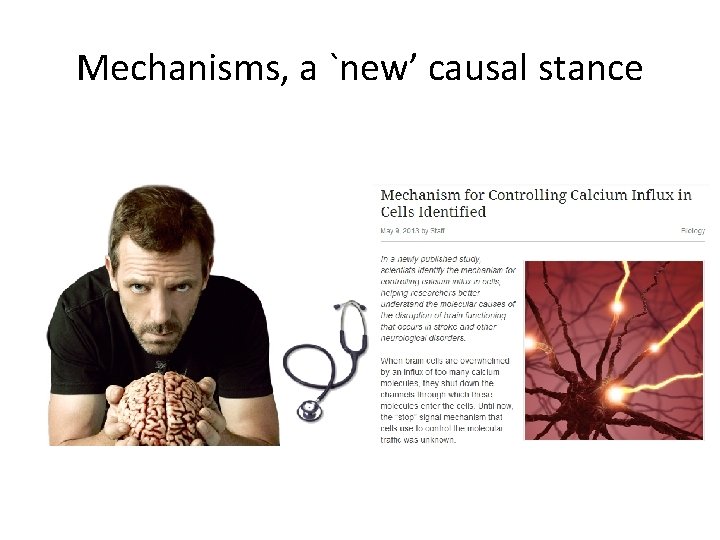
Mechanisms, a `new’ causal stance
Explanation, our stance for OD The ‘thing’ in a business process that causes variation is a causal mechanism (explanan) Definitions A causes B if there is mechanism linking A to B A mechanism is an arrangements of entities and activities that produce a behaviour Main contemporary supporters: Machamer et al, Bechtel et al, Glennan, … Remote supporters: Decartes, Newton, … 12
A causes B, what is A ? A causes variation, then: What is A in business ? Changes in the values of quality variables are by definition the result of changes in the business process in which the products are produced. The current practice in OD is to try to find (statistical) relationships between quality variables and selected process variables (e. g. the availability of machines or people, which can change in the course of time) The only thing we know about A in business is that it is a mechanism and statistics may point us or hints us about associations between variables in business. 13
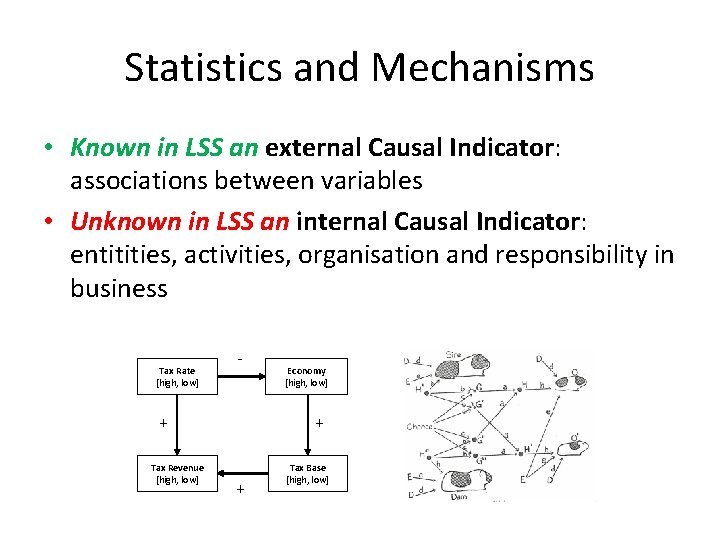
Statistics and Mechanisms • Known in LSS an external Causal Indicator: associations between variables • Unknown in LSS an internal Causal Indicator: entitities, activities, organisation and responsibility in business Tax Rate [high, low] - + Tax Revenue [high, low] Economy [high, low] + + Tax Base [high, low]
AN APPROACH TO CAUSATION CASE “ZWITSERLEVEN” 15
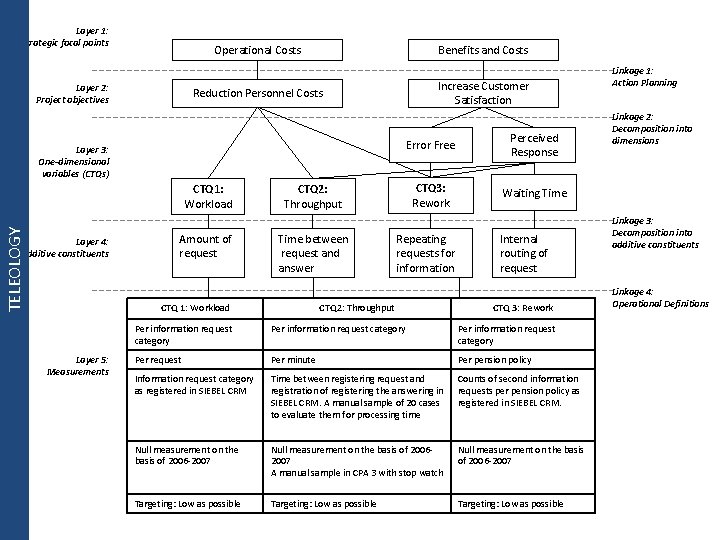
Layer 1: Strategic focal points Operational Costs Layer 2: Project objectives Benefits and Costs Increase Customer Satisfaction Reduction Personnel Costs Layer 3: One-dimensional variables (CTQs) TELEOLOGY CTQ 1: Workload Layer 4: Additive constituents Amount of request CTQ 2: Throughput Time between request and answer CTQ 1: Workload Layer 5: Measurements Error Free Perceived Response CTQ 3: Rework Waiting Time Repeating requests for information CTQ 2: Throughput Internal routing of request CTQ 3: Rework Per information request category Per request Per minute Per pension policy Information request category as registered in SIEBEL CRM Time between registering request and registration of registering the answering in SIEBEL CRM. A manual sample of 20 cases to evaluate them for processing time Counts of second information requests per pension policy as registered in SIEBEL CRM. Null measurement on the basis of 2006 -2007 Null measurement on the basis of 20062007 A manual sample in CPA 3 with stop watch Null measurement on the basis of 2006 -2007 Targeting: Low as possible Linkage 1: Action Planning Linkage 2: Decomposition into dimensions Linkage 3: Decomposition into additive constituents Linkage 4: Operational Definitions
TELEOLOGY
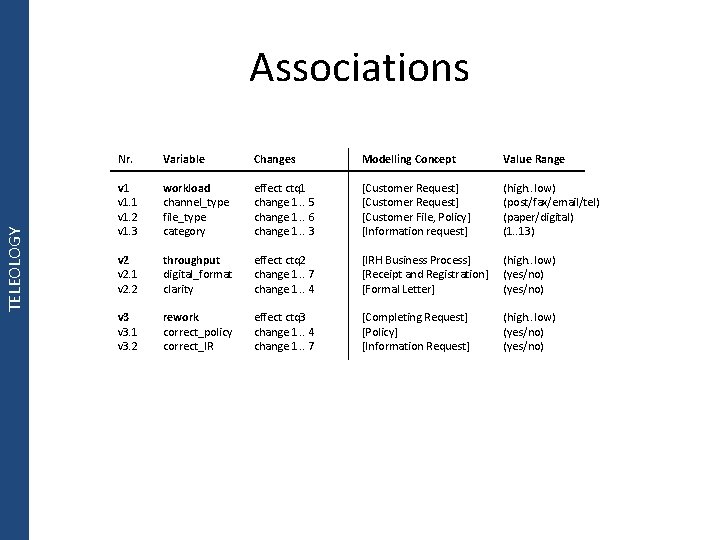
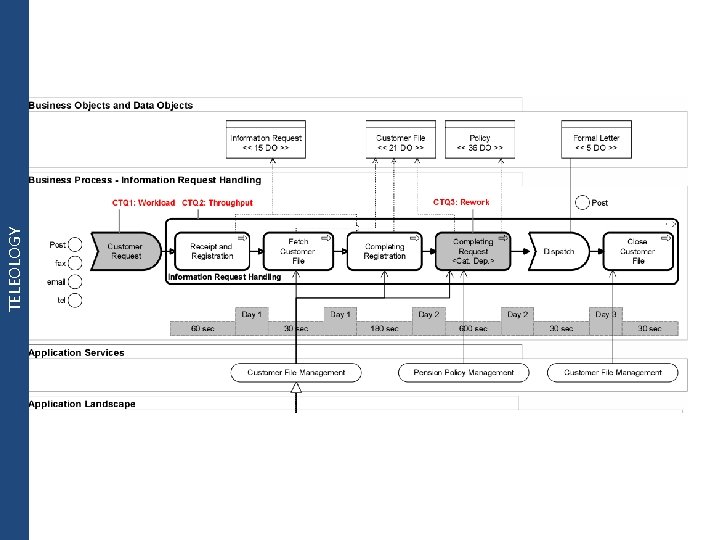
TELEOLOGY Associations Nr. Variable Changes Modelling Concept Value Range v 1. 1 v 1. 2 v 1. 3 workload channel_type file_type category effect ctq 1 change 1. . 5 change 1. . 6 change 1. . 3 [Customer Request] [Customer File, Policy] [Information request] (high. . low) (post/fax/email/tel) (paper/digital) (1. . 13) v 2. 1 v 2. 2 throughput digital_format clarity effect ctq 2 change 1. . 7 change 1. . 4 [IRH Business Process] [Receipt and Registration] [Formal Letter] (high. . low) (yes/no) v 3. 1 v 3. 2 rework correct_policy correct_IR effect ctq 3 change 1. . 4 change 1. . 7 [Completing Request] [Policy] [Information Request] (high. . low) (yes/no)
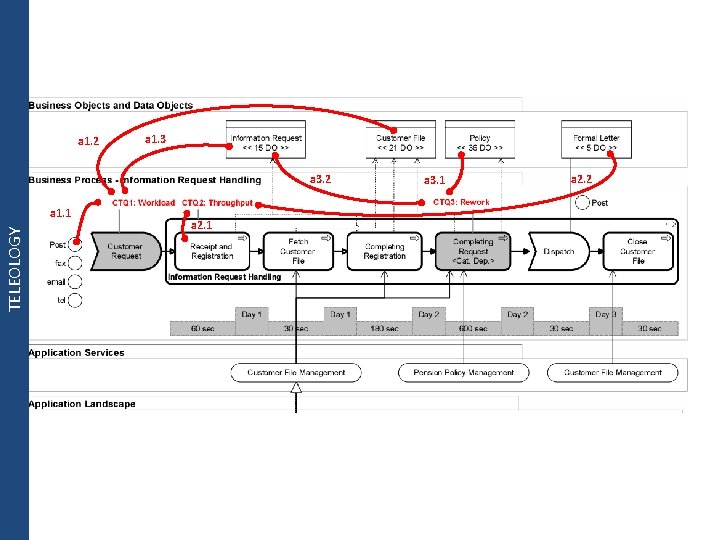
a 1. 2 a 1. 3 a 3. 2 TELEOLOGY a 1. 1 a 2. 1 a 3. 1 a 2. 2
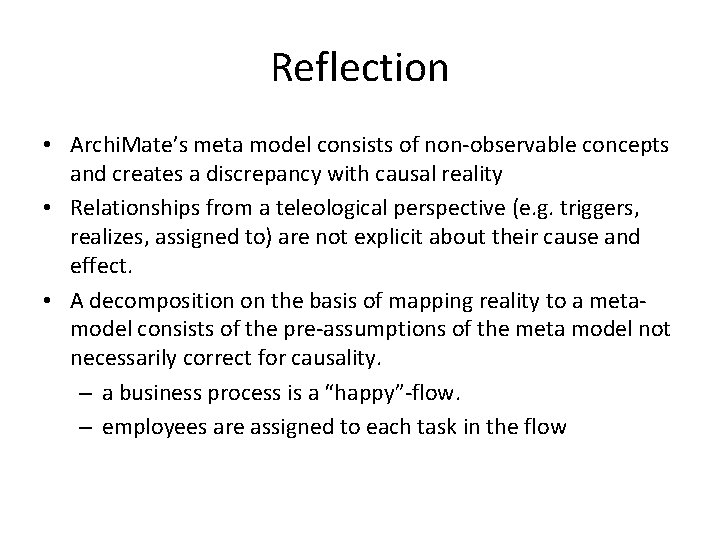
Reflection • Archi. Mate’s meta model consists of non-observable concepts and creates a discrepancy with causal reality • Relationships from a teleological perspective (e. g. triggers, realizes, assigned to) are not explicit about their cause and effect. • A decomposition on the basis of mapping reality to a metamodel consists of the pre-assumptions of the meta model not necessarily correct for causality. – a business process is a “happy”-flow. – employees are assigned to each task in the flow
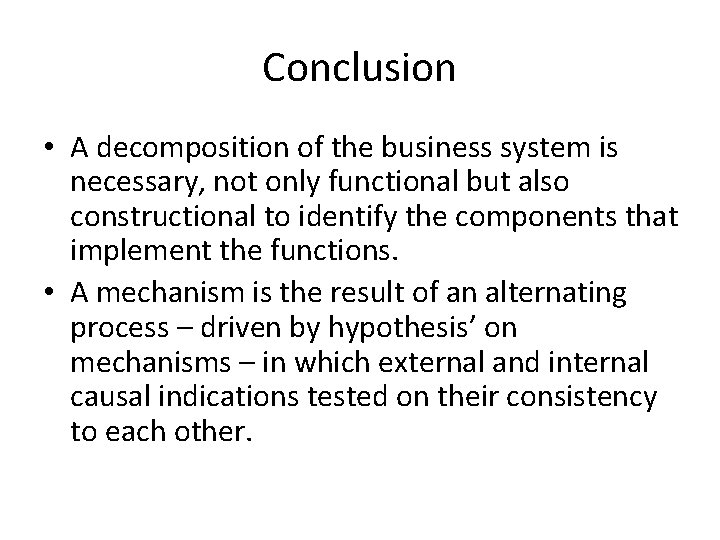
Conclusion • A decomposition of the business system is necessary, not only functional but also constructional to identify the components that implement the functions. • A mechanism is the result of an alternating process – driven by hypothesis’ on mechanisms – in which external and internal causal indications tested on their consistency to each other.
AN APPROACH TO CAUSATION CASE “MERCK” 22
- Slides: 22