
Organisational Change Chapter 8 Soft Systems Model for
- Slides: 58
Organisational Change Chapter 8 Soft Systems Model for Change Copyright Barbara Senior, Organisational Change Lecturers’ Guide 2002 1
Overview § § § This chapter challenges the notion of rationality 2 as applied to organisational change in the context of soft complexity. Lewin’s three-phase model of change is described as a simplified representation of a more detailed description of organisational development as an approach to change. Some limitations of organisational development as a change philosophy and as a change approach are discussed. Copyright Barbara Senior, Organisational Change Lecturers’ Guide 2002
Objectives § To: · recognise that some change situations 3 (problems/opportunities), by nature of their complexity and particular characteristics, require soft rather than hard systems approaches to change; · consider the philosophy, value orientation and theoretical underpinnings of Organisation Development (OD) as a generalised example of soft systems models for change; · outline and describe the processes and practices which comprise most OD approaches to designing and implementing organisational change; · discuss the limitations of OD approaches to managing change. Copyright Barbara Senior, Organisational Change Lecturers’ Guide 2002
Why Mess Management Is Needed - 1 § Various factors such as power bases, organisational culture, leadership styles, and changes in the organisation’s environment, can in many cases make organisational change a lot more technically complex and emotionally charged (therefore messy) than the Hard Systems Model of Change can adequately deal with. Copyright Barbara Senior, Organisational Change Lecturers’ Guide 2002 4
Why Mess Management Is Needed - 2 • People act in accordance with their own view of what is rational for them. • They are not puppets, dummies, cogs, cattle. Copyright Barbara Senior, Organisational Change Lecturers’ Guide 2002 5
Why Mess Management Is Needed - 3 The Hard Systems model of change is not likely to be effective: § where the nature of the presenting problems is defined differently by different people (stakeholders) in the situation. § and where quantitative criteria cannot readily be agreed upon. § and where systems are complex. § and where a pluralist ideology of relationships prevails. Copyright Barbara Senior, Organisational Change Lecturers’ Guide 2002 6
So how can managers deal with messes? Copyright Barbara Senior, Organisational Change Lecturers’ Guide 2002 7
The Art and Science of Mess Management - 1 Ackoff (1993: 47) suggests there are 3 ‘kinds of 8 things’ which can be done about messes. The first two are: • Resolve them • Select a hunch that yields a “good enough” outcome - one that satisfices (satisfies and suffices). Patch and mend, survival-oriented. • Solve them • Select quantitative approaches based on research and rational-logical methods of analysis. Focuses on the trees rather than on the wood; atomistic. Ackoff, R. L. (1993). The art and science of mess management, in Mabey, C. and Mayon-White, B. (eds) Managing Change. London, P. C. P. Copyright Barbara Senior, Organisational Change Lecturers’ Guide 2002
The Art and Science of Mess Management - 2 The third of Ackoff’s (1993: 47) ways of tackling messes is: 9 • Dissolve them - idealising • Change the nature of the problem context (or system involved) so as to remove the problem. • Development oriented – eager to improve quality of life for self and others. • Resigning systems at various levels of the organisation to dissolve the problem • This is what the soft systems approach tries to do. Ackoff, R. L. (1993). The art and science of mess management, in Mabey, C. and Mayon-White, B. (eds) Managing Change. London, P. C. P. Copyright Barbara Senior, Organisational Change Lecturers’ Guide 2002
The Art and Science of Mess Management - 3 • Change is only effective when people’s feelings, needs, perceptions, ways of doing things & hopes are addressed. AND • messy situations require managers to dissolve existing problems, by challenging underlying purposes and assumptions. Copyright Barbara Senior, Organisational Change Lecturers’ Guide 2002 10
The Art and Science of Mess Management - 4 For the manager who wishes to dissolve problems, Buchanan and Boddy (1992) suggest: • ‘backstaging’, not just ‘public performance’ • ‘political skills’ behind the scenes • ‘intervening in political and cultural systems’ • ‘managing meaning’ – ‘selling the change’ Ackoff, R. L. (1993). The art and science of mess management, in Mabey, C. and Mayon-White, B. (eds) Managing Change. London, P. C. P. Copyright Barbara Senior, Organisational Change Lecturers’ Guide 2002 11
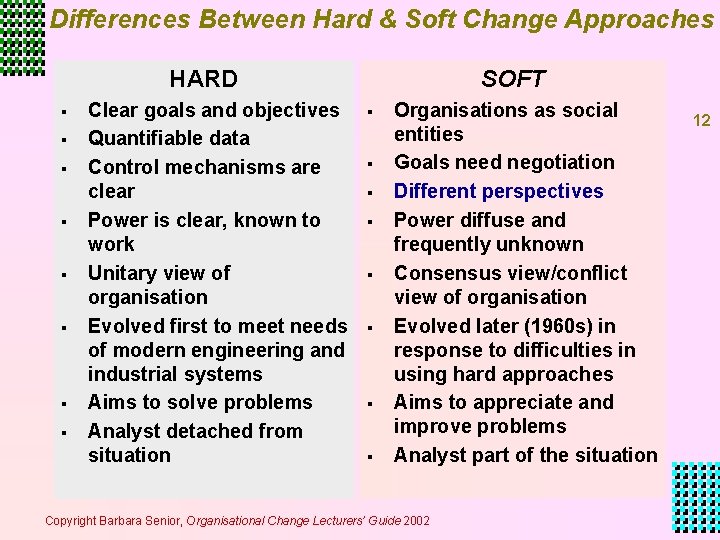
Differences Between Hard & Soft Change Approaches HARD § § § § Clear goals and objectives Quantifiable data Control mechanisms are clear Power is clear, known to work Unitary view of organisation Evolved first to meet needs of modern engineering and industrial systems Aims to solve problems Analyst detached from situation SOFT § § § § Organisations as social entities Goals need negotiation Different perspectives Power diffuse and frequently unknown Consensus view/conflict view of organisation Evolved later (1960 s) in response to difficulties in using hard approaches Aims to appreciate and improve problems Analyst part of the situation Copyright Barbara Senior, Organisational Change Lecturers’ Guide 2002 12
Organisation Development - 1 § ‘Organization development (OD) is a long term effort, led and supported by top management, to improve an organization’s visioning, empowerment, learning, and problem-solving processes, through an ongoing, collaborative management of the organization culture - with special emphasis on the culture of intact work teams and other team configurations - utilizing the consultant-facilitator role and theory and technology of applied behavioural science, including action research. ’ (French, W. L. and Bell, C. H, (1995). Organization Development: Behavioural Science Interventions for Organization Improvement, Fifth edition, Prentice-Hall, p. 28. ). Copyright Barbara Senior, Organisational Change Lecturers’ Guide 2002 13
Organisation Development - 2 § § ‘Organization development is an ongoing process of change aimed at resolving issues within an organization through the effective diagnosis and management of the organization’s culture. This development process uses behavioral and social science techniques and methodologies through a consultant facilitator and employs action-research as one of the main mechanism for instigating change in organizational groups. ’ (Mc. Calman, J & Paton, R (1992). Change Management Guide to Effective Implementation, London, P. C. P. p 131). Copyright Barbara Senior, Organisational Change Lecturers’ Guide 2002 14
Basic Assumptions of OD as a Model for Change - 1 § § § It emphasises goals and processes with emphasis on processes It deals with change over medium and long-term It is about people and recognises their worth It involves the organisation as a whole as well as its parts It emphasises the concept of a change agent/facilitator Copyright Barbara Senior, Organisational Change Lecturers’ Guide 2002 15
Basic Assumptions of OD as a Model for Change - 2 § § § It uses action research as a means of intervention It is participative, drawing on theory and practices of the behavioural sciences It subscribes to a humanistic philosophy of openness It is a process of facilitation at the individual, group and organisational level It has top-management support and involvement Copyright Barbara Senior, Organisational Change Lecturers’ Guide 2002 16
Learning Organisation - 1 § § More recently, the concept of a learning organisation has been blended in with OD. Central ideas of the LO: – A process approach to change in which everything, including existing goals and the goal setting processes, is subject to challenge. – Double-loop learning. – Change is continuous. – Development of the organisation is treated as being central to its well-being. Copyright Barbara Senior, Organisational Change Lecturers’ Guide 2002 17
Learning Organisation - 2 § More central ideas of the LO: – Shared visioning – Proactive learning – Continuous experimentation & risk taking – Leaders as facilitators and learning leaders – Team learning Copyright Barbara Senior, Organisational Change Lecturers’ Guide 2002 18
Why Organisation Development Is So Important - 1 § The volume of change in many organisations is massive § The economic scene places demands on managers while they are reluctant to change from tried and tested methods § The role of management is changing and new models are needed § Change management takes time § Some changes challenge basic assumptions, for example, the role of supervisory staff Source: Mintzberg, H. (1973), The Nature of Managerial Work, Harper & Row. Copyright Barbara Senior, Organisational Change Lecturers’ Guide 2002 19
Why Organisation Development Is So Important - 2 § The need for control remains - the skill is remaining in control when so much change is going on. § More comprehensive strategic pictures are needed which integrate different changes in the organisation and alleviate confusion. § Organisation design and re-design are as important and necessary as product, process or system design and are the responsibility of management and people in organisations, not just specialists. Source: Mintzberg, H. (1973), The Nature of Managerial Work, Harper & Row. Copyright Barbara Senior, Organisational Change Lecturers’ Guide 2002 20
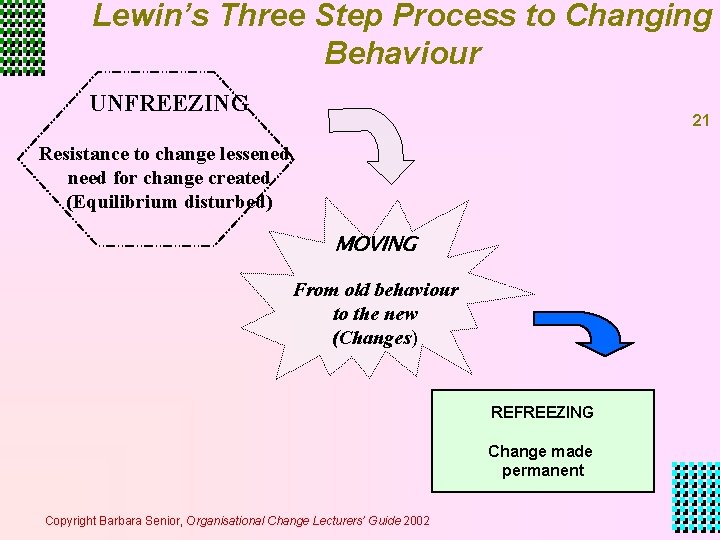
Lewin’s Three Step Process to Changing Behaviour UNFREEZING 21 Resistance to change lessened, need for change created (Equilibrium disturbed) MOVING From old behaviour to the new (Changes) REFREEZING Change made permanent Copyright Barbara Senior, Organisational Change Lecturers’ Guide 2002
Unfreezing § § § ‘Shaking up’ Disconfirmation of old ways of doing things Questioning & challenging of established wisdom Copyright Barbara Senior, Organisational Change Lecturers’ Guide 2002 22
Moving § § Making the actual changes to move to the new state of existence. Includes the development of new strategies, structures, systems & responsibilities and the shedding of old ones. Copyright Barbara Senior, Organisational Change Lecturers’ Guide 2002 23
Refreezing § § § Stabilizing, institutionalising the changes. Making sure the organisation doesn't go backwards to the old state. Reinforcement of the changes through symbols, such as changed logos, dress, building design, structures. Copyright Barbara Senior, Organisational Change Lecturers’ Guide 2002 24
Refreezing? ? ? § Re-freezing may not be appropriate in an era of continuous change, so maybe this stage involves something more like stabilising. Copyright Barbara Senior, Organisational Change Lecturers’ Guide 2002 25
Effective Management of Change § ‘An effective manager. . . : anticipates the need for change as opposed to reacting after the event to the emergency; diagnoses the nature of change that is required and carefully considers a number of alternatives that might improve organisational functioning, as opposed to taking the fastest way to escape the problem; and manages the change process over a period of time so that it is effective and accepted as opposed to lurching from one crisis to another. ’ (Pugh, D. (1993). Understanding and managing change. In Maybey, C. and Mayon-White, B. (Eds. ) Managing Change, Second edition. London, P. C. P. ). Copyright Barbara Senior, Organisational Change Lecturers’ Guide 2002 26
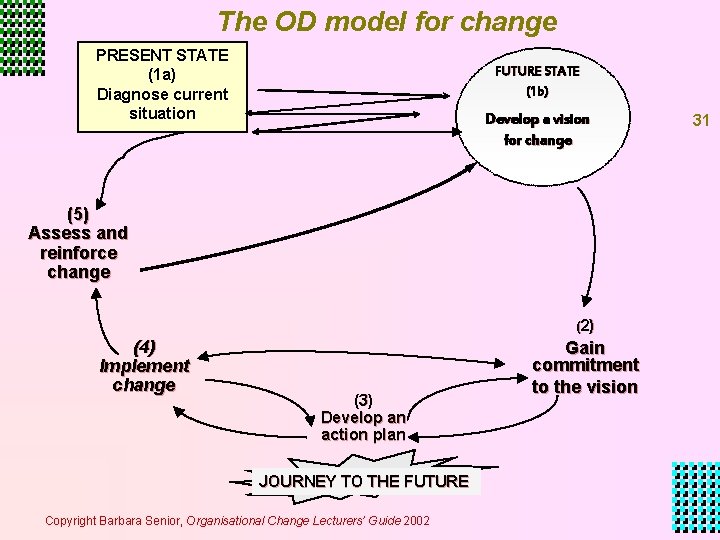
The OD Model for Change - 1 § § § A number of elements distinguish this approach from the hard systems model of change discussed in Chapter 7. Change is not a ‘one-off’ event, but is rather an iterative, cyclical process which is continuous as part of everyday organisational life. Components of the model are diagnosis, data gathering, feedback to the client group, data discussion and work by the client group, action planning and action. Copyright Barbara Senior, Organisational Change Lecturers’ Guide 2002 27
The OD Model for Change - 2 § § § These components may form cycles of activity within each stage of the OD process. The OD approach to change is firmly embedded in the assumption that all who are or who might be involved in any change should be part of the decision-making process to decide what that change might be and to bring it about. It is not a project planned and implemented by senior managers with the assumption that other workers in the organisation will automatically go along with it. Copyright Barbara Senior, Organisational Change Lecturers’ Guide 2002 28
Action Research - 1 § § Action research is central to EACH STAGE of the OD process. It is a collaborative effort between the leaders and facilitators of any change and those who have to enact it. It involves data gathering, feedback of data to the client group, data discussion, action planning, and action. Therefore, action research is, as its name suggests, a combination of research and action. Copyright Barbara Senior, Organisational Change Lecturers’ Guide 2002 29
Action Research - 2 § Action research involves collecting data relevant to the situation of interest, feeding back the results to those who must take action, collaboratively discussing the data to formulate an action plan, and finally, taking the necessary action. Copyright Barbara Senior, Organisational Change Lecturers’ Guide 2002 30
The OD model for change PRESENT STATE (1 a) Diagnose current situation FUTURE STATE (1 b) Develop a vision for change (5) Assess and reinforce change (2) (4) Implement change (3) Develop an action plan JOURNEY TO THE FUTURE Copyright Barbara Senior, Organisational Change Lecturers’ Guide 2002 Gain commitment to the vision 31
Stage 1 - Understanding Present & Future States § § At stages 1 a and 1 b the issues, problems and opportunities are to be fully explored and the (generally) multiple perspectives of people in the change situation should be understood. Diagnosing the current situation should not be rushed through without sufficient consideration of the underlying issues as well as the presenting ones. Copyright Barbara Senior, Organisational Change Lecturers’ Guide 2002 32
Stage 2 - Gaining Commitment to the Vision 33 § § § Once the vision for change has taken shape (stage 1 b), commitment to it has to be gained. Consequently, sharing the vision with all concerned is important, which might mean a review, again, of the vision for change. It is vital to ‘listen to the organisation - people's responses in words and deeds to the vision proposal. Copyright Barbara Senior, Organisational Change Lecturers’ Guide 2002
Stage 3: Develop an Action Plan (1) 34 § § Stage 3 is complex and requires much consultation and gaining the participation of those who must enact the change. Possible resistance to change must be addressed. Copyright Barbara Senior, Organisational Change Lecturers’ Guide 2002
Pugh’s Principles of Change -1 § Principle 1: –Organisations are organisms – adequacy of planning – adequacy of persuasion – adequacy of ‘digestion’ Copyright Barbara Senior, Organisational Change Lecturers’ Guide 2002 35
Pugh’s Principles of Change - 2 § Principle 2: Organisations are occupational and political systems –account taken of occupational impact –account taken of political impact Copyright Barbara Senior, Organisational Change Lecturers’ Guide 2002 36
Pugh’s Principles of Change - 3 § Principle 3: All members of an organisation operate simultaneously in all three systems - the rational, the occupational, the political – appropriateness of starting site – appropriateness of methods used Copyright Barbara Senior, Organisational Change Lecturers’ Guide 2002 37
Stage 3: Develop an Action Plan (2) § § The role of the change agent is important in the whole of stage 3. Debates occur as to whether the 38 use of an internal or external change agent is preferable. Buchanan and Boddy (1992) have written about CHANGE AGENTS’ competencies. – Sensitive, clear, flexible goal setting. – Team building, networking, handling ambiguity. – Communicating, dealing with people and meetings, enthusing, motivating. – Selling, negotiating. – Dealing with the politics, influencing, the broader view. Copyright Barbara Senior, Organisational Change Lecturers’ Guide 2002
Stage 3: Develop an Action Plan (3) CHANGE AGENTS help the organisation to: § Define the problem. § Examine and diagnose the problem. § Come up with alternative solutions. § Direct implementation of solutions. § Crystallise the learning. Copyright Barbara Senior, Organisational Change Lecturers’ Guide 2002 39
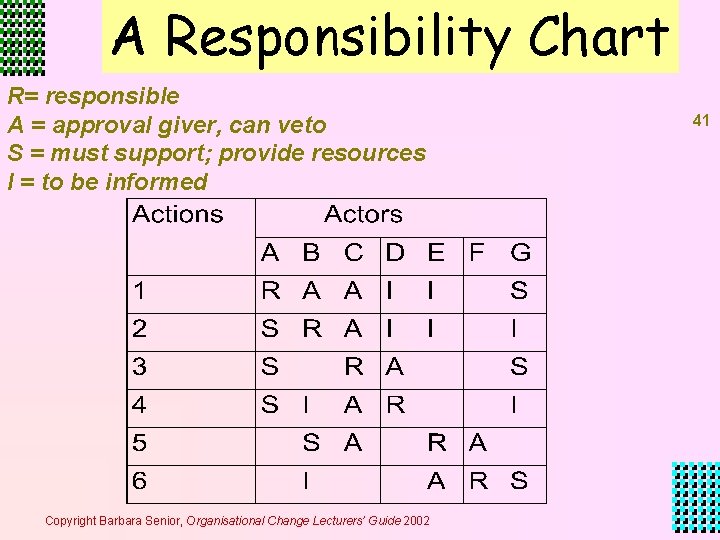
Stage 3: Develop an Action Plan (4) § § ‘Responsibility charting’ helps in the assessment of the alternative behaviours for those involved in the series of actions for change. It involves identifying and assigning the specific people involved in each action or decision. – who is responsible (one person). – who are the approval givers (not too many). – who are the supporters, resource providers (vital). – who should be be informed. Copyright Barbara Senior, Organisational Change Lecturers’ Guide 2002 40
A Responsibility Chart R= responsible A = approval giver, can veto S = must support; provide resources I = to be informed Copyright Barbara Senior, Organisational Change Lecturers’ Guide 2002 41
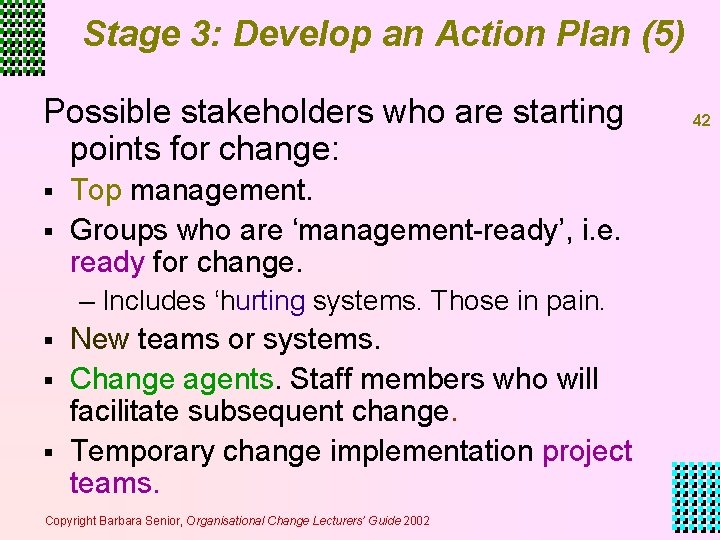
Stage 3: Develop an Action Plan (5) Possible stakeholders who are starting points for change: § § Top management. Groups who are ‘management-ready’, i. e. ready for change. – Includes ‘hurting systems. Those in pain. § § § New teams or systems. Change agents. Staff members who will facilitate subsequent change. Temporary change implementation project teams. Copyright Barbara Senior, Organisational Change Lecturers’ Guide 2002 42
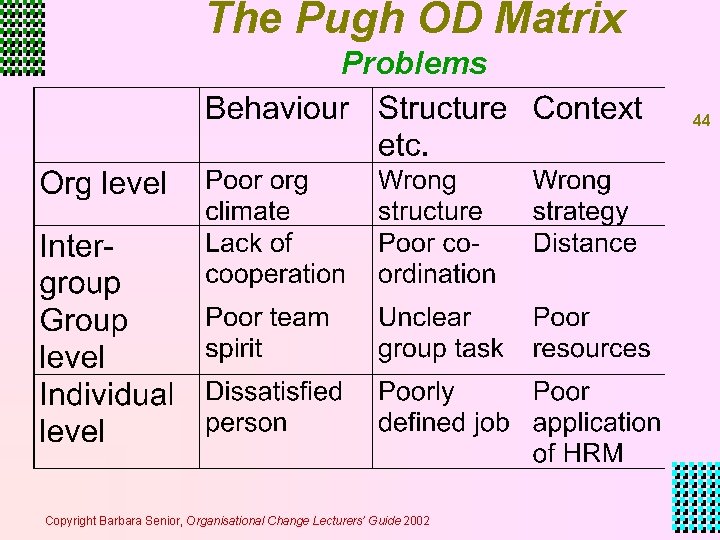
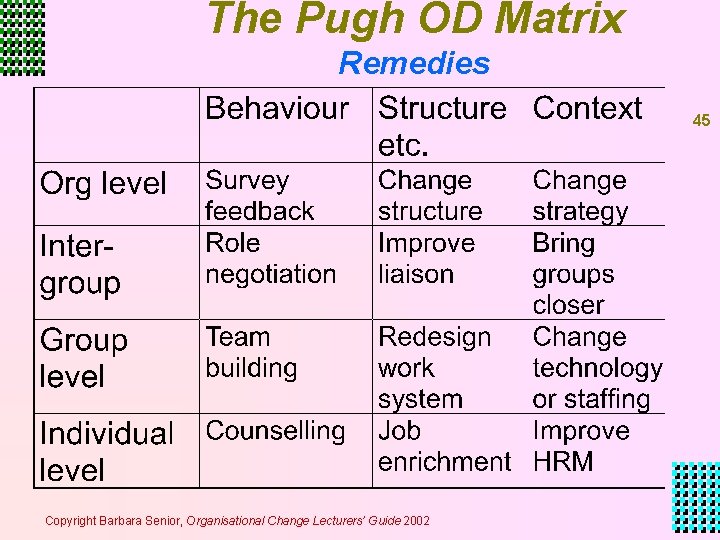
Stage 3: Develop an Action Plan (6) § Pugh’s (1986) OD matrix on p. 323 is 43 very useful in deciding where, in an organisation, change efforts should start and be planned. – start with desired behaviour that needs to change. – move to organising the system, structure, info. flows, etc. that may need to change. – move to organise the contextual setting that may also need to change. Copyright Barbara Senior, Organisational Change Lecturers’ Guide 2002
The Pugh OD Matrix Problems 44 Copyright Barbara Senior, Organisational Change Lecturers’ Guide 2002
The Pugh OD Matrix Remedies 45 Copyright Barbara Senior, Organisational Change Lecturers’ Guide 2002
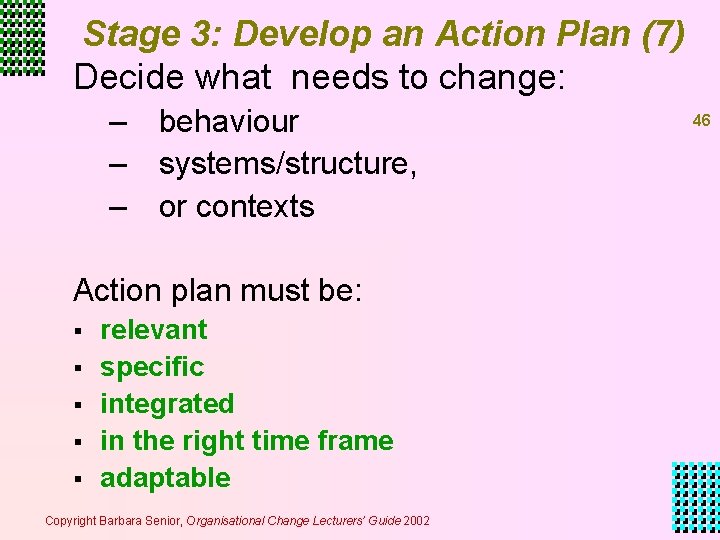
Stage 3: Develop an Action Plan (7) Decide what needs to change: – behaviour – systems/structure, – or contexts Action plan must be: § § § relevant specific integrated in the right time frame adaptable Copyright Barbara Senior, Organisational Change Lecturers’ Guide 2002 46
Stage 4 Implement the Change § Stages 4 (and 5) of the OD process ‘Implementing and assessing and reinforcing the change’ can make use of a range of techniques, some of them identified on the Pugh OD matrix. Copyright Barbara Senior, Organisational Change Lecturers’ Guide 2002 47
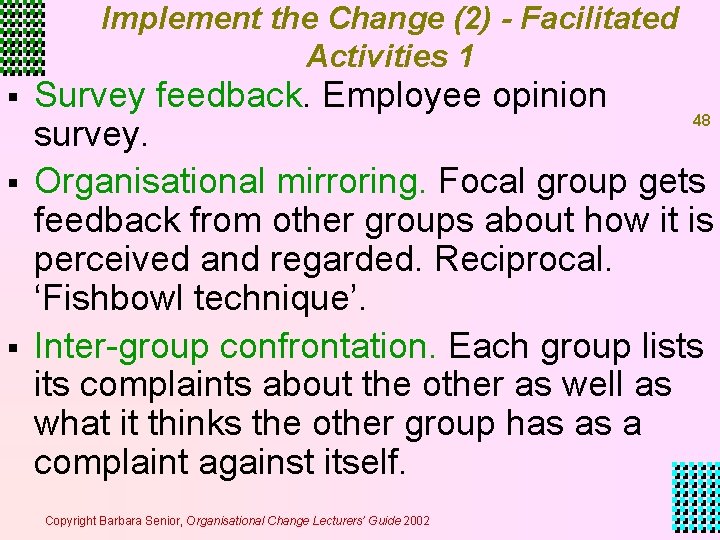
Implement the Change (2) - Facilitated Activities 1 § § § Survey feedback. Employee opinion 48 survey. Organisational mirroring. Focal group gets feedback from other groups about how it is perceived and regarded. Reciprocal. ‘Fishbowl technique’. Inter-group confrontation. Each group lists its complaints about the other as well as what it thinks the other group has as a complaint against itself. Copyright Barbara Senior, Organisational Change Lecturers’ Guide 2002
Implement the Change (2) - Facilitated Activities 2 § § Role negotiation. Focus on each other’s behaviours and negotiate an increase, decrease or status quo. Process consultation. The consultant engages in feedback, coaching, counselling, and helps individuals and groups finds their own solutions. 49 Copyright Barbara Senior, Organisational Change Lecturers’ Guide 2002
Implement the Change (3) - Facilitated Activities 3 § § § Team Building - focus on the team 50 processes, culture and responsibilities. Life and career planning - ‘Life line’ drawing, connecting past, present & future. Write your own obituary. Plus various other methods for designing structures and contexts. Copyright Barbara Senior, Organisational Change Lecturers’ Guide 2002
Implement the Change (4) § Go for a series of SHORT-TERM WINS, visible outcomes (short term goals) that: – show that sacrifices are worthwhile – reward change agents – help fine tune the visions and strategies – counterbalance the cynics – keep bosses happy – build momentum Copyright Barbara Senior, Organisational Change Lecturers’ Guide 2002 51
Stage 5: Assessing and Reinforcing Change § ‘Hard’ change is relatively easy to assess – Set hard objectives and quantifiable performance measures § ‘Soft’ change is more difficult to assess Copyright Barbara Senior, Organisational Change Lecturers’ Guide 2002 52
Assessing the ‘Soft’ Elements of Change § Survey or cultural audit. § Interviews with individuals or focus groups. § Examination of turnover and absenteeism rates. § Analysis (through observation or questionnaire) of group performance. § “Picturing” the organisation - ask staff to portray the org in pictures, not words. Copyright Barbara Senior, Organisational Change Lecturers’ Guide 2002 53
Reinforcing and Consolidating Change § Design appraisal, career and reward systems which help reinforce desired behaviours. § Orientate staff training and development to the new vision and the new situation. § Hold people accountable for maintaining the vision and continuing to implement the change. Copyright Barbara Senior, Organisational Change Lecturers’ Guide 2002 54
Iteration § At all these stages, as Figure 8. 2 on p. 312 shows, the requirement of iteration back to previous stages and then forwards again with modified plans and actions is crucial to the way the OD process operates. Copyright Barbara Senior, Organisational Change Lecturers’ Guide 2002 55
An Assessment of the OD Model for Change (1) 56 Three of the criticisms that have been aimed at this model for change are: 1. OD does not always face up to the harsh ‘realities’ of change. (‘Rather than unfreezing, people need to be shaken up’. ) 2. OD is limited when change situations are ‘constrained’. (Diagnosis and vision already set). 3. OD does not always fit with the policies and practices of bureaucracy, political systems Copyright Barbara Senior, Organisational Change Lecturers’ Guide 2002
An Assessment of the OD Model for Change (2) A fourth criticism of the soft systems model 57 for change is 4. The claim that OD cannot be applied in the same way across all cultures. Supposedly it is not suited to high Power Distance, high Uncertainty Avoidance, and high Masculinity cultures. Copyright Barbara Senior, Organisational Change Lecturers’ Guide 2002
An Assessment of the OD Model for Change (3) 58 § § Given these criticisms, care has to be taken that the OD process is modified to suit different circumstances. It must also be recognised that, in times of crisis, managers may have to act very fast and. . . – it may not be possible to put into practice the full consultation and participation that is built into the OD process. Copyright Barbara Senior, Organisational Change Lecturers’ Guide 2002