
Organisation for Economic Cooperation and Development MULTILATERAL TAX
- Slides: 15
Organisation for Economic Co-operation and Development MULTILATERAL TAX NETWORK Auditing Multinational Enterprises International Tax Avoidance and Evasion Ankara, 7 -11 May 2007 2. Features of Multinational Enterprises 1 - Opening and Introduction 1 Centre for Tax Policy and Administration
Taxation of companies § § § This week’s event is focused on the taxation of companies, rather than individuals. Companies are separate legal persons…. . . and can own assets and enter into contracts. Companies are owned by shareholders who appoint. . directors of the company, who have responsibility to direct the companies affairs and meet the objectives of the shareholders. A company’s shareholders are entitled to share in its profit
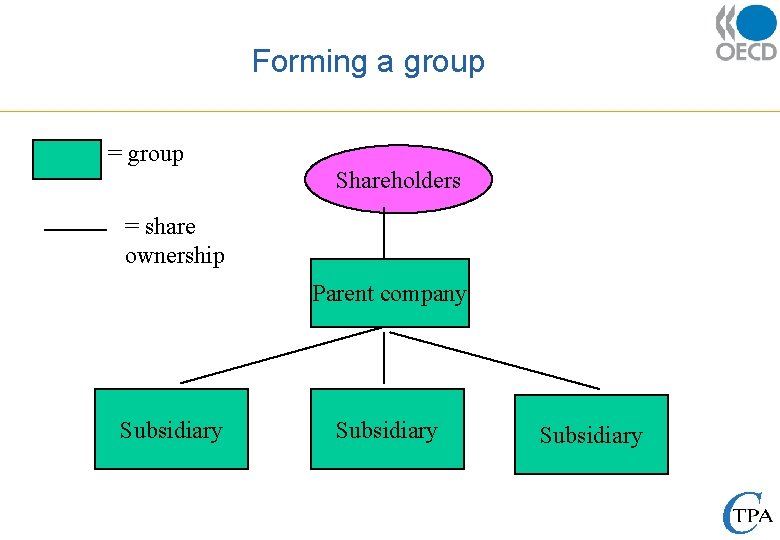
Shareholders § § Can be individuals, financial institutions or other companies A group of companies is formed when companies own shares in other companies.
Forming a group = group Shareholders = share ownership Parent company Subsidiary
Structure of Multinational Enterprises Distinguish between: § § § 5 Companies – which have their own legal identity and residence status, and may be organised in sub-groups Branches – which are legally a part of a company and do not have their own legal identity (and may be permanent establishments for taxation purposes) Hybrid entities
Company accounts § The starting point for company taxation is the audited company accounts § We need to distinguish between: - single company accounts - which include the income earned by that company only (including any dividend income it receives from any subsidiaries) - consolidated accounts – which include the income earned by the company and its subsidiaries (as though they constituted a single entity).
Tax Features of Multinational Enterprises • MNEs are made up of separate taxable entities that are connected by share ownership • Each company in the group will have a residence for taxation purposes (perhaps more than one) • Tax administrations view tax on a jurisdictional basis - that is, they will tax those group companies that are resident in their jurisdiction (in fact, they may sometimes also seek to tax all or part of the income of other group companies) 7
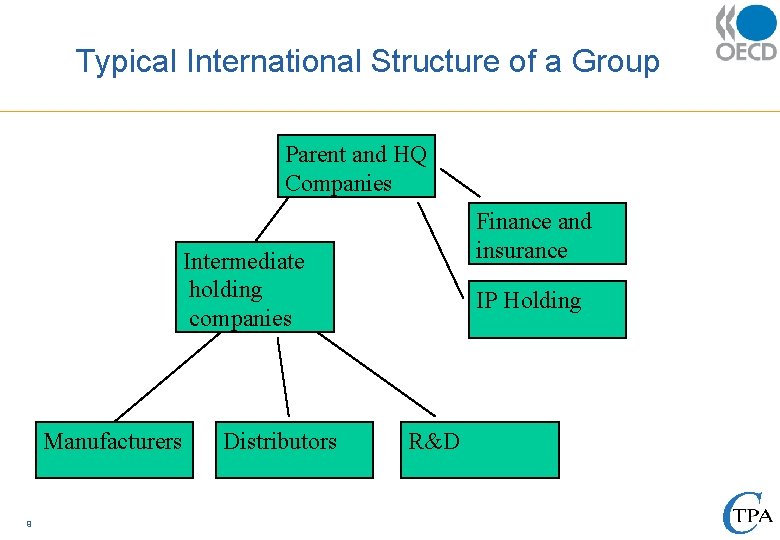
MNE - typical functions This will depend on the industry and chosen structure, but, for a manufacturing MNE for example, may include: § Ultimate parent company § Intermediate holding companies § Head office and/or regional headquarters § Manufacturing facilities § Sales and distribution entities § Research and development facilities § Intellectual property holding and management entities § Financial - treasury NB Functional organisation does not necessarily match legal organisation 8
Typical International Structure of a Group Parent and HQ Companies Finance and insurance Intermediate holding companies Manufacturers 9 Distributors IP Holding R&D
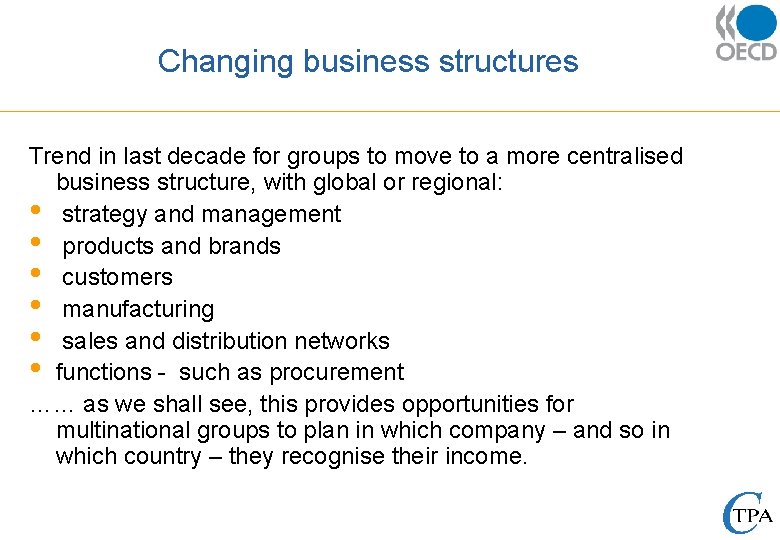
Changing business structures Trend in last decade for groups to move to a more centralised business structure, with global or regional: • strategy and management • products and brands • customers • manufacturing • sales and distribution networks • functions - such as procurement …… as we shall see, this provides opportunities for multinational groups to plan in which company – and so in which country – they recognise their income.
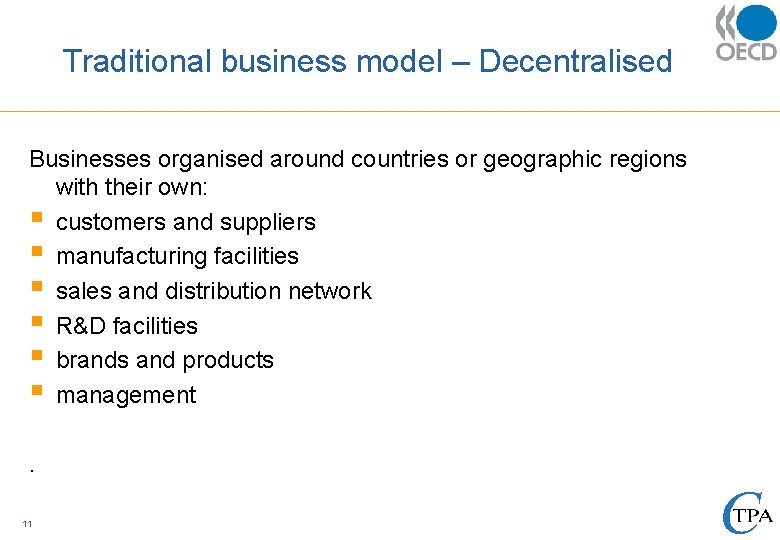
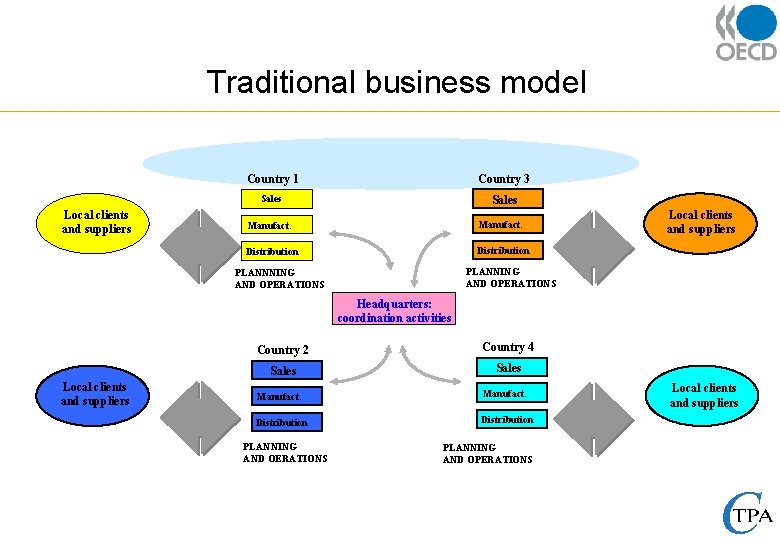
Traditional business model – Decentralised Businesses organised around countries or geographic regions with their own: § customers and suppliers § manufacturing facilities § sales and distribution network § R&D facilities § brands and products § management. 11
Traditional business model Local clients and suppliers Country 1 Country 3 Sales Manufact. Distribution Local clients and suppliers PLANNING AND OPERATIONS PLANNNING AND OPERATIONS Headquarters: coordination activities Local clients and suppliers Country 2 Country 4 Sales Manufact. Distribution PLANNING AND OERATIONS PLANNING AND OPERATIONS Local clients and suppliers
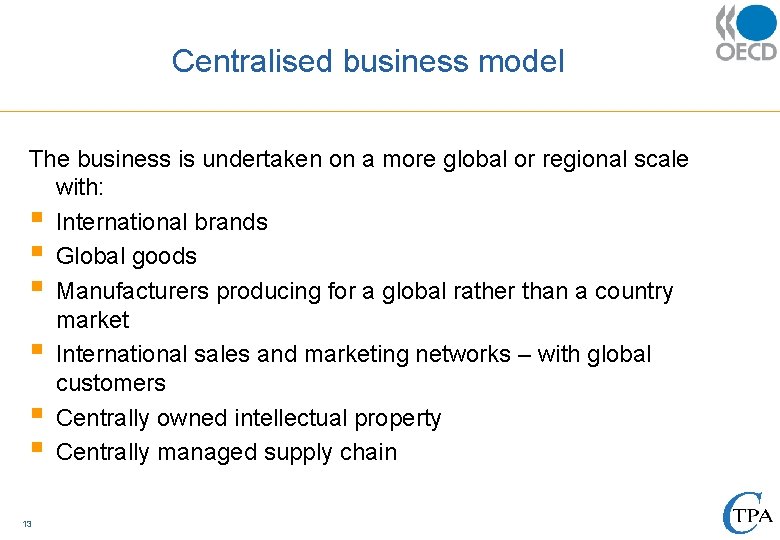
Centralised business model The business is undertaken on a more global or regional scale with: § International brands § Global goods § Manufacturers producing for a global rather than a country market § International sales and marketing networks – with global customers § Centrally owned intellectual property § Centrally managed supply chain 13
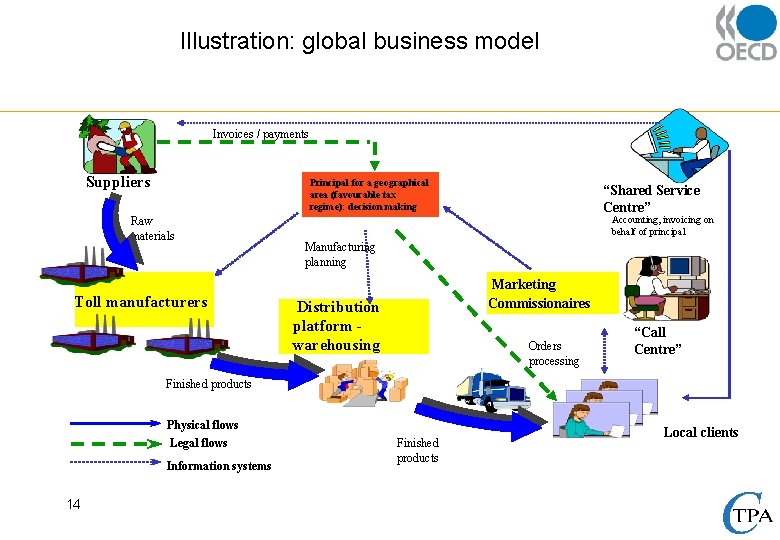
Illustration: global business model Invoices / payments Suppliers Principal for a geographical area (favourable tax regime): decision making Raw materials Toll manufacturers “Shared Service Centre” Accounting, invoicing on behalf of principal Manufacturing planning Marketing Commissionaires Distribution platform warehousing Orders processing “Call Centre” Finished products Physical flows Legal flows Information systems 14 Finished products Local clients
Centralised business model … increases business efficiency in a globalised economy … but also provides more scope for MNEs to plan where they earn their profits. 15