
Organisation and Implementation of a National Regulatory Programme
- Slides: 66
Organisation and Implementation of a National Regulatory Programme for the Control of Radiation Sources (ORGIMP) Ottawa, Canada 11 -22 September 2017 Code of Conduct on the Safety and Security of Radioactive Sources Stephen Evans
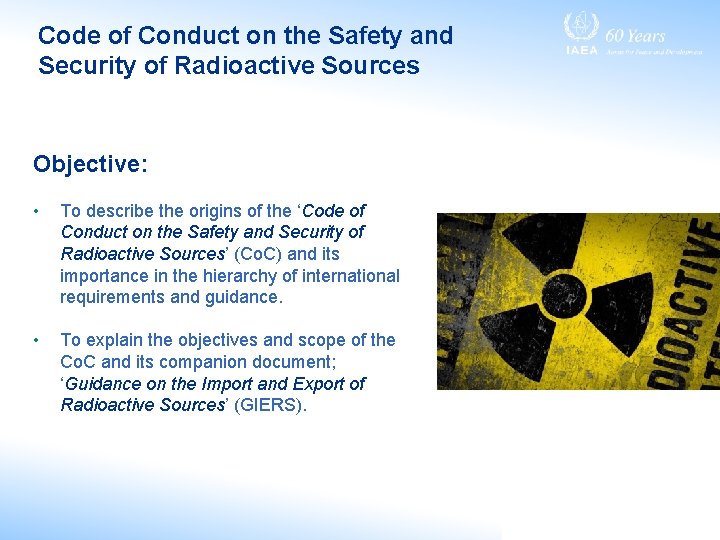
Code of Conduct on the Safety and Security of Radioactive Sources Objective: • To describe the origins of the ‘Code of Conduct on the Safety and Security of Radioactive Sources’ (Co. C) and its importance in the hierarchy of international requirements and guidance. • To explain the objectives and scope of the Co. C and its companion document; ‘Guidance on the Import and Export of Radioactive Sources’ (GIERS).
Code of Conduct on the Safety and Security of Radioactive Sources Contents: • • Radioactive Sources in Practice • • Revision of the Code • Political Commitment to the Code and Guidance • Implementation of the Code and the Guidance Development of the Code of Conduct on the Safety and Security of Radioactive Sources Objectives and Scope of the Code Contents of the Code Guidance on the Import and Export of Radioactive Sources
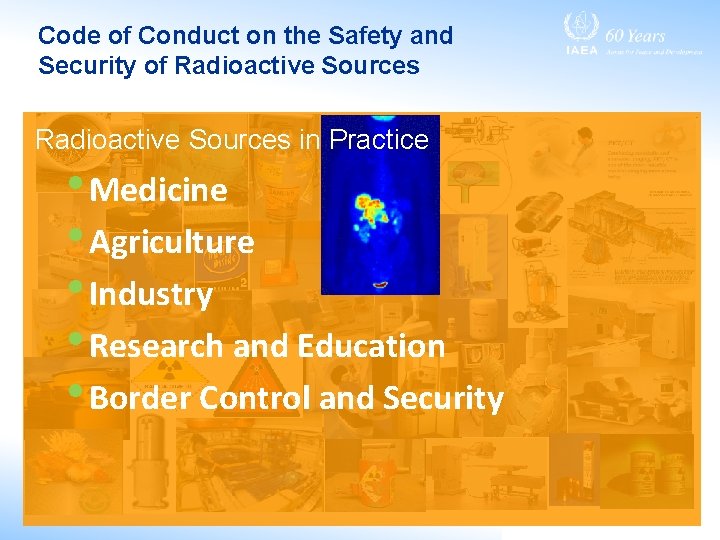
Code of Conduct on the Safety and Security of Radioactive Sources in Practice • Medicine • Agriculture • Industry • Research and Education • Border Control and Security
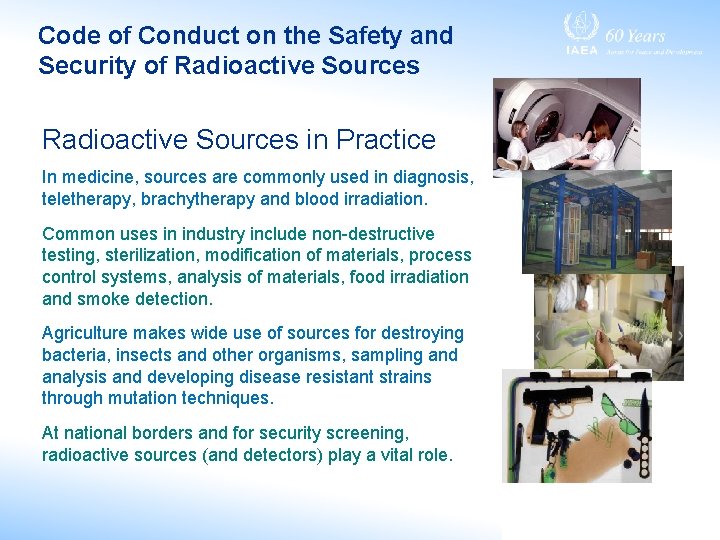
Code of Conduct on the Safety and Security of Radioactive Sources in Practice In medicine, sources are commonly used in diagnosis, teletherapy, brachytherapy and blood irradiation. Common uses in industry include non-destructive testing, sterilization, modification of materials, process control systems, analysis of materials, food irradiation and smoke detection. Agriculture makes wide use of sources for destroying bacteria, insects and other organisms, sampling and analysis and developing disease resistant strains through mutation techniques. At national borders and for security screening, radioactive sources (and detectors) play a vital role.
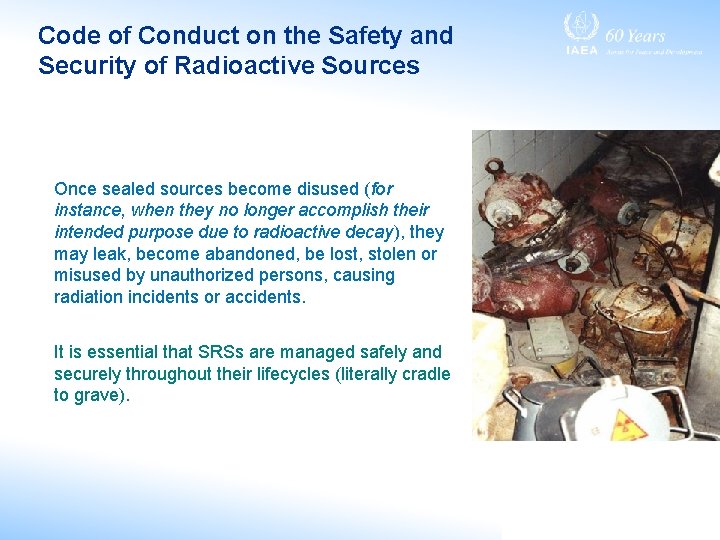
Code of Conduct on the Safety and Security of Radioactive Sources Once sealed sources become disused (for instance, when they no longer accomplish their intended purpose due to radioactive decay), they may leak, become abandoned, be lost, stolen or misused by unauthorized persons, causing radiation incidents or accidents. It is essential that SRSs are managed safely and securely throughout their lifecycles (literally cradle to grave).
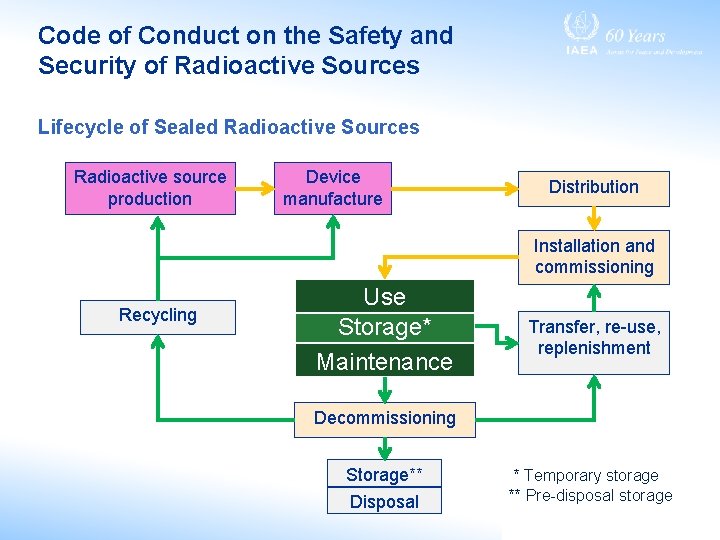
Code of Conduct on the Safety and Security of Radioactive Sources Lifecycle of Sealed Radioactive Sources Radioactive source production Device manufacture Distribution Installation and commissioning Recycling Use Storage* Maintenance Transfer, re-use, replenishment Decommissioning Storage** Disposal * Temporary storage ** Pre-disposal storage
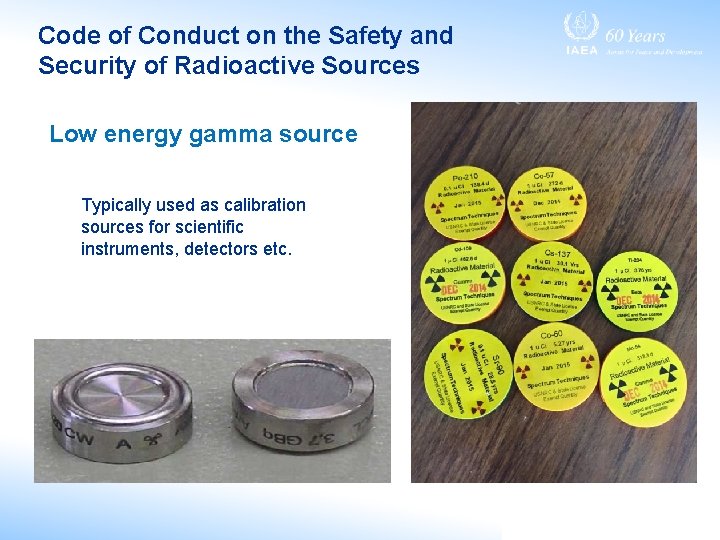
Code of Conduct on the Safety and Security of Radioactive Sources Low energy gamma source Typically used as calibration sources for scientific instruments, detectors etc.
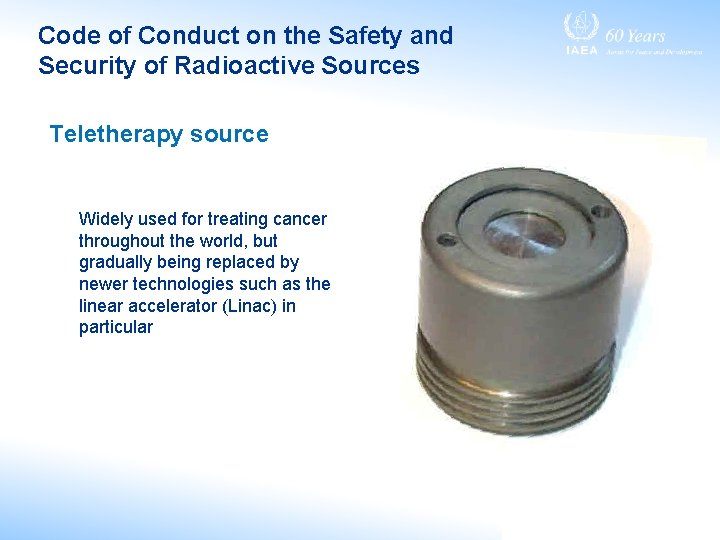
Code of Conduct on the Safety and Security of Radioactive Sources Teletherapy source Widely used for treating cancer throughout the world, but gradually being replaced by newer technologies such as the linear accelerator (Linac) in particular
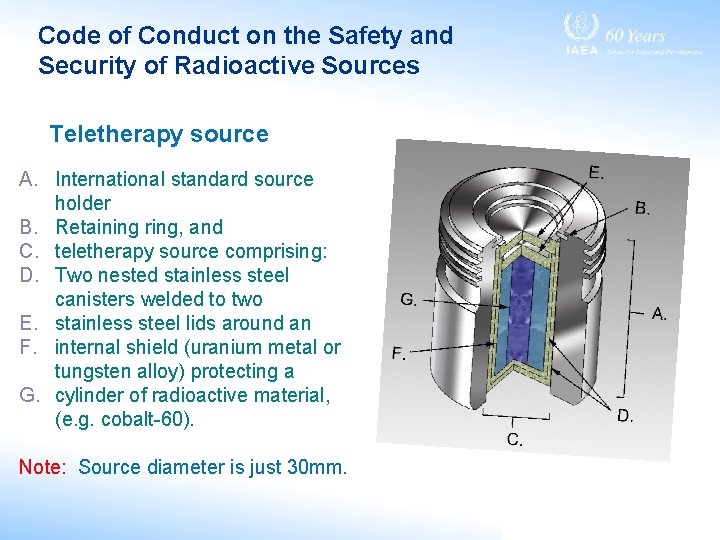
Code of Conduct on the Safety and Security of Radioactive Sources Teletherapy source A. International standard source holder B. Retaining ring, and C. teletherapy source comprising: D. Two nested stainless steel canisters welded to two E. stainless steel lids around an F. internal shield (uranium metal or tungsten alloy) protecting a G. cylinder of radioactive material, (e. g. cobalt-60). Note: Source diameter is just 30 mm.
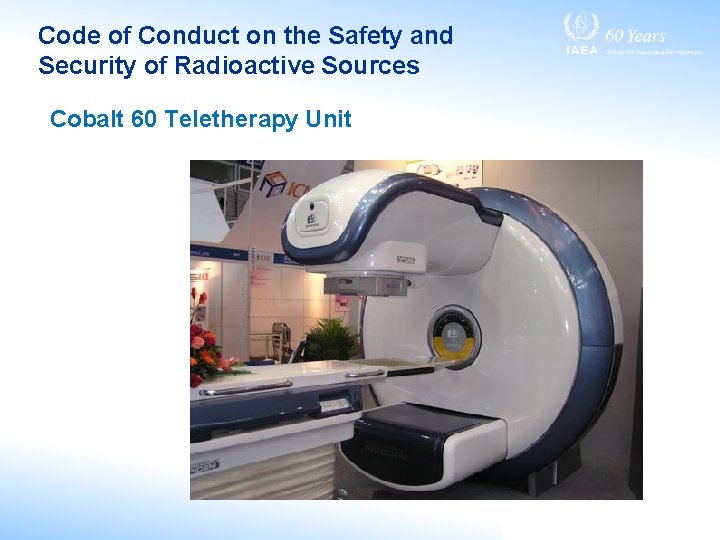
Code of Conduct on the Safety and Security of Radioactive Sources Cobalt 60 Teletherapy Unit
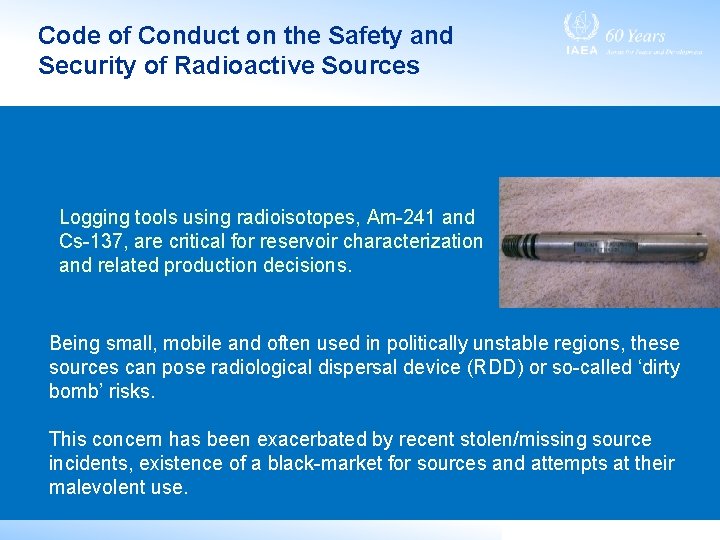
Code of Conduct on the Safety and Security of Radioactive Sources Well-logging source Logging tools using radioisotopes, Am-241 and Cs-137, are critical for reservoir characterization and related production decisions. Being small, mobile and often used in politically unstable regions, these sources can pose radiological dispersal device (RDD) or so-called ‘dirty bomb’ risks. This concern has been exacerbated by recent stolen/missing source incidents, existence of a black-market for sources and attempts at their malevolent use.
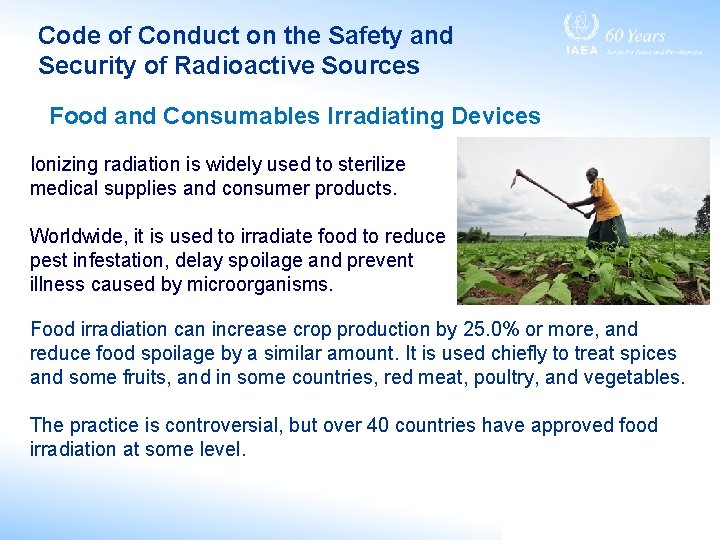
Code of Conduct on the Safety and Security of Radioactive Sources Food and Consumables Irradiating Devices Ionizing radiation is widely used to sterilize medical supplies and consumer products. Worldwide, it is used to irradiate food to reduce pest infestation, delay spoilage and prevent illness caused by microorganisms. Food irradiation can increase crop production by 25. 0% or more, and reduce food spoilage by a similar amount. It is used chiefly to treat spices and some fruits, and in some countries, red meat, poultry, and vegetables. The practice is controversial, but over 40 countries have approved food irradiation at some level.
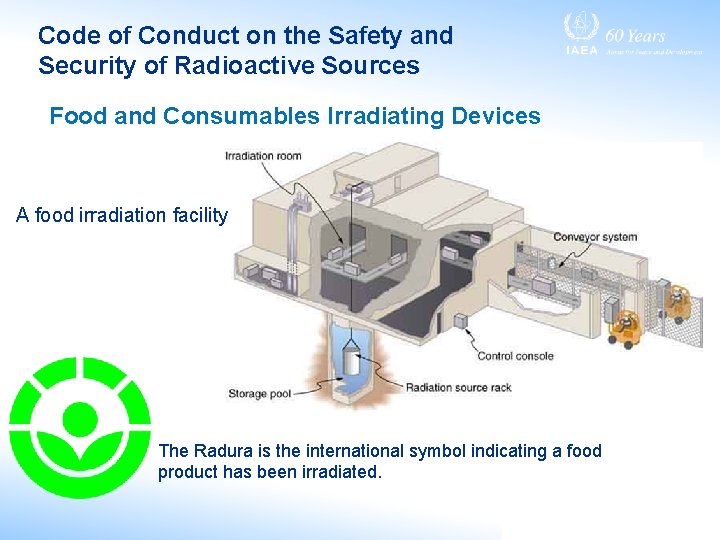
Code of Conduct on the Safety and Security of Radioactive Sources Food and Consumables Irradiating Devices A food irradiation facility The Radura is the international symbol indicating a food product has been irradiated.
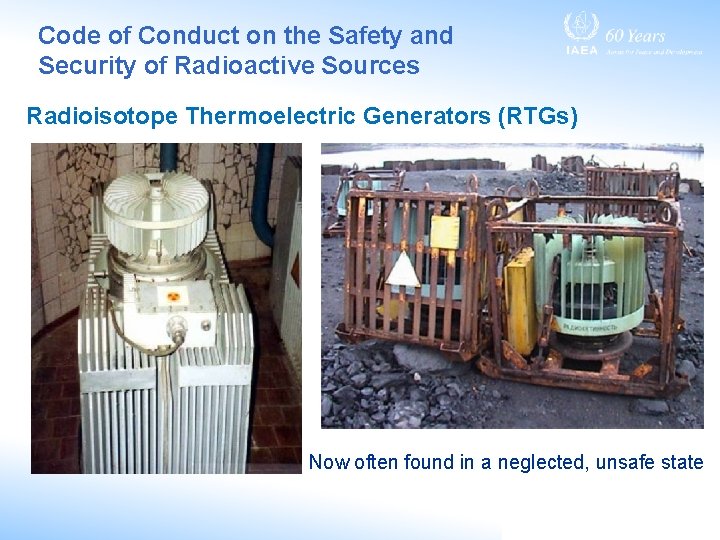
Code of Conduct on the Safety and Security of Radioactive Sources Radioisotope Thermoelectric Generators (RTGs) A radioisotope thermoelectric generator (RTG) converts heat released by radioactive decay into electricity. The generator has no moving parts. RTGs provide power sources in satellites, space probes and unmanned remote facilities such as a number of lighthouses and navigation beacons built by the former Soviet Union. RTGs are effective power sources for unmaintained facilities needing a few hundred watts of power for durations too long for fuel cells, batteries or generators and in places where solar cells are impractical. RTGs generally utilise high energy sources of long half-life and thus, their safe use requires containment of the radioisotopes long after the productive life of the unit.
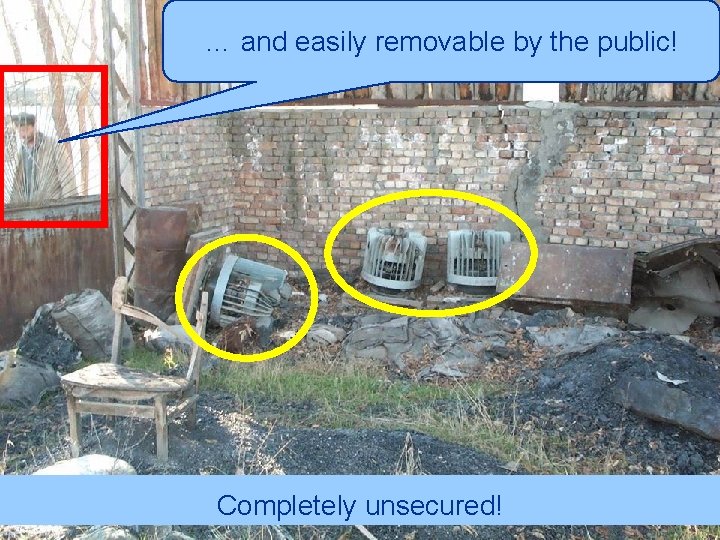
Code of Conduct on the Safety and Security of Radioactive Sources Radioisotope Thermoelectric Generators (RTGs) The former Soviet Union constructed many RTG powered facilities. Utilising strontium-90 (90 Sr), they provide a reliable and steady source of power. However, there have been environmental, safety and security problems due to leakage or theft of the radioactive material over the years, particularly at locations with poor regulatory control. There approximately 1, 000 such RTGs in Russia. All have long exhausted their 10 -year engineered life spans. They are mostly no longer functional and in need of dismantling. Some have become prey to metal hunters, who strip the metal casings, regardless of the risk of radioactive contamination and sell the hazardous material as scrap, which may be inadvertently recycled.
Code of Conduct on the Safety and Security of Radioactive Sources Radioisotope Thermoelectric Generators (RTGs) Now often found in a neglected, unsafe state
… and easily removable by the public! Completely unsecured!
Code of Conduct on the Safety and Security of Radioactive Sources So …. . Lots of benefits, but lots of risk too …. .
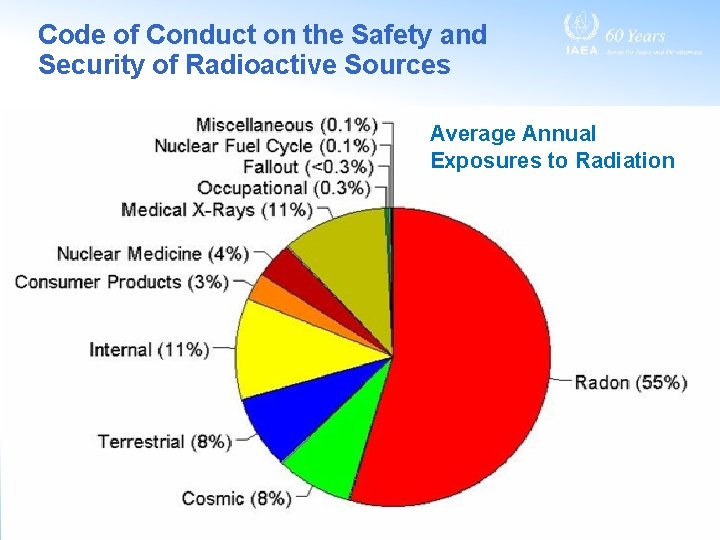
Code of Conduct on the Safety and Security of Radioactive Sources Average Annual Exposures to Radiation
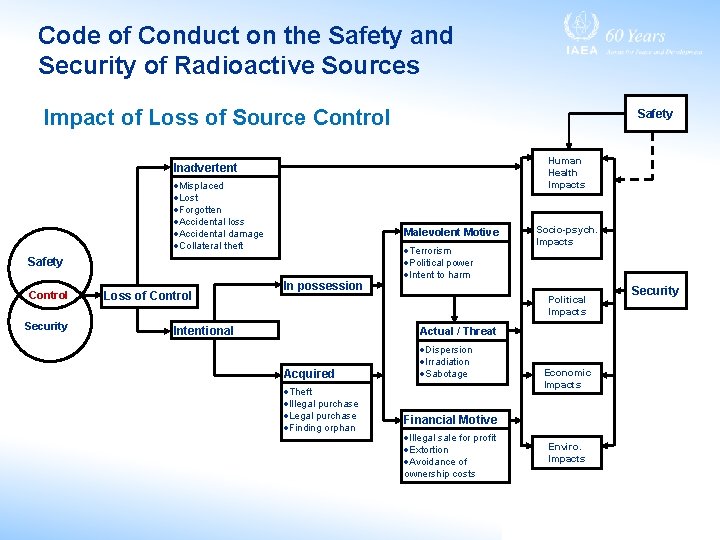
Code of Conduct on the Safety and Security of Radioactive Sources Impact of Loss of Source Control Safety Human Health Impacts Inadvertent ·Misplaced ·Lost ·Forgotten ·Accidental loss ·Accidental damage ·Collateral theft Malevolent Motive Safety Control Security Loss of Control In possession ·Terrorism ·Political power ·Intent to harm Socio-psych. Impacts Political Impacts Intentional Actual / Threat Acquired ·Theft ·Illegal purchase ·Legal purchase ·Finding orphan ·Dispersion ·Irradiation ·Sabotage Economic Impacts Financial Motive ·Illegal sale for profit ·Extortion ·Avoidance of ownership costs Enviro. Impacts Security
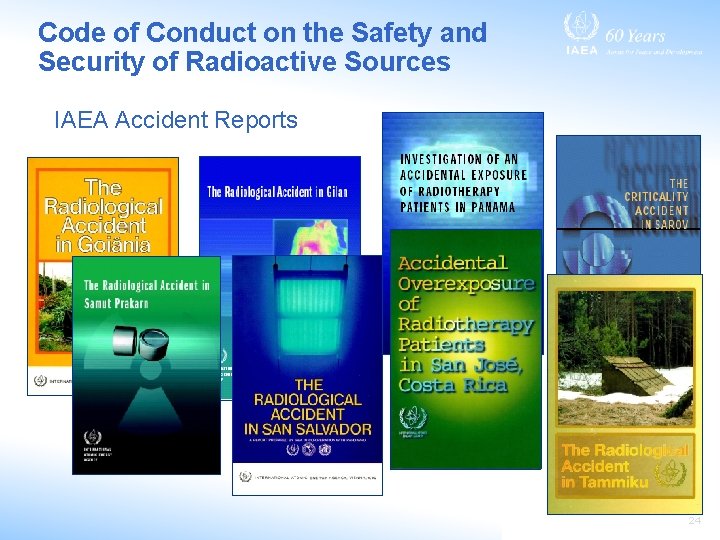
Code of Conduct on the Safety and Security of Radioactive Sources IAEA Accident Reports 24
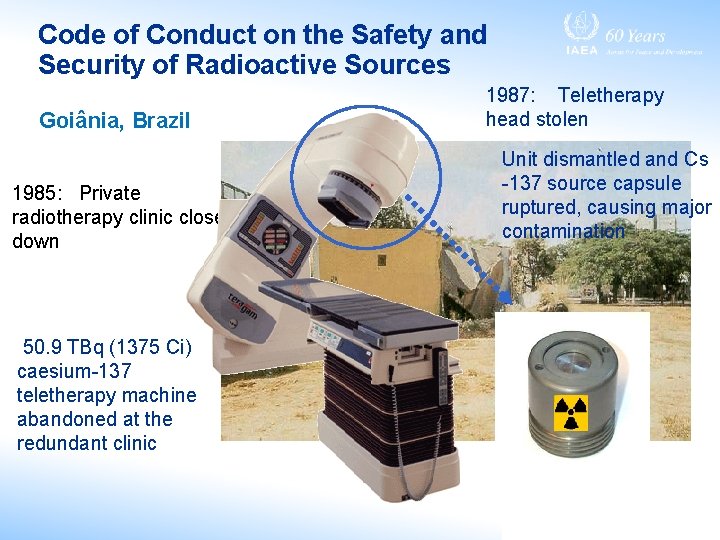
Code of Conduct on the Safety and Security of Radioactive Sources Goiânia, Brazil 1985: Private radiotherapy clinic closed down 50. 9 TBq (1375 Ci) caesium-137 teletherapy machine abandoned at the redundant clinic 1987: Teletherapy head stolen Unit dismantled and Cs -137 source capsule ruptured, causing major contamination
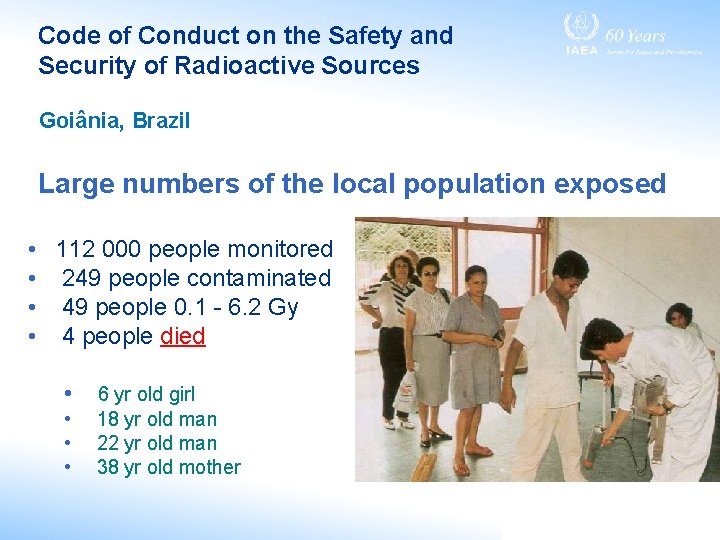
Code of Conduct on the Safety and Security of Radioactive Sources Goiânia, Brazil Large numbers of the local population exposed • 112 000 people monitored • 249 people contaminated • 49 people 0. 1 - 6. 2 Gy • 4 people died • • 6 yr old girl 18 yr old man 22 yr old man 38 yr old mother
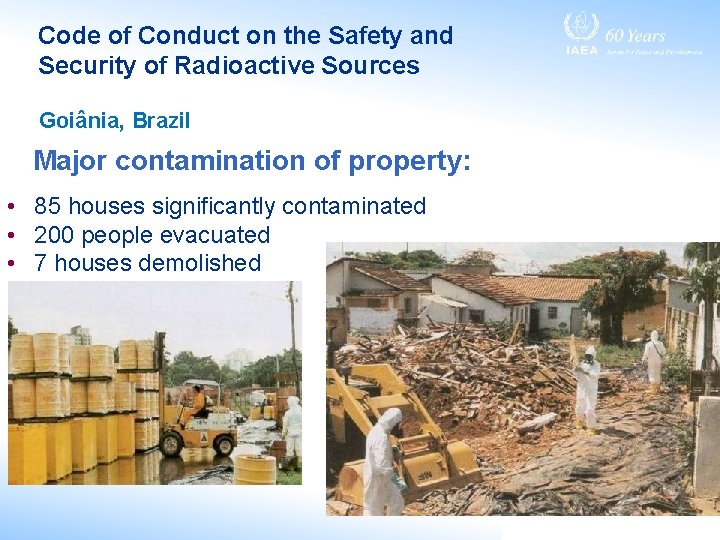
Code of Conduct on the Safety and Security of Radioactive Sources Goiânia, Brazil Major contamination of property: • 85 houses significantly contaminated • 200 people evacuated • 7 houses demolished
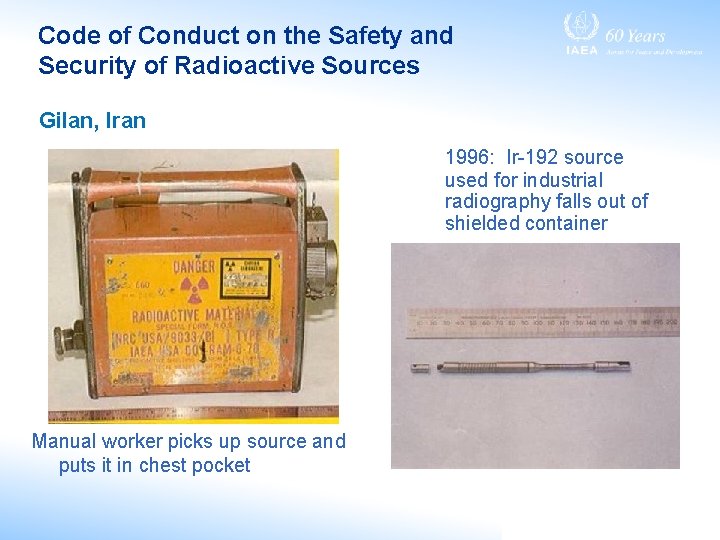
Code of Conduct on the Safety and Security of Radioactive Sources Gilan, Iran 1996: Ir-192 source used for industrial radiography falls out of shielded container Manual worker picks up source and puts it in chest pocket
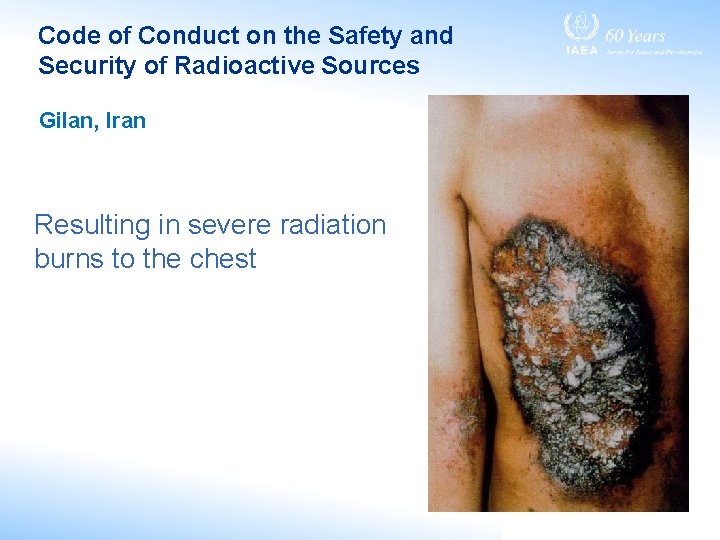
Code of Conduct on the Safety and Security of Radioactive Sources Gilan, Iran Resulting in severe radiation burns to the chest
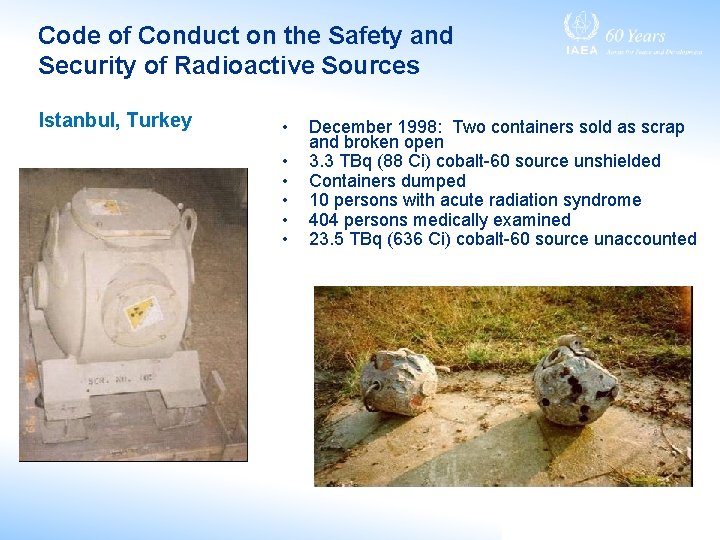
Code of Conduct on the Safety and Security of Radioactive Sources Istanbul, Turkey • • • December 1998: Two containers sold as scrap and broken open 3. 3 TBq (88 Ci) cobalt-60 source unshielded Containers dumped 10 persons with acute radiation syndrome 404 persons medically examined 23. 5 TBq (636 Ci) cobalt-60 source unaccounted
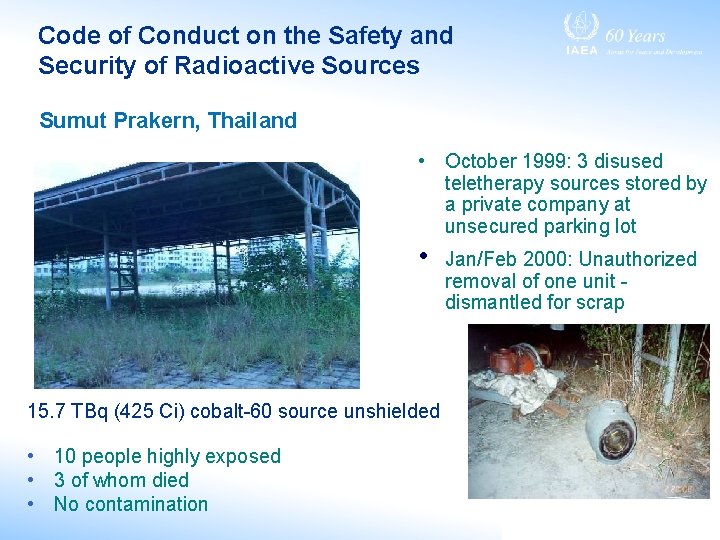
Code of Conduct on the Safety and Security of Radioactive Sources Sumut Prakern, Thailand • October 1999: 3 disused teletherapy sources stored by a private company at unsecured parking lot • 15. 7 TBq (425 Ci) cobalt-60 source unshielded • 10 people highly exposed • 3 of whom died • No contamination Jan/Feb 2000: Unauthorized removal of one unit dismantled for scrap
Code of Conduct on the Safety and Security of Radioactive Sources Lja, Georgia A group of woodcutters find two hot ‘objects’ in the forest. (Unshielded strontium-90 sources, each approximately 30, 000 Ci !)
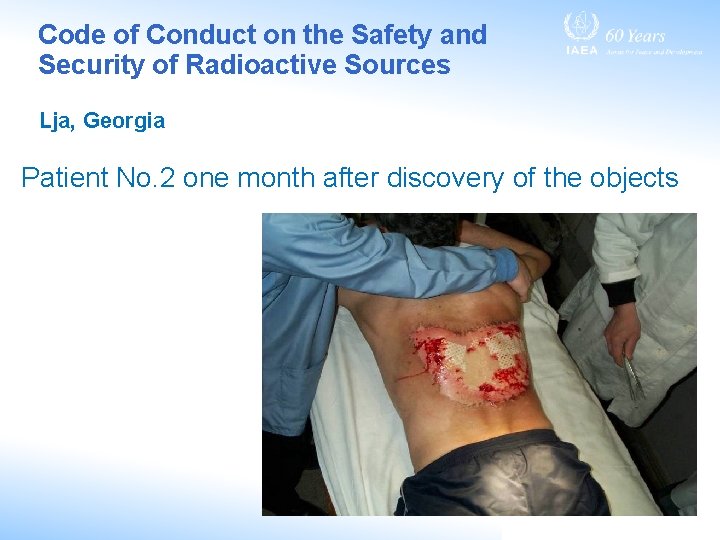
Code of Conduct on the Safety and Security of Radioactive Sources Lja, Georgia Patient No. 2 one month after discovery of the objects
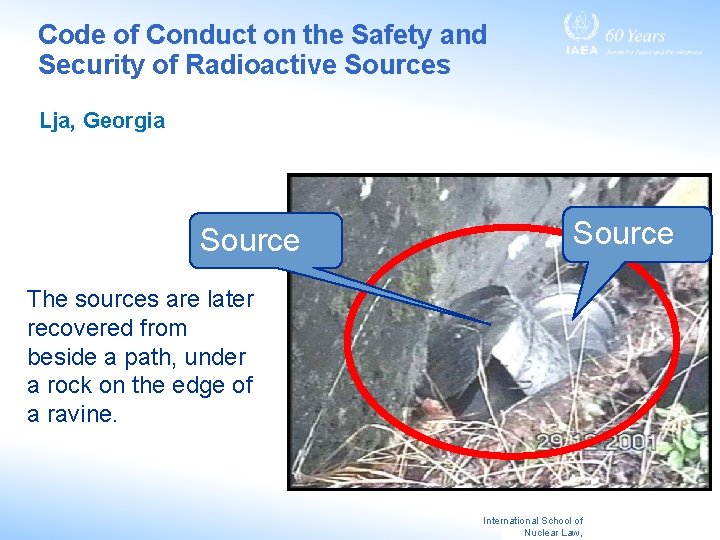
Code of Conduct on the Safety and Security of Radioactive Sources Lja, Georgia Source The sources are later recovered from beside a path, under a rock on the edge of a ravine. International School of Nuclear Law,
Code of Conduct on the Safety and Security of Radioactive Sources So, what to do?
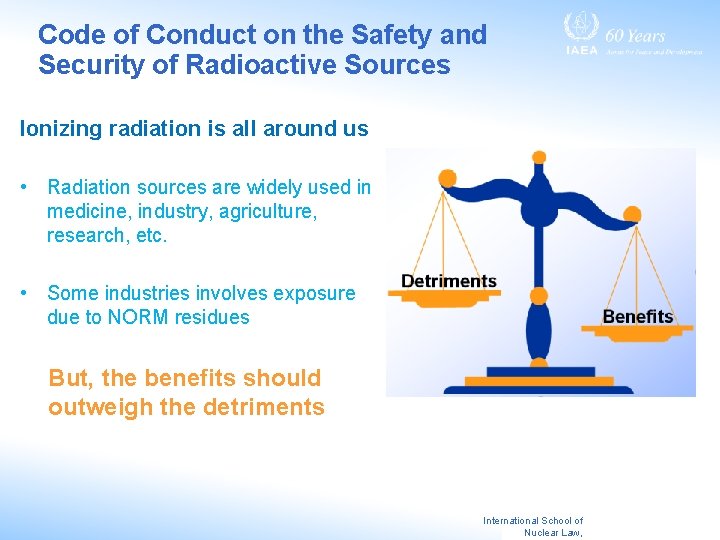
Code of Conduct on the Safety and Security of Radioactive Sources Ionizing radiation is all around us • Radiation sources are widely used in medicine, industry, agriculture, research, etc. • Some industries involves exposure due to NORM residues But, the benefits should outweigh the detriments International School of Nuclear Law,
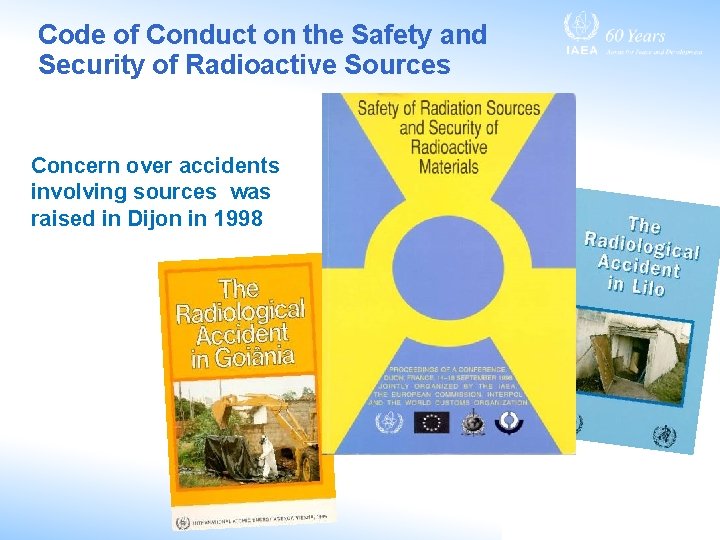
Code of Conduct on the Safety and Security of Radioactive Sources Concern over accidents involving sources was raised in Dijon in 1998
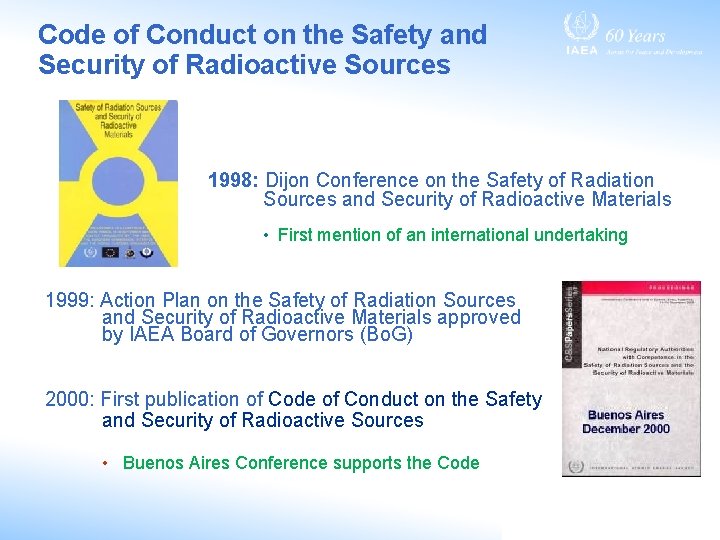
Code of Conduct on the Safety and Security of Radioactive Sources 1998: Dijon Conference on the Safety of Radiation Sources and Security of Radioactive Materials • First mention of an international undertaking 1999: Action Plan on the Safety of Radiation Sources and Security of Radioactive Materials approved by IAEA Board of Governors (Bo. G) 2000: First publication of Code of Conduct on the Safety and Security of Radioactive Sources • Buenos Aires Conference supports the Code
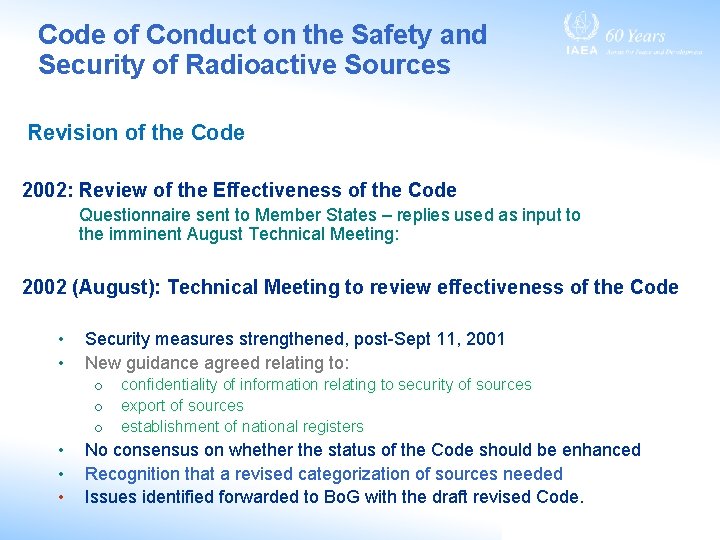
Code of Conduct on the Safety and Security of Radioactive Sources Revision of the Code 2002: Review of the Effectiveness of the Code Questionnaire sent to Member States – replies used as input to the imminent August Technical Meeting: 2002 (August): Technical Meeting to review effectiveness of the Code • • Security measures strengthened, post-Sept 11, 2001 New guidance agreed relating to: o o o • • • confidentiality of information relating to security of sources export of sources establishment of national registers No consensus on whether the status of the Code should be enhanced Recognition that a revised categorization of sources needed Issues identified forwarded to Bo. G with the draft revised Code.
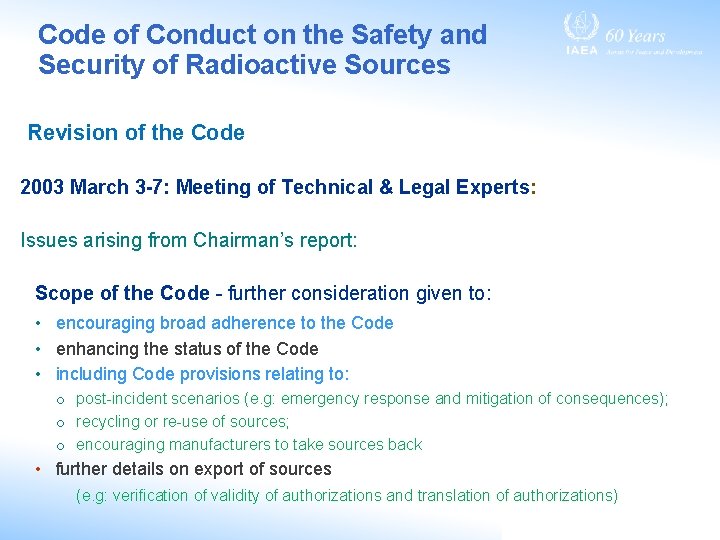
Code of Conduct on the Safety and Security of Radioactive Sources Revision of the Code 2003 March 3 -7: Meeting of Technical & Legal Experts: Issues arising from Chairman’s report: Scope of the Code - further consideration given to: • encouraging broad adherence to the Code • enhancing the status of the Code • including Code provisions relating to: o post-incident scenarios (e. g: emergency response and mitigation of consequences); o recycling or re-use of sources; o encouraging manufacturers to take sources back • further details on export of sources (e. g: verification of validity of authorizations and translation of authorizations)
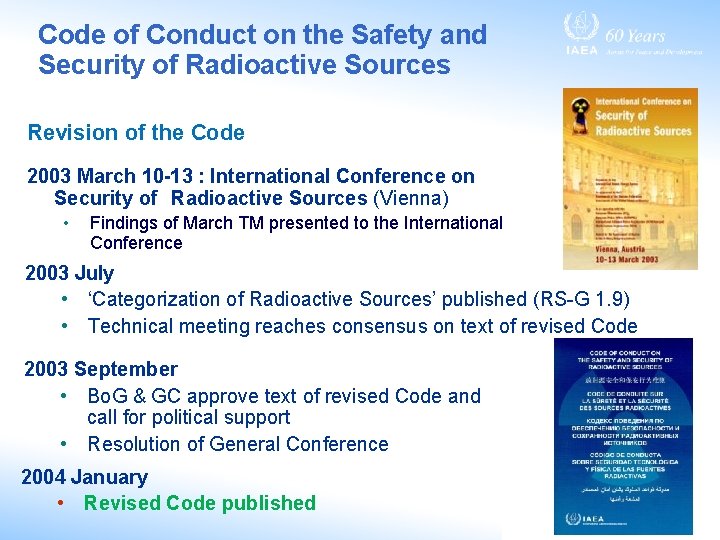
Code of Conduct on the Safety and Security of Radioactive Sources Revision of the Code 2003 March 10 -13 : International Conference on Security of Radioactive Sources (Vienna) • Findings of March TM presented to the International Conference 2003 July • ‘Categorization of Radioactive Sources’ published (RS-G 1. 9) • Technical meeting reaches consensus on text of revised Code 2003 September • Bo. G & GC approve text of revised Code and call for political support • Resolution of General Conference 2004 January • Revised Code published
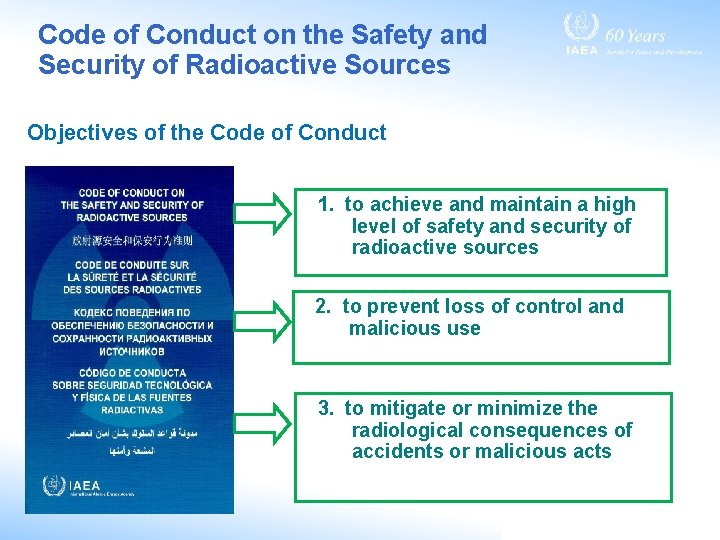
Code of Conduct on the Safety and Security of Radioactive Sources Objectives of the Code of Conduct 1. to achieve and maintain a high level of safety and security of radioactive sources 2. to prevent loss of control and malicious use 3. to mitigate or minimize the radiological consequences of accidents or malicious acts
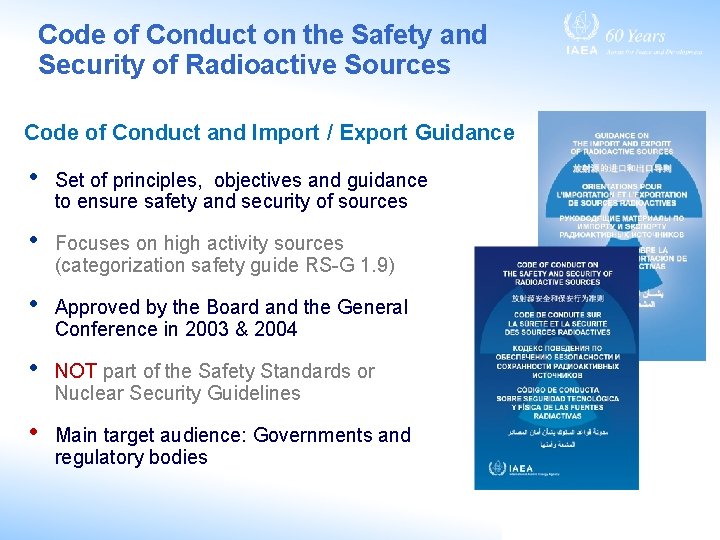
Code of Conduct on the Safety and Security of Radioactive Sources Code of Conduct and Import / Export Guidance • Set of principles, objectives and guidance to ensure safety and security of sources • Focuses on high activity sources (categorization safety guide RS-G 1. 9) • Approved by the Board and the General Conference in 2003 & 2004 • NOT part of the Safety Standards or Nuclear Security Guidelines • Main target audience: Governments and regulatory bodies
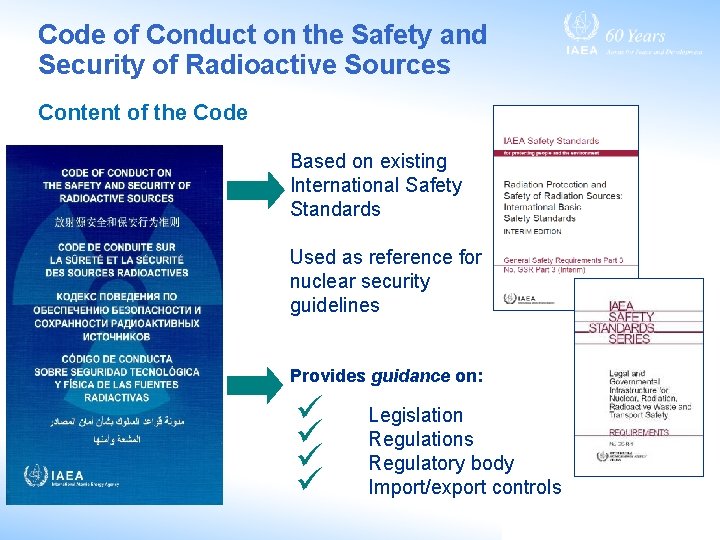
Code of Conduct on the Safety and Security of Radioactive Sources Content of the Code Based on existing International Safety Standards Used as reference for nuclear security guidelines Provides guidance on: ü ü Legislation Regulations Regulatory body Import/export controls
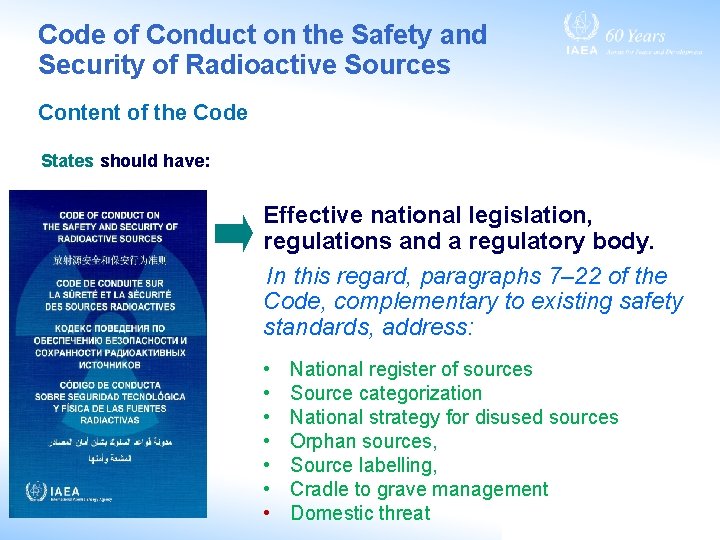
Code of Conduct on the Safety and Security of Radioactive Sources Content of the Code States should have: Effective national legislation, regulations and a regulatory body. In this regard, paragraphs 7– 22 of the Code, complementary to existing safety standards, address: • • National register of sources Source categorization National strategy for disused sources Orphan sources, Source labelling, Cradle to grave management Domestic threat
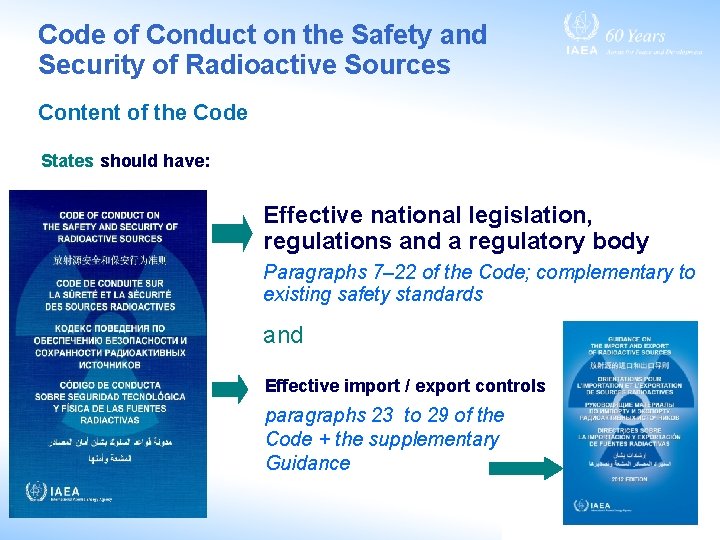
Code of Conduct on the Safety and Security of Radioactive Sources Content of the Code States should have: Effective national legislation, regulations and a regulatory body Paragraphs 7– 22 of the Code; complementary to existing safety standards and Effective import / export controls paragraphs 23 to 29 of the Code + the supplementary Guidance
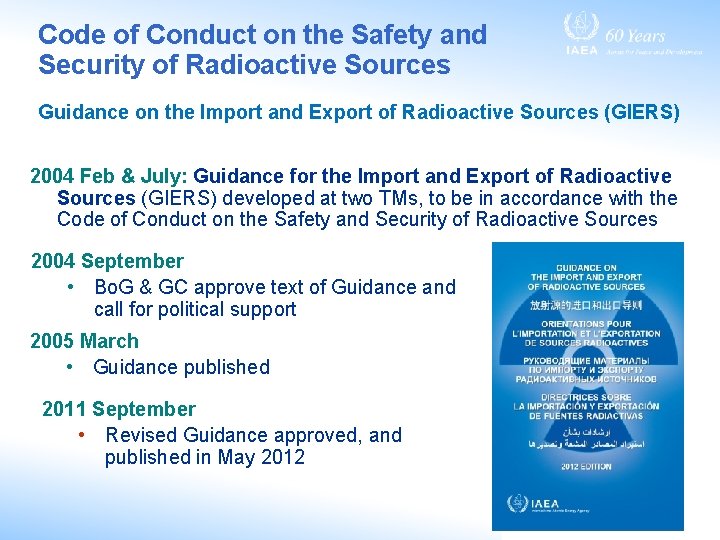
Code of Conduct on the Safety and Security of Radioactive Sources Guidance on the Import and Export of Radioactive Sources (GIERS) 2004 Feb & July: Guidance for the Import and Export of Radioactive Sources (GIERS) developed at two TMs, to be in accordance with the Code of Conduct on the Safety and Security of Radioactive Sources 2004 September • Bo. G & GC approve text of Guidance and call for political support 2005 March • Guidance published 2011 September • Revised Guidance approved, and published in May 2012
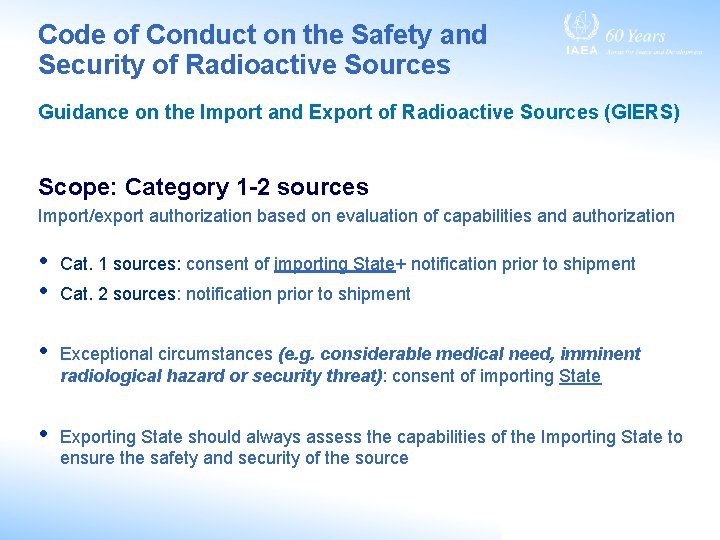
Code of Conduct on the Safety and Security of Radioactive Sources Guidance on the Import and Export of Radioactive Sources (GIERS) Scope: Category 1 -2 sources Import/export authorization based on evaluation of capabilities and authorization • • Cat. 1 sources: consent of importing State+ notification prior to shipment • Exceptional circumstances (e. g. considerable medical need, imminent radiological hazard or security threat): consent of importing State • Exporting State should always assess the capabilities of the Importing State to ensure the safety and security of the source Cat. 2 sources: notification prior to shipment
Code of Conduct on the Safety and Security of Radioactive Sources State Political Commitment to the Code In September 2003, GC urged each State to write to the Director General to the effect that: • it fully supports and endorses the Agency's efforts to enhance the safety and security of radioactive sources; and • is working toward following the guidance contained in the Code and encourages other countries to do the same (GC 47/Res 7)
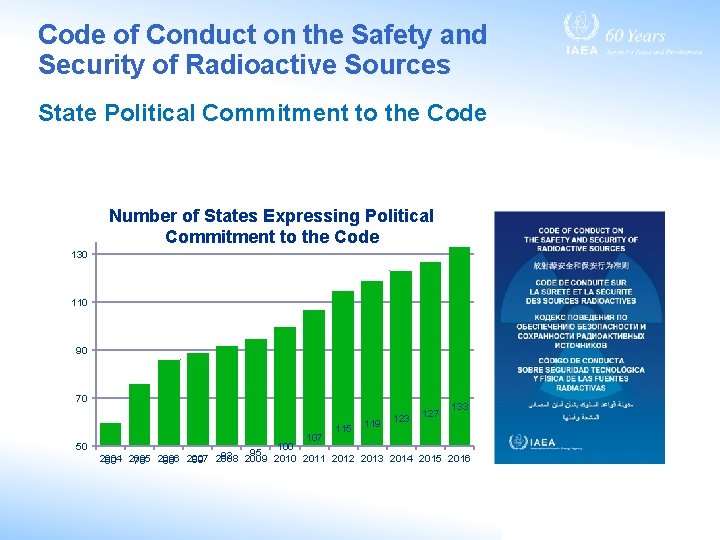
Code of Conduct on the Safety and Security of Radioactive Sources State Political Commitment to the Code Number of States Expressing Political Commitment to the Code 130 110 90 70 115 50 119 123 127 133 107 100 95 92 2009 2010 2011 2012 2013 2014 2015 2016 2004 89 2008 60 2005 76 2006 86 2007
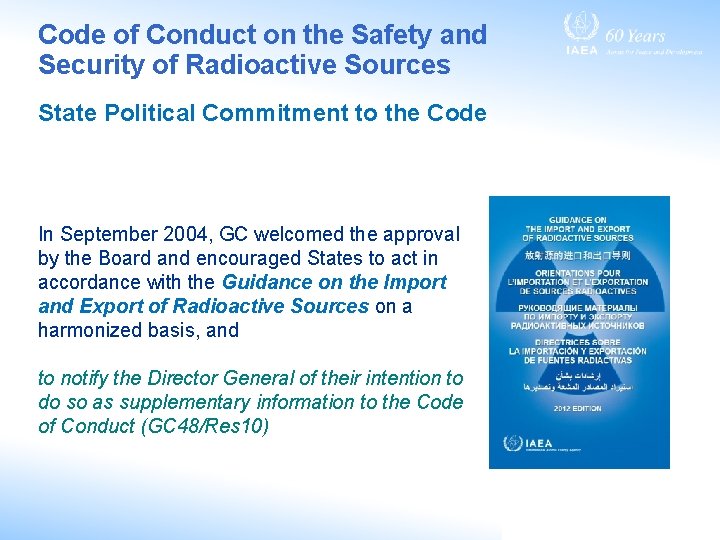
Code of Conduct on the Safety and Security of Radioactive Sources State Political Commitment to the Code In September 2004, GC welcomed the approval by the Board and encouraged States to act in accordance with the Guidance on the Import and Export of Radioactive Sources on a harmonized basis, and to notify the Director General of their intention to do so as supplementary information to the Code of Conduct (GC 48/Res 10)
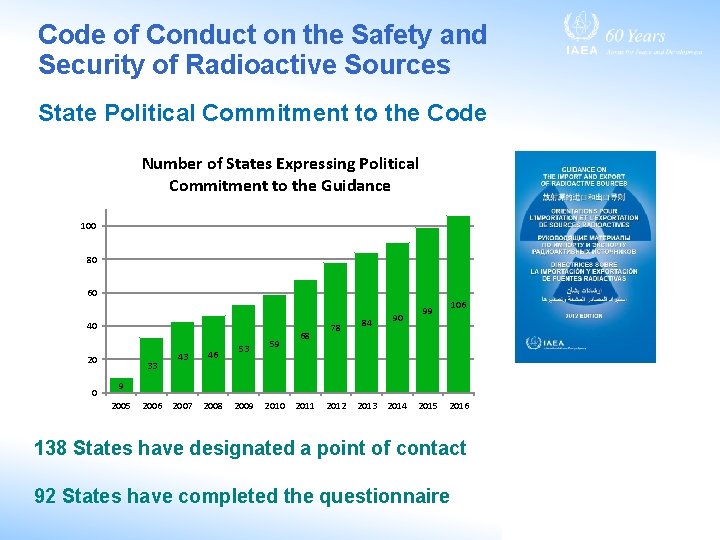
Code of Conduct on the Safety and Security of Radioactive Sources State Political Commitment to the Code Number of States Expressing Political Commitment to the Guidance 100 80 60 40 20 0 33 43 46 2007 2008 53 59 68 78 84 90 106 99 9 2005 2006 2009 2010 2011 2012 2013 2014 2015 2016 138 States have designated a point of contact 92 States have completed the questionnaire
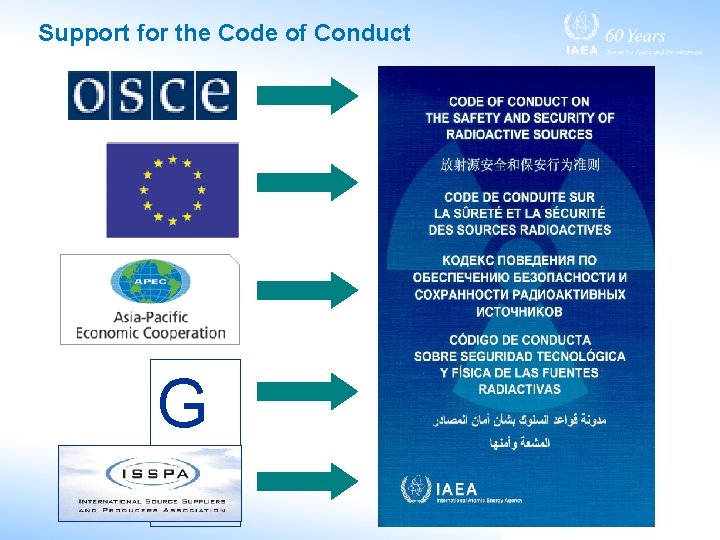
Support for the Code of Conduct G 8
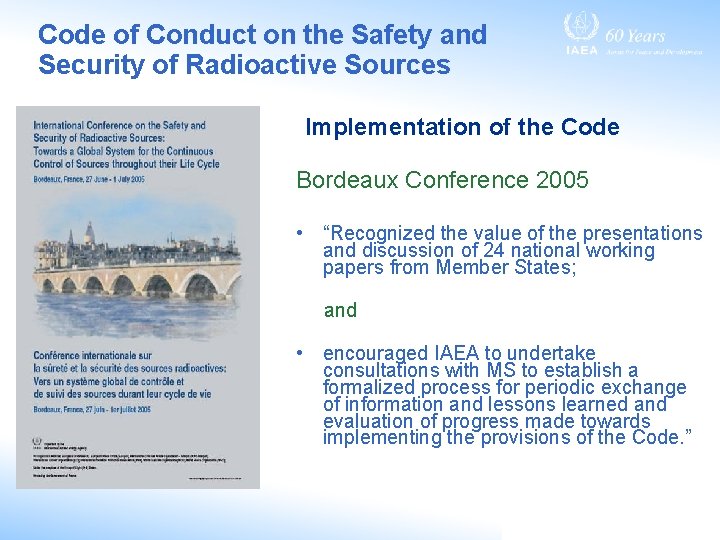
Code of Conduct on the Safety and Security of Radioactive Sources Implementation of the Code Bordeaux Conference 2005 • “Recognized the value of the presentations and discussion of 24 national working papers from Member States; and • encouraged IAEA to undertake consultations with MS to establish a formalized process for periodic exchange of information and lessons learned and evaluation of progress made towards implementing the provisions of the Code. ”
Code of Conduct on the Safety and Security of Radioactive Sources Implementation of the Code 2006 June: Draft formal process for periodic exchange of information and lessons learned on implementation of the Code 2006 September: Formalized process noted by Board and GC: “A Process for the sharing of information as to States’ implementation of the Code of Conduct on the Safety and Security of Radioactive Sources and its associated Guidance on the Import and Export of Radioactive Sources” • Periodic international meetings / regional meetings • Voluntary in nature, all States invited • Process for preparation and conduct of international meetings
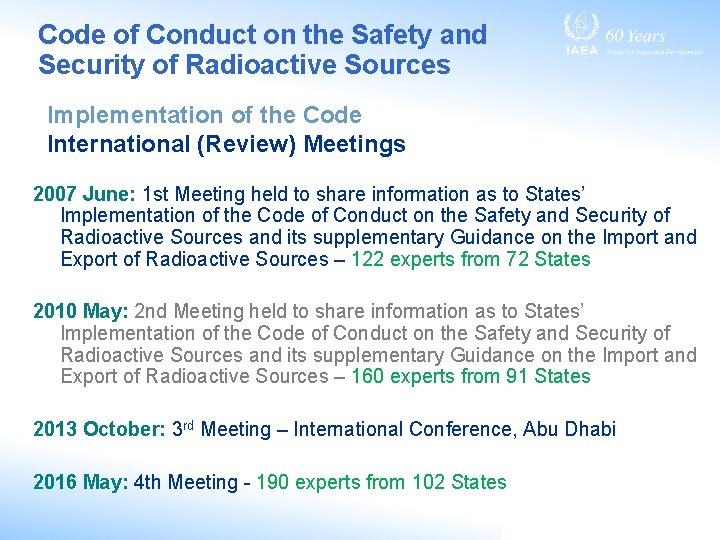
Code of Conduct on the Safety and Security of Radioactive Sources Implementation of the Code International (Review) Meetings 2007 June: 1 st Meeting held to share information as to States’ Implementation of the Code of Conduct on the Safety and Security of Radioactive Sources and its supplementary Guidance on the Import and Export of Radioactive Sources – 122 experts from 72 States 2010 May: 2 nd Meeting held to share information as to States’ Implementation of the Code of Conduct on the Safety and Security of Radioactive Sources and its supplementary Guidance on the Import and Export of Radioactive Sources – 160 experts from 91 States 2013 October: 3 rd Meeting – International Conference, Abu Dhabi 2016 May: 4 th Meeting - 190 experts from 102 States
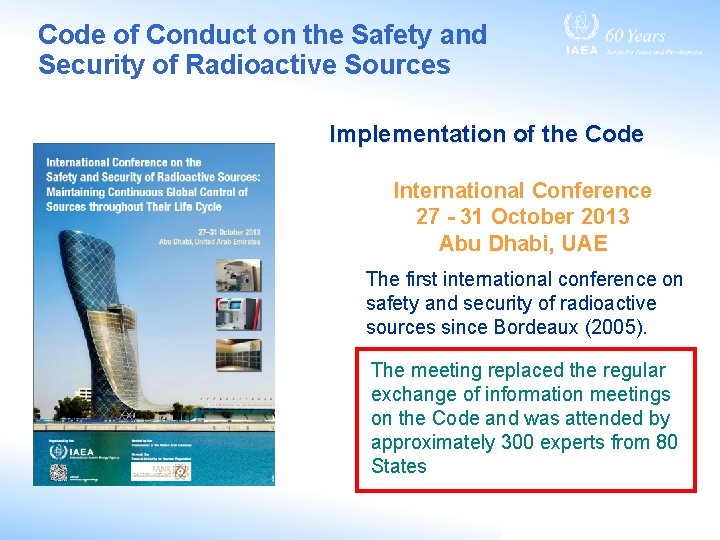
Code of Conduct on the Safety and Security of Radioactive Sources Implementation of the Code International Conference 27 - 31 October 2013 Abu Dhabi, UAE The first international conference on safety and security of radioactive sources since Bordeaux (2005). The meeting replaced the regular exchange of information meetings on the Code and was attended by approximately 300 experts from 80 States
Code of Conduct on the Safety and Security of Radioactive Sources Implementation of the Code International topical meetings 2008 May: Meeting of Technical and Legal Experts: Lessons Learned from Implementing the Supplementary Guidance on Import and Export Controls 2009 June: Technical Meeting on Implementation of the Code with Regard to Long Term Strategies for the Management of Sealed Sources 2011 May: Meeting to revise the Guidance on Import and Export Controls 2012 February : Long Term Strategies for Management of Disused Sealed Radioactive Sources
Code of Conduct on the Safety and Security of Radioactive Sources Implementation of the Code International topical meetings October 2014, December 2015 and June 2016: Meetings of technical and legal experts to develop internationally harmonized guidance for implementing the recommendations of the Code of Conduct on the Safety and Security of Radioactive Sources in relation to the management of disused radioactive sources The outcome of these meetings is a final draft of supplementary Guidance to the Code of Conduct on the management of disused sources. … and an ongoing series of regional workshops …. .
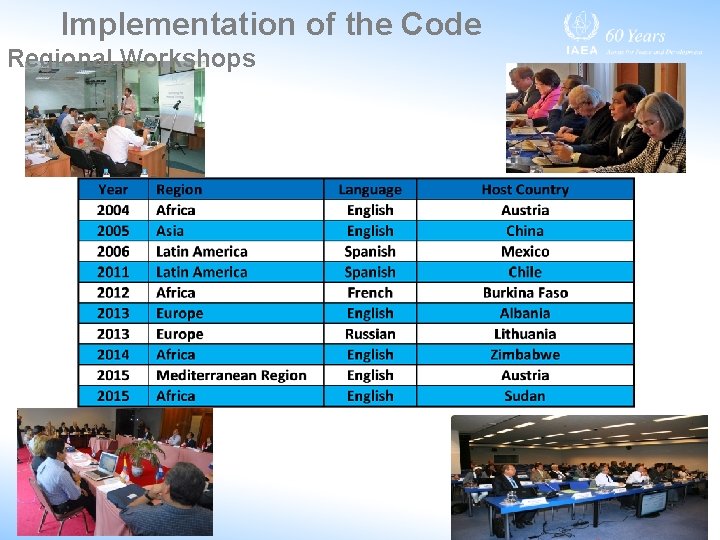
Implementation of the Code Regional Workshops
Code of Conduct on the Safety and Security of Radioactive Sources Implementation of the Code Meetings for Countries having not yet Expressed Political Support to Implementing the Code (Vienna, 11 -13 July 2011 and 2 -4 November 2015) • To identify concerns and challenges to implementing the Code in those States which have not yet expressed political support • To promote political support and implementation of the provisions!
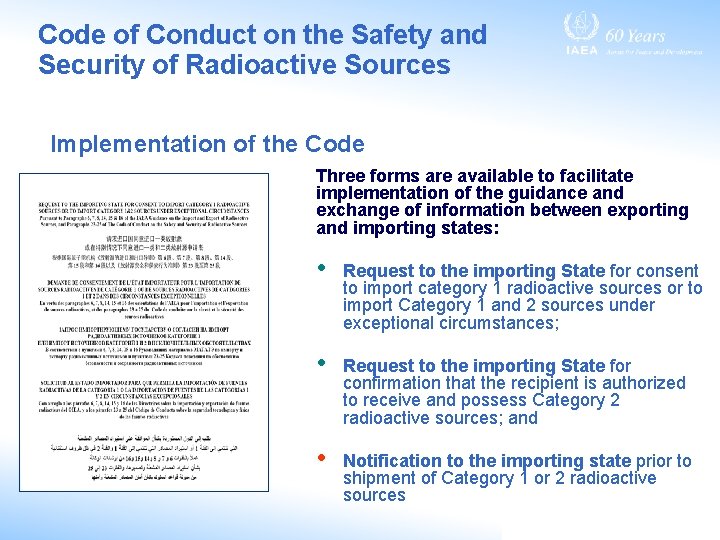
Code of Conduct on the Safety and Security of Radioactive Sources Implementation of the Code Three forms are available to facilitate implementation of the guidance and exchange of information between exporting and importing states: • Request to the importing State for consent to import category 1 radioactive sources or to import Category 1 and 2 sources under exceptional circumstances; • Request to the importing State for confirmation that the recipient is authorized to receive and possess Category 2 radioactive sources; and • Notification to the importing state prior to shipment of Category 1 or 2 radioactive sources
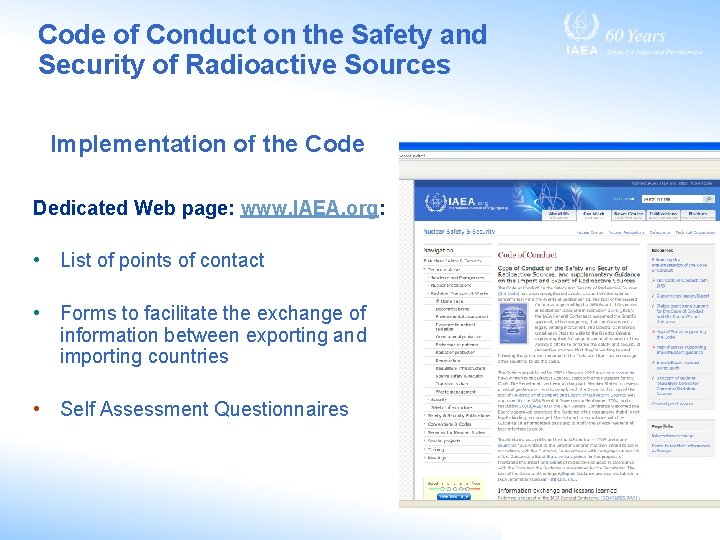
Code of Conduct on the Safety and Security of Radioactive Sources Implementation of the Code Dedicated Web page: www. IAEA. org: • List of points of contact • Forms to facilitate the exchange of information between exporting and importing countries • Self Assessment Questionnaires
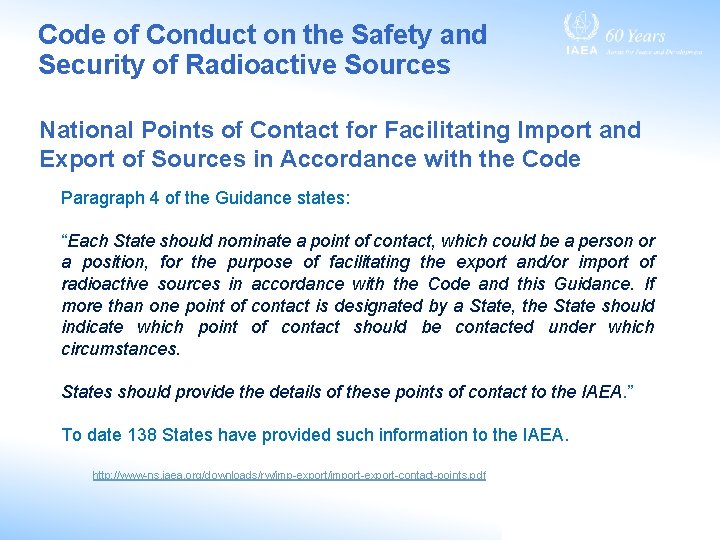
Code of Conduct on the Safety and Security of Radioactive Sources National Points of Contact for Facilitating Import and Export of Sources in Accordance with the Code Paragraph 4 of the Guidance states: “Each State should nominate a point of contact, which could be a person or a position, for the purpose of facilitating the export and/or import of radioactive sources in accordance with the Code and this Guidance. If more than one point of contact is designated by a State, the State should indicate which point of contact should be contacted under which circumstances. States should provide the details of these points of contact to the IAEA. ” To date 138 States have provided such information to the IAEA. http: //www-ns. iaea. org/downloads/rw/imp-export/import-export-contact-points. pdf
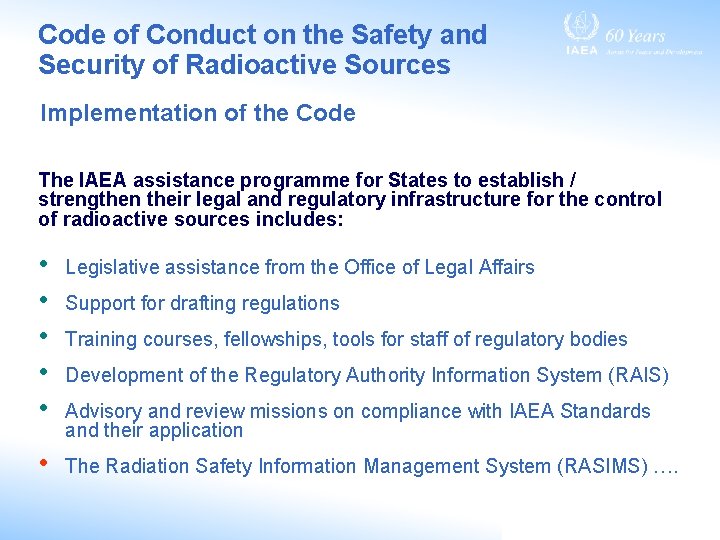
Code of Conduct on the Safety and Security of Radioactive Sources Implementation of the Code The IAEA assistance programme for States to establish / strengthen their legal and regulatory infrastructure for the control of radioactive sources includes: • • • Legislative assistance from the Office of Legal Affairs • The Radiation Safety Information Management System (RASIMS) …. Support for drafting regulations Training courses, fellowships, tools for staff of regulatory bodies Development of the Regulatory Authority Information System (RAIS) Advisory and review missions on compliance with IAEA Standards and their application
Code of Conduct on the Safety and Security of Radioactive Sources Closing Issues of Note • Implementation of the Code has resulted in an improvement in the control over radioactive sources ‘from cradle to grave’ • Most States have committed to following the Code and Guidance • Expression of commitment to the Code and the Guidance is linked to a positive impact on development of radiation safety infrastructures • States are challenged in their implementation of the Code by a lack of human and other resources • IAEA organizes many activities aimed at improving the implementation of the Code and the Guidance, but continuing support and peer encouragement from Member States is necessary for these efforts to continue
Organisation and Implementation of a National Regulatory Programme for the Control of Radiation Sources (ORGIMP) References • • Radiation Protection and Safety of Radiation Sources: International Basic Safety Standards. Generic Safety Requirements. GSR Part 3 Vienna (2014). Handbook on Nuclear Law: Volume 1 & 2 (2010). Model Regulations for the use of radiation sources and for the management of the associated radioactive waste. Draft: 2012 -04 -04. Regulatory Control of Radioactive Sources, Safety Standards Series No. GS-G 1. 5, IAEA, Vienna (2004). Notification and Authorization for the Use of Radiation Sources (Supplement to IAEA Safety Standards Series No. GS-G-1. 5) IAEA TECDOC 1525, Vienna (2007). Inspection of Radiation Sources and Regulatory Enforcement (Supplement to IAEA Safety Standards Series No. GS-G-1. 5) IAEA TECDOC 1526. Lessons Learned from Accidents in Radiotherapy, Industrial Irradiation Facilities and Industrial Radiography, (reports in) IAEA Safety Reports Series. Safety of Radiation Generators and Sealed Radioactive Sources, Safety Standard Series No. RS-G-1. 10, IAEA, Vienna (2006). IAEA, Accident reports (various). 68
Thank you!