
Organic Synthesis A synthesis is a specific sequence
- Slides: 33
Organic Synthesis • A synthesis is a specific sequence of chemical reactions that converts starting materials into the desired compound, called the target of the synthesis (or the synthetic target). • A synthesis is often the culmination of several separate reactions, which are called synthetic steps. • Often a synthesis is necessary to produce a natural product when the demand for the compound outweighs nature’s supply. • Syntheses are also used to produce new compounds that are not produced by nature.
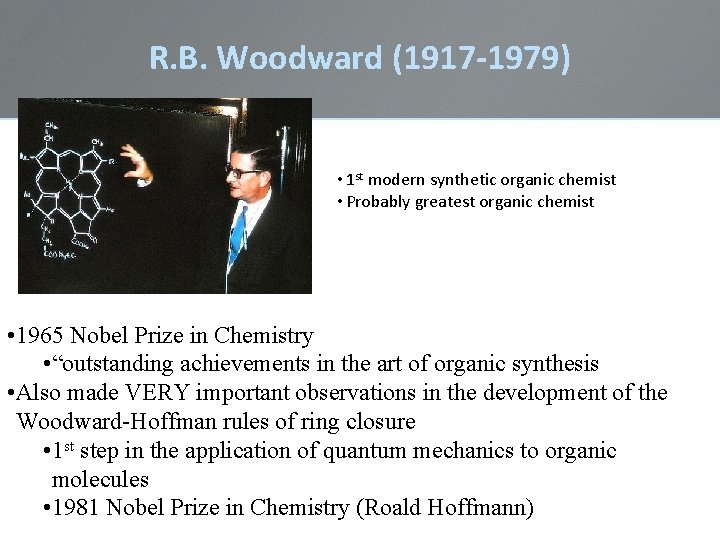
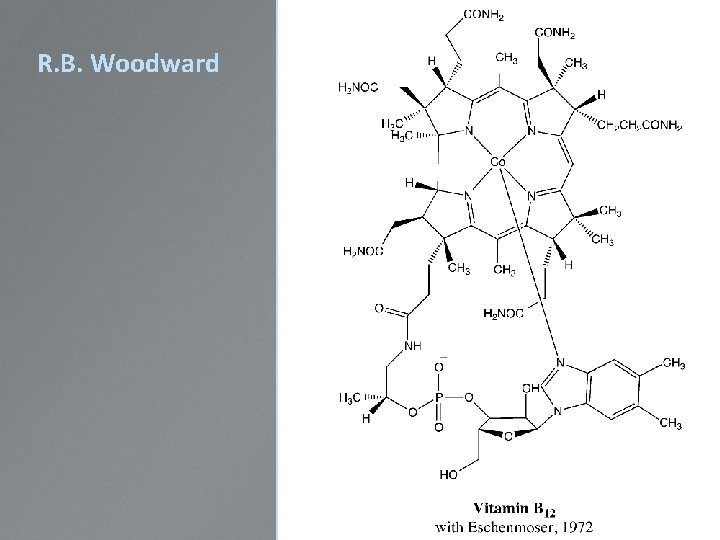
R. B. Woodward (1917 -1979) • 1 st modern synthetic organic chemist • Probably greatest organic chemist • 1965 Nobel Prize in Chemistry • “outstanding achievements in the art of organic synthesis • Also made VERY important observations in the development of the Woodward-Hoffman rules of ring closure • 1 st step in the application of quantum mechanics to organic molecules • 1981 Nobel Prize in Chemistry (Roald Hoffmann)
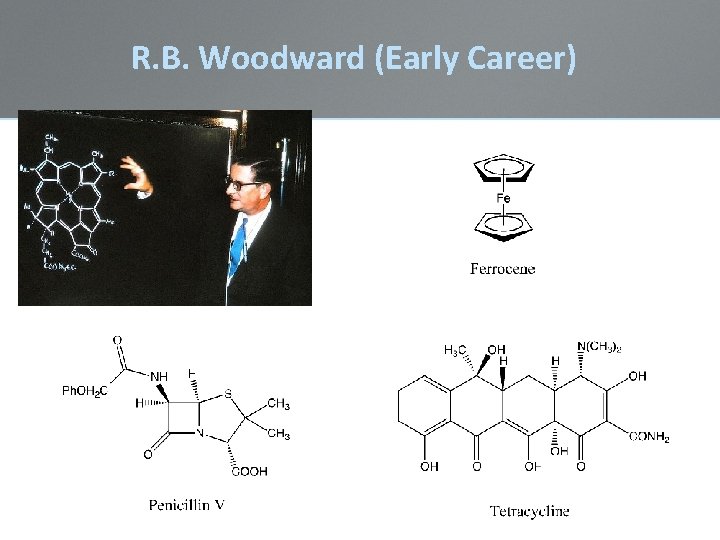
R. B. Woodward (Early Career)
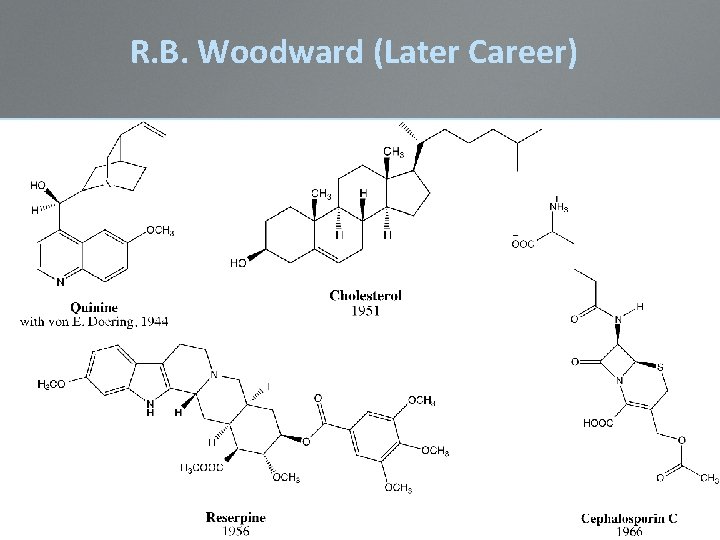
R. B. Woodward (Later Career)
R. B. Woodward
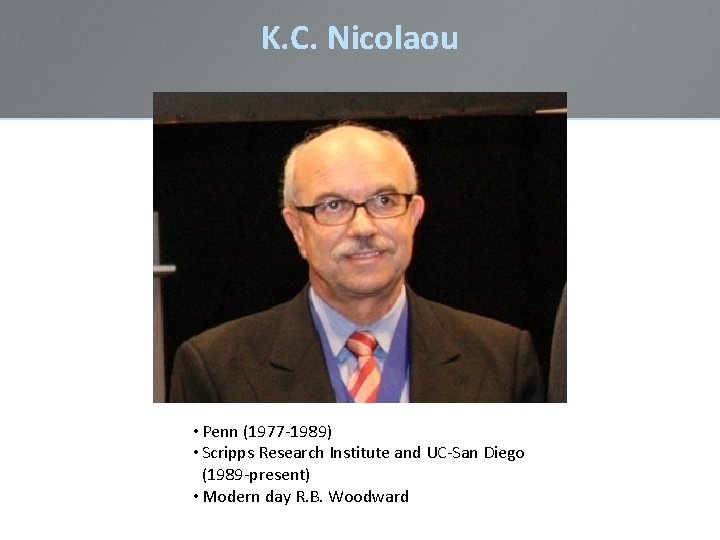
K. C. Nicolaou • Penn (1977 -1989) • Scripps Research Institute and UC-San Diego (1989 -present) • Modern day R. B. Woodward
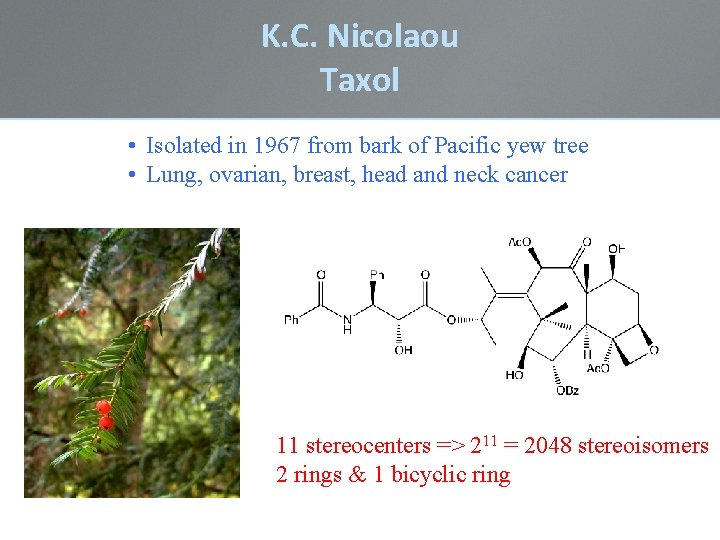
K. C. Nicolaou Taxol • Isolated in 1967 from bark of Pacific yew tree • Lung, ovarian, breast, head and neck cancer 11 stereocenters => 211 = 2048 stereoisomers 2 rings & 1 bicyclic ring
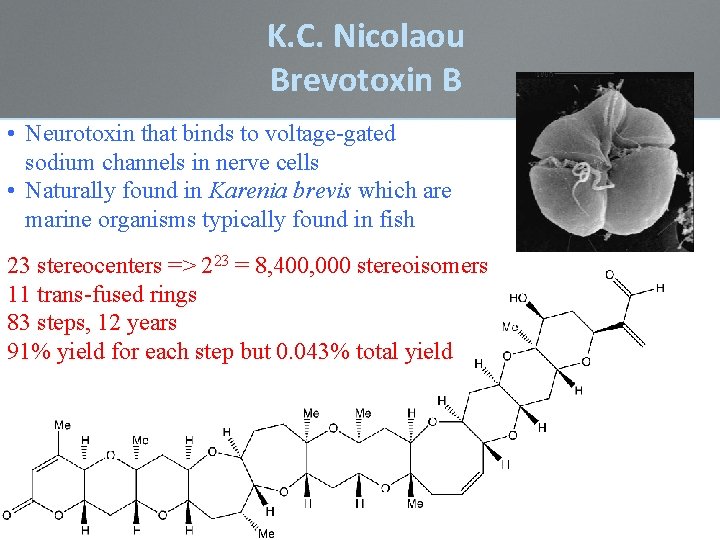
K. C. Nicolaou Brevotoxin B • Neurotoxin that binds to voltage-gated sodium channels in nerve cells • Naturally found in Karenia brevis which are marine organisms typically found in fish 23 stereocenters => 223 = 8, 400, 000 stereoisomers 11 trans-fused rings 83 steps, 12 years 91% yield for each step but 0. 043% total yield
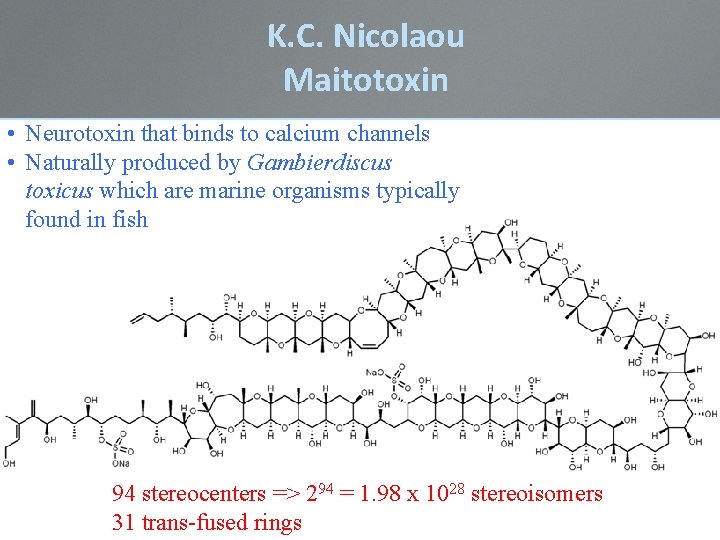
K. C. Nicolaou Maitotoxin • Neurotoxin that binds to calcium channels • Naturally produced by Gambierdiscus toxicus which are marine organisms typically found in fish 94 stereocenters => 294 = 1. 98 x 1028 stereoisomers 31 trans-fused rings
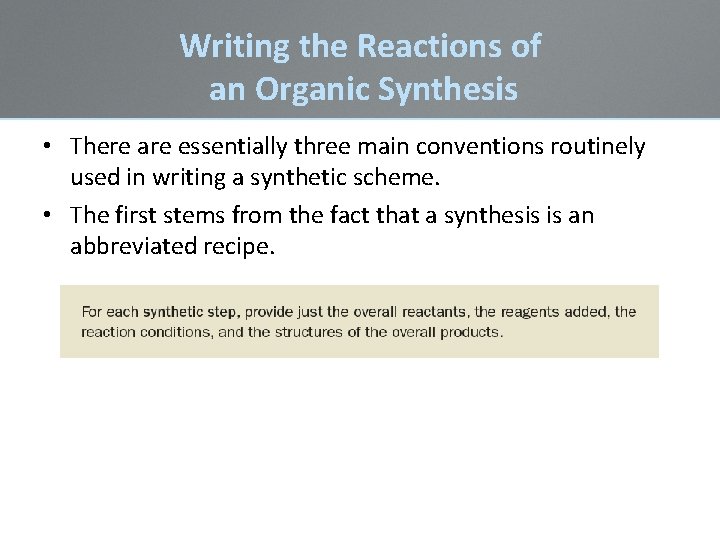
Writing the Reactions of an Organic Synthesis • There are essentially three main conventions routinely used in writing a synthetic scheme. • The first stems from the fact that a synthesis is an abbreviated recipe.
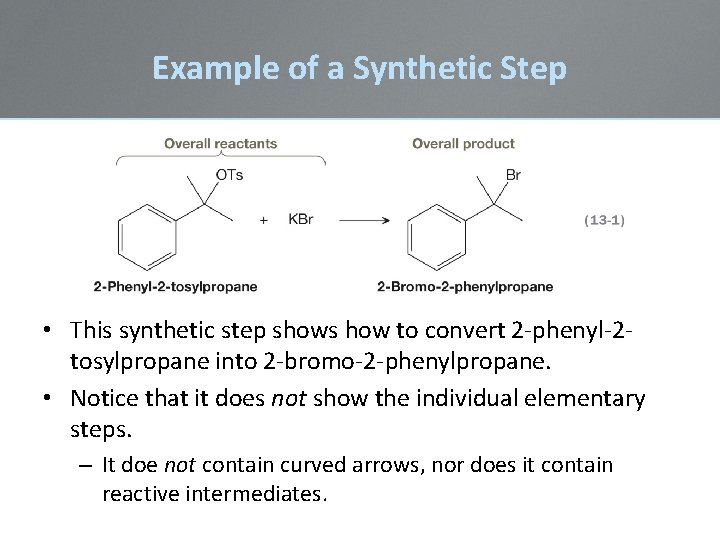
Example of a Synthetic Step • This synthetic step shows how to convert 2 -phenyl-2 tosylpropane into 2 -bromo-2 -phenylpropane. • Notice that it does not show the individual elementary steps. – It doe not contain curved arrows, nor does it contain reactive intermediates.
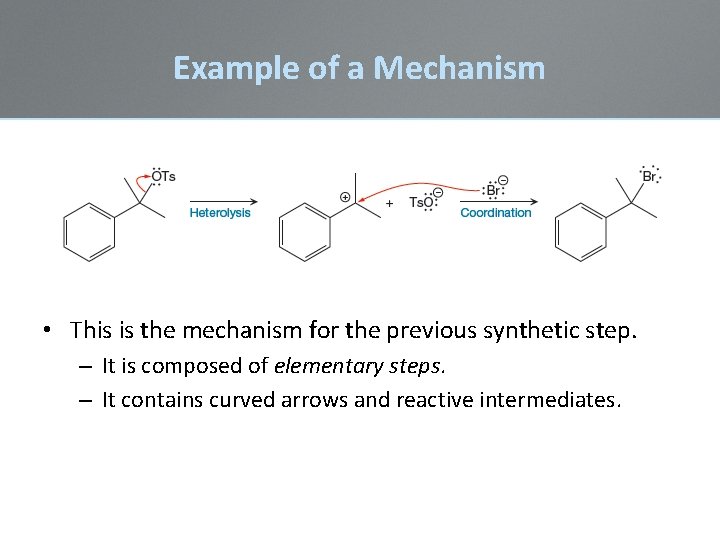
Example of a Mechanism • This is the mechanism for the previous synthetic step. – It is composed of elementary steps. – It contains curved arrows and reactive intermediates.
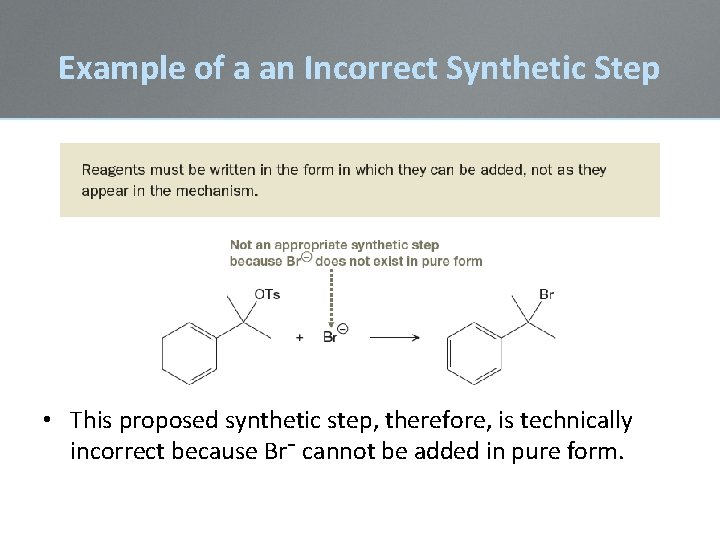
Example of a an Incorrect Synthetic Step • This proposed synthetic step, therefore, is technically incorrect because Br⁻ cannot be added in pure form.
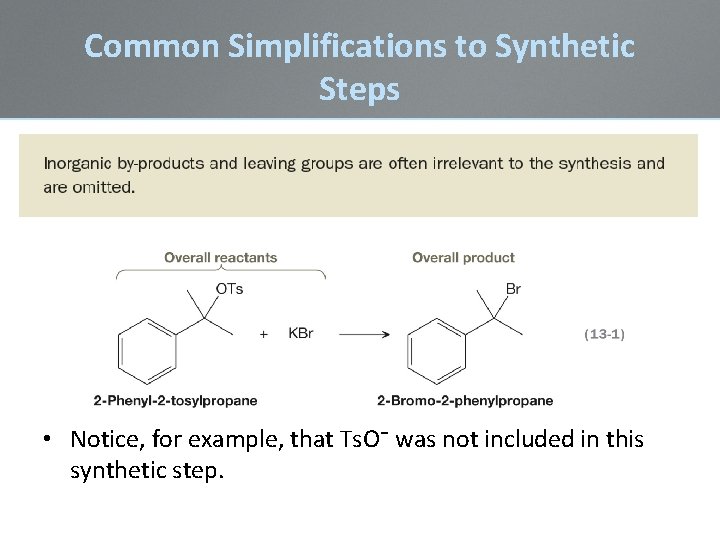
Common Simplifications to Synthetic Steps • Notice, for example, that Ts. O⁻ was not included in this synthetic step.
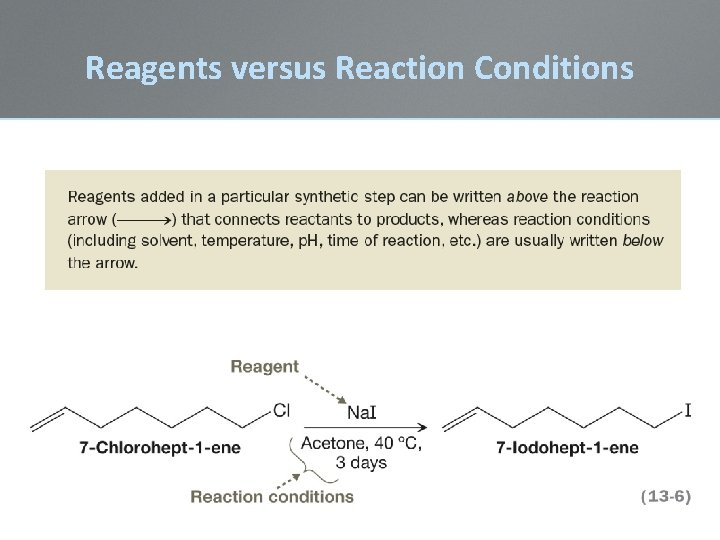
Reagents versus Reaction Conditions
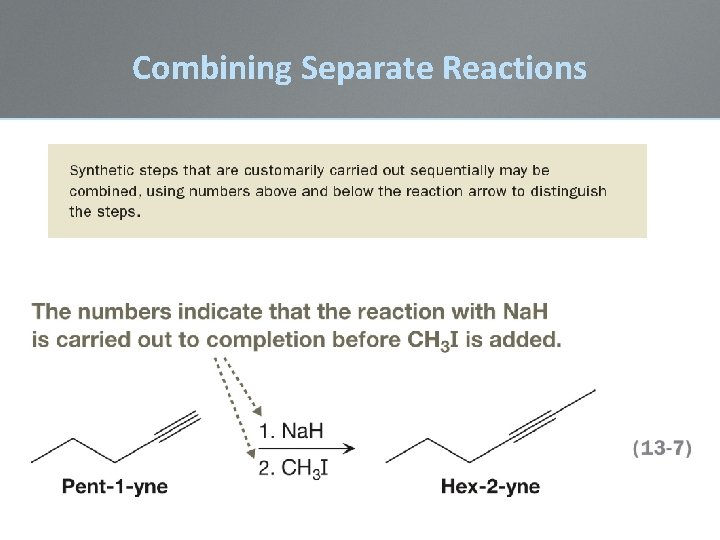
Combining Separate Reactions
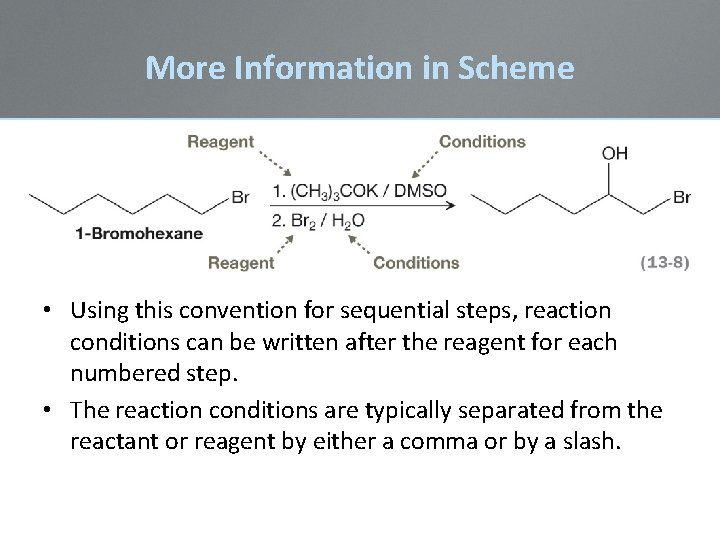
More Information in Scheme • Using this convention for sequential steps, reaction conditions can be written after the reagent for each numbered step. • The reaction conditions are typically separated from the reactant or reagent by either a comma or by a slash.
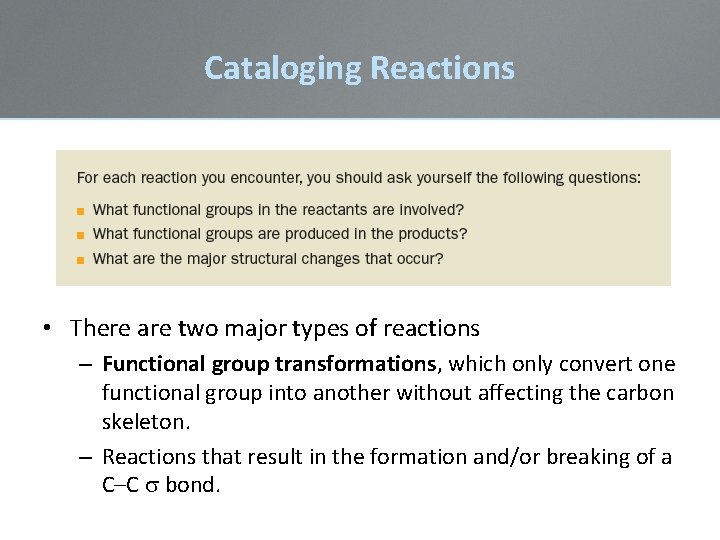
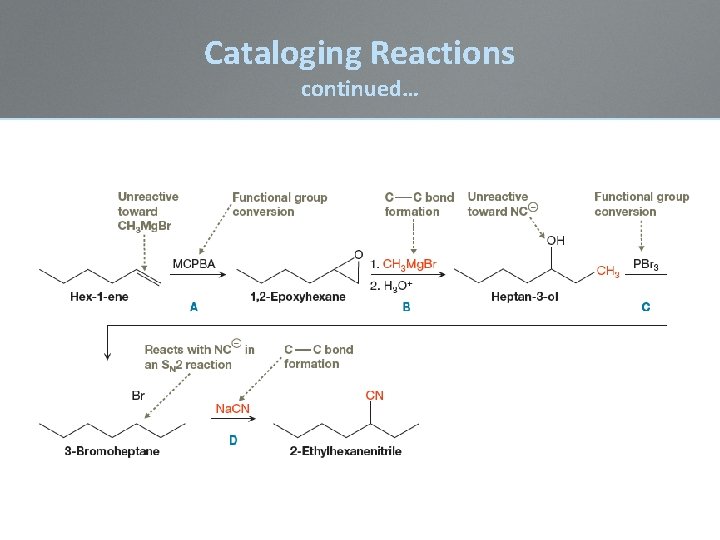
Cataloging Reactions • There are two major types of reactions – Functional group transformations, which only convert one functional group into another without affecting the carbon skeleton. – Reactions that result in the formation and/or breaking of a C–C s bond.
Cataloging Reactions continued…
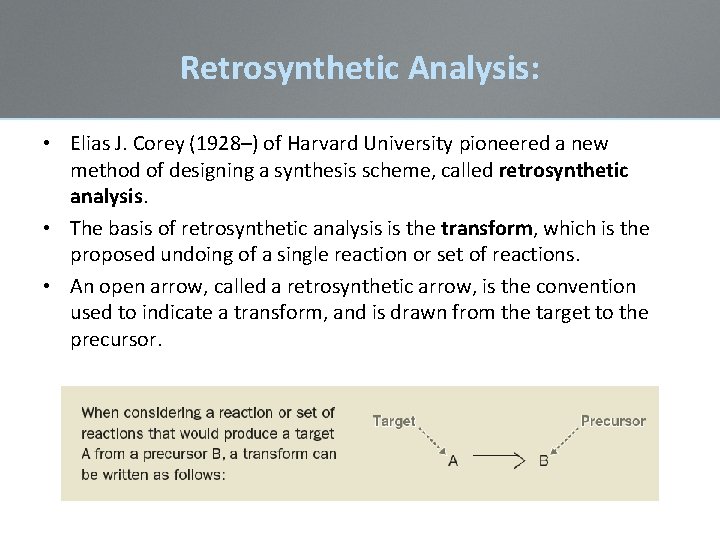
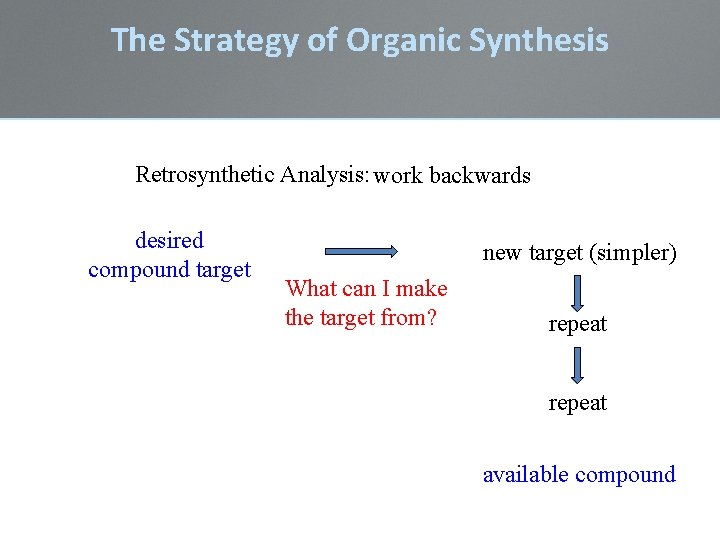
Retrosynthetic Analysis: • Elias J. Corey (1928–) of Harvard University pioneered a new method of designing a synthesis scheme, called retrosynthetic analysis. • The basis of retrosynthetic analysis is the transform, which is the proposed undoing of a single reaction or set of reactions. • An open arrow, called a retrosynthetic arrow, is the convention used to indicate a transform, and is drawn from the target to the precursor.
The Strategy of Organic Synthesis Retrosynthetic Analysis: work backwards desired compound target new target (simpler) What can I make the target from? repeat available compound
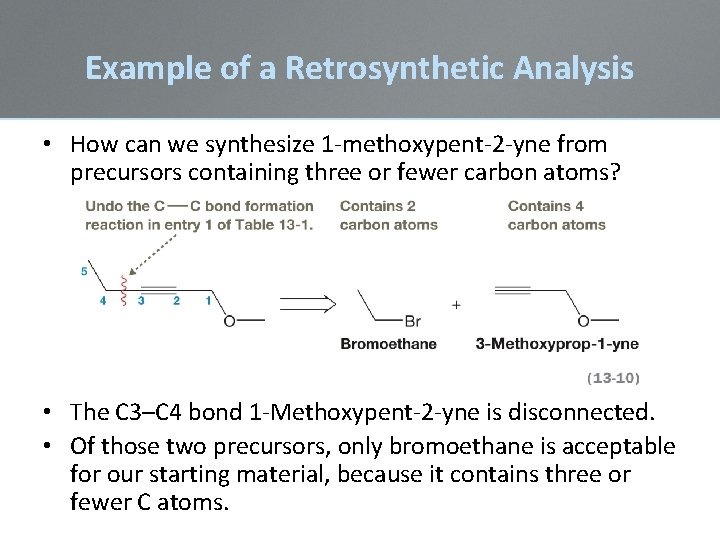
Example of a Retrosynthetic Analysis • How can we synthesize 1 -methoxypent-2 -yne from precursors containing three or fewer carbon atoms? • The C 3–C 4 bond 1 -Methoxypent-2 -yne is disconnected. • Of those two precursors, only bromoethane is acceptable for our starting material, because it contains three or fewer C atoms.
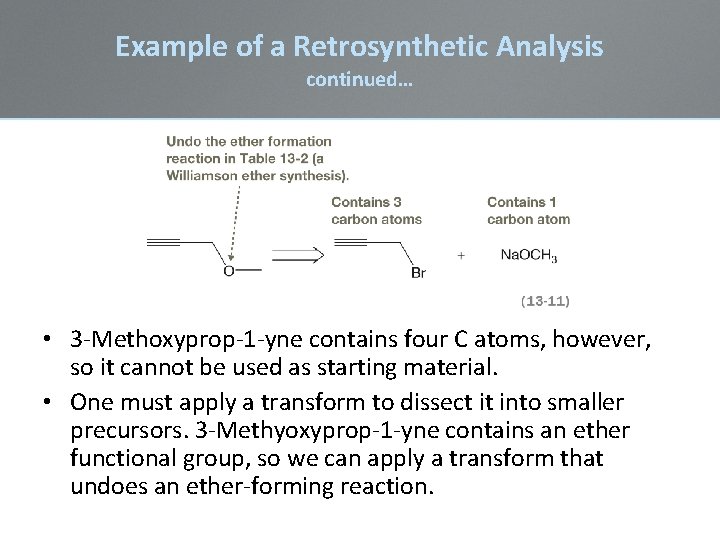
Example of a Retrosynthetic Analysis continued… • 3 -Methoxyprop-1 -yne contains four C atoms, however, so it cannot be used as starting material. • One must apply a transform to dissect it into smaller precursors. 3 -Methyoxyprop-1 -yne contains an ether functional group, so we can apply a transform that undoes an ether-forming reaction.
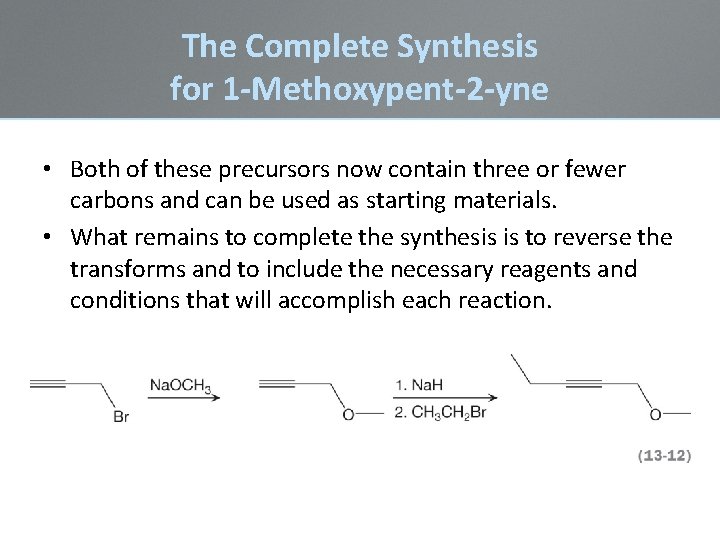
The Complete Synthesis for 1 -Methoxypent-2 -yne • Both of these precursors now contain three or fewer carbons and can be used as starting materials. • What remains to complete the synthesis is to reverse the transforms and to include the necessary reagents and conditions that will accomplish each reaction.
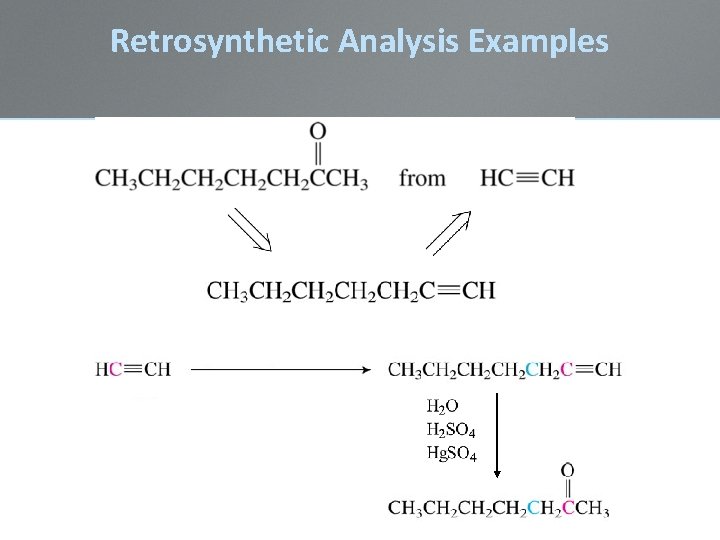
Retrosynthetic Analysis Examples
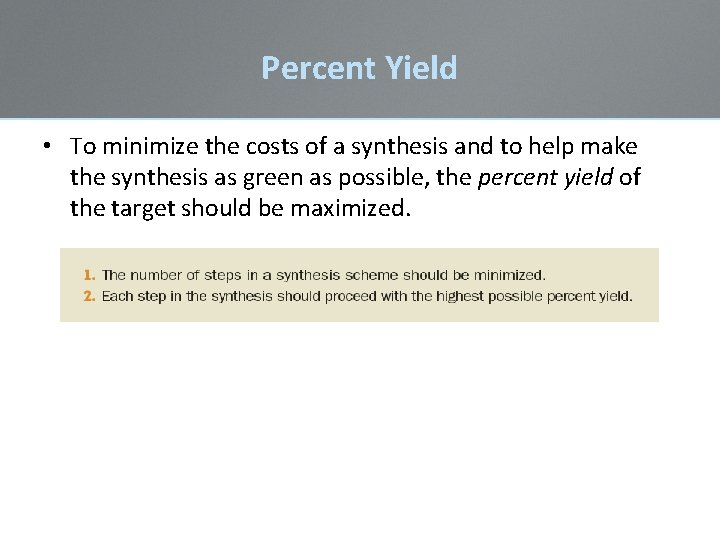
Percent Yield • To minimize the costs of a synthesis and to help make the synthesis as green as possible, the percent yield of the target should be maximized.
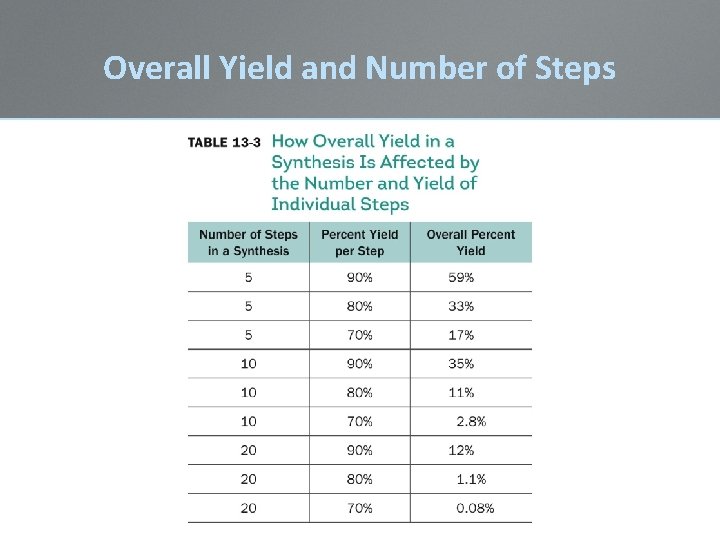
Linear Synthesis • These rules are essentially an outcome of how percent yield is computed for a linear synthesis (i. e. , a synthesis composed of sequential steps) • For a linear synthesis, the overall percent yield is equal to the product of the yields of the individual steps.
Linear Synthesis continued… • Consider two syntheses, one with three synthetic steps and the second with six synthetic steps. • If both syntheses proceeds with an 80% yield of product for each step, what would be the overall yield for each? • The three-step synthesis will have an overall yield of (0. 80) x (0. 80) = (0. 80)3 = 0. 51, or 51%. • The six-step synthesis will have an overall yield of 26%. • The synthesis with the fewer number of steps has the greater yield.
Overall Yield and Number of Steps
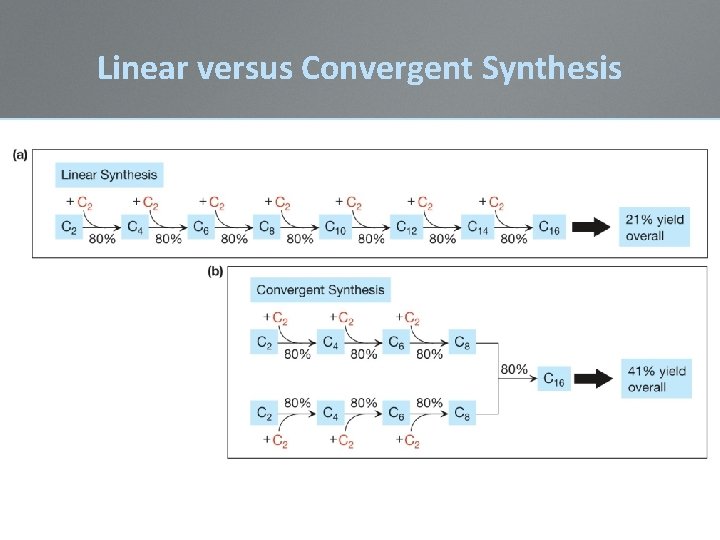
Convergent Synthesis • In a convergent synthesis, portions of a target molecule are synthesized separately and are assembled together at a later stage. • The yield can generally be improved.
Linear versus Convergent Synthesis
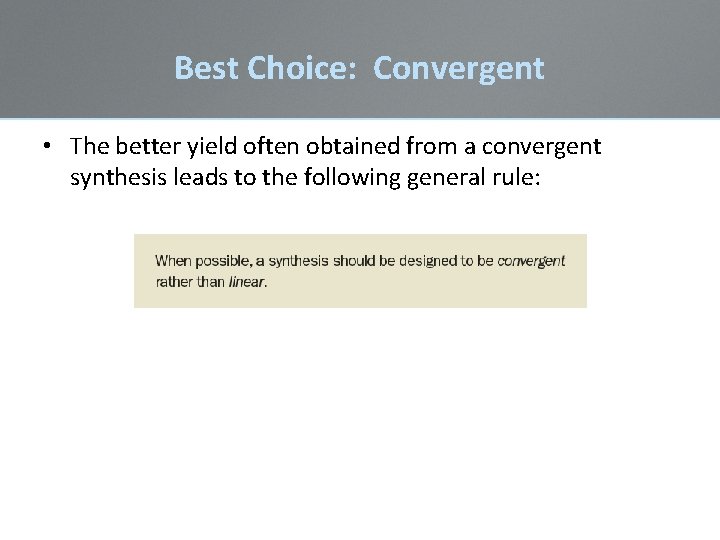
Best Choice: Convergent • The better yield often obtained from a convergent synthesis leads to the following general rule:
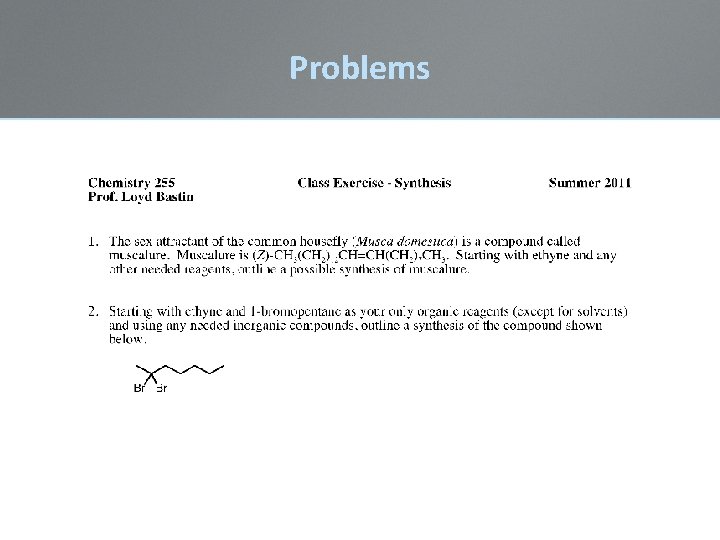
Problems