
Organic substances poisoning metaldehyde chlorinated hydrocarbons tensides surfactants
Organic substances poisoning – metaldehyde, chlorinated hydrocarbons, tensides – surfactants, methylxantines Lecture No. 4 Copyright © Pharm. Dr. Zuzana Široká, Ph. D.
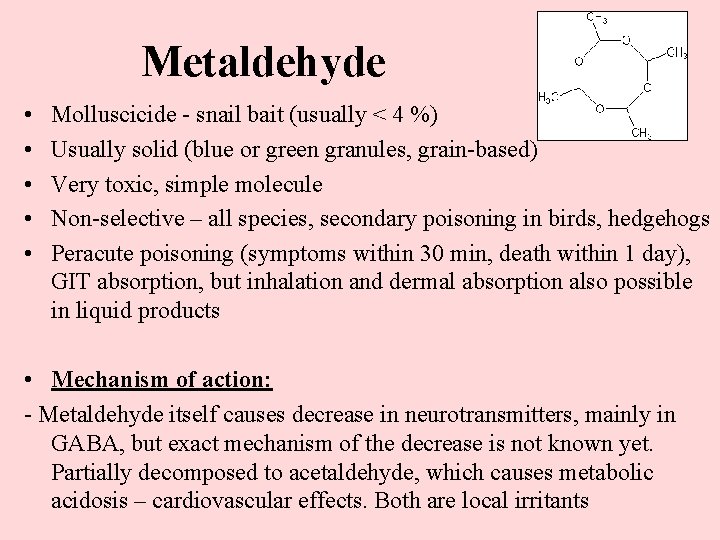
Metaldehyde • • • Molluscicide - snail bait (usually < 4 %) Usually solid (blue or green granules, grain-based) Very toxic, simple molecule Non-selective – all species, secondary poisoning in birds, hedgehogs Peracute poisoning (symptoms within 30 min, death within 1 day), GIT absorption, but inhalation and dermal absorption also possible in liquid products • Mechanism of action: - Metaldehyde itself causes decrease in neurotransmitters, mainly in GABA, but exact mechanism of the decrease is not known yet. Partially decomposed to acetaldehyde, which causes metabolic acidosis – cardiovascular effects. Both are local irritants
• Metaldehyde is metabolised also by liver cytochrome P 450 and undergoes enterohepatic cycling • Clinical signs: - irritation to the stomach and intestines = excessive salivation (thick saliva, foam), vomiting, diarrhoea, inability to control release of urine and faeces - increased heart rate, hyperventilation, mydriasis, nystagmus - anxiety, twitching, seizures – increased body temperature, death due to respiratory failure • http: //www. youtube. com/watch? v=lz. Y 59 qi. Uey I
- DIC may be seen - Liver failure syndrome or kidney failure occur in some patients approximately 2 to 3 days after poisoning - Toxic dose around 50 mg/kg, lethal is higher • Pathological examination: - congestion and haemorrhages in the liver, kidneys and heart, cider-like smell from GIT • Treatment: - no specific antidote - emetics, activated charcoal, bicarbonates, fluid therapy, diazepam
Chlorinated hydrocarbons • Simple molecules (do not confuse with chlorinated POPs!) • Trichlorethylene, tetrachlorethylene, carbon tetrachloride, chloroform, methylene chloride etc. • All of them very lipophilic, cross blood-brain barrier, neurotoxic (CNS depressants – probably interference with neuronal membrane) and hepatotoxic • Used as solvents of resins, rubber, tar, degrease agents of metals, fuel additives etc. • Rapidly absorbed • Often inhalation poisonings, treatment is only symptomatic (inducing vomiting is forbidden – aspiration of vapours!) • Slowly oxidized in liver via CYP 450 (high ROS production), accumulate in the body
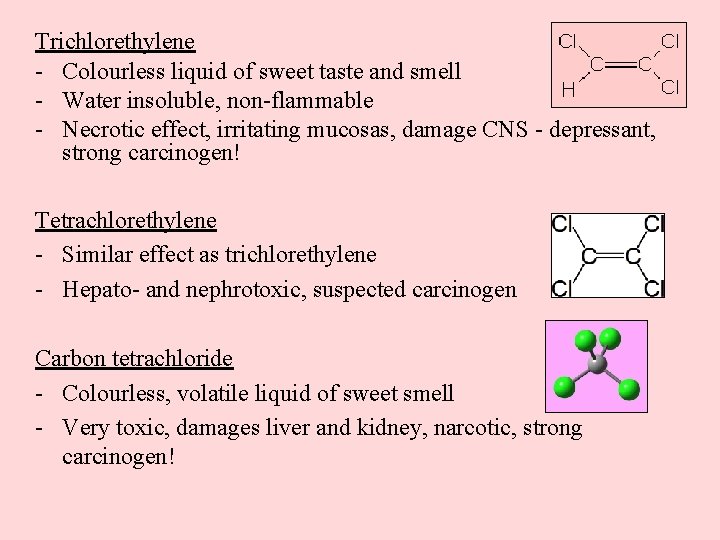
Trichlorethylene - Colourless liquid of sweet taste and smell - Water insoluble, non-flammable - Necrotic effect, irritating mucosas, damage CNS - depressant, strong carcinogen! Tetrachlorethylene - Similar effect as trichlorethylene - Hepato- and nephrotoxic, suspected carcinogen Carbon tetrachloride - Colourless, volatile liquid of sweet smell - Very toxic, damages liver and kidney, narcotic, strong carcinogen!
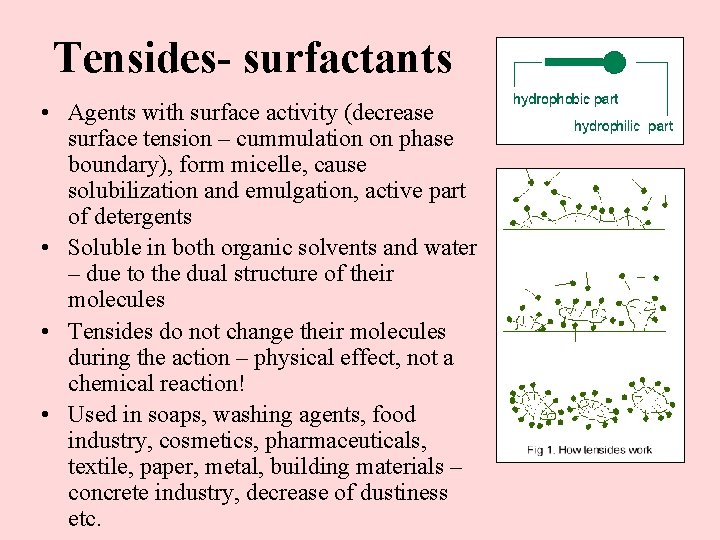
Tensides- surfactants • Agents with surface activity (decrease surface tension – cummulation on phase boundary), form micelle, cause solubilization and emulgation, active part of detergents • Soluble in both organic solvents and water – due to the dual structure of their molecules • Tensides do not change their molecules during the action – physical effect, not a chemical reaction! • Used in soaps, washing agents, food industry, cosmetics, pharmaceuticals, textile, paper, metal, building materials – concrete industry, decrease of dustiness etc.
Division: • Ionic - Anionic (based on sulfate, sulfonate or carboxylate anions) Sodium dodecyl sulfate, ammonium lauryl sulfate and other alkyl sulfate salts, sodium laureth sulfate, solid soaps = fatty acid salts - Cationic (based on quaternary ammonium cations) Alkyltrimethylammonium salts, cetylpyridinium chloride, benzalkonium chloride, benzethonium chloride - disinfectants - Amphoteric Dodecyl betaine, cocamidopropyl betaine, phospholipids • Non-ionic Polymers of polyethylene oxide and polypropylene oxide poloxamers or poloxamines, alkyl polyglucosides, fatty alcohols - cetyl alcohol and oleyl alcohol, cocamide MEA/DEA/TEA (mono/di/triethanolamine)
• Do not combine the types of tensides – damage of the effect, they need proper charge and p. H • Imbesi's law of the conservation of filth: In order for something to become clean, something else must become dirty (usually water) • Toxicity to animals: - Irritation of skin and mucosas, allergic reactions - Decrease of cell membrane surface tension – change in permeability up to cell lysis (corrosive effects of concentrated tensides) - Frothing (foam) in stomach – risk of foam aspiration and death - Cocamide DEA and TEA release nitrosamines (carcinogens) monoderivate MEA is more stable and less toxic
• Problems they cause in the environment: - Strong frothing – foam covering huge areas of water sources – oxygen deficit in water = suffocation, worsens cleaning efficiency in sewage treatment plants - Eutrophication of water due to phosphates added to detergents - Xenoestrogenic effect – degradation product of non-ionic tensides - nonylphenol and other alkylphenols - Slow degradation - Decrease surface tension on gill, wash away mucus from it – easier infection, damages spawn • Toxicity for fish: anionic – 30 mg/l cationic – 3 mg/l – most toxic non-ionic – 10 mg/l
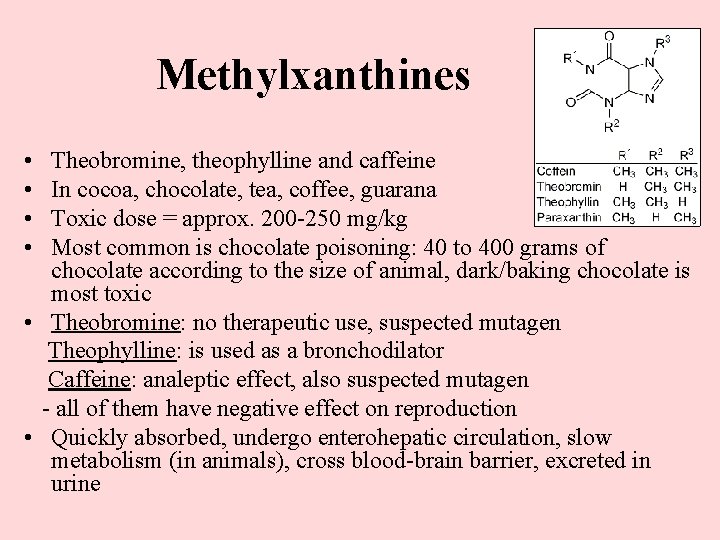
Methylxanthines • • Theobromine, theophylline and caffeine In cocoa, chocolate, tea, coffee, guarana Toxic dose = approx. 200 -250 mg/kg Most common is chocolate poisoning: 40 to 400 grams of chocolate according to the size of animal, dark/baking chocolate is most toxic • Theobromine: no therapeutic use, suspected mutagen Theophylline: is used as a bronchodilator Caffeine: analeptic effect, also suspected mutagen - all of them have negative effect on reproduction • Quickly absorbed, undergo enterohepatic circulation, slow metabolism (in animals), cross blood-brain barrier, excreted in urine
• Mechanism of action: - stimulate CNS, muscles and heart, increase diuresis, cause vasodilatation of coronary vessels (sport doping) a) inhibition of adenosine receptors in CNS – stimulation, tachycardia, vasoconstriction in brain, diuresis b) inhibition of phosphodiesterase – increased c. AMP leads to increased contractility of myocardium, increased glycolysis and lipolysis c) inhibition of Ca 2+ resorption back into sarcoplasmatic reticulum – also increased myocardial and muscle contractility
• Clinical signs: - After 6 – 12 hours - Polydypsia, polyuria, vomiting, diarrhoea, tachycardia/arrhythmias, hypertension, hyperactivity, hyperthermia, ataxia, tremor, convulsions, coma, death - Due to high content of fat in chocolate, acute pancreatitis may be present too • Treatment: - emetics, activated charcoal, monitoring of heart action, antiarrhytmic agents, fluid therapy, diazepam in convulsions
Grapes and raisins • Poisoning typical for dogs, but can probably appear also in cats and ferrets • Mechanism of action and toxic substance not known yet, but some scientists believe it is not a poisoning, but an idiosyncrastic reaction due to small amounts which sometimes lead to severe poisonings • Vomiting, diarrhoea, oliguria, anuria, lethargy, acute renal failure (tubular necrosis), death
Hops • Plant used for making beer • Exact mechanism and toxic substance not known. Probably uncoupling of oxidative phosphorylation • Poisonings described only in dogs, most of the cases in greyhounds • Typical symptoms are tachypnea, tachycardia, hyperthermia, seizures, death
Macadamia nuts • Poisonings described in dogs • Toxic substance as well as mechanism of action is unknown • Typical is weakness of rare legs • Other symptoms include vomiting, abdominal pain, ataxia, lameness, stiffness, recumbency, tremor, hyperthermia, joint and muscle pain and swelling • No lethal cases were described in healthy dogs • Symptoms may appear even in doses lower than 3 g/kg of body weight
Onion and garlic • Formerly used as a home remedy against parasites • Contain disulfides (onion – allyl propyl disulfide, garlic – allicin) with antibacterial action, they are responsible for typical smell and irritation of eyes and lacrimation • Mechanism of action is oxidation of iron in haemoglobin and formation of methaemoglobin, then Heinz bodies formation, haemolysis, anaemia, renal damage • Signs involve pale membranes, tachycardia, tachypnea, lethargy, weakness, haematuria, uremia, death • Treatment – N-acetylcysteine is a donor of cysteine for glutathione, which helps in this type of oxidative injury; blood transfusion
• More info: http: //pmep. cce. cornell. edu/profiles/extoxnet/haloxyfopmethylparathion/metaldehyde-ext. html http: //www. aspca. org/site/Doc. Server/toxbrief_0303. pdf? doc. ID=621&Add. Interest=1101 http: //www. bmj. com/cgi/content/full/331/7517/633? q=y http: //en. wikipedia. org/wiki/Surfactant http: //www. ukmarinesac. org. uk/activities/waterquality/wq 8_46. htm http: //en. wikipedia. org/wiki/Trichloroethylene http: //www. hsia. org/white_papers/tri%20 wp. htm http: //en. wikipedia. org/wiki/Tetrachloroethylene http: //www. toxnet. nlm. nih. gov/cgibin/sis/search/f? . /temp/~m. K 7 y 57: 2
- Slides: 18